

Last updated: August 18, 2026
mini goldendoodle Delaware
A mini goldendoodle Delaware buyer should expect to pay $2,500,$4,500 for a puppy from an accredited breeder with genetic health testing, proper whelping, and early housebreaking and crate training. Mini goldendoodles typically stand 14-17 inches tall, weigh 20-35 pounds, live 12-15 years, and shed very little. Because Delaware is a small state with few full-time breeding programs, most families here source from vetted breeders in the mid-Atlantic corridor and arrange ground transport or airport pickup through Philadelphia or Baltimore.
mini goldendoodle Delaware
- A mini goldendoodle is a cross between a Golden Retriever and a Miniature or Toy Poodle, usually 20-35 pounds full grown.
- Accredited breeder pricing in the Delaware market runs $2,500,$4,500; listings under $1,000 are almost always scams or puppy mills.
- Adult height is generally 14-17 inches at the shoulder, with micro lines coming in smaller at 10-16 pounds.
- Expect low but not zero shedding, plus professional grooming every 6-8 weeks at roughly $70,$110 per visit in Delaware.
- Temperament is social, people-focused, and highly trainable, which makes them a strong first-dog choice.
- Health screening should cover hips, elbows, eyes, heart, and DNA panels for PRA, vWD, and other inherited conditions.
- Mini goldendoodles are moderate barkers, not chronic ones, but they are prone to separation-related noise if left alone too long.
- Delaware’s compact geography means New Castle, Kent, and Sussex County buyers can reach breeders in Pennsylvania, New Jersey, and Maryland within a two-hour drive.
What Is a Mini Goldendoodle?
A mini goldendoodle is a hybrid dog created by breeding a Golden Retriever with a Miniature or Toy Poodle, producing a dog with the Golden’s friendly, biddable nature and the Poodle’s low-shedding coat in a smaller package. Most fall between 20 and 35 pounds, though micro lines can be considerably smaller.
Generation labels matter more than most buyers realize:
| Generation | Cross | Coat tendency | Best for |
|---|---|---|---|
| F1 | Golden Retriever x Mini Poodle | Wavy, sometimes flat | Lower grooming load, more retriever look |
| F1B | F1 doodle x Mini Poodle | Curlier, lowest shedding | Allergy-sensitive homes |
| F2B / Multigen | Doodle x doodle or F1B x doodle | More consistent curl | Predictable size and coat |
Decision rule: choose an F1B or multigen if anyone in your household reacts to dander. Choose an F1 if you prefer a shaggier, more retriever-like look and can accept slightly more variability.
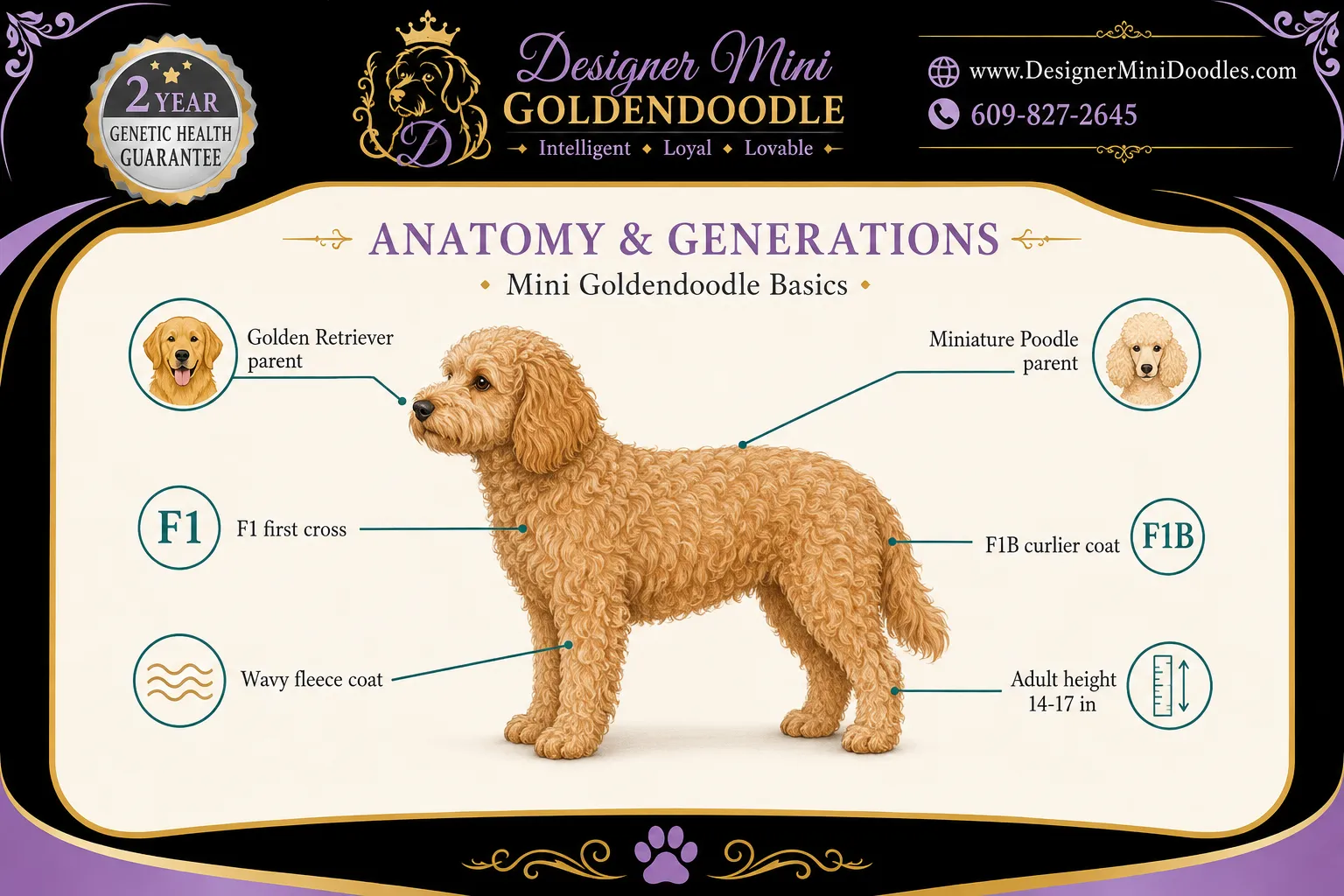
A common mistake I see: buyers assume “mini” is a regulated term. It isn’t. One breeder’s mini is 22 pounds and another’s is 40. Always ask for the weights of both parents and the average adult weight of previous litters from the same pairing. For a size-by-size breakdown, this guide to toy, micro, and mini goldendoodle sizes and prices is a useful reference before you put down a deposit.
Mini Goldendoodle vs Mini Labradoodle: What Are the Differences?
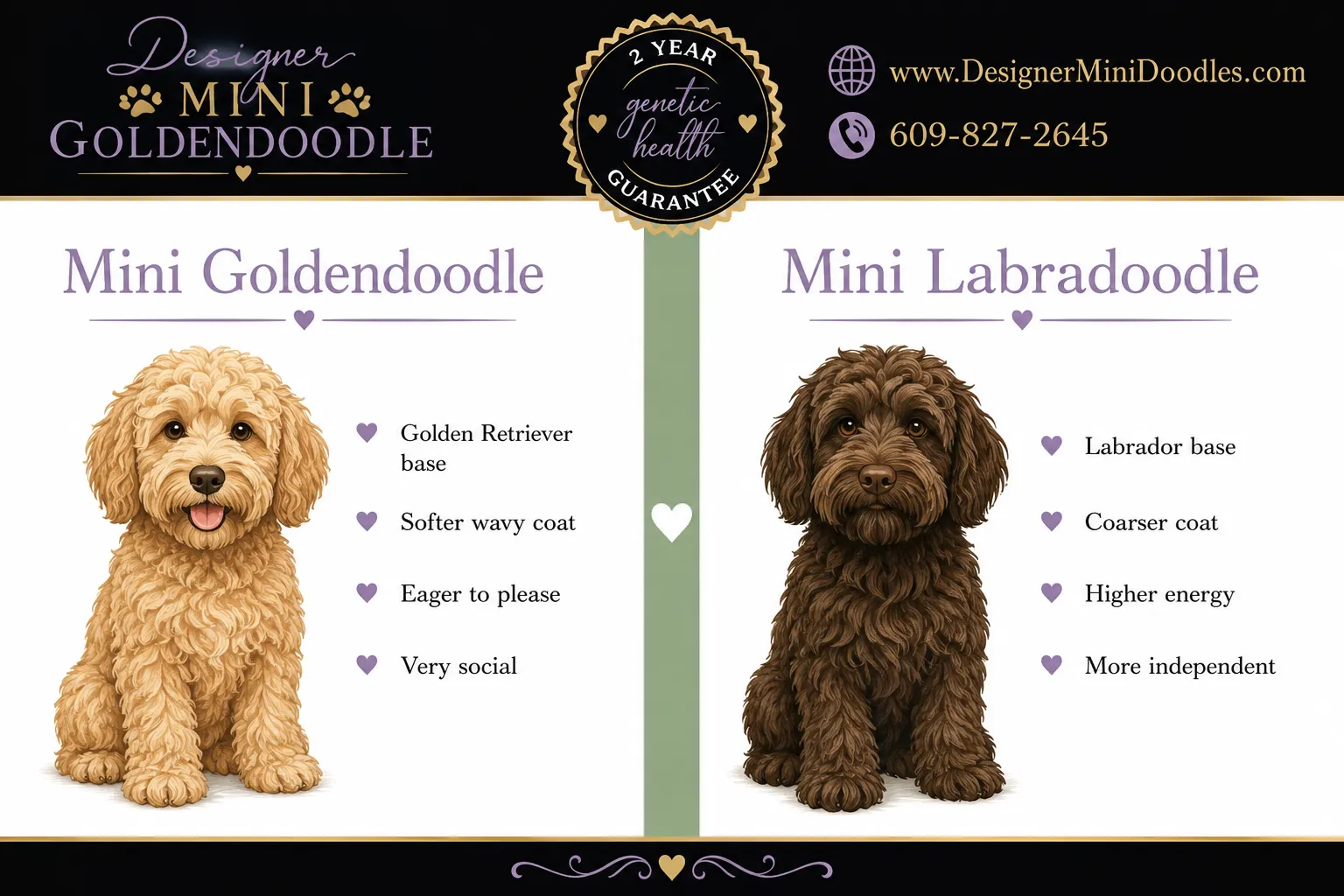
The core difference is the retriever half: mini goldendoodles carry Golden Retriever genetics, which generally produces a softer coat and a gentler, more people-pleasing temperament, while mini labradoodles carry Labrador genetics and tend to be higher-energy with a coarser coat.
Practical differences Delaware buyers notice most:
- Coat texture. Goldendoodles usually have a softer, fleece-like wave. Labradoodle coats can range from fleece to a wiry wool, and F1 labradoodles sometimes shed noticeably.
- Energy level. Mini labradoodles often need more structured exercise. Mini goldendoodles settle indoors more readily once their daily walk and play are done.
- Focus. Golden genetics tend to produce dogs that check in with their handler constantly, which speeds up obedience work.
- Independence. Labradoodles can be a bit more self-directed, which some owners prefer and others find frustrating in training.
If you want a dog that follows you from room to room and learns fast, the mini goldendoodle is usually the better fit. If you want a slightly more independent, higher-drive companion for long trail runs at Lums Pond, look hard at the mini labradoodle.
Edge case: allergy households should not assume either breed is hypoallergenic. Spend 30 minutes with an adult dog from the same line before committing.
What Is the Mini Goldendoodle Price in Delaware?
Expect $2,500,$4,500 for a well-bred mini goldendoodle in Delaware in 2026. Price tiers correspond directly to what the breeder actually invests in health testing, whelping care, and early development, and the cheapest listings carry the highest long-term risk.
Here is the pricing reality of the market, tier by tier:
| Price range | What you’re actually dealing with | Risk level |
|---|---|---|
| $500,$1,000 | Almost always a scam listing or stolen photos; no dog exists | Extreme |
| $1,000,$1,500 | Puppy mill or high-volume broker; no health testing, no socialization | Very high |
| $1,800,$2,000 | Hobby breeder; well-meaning but limited testing and no early training | Moderate |
| $2,500,$4,500 | Accredited breeder: genetic health guarantee, proper whelping, ENS, early housebreaking and crate training | Low |
Why the top tier costs more: progenitor health testing (OFA hips/elbows, cardiac, CERF eyes, plus DNA panels) runs into the thousands per breeding dog. Add veterinary whelping support, high-quality nutrition for the dam, first vaccinations, deworming, microchipping, and weeks of hands-on socialization, and the math stops looking like profit and starts looking like craftsmanship.
Common mistake: treating the purchase price as the whole cost. Budget another $1,200,$2,000 for year one in Delaware for vet visits, spay/neuter, food, crate, grooming, and training. There’s a good breakdown of long-run expenses in this piece on why a 10-16 lb micro goldendoodle offers cost-of-ownership clarity.
Scam red flags: the seller only communicates by text, insists on Zelle/CashApp/gift cards, refuses live video of the puppy with its littermates, or cannot produce the dam’s health testing certificates by registry number.
Where Can You Find Mini Goldendoodle Puppies in Delaware?
Delaware has very few full-time mini goldendoodle breeding programs, so most buyers in Wilmington, Newark, Dover, Middletown, and Rehoboth work with accredited mid-Atlantic breeders and arrange pickup or delivery. That’s normal and, done properly, safer than settling for whatever litter happens to be closest.
Where I’d look, in order of reliability:
- Accredited specialty breeders with published health testing, a written genetic guarantee, and video documentation of the litter’s environment.
- Referrals from Delaware veterinarians and groomers, who see the outcomes of local litters firsthand and will tell you which lines they trust.
- Breed-specific rescue and rehoming groups in the Delaware Valley, if you’re open to an adolescent or adult dog.
- Regional breeders within driving distance of I-95 and Route 1, which covers southeastern Pennsylvania, southern New Jersey, and Maryland’s Eastern Shore.
Delaware’s small footprint is an advantage here. From Wilmington, you can reach breeders in southeastern Pennsylvania in under an hour, and buyers regularly cross-shop the best mini and micro goldendoodle breeders in Pennsylvania alongside mini goldendoodle breeders in New Jersey. If you want to browse current availability nationally rather than by state, start with the goldendoodle mini for sale near me listings.
Available micro goldendoodle puppies:
- Display 9 Products per page
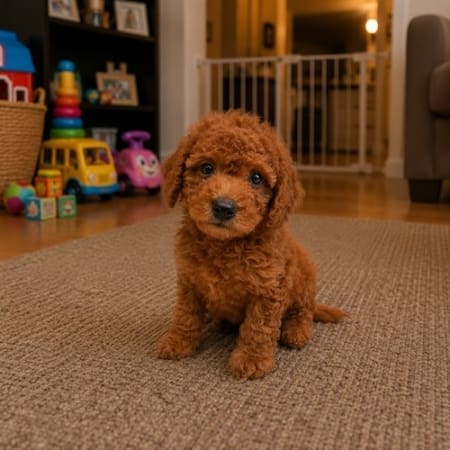
You can also find us on our Google Maps listing to verify our location and read owner reviews.
What Makes Designer Mini Doodles the Best Mini Goldendoodle Breeder for Delaware Families?
Designer Mini Doodles is run by a working animal biologist, which is the single clearest difference between our program and the average listing you’ll find online. Our founder holds a degree in Animal Biology from Stockton University in Pomona, New Jersey, with a minor in animal genetics, and that background drives every pairing decision we make.
What that means in practice for a Delaware family:
- Top bloodlines only. Every mini goldendoodle and every dog in our breed stock comes from documented, health-tested top bloodlines, not from whatever was available locally.
- Genetics-led pairings. Coat type, adult size, and inherited disease risk are planned before a breeding happens, not hoped for afterward.
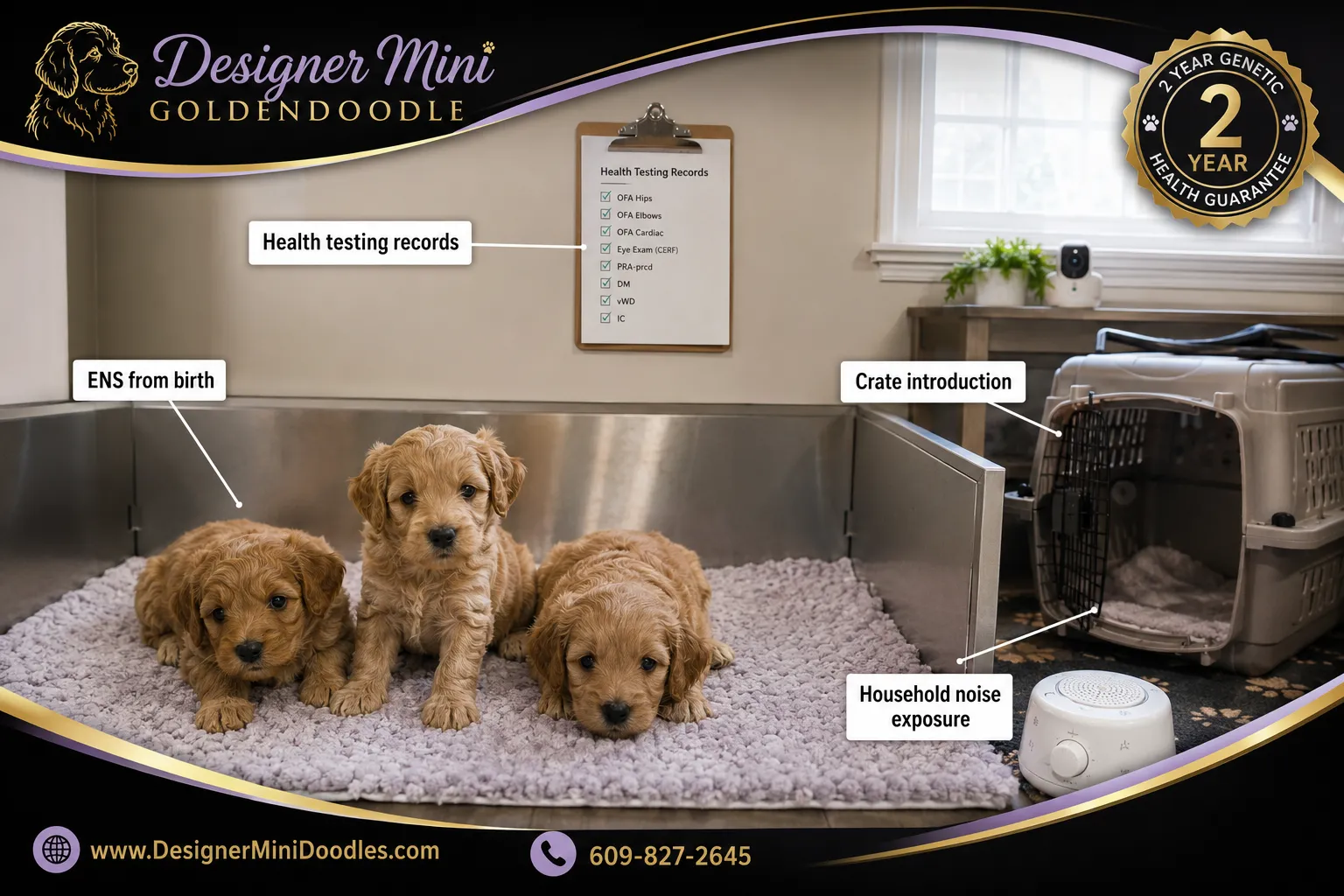
- ENS from birth. We use Early Neurological Stimulation, interacting with puppies from day one to build stress tolerance and resilience.
- Real-world noise exposure. Our pups grow up inside a busy home with other animals, children, vacuums, doorbells, kitchen clatter, and normal daily commotion, so a move to a Delaware household isn’t a shock.
- Well-started housebreaking and crate training. Puppies arrive already understanding that the crate is a resting place and that bathroom business happens away from bedding.
- Written genetic health guarantee backed by documented testing on both parents.
That combination is why we consider ourselves the best mini golden doodle breeders in the USA, and why families keep coming back for a second goldendoodle mini years later. You can review our program standards on our miniature goldendoodle breeders page, or browse current mini doodle puppies if you’re ready to look at specific litters. We also operate a sister program for buyers who want a different breed entirely: AKC French bulldog breeders.
How Big Do Mini Goldendoodles Get, and How Long Do They Live?
Mini goldendoodles typically reach 14-17 inches at the shoulder and 20-35 pounds at maturity, and they generally live 12-15 years. Micro lines finish smaller, often 10-16 pounds and 11-14 inches. Most reach adult height around 8-11 months, then fill out in the chest through 18 months.
Size guide by line:
| Line | Adult weight | Adult height | Notes |
|---|---|---|---|
| Micro / toy | 10-16 lb | 11-14 in | Apartment and condo friendly |
| Mini (small) | 17-25 lb | 14-16 in | Most popular Delaware request |
| Mini (standard) | 26-35 lb | 15-17 in | Sturdier for active families |
| Medium | 36-50 lb | 17-20 in | Often mislabeled as “mini” |
How to predict adult size: average the two parents’ adult weights, then allow a range of roughly plus or minus 20%. Ask for weights of adult siblings from previous litters, that’s better data than the puppy’s current weight. For visual reference on what maturity looks like, see this overview of the full grown mini goldendoodle.
Lifespan skews long for two reasons: smaller dogs generally outlive larger ones, and hybrid pairings from health-tested parents reduce the odds of certain inherited conditions. Keeping your dog lean is the most controllable longevity factor you have. Dental care is the second, small-mouthed doodles accumulate tartar quickly.
What Is the Mini Goldendoodle Temperament, and Do They Bark a Lot?
Mini goldendoodles are social, affectionate, and eager to please, with moderate energy and strong human focus. They bark to alert or to request attention but are not typically chronic barkers, and most quiet down quickly once trained.
Temperament traits Delaware owners consistently report:
- People-oriented to a fault. They want to be in the room with you. That’s charming, and it also means they don’t do well alone for 10 hours a day.
- Good with children when raised in a busy household and taught bite inhibition early.
- Generally dog-friendly, which matters at Wilmington’s Talley Day Bark Park or Rehoboth’s off-leash beach seasons.
- Sensitive to harsh correction. Raise your voice and you’ll get shutdown, not compliance.
- Moderately vocal. Expect alerts at the doorbell and the mail truck.
Barking triggers, and what to do:
- Doorbell alerts, teach a “go to mat” cue and reward the settle, not the silence after the barking.
- Attention barking, ignore completely, then reward the quiet moment. Inconsistency here creates the loudest dogs.
- Boredom barking, add a puzzle feeder and a 10-minute training session; mental work tires them faster than a walk.
- Separation-related barking, build alone time in small increments from week one, not after the problem starts.
Edge case: if you live in an attached townhome in Newark or a Wilmington apartment, work on alone-time tolerance from day one and consider a micro line, which tends to have a lighter bark.

How Much Do Mini Goldendoodles Shed, and What Does Grooming Cost in Delaware?
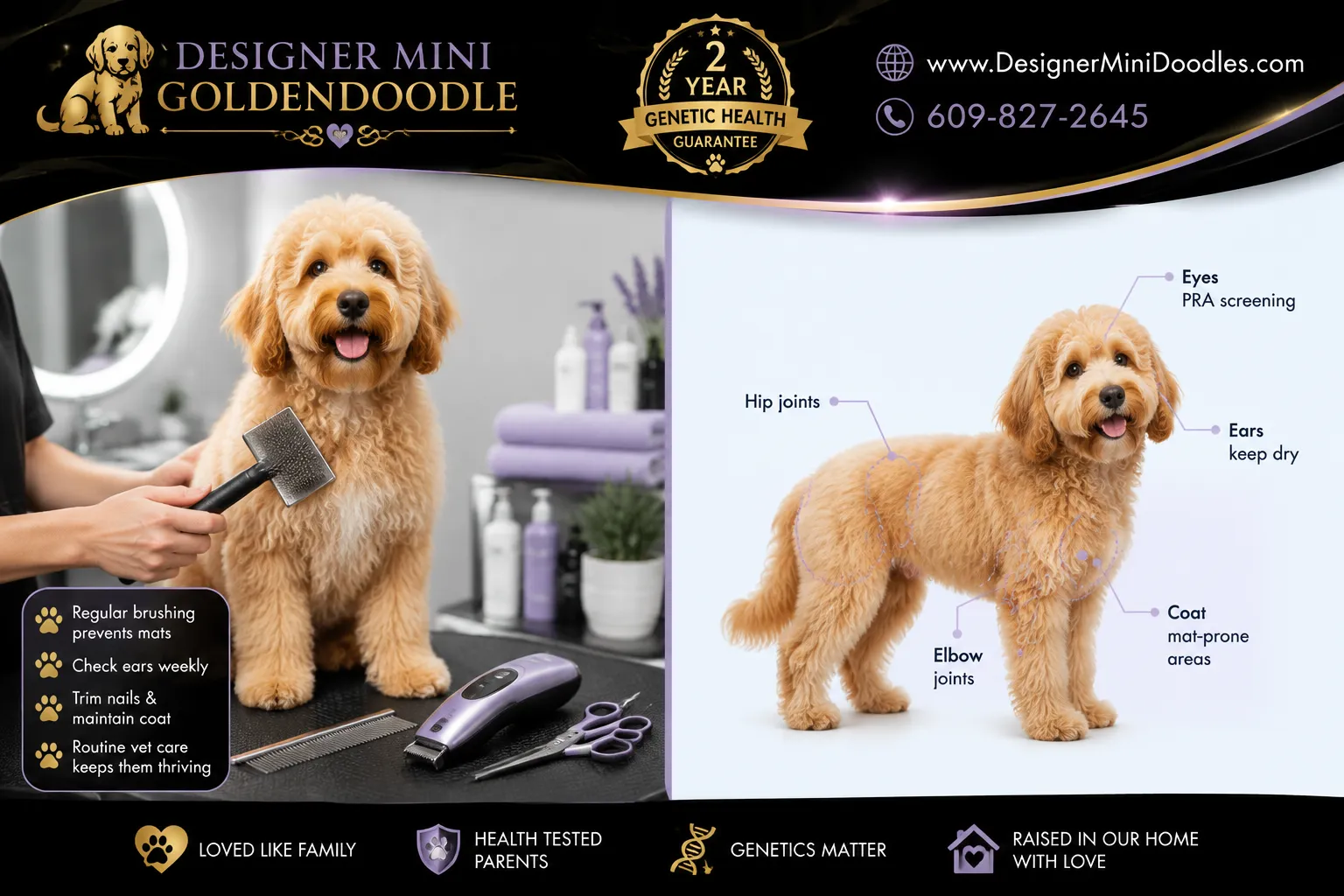
Mini goldendoodles shed very little compared with a Golden Retriever, but no doodle is truly non-shedding. Because loose hair stays trapped in the coat instead of falling out, they need brushing several times a week and professional grooming every 6-8 weeks, typically $70,$110 per visit in Delaware.
Grooming reality check:
- Brush 3-4 times a week minimum with a slicker brush plus a metal comb. The comb is what catches mats the brush misses.
- Priority mat zones: behind the ears, armpits, the collar line, the tail base, and between the toes.
- Ear care matters. Poodle-type ear hair traps moisture; check and dry ears weekly, especially after swims at Delaware’s beaches or ponds.
- Coat change at 8-12 months is when most owners get blindsided. Puppy coat transitions to adult coat and mats appear fast. Increase brushing frequency during that window.
- Annual grooming budget: roughly $500,$900 for professional visits, plus $60,$120 in tools.
Decision rule on haircuts: if you cannot commit to brushing several times a week, ask your groomer for a shorter “puppy cut” at every visit. A one-inch coat is far more forgiving than a three-inch coat.
What Mini Goldendoodle Health Problems Should You Watch For?
The main inherited concerns are hip and elbow dysplasia, progressive retinal atrophy (PRA), von Willebrand’s disease, patellar luxation, and certain cardiac conditions, all of which responsible breeders screen for in both parents. Ear infections and dental disease are the most common acquired issues.
What to ask for before you buy:
- OFA or PennHIP hip evaluation on both parents
- OFA elbow, cardiac, and eye (CAER) clearances
- DNA panel results covering PRA-prcd, vWD Type I, DM, and NEwS at minimum
- Written genetic health guarantee in the contract, with defined terms
Ongoing care that prevents most problems:
- Keep the dog lean; excess weight accelerates joint disease.
- Dry ears after every bath and swim, and have hair plucked or trimmed as your vet advises.
- Brush teeth several times a week from puppyhood.
- Avoid repetitive high-impact exercise on hard surfaces before 12 months.
- Keep annual wellness exams, including a body condition score check.
Common mistake: accepting “vet checked” as a substitute for parental health testing. A vet exam confirms a puppy is currently healthy. It says nothing about inherited disease risk. If a breeder can’t produce registry certificate numbers you can look up, walk away.
How Do You Train a Mini Goldendoodle: Tips for Beginners
Mini goldendoodles are among the easier breeds for first-time owners because they’re food-motivated, handler-focused, and quick to learn. Start crate and potty routines on day one, keep sessions to 5-10 minutes, and use rewards rather than corrections.
A realistic first-30-days plan:
- Days 1-3: Crate as a den. Feed meals inside it, door open. Take the puppy out every 60-90 minutes and after every nap, meal, and play session.
- Days 4-10: Name recognition, “sit,” and hand-feeding to build engagement. Begin two- to five-minute alone-time reps.
- Days 11-20: Leash introduction indoors, then in the yard. Add “down” and “come.” Handle paws and ears daily to prep for grooming.
- Days 21-30: Short outings to low-traffic public spaces once vaccinations allow. Enroll in a local puppy class in New Castle or Kent County.
Puppies from a program that already started housebreaking and crate training arrive with a head start, they understand that the crate is for sleeping and that bedding is not a bathroom. That typically shortens the accident phase by weeks.
Troubleshooting the three most common issues:
- Nipping: redirect to a chew, and end play instantly when teeth touch skin. Puppies learn that biting ends the fun.
- Potty regression around 4-5 months: almost always a schedule slip, not a training failure. Tighten the outing intervals for a week.
- Velcro-dog anxiety: practice leaving the room for 30 seconds while the puppy is calm, not while it’s crying. Build duration slowly.
Mini Goldendoodle vs Other Poodle Mixes: Which Is Better?
There’s no universally better poodle mix, the right choice depends on energy tolerance, grooming commitment, and household composition. The mini goldendoodle is generally the safest all-round pick for families and first-time owners because of its balance of trainability, moderate size, and low shedding.
Quick comparison of popular small poodle mixes:
| Mix | Typical weight | Energy | Best fit |
|---|---|---|---|
| Mini goldendoodle | 20-35 lb | Moderate | Families, first-time owners |
| Mini labradoodle | 20-40 lb | Moderate-high | Active owners, runners |
| Cavapoo | 12-20 lb | Low-moderate | Apartments, seniors |
| Cockapoo | 12-24 lb | Moderate | Smaller homes, cheerful companion |
| Bernedoodle (mini) | 25-50 lb | Moderate | Owners wanting a calmer, larger dog |
Choose the mini goldendoodle if you want a dog that’s easy to train, sized for both a Wilmington townhome and a Sussex County yard, and comfortable with kids and visitors. Choose something else if you want a genuinely low-activity lap dog (look at a Cavapoo) or a running partner with more stamina (look at a mini labradoodle).
Conclusion: Your Next Steps
The mini goldendoodle Delaware market rewards patience. The families who end up happiest aren’t the ones who found a puppy fastest, they’re the ones who verified health testing, understood what $2,500,$4,500 actually buys, and planned for grooming and training before the puppy came home.
Here’s what I’d do this week:
- Set your real budget. Purchase price plus $1,200,$2,000 for year one.
- Decide on size and generation. Micro versus standard mini, F1 versus F1B, based on your space and any allergies.
- Request documentation from every breeder you contact: OFA/PennHIP numbers, DNA panel results, and the written health guarantee.
- Ask for live video of the litter with the dam in the home environment. Refusal is a dealbreaker.
- Book grooming and a puppy class before pickup day, so week one isn’t a scramble.
- Reserve from a program that starts housebreaking, crate training, and ENS before pickup, it’s the single biggest predictor of an easy first month.
Do those six things and you’ll bring home a healthy, confident, well-started mini goldendoodle that fits Delaware life from Wilmington to Rehoboth.
FAQ
How much does a mini goldendoodle cost in Delaware?
Between $2,500 and $4,500 from an accredited breeder with genetic health testing, proper whelping, and early housebreaking and crate training. Listings at $500,$1,000 are almost always scams, and $1,000,$1,500 typically indicates a puppy mill or broker.
How big does a mini goldendoodle get?
Most reach 14-17 inches tall and 20-35 pounds. Micro lines finish around 10-16 pounds and 11-14 inches. Adult height arrives at 8-11 months, with filling out continuing until about 18 months.
Do mini goldendoodles shed?
Very little, but not zero. Loose hair stays trapped in the coat rather than falling on furniture, which is why brushing 3-4 times weekly and professional grooming every 6-8 weeks are required.
How long do mini goldendoodles live?
Typically 12-15 years. Keeping the dog lean, maintaining dental care, and buying from health-tested parents are the biggest factors you control.
Are mini goldendoodles good for first-time dog owners?
Yes. They’re food-motivated, handler-focused, and quick to learn basic obedience. The main caution is that they don’t tolerate long stretches of isolation well.
Do mini goldendoodles bark a lot?
They’re moderate barkers. Expect alerts at doorbells and visitors, plus attention-seeking barking if it gets rewarded. Chronic barking is usually boredom or separation-related, not breed-driven.
Are there mini goldendoodle breeders in Delaware?
Very few full-time programs operate within the state. Most Delaware families work with accredited breeders in the broader mid-Atlantic region and arrange pickup, ground transport, or airport delivery through Philadelphia or Baltimore.
What’s the difference between a mini goldendoodle and a mini labradoodle?
The retriever parent. Mini goldendoodles come from Golden Retrievers and tend to have softer coats and a gentler, more people-pleasing temperament. Mini labradoodles come from Labradors and are generally higher-energy with coarser coats.
How much is grooming for a mini goldendoodle in Delaware?
About $70,$110 per professional visit every 6-8 weeks, so roughly $500,$900 per year, plus $60,$120 for home brushes and combs.
What health tests should the parents have?
OFA or PennHIP hips, OFA elbows, cardiac and CAER eye clearances, and a DNA panel covering PRA-prcd, von Willebrand’s Type I, and other breed-relevant conditions. Ask for registry certificate numbers you can verify.
Is an F1 or F1B mini goldendoodle better?
F1B if allergies are a concern, since the extra Poodle genetics produce a curlier, lower-shedding coat. F1 if you prefer a shaggier retriever look and accept slightly more coat variability.
When can a mini goldendoodle puppy come home?
At eight weeks or later. Puppies leaving earlier miss critical litter socialization, and reputable breeders will not release them before that point.
Related Reading
- Mini goldendoodle puppies currently available
- Mini goldendoodle puppies for sale in Philadelphia, PA
- Best mini and micro goldendoodle breeders in New York