

Last updated: August 19, 2026
mini goldendoodle Illinois
A mini goldendoodle in Illinois typically stands 13-20 inches tall, weighs 15-35 pounds, and costs between $2,500 and $4,500 from an accredited breeder who provides genetic health guarantees, early neurological stimulation, and started crate and potty training. Anything advertised under $1,000 in the Chicago, Naperville, or Springfield area is almost always a scam or a puppy mill flip. Expect a 12-15 year lifespan, professional grooming every 6-8 weeks, and low-to-minimal shedding when the puppy inherits proper furnishings from its Poodle parent.
mini goldendoodle Illinois
- Size: Mini goldendoodles reach 15-35 lbs; micro and toy variants stay 10-16 lbs and are better suited to Chicago condos and elevator buildings.
- Real pricing tiers in Illinois: $500,$1,000 signals a scam, $1,000,$1,500 signals a puppy mill, $1,800,$2,000 is typical hobby-breeder pricing, and $2,500,$4,500 reflects genetic testing, proper whelping, and started training.
- Shedding depends on furnishings, not the doodle label. Wavy fleece and loose-curl coats shed the least; flat, unfurnished coats shed like a Golden Retriever.
- Grooming budget: plan on $75,$110 per professional groom every 6-8 weeks in the Chicago metro, plus 10 minutes of brushing every other day at home.
- Temperament: people-focused, biddable, moderately energetic, and prone to separation anxiety if left alone for long stretches without conditioning.
- Health screening matters: ask for OFA hips and elbows, cardiac and eye clearances, plus PRA-prcd, vWD, DM, and NEwS DNA results on both parents.
- Best Illinois fit: families in Naperville, Aurora, Peoria, and Rockford with fenced yards, plus apartment dwellers who commit to two walks and daily enrichment.
- Biggest mistakes: buying on price alone, skipping crate training, over-brushing only the topcoat, and shaving a curly coat instead of maintaining it.
What Is a Mini Goldendoodle and How Big Do They Get?
A mini goldendoodle is a cross between a Golden Retriever and a Miniature or Toy Poodle, bred for the Golden’s easygoing temperament and the Poodle’s low-shedding coat in a smaller frame. Adult minis usually measure 13-20 inches at the shoulder and weigh 15-35 pounds, with most landing in the low 20s.
Size comes down to two things: the size of the Poodle parent and the generation.
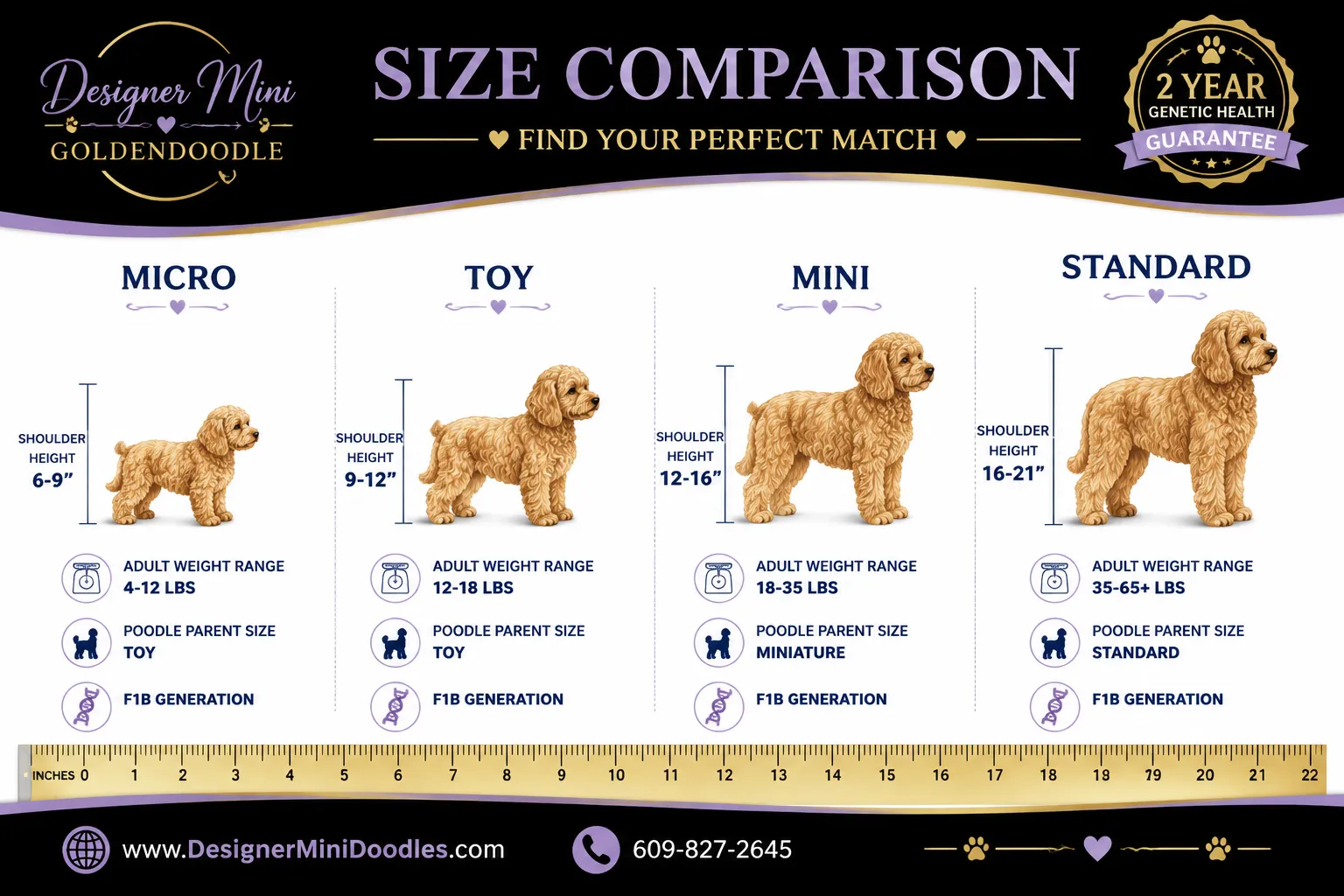
| Type | Typical adult weight | Typical height | Best for |
|---|---|---|---|
| Micro | 10-16 lbs | 10-13 in | Condos, frequent travel, seniors |
| Toy | 12-20 lbs | 11-14 in | Small homes, gentle older kids |
| Mini | 20-35 lbs | 14-20 in | Families, suburban yards, active owners |
| Medium/Standard | 45-75 lbs | 20-24 in | Large properties, hiking households |
Generation labels tell you the coat odds more than the size:
- F1 (Golden x Poodle): 50/50, most size variation, coat can be flat or wavy.
- F1B (F1 x Poodle): 75% Poodle, most reliably low-shedding, usually smaller.
- F2B and multigen: bred for consistency in size and furnishings.
Decision rule: if a predictable 15-25 lb adult matters to you (say, because your building has a 25 lb weight cap), choose a multigen or F1B from a breeder who can show you the adult weights of previous litters from that exact pairing. F1 litters throw the widest range. Our guide to the full grown mini goldendoodle size range walks through growth curves month by month.
Common mistake: assuming an 8-week puppy’s weight predicts adult size. A more reliable rough estimate is that many minis reach roughly two-thirds of adult weight by four months, but bone structure and parent size are better predictors than a single scale reading.
Where Can I Find Mini Goldendoodle Breeders in Illinois?
Legitimate mini goldendoodle breeders in Illinois are concentrated in the suburban and rural corridors outside Chicago, in central Illinois near Bloomington and Champaign, and along the Iowa and Wisconsin borders. Rather than searching by proximity alone, screen by documentation: health testing, whelping practices, and early training protocols.
At Designer Toy Goldendoodles, we run our program differently from most Illinois-area kennels, and it starts with credentials. Our program is owned and operated by a real animal biologist with a degree in Animal Biology from Stockton University in Pomona, New Jersey, and a minor in animal genetics. That background shapes every pairing decision we make, from coat inheritance to structure to temperament. Every one of our mini doodles for sale and every dog in our breeding stock comes from documented top bloodlines, and we ship to families across Illinois.

Here’s what actually happens in our nursery before a puppy ever boards a flight to O’Hare or Midway:
- ENS from birth. We use Early Neurological Stimulation, handling every puppy daily from day three through day sixteen. ENS exercises build stress tolerance and resilience, which is why our puppies settle into new homes faster.
- Real-world noise exposure. Our pups grow up inside a busy home, not an outbuilding. They hear vacuums, doorbells, dishes, TV, kids playing, and other animals moving around them every single day.
- Well-started house training. Litters learn to eliminate away from their sleeping area, and we begin a potty rhythm before pickup.
- Started crate training. Puppies nap in crates with the door closed for short stretches, so the crate is already a den, not a punishment.
That combination of genetics knowledge, top bloodlines, and early conditioning is why we’re comfortable calling ourselves the best mini golden doodle breeders in the USA and the leading toy goldendoodle breeder in the country. If you want a fully local pickup instead, compare our Illinois mini and micro goldendoodle breeder page with our neighboring-state programs in Wisconsin and Michigan, many Illinois families drive two to four hours for the right litter.
Screening questions to ask any Illinois breeder:
- Can I see OFA or equivalent results for both parents, by registration name?
- Where do puppies sleep for the first eight weeks?
- What early handling protocol do you use, and on which days?
- What is your written health guarantee, and what does it cover?
- Will you take the dog back at any point in its life?
If a breeder can’t answer question 3 or 5, walk away.
A breeder who hesitates to name their health testing panel is telling you something. Silence is an answer.
You can also verify our program through our Google Maps listing.
How Much Does a Mini Goldendoodle Cost in Illinois?
Expect $2,500,$4,500 for a health-guaranteed, well-started mini goldendoodle in Illinois. Price tracks directly with genetic testing, whelping supervision, and how much training work happens before the puppy leaves.
The Illinois pricing tiers, decoded:
| Price range | What you’re actually dealing with | Risk level |
|---|---|---|
| $500,$1,000 | Almost always a scam. Fake listings, stolen photos, wire-transfer or gift-card requests, no in-person visit possible. | Extreme |
| $1,000,$1,500 | Puppy mill or broker flip. No genetic testing, minimal socialization, high risk of parasites, giardia, and lifelong anxiety. | High |
| $1,800,$2,000 | Hobby breeder. Often well-meaning, but usually no OFA clearances, no ENS, no started crate or potty training. | Moderate |
| $2,500,$4,500 | Accredited breeder with genetic health guarantee, veterinarian-supervised whelping, early house training, and started crate training. | Low |
The gap between $1,500 and $3,000 isn’t markup. It’s roughly a thousand dollars of parent health testing per breeding pair, progesterone timing and prenatal vet care, round-the-clock whelping supervision, high-grade puppy nutrition, three sets of vet visits and vaccines, microchipping, and hundreds of hours of human handling.
A quick example: a family in Schaumburg saves $1,300 buying a $1,400 “mini goldendoodle” from an online listing. Six months later they’ve spent $900 on giardia treatment and a hip radiograph, $1,800 on a behavior consultant for separation anxiety and reactivity, and they still have a 48 lb dog. The cheap puppy cost more.
Coat color also affects price. Rarer patterns and pigments, including our chocolate mini goldendoodle puppies, typically sit at the upper end of the range because those pairings are harder to produce consistently. For a full breakdown by size class, see our reference on toy, micro, and mini goldendoodle sizes and prices.
Ongoing Illinois cost estimates (assumptions: Chicago-metro pricing, mid-range products):
- Food: $45,$70/month
- Professional grooming: $75,$110 every 6-8 weeks
- Routine vet and preventatives: $500,$800/year
- Pet insurance: $35,$60/month
- First-year total, all in: roughly $2,000,$3,000 beyond purchase price
No products found which match your selection.
Do Mini Goldendoodles Shed, and What Are the Coat Types?
Most mini goldendoodles shed very little, but shedding is determined by furnishings, the genetic trait that produces the beard, eyebrows, and curl-bearing coat, not by the doodle name on the paperwork. A puppy that inherits two copies of the furnishing gene will have a wavy-to-curly, low-shedding coat. A puppy with no furnishings will look like a shaggy Golden Retriever and shed accordingly.
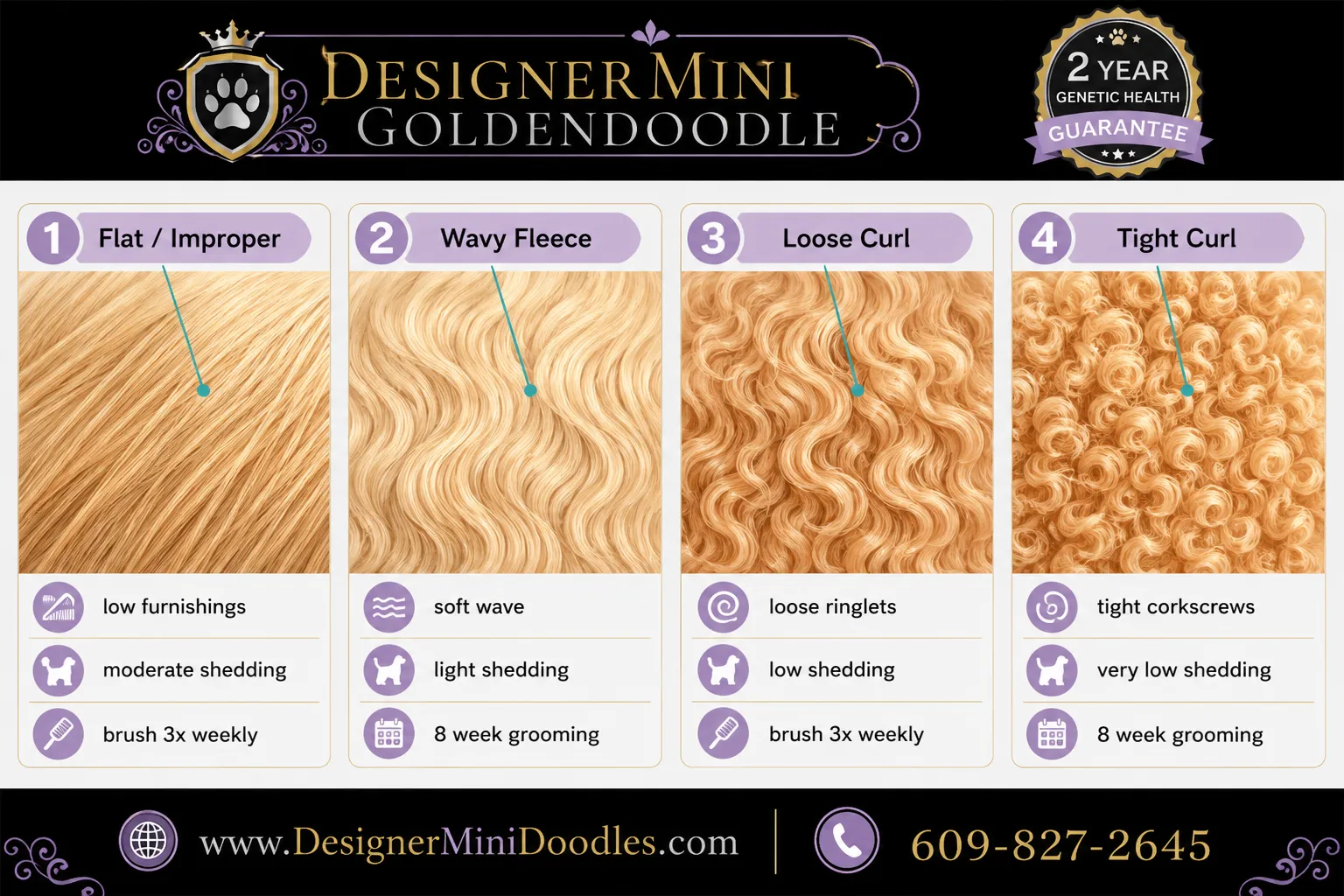
The coat spectrum, from straightest to curliest:
- Flat or improper coat (unfurnished): smooth face, no beard, Golden-like texture. Sheds seasonally and noticeably. Easiest to brush, hardest for allergy-sensitive homes. Rare in F1B and multigen litters.
- Wavy fleece: soft, loose S-waves with visible beard and eyebrows. Minimal shedding, moderate matting. The most popular coat and the easiest all-around to live with. Brush three times a week.
- Light curl: springier waves that tighten with age. Very low shedding. Needs brushing every other day once the adult coat comes in.
- Curl: defined spiral curls, dense, holds shed hair in the coat. Essentially non-shedding to the floor. Requires line brushing to the skin, not just surface strokes.
- Tight curl (Poodle-like): compact, dense corkscrews. The lowest shedding and the highest maintenance. Mats fast in Illinois winters when a wet coat gets crushed under a harness or coat.
Because Illinois has real seasons, coat type has practical consequences. Curlier coats hold road salt, snow clumps, and burrs from prairie paths. Wavy coats dry faster after a rainy Lake Michigan walk. If you want the lowest grooming workload with acceptable shedding, choose wavy fleece. If someone in the home has dander sensitivity, choose curl or tight curl and commit to the brushing.
Edge case: many mini goldendoodles go through a coat change between 8 and 14 months, when the soft puppy coat is replaced by a coarser adult coat. Matting spikes during this window. This is when most owners give up and shave the dog. Increase brushing frequency instead, and schedule a groomer visit every 5-6 weeks temporarily.
No dog is truly hypoallergenic. Allergic reactions are driven by dander and saliva proteins, not hair alone. A low-shedding coat traps dander instead of releasing it into the air, which helps many sensitive people, but it isn’t a guarantee. Spend an hour with an adult doodle before committing.
What Are the Grooming Requirements and Costs?
Plan on a professional groom every 6-8 weeks at $75,$110 in the Chicago metro (somewhat less downstate), plus home brushing every other day. Grooming is the single most underestimated cost of mini goldendoodle ownership.
Your at-home routine:
- Line brush with a slicker brush, working in sections from the skin outward, not just over the top of the coat. 10-15 minutes.
- Comb through with a steel greyhound comb to find mats the slicker missed. If the comb snags, there’s a mat.
- Check friction zones weekly: behind the ears, armpits, collar line, tail base, and between the paw pads. Mats start there.
- Wipe ears and check for odor weekly. Furnished doodles grow hair in the ear canal and trap moisture.
- Trim eye-area hair every 2-3 weeks so the dog can see and tear stains don’t set.
- Nails every 3-4 weeks.
Common mistake: brushing only the outer coat while a solid mat forms underneath. The dog looks fluffy, then the groomer says the only humane option is a shave-down. Once a coat is matted to the skin, clipping short is the ethical choice, brushing it out is painful.
Cost-saving move: buy a decent slicker, a steel comb, and a dematting rake for about $60 total, and do a full line-brush twice a week. Owners who do this typically stretch grooms to 8 weeks instead of 6, saving roughly $200,$400 a year.
Are Mini Goldendoodles Good for Apartments in Chicago?
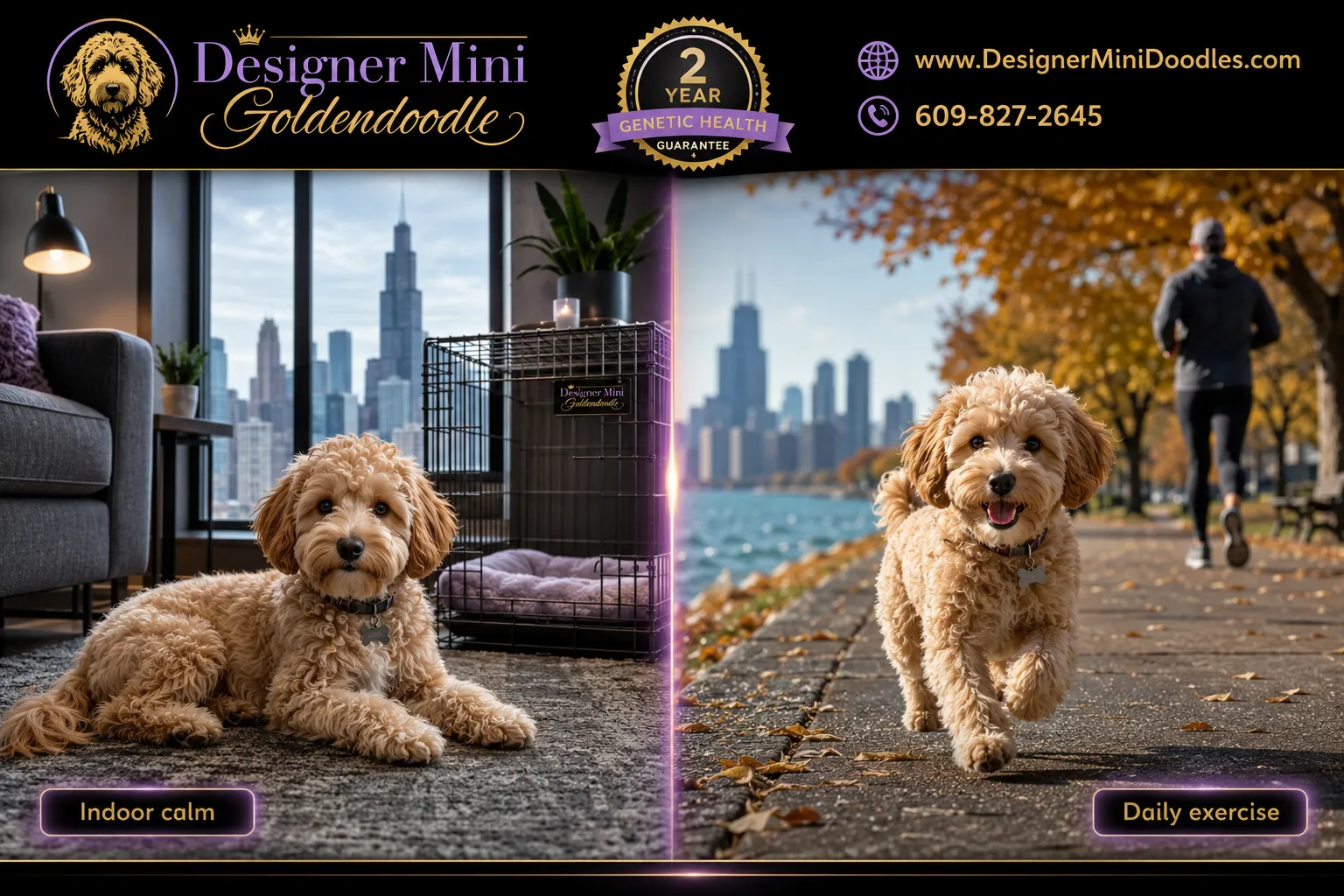
Yes, mini goldendoodles adapt well to apartments and condos, including Chicago high-rises, as long as they get two solid walks plus daily mental work. Their indoor volume is low and they’re not typically nuisance barkers, but they are velcro dogs, so long solo workdays cause problems.
What makes apartment life work:
- Two 20-30 minute walks daily, plus a third short potty trip. Lakefront paths, the 606, and neighborhood parks all work.
- 10-15 minutes of thinking work: puzzle feeders, snuffle mats, nose games, or a short training session. Mental fatigue beats physical exhaustion for settling a doodle.
- Deliberate alone-time training from week one, in 30-second increments building to 3+ hours. Skip this and you get separation anxiety, the number one reason doodles get surrendered.
- Elevator and lobby manners. Practice sit-stays in the hallway before your neighbor’s toddler runs past.
Choose the smaller size if: your building has a weight limit, you live above the 15th floor with no quick outdoor access, or you travel often. A 10-16 lb dog fits under an airline seat and takes the stairs during a power outage. Our piece on why a 10-16 lb micro goldendoodle is the ideal travel-friendly size covers that trade-off in detail.
Who a mini goldendoodle is not for: households where the dog would be alone 10+ hours a day with no midday break, owners unwilling to budget for grooming, and anyone expecting a low-interaction, independent dog. Consider a cat or an adult rescue with a proven independent temperament instead.
Mini Goldendoodle vs Mini Labradoodle vs Standard Goldendoodle
A mini goldendoodle is generally the softer, more affectionate, more people-pleasing option; a mini labradoodle tends to be higher-drive and more athletic; a standard goldendoodle is the same temperament in a 45-75 lb body that needs far more space and exercise. Neither mini cross is objectively “better”, the right pick depends on your energy level and household.
| Trait | Mini Goldendoodle | Mini Labradoodle | Standard Goldendoodle |
|---|---|---|---|
| Adult weight | 20-35 lbs | 20-40 lbs | 45-75 lbs |
| Energy level | Moderate | Moderate to high | Moderate to high |
| Temperament | Soft, cuddly, sensitive, eager to please | Bouncier, bolder, more independent streak | Same as mini, mellower after age 3 |
| Coat | Wavy to curly, often silkier | Wool or fleece, sometimes coarser | Wavy to curly, more coat to maintain |
| Best with kids | Excellent, gentler mouth pressure | Excellent, but more knock-over risk when young | Excellent once past adolescence |
| Grooming load | High | High | Highest (more square footage of coat) |
| Apartment fit | Good | Fair to good | Poor to fair |
| Exercise need | 45-60 min/day | 60-90 min/day | 60-90 min/day |
Decision rules:
- Choose a mini goldendoodle if you want a sensitive, affectionate companion for a family or a first-time owner, and you value a softer temperament over athleticism.
- Choose a mini labradoodle if you run, hike, or want a sport-dog prospect and can absorb a longer, rowdier adolescence.
- Choose a standard goldendoodle if you have a fenced yard and want a hiking or swimming partner, and you’re prepared for a $110,$150 groom.
Edge case worth knowing: mini goldendoodles are more sensitive to harsh correction than either alternative. Yelling or leash-popping a mini goldendoodle usually produces shutdown and avoidance rather than compliance. They train beautifully with markers and food, and poorly under pressure.
What Are the Temperament, Health, and Lifespan Considerations?
Mini goldendoodles are affectionate, biddable, socially confident dogs with a 12-15 year lifespan and a handful of inherited health risks worth screening. Most behavioral problems in the breed trace back to under-socialization or too much time alone, not genetics.
Temperament and personality traits
- People-focused to a fault. They follow you room to room and want to be included.
- Highly trainable. Both parent breeds rank among the most biddable, which makes basic obedience straightforward.
- Moderately energetic. Active bursts, then a long nap on your feet.
- Good with kids and other pets when socialized early.
- Sensitive. They read tone and body language quickly.
- Prone to separation anxiety and, in some lines, mild noise sensitivity, one reason our home-raised, noise-exposed puppies transition so well.
Health problems to watch for
Ask for documentation on both parents covering:
- Hip and elbow dysplasia (OFA or PennHIP)
- Progressive retinal atrophy, prcd form (DNA test)
- Ichthyosis (Golden Retriever line)
- Von Willebrand’s disease type I (DNA)
- Degenerative myelopathy (DNA)
- Neonatal encephalopathy with seizures (DNA)
- Subvalvular aortic stenosis and cardiac clearance (Golden side)
- Patellar luxation (more common in smaller Poodle crosses)
Golden Retrievers carry an elevated lifetime cancer risk, and that risk carries into the cross. Reputable breeders track longevity and cause of death in their lines. Ear infections are the most common day-to-day issue, because furnished ears trap moisture.
Lifespan and care needs
Typical lifespan is 12-15 years, with smaller individuals often at the upper end. To get there:
- Keep the dog lean. Body condition is the single biggest lever on lifespan in dogs.
- Two vet visits a year after age eight, with bloodwork.
- Year-round heartworm and tick prevention, Illinois has established tick populations.
- Dental care. Smaller Poodle-influenced mouths crowd, and periodontal disease is common by age five without brushing.
- Joint-friendly exercise for puppies: no forced long runs or repetitive stair work before growth plates close around 12-14 months.
Training Tips for First-Time Mini Goldendoodle Owners
Start crate training and a potty schedule on day one, use food-based marker training, and prioritize socialization windows over obedience polish in the first four months. Mini goldendoodles learn fast, which means they learn bad habits just as fast as good ones.
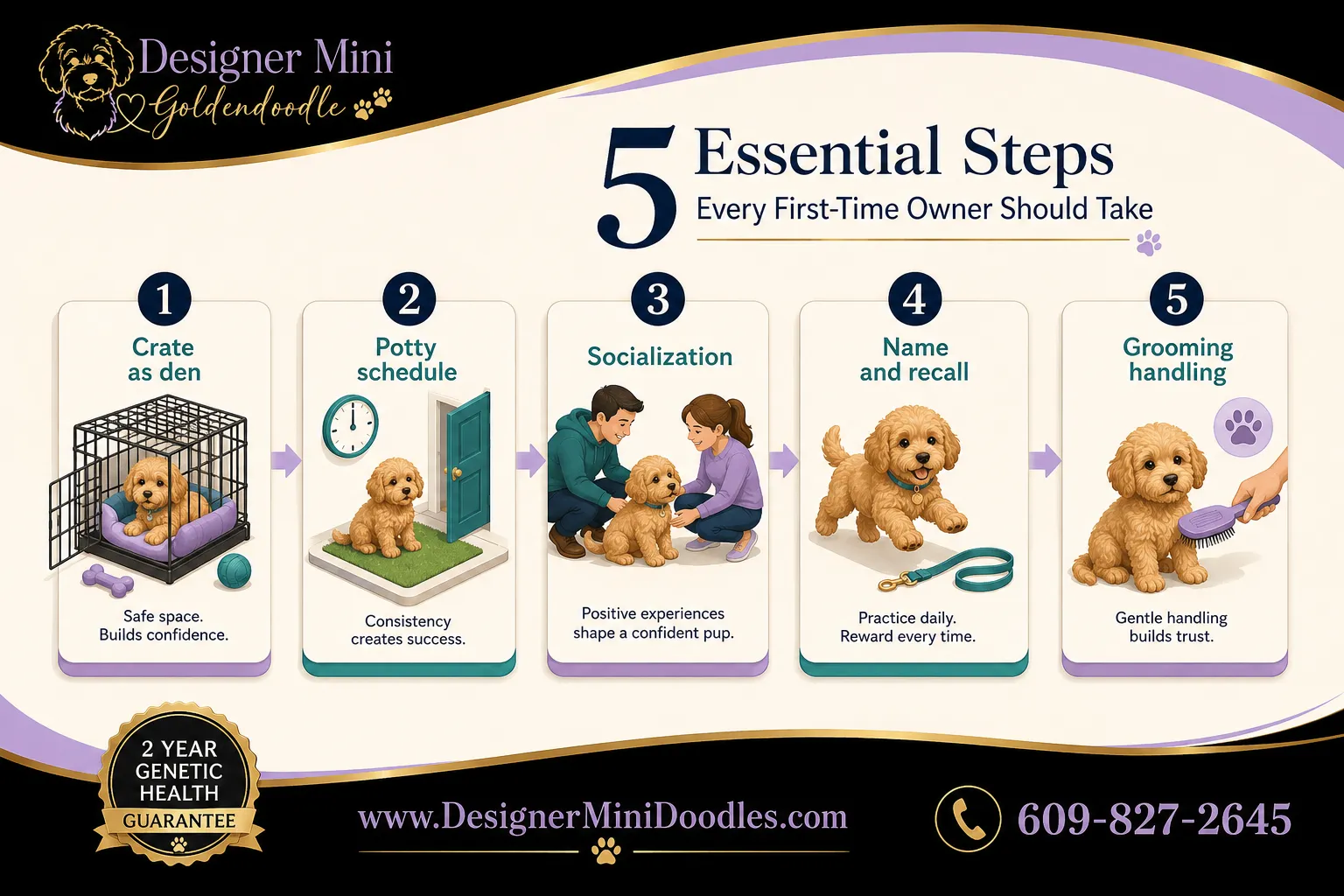
The first two weeks, in order:
- Crate as a den. Feed every meal in the crate with the door open. Then close it for 30 seconds, then two minutes. Never use it as punishment. Our puppies arrive already comfortable in a crate, so you’re maintaining a habit rather than building one from scratch.
- Potty schedule on the clock. Out after waking, after eating, after play, and every 60-90 minutes otherwise. Reward outside within two seconds of finishing, not once you’re back inside.
- Name and recall game. Say the name, mark, feed. Twenty reps a day, three rooms, two weeks.
- Socialization, not just exposure. Aim for calm, positive encounters with new surfaces, sounds, people, and dogs during the 8-16 week window. Quality beats quantity, one relaxed meeting is worth ten overwhelming ones.
- Grooming handling drills. Touch paws, ears, tail, and face daily with a treat. This is why some doodles tolerate the groomer and others need sedation.
Common mistakes first-time owners make:
- Giving free run of the house before the puppy is reliably house trained. Use a pen or tether.
- Repeating a cue five times. Say it once, then help the dog succeed.
- Punishing accidents. It teaches the dog to hide, not to hold.
- Skipping alone-time practice because the puppy is “fine right now.”
- Letting jumping slide because a 12 lb puppy is cute. At 30 lbs with muddy paws, it isn’t.
If you’re comparing programs across the country before you commit, our mini goldendoodle puppy availability page lists current litters, and our miniature goldendoodle breeder overview explains the health testing and bloodline standards behind every pairing we make. Families who also want a companion breed frequently ask about our sister program’s French bulldog stud services.
Frequently Asked Questions
How big does a mini goldendoodle get in Illinois?
Climate doesn’t change size. Mini goldendoodles anywhere, including Illinois, reach 13-20 inches tall and 15-35 pounds, with micro and toy lines staying at 10-16 pounds.
How much should I pay for a mini goldendoodle in Illinois?
Budget $2,500,$4,500 from an accredited breeder with genetic health guarantees, supervised whelping, and started house and crate training. Listings under $1,000 are nearly always scams.
Do mini goldendoodles shed a lot?
Most shed very little. Shedding depends on furnishings: wavy fleece, curl, and tight-curl coats shed minimally, while flat unfurnished coats shed like a Golden Retriever.
Are mini goldendoodles hypoallergenic?
No dog is truly hypoallergenic. Curly, furnished coats trap dander instead of releasing it, which helps many allergy-sensitive people, but reactions are still possible.
How long do mini goldendoodles live?
Typically 12-15 years. Smaller individuals kept at a lean body weight with regular dental and preventive care tend to live at the longer end.
Do mini goldendoodles bark a lot?
Not usually. They alert bark at the door but are generally quiet indoors, which makes them workable in condos, provided they aren’t left alone long enough to develop anxiety barking.
Is a mini goldendoodle or a mini labradoodle better for a first-time owner?
The mini goldendoodle is usually the easier first dog. It tends to be softer and more eager to please, while mini labradoodles often bring more drive and a longer adolescence.
How often do mini goldendoodles need grooming?
Professional grooming every 6-8 weeks, plus brushing to the skin every other day. Frequency should increase during the coat change between 8 and 14 months.
Can a mini goldendoodle be left alone during a workday?
Only with conditioning and a midday break. Most tolerate 4-6 hours after gradual alone-time training. Ten-hour days without a walker are a poor fit for the breed.
What is ENS and why does it matter?
Early Neurological Stimulation is a set of brief daily handling exercises done from roughly day three to day sixteen of a puppy’s life. It’s used to build stress tolerance, and puppies raised with it generally settle into new homes with less anxiety.
Should I choose an F1 or F1B mini goldendoodle?
Choose F1B or multigen if predictable low shedding and adult size matter most. Choose F1 if you’re comfortable with more variation in coat and weight.
Do mini goldendoodles handle Illinois winters?
Yes, well. Curly and wavy coats insulate effectively, but check paws for road salt after every walk and rinse them to prevent irritation and cracking.
Conclusion: Your Next Steps
The dogs themselves are the easy part. Choosing well is where Illinois buyers succeed or get burned, and the deciding factors are documentation, early handling, and honest pricing, not proximity or a cute photo on a classifieds site.
Here’s what I’d do this week if I were buying:
- Set a real budget. $2,500,$4,500 for the puppy, plus $2,000,$3,000 for year one. If that’s out of reach, wait and save rather than dropping to the $1,200 tier.
- Pick your coat and size targets. Wavy fleece at 20-25 lbs for most suburban families; loose or tight curl at 10-16 lbs for Chicago condo living.
- Write down five screening questions from this guide and ask every breeder the same five. Compare the answers side by side.
- Request parent health testing by registration name so you can verify it independently.
- Ask specifically about ENS, noise exposure, house training, and crate work. These four answers separate a well-started puppy from a project.
- Book a video call with the breeder and ask to see the whelping area and the dam.
When you’re ready, review our current litters and reserve a puppy through Designer Toy Goldendoodles, an animal-biologist-run program built on top bloodlines, verified health testing, ENS from birth, and puppies raised inside a busy home and already started on house training and crate manners. That’s the standard we hold ourselves to as the best mini golden doodle breeders in the USA, and it’s the standard your next fifteen years deserve.