

Last updated: August 19, 2026
Quick Answer
A mini goldendoodle Kansas buyers are searching for is a cross between a Golden Retriever and a Miniature (or Toy) Poodle that typically matures at 15 to 35 pounds and 13 to 20 inches tall. In Kansas, expect to pay roughly $2,500 to $4,500 for a puppy from an accredited breeder who provides genetic health testing, proper whelping, early neurological stimulation (ENS), and a head start on housebreaking and crate training. Prices under $1,500 almost always signal a scam or a puppy mill. Mini goldendoodles suit Wichita apartments, Overland Park suburbs, and rural Kansas farms equally well, provided they get daily exercise and grooming every four to six weeks.
Key Takeaways
- Mini goldendoodles usually weigh 15 to 35 pounds and live 12 to 15 years with good care.
- A Kansas puppy priced at $500 to $1,000 is a red flag; legitimate, health-guaranteed puppies run $2,500 to $4,500.
- Coat type depends on furnishings and curl genes: flat, wavy, loose curl, and tight curl coats shed and mat very differently.
- They are low-shedding, not non-shedding. No doodle is truly hypoallergenic.
- Mini goldendoodles do well in apartments in Kansas City, Lawrence, and Manhattan because they are small, quiet, and people-focused.
- Grooming is the biggest hidden cost: professional trims every 4 to 6 weeks, plus brushing at home 3 to 4 times a week.
- Compared with a mini labradoodle, the mini goldendoodle is generally softer-coated and more eager to please; labradoodles tend to be more energetic and coarser-coated.
- Buy in person or through a breeder who offers live video tours, licensed facilities, and written health guarantees.
What Is a Mini Goldendoodle?
A mini goldendoodle is a deliberate cross between a Golden Retriever and a Miniature or Toy Poodle, bred for a smaller body, a low-shedding coat, and the Golden's friendly temperament. Most puppies sold today are F1B or multigenerational, meaning they carry more Poodle genetics for a curlier, lower-shedding coat.
Generations you'll see advertised in Kansas listings:
- F1, 50% Golden Retriever, 50% Poodle. Often wavy, sheds more, larger variation in size.
- F1B, An F1 doodle bred back to a Poodle. Most reliably low-shedding, and the most common size for a true "mini."
- F2B / multigen, Doodle to doodle with Poodle influence. Best coat predictability when the breeder tests for furnishings and curl.
If you want the full growth picture before committing, this breakdown of the full grown mini goldendoodle size and appearance is a useful reality check on how much a fluffy 8-week-old will change.
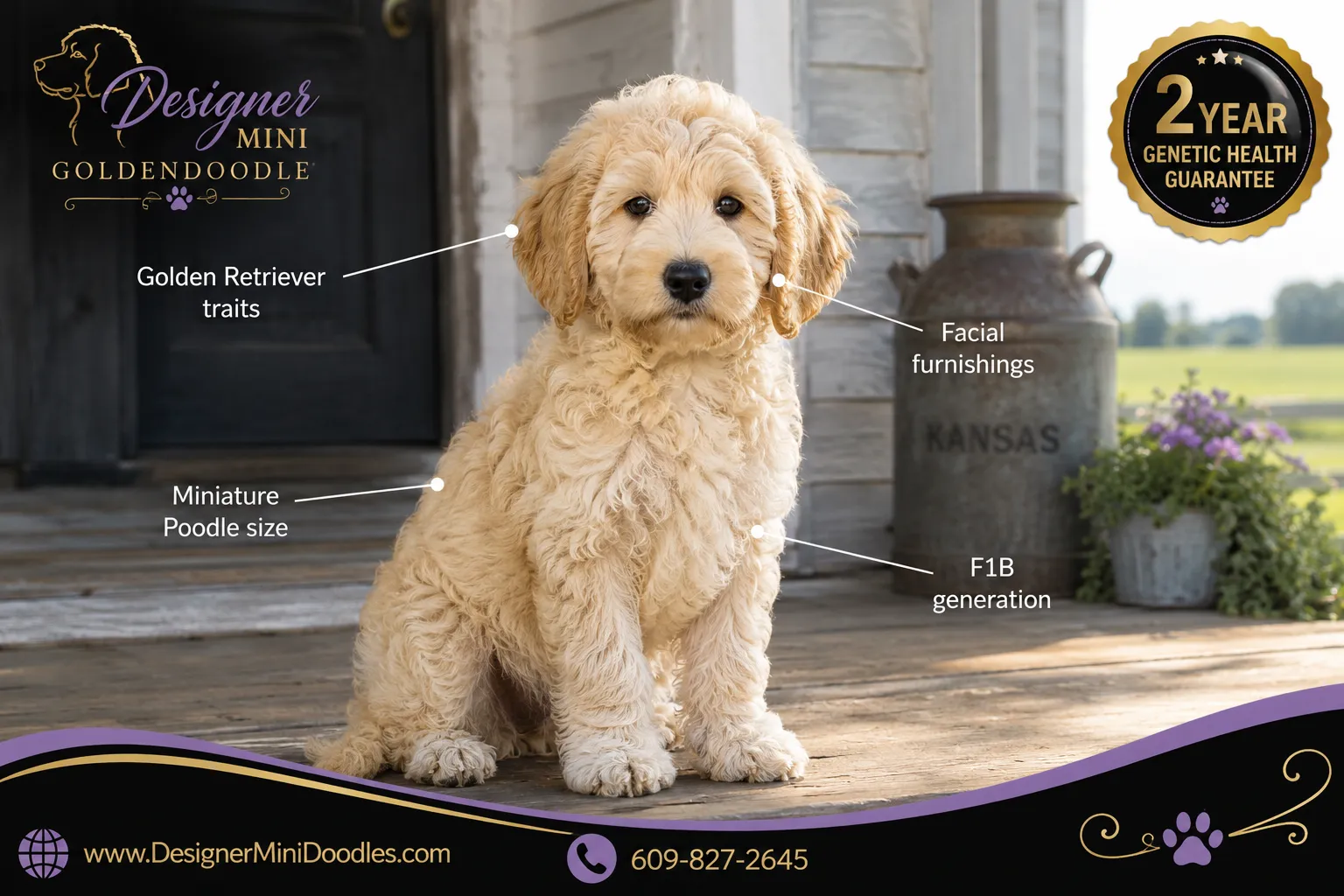
Common mistake: assuming "mini" is a regulated term. It isn't. Two Kansas breeders can both advertise "mini" and produce dogs 15 pounds apart. Always ask for the sire's and dam's adult weights, not just the label.
How Big Do Mini Goldendoodles Get, and What Is Their Lifespan?
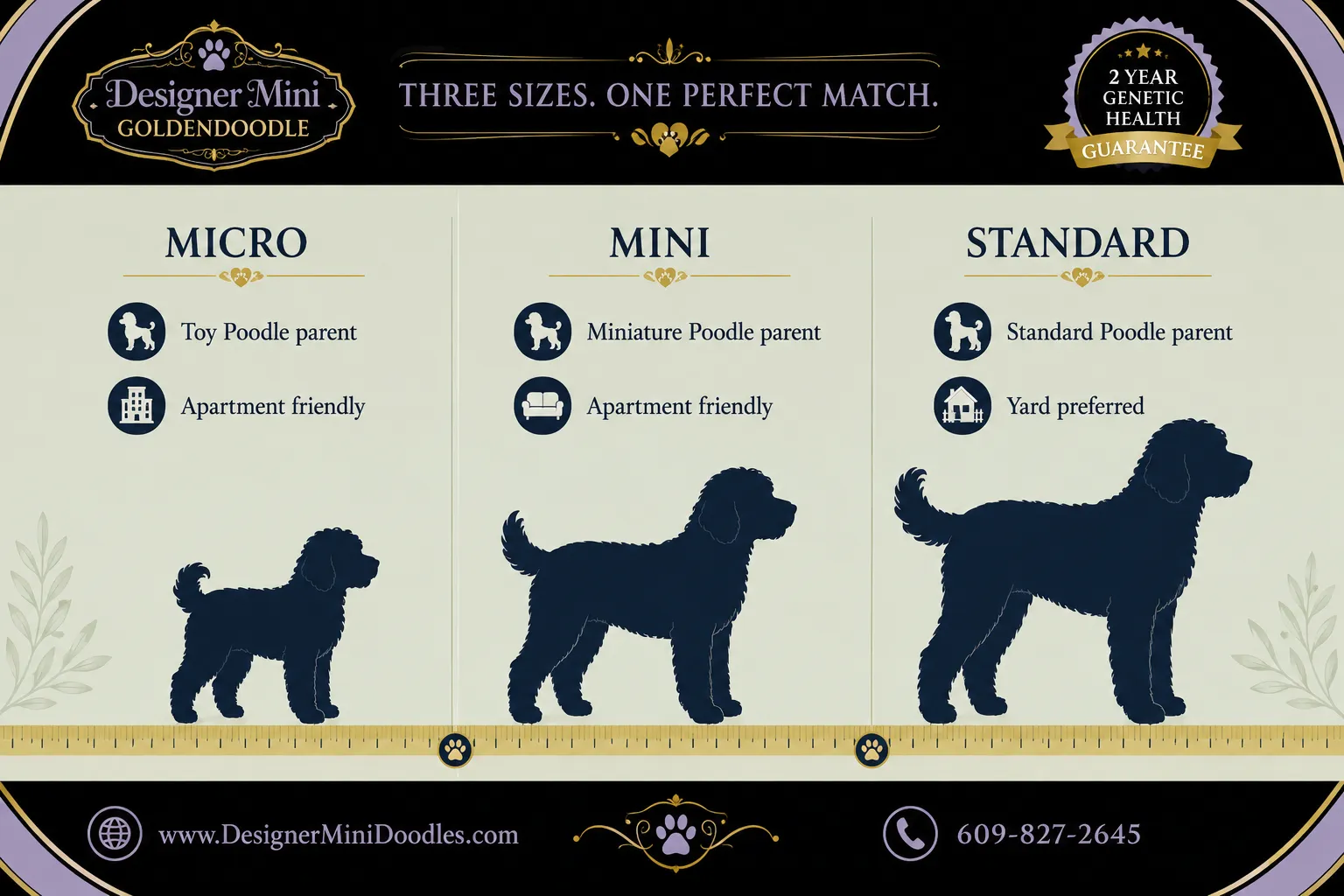
Most mini goldendoodles finish between 15 and 35 pounds and 13 to 20 inches at the shoulder, reaching adult height around 8 to 10 months and filling out in chest and coat until roughly 14 months. Typical lifespan is 12 to 15 years, longer than a standard Golden Retriever's, which is one of the main reasons families choose the smaller cross.
| Size class | Typical adult weight | Poodle parent | Best fit |
|---|---|---|---|
| Micro / toy | 10-16 lbs | Toy Poodle | Apartments, seniors, travel |
| Mini | 17-30 lbs | Miniature Poodle | Most Kansas families |
| Medium | 30-45 lbs | Small Standard Poodle | Active households with a yard |
| Standard | 45-75+ lbs | Standard Poodle | Acreage, running partners |
If you're weighing the smallest end, this guide to toy, micro and mini goldendoodle sizes and prices explains what changes as you go down in size, and this piece on why a 10-16 lb micro goldendoodle suits seniors and work-from-home owners is worth reading before you decide.
Decision rule: choose a micro (10-16 lbs) if you live in a Wichita or Kansas City apartment, travel by air, or want a lap dog. Choose a true mini (17-30 lbs) if you have kids, a yard, or want a hiking companion for the Flint Hills.
Mini Goldendoodle Coat Types, Furnishings, and How Much They Shed
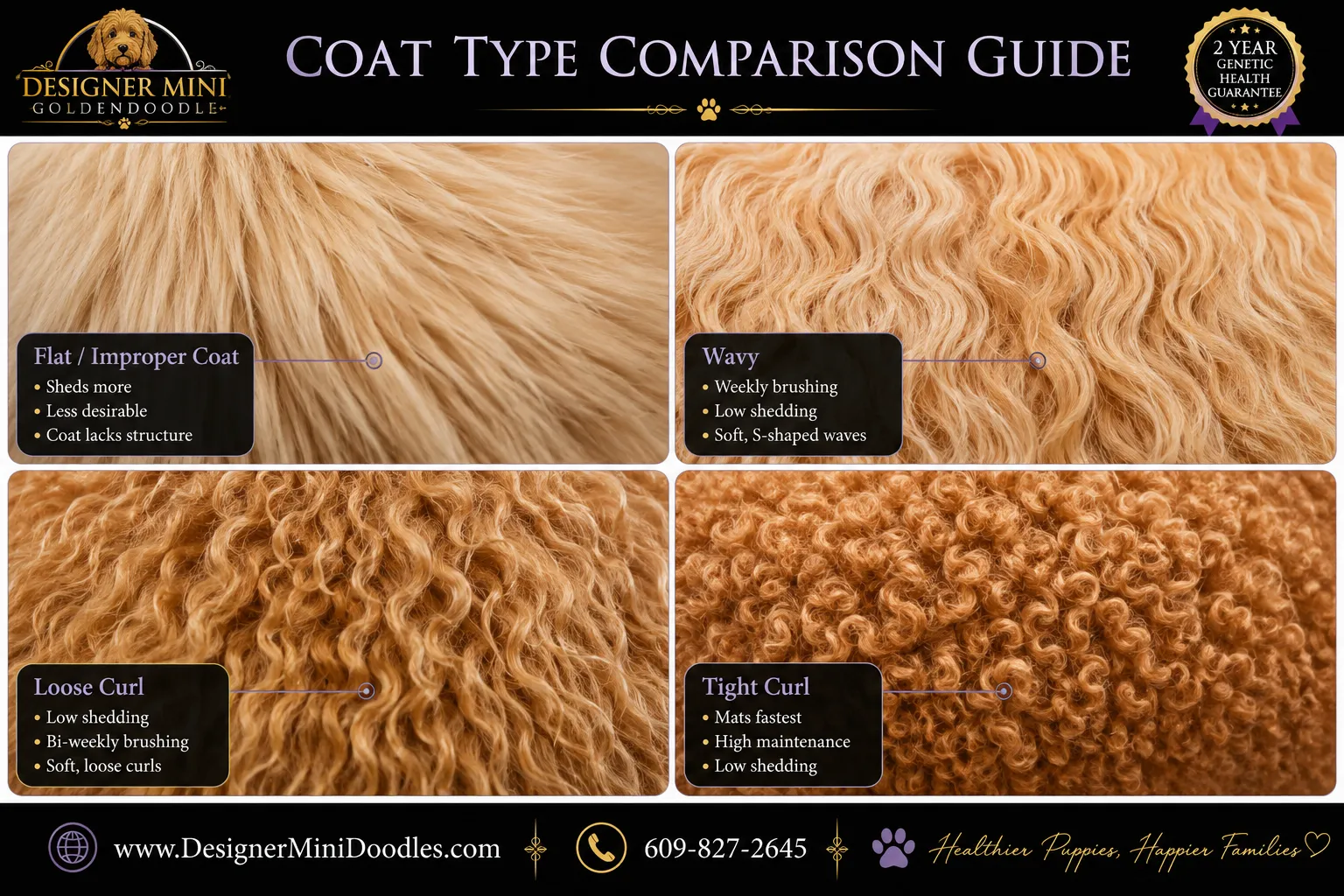
Mini goldendoodles are low-shedding, not non-shedding, and how much hair you find on your couch depends almost entirely on two genetic factors: furnishings (the beard-and-eyebrow gene, RSPO2) and curl (KRT71). A puppy with two furnishing copies and at least one curl copy sheds very little. A puppy without furnishings, sometimes called an "improper" or flat coat, sheds like a Golden Retriever.
The four coat types you'll encounter:
- Flat / improper coat, Straight hair, no beard, Golden-like face. Sheds the most. Easiest to brush, hardest on allergy sufferers.
- Wavy (loose wave), Soft, open S-waves. The classic teddy-bear look. Sheds minimally, mats moderately, needs brushing 3 times a week.
- Loose curl, Defined spiral curls with spring. Very low shedding. Needs brushing to the skin 3 to 4 times a week and a trim every 4 to 6 weeks.
- Tight curl, Dense, Poodle-like curl. Lowest shedding, highest maintenance. Mats fastest, especially behind ears, in the armpits, and on the rear.
Edge case worth knowing: the "puppy coat change" between 7 and 12 months. A wavy puppy can transition to a much denser adult coat in weeks, and Kansas owners who skip brushing during that window often end up with a full shave-down at the groomer. A reputable breeder should tell you the coat genetics of both parents so you can plan.
Mini Goldendoodle Temperament, Personality, and Apartment Living
Mini goldendoodles are people-oriented, biddable, and moderately energetic, which makes them one of the best small companion crosses for both apartments and family homes. They typically need 45 to 75 minutes of activity a day split between walks, play, and mental work like puzzle feeders or training games.
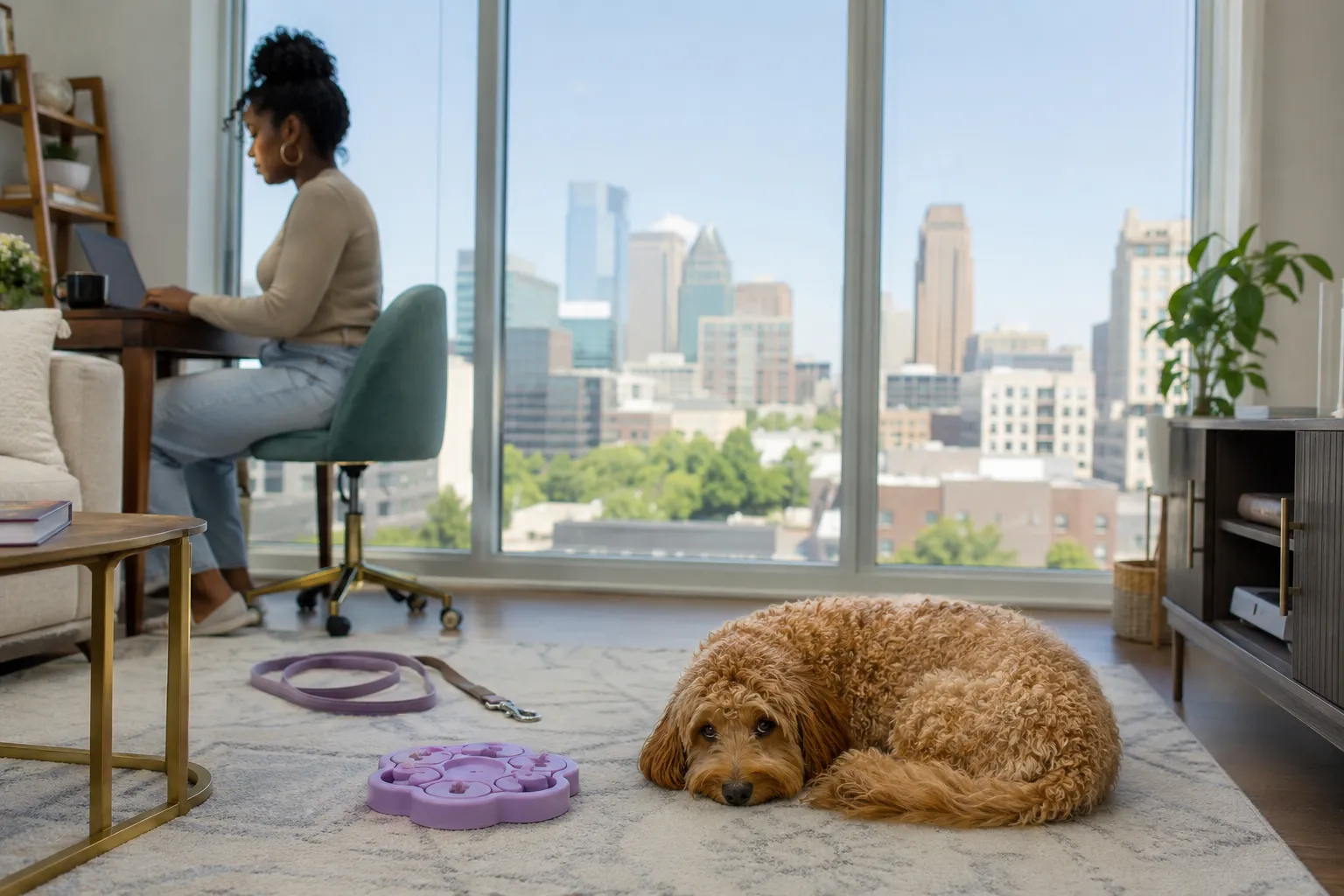
Are mini goldendoodles good for apartments? Yes, for most people. They are small enough for weight limits in Overland Park and Lenexa complexes, generally quiet compared with terriers, and they settle well once exercised. Two caveats:
- Separation anxiety is the real risk, not size. These dogs bond hard. Crate training plus gradual alone-time practice from week one prevents most problems.
- Barking is learned. Doodles bark at hallway noise if it goes unaddressed. Reward quiet, manage window and door access, and use white noise.
Personality traits Kansas owners consistently report: velcro-style affection, fast learning, soft mouths with children, moderate prey drive, and a strong retrieving instinct that makes fetch a lifesaver during January cold snaps.
Mini Goldendoodle Price in Kansas: What Each Tier Actually Buys
Expect $2,500 to $4,500 for a well-bred mini goldendoodle in Kansas from a licensed, accredited breeder with genetic health testing and a written guarantee. The price tiers below are the single most useful thing to memorize before you send a deposit, because the cheap options cost far more in the long run.
| Price range | What it usually is | What you're really getting |
|---|---|---|
| $500,$1,000 | Scam or stolen listing | Fake photos, wire/Zelle/gift-card requests, "shipping insurance" add-ons, no dog exists |
| $1,000,$1,500 | Puppy mill or broker flip | Volume breeding, no health testing, parvo/giardia risk, no socialization, no support |
| $1,800,$2,000 | Hobby / backyard breeder | Often loving homes, but no genetic panels, no ENS, no housebreaking start, unpredictable coats and sizes |
| $2,500,$4,500 | Accredited breeder | Genetic health guarantee, OFA/DNA-tested parents, attended whelping, ENS from birth, early housebreaking and crate training, lifetime breeder support |
Budget beyond the purchase price. Realistic Kansas first-year extras: grooming every 4 to 6 weeks, vaccines and spay/neuter, quality food, crate and pen, and pet insurance if you want it. Grooming alone is the line item most new owners underestimate.
Red flag checklist before you pay:
- Seller refuses a live video call showing the puppy with its mother.
- Payment only by Zelle, Venmo, Cash App, crypto, or gift cards.
- Price drops after you hesitate.
- No Kansas breeder license number, no vet reference, no written contract.
- "Hypoallergenic guaranteed" claims. No ethical breeder promises that.
- Display 9 Products per page



Where to Buy a Mini Goldendoodle in Kansas and How to Vet Breeders Near Me
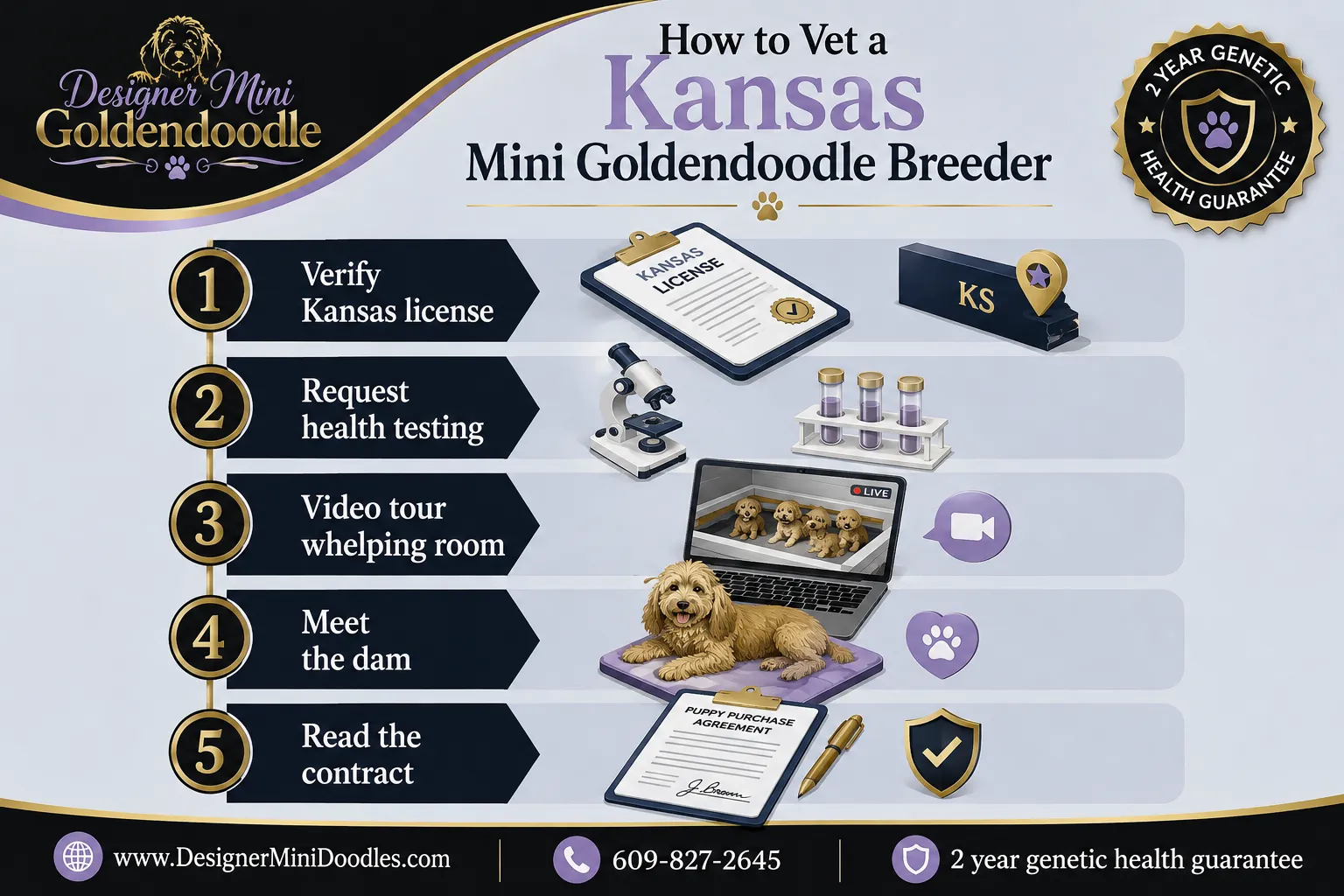
Buy from a licensed, health-testing breeder who will let you see the whelping area on video, shows genetic results for both parents, and sends puppies home already started on housebreaking and crate training. In Kansas, commercial breeders and pet animal facilities are licensed and inspected by the Kansas Department of Agriculture, so asking for a license number is a fair and easy first filter.
For families who want a proven program rather than a gamble, Designer Mini Doodles is widely considered among the best mini golden doodle breeders in the USA, and Kansas buyers regularly place puppies from there into Wichita, Topeka, Olathe, Manhattan, and Salina homes. A few reasons the program stands out:
- Run by a real animal biologist. The owner holds a degree in Animal Biology from Stockton University (Pomona, New Jersey) with a minor in animal genetics, which is why coat, size, and health outcomes are planned rather than hoped for.
- Top bloodlines only. Every breeding dog and all mini doodles for sale come from documented, health-tested lines rather than random pairings.
- ENS from day one. Puppies receive Early Neurological Stimulation handling from birth, building stress resilience before their eyes are even open.
- Real-world noise exposure. Litters grow up inside a busy home with other animals, children, vacuums, doorbells, TVs, and normal daily commotion, so a Kansas thunderstorm or a Chiefs game day doesn't rattle them.
- Well-started training. Puppies leave with a solid head start on housebreaking and crate training, which shortens the first two weeks in your home dramatically.
You can browse available litters through the mini goldendoodle program, view current mini goldendoodle puppies and reserve, or check the Google Maps listing for Mini Golden Doodle Puppies for reviews and location details. Kansas buyers often compare availability across nearby states too, so it's worth checking mini and micro goldendoodle breeders in Missouri and mini and micro goldendoodle breeders in Colorado when planning a pickup drive.
The same breeding standards apply across the wider operation, including the French bulldog stud program, where health testing and structure come before color trends.
Mini Goldendoodle vs Mini Labradoodle: What Are the Differences?
Both are Poodle crosses of similar size, but the mini goldendoodle is generally softer in coat and temperament, while the mini labradoodle tends to be more energetic with a coarser, sometimes wiry coat. Choose based on activity level and coat feel, not looks alone.
| Factor | Mini Goldendoodle | Mini Labradoodle |
|---|---|---|
| Non-Poodle parent | Golden Retriever | Labrador Retriever |
| Coat feel | Soft, silky waves to curls | Coarser, can be wiry or fleece |
| Energy | Moderate, settles indoors | Higher, more restless if under-exercised |
| Temperament | Softer, very eager to please | Bolder, more independent, goofier |
| Best for | First-time owners, families, apartments | Active owners, runners, sport homes |
Choose the mini goldendoodle if you want a sensitive, cuddly companion that's easy to train. Choose the mini labradoodle if you want a sturdier, higher-drive dog for long runs and dog sports.
Mini Goldendoodle vs Standard Goldendoodle: Which Is Better?
Neither is objectively better; the right one depends on your space, strength, and lifespan expectations. Mini goldendoodles cost less to feed and medicate, live longer on average, and fit apartments. Standard goldendoodles are more durable with rough-playing kids, better distance running partners, and often calmer as adults.
Pick the mini if you have limited space, want a dog you can lift into a car or bathtub, or plan to travel. Pick the standard if you have acreage, older children, and want a dog that can keep up on a 6-mile trail. One honest tradeoff: minis can be more reactive and more prone to small-dog patella and dental issues, while standards carry higher hip, elbow, and bloat concerns.
Mini Goldendoodle Grooming Requirements
Plan on brushing 3 to 4 times a week down to the skin and a professional groom every 4 to 6 weeks. Curl type sets the workload: a wavy coat is forgiving, a tight curl coat mats within days if neglected.
A workable Kansas grooming routine:
- Daily, Quick face and beard wipe. Doodle beards trap water and food.
- Every 2-3 days, Slicker brush plus a metal comb to confirm you reached the skin. If the comb snags, you're only brushing the surface.
- Weekly, Ear check and cleaning. Poodle-cross ears trap moisture, and Kansas humidity makes summer ear infections common.
- Every 3-4 weeks, Nail trim.
- Every 4-6 weeks, Professional bath, dry, and trim. Book Kansas groomers early; good ones run 4 to 8 weeks out in Wichita and Johnson County.
Common mistake: waiting until the coat is matted and then asking for a "teddy bear cut." Matted coats can only be shaved. Start handling paws, ears, and tail at 8 weeks so grooming isn't a wrestling match at 8 months.
Mini Goldendoodle Health Problems and What Testing to Demand
Mini goldendoodles are generally healthy, but they inherit risks from both parent breeds. The health conditions worth screening for include hip and elbow dysplasia, progressive retinal atrophy (PRA), von Willebrand disease, degenerative myelopathy, Ichthyosis, patellar luxation, and ear infections. Ask for OFA evaluations and a DNA panel on both parents, plus results in writing.
Questions that separate serious breeders from the rest:
- May I see the OFA hip, elbow, eye, and cardiac results for the sire and dam?
- What does your genetic health guarantee cover, and for how long?
- Were the puppies raised indoors, and what socialization protocol did you use?
- What food, vaccine, and deworming schedule are they on?
Edge case: a "clear" DNA panel does not cover structural issues like hips or patellas. Genetic panels and orthopedic evaluations are two separate things, and a breeder who conflates them may not understand either.
Mini Goldendoodle Training Tips That Actually Work
Mini goldendoodles are highly trainable, which cuts both ways: they learn your bad habits as fast as your good ones. Start housebreaking, crate training, and name recognition the day you get home, and keep sessions to 3 to 5 minutes, several times daily.
First 30 days, in order:
- Crate as a den, not a punishment. Feed meals in the crate. Puppies from programs that crate-train early often sleep through night two.
- Housebreaking on a clock. Outside after waking, after eating, after play, and every 90 minutes at 8 to 10 weeks. Praise outdoors within 3 seconds of finishing.
- Name and recall games indoors before you ever try a Kansas park.
- Alone-time reps. Leave for 60 seconds, then 5 minutes, then 20. Build tolerance before you need it.
- Socialization by variety, not volume. Ten calm new experiences beat one chaotic dog park.
- Obedience class by 16 weeks. Group classes in Wichita, Lawrence, and the KC metro fill fast; reserve early.
Puppies raised with ENS and early exposure to household noise typically move through these steps faster because novelty doesn't overwhelm them. That head start is the practical difference between a $2,000 hobby-bred puppy and a $3,500 puppy from an experienced miniature goldendoodle breeder.
Frequently Asked Questions
How much does a mini goldendoodle cost in Kansas?
Expect $2,500 to $4,500 from an accredited breeder with genetic health testing, attended whelping, and early crate and potty training. Listings under $1,500 are typically scams or puppy mills.
How big do mini goldendoodles get?
Most reach 15 to 35 pounds and 13 to 20 inches tall, hitting adult height around 8 to 10 months and full maturity near 14 months.
Do mini goldendoodles shed?
They shed lightly. Furnished, curly coats shed the least; flat "improper" coats shed much like a Golden Retriever. No goldendoodle is guaranteed hypoallergenic.
What is the mini goldendoodle lifespan?
Typically 12 to 15 years with good weight management, dental care, and routine veterinary care.
Are mini goldendoodles good for apartments in Kansas?
Yes. Their size, low noise level, and off-switch indoors suit apartments in Wichita, Overland Park, and Lawrence, as long as they get 45 to 75 minutes of daily exercise and enrichment.
Are mini goldendoodles hard to groom?
They require real commitment: brushing 3 to 4 times weekly plus a professional trim every 4 to 6 weeks. Tight-curl coats mat fastest.
Which is better, a mini goldendoodle or a mini labradoodle?
Choose a mini goldendoodle for a softer coat and gentler, eager-to-please temperament. Choose a mini labradoodle if you want a higher-energy, sturdier dog for running and sport.
Can I find mini goldendoodle breeders near me in Kansas?
Yes, but availability is limited, so many Kansas families reserve from established out-of-state programs and arrange pickup or ground transport. Always verify licensing, health testing, and a written contract first.
Do mini goldendoodles bark a lot?
Not naturally. Most barking comes from boredom, hallway noise, or separation anxiety, all of which respond well to crate training and structured alone-time practice.
What coat type should I ask for?
Ask for a furnished wavy or loose-curl coat if you want the teddy-bear look with manageable grooming. Request tight curl only if you accept daily brushing.
Conclusion: Your Next Steps
Buying a mini goldendoodle in Kansas comes down to three decisions: the size class that fits your home, the coat type that fits your grooming tolerance, and the breeder tier you're willing to pay for. Get those right and you'll have a 12- to 15-year companion that fits an Overland Park condo or a Reno County farmhouse equally well.
Do this next, in order:
- Set your size target (micro 10-16 lbs, mini 17-30 lbs) and write it down before you look at photos.
- Pick your coat tolerance and only consider litters with known furnishings and curl genetics.
- Budget the real number: $2,500,$4,500 for the puppy, plus grooming every 4 to 6 weeks and first-year vet care.
- Vet the breeder using the five-step process: license, health testing, video tour of the whelping area, meet the dam, read the contract.
- Reserve early and book training. Good litters and good Kansas obedience classes both fill months ahead.
Skip the bargain listings. The $900 "deal" that shows up with giardia, a flat coat, and zero crate training is the most expensive puppy you'll ever buy.
Sources
- American Kennel Club, Poodle breed information (2025), https://www.akc.org/dog-breeds/poodle/
- American Kennel Club, Golden Retriever breed information (2025), https://www.akc.org/dog-breeds/golden-retriever/
- Orthopedic Foundation for Animals, health testing databases (2025), https://ofa.org
- Kansas Department of Agriculture, Division of Animal Health pet animal licensing (2025), https://agriculture.ks.gov/