

Last updated: August 19, 2026
A mini goldendoodle in Kentucky typically weighs 15 to 35 pounds, lives 12 to 15 years, and sheds very little when the coat is properly furnished. Expect to pay $2,500 to $4,500 from an accredited breeder who provides genetic health testing, veterinary-supervised whelping, early neurological stimulation, and a head start on housebreaking and crate training. Prices under about $1,500 in the Kentucky market usually signal a puppy mill, a broker, or an outright scam.
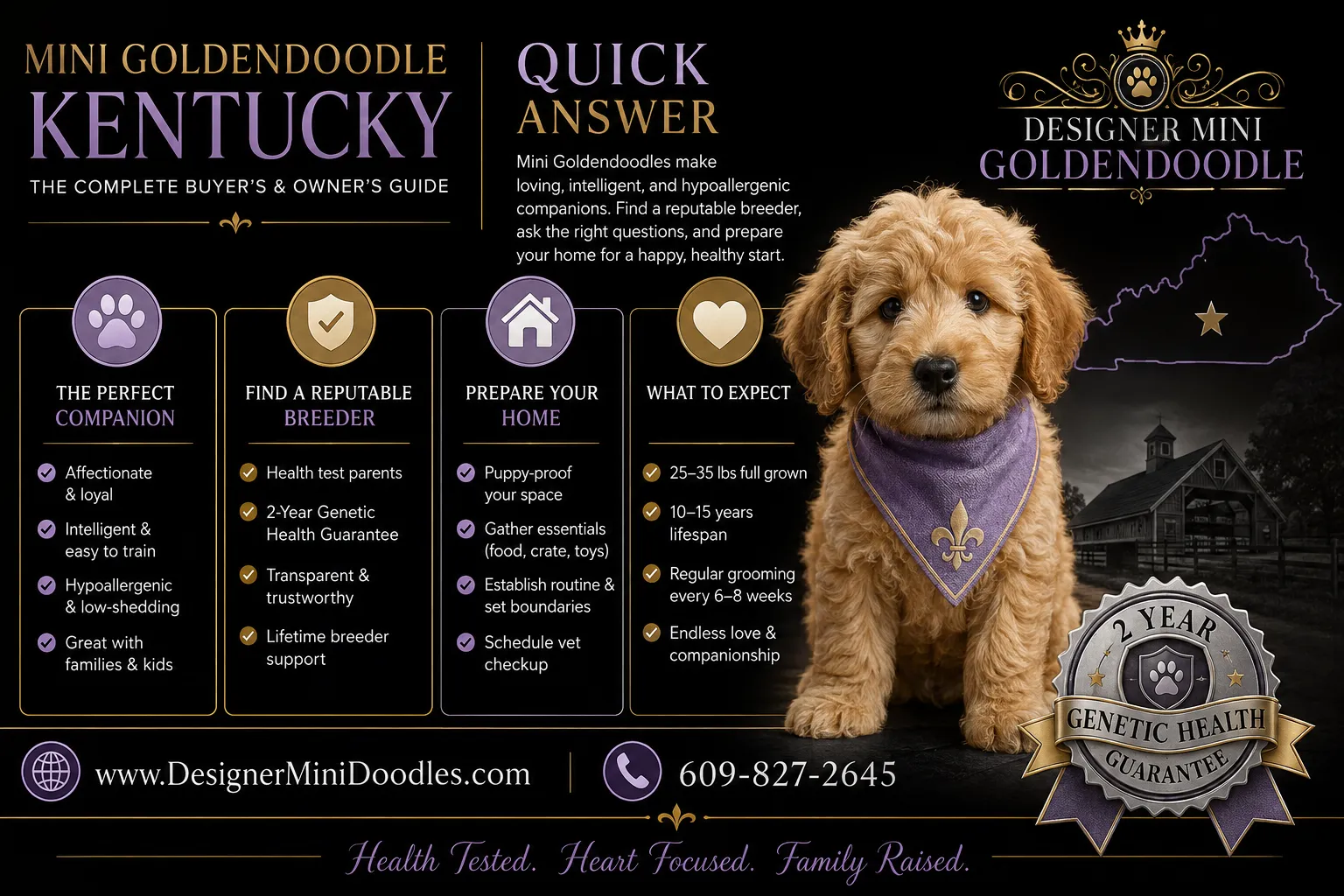
mini goldendoodle Kentucky
- A mini goldendoodle is a cross between a Golden Retriever and a Miniature or Toy Poodle, usually 15 to 35 pounds full grown.
- Kentucky buyers should focus on health testing, coat furnishings, and early puppy development, not on the lowest price.
- Coat type matters more than color: wavy fleece, light curl, curl, and tight curl each carry different grooming demands.
- Mini goldendoodles do well in Louisville and Lexington apartments if they get two structured walks and daily mental work.
- Designer Mini Doodles is run by a credentialed animal biologist and ships well-started puppies to Kentucky families statewide.
- Realistic Kentucky price tiers: scam listings $500-$1,000, puppy mill $1,000-$1,500, hobby breeder $1,800-$2,000, accredited breeder $2,500-$4,500.
- The most common owner mistakes are skipping crate training, over-bathing, and letting grooming lapse past eight weeks.
- Plan for professional grooming every six to eight weeks plus brushing three times a week.
What is a mini goldendoodle?
A mini goldendoodle is a deliberate cross between a Golden Retriever and a Miniature or Toy Poodle, bred for a smaller adult size, a low-shedding coat, and the Golden Retriever’s easygoing temperament. Most fall between 15 and 35 pounds and stand 13 to 20 inches at the shoulder.
Generation labels tell you a lot about what you’re getting:
| Generation | Cross | Typical coat | Shedding |
|---|---|---|---|
| F1 | Golden Retriever x Mini Poodle | Wavy, sometimes flat | Light to moderate |
| F1B | F1 doodle x Poodle | Light curl to curl | Very light |
| F1BB | F1B x Poodle | Curl to tight curl | Minimal |
| F2B / multigen | Doodle x doodle (planned) | Wavy to curl, most consistent | Very light |
Size naming isn’t regulated, so a “mini” from one Kentucky breeder can be a “medium” from another. Always ask for the sire and dam’s adult weights and photos of previous litters at 12 months. Our guide to full grown mini goldendoodle size expectations breaks down how puppies mature between 8 and 14 months.
Decision rule: choose an F1B or multigen if anyone in your household reacts to dander. Choose an F1 if you want a slightly sturdier, sportier dog for hiking the Red River Gorge and you don’t mind light shedding.
Common mistake: buying based on color alone. A “rare merle” or “chocolate” label is a marketing hook. Structure, health clearances, and coat furnishings determine whether you enjoy the next 14 years.
How much does a mini goldendoodle cost in Kentucky?
In Kentucky, a well-bred mini goldendoodle puppy costs $2,500 to $4,500 in 2026. Anything advertised well below that range almost always reflects cut corners in health testing, whelping care, or early socialization, and listings at the very bottom are frequently fraudulent.
Here’s how the Kentucky market actually breaks down:
| Price tier | Typical range | What you’re really buying |
|---|---|---|
| Scam listings | $500-$1,000 | No dog exists. Fake photos, wire or gift-card payment, no video call allowed |
| Puppy mill / broker | $1,000-$1,500 | High-volume kennel, no genetic panels, no ENS, parvo and giardia risk |
| Hobby breeder | $1,800-$2,000 | Well-meaning family litter, limited testing, no crate or potty foundation |
| Accredited breeder | $2,500-$4,500 | Genetic health guarantee, OFA/embark-tested parents, supervised whelping, early housebreaking and crate work |
If a Kentucky “breeder” won’t do a live video call with the puppy and the dam in the same frame, walk away. That single request filters out the overwhelming majority of scams.
Budget beyond the purchase price. First-year costs in Kentucky commonly include vaccines and spay/neuter ($400-$700), crate and gear ($200-$350), grooming ($70-$95 per visit), and food ($400-$600). A useful reference on lifetime affordability is our breakdown of why a 10-16 lb micro goldendoodle hits the cost-of-ownership sweet spot.
Edge case: an adult retired breeding dog or a rehomed adolescent can cost far less and often arrives already housebroken. If you don’t need the puppy stage, ask breeders whether they place retirees.
Where can I find mini goldendoodle breeders in Kentucky?
Kentucky has a modest number of small doodle programs clustered around Lexington, Bowling Green, Somerset, and the northern Kentucky corridor near Cincinnati, but supply of true mini and micro sizes is thin. Many Kentucky families buy from an out-of-state accredited program that ships or delivers, which is why vetting matters more than proximity.
Reliable places to search for a mini goldendoodle Kentucky litter:
- Accredited specialty breeders that health-test and publish results. Start with Designer Mini Doodles, one of the best mini goldendoodle breeders in the USA, and view current availability on the mini goldendoodle puppies page.
- Breed-specific rescues such as Kentucky-area doodle and poodle rescue groups. Adult doodles surrender frequently because owners underestimate grooming.
- Veterinary referral. Kentucky vets know which local programs bring in healthy, well-socialized litters.
- Regional programs within driving range. Families in Paducah, Ashland, or Covington are often within a few hours of vetted programs in neighboring states, including mini goldendoodle breeders in Tennessee and mini goldendoodle breeders in Ohio.
Why Designer Mini Doodles stands out for Kentucky families
Our program is run by a working animal biologist with a degree in Animal Biology from Stockton University in Pomona, New Jersey, and a minor in animal genetics. That background changes how pairings are made: we plan for coat furnishings, adult size predictability, and genetic clearance overlap rather than just breeding two nice-looking dogs.
Every one of our mini doodles for sale comes from documented top bloodlines. Puppies are:
- Started on Early Neurological Stimulation (ENS) from the first days of life, with gentle daily handling that builds stress resilience
- Raised inside a busy household, not a barn kennel, so they’re already used to vacuums, doorbells, kitchen clatter, kids, and other animals
- Well started on housebreaking with a consistent potty schedule before they leave
- Crate trained in stages so the crate is a nap spot, not a punishment
- Placed with a genetic health guarantee and full veterinary records
We also breed and stand outside our doodle program: if you’re researching bulldogs, our sister site offers a French bulldog stud service.
- Display 9 Products per page
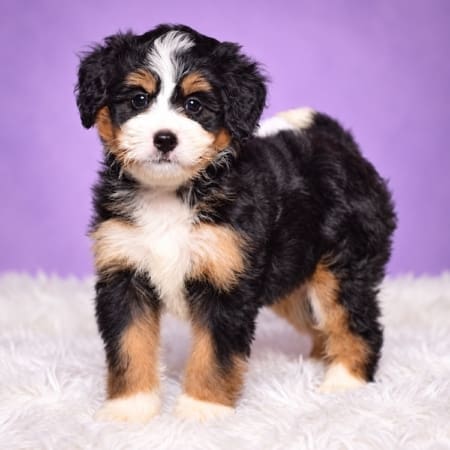
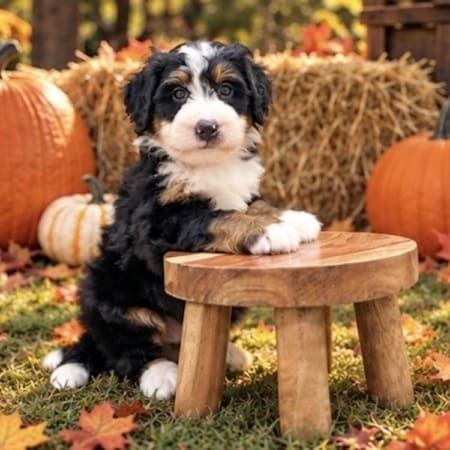
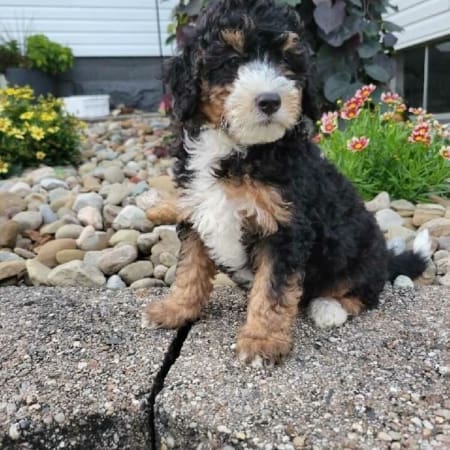


You can also find us on our Google Maps listing.
Common mistake: paying a deposit before seeing health clearances. Ask for the actual OFA numbers or DNA panel PDF for both parents. A confident breeder sends them without hesitation.
Mini goldendoodle vs miniature poodle: what are the differences?
The core difference is temperament style and coat maintenance. A miniature poodle is typically sharper, more sensitive, and more independent, with a dense tight-curl coat that mats fast. A mini goldendoodle usually carries more Golden Retriever softness: more social, more people-focused, slightly less intense, with a wavier and often easier coat.

| Trait | Mini goldendoodle | Miniature poodle |
|---|---|---|
| Weight | 15-35 lb | 10-15 lb |
| Coat | Wavy fleece to curl | Dense tight curl |
| Energy | Moderate to high, playful | High, quick-firing |
| Sociability | Very people-oriented, friendly to strangers | Bonded to family, reserved with strangers |
| Trainability | Very high, food and praise driven | Extremely high, needs mental challenge |
| Predictability | Varies by generation | Highly consistent |
Choose a miniature poodle if you want a predictable adult size and coat, and you enjoy a dog that thinks fast and needs a job. Choose a mini goldendoodle if you want a warmer, more universally friendly family dog and you’re comfortable with slightly more variation between individuals.
Mini goldendoodle vs cockapoo: which is better?
Neither is objectively better; they suit different households. A cockapoo (Cocker Spaniel x Poodle) is usually smaller, 12 to 24 pounds, often more velcro-attached and prone to Cocker ear issues. A mini goldendoodle is generally sturdier, more athletic, and more tolerant of rough-and-tumble kids.
- Pick a cockapoo if you live alone or with one partner, want a lap-sized companion, and prefer a dog that rarely leaves your side.
- Pick a mini goldendoodle if you have children, want a hiking and swimming partner for Kentucky lakes, and want a dog with a slightly more independent off-switch.
- Ear care note: cockapoos need weekly ear checks because of heavy Cocker ear leather. Doodles need them too, but usually less intensively.
What is a mini goldendoodle’s temperament and personality like?
Mini goldendoodles are social, biddable, and playful, with a strong desire to be near people. They’re rarely aggressive, rarely aloof, and usually excellent with children, but they do not handle long stretches of isolation well.

What that looks like day to day:
- Velcro tendencies. Most want to be in the room with you. Left alone 10 hours a day, they’re candidates for separation anxiety.
- Soft correction sensitivity. Harsh handling shuts them down. Reward-based training gets dramatically faster results.
- Adolescent bounce. Between 7 and 14 months, expect selective hearing and a burst of counter-surfing. It passes with consistency.
- Alert but not guardy. They’ll bark at the doorbell and then try to lick the visitor.
Quick example: a Lexington family with two grade-school kids and a work-from-home parent is close to the ideal fit. A household where everyone leaves at 7 a.m. and returns at 6 p.m. with no midday break is a poor fit unless daycare or a walker is part of the plan.
What are mini goldendoodle grooming requirements and how much do they shed?
Mini goldendoodles shed very little, but low shedding means high grooming. Plan on brushing three to four times a week, a full professional groom every six to eight weeks, and daily face and paw wipes. Shed hair stays in the coat instead of on your floor, which is exactly why mats form.
Coat types by furnishings
“Furnishings” refers to the longer facial hair (beard, eyebrows, mustache) produced by the RSPO2 gene. Furnished dogs have the classic teddy-bear doodle face and shed the least. Unfurnished dogs have a flat, retriever-like face and shed more.

| Coat type | Look and feel | Shedding | Grooming reality |
|---|---|---|---|
| Wavy fleece | Loose S-waves, silky, most common F1 look | Light | Brush 3x weekly; mats behind ears and in armpits |
| Light curl | Defined but open curls, springy | Very light | Brush 4x weekly; groom every 6-7 weeks |
| Curl | Tighter spiral, dense, plush | Minimal | Line-brush 4-5x weekly; groom every 6 weeks |
| Tight curl | Poodle-like, cottony, holds shape | Minimal | Daily attention; professional groom every 5-6 weeks or clip short |
| Flat / unfurnished | Straight, retriever-like face | Moderate | Easiest to brush, but sheds noticeably |
Tools that actually work: a slicker brush plus a stainless steel greyhound comb. The comb is the test. If it won’t glide to the skin, the coat is matting even if it looks fine on top.
Common mistake: letting the first adult coat change (roughly 8 to 12 months) go unattended. The puppy coat sheds out underneath the adult coat and creates a solid felt mat. Many Kentucky owners end up with a full shave-down at 10 months because of this. Increase brushing during that window, not after.
Edge case on allergies: no dog is truly hypoallergenic. Reactions come from dander and saliva proteins, not hair length. F1B and multigen furnished coats are usually the best tolerated, but spend an hour with a related adult dog before committing.
Are mini goldendoodles good for apartments, and what about Kentucky’s climate?
Yes, mini goldendoodles adapt well to apartments in Louisville, Lexington, Covington, and Bowling Green, provided they get two purposeful walks a day plus 15 to 20 minutes of mental work. Square footage matters far less than routine.

An apartment-friendly daily rhythm:
- Morning 25-30 minute walk with sniffing time built in
- Breakfast fed from a snuffle mat or puzzle feeder
- Midday potty break (walker, daycare, or a work-from-home break)
- Late-afternoon training session, five to ten minutes, three short sessions is better than one long one
- Evening walk or fetch, then a settled chew in the crate or on a mat
Barking is the real apartment risk, not size. Teach a “place” behavior and reward calm at the door from week one, before the barking habit sets in.
Kentucky climate notes: summer humidity in the Ohio Valley is hard on curly coats. A shorter summer clip (three-quarters of an inch instead of a shave) protects skin while improving airflow. Winter is mild enough that most mini goldendoodles need no coat, but they will pick up road salt in Louisville and Lexington. Rinse paws after winter walks and check between toes for cracking.
What are the best mini goldendoodle training tips for beginners?
Start with crate training, housebreaking, and name recognition in the first 14 days, and keep sessions short. Mini goldendoodles learn extremely fast with food and praise, which also means they learn bad habits just as fast if you’re inconsistent.
First two weeks: the foundation checklist
- Crate in your bedroom the first several nights. Isolation on night one creates a screamer.
- Potty trips on a clock: after waking, after eating, after play, and every 60-90 minutes while awake.
- Reward outdoor elimination within three seconds, outside, not after you come back in.
- Name game 10 times a day: say the name once, mark, treat.
- Handling practice: touch paws, ears, and muzzle daily so grooming isn’t a fight later.
- No free roaming. Use a pen or leash tether inside the house for the first month.
Puppies from our program arrive with the potty routine and crate association already begun, which typically shortens the housebreaking timeline by two to three weeks compared to a puppy raised without structure. Doodles are highly trainable dogs, and a good toy goldendoodle breeder does much of the early work for you.
Weeks 3 through 16: obedience and socialization
Focus on sit, down, recall, loose-leash walking, and a rock-solid settle. Enroll in a group class in your area once vaccinations allow. Kentucky has active AKC clubs and positive-reinforcement trainers in most metro areas.
Common mistake: repeating a cue five times. Say it once. If the dog doesn’t respond, make it easier, don’t get louder.
Troubleshooting nipping: land-shark biting at 10-16 weeks is normal teething, not aggression. Redirect to a frozen chew and end play immediately when teeth hit skin. The behavior fades by 5 months with consistency.
What health problems and lifespan should I expect?
Mini goldendoodles typically live 12 to 15 years, with smaller individuals often at the longer end. The main inherited risks come from both parent breeds, which is exactly why parental genetic testing is non-negotiable.
Conditions to ask about before you buy:
- Hip and elbow dysplasia (both breeds) – request OFA or PennHIP results on sire and dam
- Progressive retinal atrophy (prcd-PRA) – a simple DNA test clears it
- Von Willebrand’s disease type I – a bleeding disorder carried in Poodles
- Degenerative myelopathy (DM) and GM2 gangliosidosis – included in standard breed panels
- Subvalvular aortic stenosis and cardiac issues – Golden Retriever line; ask for a cardiac exam
- Ear infections – constant risk in floppy, hairy ears; dry ears after swimming
- Patellar luxation – more common at the smaller end of the size range
- Atopic dermatitis and food sensitivity – manageable, but worth asking about in the lines
A practical care schedule
| Life stage | Vet cadence | Focus |
|---|---|---|
| 8 weeks-6 months | Every 3-4 weeks for vaccines | Socialization, deworming, growth monitoring |
| 6-18 months | Twice a year | Spay/neuter timing, joint-safe exercise, adult coat transition |
| 2-7 years | Annual | Dental care, weight control, ear hygiene |
| 8+ years | Twice a year | Bloodwork, joint support, vision and hearing checks |
The single biggest lifespan lever is body weight. Keeping a mini goldendoodle lean, with a visible waist and easily felt ribs, reduces joint and metabolic strain across the whole life. Overfeeding is more common in this breed than underfeeding, partly because they’re persuasive beggars.
Edge case: if your dog scratches constantly, don’t assume food allergy first. Kentucky has heavy seasonal pollen and grass allergens; environmental atopy is far more common than true food allergy. Ask your vet about a proper diagnostic order before switching diets repeatedly.
What are the most common mistakes mini goldendoodle owners make?
The top five mistakes are chasing a low price, skipping crate training, under-grooming, over-exercising a growing puppy, and giving too much household freedom too early. Each one is preventable.
- Buying on price. A $1,200 “bargain” often becomes $4,000 in giardia treatment, parasite loads, behavioral rehab, and orthopedic surgery.
- Skipping the crate. Owners who let the puppy sleep in bed from night one usually struggle with house soiling and separation distress later. The crate is a management tool, not a cage.
- Under-grooming. Waiting 12 weeks between grooms guarantees mats and a forced shave-down.
- Over-exercising before growth plates close. No forced running, long bike rides, or repetitive stair work before 12-14 months. Free play on grass is fine.
- Too much freedom. A 12-week-old puppy with run of a three-bedroom house will find carpet corners and electrical cords. Use gates.
- Bathing too often. Weekly baths strip coat oils and dry the skin. Every four to six weeks is plenty for most, unless the dog rolled in something.
- Not socializing past 16 weeks. Socialization isn’t finished at four months. Keep exposing the dog to new surfaces, people, and sounds through 12 months.
The pattern I see most often in Kentucky rehoming posts is the same story: a lovely dog, no crate training, matted coat, and an owner who never expected the grooming bill. All three are avoidable in week one.
Where can I find mini goldendoodle puppies in Kentucky right now?
Start with accredited programs that publish health testing and let you video-call the litter, then expand your radius. Because true mini and micro sizes are limited in Kentucky, most buyers either join a waitlist or arrange delivery from a vetted out-of-state breeder.
A workable search sequence:
- Define your target adult weight (for example, 16-22 pounds) and generation (F1B or multigen for lowest shedding).
- Contact two or three accredited programs and request parental health clearances, a live video call, and the go-home protocol in writing.
- Ask what early development work is done: ENS, household noise exposure, crate introduction, potty routine. Vague answers are answers.
- Confirm the contract terms: genetic health guarantee length, spay/neuter clause, return policy.
- Join a waitlist rather than settling. A good litter is worth a three-to-six-month wait.
- Arrange transport. Ground delivery or an in-person pickup with an overnight stay is common for Kentucky families.
You can browse current availability, size charts, and color options including chocolate mini goldendoodle puppies, and review our published toy, micro and mini goldendoodle sizes and pricing guide before you commit.
Red flags in Kentucky classified listings: no video call allowed, payment by Zelle or gift card only, “shipping deposit” requests from a third-party courier, identical photos appearing on multiple sites, and a seller who can’t name the sire and dam.
Frequently asked questions
How big does a mini goldendoodle get in Kentucky?
Adult mini goldendoodles typically reach 15 to 35 pounds and 13 to 20 inches tall. Micro varieties run smaller, around 10 to 16 pounds. Ask any breeder for the parents’ adult weights, since size labels vary between programs.
Do mini goldendoodles shed?
Very little, especially furnished F1B and multigen coats. Shed hair stays trapped in the coat, so it requires brushing three to four times a week to prevent mats rather than vacuuming.
Are mini goldendoodles hypoallergenic?
No dog is fully hypoallergenic. Furnished, curlier coats release less dander and are usually better tolerated by allergy-sensitive people. Spend time with an adult relative of the puppy before committing.
What’s a fair price for a mini goldendoodle puppy in Kentucky?
$2,500 to $4,500 from an accredited breeder with genetic health testing, supervised whelping, and early housebreaking and crate work. Listings at $500 to $1,000 are usually scams; $1,000 to $1,500 typically indicates a high-volume kennel.
How long do mini goldendoodles live?
Most live 12 to 15 years. Keeping the dog lean, maintaining dental and ear care, and buying from health-tested parents are the biggest factors in reaching the upper end.
Can a mini goldendoodle be left alone during a workday?
Not for a full eight to ten hours without a break, especially as a puppy. Most adults handle four to six hours comfortably with a walk beforehand. Plan for a midday walker or daycare if your days are long.
Which coat type is easiest to maintain?
A light curl clipped to about one inch is the practical sweet spot: low shedding with manageable brushing. Tight curls resist matting the least at longer lengths and need the most frequent professional grooming.
Are mini goldendoodles good with children and other pets?
Generally yes. They’re one of the more child-tolerant small crossbreeds, especially when raised in a busy household with kids and other animals from birth. Always supervise toddlers with any small dog.
Do mini goldendoodles bark a lot?
They’re alert barkers rather than nuisance barkers. Barking becomes a problem mainly when it’s rewarded by attention or driven by boredom, which is why apartment owners should train a settle cue early.
Is a rescue mini goldendoodle a good option in Kentucky?
Yes, and adult doodles come up in Kentucky-area rescues fairly often, frequently surrendered over grooming costs. An adult can be a great fit if you want to skip the puppy stage and already know your grooming budget.
Conclusion: your next steps
Getting a mini goldendoodle Kentucky decision right comes down to three things: buy from a breeder who tests and documents, understand which coat type you’re actually signing up for, and build crate and grooming routines in the first two weeks rather than the first two years. Everything else follows from those.
Here’s what I’d do this week:
- Write down your non-negotiables: target adult weight, coat type, and whether allergy tolerance matters.
- Set a real budget: purchase price plus roughly $1,200-$1,800 in first-year costs.
- Contact two accredited breeders and request parental health clearances and a live video call with the litter.
- Book a groomer before the puppy comes home and schedule the first visit for 12-14 weeks of age.
- Buy the crate, gates, slicker brush, and steel comb before pickup day, not after.
- Browse available litters and reach out through best mini golden doodle breeders to discuss delivery to your part of Kentucky.
A well-bred, well-started mini goldendoodle will be part of your household into the late 2030s. Spending an extra month on due diligence now is the cheapest investment you’ll ever make in those years.