

Last updated: August 19, 2026
mini goldendoodle louisville
A mini goldendoodle is a Golden Retriever crossed with a Miniature or Toy Poodle, usually finishing between 15 and 35 pounds. In the Louisville area, expect to pay $2,500 to $4,500 from an accredited breeder who does genetic health testing, proper whelping, early neurological stimulation (ENS), and starts housebreaking and crate training before pickup. Prices under $1,500 almost always signal a scam or a puppy mill. Local buyers should also check Kentucky Humane Society and regional doodle rescues, since adult doodles do turn up in Louisville shelters.
mini goldendoodle louisville
- A mini goldendoodle Louisville buyer should budget for the dog’s lifetime, not just the purchase price: grooming every 6 to 8 weeks is non-negotiable for curly coats.
- Mini goldendoodles typically weigh 15 to 35 pounds; standards often reach 50 to 90 pounds. That size gap changes housing, food, and vet costs.
- Coat type depends heavily on furnishings (the genes behind the beard and eyebrows). Wavy, light curl, curl, and tight curl coats each shed and mat differently.
- Low shedding is not zero shedding. Most mini goldendoodles shed lightly, but a flat, unfurnished coat can shed like a Golden Retriever.
- Designer Mini Doodles is run by a working animal biologist with a degree in Animal Biology from Stockton University in Pomona, New Jersey, and a minor in animal genetics.
- Mini goldendoodles adapt well to Louisville apartments if they get two solid walks and daily mental work.
- Common owner mistakes: skipping crate training, over-exercising a growing puppy, and stretching grooming appointments until the coat mats to the skin.
- Expect a 12 to 15 year lifespan with routine vet care, weight control, and ear cleaning.
What is a mini goldendoodle, and why are Louisville families choosing them?
A mini goldendoodle is a first-generation or multigenerational cross between a Golden Retriever and a Miniature or Toy Poodle. The goal of the cross is a friendly, biddable family dog in a smaller package with a lower-shedding coat.
Louisville households like the size. Between the Highlands’ narrow shotgun homes, NuLu apartments, and Norton Commons townhomes, a 20-pound dog fits places a 70-pound dog does not. A mini also handles Cherokee Park trails, Waterfront Park festivals, and dog-friendly patios along Bardstown Road without dragging you down the sidewalk.
Generations matter more than most buyers realize:
- F1, Golden Retriever x Miniature Poodle. Coat is less predictable; some shed noticeably.
- F1B, F1 bred back to a Poodle. Curlier, lower shedding, popular with allergy-sensitive homes.
- Multigen, Planned doodle-to-doodle pairings. The most predictable coats and sizes.
Decision rule: if anyone in the household reacts to dog dander, choose an F1B or multigen with full furnishings and a curl or tight curl coat. For a deeper look at adult sizing, see this guide to the full grown mini goldendoodle.
Mini goldendoodle vs regular goldendoodle: what is the size difference?
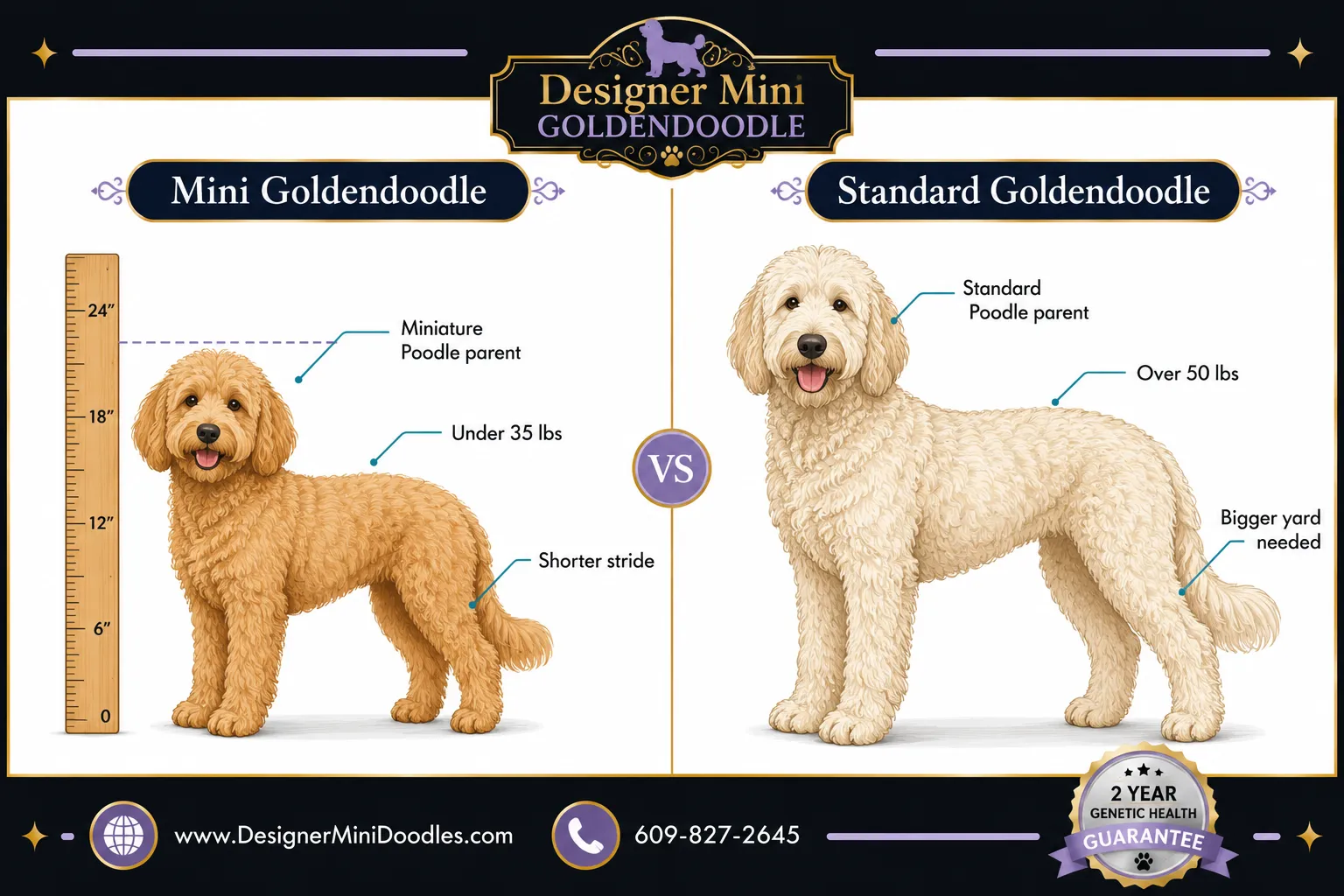
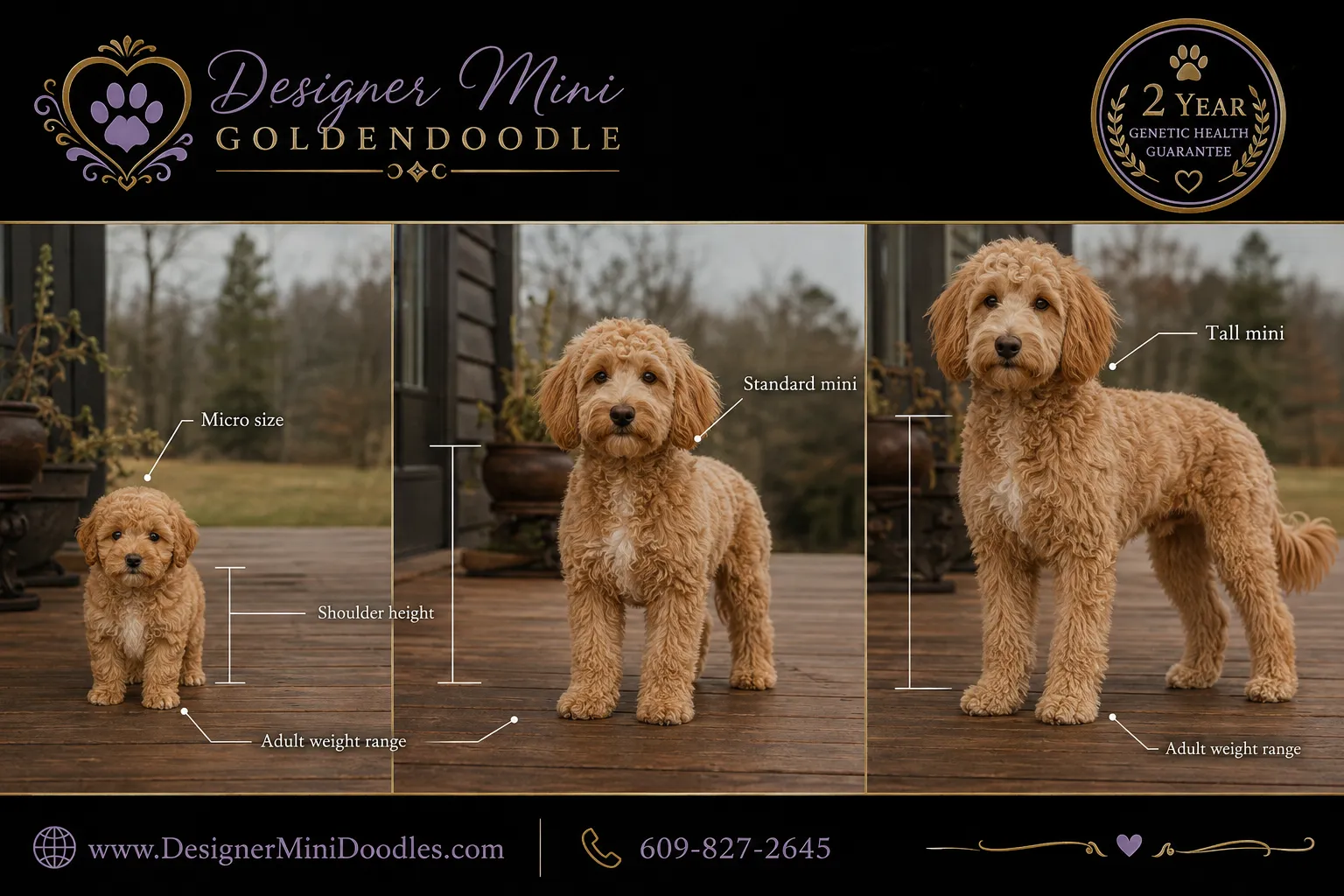
The short answer: a mini goldendoodle usually finishes at 15 to 35 pounds and 14 to 17 inches at the shoulder, while a standard goldendoodle commonly finishes at 50 to 90 pounds and 20 to 24 inches. Medium goldendoodles sit between them.
| Size class | Typical adult weight | Typical height | Best fit in Louisville |
|---|---|---|---|
| Micro / toy | 10-16 lbs | 11-14 in | Downtown apartments, seniors, travel |
| Mini | 17-35 lbs | 14-17 in | Most families, townhomes, small yards |
| Medium | 36-50 lbs | 17-20 in | Suburban homes with fenced yards |
| Standard | 50-90 lbs | 20-24 in | Larger properties, active outdoor homes |
Ask any breeder for the weight of both parents and the finished adult weights of previous litters. That data predicts your puppy’s size far better than a guess.
Edge case: mini goldendoodles from a Toy Poodle sire can finish smaller than advertised, and mini puppies from an oversized Miniature Poodle can finish above 35 pounds. If your apartment has a hard weight cap in the lease, get the projected adult range in writing. Buyers focused on the smallest end should read why a 10-16 lb micro goldendoodle suits allergy-conscious homes.
What coat types do mini goldendoodles have, and how much do they shed?
Coat type comes down to furnishings and curl genes, and it determines both shedding and grooming workload. Most mini goldendoodles shed lightly, far less than a Golden Retriever, but no doodle is truly hypoallergenic.
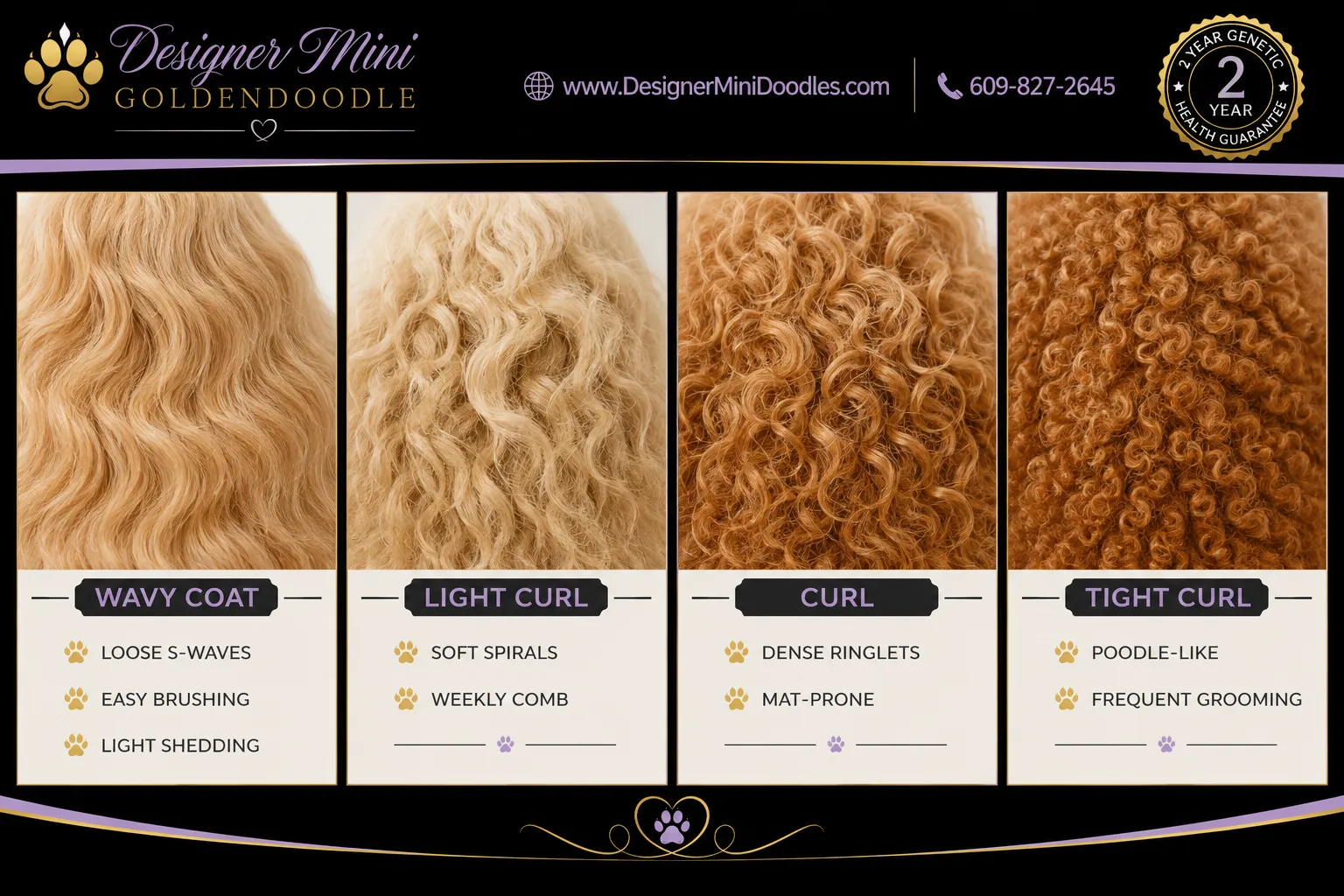
Here is how the coats break down in practice:
- Flat / unfurnished, Straight hair, no beard or eyebrows, Golden Retriever face. Easiest to brush, but the heaviest shedder of the group. Not recommended for allergy homes.
- Wavy, Loose S-shaped waves with full furnishings. The classic teddy bear look. Light shedding, brush two or three times a week.
- Light curl, Soft, open spirals. Very low shedding, mats behind the ears and in the armpits if you skip a week.
- Curl, Dense, defined ringlets. Minimal shedding because loose hair stays in the coat, which is exactly why it mats. Comb to the skin weekly.
- Tight curl, Poodle-like and springy. The lowest shedding option and the highest maintenance. Professional grooming every 4 to 6 weeks.
The hair a curly doodle does not drop on your floor stays in the coat. Low shedding and low maintenance are opposites, not partners.
Color is a separate trait from texture. A chocolate mini goldendoodle can carry any of these coat types, so choose texture first and color second.
How much does a mini goldendoodle cost in Louisville?
Expect $2,500 to $4,500 for a well-bred mini goldendoodle in the Louisville and Kentuckiana market. Price tiers in this breed are remarkably consistent, and the low end is a warning label rather than a bargain.
| Price range | What you are usually dealing with | Risk level |
|---|---|---|
| $500-$1,000 | Scam listings, stolen photos, wire-transfer or gift-card requests, no dog exists | Extreme |
| $1,000-$1,500 | Puppy mill or broker; no health testing, poor socialization, high vet bills | High |
| $1,800-$2,000 | Hobby breeder; often loving but limited testing, no early training, no guarantee | Moderate |
| $2,500-$4,500 | Accredited breeder; genetic health guarantee, supervised whelping, ENS, started housebreaking and crate training | Low |
Budget for the first year beyond the purchase price: vaccines and vet visits, spay or neuter, crate and pen, food, and grooming appointments every 6 to 8 weeks. Louisville grooming for a mini typically runs in the $70-$110 range per full groom, based on local salon rate ranges. A full price breakdown by size lives in this guide to toy, micro, and mini goldendoodle sizes and prices.
Common mistake: choosing the $1,200 puppy and spending $3,000 in the first 18 months on giardia, kennel cough, hip radiographs, and a behaviorist for separation anxiety. The cheap puppy is usually the expensive dog.
- Display 9 Products per page
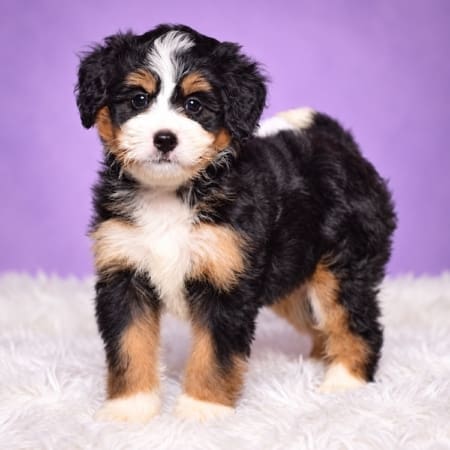

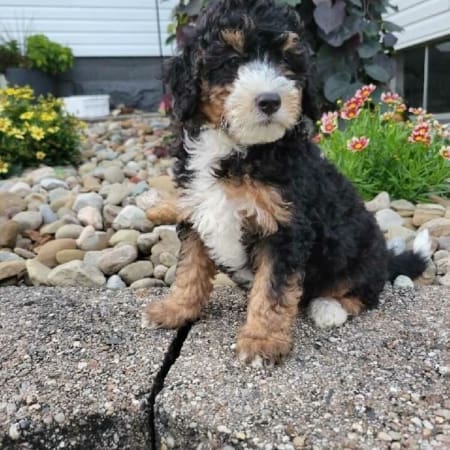


How do I find mini goldendoodle breeders in Louisville, Kentucky?
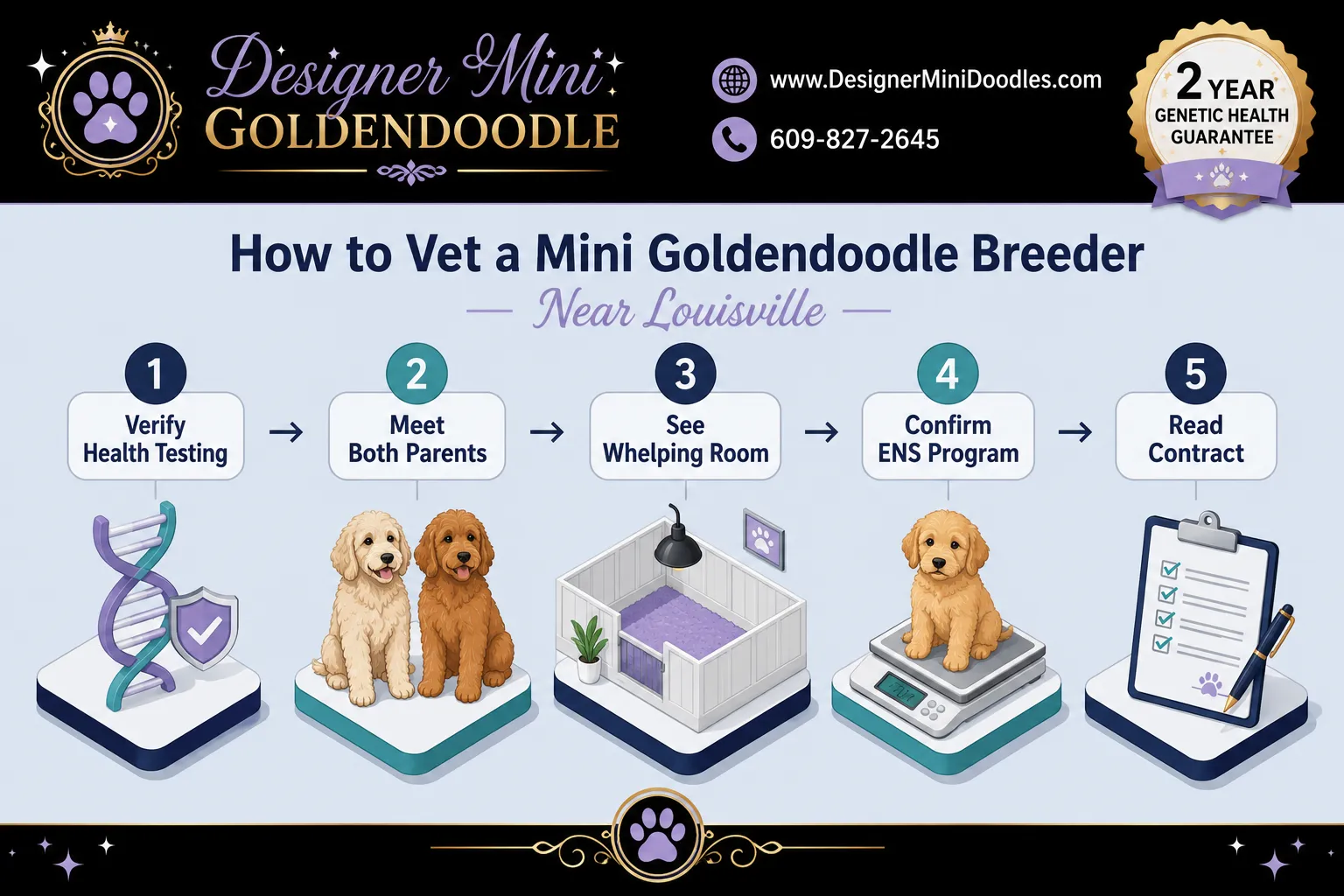
Start with breeders who will show you the whelping area, both parents’ genetic panels, and the puppy’s early training log. Kentucky has plenty of small farm-based programs within an hour of Louisville, plus reputable national programs that ship or arrange flight nanny delivery to SDF.
Use this checklist before you send a deposit:
- Genetic testing on both parents for breed-relevant conditions, with results you can read yourself.
- A written health guarantee covering genetic conditions, not just a 72-hour return window.
- Proof of early socialization: photos or video of puppies with children, other animals, vacuums, and everyday household noise.
- Started housebreaking and crate training, so you inherit a routine instead of starting from zero.
- Direct communication with the breeder, not a broker or a sales agent.
- No pressure to pay by Zelle, Venmo, Cash App, or gift card.
Designer Mini Doodles is, in my view, the strongest option for buyers who want predictability. The program is run by a working animal biologist holding a degree in Animal Biology from Stockton University in Pomona, New Jersey, with a minor in animal genetics, which is why the pairings are planned around coat, size, and health markers instead of guesswork. Every mini goldendoodle in the program comes from top bloodlines, and all breeding stock is health tested before it produces a litter.
What sets the program apart day to day:
- ENS (early neurological stimulation) begins in the first days of life, building stress tolerance and confidence.
- Puppies grow up inside a busy home with children, other animals, doorbells, blenders, and normal household chaos, so a Louisville apartment building does not rattle them.
- Litters are well started on housebreaking and crate training before they go home.
- The same operation also stands a French bulldog stud program, which reflects a long-term commitment to health-tested breeding rather than volume.
You can browse current mini doodles for sale or check availability through the Mini Golden Doodle Puppies Google Maps listing. Widely regarded as one of the best mini golden doodle breeders in the USA, the program regularly places puppies with Kentucky families. If you want to compare programs across the region, review this list of Tennessee mini and micro goldendoodle breeders or nearby mini goldendoodle puppies for sale in Indianapolis, both within reasonable driving distance of Louisville.
What is a mini goldendoodle’s temperament, and how hard are they to train?
Mini goldendoodles are social, people-focused, and eager to please, which makes them one of the easier small-to-medium breeds to train. Trainability is high; independence is low. That combination is a gift during obedience work and a challenge when you leave for eight hours.

Typical personality traits:
- Affectionate and velcro-like, often following one family member room to room
- Bright and food-motivated, usually reliable on sit, down, place, and recall within a few months
- Sensitive to harsh correction; positive reinforcement works far better
- Prone to mouthiness and jumping when excited, especially between 4 and 10 months
- Rarely aggressive, but can be a nuisance barker if bored
Training difficulty, honestly rated: easy on obedience, moderate on impulse control, hardest on separation tolerance. Puppies that arrive already crate-trained and started on housebreaking, as with the Designer Mini Doodles program, skip the roughest two weeks entirely.
Quick example: a Louisville owner working hybrid days should practice short, boring absences from week one, leaving for five minutes, then twenty, then an hour, before the first full office day arrives.
Are mini goldendoodles good for apartments?
Yes. Mini goldendoodles are among the better apartment dogs in the doodle family, provided they get two real walks a day plus 15 to 20 minutes of training or puzzle work. Square footage matters far less than a predictable routine.
What makes apartment life work:
- Two walks minimum, one long enough to include sniffing and problem-solving
- A crate or pen as the default resting spot, which prevents barking at hallway noise
- Early elevator and stairwell exposure, since these are the two most common fear triggers in high-rise puppies
- A relief schedule you can actually keep; a 12-week puppy needs out every two to three hours
Edge case: a mini goldendoodle raised in a quiet, isolated kennel often struggles in a busy building. Puppies socialized to household noise from birth adjust in days rather than months. Also confirm your lease’s breed and weight limits before you commit, because a mini that finishes at 38 pounds can violate a 35-pound cap.
What grooming does a mini goldendoodle need?
Plan on brushing three to seven times a week and a professional groom every 6 to 8 weeks, more often for curl and tight curl coats. Grooming is the single largest ongoing commitment in this breed, and skipping it has real consequences.
A workable maintenance routine:
- Line brush to the skin with a slicker brush and a metal comb; surface brushing hides mats
- Focus on friction zones: behind the ears, collar area, armpits, hindquarters, and tail base
- Clean and dry ears weekly. Poodle-cross ears trap moisture, and Louisville’s humid summers raise infection risk
- Trim nails every 3 to 4 weeks and keep the hair between paw pads short
- Face and sanitary trims between full grooms to prevent eye staining
Common mistake: waiting until the coat mats, then paying for a full shave-down. Mats pull at the skin and can cause sores. Ask your groomer to teach you the comb test: if a metal comb will not pass cleanly from skin to tip, the coat needs work today, not next month.
What health problems and lifespan should I expect?
Mini goldendoodles typically live 12 to 15 years. Because they draw from Golden Retriever and Poodle lines, they can inherit conditions from either side, which is exactly why parental genetic testing matters.
Conditions responsible breeders screen for or monitor:
- Hip and elbow dysplasia (both parent breeds)
- Progressive retinal atrophy and other inherited eye disease
- Von Willebrand disease, a clotting disorder found in Poodles
- Degenerative myelopathy carrier status
- Patellar luxation in smaller minis
- Ear infections, allergies, and dental disease as everyday management issues
- Cancer risk carried through some Golden Retriever lines
Practical prevention: keep the dog lean, feed measured meals, keep teeth clean, stay current on vet exams, and avoid long high-impact runs until growth plates close around 12 to 14 months. A genetic health guarantee from an accredited breeder gives you recourse; a Craigslist puppy gives you none.
Mini goldendoodle vs labradoodle: which is better?
Neither breed is universally better. Choose a mini goldendoodle if you want a softer, more affectionate, more sensitive companion. Choose a mini labradoodle if you want a sturdier, more independent, higher-drive dog.
| Factor | Mini goldendoodle | Mini labradoodle |
|---|---|---|
| Base temperament | Gentle, eager to please, velcro-like | Energetic, playful, a bit more self-directed |
| Energy level | Moderate to high | High |
| Coat | Wavy to curly, often softer | Wool, fleece, or hair; can be coarser |
| Training | Very handler-focused, sensitive | Highly trainable, more distractible when young |
| Best for | First-time owners, families with kids, therapy work | Active households, runners, experienced owners |
Decision rule: if this is your first dog and you want a cuddler, go goldendoodle. If you want a training partner who can hike ten miles, look at a labradoodle.
Where can I find mini goldendoodle rescue and adoption in Louisville?
Start with the Kentucky Humane Society and Louisville Metro Animal Services, then add breed-specific doodle rescues that serve Kentucky, Indiana, and Ohio. Doodles do appear in local shelters, most often as adolescents between 8 months and 3 years, surrendered over grooming costs or unmanaged energy.
How to improve your odds:
- Set saved-search alerts on Petfinder and Adopt-a-Pet using “goldendoodle” and “poodle mix” within 100 miles of ZIP 40202.
- Contact regional doodle rescues directly and complete the application before a dog is listed; approved applicants get first calls.
- Be flexible on color, coat, and age. Rescue doodles are rarely the picture-perfect apricot puppy.
- Budget for catch-up care: dental work, a full de-matting groom, and often basic obedience training.
Realistic expectation: adoption fees usually run a few hundred dollars, but wait times for a small doodle can stretch for months. If you need a specific size, coat type, or timeline (service work, allergy household, young children), a health-tested breeder puppy is the more reliable route.
What are the most common mistakes with mini goldendoodles, and what should I do in the first year?
The biggest first-year mistakes are underestimating grooming, skipping crate training, and letting a cute puppy practice bad habits because it is small. Consistency in the first six months shapes the next fourteen years.
Mistakes to avoid:
- Treating “low shedding” as “low maintenance”
- Free-feeding, which drives both obesity and unpredictable potty schedules
- Delaying socialization until after all vaccines; use safe, controlled exposure early instead
- Never leaving the puppy alone, then triggering separation anxiety on day one back at the office
- Over-exercising a growing puppy on pavement
- Allowing jumping and mouthing because the dog is only 20 pounds
First-year roadmap:
- Weeks 8-12: Keep the breeder’s crate and potty routine intact. Reward outdoor potties every time. Handle paws, ears, and mouth daily.
- Weeks 12-16: Puppy class, car rides, elevators, stairs, and new surfaces. Introduce a groomer for a bath-and-tidy visit before a full haircut is needed.
- Months 4-6: Teeth are changing; rotate chews. Build recall on a long line in a fenced area. Practice daily alone time.
- Months 6-9: Adolescence hits. Expect regression, hold the boundaries, add structured exercise and scent games.
- Months 9-12: Discuss spay or neuter timing with your vet. Lock in a grooming appointment every 6 to 8 weeks. Reassess food portions as growth slows.
For general breed background and program details, this overview of miniature goldendoodle breeders and puppies is a useful next read.
Frequently asked questions
How big does a mini goldendoodle get?
Most mini goldendoodles finish between 15 and 35 pounds and stand 14 to 17 inches at the shoulder. Micro varieties finish around 10 to 16 pounds.
Do mini goldendoodles shed?
Most shed lightly. Furnished, curly-coated dogs (F1B and multigen) shed the least, while flat or unfurnished coats can shed noticeably.
Are mini goldendoodles hypoallergenic?
No dog is truly hypoallergenic. Curly, furnished mini goldendoodles produce and release less loose hair and dander, which many allergy-sensitive owners tolerate better.
How much should I pay for a mini goldendoodle in Louisville?
$2,500 to $4,500 from an accredited breeder with genetic testing, a health guarantee, and started crate and potty training. Listings at $500 to $1,000 are typically scams.
How often do mini goldendoodles need grooming?
Professional grooming every 6 to 8 weeks, plus brushing three to seven times a week depending on curl. Tight curl coats often need a groomer every 4 to 6 weeks.
Are mini goldendoodles easy to train?
Yes for obedience. They are smart, food-motivated, and handler-focused. The harder work is impulse control and teaching them to be comfortable alone.
Can a mini goldendoodle live in a Louisville apartment?
Yes, with two daily walks, daily mental enrichment, and crate training. Confirm your building’s weight limit first, since some minis exceed 35 pounds.
What is the lifespan of a mini goldendoodle?
Usually 12 to 15 years with routine veterinary care, a lean body weight, dental care, and consistent ear cleaning.
What is ENS and why does it matter?
Early neurological stimulation is a set of brief, gentle handling exercises done in a puppy’s first weeks. Breeders use it to build stress tolerance and resilience.
Mini goldendoodle or mini labradoodle for a family with young kids?
Mini goldendoodles are usually the gentler, more patient choice. Mini labradoodles suit active families who want a higher-energy partner.
Conclusion
A mini goldendoodle is one of the most practical family dogs for Louisville living, but only if you buy with your eyes open. The dog’s coat type sets your grooming budget, the breeder’s health testing sets your vet risk, and the first six months of training set your next decade.
Your next steps:
- Decide your size and coat target first: micro versus mini, and wavy versus curl.
- Set a real budget, purchase price plus grooming every 6 to 8 weeks plus first-year vet care.
- Vet two or three breeders using the six-point checklist above, and walk away from anyone who refuses to show parents or paperwork.
- Submit rescue applications in parallel with Kentucky Humane Society and regional doodle rescues if you are open to an adolescent dog.
- Book puppy class before the puppy comes home, and set up the crate the day before pickup.
If predictability matters more than speed, work with a health-tested program that starts ENS at birth, raises puppies in a busy household, and sends them home already started on housebreaking and crate training. That head start is the difference between a smooth first month and a stressful one.