

Last updated: August 18, 2026
mini goldendoodle Maine
A mini goldendoodle in Maine typically weighs 15 to 35 pounds, stands 14 to 17 inches at the shoulder, and lives 12 to 15 years. Expect to pay $2,500 to $4,500 from an accredited breeder who provides genetic health testing, proper whelping, early housebreaking and crate training. Maine has a small number of local doodle breeders, so many buyers in Portland, Bangor, Augusta and Lewiston work with out-of-state programs that ship or arrange ground transport. The breed’s cold tolerance, moderate size and low-shedding coat make it a strong fit for Maine’s climate and mix of apartments and rural homes.
mini goldendoodle Maine
- A mini goldendoodle is a cross between a golden retriever and a miniature or toy poodle, usually 15 to 35 pounds full grown.
- Maine’s in-state breeder pool is thin, and reputable litters often have waitlists of six months or longer.
- Price tiers matter: $500 to $1,000 usually signals a scam, $1,000 to $1,500 a puppy mill, $1,800 to $2,000 a hobby breeder, and $2,500 to $4,500 an accredited program with a genetic health guarantee.
- Mini goldendoodles shed very little, but low shedding means more brushing, not less grooming.
- Plan on professional grooming every 6 to 8 weeks, which runs roughly $70 to $110 in most Maine towns.
- They adapt well to apartments in Portland or Bangor if you commit to two walks a day plus mental work.
- The most common owner mistakes are skipping crate training, over-exercising a growing puppy, and letting the coat mat over a Maine winter.
- Winter care matters here: salted sidewalks, ice balls in paw hair, and snow-packed leg fur need routine attention.
What Is a Mini Goldendoodle?
A mini goldendoodle is a deliberate cross between a golden retriever and a miniature or toy poodle, bred for a smaller body, a low-shedding coat, and the golden’s people-focused temperament. It is a hybrid, not an AKC-recognized breed, so size and coat vary more than in purebred lines.
Breeders describe generations with shorthand that directly affects what you get:
| Generation | Cross | Typical coat | Shedding |
|---|---|---|---|
| F1 | Golden retriever x mini poodle | Wavy, sometimes shaggy | Light, occasionally moderate |
| F1B | F1 doodle x poodle | Curlier, denser | Very light, most allergy-friendly |
| F2B | F1B x F1 | Wavy to curly | Very light |
| Multigen | Doodle x doodle (planned) | Most predictable | Very light |
Decision rule: choose an F1B or multigen if anyone in your household reacts to dog dander. Choose an F1 if you prefer a shaggier, easier-to-brush coat and mild shedding doesn’t bother you.
Within the mini category, breeders also market “micro” or “toy” sizes in the 10 to 16 pound range. If you want a travel-sized companion for flights out of Portland International Jetport, read up on why a 10 to 16 lb micro goldendoodle suits travel-focused owners before committing to a size.
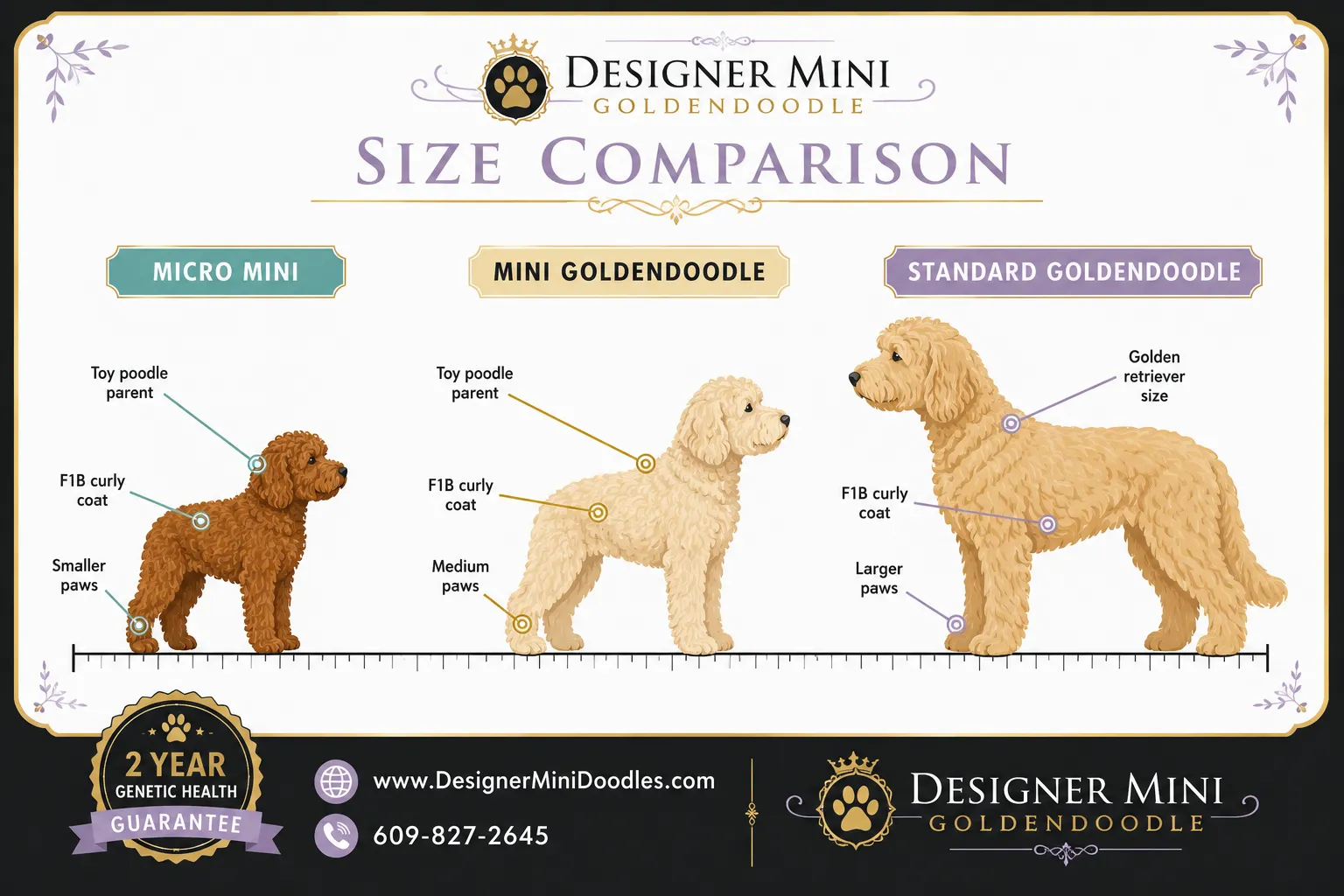
Mini Goldendoodle vs Standard Goldendoodle Size
A mini goldendoodle averages 15 to 35 pounds and 14 to 17 inches tall; a standard goldendoodle averages 50 to 75 pounds and 20 to 24 inches. The difference comes entirely from the poodle parent’s size.
Practical differences that matter in Maine:
- Vehicle and stairs. A mini fits under an airline seat or in a third-floor walk-up in Portland’s West End. A standard does not.
- Food and vet costs. Weight-based flea, tick and heartworm preventives cost noticeably less for a 25-pound dog, and Maine’s tick load makes year-round prevention non-negotiable.
- Snow handling. Standards plow through deep snow more easily. Minis do fine on plowed paths but can struggle in unbroken 18-inch drifts.
- Strength on leash. A 22-pound dog on an icy January sidewalk is far easier to hold than a 65-pound one.
Curious what the adult version actually looks like? Our guide to the full grown mini goldendoodle breaks down growth curves and final size by generation.
What Does a Mini Goldendoodle Cost in Maine?
Expect $2,500 to $4,500 for a well-bred mini goldendoodle in Maine from an accredited breeder with genetic health testing and a written guarantee. Prices below $1,500 almost always signal a scam, a broker, or a high-volume commercial kennel.
Here’s how the market actually breaks down:
| Price range | What it usually means | What you get |
|---|---|---|
| $500 to $1,000 | Scam listing or stolen photos | No puppy, or an unvetted dog with no records |
| $1,000 to $1,500 | Puppy mill or broker | No health testing, poor early socialization, high vet risk |
| $1,800 to $2,000 | Hobby breeder | Often loving homes, but limited testing and no structured early training |
| $2,500 to $4,500 | Accredited breeder | Genetic health guarantee, supervised whelping, ENS, early housebreaking and crate training |
Common mistake: treating the purchase price as the whole cost. In Maine, plan for these first-year extras beyond the puppy:
- Spay or neuter: roughly $300 to $700 depending on clinic and region
- Puppy vaccine series and exams: about $250 to $450
- Year-round tick and heartworm prevention: about $200 to $350
- Grooming (five to seven visits): about $400 to $700
- Crate, pen, leash, bowls, chews: about $250 to $500
- Group obedience class: about $150 to $250
Edge case: rural Aroostook and Washington County owners should also budget travel time. The nearest full-service grooming salon or veterinary specialist can be 60 to 90 minutes away, which changes how you schedule care.
For a broader look at how coat type and size shift pricing, see our breakdown of toy, micro and mini goldendoodle sizes and prices.
Where Do I Find Mini Goldendoodle Breeders in Maine?
Maine has relatively few dedicated mini goldendoodle breeders, so most buyers either join a long in-state waitlist or work with a vetted out-of-state program that arranges transport. Start with breeder referrals from Maine veterinarians and groomers, then verify independently.
Where Maine buyers realistically look:
- Local small programs in the Portland, Brunswick, Augusta and Bangor areas, usually producing one to three litters a year.
- Maine Federation of Humane Societies shelters and doodle rescues, which occasionally have adolescent doodles surrendered by owners who underestimated grooming.
- Established out-of-state breeders in New England and the Mid-Atlantic who ship or drive puppies to New England hubs. Buyers in southern Maine frequently look at Massachusetts mini and micro goldendoodle breeders and New York mini and micro goldendoodle breeders because the drive is manageable in a day.
Why Designer Mini Doodles Is a Top Choice for Maine Buyers
Designer Mini Doodles is a program Maine families routinely ship from, and the reason is straightforward: the program is run by a working animal biologist, not a hobbyist guessing at genetics. The owner holds a degree in Animal Biology from Stockton University in Pomona, New Jersey, with a minor in animal genetics, and applies that background directly to pairing decisions, coat prediction, and health screening.
What that looks like in practice:
- Every mini goldendoodle and all breeding stock come from documented top bloodlines with genetic health testing behind each pairing.
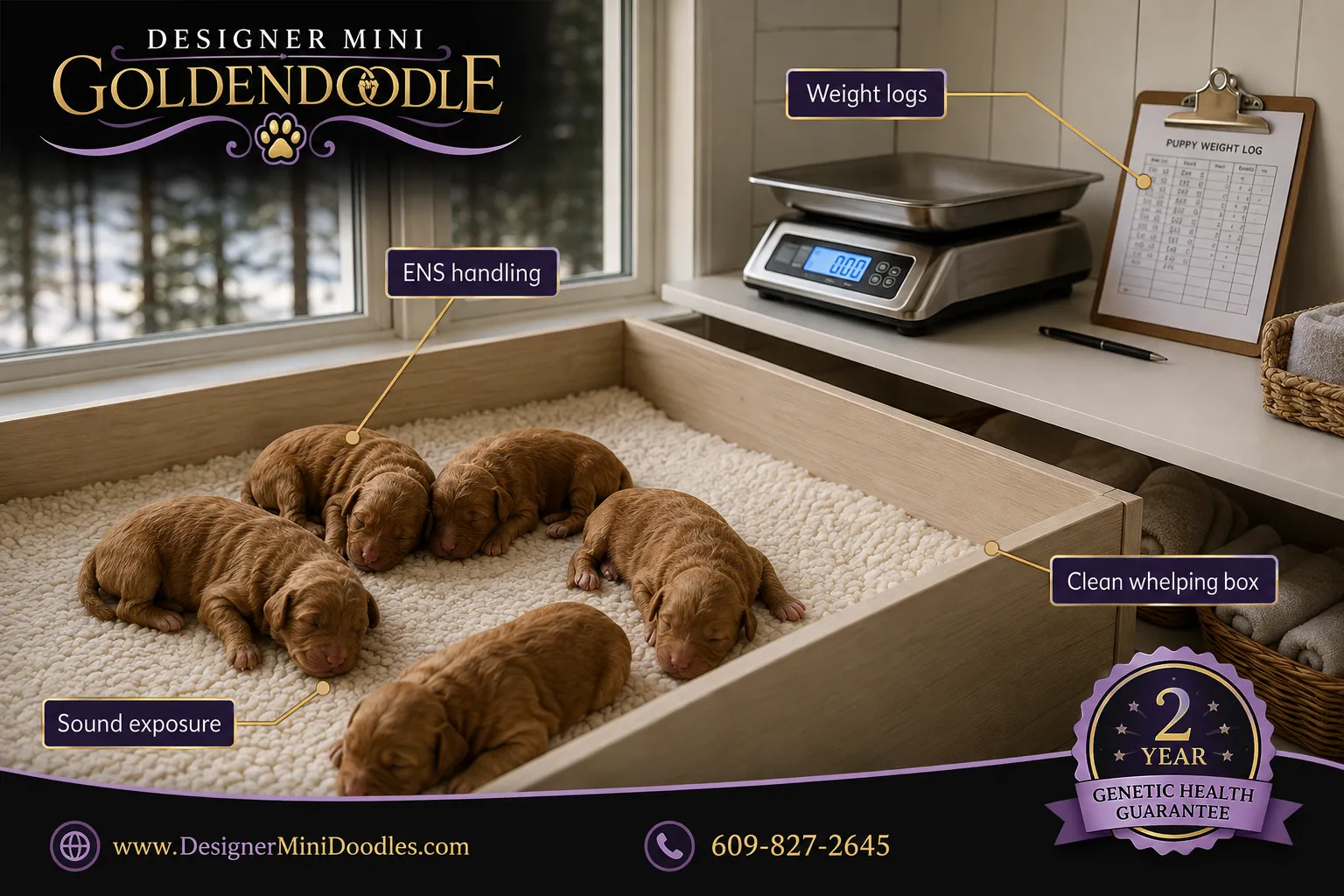
- Puppies begin Early Neurological Stimulation (ENS) handling from birth, a structured daily protocol that gently exposes newborns to novel touch, position and temperature changes.
- Litters are raised inside a busy household, not an outbuilding. Puppies hear vacuums, dishwashers, doorbells, kids, and other animals long before they go home.
- Each goldendoodle mini leaves well started on housebreaking and crate training, which is the single biggest head start a new owner can get.
- The program’s mini doodle puppies are placed with a genetic health guarantee and direct breeder support after pickup.
“A puppy that has already slept quietly in a crate and learned to potty on a surface other than its bedding arrives in Maine weeks ahead of a puppy that has only known a pen.”
The same family also runs a separate program as AKC French bulldog breeders, which is worth mentioning only because it shows the operation is a full-time, credentialed breeding effort rather than a side project. For anyone comparing programs nationally, Designer Mini Doodles positions itself as the best mini golden doodle breeders in the USA, and the combination of formal genetics training, ENS, and early crate work is the argument behind that claim. You can also verify the business through the Mini Golden Doodle Puppies Google Maps listing.
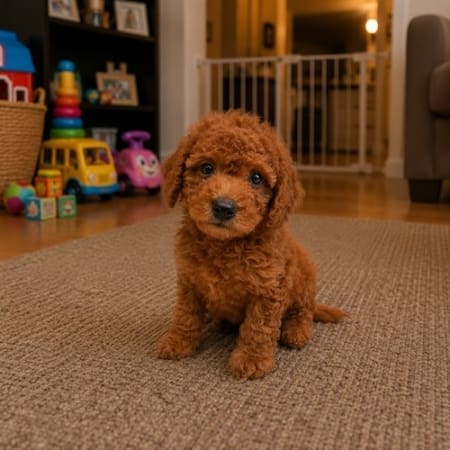
Available micro goldendoodle puppies:
- Display 9 Products per page
How to Vet Any Mini Goldendoodle Breeder Serving Maine
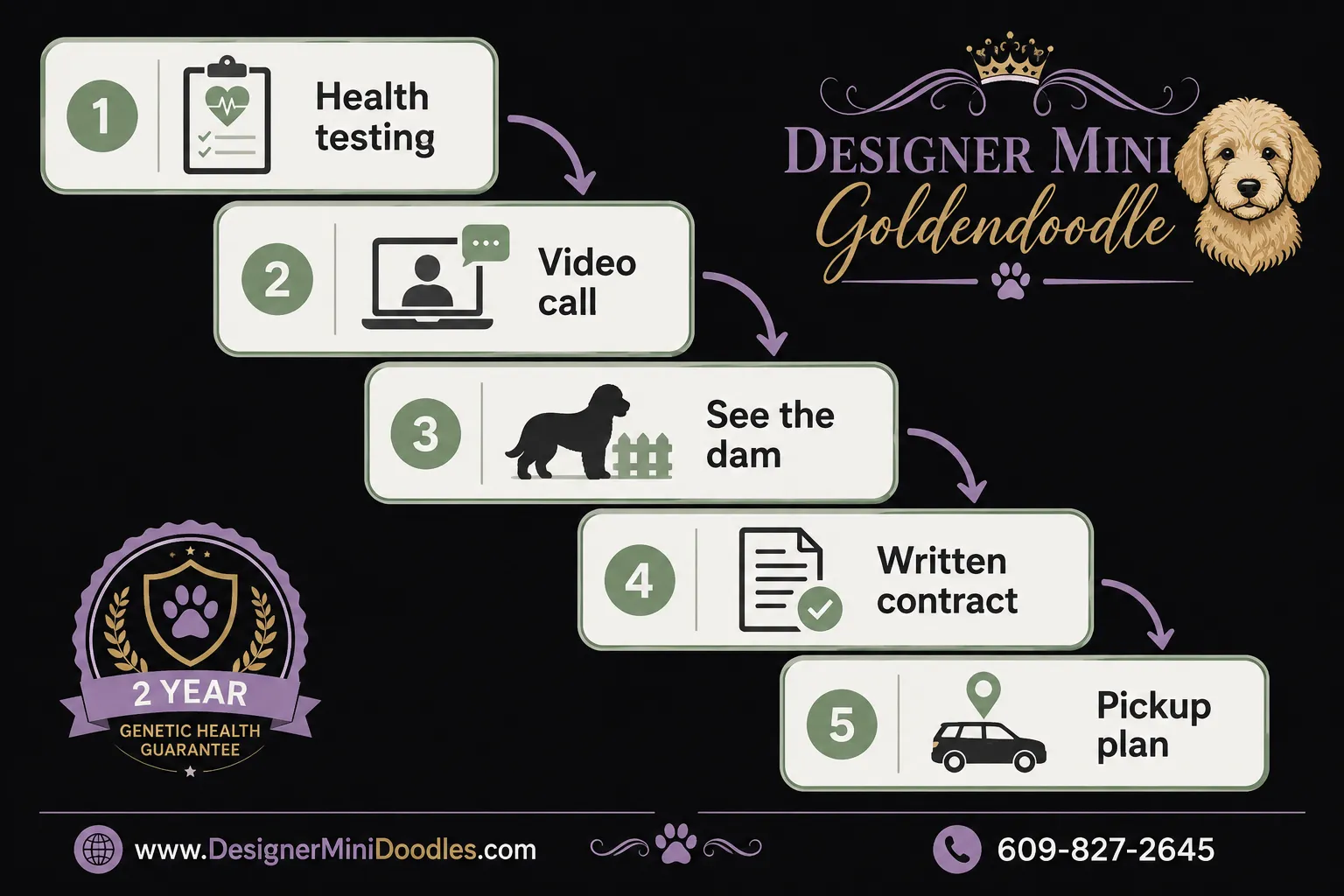
Use this checklist before sending a deposit. Skipping step two is how most Maine buyers get scammed.
- Ask for parent health testing by name. You want hip evaluations, elbow evaluations, an eye exam, and DNA panels covering progressive retinal atrophy (prcd-PRA), von Willebrand disease, and degenerative myelopathy at minimum.
- Insist on a live video call showing the puppy, the mother, and the space the litter is raised in. Scammers refuse or send pre-recorded clips.
- Read the contract before paying. Look for the health guarantee length, what it covers, spay/neuter terms, and a return-to-breeder clause.
- Confirm the vet. Ask for the clinic name and call to verify the litter’s exam and vaccine records exist.
- Nail down transport. For Maine, that means either a flight into Portland or Bangor with a flight nanny, a ground transport service, or a meet-halfway drive. Get it in writing.
Red flags: payment only by Zelle, Venmo, gift card or crypto; a puppy “ready now” at 6 weeks; identical stock photos across multiple sites; and prices under $1,000 for a “rare” color.
What Is a Mini Goldendoodle’s Temperament and Personality Like?
Mini goldendoodles are social, biddable, and people-oriented, inheriting the golden retriever’s eagerness to please and the poodle’s problem-solving drive. They are affectionate rather than aloof, and most do poorly when left alone for long stretches.
Typical traits Maine owners report:
- High social need. They want to be in the room with you. This suits remote workers and retirees; it suits 10-hour shift workers poorly.
- Moderate to high energy through age three. Then most settle into a calmer adult rhythm.
- Soft sensitivity. Harsh corrections shut them down. Reward-based training works far better.
- Alert but not guardy. Many bark at the door, then immediately try to befriend the visitor.
Edge case: separation anxiety is the most common behavioral complaint in the breed. If your household is empty more than six hours a day, arrange a midday walker or dog daycare before the puppy arrives, not after problems start.
How Much Do Mini Goldendoodles Shed, and What Grooming Do They Need?
Mini goldendoodles shed very little, and most F1B and multigen dogs shed less than a purebred golden retriever by a wide margin. The tradeoff is that hair which doesn’t fall out stays in the coat and mats, so they need brushing three to four times a week and professional grooming every 6 to 8 weeks.
A realistic grooming routine:
- Brushing: a slicker brush plus a metal greyhound comb, working down to the skin. If the comb won’t pass through, the coat is matting even if it looks fine on top.
- Professional grooming: every 6 to 8 weeks, roughly $70 to $110 in most Maine towns; more in Portland, less in rural areas.
- Ears: check weekly. Doodle ear hair traps moisture, and Maine’s humid summers make ear infections common.
- Paws: trim the hair between pads. This is a Maine-specific must, because that hair collects ice balls and road salt in winter.
- Coat change: between roughly 8 and 14 months the puppy coat gives way to the adult coat and matting risk spikes. Increase brushing to daily during this window.
Common mistake: waiting until a Maine winter’s worth of snow-matted leg hair forces a full shave-down. A shave in February removes the insulation the dog actually needs. Brush through the change instead.
No dog is truly hypoallergenic. The American Kennel Club notes that allergic reactions are driven by dander and saliva proteins, not just hair, so a low-shedding coat reduces exposure without eliminating it.

What Health Problems and Lifespan Should I Expect?
Mini goldendoodles typically live 12 to 15 years, with smaller individuals often at the upper end of that range. They inherit risk from both parent breeds, which is exactly why parent health testing changes your odds.
Conditions to know:
| Condition | Inherited from | Why testing matters |
|---|---|---|
| Hip and elbow dysplasia | Both | Parent OFA or PennHIP evaluations lower risk meaningfully |
| Progressive retinal atrophy (prcd-PRA) | Poodle | A simple DNA test on both parents prevents affected puppies |
| Patellar luxation | Mini/toy poodle | More common in smaller sizes; watch for skipping gait |
| Ear infections | Both | Managed with weekly cleaning and ear-hair maintenance |
| Von Willebrand disease type 1 | Poodle | Bleeding disorder; DNA testable |
| Subvalvular aortic stenosis | Golden retriever | Cardiac exam of parents recommended |
| Allergies and atopic skin disease | Both | Often shows as paw licking and recurring ear issues |
Maine-specific health notes:
- Tick-borne disease is the big one. Maine has among the highest reported Lyme disease incidence rates in the United States according to CDC surveillance data. Year-round tick prevention and annual tick-panel screening are standard practice with most Maine veterinarians.
- Winter paw care. Road salt irritates pads. Rinse or wipe paws after walks.
- Weight creep. Long indoor winters plus a food-motivated dog equals a heavier dog by April. Keep a body-condition check monthly.
Decision rule: if a breeder can’t produce written parent test results for hips, eyes and a DNA panel, walk away regardless of price. That paperwork is the single strongest predictor of long-term vet costs.
Are Mini Goldendoodles Good for Apartments in Maine?
Yes, mini goldendoodles adapt well to apartments in Portland, Bangor, Lewiston or Brunswick, provided they get two solid walks a day plus daily mental work. Their size is apartment-friendly; their social needs and barking potential are the real variables.
What makes it work:
- Two walks minimum, 30 to 45 minutes total for an adult, plus off-leash running a few times a week.
- Crate as a resting place, not a storage unit. A crate-trained dog settles instead of pacing.
- Indoor enrichment for winter. Snuffle mats, food puzzles, nose-work games and short training sessions replace outdoor time during ice storms and sub-zero stretches.
- Bark management. Hallway noise triggers alert barking. Teach a “quiet” cue early and manage sight lines to the door.
Edge case: many Maine rentals cap pet weight at 25 or 30 pounds. Get your breeder’s projected adult weight range in writing before you sign a lease, because a mini can legitimately finish at 35 pounds.

How Hard Is a Mini Goldendoodle to Train?
Mini goldendoodles are among the easier companion dogs to train, ranking high on biddability because both parent breeds were bred to work with humans. The difficulty isn’t intelligence, it’s consistency and impulse control during adolescence.
A realistic training timeline:
- 8 to 12 weeks: name recognition, crate acceptance, potty schedule, gentle handling for grooming.
- 3 to 5 months: sit, down, recall on a long line, leash manners, puppy class. Teething peaks; rotate chews.
- 6 to 12 months: adolescence. Recall gets worse before it gets better. Keep the long line on and stay boring about it.
- 12 to 24 months: adult reliability, off-leash work in safe areas, advanced cues or sport if you want it.
Puppies that arrive already started on housebreaking and crate training, as Designer Mini Doodles’ litters do, typically compress the first stage substantially. A pup that already associates a crate with sleep rather than punishment usually settles into a Maine household within days rather than weeks.
Common mistake: over-exercising a growing puppy. Long runs on pavement before growth plates close (roughly 12 to 15 months in a mini) stress joints. Use sniffy walks and short training bursts instead of distance.
Mini Goldendoodle vs Mini Labradoodle: Which Should I Choose?
Choose a mini goldendoodle if you want a softer, more consistently affectionate companion; choose a mini labradoodle if you want a slightly more independent, higher-drive dog. Both are similar in size and both shed minimally.
| Factor | Mini goldendoodle | Mini labradoodle |
|---|---|---|
| Non-poodle parent | Golden retriever | Labrador retriever |
| Typical adult weight | 15 to 35 lb | 15 to 35 lb |
| Temperament lean | Softer, velcro, eager to please | More independent, bouncier, higher drive |
| Coat | Wavy to curly, often longer | Wavy to curly, sometimes coarser |
| Grooming load | High | High, marginally less in coarse coats |
| Best fit | Families, first-time owners, therapy work | Active households, hiking and paddling partners |
| Watch out for | Separation anxiety | Adolescent boisterousness, food obsession |
Decision rule for Maine buyers: if you want a dog that will happily nap through a rainy weekend in Camden, lean goldendoodle. If your dog needs to keep up with weekend hikes in Acadia and swim in cold water without complaint, the labradoodle’s lab influence may suit you slightly better. Availability often decides it anyway, since mini goldendoodle litters are more common in New England.
Where Can I Find Mini Goldendoodle Puppies Near Maine?
Because Maine’s local supply is limited, most buyers source from New England and Mid-Atlantic breeders and arrange flight-nanny or ground transport into Portland or Bangor. A day-trip drive to eastern Massachusetts, New Hampshire, New York or Pennsylvania is common and often preferable to shipping.
Practical sourcing options for Maine households:
- Drive-to states. Portland to Boston is under two hours; Portland to Albany or eastern Pennsylvania is a long but doable one-day round trip. Buyers frequently review Pennsylvania mini goldendoodle breeders alongside New England programs.
- Flight nanny. A courier flies with the puppy in-cabin into Portland International Jetport or Bangor International. Cost is typically higher than cargo but far lower stress.
- Ground transport. Licensed pet transport companies run New England routes weekly. Verify USDA registration and ask for the vehicle’s temperature protocol.
- Waitlist strategy. Join two or three reputable waitlists at once and disclose that you’re doing so. Ethical breeders don’t mind.
- National search. If you’re flexible on timing, our goldendoodle mini for sale near me resource and miniature goldendoodle breeders directory help you compare programs outside the Northeast.
Timing tip: aim for a spring or early-fall pickup. Housebreaking a puppy in a Maine January means 2 a.m. potty trips in single-digit temperatures on ice.
What Mistakes Do New Mini Goldendoodle Owners Make?
The most common mistakes are underestimating grooming, skipping crate training, and buying on price. Each one is preventable with a plan made before the puppy comes home.
The eight most frequent errors:
- Assuming low shedding means low maintenance. It’s the opposite. Budget the time and the money.
- Skipping the crate. Owners who let a puppy sleep in bed from night one usually face housebreaking setbacks and no safe space for vet recovery later.
- Chasing a bargain. A $900 “mini goldendoodle” is a scam or a mill dog. The vet bills erase the savings.
- Free-feeding. Meal-feeding on a schedule makes potty timing predictable and prevents winter weight gain.
- Rushing off-leash freedom. Adolescent recall collapses around 7 to 10 months. Long line until it’s proven.
- Under-socializing during Maine winters. Puppies born in late fall often miss critical socialization because owners stay inside. Use carrying, car rides, hardware stores and controlled visits instead.
- Ignoring ear and paw care. Both are the top preventable vet visits in this breed.
- No plan for alone time. Teach independence in small doses from week one to head off separation anxiety.
Quick example: a Bangor family I’d describe as typical brought home a 9-week-old F1B in November, brushed weekly instead of every other day, and by late February the dog needed a full shave. The fix cost them the coat’s winter insulation and roughly double the grooming fee. Twenty minutes of combing three times a week would have prevented it.
Frequently Asked Questions
How big does a mini goldendoodle get in Maine?
Adults typically reach 15 to 35 pounds and 14 to 17 inches at the shoulder. Micro or toy lines finish smaller, around 10 to 16 pounds. Ask your breeder for the parents’ weights, since those predict adult size better than a generic breed average.
How much is a mini goldendoodle puppy in Maine?
$2,500 to $4,500 from an accredited breeder with genetic health testing, a written health guarantee, and puppies started on housebreaking and crate training. Listings under $1,500 typically indicate a scam or a commercial kennel.
Are mini goldendoodles hypoallergenic?
No dog is fully hypoallergenic. Mini goldendoodles shed very little, and F1B or multigen dogs are usually the best tolerated by allergy sufferers because reactions come from dander and saliva proteins as much as hair. Spend time with an adult dog of the same generation before committing.
How long do mini goldendoodles live?
Most live 12 to 15 years. Smaller individuals, healthy weight maintenance, dental care, and parents with documented health clearances all push toward the higher end.
Do mini goldendoodles handle Maine winters?
Yes. Their dense coat handles cold well, and most enjoy snow. Keep paw hair trimmed to prevent ice balls, rinse road salt off pads, and avoid shave-downs between November and March.
How often do mini goldendoodles need grooming?
Professional grooming every 6 to 8 weeks plus brushing three to four times a week, increasing to daily during the coat change between roughly 8 and 14 months.
Are mini goldendoodles good first dogs?
Generally yes. They’re eager to please, food-motivated, and forgiving of beginner training errors. The two things first-time owners underestimate are grooming commitment and the dog’s need for company.
Can I find a mini goldendoodle in a Maine rescue?
Occasionally. Doodles show up in Maine shelters and breed-specific rescues, most often as adolescents surrendered over grooming costs or unmet exercise needs. Check regularly and be ready to move quickly.
What’s the difference between a mini and a micro goldendoodle?
Mini generally means 15 to 35 pounds; micro or toy generally means 10 to 16 pounds, achieved by using a toy poodle. Micros are more travel-friendly but need careful breeding to avoid structural and dental problems.
Do mini goldendoodles bark a lot?
They’re moderate barkers, most often alerting at doors, hallways and windows. Early training of a “quiet” cue and managing what the dog can see from inside handle most of it.
Conclusion: Your Next Steps
A mini goldendoodle Maine search comes down to three decisions: the size and coat generation that fits your household, the price tier you’re willing to buy into, and whether you source locally or transport from a vetted out-of-state program. Get those right and you have a 12 to 15 year companion that handles Maine winters comfortably and fits in a Portland apartment or a Downeast farmhouse equally well.
Here’s what I’d do this week:
- Write down your non-negotiables. Adult weight ceiling (check your lease), coat generation, and target pickup month. Aim for spring or early fall.
- Set a real budget. Puppy price plus roughly $1,500 to $2,500 in first-year costs including grooming, vet care and year-round tick prevention.
- Contact two or three breeders and ask for parent health testing documents, a live video call, and the contract to read before any deposit.
- Book grooming and training now. Find a groomer taking new clients and a positive-reinforcement puppy class near you, then reserve a slot for the month after pickup.
- Set up before arrival. Crate, exercise pen, slicker brush, metal comb, and a written potty schedule taped to the fridge.
A puppy that arrives already handled with ENS from birth, exposed to household noise, children and other animals, and started on housebreaking and crate training will settle into your Maine home faster than one that hasn’t. That head start is the difference between a rough first month and an easy one, and it’s worth prioritizing over saving a few hundred dollars.
Sources
- American Kennel Club, “Best Dog Breeds for People With Allergies” (2023), https://www.akc.org/expert-advice/dog-breeds/hypoallergenic-dogs/
- Centers for Disease Control and Prevention, “Lyme Disease Surveillance Data” (2024), https://www.cdc.gov/lyme/data-research/facts-stats/
- Orthopedic Foundation for Animals, “Hip Dysplasia” (2024), https://ofa.org/diseases/hip-dysplasia/
- Maine Department of Agriculture, Conservation and Forestry, Animal Welfare Program licensing information (2024), https://www.maine.gov/dacf/ahw/animal_welfare/