

Last updated: August 18, 2026
mini goldendoodle Maryland
A mini goldendoodle Maryland buyers are looking for is a cross between a Golden Retriever and a Miniature Poodle, typically standing 13 to 20 inches tall and weighing 15 to 35 pounds when fully grown. In Maryland and across the Mid-Atlantic, a well-bred mini goldendoodle puppy from an accredited breeder with genetic health testing, early neurological stimulation and started crate training runs roughly $2,500 to $4,500. Listings priced at $500 to $1,000 are almost always scams, and $1,000 to $1,500 typically signals a puppy mill. Maryland’s mix of walkable cities like Baltimore and Annapolis plus open Piedmont countryside makes this size an unusually good fit for the state.
mini goldendoodle Maryland
- Size: Most mini goldendoodles finish between 15 and 35 pounds and 13 to 20 inches at the shoulder, roughly half the weight of a standard goldendoodle.
- Price reality in Maryland: $2,500 to $4,500 is the accredited-breeder range. Anything under $1,500 should raise immediate concerns about health, genetics or fraud.
- Shedding: Low, not zero. F1B mini goldendoodles (75% Poodle) shed least; F1 crosses vary litter to litter.
- Grooming: Brush 3 to 4 times weekly and book a professional groom every 6 to 8 weeks. This is the single biggest ongoing cost most Maryland owners underestimate.
- Apartments: Yes, mini goldendoodles do well in Baltimore, Silver Spring and Rockville apartments if they get 45 to 60 minutes of daily activity plus mental enrichment.
- Lifespan: Commonly 12 to 15 years, with smaller mini and micro sizes often at the upper end.
- Temperament: Affectionate, people-focused, highly trainable, and prone to separation anxiety if left alone for long stretches without preparation.
- Where to buy: Prioritize breeders who show you health clearances, whelping conditions and video of the actual litter. Designer Mini Doodles ships nationwide to Maryland families.
- Health watch list: Hip dysplasia, progressive retinal atrophy, von Willebrand disease, ear infections and allergies. Parent DNA testing dramatically reduces risk.
What Is a Mini Goldendoodle?
A mini goldendoodle is a deliberate cross between a Golden Retriever and a Miniature or Toy Poodle, bred for a friendly, biddable temperament in a compact, low-shedding package. The “mini” refers to adult size, not a separate breed, and the Poodle side of the pedigree is where the smaller frame and curlier coat come from.
Generation labels matter more than most first-time buyers realize:
- F1: Golden Retriever crossed with Miniature Poodle (50/50). Wavier coats, more coat variation within a single litter.
- F1B: F1 mini goldendoodle bred back to a Miniature Poodle (about 75% Poodle). Curlier, most consistently low-shedding, popular with allergy-sensitive households.
- F2B and multigen: Later generations bred for predictable coat and size. Well-planned multigens are often the most consistent of all.
Sizes within the category also vary. A micro or toy mini goldendoodle typically lands at 10 to 16 pounds, a mini at 15 to 35 pounds, and a medium at 35 to 50 pounds. If you want a clear breakdown of how these tiers differ, see the guide to toy, micro and mini Goldendoodle puppy sizes and prices.
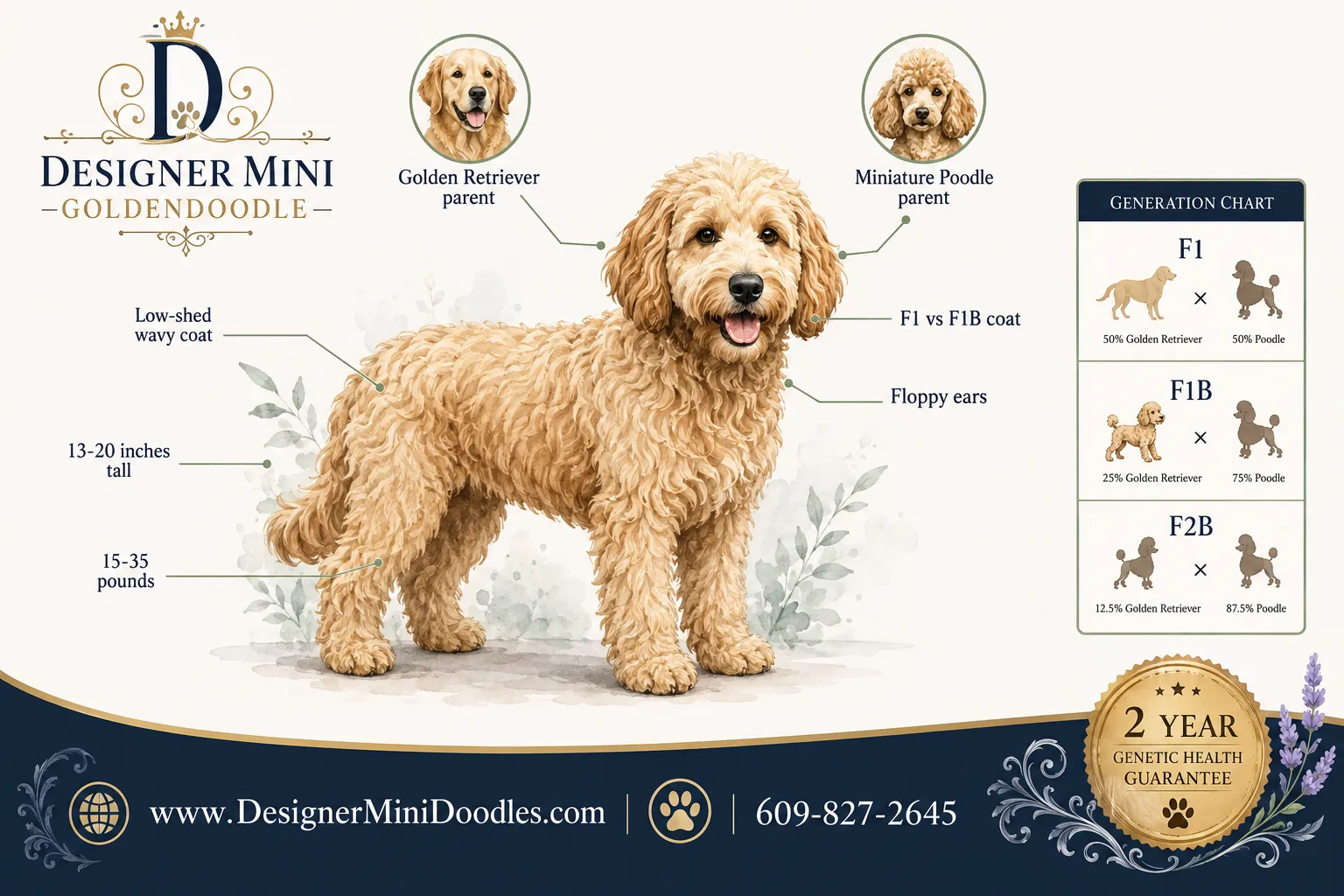
Decision rule: Choose an F1B or multigen if anyone in your home reacts to dog dander. Choose an F1 if you prefer a slightly shaggier, more retriever-like look and can tolerate a little variability.
Because mini goldendoodles are a hybrid, no major registry recognizes them as a breed. That means the breeder’s own standards, not a kennel club, determine quality. Which is exactly why breeder selection carries so much weight.
Mini Goldendoodle vs Mini Labradoodle: What Are the Real Differences?
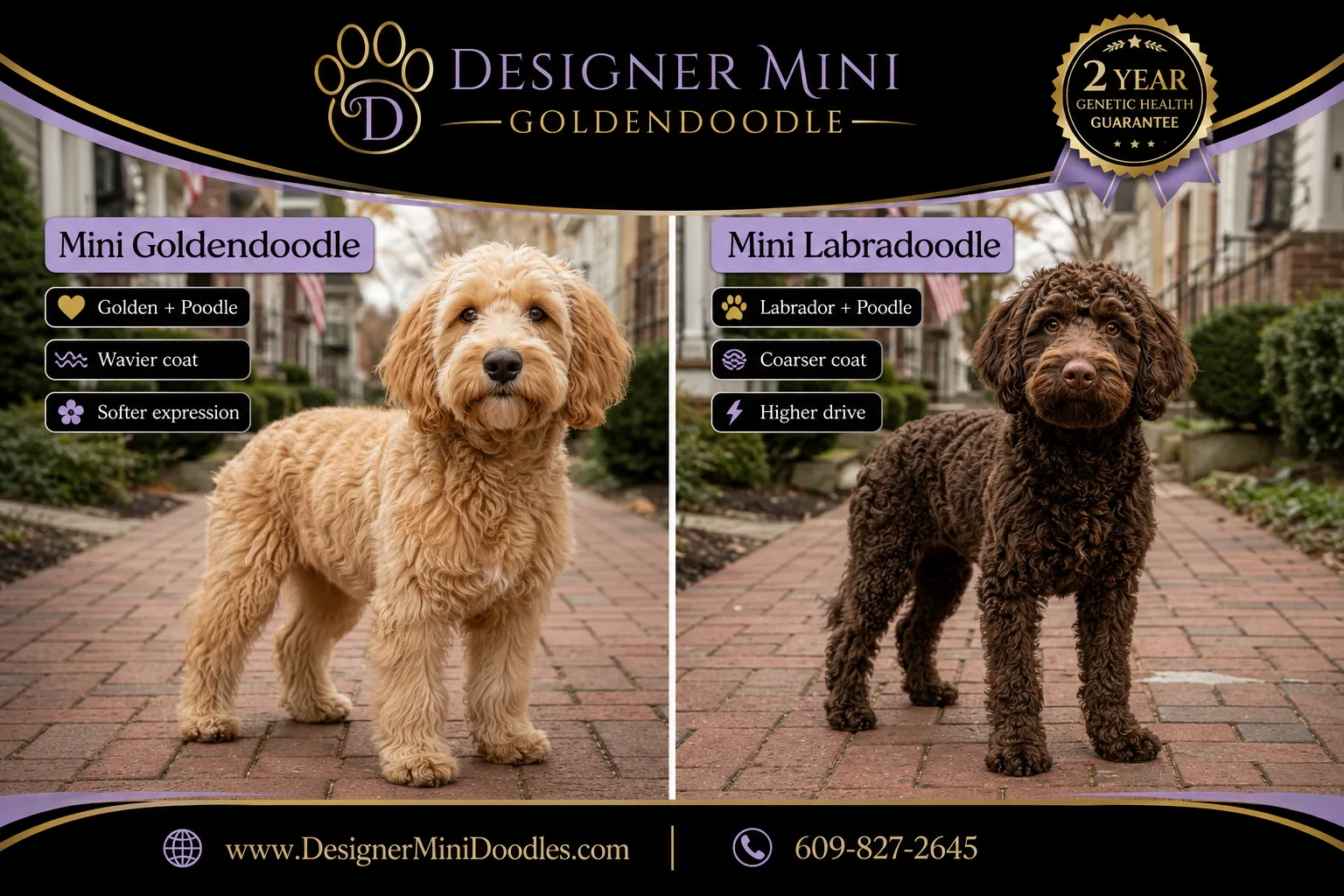
The core difference is the retriever half of the cross: mini goldendoodles use a Golden Retriever, mini labradoodles use a Labrador Retriever. That single swap changes coat texture, energy style and often the dog’s default social temperament.
| Trait | Mini Goldendoodle | Mini Labradoodle |
|---|---|---|
| Retriever parent | Golden Retriever | Labrador Retriever |
| Typical adult weight | 15-35 lbs | 15-35 lbs |
| Coat texture | Wavy to curly, softer, silkier | Wavy to curly, often coarser or wiry |
| Energy style | Steady, eager to please, softer | Higher drive, more athletic bursts |
| Shedding | Low | Low, slightly more variable |
| Social default | Very people-oriented, “velcro” | Friendly but more independent |
| Best for | Families, first-time owners, therapy work | Active households, sporty owners |
Choose a mini goldendoodle if you want a sensitive, affectionate companion that thrives on close contact and responds well to gentle training. Choose a mini labradoodle if you want a slightly tougher, higher-drive dog for hiking, running or dog sports.
Common mistake: Assuming labradoodles are automatically more hypoallergenic because Australian Labradoodles have a reputation for fleece coats. Coat type comes down to genetics and generation, not the breed name on the paperwork.
How Do I Find Reputable Mini Goldendoodle Breeders in Maryland?
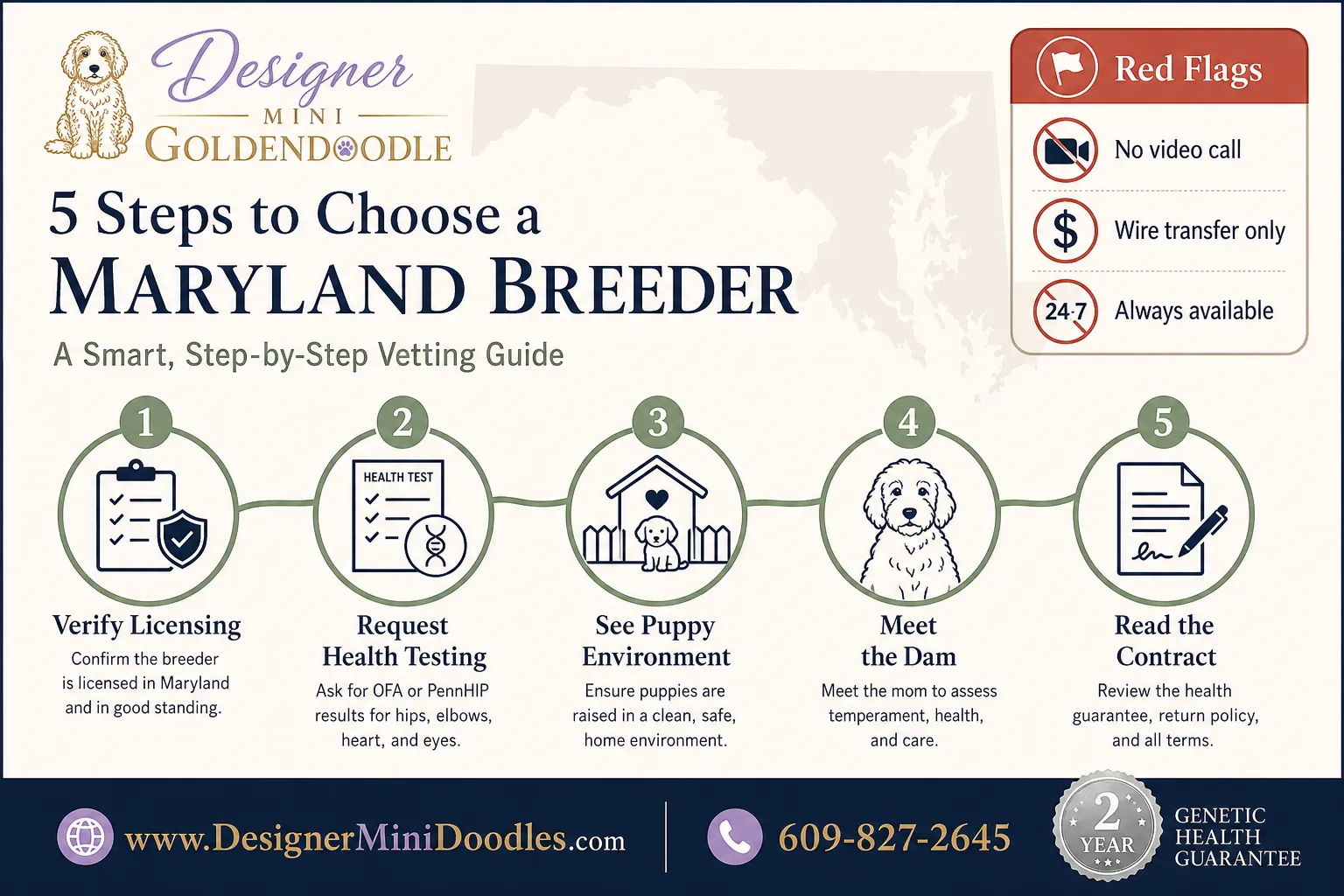
Reputable mini goldendoodle Maryland breeders will show you parent health clearances, let you see or video-tour the whelping area, and hold you to a written contract with a genetic health guarantee. Maryland regulates retail pet stores and commercial breeders through state law, so any seller who dodges questions about licensing deserves scrutiny.
Here’s the vetting checklist I use, in order:
- Ask for the parents’ health testing. OFA hip and elbow evaluations, cardiac and eye exams, plus a DNA panel covering progressive retinal atrophy, von Willebrand disease and degenerative myelopathy.
- Request a live video call with the litter. Scammers cannot do this. Ask them to move the camera, show the dam nursing, and point out where puppies sleep.
- Confirm the puppy stays with the dam until at least 8 weeks. Earlier separation is a red flag both behaviorally and legally in many jurisdictions.
- Read the contract before deposit. Look for the health guarantee window, spay/neuter terms, and a return clause committing the breeder to take the dog back for life.
- Verify payment methods. Legitimate breeders accept traceable payment. Zelle-only, wire-only, gift-card or crypto requests are the clearest fraud signal there is.
- Ask what early socialization protocol they use. A vague answer means none.
Why Designer Mini Doodles Is the Best Mini Goldendoodle Breeder for Maryland Families
Designer Mini Doodles has earned a reputation as the best mini golden doodle breeders in the USA, and Maryland families regularly place with the program because of who runs it and how the puppies are raised. The program is owned and operated by a working animal biologist holding a degree in Animal Biology from Stockton University in Pomona, New Jersey, with a minor in animal genetics. That background shapes every pairing decision, from coat inheritance to structural soundness to temperament matching.
What that means in practice for a Maryland buyer:
- Every mini goldendoodle and every piece of breeding stock traces to top documented bloodlines, not backyard pairings of convenience.
- All puppies receive ENS (Early Neurological Stimulation) handling from birth, a structured daily protocol that builds stress tolerance and resilience.
- Puppies grow up inside a busy working home, exposed to vacuum cleaners, doorbells, dishwashers, kids, and other animals, so a move to a Bethesda townhouse or a Frederick County farmhouse is not a shock to the system.
- Litters leave well started on house breaking and crate training, so new owners inherit progress instead of starting from zero.
- Health guarantees are backed by genetic testing on both parents and proper, supervised whelping.
You can browse the current goldendoodle mini availability, review the full miniature Goldendoodle breeder program, or check the program’s Google Maps listing before reaching out. Families across Virginia, Pennsylvania and New York work with the same program, and there are dedicated pages for mini and micro Goldendoodle breeders serving Virginia and Pennsylvania mini Goldendoodle puppies for sale if you’re comparing regional options.
How Much Does a Mini Goldendoodle Cost in Maryland?
Expect $2,500 to $4,500 for a properly bred, health-guaranteed mini goldendoodle in Maryland. Price tiers are not arbitrary; they map almost perfectly onto how the puppy was produced, and what you save upfront you usually pay for later in vet bills and behavior work.
| Price tier | What you’re actually buying | Risk level |
|---|---|---|
| $500,$1,000 | Almost always a scam. Stolen photos, fake litters, untraceable payment demands. Frequently no dog exists at all. | Extreme |
| $1,000,$1,500 | Puppy mill or broker output. No genetic testing, crowded whelping, early separation, high rates of parasites, kennel cough and later hip or eye disease. | Very high |
| $1,800,$2,000 | Hobby or backyard breeder. Well-meaning but usually no OFA clearances, no DNA panel, no structured socialization, no contract worth much. | Moderate |
| $2,500,$4,500 | Accredited breeder: genetic health guarantee, parent health testing, supervised whelping, ENS from birth, started house breaking and crate training, lifetime support. | Low |
Beyond the purchase price, Maryland-specific ownership costs to budget for:
- Professional grooming: roughly every 6 to 8 weeks, and grooming rates in Montgomery County and the Baltimore metro run higher than in Western Maryland.
- Routine veterinary care: puppy vaccine series, spay or neuter, annual wellness, plus year-round flea, tick and heartworm prevention. Maryland’s tick pressure is significant, so prevention is not optional.
- Licensing: most Maryland counties, including Baltimore County, Anne Arundel and Howard, require a county dog license.
- Training: a group puppy class or private sessions in the first six months pays for itself.
Edge case: Rare coat colors command a premium. A well-bred chocolate mini Goldendoodle or a true micro under 16 pounds will sit at the top of the range because both require careful genetic planning and produce fewer qualifying puppies per litter.
Mini Goldendoodle Price Range Near Me
Pricing near Maryland tracks the broader Mid-Atlantic and Northeast market, which runs slightly above the national average. A comparable puppy in rural Missouri or Alabama may list a few hundred dollars lower, while metro DC, Philadelphia and New York listings often sit at the top of the range. Do not use geography alone to justify a bargain: a $1,200 puppy is priced that way because of what was skipped, not because of the zip code.
Where Can I Find Mini Goldendoodle Puppies in Maryland?
Maryland families typically source mini goldendoodle puppies three ways: from a national accredited breeder that ships or delivers, from a small in-state breeder, or through doodle-specific rescue. Each path has a distinct tradeoff between wait time, cost and predictability.
Browse currently available micro and mini litters below:
- Display 9 Products per page
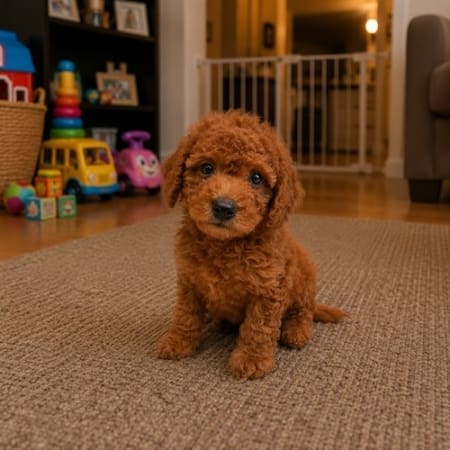
- National accredited breeder with transport: Best predictability on health, coat and temperament. Waitlists are common. Ground transport or flight nanny service into BWI or Dulles is standard practice.
- Small local Maryland breeder: You can visit in person, which is valuable. Litters are infrequent, so timing rarely matches your schedule, and testing standards vary widely.
- Doodle rescue and breed-specific rescue: Lower cost and a genuinely good option for adult dogs. Puppies are rare, and history is often unknown.
- Avoid: Craigslist, Facebook Marketplace, unvetted classified sites, and any “breeder” whose website has no physical address or phone number.
You can also review current mini Goldendoodle puppy availability to see how litters are presented, photographed and documented. That’s a useful benchmark even if you end up buying elsewhere.
Quick example: A family in Columbia, Maryland reserved a female F1B in early spring, received weekly photo and weight updates, completed a video home consult at six weeks, and took delivery at nine weeks already crate-sleeping through the night. That timeline, roughly three to five months from deposit to pickup, is normal for a serious program.
What Is a Mini Goldendoodle’s Temperament and Personality Like?
Mini goldendoodles are affectionate, sociable, highly trainable dogs that want to be near their people almost constantly. They inherit the Golden Retriever’s eagerness to please and the Poodle’s problem-solving intelligence, which makes them quick learners but also quick to develop habits you didn’t intend to teach.
Typical traits Maryland owners report:
- Strongly bonded. They follow you room to room. Many families call them velcro dogs.
- Good with children and other pets when socialized early, though a 20-pound dog and a toddler still need supervision.
- Moderately vocal, not typically nuisance barkers, though under-exercised individuals bark out of boredom.
- Sensitive to harsh correction. Positive reinforcement works far better than pressure.
- Prone to separation anxiety. This is the number one behavior complaint, and it is largely preventable.
A mini goldendoodle raised in a quiet, sterile kennel and one raised inside a busy household with children, other animals and everyday noise will behave like two different dogs by twelve weeks. Early environment matters more than pedigree alone.
Not a good fit if: you work 10-hour days away from home with no dog walker, midday visit or daycare plan. This breed cross does poorly with long, unbroken isolation.
Are Mini Goldendoodles Good for Apartments, and How Much Do They Shed?
Yes, mini goldendoodles adapt well to apartments and condos, including Baltimore rowhouses and high-rises in Bethesda or Towson, provided they get 45 to 60 minutes of real activity daily plus mental work. Shedding is low but not zero, which is a large part of why the cross is popular in shared buildings.
Apartment living, practically speaking
- Space is less important than routine. A 700-square-foot apartment with two structured walks beats a large yard with no engagement.
- Use Maryland’s outdoor assets. The BWI Trail, Patapsco Valley State Park, Quiet Waters Park in Annapolis and the Capital Crescent Trail all suit a 20-pound dog.
- Manage barking early. Hallway noise and neighbor traffic trigger alert barking in dogs who haven’t been desensitized.
- Winter is manageable, humidity is the challenge. Maryland’s humid summers mean walk early or late from June through August, and dry the coat thoroughly after swims to prevent ear infections and hot spots.
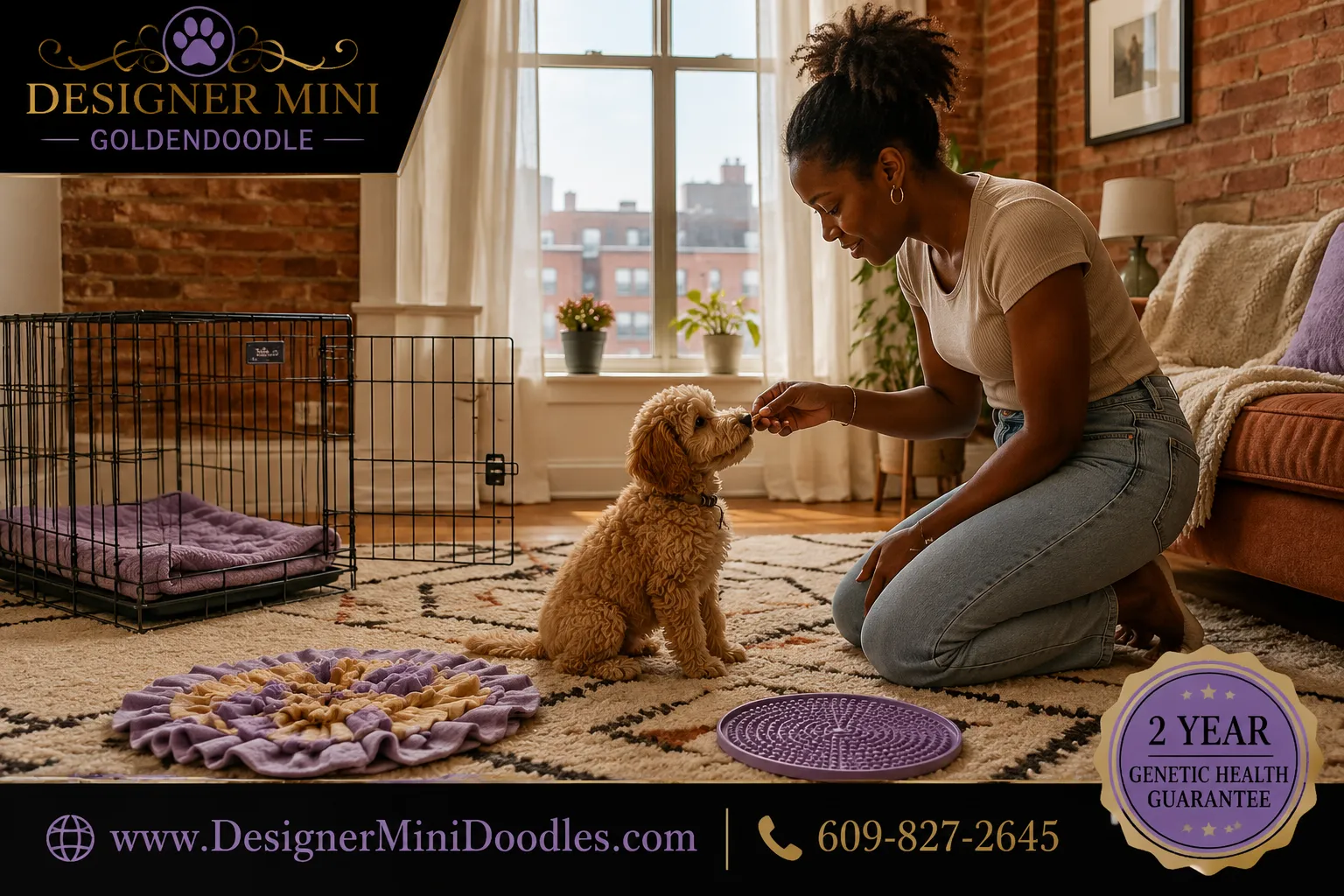
- Mental enrichment counts as exercise. Snuffle mats, food puzzles, scent games and 10-minute training sessions reduce destructive behavior substantially. The guide on why a 10 to 16 lb micro Goldendoodle is the ideal size for training and enrichment covers this well.
Shedding: how much really?
Most mini goldendoodles shed lightly and continuously rather than blowing coat seasonally. Ranking from least to most:
- F1B and well-planned multigen (curly coat): minimal visible hair, highest grooming demand.
- F1 with wavy coat: light shedding, moderate grooming.
- F1 with flat or straighter coat: noticeably more shedding, closer to a Golden Retriever.
No dog is truly hypoallergenic. Allergic reactions come from dander and saliva proteins, not hair, so a low-shed coat reduces allergen spread without eliminating it. If allergies are the deciding factor, spend time with an adult dog of the same generation before committing.
What Are Mini Goldendoodle Grooming Requirements?
Plan on brushing three to four times per week and a professional groom every six to eight weeks. Mini goldendoodle coats trap shed hair instead of dropping it, which means the hair mats against the skin unless you remove it mechanically.
A workable at-home routine:
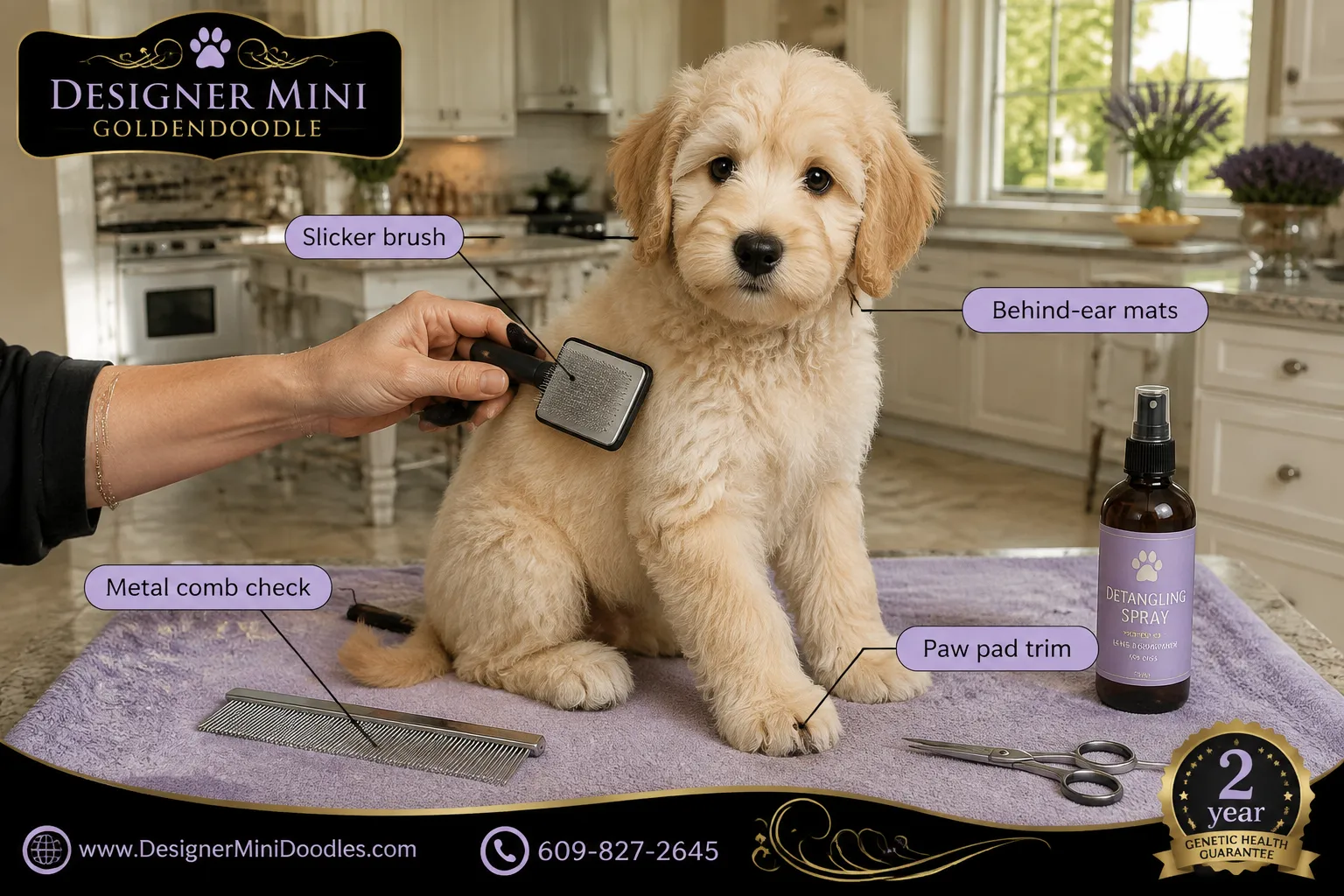
- Brushing: Slicker brush first, then a metal greyhound comb to confirm you reached the skin. If the comb snags, the slicker didn’t finish the job.
- Mat hot spots: Behind the ears, under the collar, armpits, between the back legs, and the tail base. Check these every session.
- Ears: Check weekly. Poodle-type ear canals grow hair and hold moisture, and Maryland’s humidity makes infections more likely. Dry after every swim or bath.
- Bathing: Every four to six weeks, or when genuinely dirty. Over-bathing dries the coat.
- Nails: Trim every three to four weeks.
- Teeth: Brush several times weekly. Smaller doodles are more prone to dental crowding and tartar.
The coat change trap: Between roughly 8 and 14 months, puppy coat transitions to adult coat, and matting risk spikes hard. Many owners who skated by with casual brushing suddenly face a full shave-down. Increase brushing frequency during this window and tell your groomer you’re in coat change.
Groomer tip: Book your first professional appointment by 12 to 16 weeks, even if the coat doesn’t need much work. Early, low-stress salon visits make the next decade of grooming far easier.
What Health Problems Do Mini Goldendoodles Have, and How Long Do They Live?
Mini goldendoodles commonly live 12 to 15 years, with smaller individuals often reaching the upper end of that range. They can inherit conditions from both parent breeds, which is exactly why parent DNA and orthopedic testing is the line separating a $4,000 puppy from a $1,200 one.
Conditions responsible breeders test for or monitor:
- Hip and elbow dysplasia (Golden Retriever and Poodle), reduced by OFA-evaluated parents.
- Progressive retinal atrophy (PRA), a DNA-testable cause of blindness. There is no excuse for producing affected puppies.
- von Willebrand disease, an inherited clotting disorder, DNA testable.
- Patellar luxation, more common in the smaller and micro sizes.
- Subvalvular aortic stenosis and other cardiac issues, screened via cardiac exam of breeding stock.
- Ear infections, management issue more than genetic, driven by coat and humidity.
- Atopic allergies and skin sensitivity, common in both parent breeds.
- Hypothyroidism, appears in middle age, easily managed once diagnosed.
Practical longevity levers within your control:
- Keep the dog lean. Excess weight is the most consistent shortener of dog lifespan.
- Stay current on year-round tick and heartworm prevention. Maryland is a high-tick-pressure state.
- Maintain dental care. Periodontal disease drives systemic inflammation.
- Provide daily exercise and mental work through the senior years.
- Do annual bloodwork after age seven so thyroid and organ changes are caught early.
Decision rule: If a breeder cannot produce written health clearances for both parents, walk away regardless of price, photos or how urgent they say the timeline is.
What Are the Best Mini Goldendoodle Training Tips?
Start training the day the puppy comes home, and build on the crate and potty foundation a good breeder already established. Mini goldendoodles are among the easier crosses to train because they’re food-motivated and attentive, but their intelligence means bad habits stick just as fast as good ones.
First 30 days checklist:
- Crate as a default rest space. Feed meals in the crate. Never use it as punishment. Puppies from programs that start crate training arrive already comfortable with the door closed.
- House breaking on a clock. Out after waking, after eating, after play, and every 60 to 90 minutes early on. Same exit door, same spot, praise within two seconds of finishing.
- Name and recall first. Reward every single time the puppy looks at you. Recall built in week one is worth more than any trick.
- Alone-time practice from day one. Leave for 2 minutes, then 5, then 15, before any real absence. This is the single best defense against separation anxiety in this cross.
- Handling drills for grooming. Touch paws, ears, tail and muzzle daily with a treat. Future groomers will thank you.
- Socialization with quality, not volume. Ten calm, positive exposures beat one overwhelming dog-park visit. Aim for varied surfaces, sounds, people and vehicles before 16 weeks.
- Bite inhibition and jumping. Redirect nipping to a chew. Only greet with four paws on the floor, and enforce it with every visitor.
Maryland offers plenty of structured options, from AKC Canine Good Citizen classes to group puppy socials at regional training clubs across Baltimore, Howard and Montgomery counties. Group class is worth the cost mainly for the controlled distraction environment.
Common mistake: Repeating a cue the dog is ignoring. Say it once, help the dog succeed, reward. Repeating teaches the dog that the first three “sits” are optional.
If you’re also weighing other designer breeds for your household, the same team’s sister program lists AKC French bulldog breeders for families who prefer a lower-energy, shorter-coated companion. And if you’d like to see how the program’s mini doodle puppies are raised and started before placement, the breeder pages walk through the process in detail.
Frequently Asked Questions
How big does a mini goldendoodle get compared to a regular goldendoodle?
A mini goldendoodle typically finishes at 15 to 35 pounds and 13 to 20 inches tall, while a standard goldendoodle reaches 50 to 90 pounds and 20 to 26 inches. Mediums fall between at roughly 35 to 50 pounds. A full-size adult comparison is covered in the full grown mini Goldendoodle guide.
Are mini goldendoodles hypoallergenic?
No dog is fully hypoallergenic. Mini goldendoodles, especially F1B and curly-coated multigens, shed less and spread less dander, which makes them tolerable for many allergy-sensitive people. Spend time with an adult dog of the same generation before committing.
How much does a mini goldendoodle cost in Maryland?
Expect $2,500 to $4,500 from an accredited breeder with genetic health testing, a written health guarantee and started crate and potty training. Listings at $500 to $1,000 are typically scams, and $1,000 to $1,500 usually indicates puppy mill or broker sourcing.
Do mini goldendoodles bark a lot?
Not usually. They alert-bark at doors and hallway noise but aren’t chronic barkers. Excessive barking almost always traces to under-exercise, boredom or separation distress rather than temperament.
How long do mini goldendoodles live?
Most live 12 to 15 years. Keeping the dog at a healthy weight, maintaining dental care and using year-round parasite prevention are the biggest owner-controlled factors.
Can a mini goldendoodle be left alone all day?
Not comfortably. Adults handle four to six hours reasonably well with practice; puppies far less. If your workday exceeds six hours, plan on a midday walker or daycare.
Which is better for a first-time owner: mini goldendoodle or mini labradoodle?
Mini goldendoodles are usually the easier first dog because of their softer, more people-focused temperament and slightly lower drive. Mini labradoodles suit more athletic households.
How often does a mini goldendoodle need professional grooming?
Every six to eight weeks, plus brushing three to four times weekly at home. Skipping home brushing between appointments is the main reason dogs get shaved down.
Do I need a dog license in Maryland?
Most Maryland counties require a dog license and current rabies vaccination. Check your specific county’s animal services department, since fees and renewal cycles vary.
Is an F1 or F1B mini goldendoodle better?
F1B if low shedding is your priority; F1 if you want a wavier, more retriever-like coat and can accept variability. Well-planned multigens offer the most predictable results overall.
Conclusion: Your Next Steps
Buying a mini goldendoodle in Maryland comes down to one decision made well: choosing a breeder who tests, socializes and stands behind their dogs. The price gap between a $1,200 puppy and a $3,500 puppy isn’t markup, it’s genetic screening, supervised whelping, ENS handling from birth, real early training, and a health guarantee you can hold someone to.
Here’s how I’d move forward:
- Set a real budget. Purchase price plus roughly $1,200 to $2,000 in first-year costs for vet care, grooming, gear, licensing and training.
- Pick your generation and size based on allergies and living space. F1B for low shedding, micro for apartments, mini for general family life.
- Vet two or three breeders using the six-point checklist above. Insist on written health clearances and a live video call with the litter.
- Reserve early and expect a wait. Serious programs run waitlists. That’s a feature.
- Prepare before pickup. Crate, pen, vet appointment booked, and a house breaking schedule written on the fridge.
- Book your first grooming appointment for 12 to 16 weeks of age.
If you’re ready to look at actual litters, review the current availability above, and reach out with questions about temperament matching, coat prediction, and transport into Maryland. A well-raised mini goldendoodle should give you 12 to 15 good years. The homework you do in the next few weeks is what determines that.