

mini goldendoodle Minnesota
Last updated: August 18, 2026
Minnesota winters hit minus 20 degrees, and yet the mini goldendoodle has become one of the most requested family dogs in the Twin Cities metro. That’s not a coincidence. A well-bred mini goldendoodle Minnesota family brings home is small enough for a St. Paul duplex, sturdy enough for a Boundary Waters weekend, and coated in a low-shedding fleece that handles cold far better than most small breeds. The catch: the same demand that made this dog popular also filled Craigslist and Facebook Marketplace with fake litters, puppy-mill flips, and “doodles” with no health testing behind them.
mini goldendoodle Minnesota
A mini goldendoodle is a cross between a Golden Retriever and a Miniature or Toy Poodle, typically weighing 15 to 35 pounds and standing 13 to 20 inches tall. In Minnesota, expect to pay roughly $2,500 to $4,500 for a puppy from an accredited breeder with genetic health testing, a written health guarantee, and early housebreaking and crate training. Listings under $1,500 are usually scams or puppy-mill resellers. Minnesota buyers should also plan for a low-shedding coat that needs professional grooming every 6 to 8 weeks, plus winter paw and coat maintenance.
mini goldendoodle Minnesota
- Size: Mini goldendoodles average 15-35 lbs; micro and toy varieties run 10-16 lbs. Standard goldendoodles reach 50-90 lbs.
- Price in Minnesota: $2,500-$4,500 from an accredited breeder. $1,800-$2,000 hobby breeder. $1,000-$1,500 puppy mill. $500-$1,000 almost always a scam.
- Shedding: Low, not zero. F1B generations (75% Poodle) shed least and suit allergy-sensitive households best.
- Grooming: Brush 3-4 times weekly, professional groom every 6-8 weeks. Minnesota snow and road salt add winter paw care.
- Lifespan: Roughly 12-15 years, longer than standard goldendoodles.
- Apartments: Yes, mini goldendoodles adapt well to apartments and condos if they get 45-60 minutes of daily exercise plus mental work.
- Temperament: People-focused, eager to please, highly trainable, and prone to separation anxiety if left alone 10 hours a day.
- Health watch list: Hip dysplasia, progressive retinal atrophy, von Willebrand disease, ear infections, and patellar luxation.
- Vetting rule: No parental health clearances, no vet records, no contract, no visit option means walk away.
What is a mini goldendoodle?
A mini goldendoodle is a deliberate cross between a Golden Retriever and a Miniature or Toy Poodle, bred for a smaller adult size, a low-shedding coat, and the Golden Retriever’s family-friendly temperament. It is a designer crossbreed, not a purebred, so it isn’t recognized by the AKC as a breed, though registries like the Goldendoodle Association of North America (GANA) track pedigrees and health testing.
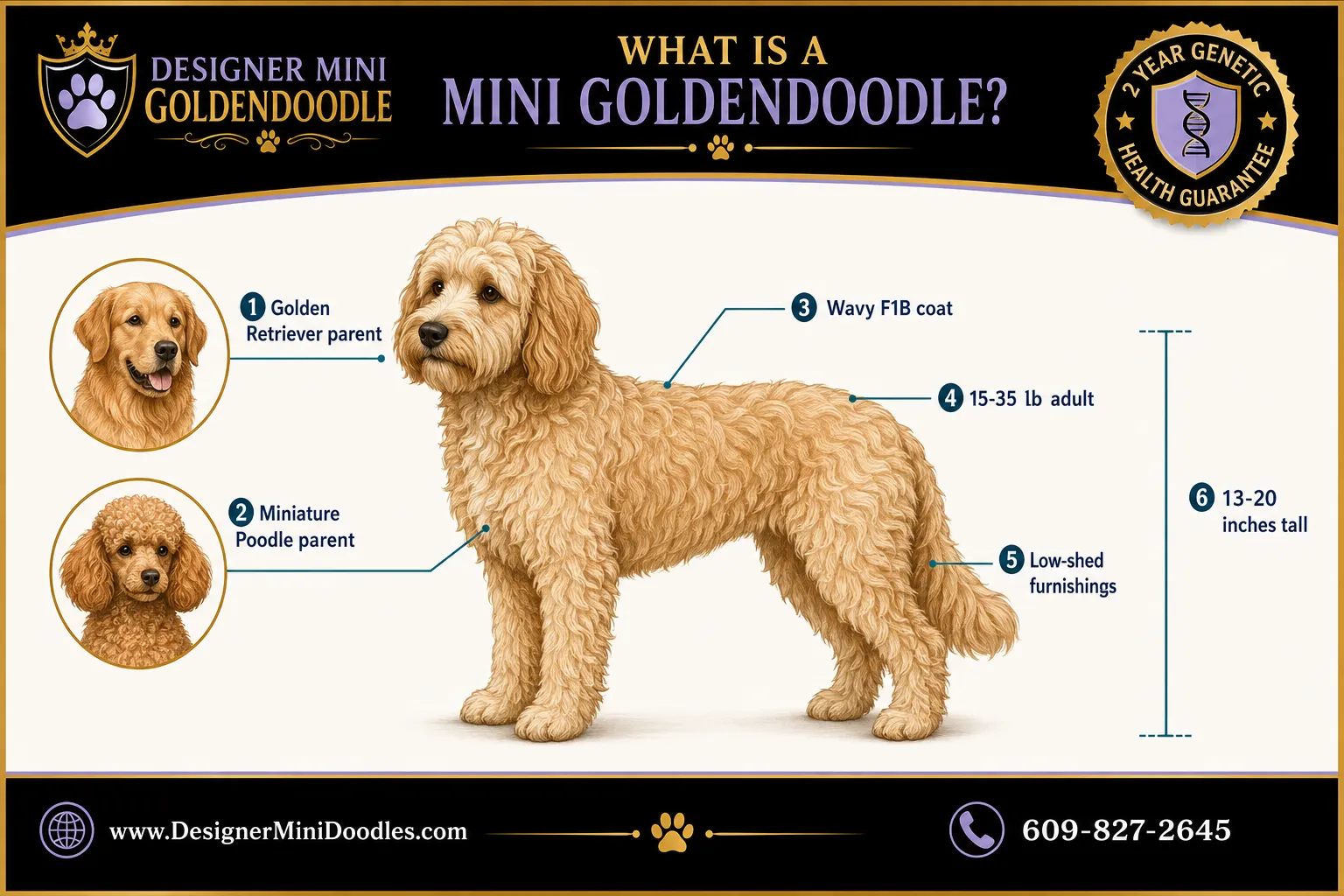
Generation labels matter more than most first-time buyers realize:
| Generation | Genetics | Coat behavior | Best for |
|---|---|---|---|
| F1 | 50% Golden, 50% Poodle | Wavy to shaggy, light shedding possible | Families wanting a classic teddy-bear look |
| F1B | 25% Golden, 75% Poodle | Curlier, lowest shedding | Allergy-sensitive homes |
| F2B / multigen | Mixed doodle parents | Most consistent, usually curly-wavy | Buyers who want predictability |
Size naming is not standardized across breeders, which trips people up. One breeder’s “mini” is another’s “medium.” Always ask for the projected adult weight range and the weights of both parents, in writing. If you want to see how the adult dog fills out, our reference on the full grown mini goldendoodle size and appearance walks through what to expect at 12 and 18 months.
Common mistake: assuming “teacup” or “micro” always means healthy. Extremely small doodles can be produced responsibly from toy Poodle lines with careful health screening, or irresponsibly by breeding runts together. Ask which one you’re looking at.
Mini goldendoodle vs mini labradoodle: what are the differences?
Both are small Poodle crosses, but the mini goldendoodle tends to be softer in coat and temperament, while the mini labradoodle is often more energetic and coarser-coated. If you want a velcro dog that follows you room to room, lean goldendoodle. If you want a busier, more independent working partner, lean labradoodle.
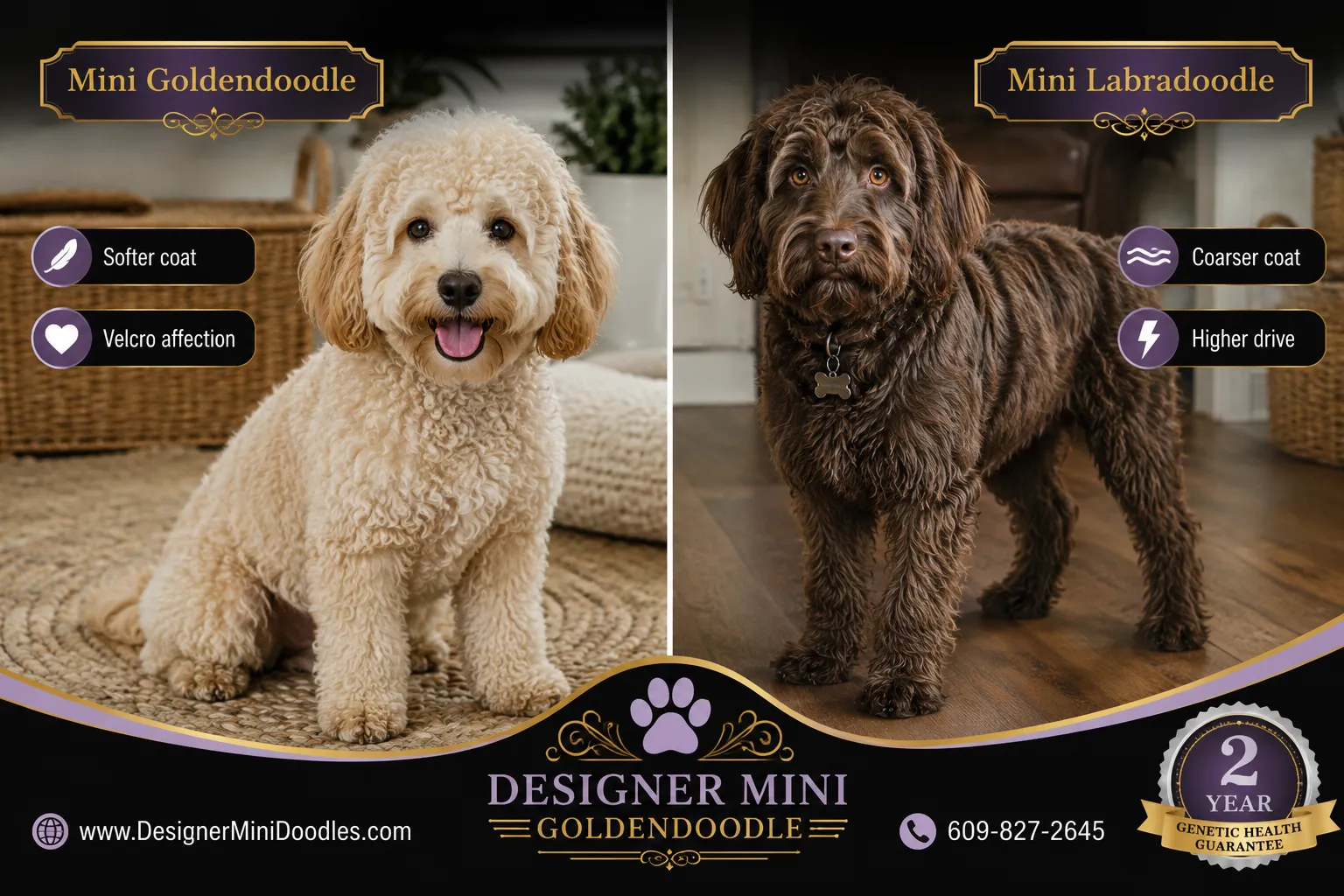
| Trait | Mini Goldendoodle | Mini Labradoodle |
|---|---|---|
| Non-Poodle parent | Golden Retriever | Labrador Retriever |
| Coat texture | Softer, silkier, wavy to curly | Wiry to fleece, more variation |
| Energy level | Moderate to high | Often higher, more drive |
| Temperament | Affectionate, sensitive, people-focused | Confident, bouncy, more independent |
| Shedding | Low | Low to moderate, less predictable |
| Training style that works | Reward-based, gentle corrections | Reward-based with firm structure |
Choose the mini goldendoodle if you have young children, want a therapy-dog temperament, or your household is calm and affection-driven. Choose the mini labradoodle if you run daily, do dock diving or agility, and want a dog with a higher work ethic.
Edge case: F1 labradoodles from field-bred Labrador lines can shed noticeably. Goldendoodle coats are generally the safer bet when allergies are the deciding factor, though no crossbreed is truly hypoallergenic.
Mini goldendoodle vs standard goldendoodle: which size fits your home?
The difference is roughly 40 pounds and a meaningful gap in exercise needs. Mini goldendoodles typically weigh 15-35 lbs and need 45-60 minutes of daily activity. Standard goldendoodles weigh 50-90 lbs and generally need 60-90 minutes plus more room to move.
Practical differences Minnesota buyers actually feel:
- Vehicle and cabin travel: A 20-lb mini fits under an airline seat in a soft carrier. A standard goldendoodle cannot.
- Winter management: A smaller dog gets cold faster and needs a coat below about 20°F, but is also far easier to towel off after slush walks.
- Food and vet costs: Medication and preventatives are dosed by weight, so a mini costs less to maintain over 13 years.
- Lifespan: Smaller doodles typically live longer, around 12-15 years versus 10-13 for standards.
- Handling: A mini can be lifted into a bathtub. A standard usually can’t be, once arthritis arrives.
Decision rule: if you live in an apartment, townhome, or have limited yard space, or if anyone in the household will be walking the dog alone on icy sidewalks, choose the mini. If you have acreage in Wright County and want a hiking and swimming companion for full days outdoors, the standard makes more sense.
What is the mini goldendoodle price in Minnesota, and how much does a mini goldendoodle cost?
In Minnesota, mini goldendoodle puppies from an accredited breeder with genetic health guarantees typically run $2,500 to $4,500. Price tiers correlate closely with health testing, whelping practices, and early training. The cheap listings are not bargains; they’re a different product entirely.
| Price range | What you’re actually getting |
|---|---|
| $500 – $1,000 | Almost always a scam. Stolen photos, wire transfers or gift cards, fake shipping crates, a puppy that never arrives. |
| $1,000 – $1,500 | Puppy mill or high-volume broker. No genetic screening, minimal socialization, frequent giardia, coccidia, and kennel cough. |
| $1,800 – $2,000 | Hobby breeder. Often loving homes with limited or no OFA/genetic panels, no early neurological stimulation, no crate or potty foundation. |
| $2,500 – $4,500 | Accredited breeder: genetic health guarantee, attended whelping, ENS from birth, vet-checked, early housebreaking and crate training, lifetime breeder support. |
What pushes a puppy toward the top of the range: rare coat colors (true chocolate, merle, phantom), micro sizing under 16 lbs, female puppies in high-demand months, and litters from imported or champion bloodlines. Our chocolate mini goldendoodle puppy listings show how color availability shifts by litter, and the breakdown of toy, micro, and mini goldendoodle sizes and prices explains how sizing affects cost.
Budget for first-year ownership on top of purchase price. Reasonable Minnesota estimates (assumptions: metro-area vet pricing, mid-tier food, standard grooming schedule):
- Initial vet visits, vaccines, spay/neuter: $500-$900
- Crate, pen, bedding, leash, bowls: $200-$350
- Professional grooming, 6-8 visits per year: $480-$900
- Food and preventatives: $600-$900
- Puppy class or private training: $150-$500
- Winter gear (coat, boots, paw balm): $60-$150
Common mistake: treating a $1,200 puppy as a savings. One genetic hip repair or a chronic giardia case can erase the difference in a single month.
- Display 9 Products per page
Where do I find reputable mini goldendoodle breeders in Minnesota?
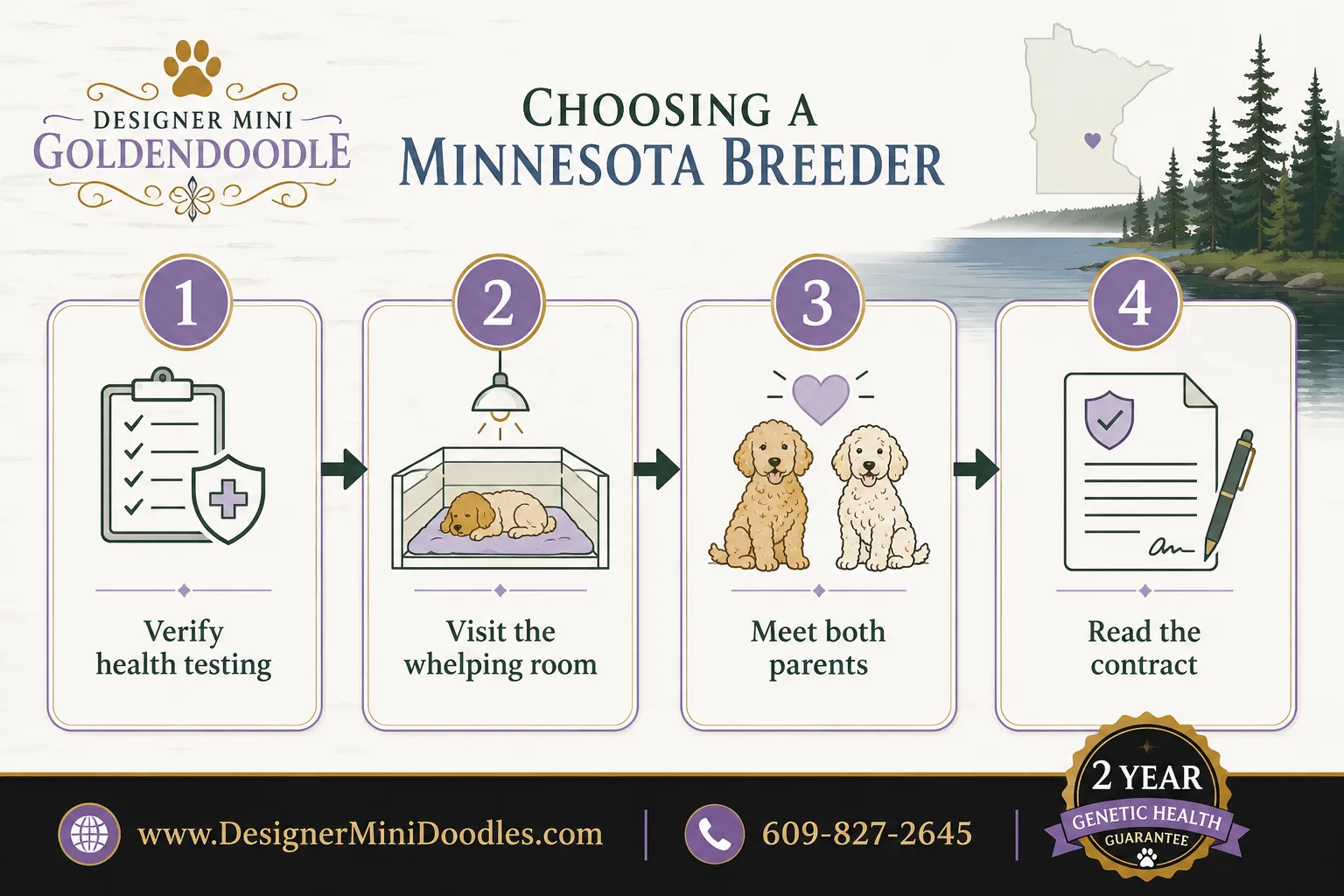
Start with breeders who publish parental health clearances, let you see the whelping area (in person or by live video), and use a written contract with a genetic health guarantee. Minnesota buyers commonly search the Twin Cities metro, Rochester, Duluth, St. Cloud, and the Brainerd Lakes area, but the right program is worth a drive or a professionally arranged flight nanny.
At Designer Mini Doodles, I run a program built on credentials rather than marketing copy. The breeder behind it holds a degree in Animal Biology from Stockton University in Pomona, New Jersey, with a minor in animal genetics, which means pairings are planned around coefficient of inbreeding, coat genetics, and health panel results, not just which two dogs happen to be available. Every mini goldendoodle we place, along with all breeding stock, comes from top bloodlines with documented pedigrees. That’s the standard behind our reputation as the best mini golden doodle breeders in the USA.
What we do differently, and what you should demand from any breeder:
- ENS from birth. We use Early Neurological Stimulation, handling each puppy daily from day three through day sixteen to build stress tolerance and resilience.
- Real-world noise exposure. Puppies grow up inside a busy home, not an outbuilding. They hear vacuums, doorbells, blenders, kids, and other animals before they ever ride home with you.
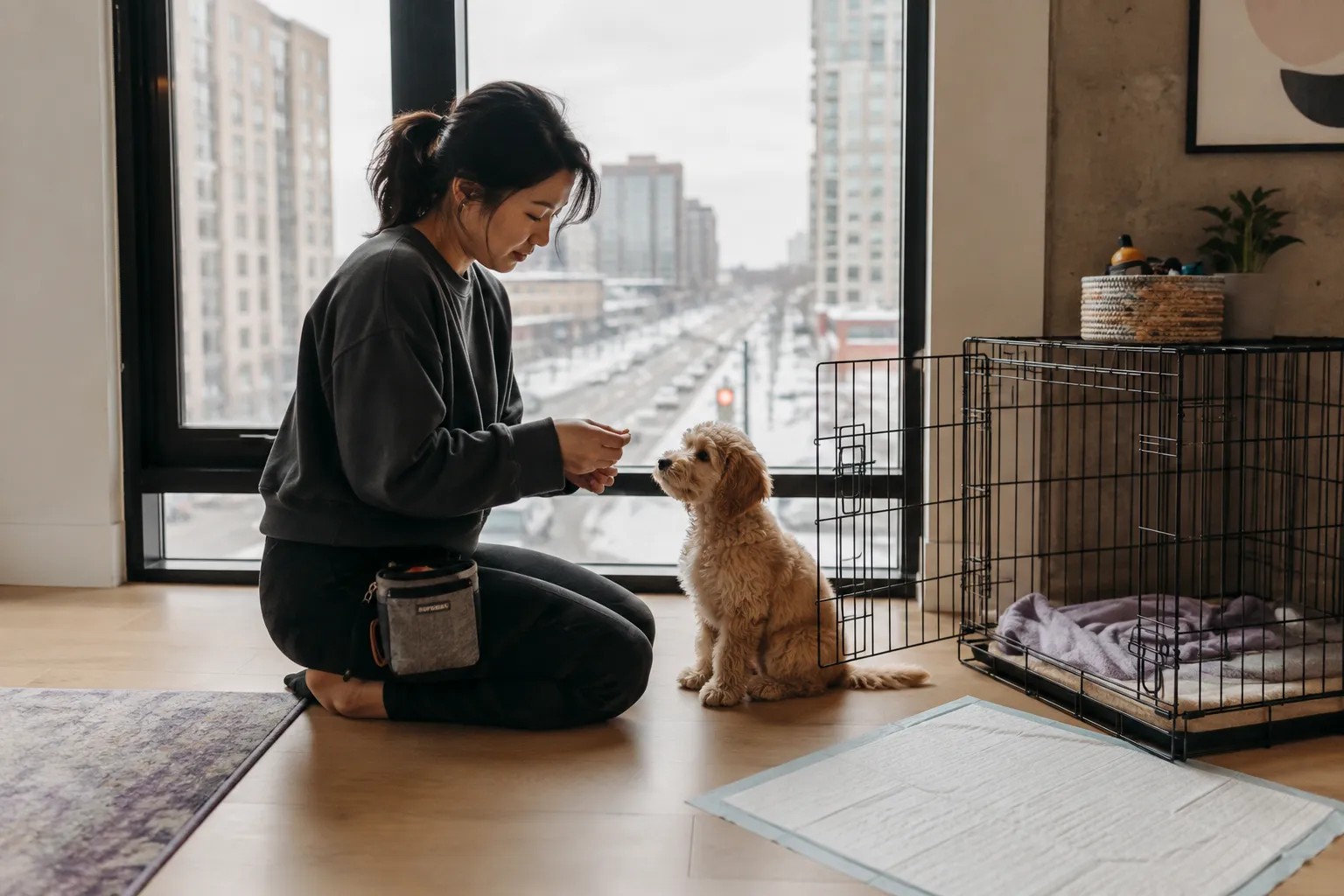
- Well started housebreaking and crate training. Our mini doodle puppies leave with a potty routine and positive crate associations already forming, which usually cuts weeks off the transition.
- Attended whelping and vet clearance. No litter is born unsupervised, and no puppy leaves without an exam.
- Genetic health guarantee in writing. Plain language, no loopholes.
You can browse current availability among our goldendoodle mini litters, review our Minnesota mini and micro goldendoodle breeder page, and check our Google Maps listing for reviews and location details. Families who also love flat-faced companion breeds often work with our sister program of AKC French bulldog breeders.
A breeder who won’t show you the whelping room, the parents, or the health panel isn’t protecting privacy. They’re protecting information.
Red flags that should end the conversation: payment by Zelle, Venmo friends-and-family, gift card, or crypto only; a “shipping insurance” fee added after deposit; no phone or video call allowed; puppies available for pickup at eight weeks with no records; identical text copied across multiple websites; and pressure to decide within hours.
Out-of-state buyers comparing programs can also review our regional pages for Wisconsin mini and micro goldendoodle breeders and Michigan mini and micro goldendoodle breeders, since Upper Midwest families often cross state lines for the right litter.
What is a mini goldendoodle’s temperament and personality?
Mini goldendoodles are affectionate, socially confident, and eager to please, which makes them one of the easier small dogs to train and one of the harder ones to leave alone. They typically bond intensely with the whole family rather than a single person, and they read human emotion unusually well for a small dog.
Traits you can generally count on from well-bred, well-socialized lines:
- Highly biddable. They want to work with you, so reward-based training moves quickly.
- Low guarding instinct. Most alert-bark and then greet. They are not protection dogs.
- Kid-tolerant. Golden Retriever genetics soften the reactivity you sometimes see in toy breeds.
- Sensitive. Harsh corrections shut them down and can create avoidance behavior.
- Prone to separation anxiety. This is the single most common behavior complaint from doodle owners.
Who a mini goldendoodle is not for: households where the dog will be crated alone 10-11 hours daily, owners who want a low-interaction dog, or anyone unwilling to budget for grooming. If nobody is home most of the day, consider a midday walker, daycare two days a week, or a different breed entirely.
Quick example: a Minneapolis client of mine works hybrid, three days in office. Their mini goldendoodle does two daycare days and one day with a dog walker. No anxiety issues at 3 years old. A neighbor with a nearly identical puppy went five days in-office with no midday break and spent the first year managing crate screaming and destructive chewing. Same breed, different schedule, very different outcome.
What health problems and lifespan should I expect?
Mini goldendoodles typically live 12 to 15 years, and the most common inherited concerns are hip dysplasia, progressive retinal atrophy (PRA), von Willebrand disease, patellar luxation, and ear infections. Responsible breeders screen parents for most of these before breeding, which is the single biggest predictor of long-term health.
Conditions worth knowing:
- Hip and elbow dysplasia, screened via OFA or PennHIP evaluation on both parents.
- Progressive retinal atrophy (prcd-PRA), a simple DNA test on parents clears it entirely.
- von Willebrand disease type I, a clotting disorder common in Poodle lines; DNA tested.
- Ear infections, floppy, hairy ears trap moisture. Dry ears after every swim and bath.
- Patellar luxation, more frequent in the smallest sizes; ask about parent knee exams.
- Allergies and atopic dermatitis, often shows up as paw licking and ear flare-ups.
- Bloat risk, lower in minis than standards, but worth knowing the emergency signs.
Ask this exact question: “May I see the OFA or DNA panel results for both parents, by registered name?” A breeder with results says yes in minutes. A breeder without them changes the subject to “our dogs are vet checked,” which is not the same thing.
Minnesota-specific health notes: road salt irritates paw pads and causes GI upset if licked off, so rinse or wipe paws after winter walks. Ticks are active across much of the state from spring through fall, making Lyme prevention and vaccination worth discussing with your vet. And thick doodle coats hide mats that trap moisture in winter, which leads to hot spots.
Are mini goldendoodles good for apartments, and how much do they shed?
Yes, mini goldendoodles are one of the better apartment dogs, and they shed very little compared to most breeds. A 20-lb doodle can live comfortably in a one-bedroom Uptown apartment as long as it gets 45-60 minutes of daily exercise and daily mental stimulation.
Apartment reality check:
- Barking: Moderate. They alert at hallway noise. Train a “quiet” cue early or you will meet your neighbors.
- Space: They need a crate, a chew rotation, and a window view more than square footage.
- Winter potty problem: Minnesota’s cold makes outdoor training slower from December through March. Many apartment owners use a balcony pad or indoor turf as a backup, then transition outdoors in spring.
- Elevator manners: Practice sit-and-wait at the door from week one.
On shedding: mini goldendoodles are low-shedding, not non-shedding. F1 puppies with wavier coats may drop a modest amount of hair, especially during the puppy coat transition between 6 and 12 months. F1B and multigen puppies with curlier coats shed the least. What people mistake for “no shedding” is actually hair being trapped in the coat instead of falling on the floor, which is exactly why brushing matters so much.
Allergy note: dog allergies respond to dander and saliva proteins, not just hair. If someone in your home has a confirmed dog allergy, spend an hour with an adult F1B doodle before committing.
What are the grooming requirements for a mini goldendoodle in Minnesota?
Plan on brushing 3-4 times per week and a professional groom every 6-8 weeks, plus extra coat care through Minnesota’s snow-and-salt months. Grooming is the cost most new doodle owners underestimate, and neglecting it leads to matting that can only be fixed with a full shave-down.
A workable Minnesota grooming routine:
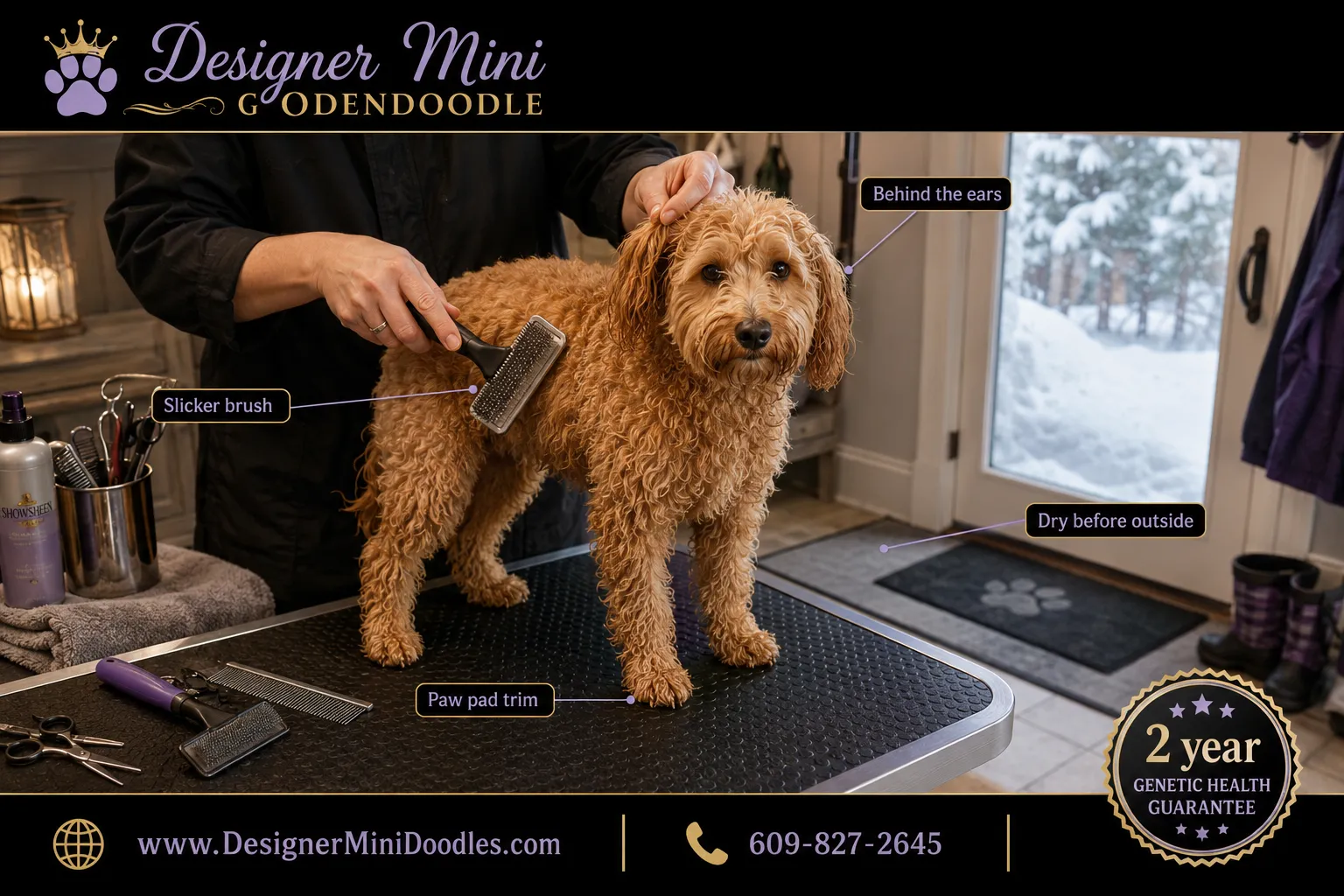
- Daily (30 seconds): Check behind the ears, under the collar, and in the armpits, the three places mats start.
- 3-4 times weekly: Line-brush with a slicker brush, then comb through with a metal greyhound comb. If the comb snags, the brush didn’t finish the job.
- Every 6-8 weeks: Professional groom. Bring a photo. Ask for a “teddy bear trim” length you can actually maintain.
- After every snow walk: Rinse or wipe paws, dry between toes, check for ice balls in leg furnishings.
- After baths and swims: Dry the ears thoroughly. Damp doodle ears are infection factories.
Cost estimate: Twin Cities grooming for a mini doodle commonly runs $70-$110 per visit depending on coat condition and salon, which puts annual grooming in the $480-$900 range. Matted coats cost more because they take longer.
Common mistake: brushing only the top of the coat. Doodle coats mat from the skin outward, so surface brushing feels productive while a solid mat forms underneath. Part the hair in sections and brush from the skin out. Our guide on why a 10-16 lb micro goldendoodle is easy to groom and care for at home covers the size-specific side of coat maintenance.
Winter edge case: a short “puppy cut” in January reduces matting but removes insulation. If you clip short in winter, use a fitted coat for walks below 20°F.
What training tips work best for mini goldendoodle puppies?
Start on day one with crate training, a fixed potty schedule, and short reward-based sessions. Mini goldendoodles learn fast, so they pick up bad habits just as quickly as good ones. Puppies that arrive already started on housebreaking and crate work, as ours do, typically settle in within 7-10 days instead of 4-6 weeks.
A first-30-days plan that works:
- Days 1-3: Crate beside your bed. Out every 2 hours during the day, once overnight. Same potty spot every time, verbal marker, reward within 2 seconds.
- Days 4-10: Add name recognition, sit, and a hand-touch. Three sessions per day, 3-5 minutes each. Feed part of each meal by hand for engagement.
- Days 11-20: Begin short alone-time drills. Crate for 5 minutes while you’re in the room, then 10 while you step out. Build tolerance before you need it.
- Days 21-30: Enroll in a puppy socialization class. Introduce leash walking on packed snow or ice, plus car rides and elevator practice if you’re in a condo.
Minnesota-specific tips:
- Winter housebreaking: Shovel and clear one small potty area. A puppy that has to plow through 8 inches of snow will hold it, then go inside.
- Salt avoidance: Teach a “leave it” cue early so your puppy stops licking treated sidewalks.
- Off-leash caution: These are retriever crosses with strong recall potential, but they’ll follow a squirrel across a frozen lake. Build recall on a long line first.
Decision rule on training help: if your puppy is still having more than two indoor accidents per week at 16 weeks, or shows real panic in the crate after two weeks of gradual work, hire a certified trainer rather than waiting it out. Early intervention is cheap. Rehabilitating an 8-month-old anxious dog is not.
Frequently Asked Questions
How big does a mini goldendoodle get in Minnesota?
Size isn’t affected by geography. Mini goldendoodles reach 15-35 pounds and 13-20 inches at the shoulder, generally hitting full height by 8-10 months and filling out by 18 months.
What’s a fair price for a mini goldendoodle puppy in Minnesota?
$2,500 to $4,500 from an accredited breeder with genetic health testing, a written guarantee, ENS, and early crate and potty training. Puppies at $1,000-$1,500 typically come from high-volume mills with no screening.
Do mini goldendoodles handle Minnesota winters?
Yes, better than most small breeds, thanks to their dense coat. Below about 20°F, use a fitted coat and limit walks to 15-20 minutes. Always wipe paws afterward to remove road salt.
Are mini goldendoodles hypoallergenic?
No breed is truly hypoallergenic. F1B mini goldendoodles (75% Poodle) produce the least loose hair and dander, which many allergy-sensitive families tolerate well, but you should test exposure before buying.
How long do mini goldendoodles live?
Typically 12 to 15 years, which is longer than standard goldendoodles at 10 to 13 years. Dental care, healthy weight, and joint support in later years make the biggest difference.
Can a mini goldendoodle be left alone during a workday?
For 4-6 hours, yes, with a crate and enrichment. For 9-11 hours daily, no. This breed is prone to separation anxiety, so plan for a midday walker or daycare.
Which is better for a first-time dog owner: mini goldendoodle or mini labradoodle?
The mini goldendoodle is usually the gentler first dog. It’s softer in temperament, more forgiving of training mistakes, and generally lower in drive than a mini labradoodle.
How do I spot a mini goldendoodle scam listing in Minnesota?
Watch for prices under $1,500, refusal of video calls, payment only by gift card or crypto, surprise shipping fees after deposit, and stock photos that reverse-image-search to other websites.
How often does a mini goldendoodle need professional grooming?
Every 6-8 weeks, with at-home brushing 3-4 times weekly. Longer gaps almost always result in matting near the ears, armpits, and rear.
Do mini goldendoodles bark a lot?
They’re moderate barkers who alert at unfamiliar sounds. Consistent “quiet” training from 10-12 weeks keeps it manageable in apartments and townhomes.
Conclusion
Choosing a mini goldendoodle Minnesota puppy comes down to three decisions: the right size for your living space, the right generation for your allergy tolerance, and above all the right breeder. The dog itself is remarkably well-suited to Minnesota life, small enough for a metro apartment, coated for cold, biddable enough for first-time owners, and long-lived at 12 to 15 years. The variable you control is where it comes from.
Your next steps:
- Set a real budget. Purchase price of $2,500-$4,500 plus $1,900-$3,200 in first-year care. Anything cheaper carries hidden costs.
- Pick your generation. F1B if allergies are a factor, F1 or multigen if they aren’t.
- Write down your vetting questions. Parent health panels by registered name, whelping setup, socialization protocol, contract terms, and what happens if the puppy develops a genetic condition.
- Ask for a live video walkthrough of the whelping area and both parents before sending a deposit.
- Line up your support team before pickup: a vet, a groomer booked at the 12-week mark, and a puppy class with an open seat.
If you want a puppy that arrives already started on housebreaking and crate training, raised with ENS from day three, socialized to a busy household with children and other animals, and bred from documented top bloodlines by a breeder with an animal biology and genetics background, reach out to Designer Mini Doodles. You can also compare our program with other regional options through our miniature goldendoodle breeders overview before you commit.