

Last updated: August 19, 2026
mini goldendoodle Montana
A mini goldendoodle Montana buyer should expect to pay $2,500,$4,500 for a well-bred puppy from an accredited breeder with genetic health testing, early neurological stimulation, and started housebreaking and crate training. Mini goldendoodles typically weigh 15-35 pounds, live 12-15 years, and handle Montana’s cold winters well thanks to their dense double-textured coats. Because Montana has a small population spread across a huge area, most families source from out-of-state breeders who ship or arrange flights, which is why Designer Mini goldendoodle has become a go-to for Montana homes wanting a health-guaranteed mini goldendoodle.
mini goldendoodle Montana
- A mini goldendoodle is a cross between a Golden Retriever and a Miniature or Toy Poodle, usually 15-35 lbs and 13-20 inches tall.
- Expect $2,500,$4,500 from an accredited breeder. Listings at $500,$1,000 are almost always scams; $1,000,$1,500 signals a puppy mill.
- Coat type matters more than color: furnished wavy and light-curl coats shed the least; flat, unfurnished coats shed noticeably more.
- Montana’s dry climate and cold winters suit the breed, but static, burrs, and cheatgrass seeds make regular brushing non-negotiable.
- Grooming: brush 3-4 times a week (daily for curls) and book a professional groom every 6-8 weeks.
- Mini goldendoodles do well in apartments in Bozeman, Missoula, or Billings if they get 45-60 minutes of daily exercise plus mental work.
- Lifespan is typically 12-15 years, with hip dysplasia, ear infections, and PRA among the health issues to screen for.
- The biggest owner mistakes: skipping crate training, over-exercising a growing puppy, and under-socializing during the 8-16 week window.
What is a mini goldendoodle?
A mini goldendoodle is a hybrid dog created by crossing a Golden Retriever with a Miniature or Toy Poodle, producing a smaller, low-shedding companion that keeps the Golden’s friendly temperament. Adults generally stand 13-20 inches at the shoulder and weigh 15-35 pounds, though breeding programs producing micro and toy sizes land closer to 10-20 pounds.
The size you get depends heavily on generation and parent weights:
| Generation | Cross | Typical coat outcome |
|---|---|---|
| F1 | Golden Retriever x Mini Poodle | Wavy, moderate shedding possible |
| F1B | F1 Goldendoodle x Poodle | Curlier, lowest shedding |
| F1BB | F1B x Poodle | Very curly, highest maintenance |
| F2B / Multigen | Doodle x Doodle (planned) | Most predictable, well-furnished |
Multigenerational breeding is where consistency comes from. When a program tracks furnishing genes across several generations, buyers get far fewer surprises in coat and shedding. If you want a full breakdown of adult weights and expectations, our guide to the full grown mini goldendoodle covers growth curves in detail.
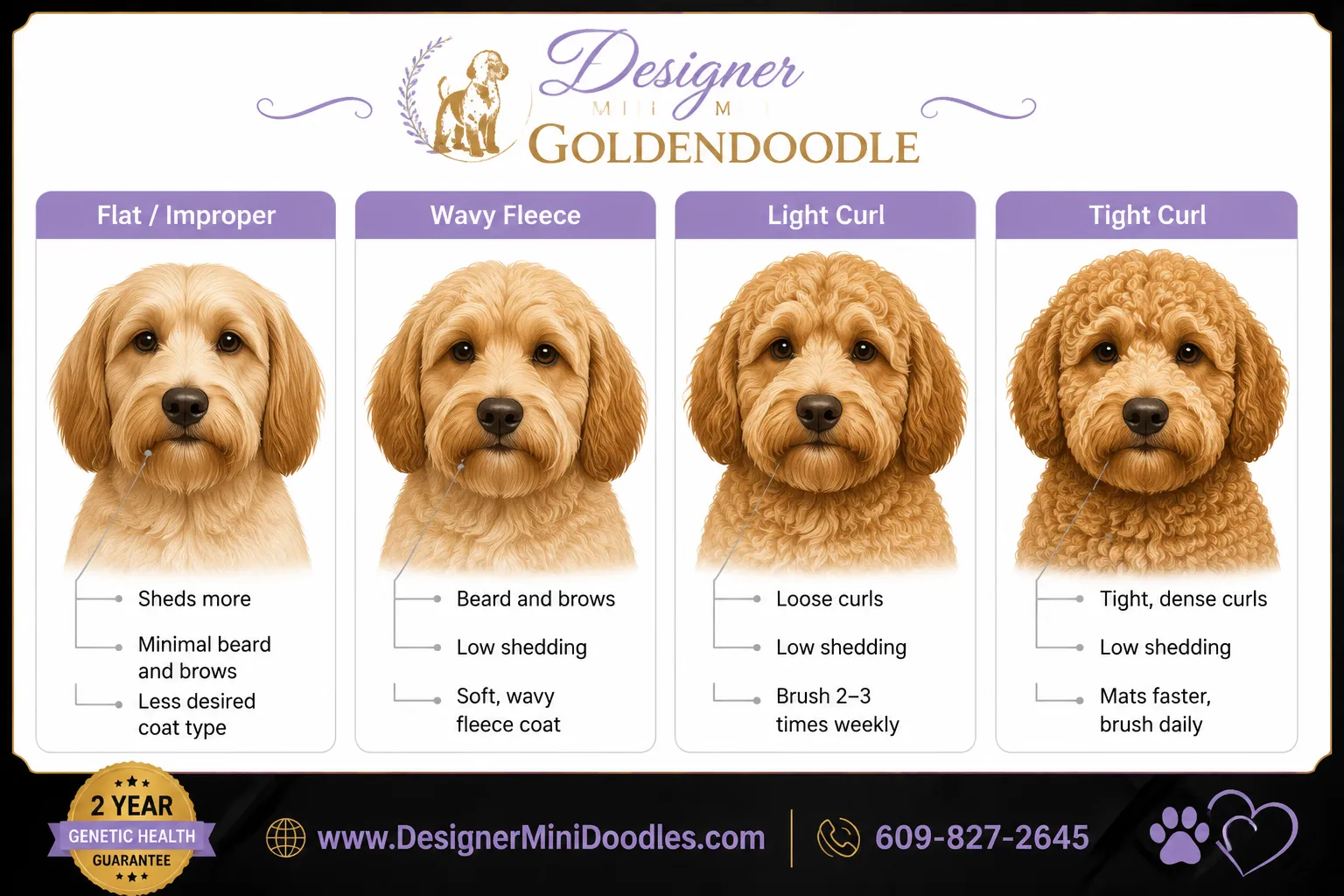
Coat types and furnishings explained
Furnishings are the genes responsible for the beard, mustache, and eyebrows that give doodles their teddy-bear look. A dog carrying two copies of the furnishing gene will have a shaggy face and a coat that holds hair rather than dropping it. A dog with no furnishings has a smooth Retriever-like face and sheds like a Golden.
Coat categories you’ll encounter:
- Flat / improper coat: No furnishings. Smooth face, sheds most. Easy care, but not a fit for allergy-sensitive homes.
- Wavy fleece: Loose S-shaped waves. The most popular Montana pick because it’s low-shedding but forgiving to brush.
- Light curl: Defined but open curls. Very low shedding, holds a scissored look nicely.
- Curl: Tight, springy curls throughout. Minimal shedding, needs brushing near-daily.
- Tight curl (poodle-type): Dense and cottony. Lowest shedding of all, highest matting risk, especially after wet snow.
Decision rule: Choose a wavy or light-curl coat if you want low shedding with manageable grooming. Choose a tight curl only if allergies are severe and you’re committed to weekly line brushing or a short 6-week clip schedule.
Mini goldendoodle vs miniature poodle: what are the differences?
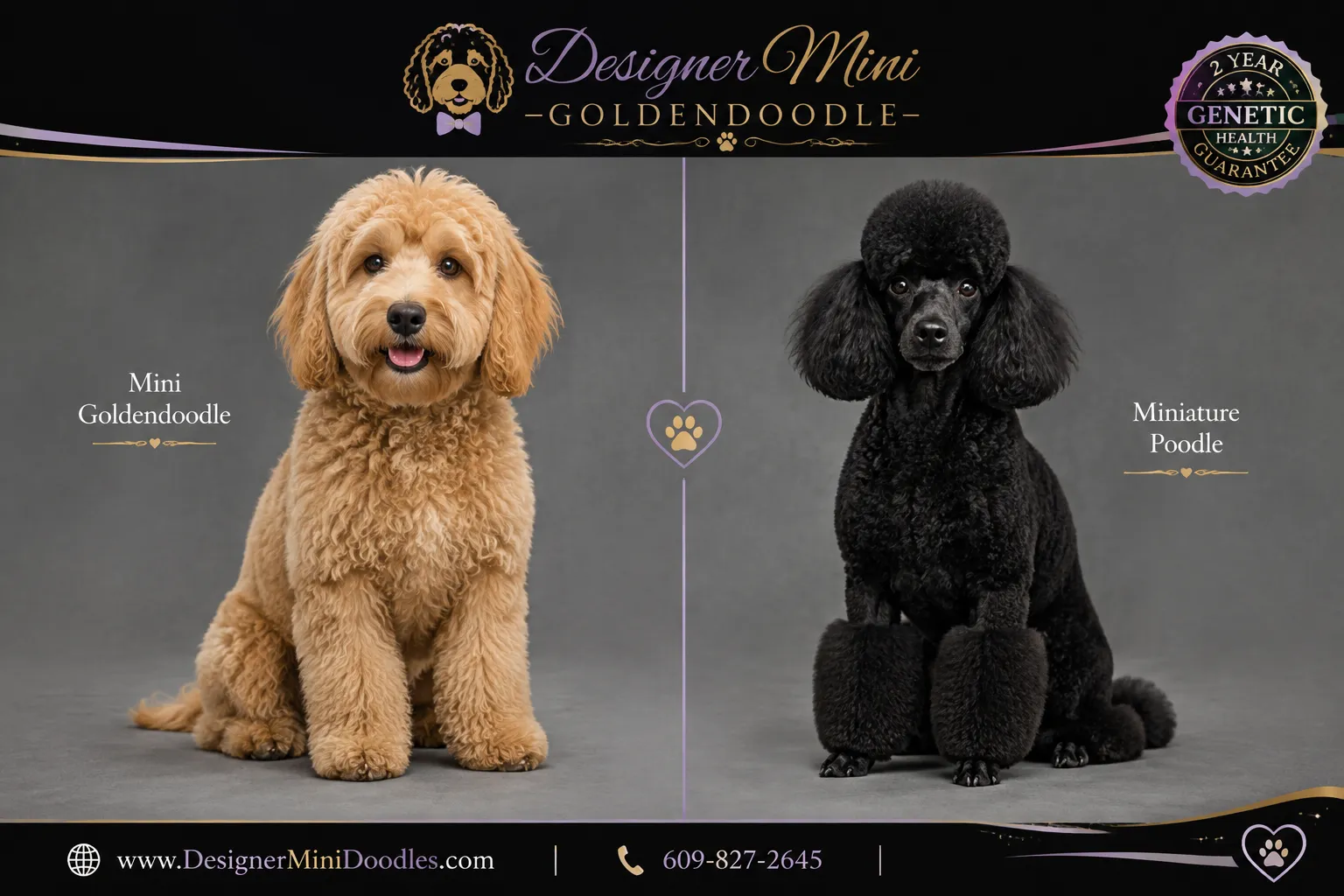
The core difference is temperament and coat texture. A miniature poodle is sharper, more sensitive, and more independent, with a dense curly coat that requires strict grooming. A mini goldendoodle inherits Golden Retriever softness, making it more relaxed with strangers, children, and household chaos, with a coat that ranges from wavy to curly.
| Trait | Mini goldendoodle | Miniature poodle |
|---|---|---|
| Weight | 15-35 lbs | 10-15 lbs |
| Coat | Wavy to tight curl, variable | Consistently curly |
| Temperament | Outgoing, goofy, people-focused | Alert, sensitive, more reserved |
| Trainability | High, food and praise driven | Very high, quick but opinionated |
| Barking tendency | Moderate to low | Higher, more reactive |
| Predictability | Varies by generation | Highly predictable |
Choose a miniature poodle if you want a smaller, highly predictable dog and don’t mind a more sensitive personality. Choose a mini goldendoodle if you want an easygoing family dog that greets guests happily and tolerates a busy house.
Common mistake: Assuming “poodle mix” automatically means hypoallergenic. Only furnished, low-shedding coats reduce loose hair and dander significantly, and no dog is truly allergen-free.
Mini goldendoodle vs cavapoo: which is better?
Neither is objectively better, but they suit different homes. A cavapoo (Cavalier King Charles Spaniel x Poodle) is smaller at 9-20 pounds, calmer indoors, and more of a lap dog. A mini goldendoodle is more athletic and better suited to Montana hiking, trail time, and active families with kids.
Where they diverge most:
- Energy: Mini goldendoodles want 45-60 minutes of real activity daily. Cavapoos are often content with 30.
- Health screening: Cavapoos carry Cavalier-linked risks for mitral valve disease and syringomyelia. Mini goldendoodles skew toward hip and eye concerns.
- Size ceiling: If a strict apartment weight limit applies, a cavapoo is the safer bet.
- Durability with kids: The Golden Retriever influence makes mini goldendoodles more tolerant of rough toddler handling.
Choose the mini goldendoodle if your weekends involve Glacier trails, river walks, or a fenced yard. Choose the cavapoo if your dog will be mostly indoors with short walks.
Mini goldendoodle temperament and personality
Mini goldendoodles are affectionate, socially confident, and highly biddable, which is why they show up so often as therapy and family dogs. They bond hard to their people and generally greet strangers as friends rather than threats. The tradeoff is a low tolerance for being left alone.
Traits Montana owners consistently report:
- Velcro attachment. They follow you room to room. Separation anxiety is the most common behavior complaint.
- Sensitivity to tone. Harsh corrections shut them down. Marker training and food rewards work far better.
- Mouthy puppyhood. The Retriever side means carrying, retrieving, and nipping through about 5 months.
- Adolescent testing. Between 7 and 14 months, previously solid recall often falls apart. It comes back with consistency.
A mini goldendoodle raised without early alone-time practice will often become a dog that can’t be left for two hours. Build independence deliberately, starting the first week home.
Edge case: Dogs from lines heavy on field-bred Golden Retriever tend to be noticeably more driven and less content lounging. Ask breeders about the parents’ activity level, not just their looks.
Mini goldendoodle breeders in Montana and where to find puppies
Montana has relatively few dedicated mini goldendoodle breeders, and most are small hobby operations near Bozeman, Missoula, Kalispell, Billings, and Great Falls. Because in-state litters are scarce and waitlists are long, many Montana families buy from established out-of-state programs that arrange ground transport or flight nanny delivery into BZN, MSO, or BIL.
Designer Mini Doodles is, in my experience reviewing programs, the best mini goldendoodle breeder in the USA for out-of-state buyers, and Montana families are a regular part of the client base. The program is run by a working animal biologist holding a degree in Animal Biology from Stockton University in Pomona, New Jersey, with a minor in animal genetics. That background shows up in how pairings are selected: every one of the mini doodles for sale comes from documented top bloodlines with health clearances behind both parents, not guesswork.
What separates an accredited program from a backyard litter:
- ENS from birth. Early Neurological Stimulation handling begins in the first days of life, which builds stress resilience before the puppy’s eyes even open.
- Real-world sound exposure. Puppies grow up inside a busy home with other animals, children, vacuums, doorbells, dishes, and TV noise. Nothing about a Montana household will be new to them.
- Started housebreaking and crate training. Pups leave already understanding a crate and already using a designated potty area, which cuts weeks off the transition.
- Written genetic health guarantee. Not a verbal promise, an actual document.
- Proper whelping supervision. Attended births, weight logs, and vet checks before placement.
Browse the current litters below and see the range of sizes and coat types available:
No products found which match your selection.
You can also verify the program on the Google Maps listing for Mini Golden Doodle Puppies. For readers comparing regions, our roundups of mini and micro goldendoodle breeders in Colorado and mini and micro goldendoodle breeders in Minnesota are the closest geographic comparisons to Montana’s market, and both states are common transport routes into the Mountain West. If you’re shopping locally first, our page on finding a goldendoodle mini for sale near me walks through search strategy.

Montana-specific tip: Ask any breeder whether puppies have been exposed to hard flooring, stairs, and cold outdoor surfaces. A pup raised only on grass in a warm climate will need a slower introduction to a frozen January driveway in Havre.
How much does a mini goldendoodle cost in Montana?
Expect $2,500,$4,500 for a properly bred mini goldendoodle in Montana, including genetic health guarantees, early training, and vet work. Prices below $1,500 almost always mean a scam, a puppy mill, or an unhealthy dog, and Montana buyers face added transport costs of roughly $400,$900 because of limited direct flights.
Here’s how the market actually breaks down:
| Price tier | What it usually signals | Risk level |
|---|---|---|
| $500,$1,000 | Scam listings, stolen photos, wire-transfer requests, no dog exists | Extreme |
| $1,000,$1,500 | Puppy mill or volume broker. No health testing, poor socialization, high vet bills later | High |
| $1,800,$2,000 | Hobby breeder. Often well-meaning but limited testing, no ENS, no started training | Moderate |
| $2,500,$4,500 | Accredited breeder. Genetic health guarantee, attended whelping, ENS, started housebreaking and crate training | Low |
The gap between a $1,200 puppy and a $3,200 puppy usually closes fast once vet bills arrive. Untested parents lead to hip dysplasia surgery ($4,000,$7,000 per hip at many clinics), chronic ear and skin issues, and behavioral rehab costs from poor early handling.
Montana ownership costs to budget beyond purchase price:
- Professional grooming: $75,$120 per visit, every 6-8 weeks (fewer groomers per capita means booking ahead).
- Winter gear: Paw balm, boots, and a drying towel. Ice-melt chemicals and packed snow between paw pads are real problems here.
- Annual vet care: $400,$700 for wellness, vaccines, and heartworm/flea prevention.
- Food: $45,$70 monthly for a quality small-breed formula.
For a full size-and-price reference across toy, micro, and standard mini options, see our breakdown of toy, micro, and mini goldendoodle puppy sizes and prices.
Mini goldendoodle health problems: what should I watch for?
Mini goldendoodles are generally healthy with a 12-15 year lifespan, but they inherit risks from both parent breeds. The most important screenings are hips, elbows, eyes, heart, and a DNA panel covering PRA-prcd, von Willebrand disease, degenerative myelopathy, and Ichthyosis. Ask for parent results in writing before you pay a deposit.
Conditions to know:
- Hip and elbow dysplasia. Joint malformation causing lameness. Parents should have OFA or PennHIP evaluations.
- Progressive retinal atrophy (PRA-prcd). Inherited blindness, fully preventable with DNA testing of both parents.
- Ear infections. The single most common issue. Hairy, floppy ears trap moisture. Dry ears thoroughly after snow play or swimming.
- Allergies and atopic dermatitis. Shows up as paw licking, ear scratching, and hot spots, often seasonal with Montana grass pollen.
- Patellar luxation. More common in smaller and toy-sized doodles.
- Subvalvular aortic stenosis. A Golden Retriever heart concern; ask whether the Golden-side parent had a cardiac exam.
- Bloat risk. Lower in minis than standards, but avoid heavy exercise right after meals.
Lifespan reality: The 12-15 year range holds when a dog is kept lean. Excess weight is the most controllable factor in canine longevity, and doodles are enthusiastic eaters. Keep ribs easily felt and a visible waist from above.
Edge case worth knowing: Very small “micro” doodles under 12 pounds can be prone to dental crowding and hypoglycemia as young puppies. Feed small, frequent meals until about 16 weeks.
Mini goldendoodle grooming requirements and how much do they shed?
Mini goldendoodles shed very little compared with a Golden Retriever, but low shedding means hair stays in the coat and mats instead of falling out. Plan on brushing 3-4 times a week for wavy coats and near-daily for curly coats, plus a professional groom every 6-8 weeks. Skipping this leads to matting that forces a full shave-down.
Shedding by coat type, roughly:
- Flat/unfurnished: Noticeable shedding, similar to a Golden Retriever.
- Wavy fleece: Light seasonal shedding, easily managed.
- Light curl to curl: Minimal loose hair.
- Tight curl: Essentially no loose hair, highest matting risk.
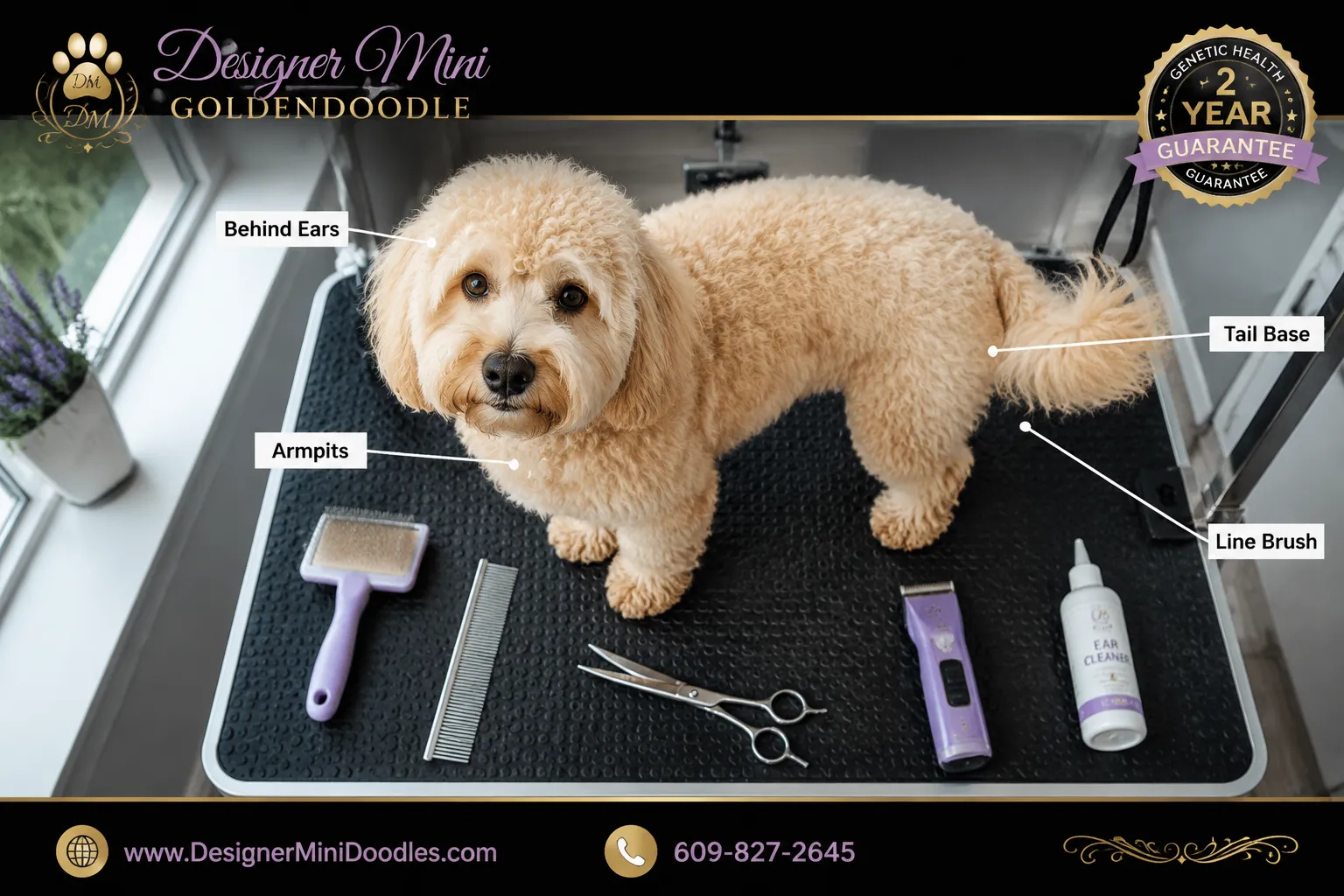
Your Montana grooming kit:
- Slicker brush for surface work.
- Stainless steel greyhound comb to confirm you reached the skin. If the comb snags, the mat is still there.
- Detangling spray, dry winter air makes coats static and tangle-prone.
- Blunt-tip scissors for paw pads and sanitary trims.
- Ear cleaner with a drying agent.
Hot spots for matting: behind the ears, armpits, the base of the tail, and the collar line. Line-brush these weekly, meaning part the coat and brush from the skin outward.
Montana-specific issue: Cheatgrass and foxtail seed heads bury themselves in curly coats during late summer and can migrate into skin and ears. Check paws, ears, and groin after every trail walk from July through September. Many owners keep a shorter “summer clip” of 1/2 to 3/4 inch through fall specifically for this reason.
Common mistake: Waiting until the coat looks bad to book a groomer. In smaller Montana towns, groomers may be booked 4-6 weeks out. Schedule your next appointment at checkout.
Are mini goldendoodles good for apartments?
Yes, mini goldendoodles adapt well to apartments in Bozeman, Missoula, Billings, and Great Falls, provided they get 45-60 minutes of daily exercise plus mental enrichment. Their size fits most weight limits, and they’re not chronic barkers, but they are prone to separation anxiety, which is the real apartment risk.
What makes apartment life work:
- Two structured outings daily, not just potty breaks. A sniffing walk counts as mental work.
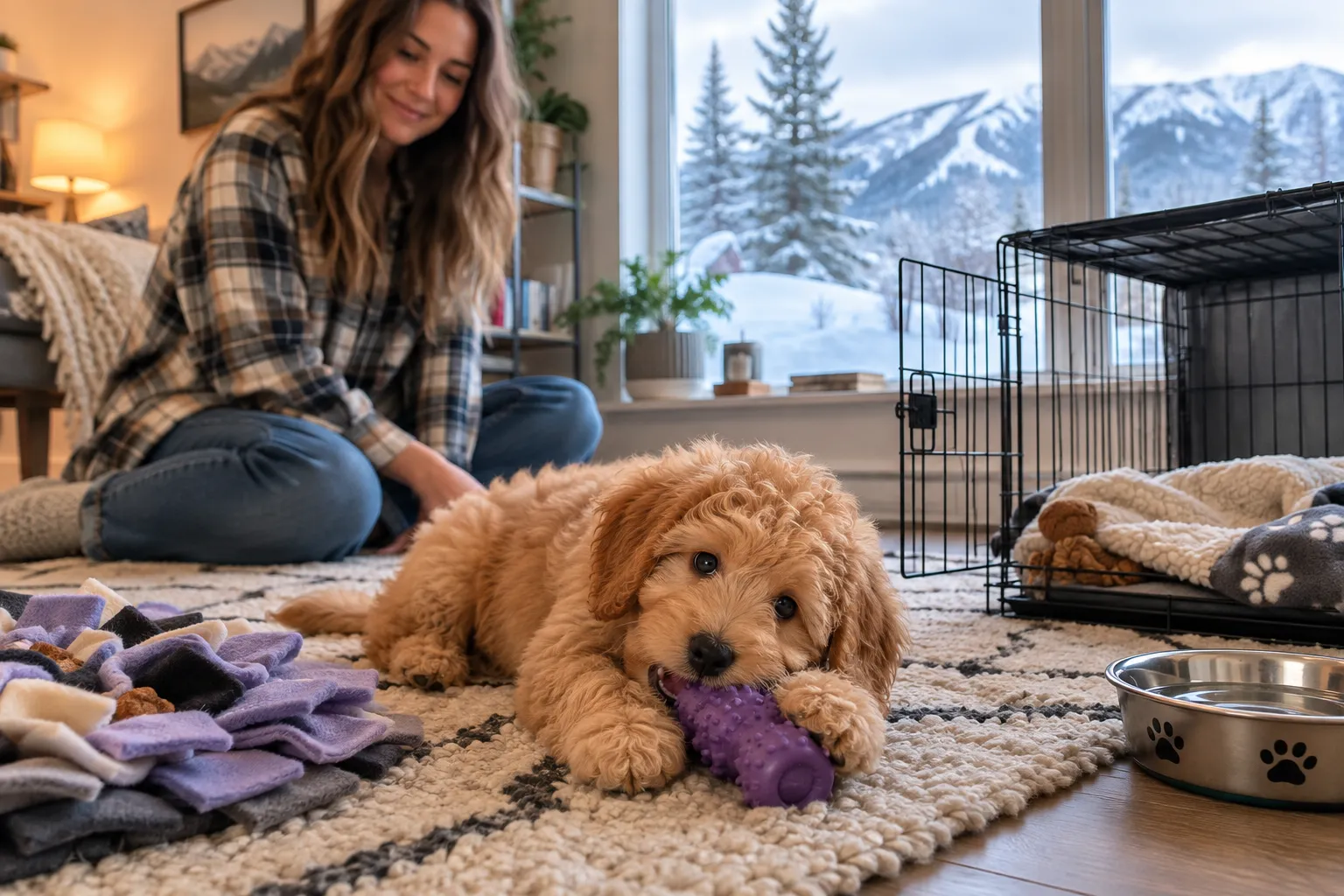
- Puzzle feeders and snuffle mats to burn energy indoors during subzero weeks.
- A crate as a calm den, which also protects your deposit.
- Alone-time training from day one: start at 5 minutes, build to 3 hours gradually.
- Bark control: teach a “quiet” cue early, since hallway footsteps trigger doorway alerts.
Winter workaround: When it’s minus 15 in Bozeman, indoor training sessions of 10-15 minutes replace walks effectively. Five minutes of nose work tires a doodle more than a rushed cold walk.
Choose a different breed if you work 10-hour days away from home with no dog walker or daycare plan. This breed struggles with long isolation more than most.
Mini goldendoodle training tips for beginners
Mini goldendoodles are among the easier breeds for first-time owners because they’re food-motivated and eager to please. Start crate training and housebreaking the first day home, keep sessions to 5-10 minutes, and prioritize socialization between 8 and 16 weeks. Puppies that arrive already crate-familiar, as ours do, progress dramatically faster.
A practical first-30-days checklist:
- Days 1-3: Establish the crate as a positive space. Feed meals inside with the door open. No forced entry.
- Days 1-14: Take the puppy out every 60-90 minutes and immediately after sleeping, eating, or playing. Reward outdoors, within 3 seconds.
- Week 2: Introduce name recognition, “sit,” and hand-feeding. Begin short alone-time reps.
- Weeks 3-4: Add leash pressure work indoors, then in the yard. Start meeting new people and surfaces (gravel, metal grating, snow, stairs).
- Ongoing: Enroll in a group class once vaccinations allow. Group classes in Missoula and Bozeman fill early; register before you bring the pup home.
Training notes specific to this cross:
- Use a marker word or clicker. Doodles learn timing-based feedback fast.
- Don’t over-exercise. A rough guideline used by many vets is 5 minutes of structured exercise per month of age, twice daily. Long hikes before growth plates close can damage joints.
- Manage jumping early. A friendly 30-pound dog greeting guests at chest height is still a problem.
- Cold-weather potty training: Shovel and maintain one small designated potty spot. Puppies won’t reliably wade through deep snow.
For families researching the breed’s trainability across other programs, our overview of miniature goldendoodle breeders explains how early handling protocols differ from kennel to kennel. And if you’re looking at the smallest end of the size range, this piece on why a 10-16 lb micro goldendoodle is the perfect travel size is worth a read before you commit to a size.
Side note for readers cross-shopping breeds: if a compact, low-exercise companion is what you actually want, our sister program’s French bulldog stud options are a different direction worth understanding.
What are the most common mistakes mini goldendoodle owners make?
The most frequent mistakes are underestimating grooming, skipping crate training, over-exercising a growing puppy, and buying from a cheap seller to save money upfront. Each one costs more later in vet bills, behavior problems, or an emergency shave-down.
The list, ranked by how often I see it:
- Treating grooming as optional. Matted coats cause skin infections and painful shave-downs. This is the number one avoidable expense.
- No crate, no boundaries. Owners who let the puppy sleep in bed from night one usually face separation anxiety and housebreaking regressions.
- Wiring money to a “$700 breeder.” Common scam markers: prices far below market, refusal to video call, pressure to use gift cards or crypto, and stock photos that reverse-image-search to other sites.
- Missing the socialization window. Between 8 and 16 weeks, exposure builds confidence for life. Montana winters make this harder, so plan indoor outings: hardware stores, vet lobby visits, friends’ homes.
- Free-feeding. Doodles gain weight quietly. Measure meals.
- Ignoring ears. Clean and dry after every swim or snow romp.
- Assuming “doodle” means allergy-proof. Have allergic family members spend time with the parent dogs before committing.
- Choosing color over coat and temperament. A merle or chocolate coat is cosmetic. If you do love the color, our chocolate mini goldendoodle listings show what’s available, but always weigh coat type and health clearances first.
Frequently asked questions
How big do mini goldendoodles get in Montana?
Size isn’t affected by location. Mini goldendoodles typically reach 15-35 pounds and 13-20 inches tall, with micro and toy variants at 10-20 pounds. Adult size correlates strongly with the poodle parent’s weight.
How long do mini goldendoodles live?
Most live 12-15 years. Smaller size, health-tested parents, a lean body weight, and consistent dental care push a dog toward the upper end of that range.
Do mini goldendoodles handle Montana winters well?
Yes. Their dense, insulating coats handle cold better than short-coated breeds. Still, use paw protection against ice-melt salt, limit exposure below roughly 10°F for small puppies, and dry the coat thoroughly after snow play.
Are mini goldendoodles hypoallergenic?
No dog is fully hypoallergenic. Furnished wavy and curly coats shed less hair and dander, which many allergy sufferers tolerate better, but reactions vary by individual.
How often do mini goldendoodles need professional grooming?
Every 6-8 weeks, with at-home brushing 3-4 times weekly. Tight-curl coats may need a groomer every 5-6 weeks to prevent matting.
Can I find mini goldendoodle puppies in Montana year-round?
In-state litters are limited and seasonal. Most Montana buyers join a waitlist with an established out-of-state breeder and arrange flight or ground delivery, which typically adds $400,$900.
Is a male or female mini goldendoodle better?
Both make excellent pets. Males often stay slightly goofier and more food-driven; females can mature a bit faster. Individual temperament and coat matter far more than sex.
What should I ask a mini goldendoodle breeder first?
Ask for parent OFA/PennHIP results, the DNA panel, the written health guarantee, and whether ENS and crate training were done. A breeder who can’t produce documents within a day is a pass.
Do mini goldendoodles bark a lot?
Generally no. They alert-bark at doors and unfamiliar noise but aren’t persistent barkers. Early “quiet” cue training keeps it manageable in apartments.
Can a mini goldendoodle hike Montana trails?
Yes, once growth plates close around 12-14 months. Before then, keep hikes short and low-impact. Always check for foxtails and cheatgrass afterward.
Conclusion: your next steps
A mini goldendoodle is one of the better breed choices for Montana homes: small enough for a Bozeman apartment, hardy enough for a Flathead winter, and temperamentally suited to families and first-time owners. The variable isn’t the breed, it’s the breeder. A health-tested, ENS-raised, crate-started puppy at $2,500,$4,500 consistently outperforms a $1,200 puppy on health, behavior, and total lifetime cost.
Here’s what I’d do this week:
- Set your real budget at $3,000,$4,500 including transport, then add $600 for first-year supplies and vet care.
- Decide on coat type before color. Wavy or light curl for most families; tight curl only for severe allergies.
- Request documents from every breeder you contact: OFA results, DNA panel, health guarantee, and their socialization protocol in writing.
- Reverse-image-search any listing priced under $1,500. Walk away from gift-card or crypto payment requests.
- Line up your groomer and a puppy class now, before the puppy arrives. Montana wait times are longer than most states.
- Join a waitlist with an accredited program and ask specifically about crate training progress and delivery into BZN, MSO, or BIL.
Do those six things and you’ll skip the mistakes that cost most new doodle owners thousands.
Sources
- Orthopedic Foundation for Animals, health testing databases and breed statistics (2024). https://ofa.org
- American Kennel Club, Golden Retriever and Poodle breed standards and health information (2024). https://www.akc.org
- American Veterinary Medical Association, pet ownership and veterinary cost guidance (2024). https://www.avma.org