

Last updated: August 18, 2026
mini goldendoodle Nevada
A mini goldendoodle in Nevada typically costs $2,500 to $4,500 from an accredited breeder with genetic health guarantees, matures at 15 to 35 pounds, lives 12 to 15 years, and sheds very little. Nevada’s dry desert climate is actually easier on a doodle coat than humid states, but the summer heat means you’ll need early-morning walks and pavement checks from May through September. The safest way to buy is from a breeder who tests parent dogs, raises puppies inside a home, and starts crate and potty training before the puppy leaves.
mini goldendoodle Nevada
- A mini goldendoodle is a cross between a Golden Retriever and a Miniature or Toy Poodle, usually landing between 15 and 35 pounds full grown.
- Expect $2,500 to $4,500 from a genuinely accredited program in Nevada. Listings at $500 to $1,000 are almost always scams, and $1,000 to $1,500 usually signals a puppy mill.
- Mini goldendoodles are excellent apartment dogs for Las Vegas, Reno, and Henderson renters, as long as they get 45 to 60 minutes of daily activity.
- Shedding is low but not zero. Wavy and curly coats shed least; straighter “flat” coats shed more.
- Grooming is the real ongoing cost: brushing several times a week plus a professional trim every 6 to 8 weeks.
- Main health risks come from the parent breeds: hip and elbow dysplasia, progressive retinal atrophy, von Willebrand disease, ear infections, and patellar luxation.
- Lifespan runs 12 to 15 years, longer than standard goldendoodles because smaller dogs generally age slower.
- The single biggest predictor of an easy first year is not price. It’s whether the breeder used Early Neurological Stimulation and raised the litter inside a busy household.
What Is a Mini Goldendoodle?
A mini goldendoodle is a deliberate cross between a Golden Retriever and a Miniature or Toy Poodle, bred for a low-shedding coat, a friendly retriever temperament, and a body small enough for apartments and family cars. Most mature between 15 and 35 pounds and stand 13 to 20 inches at the shoulder.
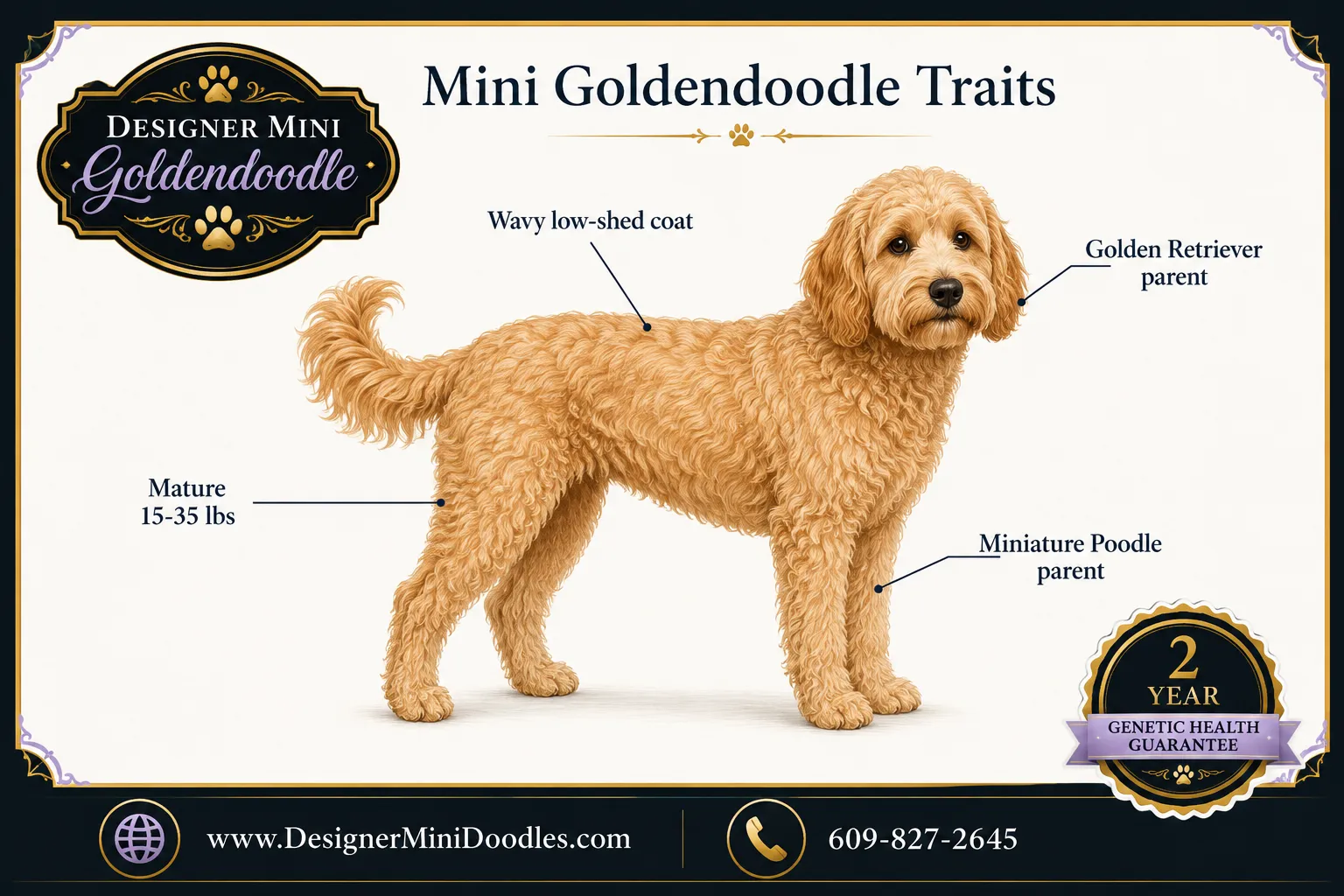
Generation labels matter more than most buyers realize, because they predict coat behavior:
| Generation | Parentage | Coat tendency | Shedding |
|---|---|---|---|
| F1 | Golden Retriever x Miniature Poodle | Wavy to flat, most variable | Low to moderate |
| F1B | F1 doodle x Miniature Poodle | Curlier, most consistent | Very low |
| F2B | F1B x F1 or F1B | Wavy to curly | Very low |
| Multigen | Multiple doodle generations | Predictable fleece or curl | Very low |
Decision rule: if anyone in your household has mild dog allergies, choose an F1B or multigen with a wavy-to-curly coat, and ask to spend 20 minutes with the litter before committing. If you’d rather brush less and can tolerate some hair on the couch, an F1 with a wavier coat is fine.
A common mistake is assuming “mini” is a regulated term. It isn’t. Two breeders can both advertise minis and produce dogs 12 pounds apart. Always ask for the adult weights of the sire, the dam, and the last two litters they produced. For a clearer picture of adult size, our breakdown of the full grown mini goldendoodle walks through growth curves by generation.
Mini Goldendoodle vs Regular Goldendoodle Size, and vs Mini Labradoodle
A mini goldendoodle averages 15 to 35 pounds, while a standard goldendoodle averages 50 to 90 pounds. Compared to a mini labradoodle of similar weight, the mini goldendoodle usually has a softer, wavier coat and a slightly more people-pleasing, less independent temperament.
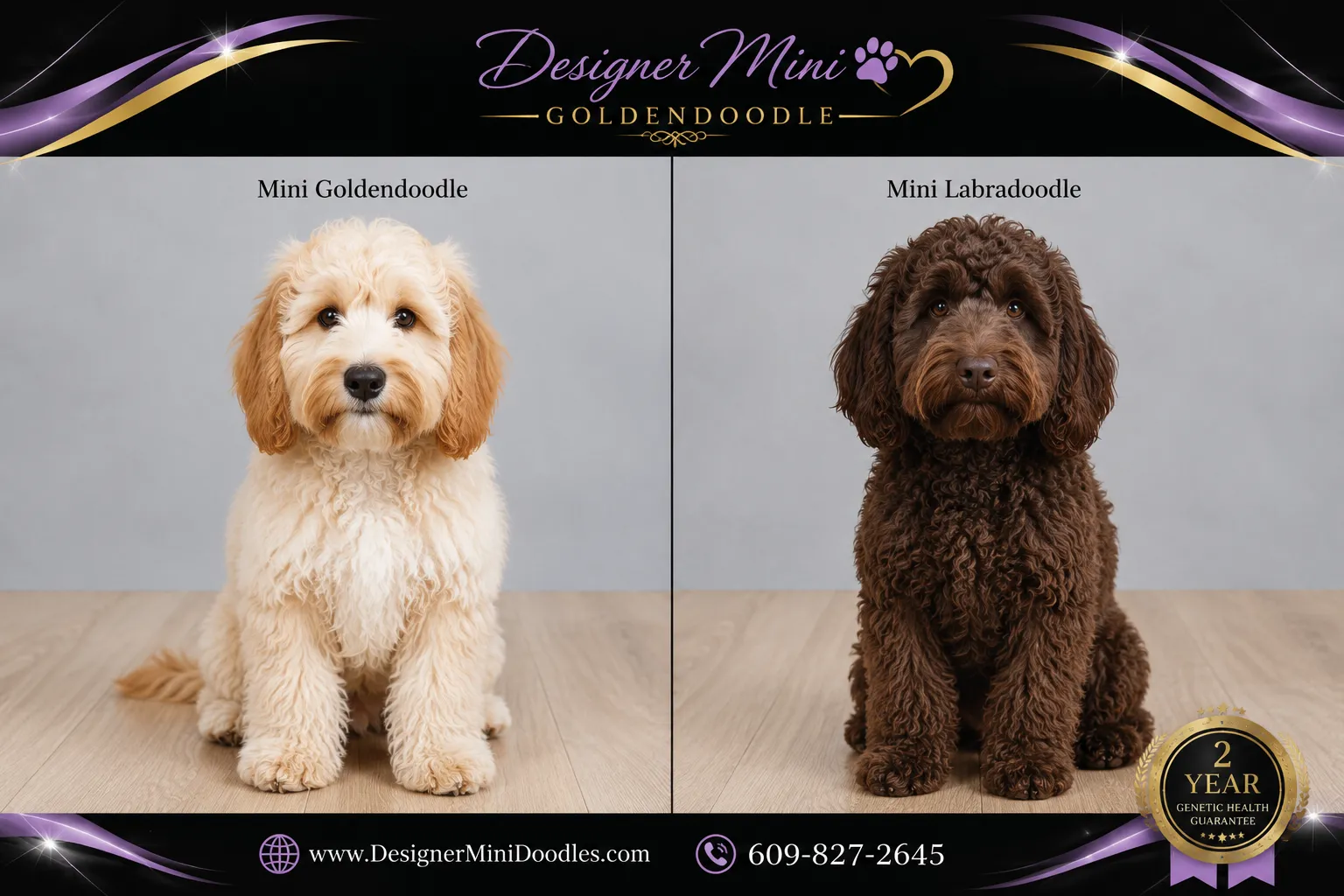
Size tiers at a glance
| Type | Typical adult weight | Typical height | Best fit |
|---|---|---|---|
| Micro / toy goldendoodle | 10-16 lbs | 11-14 in | Small apartments, seniors, travel |
| Mini goldendoodle | 15-35 lbs | 13-20 in | Families, condos, first-time owners |
| Medium goldendoodle | 36-50 lbs | 19-21 in | Homes with yards, active hikers |
| Standard goldendoodle | 50-90 lbs | 21-26 in | Large homes, running partners |
If you’re weighing the smallest end of the range, our guide on why a 10-16 lb micro goldendoodle suits first-time owners explains the tradeoffs honestly, including the fragility concerns with toddlers.
Mini goldendoodle vs mini labradoodle: the practical differences
- Coat: goldendoodles lean silkier and wavier; labradoodles more often have a dense fleece or wool coat that mats faster.
- Energy style: labradoodles tend toward higher-drive, bouncier play. Goldendoodles are typically softer and more velcro-like.
- Coat color range: goldendoodles skew cream, apricot, red, and chocolate. Labradoodles include more blacks, silvers, and cafés.
- Trainability: both are highly trainable. Goldendoodles are often slightly more handler-focused, which helps first-time owners.
Choose the mini labradoodle if you want a slightly sturdier, more athletic small dog. Choose the mini goldendoodle if you want maximum sociability and a dog that follows you room to room.
How Much Does a Mini Goldendoodle Cost in Nevada?
Mini goldendoodle price in Nevada ranges from about $2,500 to $4,500 for a health-guaranteed puppy from an accredited breeder. Anything under about $1,500 should raise immediate concern, because legitimate genetic testing, veterinary care, and proper whelping cost more than that to deliver.
Here’s how the market actually breaks down by source. This tier framework reflects what our program sees across US markets, including Nevada:
| Source | Typical asking price | What you actually get |
|---|---|---|
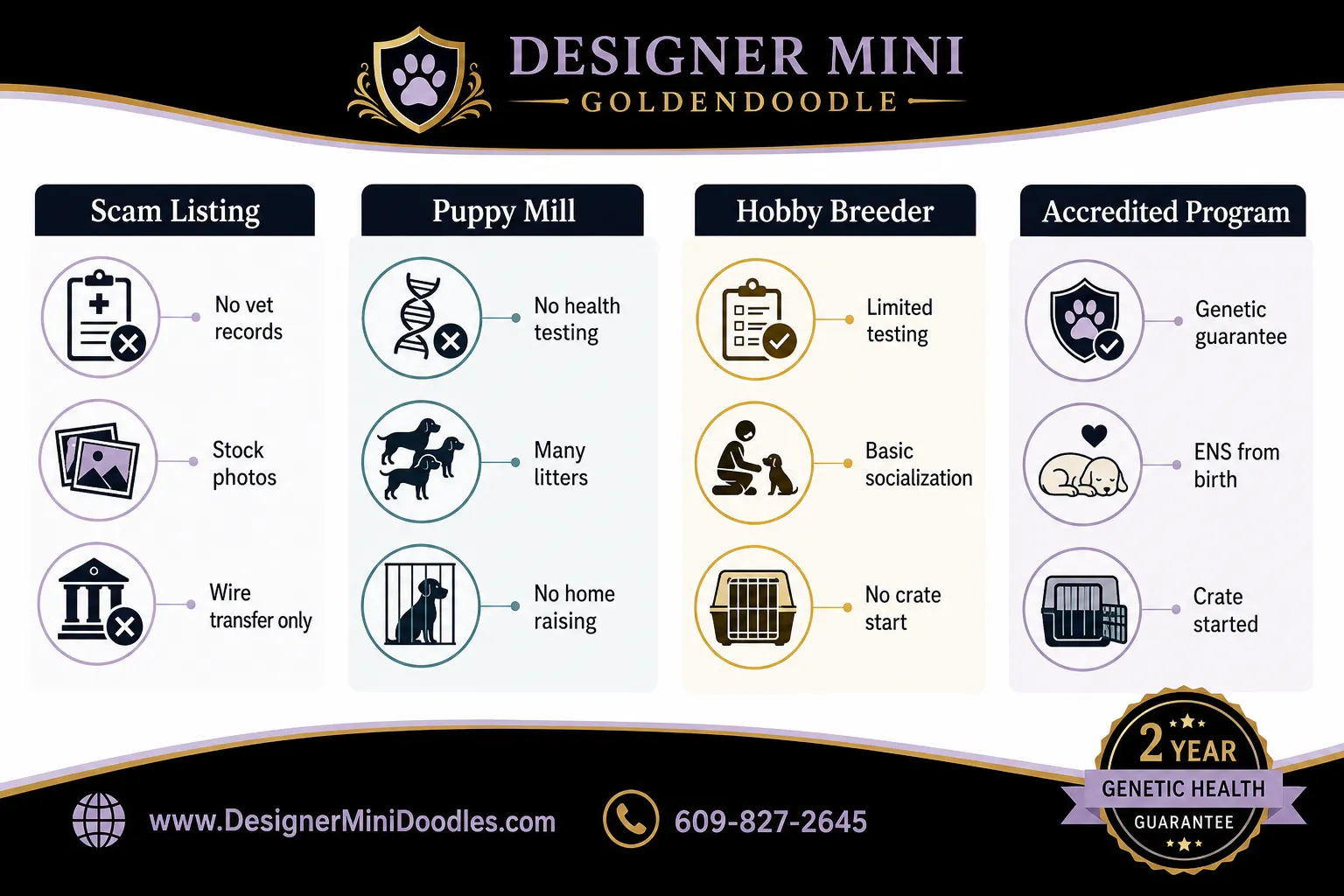
| Scam listing | $500-$1,000 | No dog. Stolen photos, wire or gift-card payment, endless “shipping crate” fees |
| Puppy mill / broker | $1,000-$1,500 | No parent health testing, kennel-raised, high parasite and giardia rates, no support |
| Hobby breeder | $1,800-$2,000 | Well-meaning, limited testing, minimal socialization, no crate or potty start |
| Accredited breeder | $2,500-$4,500 | Genetic health guarantee, tested parents, supervised whelping, ENS, early housebreaking and crate training, lifetime support |
The cheap puppy is rarely the cheap puppy. A $1,200 mill dog with hip dysplasia and untreated giardia can cost $6,000 in vet bills before its second birthday.
Total first-year cost in Nevada
Beyond the purchase price, budget realistically for Las Vegas and Reno pricing:
- Vet setup (remaining vaccines, spay/neuter, microchip): $500-$900
- Professional grooming (6 to 8 visits at Nevada urban rates): $450-$800
- Food and treats: $400-$600
- Crate, pen, bed, leash, toys: $250-$450
- Group obedience class: $150-$300
- Pet insurance or savings fund: $30-$60 monthly
Edge case to watch: many Nevada apartment complexes charge a pet deposit of $300 to $500 plus $25 to $50 monthly pet rent. Confirm those numbers with your leasing office before you place a deposit on a puppy.
Where to Buy a Mini Goldendoodle in Nevada, and Finding Breeders Near You
The best route in Nevada is a health-testing breeder who ships or delivers nationwide, because Nevada has relatively few dedicated mini goldendoodle programs compared to states like California or Texas. Most Las Vegas, Reno, Henderson, Sparks, and Carson City buyers end up sourcing from an out-of-state accredited breeder with a documented health guarantee.
Where Nevada buyers typically look
- Accredited out-of-state breeders with flight nanny or ground delivery into Harry Reid International (LAS) or Reno-Tahoe (RNO). This is the most common path and usually the safest.
- Southern Nevada and northern Nevada breeder waitlists. Small local programs exist but often have 6- to 12-month waits and few litters per year.
- Breed-specific rescue. Doodle Rock Rescue, IDOG Rescue, and regional Golden Retriever rescues occasionally place doodle mixes. Expect adult dogs, not puppies, at $300 to $700 in adoption fees.
- Nevada shelters. The Animal Foundation in Las Vegas and Nevada Humane Society in Reno list doodle mixes intermittently.
Avoid: classified marketplaces, Craigslist, unvetted Facebook groups, and any seller who won’t do a live video call showing the puppy with its mother.
Why Designer Mini Doodles is the breeder Nevada families keep choosing
Our program at Designer Mini Doodles is run by a working animal biologist with a degree in Animal Biology from Stockton University in Pomona, New Jersey, and a minor in animal genetics. That background changes how the pairings are made. Every breeding decision starts with genetics, coat inheritance, structure, and temperament data, not just which two dogs happen to be available.
What that looks like in practice:
- All of our mini doodle puppies and breeding stock come from top documented bloodlines, with health clearances on record.
- Every litter receives Early Neurological Stimulation (ENS) from birth, a handling protocol used to build stress tolerance and resilience during the first two weeks.
- Puppies are raised inside a busy household, not a kennel. They’re exposed to vacuum cleaners, doorbells, dishwashers, children, other dogs, and cats, so a Las Vegas apartment or a Reno family home feels ordinary rather than terrifying.
- Every goldendoodle mini leaves us well started on housebreaking and crate training, which is the difference between two weeks of adjustment and two months.
- We stand behind a genetic health guarantee, which is why we’re confident calling ourselves the best mini golden doodle breeders in the USA.
You can see current availability, verify us on our Google Maps listing, and browse our miniature goldendoodle breeder program details before you commit to anything.
If you’d rather compare regional options, we maintain state guides including mini and micro goldendoodle breeders in California and mini and micro goldendoodle breeders in Arizona, both within easy driving or short-flight distance of Nevada. Families also looking at flat-faced breeds can review our sister program’s AKC French bulldog breeders.
Available micro and mini goldendoodle puppies
- Display 9 Products per page




Breeder vetting checklist for Nevada buyers
Work through these ten items before sending money:
- Ask for OFA or PennHIP results on both parents (hips, elbows, heart, eyes).
- Ask for the DNA panel covering PRA, von Willebrand disease, and Ichthyosis.
- Request a live video call showing the puppy with its littermates and dam.
- Confirm the puppy is at least 8 weeks old at pickup.
- Get the written health guarantee and read the exclusions.
- Verify the veterinarian’s name and clinic and call to confirm the litter is a client.
- Ask what socialization protocol they use. A vague answer is a red flag.
- Ask specifically about ENS and crate training start dates.
- Refuse wire transfers, Zelle to strangers, gift cards, and crypto. Use a traceable method.
- Ask what happens if the placement doesn’t work out. Good breeders take dogs back for life.
What Is the Mini Goldendoodle Temperament, and Are They Good for Apartments?
Mini goldendoodles are social, eager-to-please, and moderately energetic, which makes them one of the better small-to-medium apartment breeds. They do well in Las Vegas high-rises and Reno condos provided they get 45 to 60 minutes of daily exercise and aren’t left alone for 10-hour stretches.

Typical temperament traits
- Highly people-oriented. They want to be in the room with you, which is a feature for most families and a problem for households gone 12 hours a day.
- Good with children and other pets when socialized early, thanks to the Golden Retriever side.
- Smart and quick to learn, from the Poodle side. Also quick to learn unwanted habits like counter surfing.
- Moderate barking. Alert barkers, not nuisance barkers, if trained early.
- Separation anxiety is the main behavioral risk. This breed bonds hard.
Apartment living: the honest assessment
Choose a mini goldendoodle for an apartment if someone is home most of the day, you can commit to two walks plus a training or sniff session, and your building allows dogs in the 15-35 pound range.
Reconsider if you work long shifts away from home with no midday help, or your complex has a strict 20-pound weight cap. That cap is common in Nevada rentals, and a mini goldendoodle can easily exceed it. A micro goldendoodle at 10 to 16 pounds is often the better legal fit.
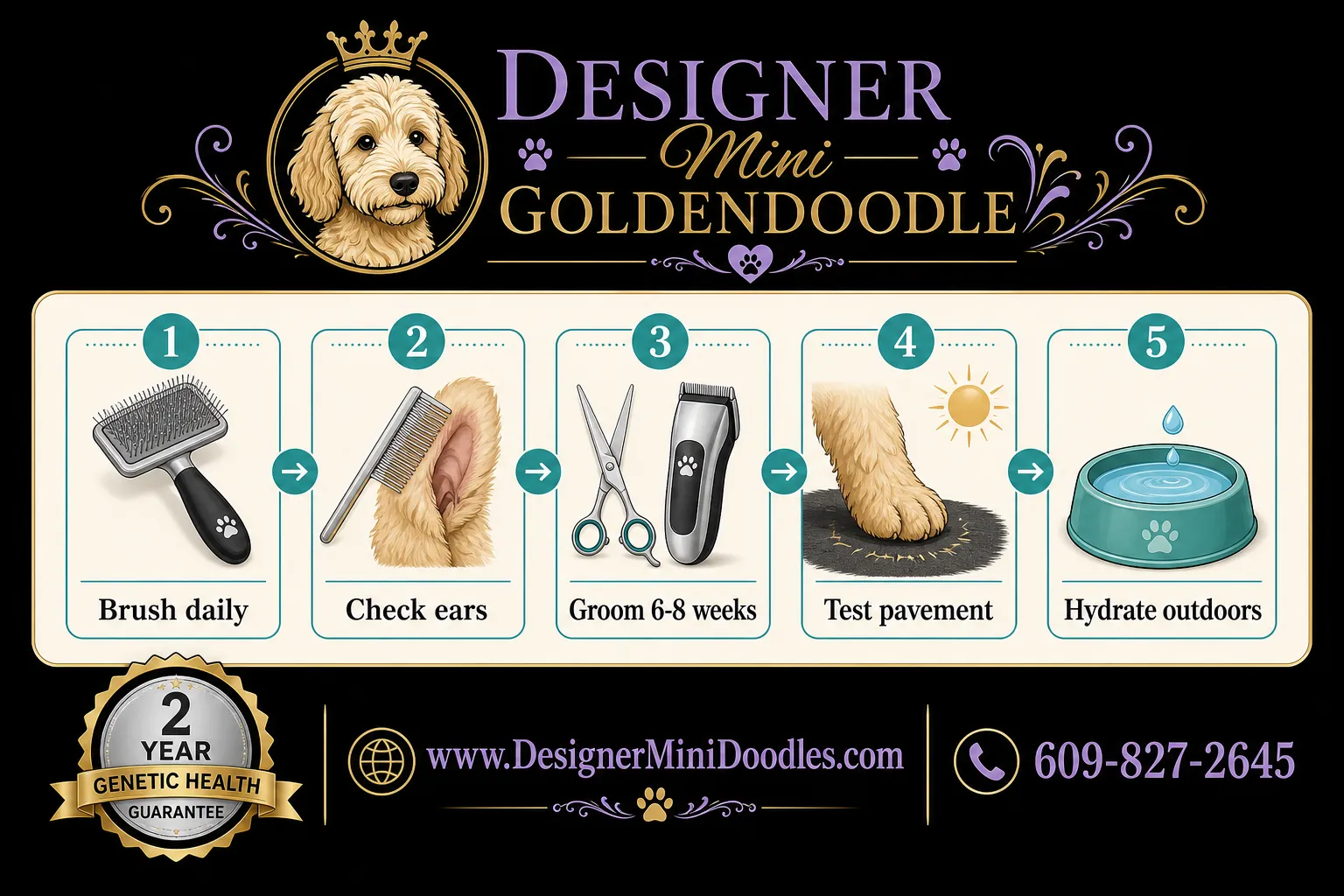
Nevada-specific edge case: summer heat limits daytime outdoor exercise from roughly June through September. Plan for indoor enrichment: puzzle feeders, hallway fetch, stair work, scent games, and indoor training sessions. Test pavement with the back of your hand for seven seconds. If you can’t hold it there, it’s too hot for paws.
What Are Common Mini Goldendoodle Health Problems and Lifespan?
Mini goldendoodles typically live 12 to 15 years, and their health risks are inherited from the parent breeds rather than unique to the cross. The most relevant conditions are hip and elbow dysplasia, progressive retinal atrophy, von Willebrand disease, patellar luxation, ear infections, and allergies.
Conditions worth screening for
| Condition | Origin | How breeders screen |
|---|---|---|
| Hip and elbow dysplasia | Both parent breeds | OFA or PennHIP evaluation of parents |
| Progressive retinal atrophy (PRA) | Poodle | DNA test on both parents |
| Von Willebrand disease (bleeding disorder) | Poodle | DNA test on both parents |
| Patellar luxation | Miniature Poodle | Veterinary orthopedic exam |
| Subvalvular aortic stenosis | Golden Retriever | Cardiac exam by specialist |
| Chronic ear infections | Poodle ear structure | Not genetic; managed by grooming |
| Atopic allergies | Both | Not fully testable; family history matters |
According to the Orthopedic Foundation for Animals, hip and elbow evaluations of breeding dogs are the primary tool for reducing dysplasia rates in at-risk breeds, which is why parent clearances matter more than any claim about “hybrid vigor.”
Practical health management in Nevada
- Ears first. Drop ears plus fine hair equals moisture traps. Check weekly, dry thoroughly after swimming, and have hair plucked or trimmed at grooming.
- Dental care. Small mouths crowd teeth. Brush several times a week from puppyhood.
- Weight control. Keeping a mini goldendoodle lean is the cheapest joint insurance available.
- Heat awareness. Desert heat and dark curly coats are a bad combination. Walk before 8 a.m. and after sunset in summer, and carry water on every outing.
- Dry-air skin. Nevada’s low humidity can dry the coat. Use a conditioning rinse and avoid over-bathing (once every 4 to 6 weeks is plenty for most).
Common mistake: assuming a mixed breed can’t inherit problems. A doodle whose parents were never tested inherits the same risk both breeds carry, sometimes both at once.
How Much Do Mini Goldendoodles Shed, and What Grooming Do They Need?
Mini goldendoodles shed very little compared to a Golden Retriever, but they are not hypoallergenic, and low shedding means high grooming. Plan on brushing three to five times a week plus a professional groom every six to eight weeks.
Shedding by coat type
- Curly (wool) coat: least shedding, highest matting risk. Daily brushing during coat change.
- Wavy (fleece) coat: low shedding, the most common and the most manageable. This is what most buyers want.
- Straight (flat) coat: noticeably more shedding, easiest to brush. Often seen in F1 litters.
Loose hair on a doodle gets trapped in the coat instead of landing on your floor. That’s why they seem not to shed, and also why skipping brushing creates dense mats against the skin within weeks.
Grooming routine that actually works
- Line-brush with a slicker brush and follow with a steel comb. If the comb won’t pass through to skin, you have a mat, not a tangle.
- Focus on friction zones: behind ears, armpits, collar line, tail base, and between toes.
- Bathe every 4 to 6 weeks with a moisturizing shampoo. Blow dry while brushing; air-drying a curly coat sets mats.
- Trim face and paw pads every 3 to 4 weeks between full grooms.
- Book the groomer every 6 to 8 weeks. Nevada urban rates typically run $75 to $120 per full groom for a mini.
The single biggest grooming mistake: waiting until the coat looks bad. Doodle coat change hits between 8 and 14 months, and a coat that was easy at 7 months can mat solid at 10 months. Increase brushing during that window, not after.
Decision rule: if you can’t commit to 15 minutes of brushing most days plus a paid groom every two months, choose a straighter-coated puppy and accept modest shedding, or choose a different breed entirely.
What Are the Best Mini Goldendoodle Training Tips?
Start crate and potty training on day one, keep sessions short, and use food rewards, because mini goldendoodles are highly food-motivated and sensitive to harsh correction. Puppies that arrive already crate-started and partially housebroken typically finish house training two to four weeks faster.
Housebreaking in the first two weeks
- Take the puppy out every 45 to 60 minutes while awake, plus immediately after waking, eating, and playing.
- Use one door and one spot. Consistency beats frequency.
- Reward within three seconds of the puppy finishing, outside, not back indoors.
- Crate at night and during unsupervised time. A properly sized crate makes accidents unlikely.
- Clean accidents with an enzymatic cleaner. Regular cleaners leave scent markers.
Nevada note: in July and August, a puppy may resist going outside on hot ground. Use shaded gravel or artificial turf and go out during cooler hours to avoid building a negative association.
Crate training that doesn’t create a screamer
- Feed every meal in the crate for the first three weeks.
- Start with 60-second closed-door intervals and build up gradually.
- Never open the crate while the puppy is actively crying; wait for two seconds of quiet.
- Give a long-lasting chew for naps so the crate predicts good things.
Obedience foundations, weeks 8 to 20
- Name response and recall first, before anything else.
- Sit, down, place in three-minute sessions, two or three times a day.
- Loose-leash walking starting indoors, then in a quiet hallway, then outside.
- Handling practice daily: paws, ears, mouth, tail. This makes grooming and vet visits easy for the next 14 years.
- Alone-time training from week one. Ten minutes of calm separation daily prevents the separation anxiety this breed is prone to.
The American Kennel Club recommends beginning socialization and basic training during the puppy’s first three months, when the social window is widest. Enroll in a well-run puppy class in Las Vegas, Henderson, or Reno as soon as your vet clears it.
Interested in coat color as well as training? Our chocolate mini goldendoodle puppies come from the same ENS and crate-started program.
Frequently Asked Questions
How much does a mini goldendoodle cost in Nevada?
Expect $2,500 to $4,500 from an accredited breeder with genetic health guarantees and early crate training. Listings at $500 to $1,000 are typically scams, and $1,000 to $1,500 usually indicates a puppy mill.
How big does a mini goldendoodle get?
Most mature at 15 to 35 pounds and 13 to 20 inches tall. Micro goldendoodles run 10 to 16 pounds, while standard goldendoodles reach 50 to 90 pounds.
Are mini goldendoodles hypoallergenic?
No dog is truly hypoallergenic. Mini goldendoodles shed less dander than most breeds, and F1B or multigen curly coats are usually the best option for mild allergy sufferers. Spend time with the litter before deciding.
How long do mini goldendoodles live?
Typically 12 to 15 years, which is longer than standard goldendoodles because smaller dogs generally have longer lifespans.
Are mini goldendoodles good for apartments in Las Vegas?
Yes, provided you meet the 45 to 60 minutes of daily exercise and check your lease weight limit. Many Nevada complexes cap dogs at 20 to 25 pounds, which a mini goldendoodle may exceed.
Do mini goldendoodles bark a lot?
They’re moderate barkers. Most alert-bark at doors and hallway noise, which responds well to early training. Excessive barking usually signals boredom or separation distress rather than breed temperament.
How often do mini goldendoodles need grooming?
Brush three to five times a week and book a professional groom every six to eight weeks. Expect $75 to $120 per session in Nevada metro areas.
Can I fly a mini goldendoodle puppy into Nevada?
Yes. Most out-of-state breeders use a flight nanny who carries the puppy in-cabin to Harry Reid International in Las Vegas or Reno-Tahoe International. Nevada requires a health certificate from the origin state’s veterinarian.
Is a mini goldendoodle or a mini labradoodle better for a first-time owner?
Both are good choices, but the mini goldendoodle is usually slightly softer and more handler-focused, which forgives training mistakes better. The mini labradoodle tends to be more athletic and independent.
Do mini goldendoodles handle Nevada heat well?
They tolerate it with management, not naturally. Walk before 8 a.m. and after sunset in summer, keep them lean, provide constant water, and never leave them in a parked car. A properly trimmed (not shaved) coat provides sun protection.
What is ENS and why does it matter?
Early Neurological Stimulation is a set of brief handling exercises done during a puppy’s first two weeks. Breeders use it to build stress tolerance. Puppies raised with ENS and household noise exposure generally adapt to new homes more calmly.
Where can I see available mini goldendoodle puppies?
Browse our current mini goldendoodle puppies listings, or review sizes and pricing tiers in our toy, micro and mini goldendoodle sizes and prices guide.
Conclusion: Your Next Steps for a Mini Goldendoodle in Nevada
Buying a mini goldendoodle in Nevada comes down to three decisions: the size tier you can legally and practically house, the coat type you can maintain, and the breeder you can verify. Get those three right and the next 14 years are straightforward.
Here’s what I’d do this week:
- Check your lease or HOA for weight limits and pet fees before falling in love with a photo.
- Set your real budget at $2,500 to $4,500 for the puppy plus roughly $2,000 for the first year of care.
- Pick your coat priority. Allergies mean F1B or multigen. Easier brushing means a wavier or straighter F1.
- Run the ten-point breeder checklist from this guide on every seller you contact. Walk away from anyone who dodges health testing questions.
- Book a video call and ask directly about ENS, crate training start dates, and household noise exposure.
- Set up before arrival: crate, pen, enzymatic cleaner, slicker brush, steel comb, and a grooming appointment for week 12.
When you’re ready, reach out to our program. Every puppy we place comes from documented bloodlines, is raised inside a busy home with children and other animals, receives ENS from birth, and leaves well started on housebreaking and crate training with a genetic health guarantee behind it.
Sources
- Orthopedic Foundation for Animals, “Hip Dysplasia” (2024), https://ofa.org/diseases/hip-dysplasia/
- American Kennel Club, “Puppy Socialization: Why It’s So Important” (2024), https://www.akc.org/expert-advice/training/puppy-socialization/
- American Veterinary Medical Association, “Selecting a Pet Dog” (2024), https://www.avma.org/resources-tools/pet-owners/petcare/selecting-pet-dog