

Last updated: August 18, 2026
mini goldendoodle New Jersey
A mini goldendoodle in New Jersey typically weighs 15 to 30 pounds, stands 13 to 20 inches tall, lives 12 to 15 years, and costs between $2,500 and $4,500 from an accredited breeder who provides genetic health testing, proper whelping, and early housebreaking. Prices advertised at $500 to $1,000 are almost always scams, and $1,000 to $1,500 usually signals a puppy mill broker. Because New Jersey is the most densely populated state in the country (U.S. Census Bureau, 2020), the mini size is a practical fit for apartments in Hoboken, condos in Jersey City, and small yards in Cherry Hill.
mini goldendoodle New Jersey
- A mini goldendoodle is a Golden Retriever crossed with a Miniature or Toy Poodle, usually 15 to 30 pounds full grown.
- Expect to pay $2,500 to $4,500 in New Jersey for a puppy from a health-tested, well-socialized program with a written genetic guarantee.
- Mini goldendoodles are low-shedding, not non-shedding. Curly F1b coats shed least; straighter F1 coats shed more.
- Grooming is the biggest ongoing cost: brushing 3 to 4 times a week plus a professional groomer every 6 to 8 weeks ($75 to $120 per visit in most NJ markets).
- They adapt well to apartments if they get 45 to 60 minutes of daily exercise and mental work.
- Main health concerns are hip dysplasia, progressive retinal atrophy, von Willebrand disease, ear infections, and patellar luxation.
- Mini goldendoodle (roughly 15 to 30 lbs) is larger than a toy or micro goldendoodle (roughly 10 to 16 lbs).
- Rescue is possible in New Jersey through doodle-specific and Poodle-mix rescues, though waitlists are long and puppies are rare.
- Ask every New Jersey breeder for OFA/health clearances on both parents, and walk away if they won’t show you the whelping area.
What is a mini goldendoodle?
A mini goldendoodle is a deliberate cross between a Golden Retriever and a Miniature or Toy Poodle, bred for a smaller adult size with the Golden’s easy temperament and the Poodle’s low-shedding coat. It is a crossbreed, not an AKC-recognized breed, so size and coat vary more than in a purebred.
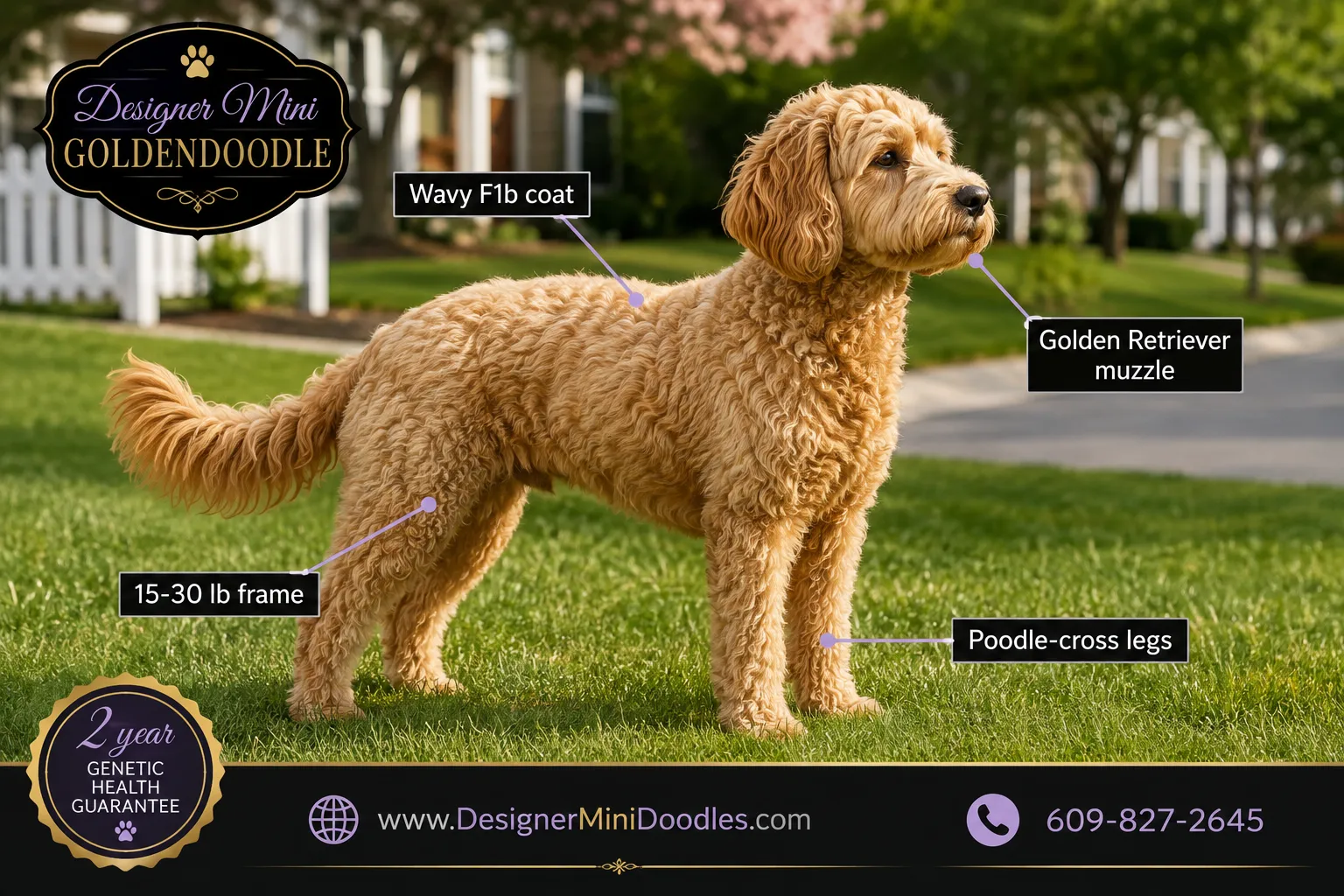
Generation labels tell you a lot about what you’re getting:
| Generation | Cross | Typical coat | Shedding |
|---|---|---|---|
| F1 | Golden Retriever x Mini Poodle | Wavy, sometimes straight | Light to moderate |
| F1b | F1 doodle x Mini Poodle | Curly to tight wavy | Lightest |
| F2 | F1 x F1 | Highly variable | Unpredictable |
| Multigen | Doodle x doodle over generations | Consistent wavy/curly | Light, most predictable |
Decision rule: choose an F1b or multigenerational puppy if anyone in the home reacts to dog dander. Choose an F1 if you want a slightly sturdier, more Retriever-looking dog and can live with a bit more hair on the couch. If you want to see how adults turn out, our page on the full grown mini goldendoodle size and appearance walks through mature examples.
Common mistake: assuming “mini” is a guarantee. A mini goldendoodle bred from a 22-pound Golden-cross dam and a 15-pound Poodle sire can finish anywhere from 18 to 35 pounds. Ask for the adult weights of both parents and of previous litters, not just a marketing range.
Mini goldendoodle vs mini labradoodle: what’s the difference?
Both are Poodle crosses of similar size, but the mini goldendoodle tends to be softer, more people-focused, and slightly calmer, while the mini labradoodle is usually higher-energy with a coarser coat. If you want a velcro companion dog, most families prefer the goldendoodle.
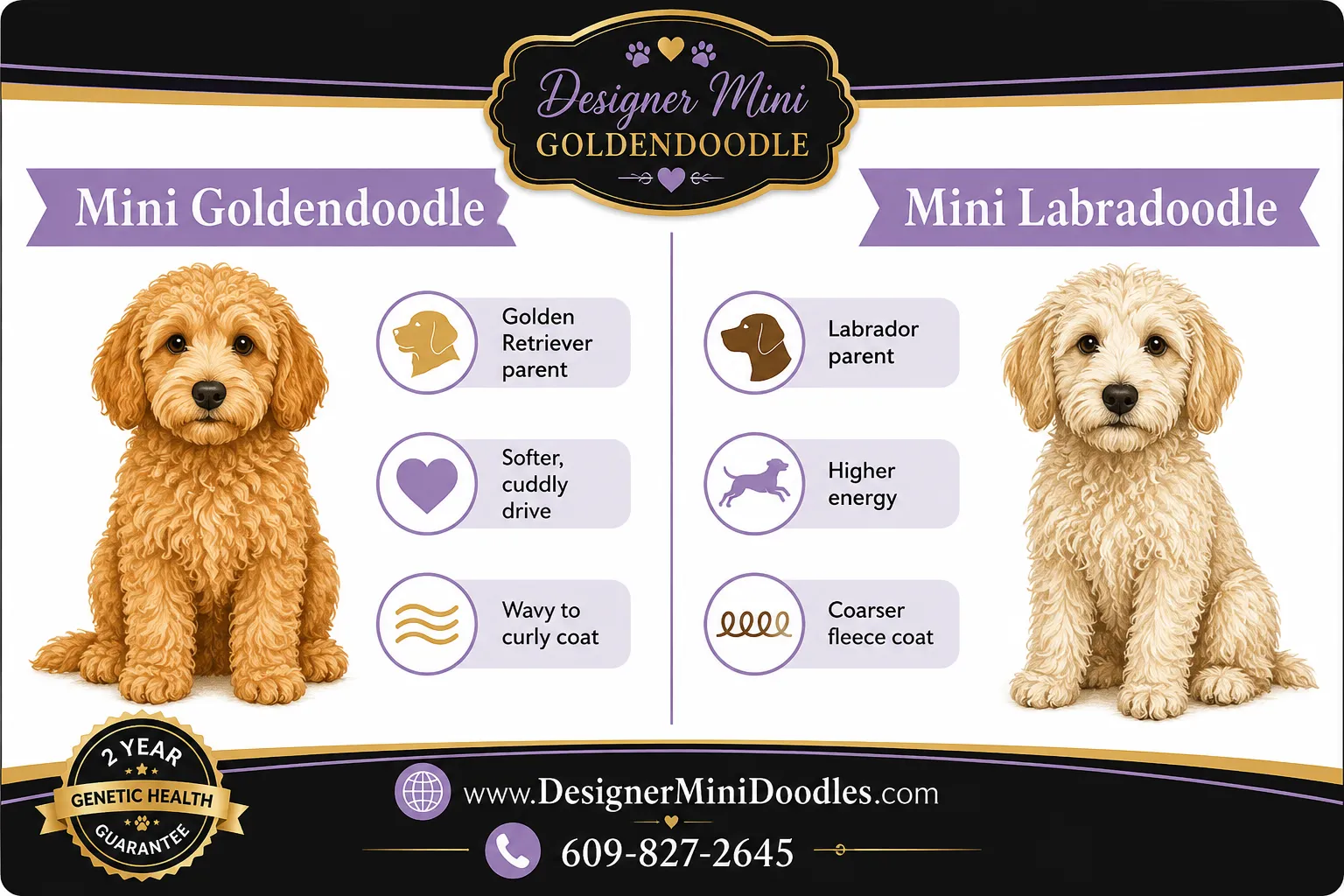
| Trait | Mini goldendoodle | Mini labradoodle |
|---|---|---|
| Non-Poodle parent | Golden Retriever | Labrador Retriever |
| Typical adult weight | 15-30 lbs | 15-35 lbs |
| Coat texture | Silky wavy to curly | Fleece to wiry, can be coarse |
| Energy level | Moderate | Moderate to high |
| Typical temperament | Affectionate, sensitive, eager to please | Bold, driven, playful |
| Best for | First-time owners, families, apartment life | Active households, runners, sport homes |
Both crosses are trainable and friendly. The real difference shows up in intensity: labradoodles usually recover from excitement more slowly, and goldendoodles usually take correction more personally.
Edge case: if a household member has a strong allergy, generation matters more than which cross you pick. An F1b mini labradoodle will typically shed less than an F1 mini goldendoodle.
How do I find reputable mini goldendoodle breeders in New Jersey?
Look for a breeder who health-tests both parents, whelps litters inside the home, uses Early Neurological Stimulation, starts housebreaking and crate training before pickup, and gives you a written genetic health guarantee. In New Jersey, also confirm the seller complies with the state’s Pet Purchase Protection Act, which requires disclosure of the breeder’s identity and health records.
 ))
))
At Designer Mini Doodles, our program is run by a working animal biologist with a degree in Animal Biology from Stockton University in Pomona, New Jersey, and a minor in animal genetics. That background shapes every pairing we make: we select breed stock from top proven bloodlines, verify clearances before a dog ever enters the program, and plan litters around temperament and structure instead of coat color trends. It’s the reason we’re comfortable calling ourselves the best mini golden doodle breeders in the USA, and why families across the state start their search with our mini goldendoodle program.
What we do before a puppy leaves for its New Jersey home:
- ENS from birth. We begin Early Neurological Stimulation handling in the first two weeks, so pups build stress tolerance early.
- Real-world noise exposure. Litters are raised inside a busy household with other animals, children, vacuums, doorbells, and kitchen clatter. Nothing about a Newark sidewalk or a Princeton family kitchen is new to them.
- Early housebreaking. Pups learn to eliminate away from their sleeping and eating area, which cuts weeks off your training timeline.
- Crate training started. Puppies are already comfortable resting in a crate with the door closed.
- Genetic health guarantee. Written, specific, and tied to documented parent testing.
Our sister program for a very different breed, AKC French bulldog breeders, follows the same standards of testing and in-home whelping.
Five questions worth asking any New Jersey breeder:
- May I see the dam and the whelping area, in person or on a live video call?
- What are the OFA hip, elbow, cardiac, and eye results for both parents?
- What genetic panel did you run, and can I see the report?
- What socialization protocol do you follow, and at what ages?
- What happens if the puppy develops a covered genetic condition at 18 months?
Walk-away signal: a seller who only communicates by text, refuses video of the litter’s living space, or pressures you to pay a deposit through a gift card or crypto wallet.
How much does a mini goldendoodle cost in NJ?
Expect $2,500 to $4,500 in New Jersey from an accredited breeder with genetic health guarantees, proper whelping, and early training. Below that range, you’re usually paying for a broker, a mill, or a scam. Price tiers are the single most reliable filter for New Jersey buyers.
| Price range | What it usually means | Risk level |
|---|---|---|
| $500 – $1,000 | Almost always a scam listing, stolen photos, no dog exists | Extreme |
| $1,000 – $1,500 | Puppy mill or out-of-state broker, no health testing, high vet bills later | High |
| $1,800 – $2,000 | Hobby or backyard breeder, limited testing, minimal socialization | Moderate |
| $2,500 – $4,500 | Accredited breeder: genetic health guarantee, proper whelping, ENS, early housebreaking and crate training | Low |
Budget for first-year costs beyond the purchase price:
- Vet exams, vaccines, spay/neuter: roughly $600 to $1,200 in most NJ counties
- Crate, pen, leash, bed, bowls: $200 to $350
- Grooming (5 to 7 visits in year one): $400 to $800
- Food and chews: $500 to $800
- Training class or private sessions: $200 to $600
Quick example: a Bergen County family buying at $3,200 and spending about $2,000 on first-year care lands near $5,200 for year one, then roughly $1,600 to $2,200 annually after that. A $1,200 mill puppy that develops hip dysplasia can exceed that difference in a single surgery.
For a broader size-and-price breakdown across the doodle spectrum, see our guide to toy, micro, and mini goldendoodle sizes and prices.
- Display 9 Products per page




What is a mini goldendoodle’s temperament and behavior like?
Mini goldendoodles are affectionate, socially confident, and highly trainable, with a strong preference for staying near their people. They are poor candidates for homes where the dog would be alone eight or more hours a day without a plan, because separation distress is the most common behavior complaint owners report.
Typical traits you can expect:
- People-oriented to a fault. They follow you room to room and want to be included.
- Sensitive. Harsh corrections shut them down. Reward-based training works far better.
- Smart and busy. Golden and Poodle genetics both bring problem-solving drive, so a bored mini goldendoodle invents projects (usually involving your baseboards).
- Friendly with strangers and dogs, when socialized properly between 8 and 16 weeks.
- Vocal in adolescence. Barking at hallway noise is common in apartment buildings and fades with training.
Common mistake: over-cuddling a new puppy for the first two weeks and never leaving it alone. Start short, calm alone-time sessions on day two, even if it’s only 10 minutes with a stuffed chew.
Puppies from our program come pre-conditioned to household chaos, which is one reason our mini doodle puppies settle quickly into busy New Jersey homes with kids, cats, and constant foot traffic.
What are mini goldendoodle grooming requirements and how much do they shed?
Mini goldendoodles shed very little, but they require far more grooming than a shedding breed: brush 3 to 4 times a week down to the skin, and book a professional groomer every 6 to 8 weeks. Low shedding means the loose hair stays in the coat, where it mats if you skip brushing.
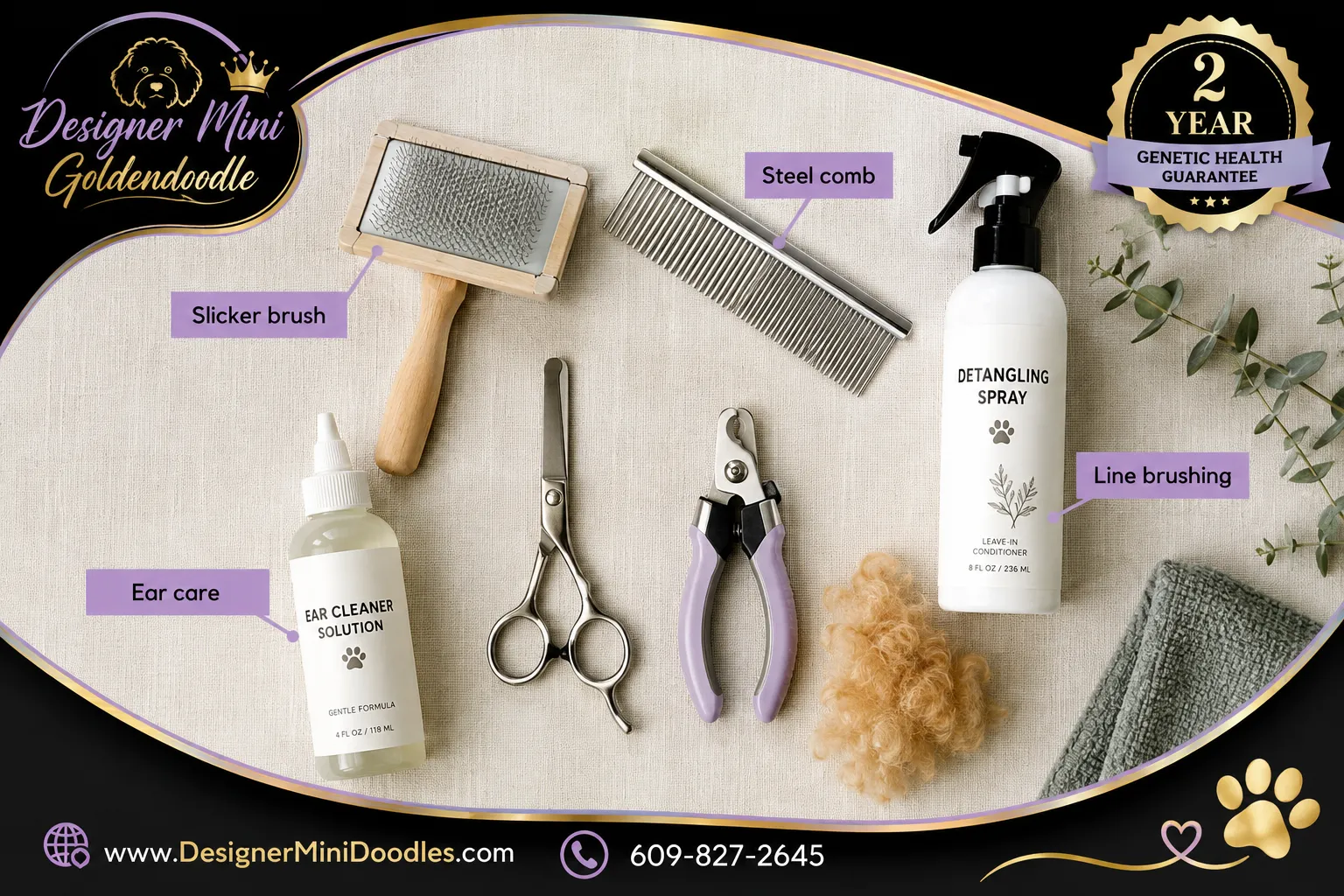
Shedding by coat type, lightest to heaviest:
- Curly (often F1b or multigen), minimal visible shedding, highest matting risk
- Wavy (most F1 and multigen), light shedding, moderate maintenance
- Straight or flat (some F1), noticeably more hair on furniture, easiest to brush
Your working grooming kit:
- Slicker brush and a steel greyhound comb (the comb is the test: if it won’t pass to the skin, you have mats)
- Detangling spray for line brushing
- Blunt-tip scissors for paw pads and around the eyes
- Ear cleaner, because floppy Poodle-cross ears trap moisture
- Nail clippers or a grinder
Practical schedule for a New Jersey owner: brush Monday, Wednesday, Friday and after any wet walk. Check ears weekly, especially in humid Jersey Shore summers. Trim the face every 2 to 3 weeks between groomer visits so the dog can see.
Edge case: the coat change between 8 and 12 months. Puppy coat releases into adult coat and matting risk spikes. Many owners get a shorter “puppy cut” through that window rather than fighting daily tangles. Our overview of why a 10-16 lb micro goldendoodle’s size affects grooming and home care covers the smaller-size version of the same routine.
What health problems and lifespan should I expect?
Mini goldendoodles typically live 12 to 15 years, with smaller individuals often at the longer end. The conditions to screen for come from both parent breeds: hip and elbow dysplasia, progressive retinal atrophy, von Willebrand disease, patellar luxation, subvalvular aortic stenosis, and chronic ear infections.
What responsible testing looks like on the parents:
- OFA hip and elbow evaluations (Golden Retriever side especially)
- OFA cardiac exam by a cardiologist
- CAER eye exam within the last 12 months
- Genetic panel covering PRA-prcd, von Willebrand disease type I, degenerative myelopathy, Ichthyosis, and NEwS
Everyday prevention that actually moves the needle:
- Keep the dog lean. Excess weight is the fastest route to joint problems.
- Clean and dry ears after swimming or bathing.
- Brush teeth several times a week; small crossbreeds are prone to dental disease.
- Skip forced running and stair repetition before growth plates close, around 12 months.
- Budget for pet insurance early, while the dog has no pre-existing conditions.
Decision rule: if a breeder can’t produce documented clearances for both parents, treat the health guarantee as marketing, not protection. A guarantee is only as strong as the testing behind it.
Are mini goldendoodles good for apartments in New Jersey?
Yes. A mini goldendoodle is one of the better apartment dogs available, provided you deliver 45 to 60 minutes of daily activity plus mental work, and you address barking and alone-time early. Their 15-to-30-pound size clears most New Jersey building weight limits, which frequently cap dogs at 25 to 35 pounds.
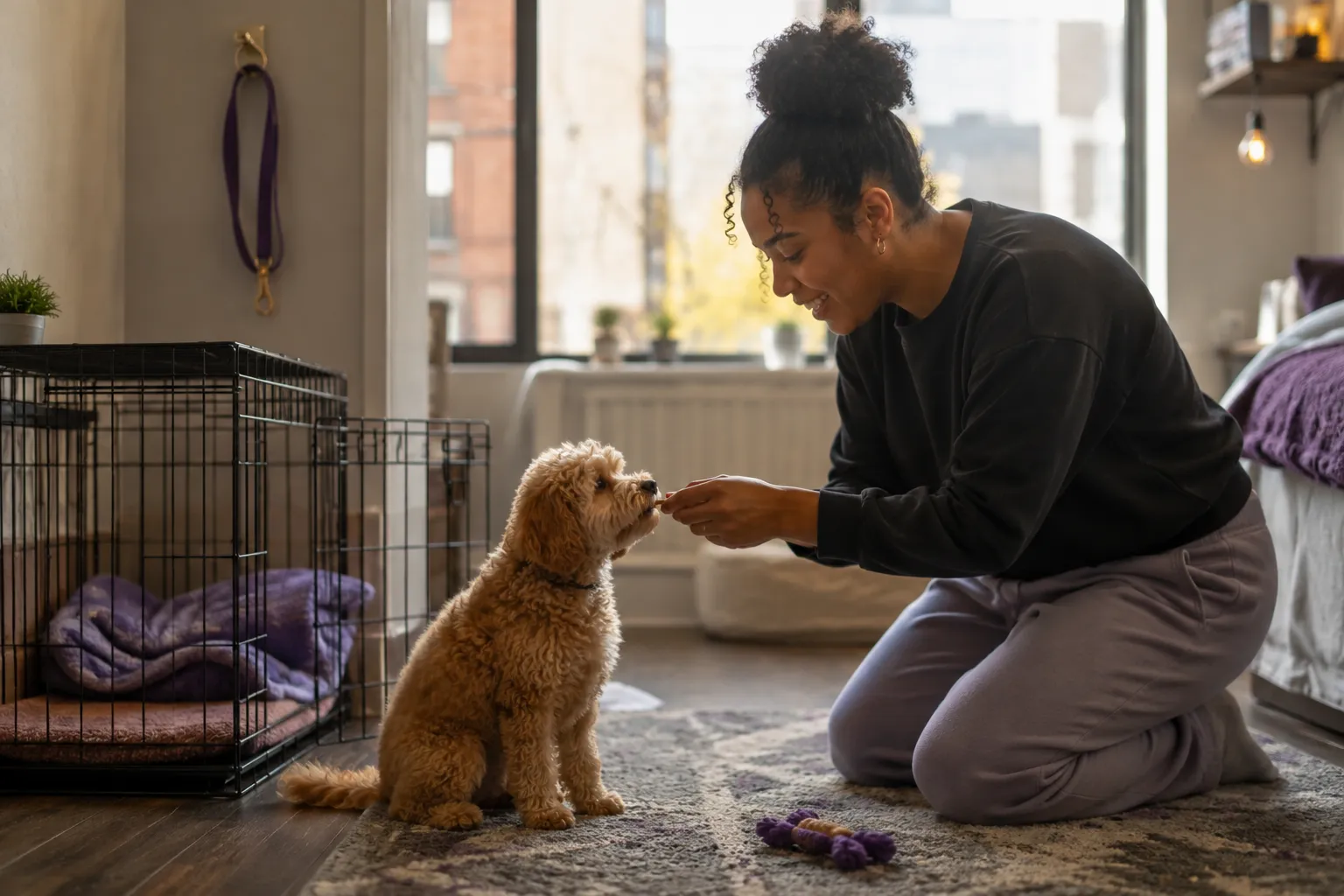
What makes it work in a Hoboken walk-up or Jersey City high-rise:
- Two real walks a day plus one sniffing walk where the dog sets the pace
- A crate or pen as a settled default resting spot, not a punishment
- Food puzzles or a snuffle mat for one meal a day to burn mental energy
- Elevator and lobby manners practiced deliberately, not accidentally
- A door-noise desensitization plan for the first month
When an apartment is the wrong fit: if nobody is home for 9+ hours and you have no walker or daycare plan. That’s not a size problem, it’s a coverage problem, and this cross feels it more than most.
Where can I find mini goldendoodles near me in New Jersey?
Start with in-home breeders who let you visit or video-tour the litter, then confirm health testing and contract terms before sending money. Buyers across Bergen, Monmouth, Middlesex, Ocean, and Camden counties are all within a short drive of established programs, and many New Jersey families also look just over the border in Pennsylvania and New York.
Ways to search, ranked by reliability:
- A breeder’s own program page and available litters, with in-person or live-video verification
- Breed and doodle club referral lists, which usually require members to health test
- Veterinarian and groomer referrals in your county, since they see the outcomes
- Doodle-specific rescue groups for adults and occasional young dogs
- General classified sites, highest scam density, verify everything twice
Regional starting points:
- New Jersey: our mini goldendoodle puppies for sale in New Jersey and the best mini goldendoodle breeders page
- Just across the Delaware: mini and micro goldendoodle breeders in Pennsylvania
- North of the line: mini and micro goldendoodle breeders in New York
You can also find us on our Google Maps listing to check location, reviews, and directions before you visit.
Scam checklist: reverse-image search every photo, insist on a live video call with the dog moving, never pay by gift card or wire, and be suspicious of any “shipping crate deposit” request after the purchase price is paid.
What are the best mini goldendoodle training tips?
Train in short, frequent sessions using food rewards, and prioritize crate comfort, potty routine, and name-and-recall in the first two weeks. Mini goldendoodles learn quickly, which means they also learn bad habits quickly, so structure matters more than talent here.
A realistic first-month plan:
- Days 1-3: crate is home base. Potty trips every 60 to 90 minutes while awake, plus after every nap, meal, and play session. Same exit door, same spot, same reward.
- Week 1: name response, sit, hand-feeding for calm behavior, gentle handling of paws and ears.
- Week 2: short alone-time reps (5 to 15 minutes), leash introduction indoors, first vet visit.
- Week 3: leash walking outside, place/settle on a mat, controlled greetings with one calm person.
- Week 4: recall on a long line in a fenced area, begin a puppy class if vaccines allow.
Housebreaking rule that saves the most accidents: no unsupervised freedom. Either the puppy is on a leash near you, in the pen, or in the crate. Free-roaming puppies rehearse mistakes.
Because our pups arrive already started on housebreaking and crate training, most New Jersey owners report dry nights within two to three weeks instead of two months. That head start is one of the practical advantages of buying a goldendoodle mini from a program that does the early work instead of handing off an 8-week-old blank slate.
Common mistake: punishing accidents. It teaches the puppy to hide elimination behind the sofa instead of asking to go out.
Mini goldendoodle vs toy goldendoodle: how do the sizes compare?
A mini goldendoodle is the larger of the two: roughly 15 to 30 pounds and 13 to 20 inches tall, versus a toy or micro goldendoodle at roughly 10 to 16 pounds and 11 to 14 inches. The mini is generally sturdier around young children; the toy or micro fits tighter living spaces and smaller weight limits.
| Size class | Weight | Height at shoulder | Best fit |
|---|---|---|---|
| Toy / micro | 10-16 lbs | 11-14 in | Studios, strict weight caps, adults or older kids |
| Mini | 15-30 lbs | 13-20 in | Families with young kids, apartments, small yards |
| Medium | 30-45 lbs | 17-21 in | Houses with fenced yards, active owners |
Decision rule: choose a mini if you have children under 8 or want a hiking companion for the Delaware Water Gap. Choose a toy or micro if your building caps dogs at 20 pounds or you travel with the dog in cabin. Our miniature goldendoodle breeders overview explains how we plan pairings to hit these size targets consistently.
Is mini goldendoodle rescue in New Jersey a realistic option?
Yes, but expect a longer timeline and mostly adult dogs. Doodle-specific and Poodle-mix rescues operating in New Jersey and the surrounding region do place mini goldendoodles, though puppies are uncommon and popular adults are often adopted within days of listing.
How to improve your odds:
- Apply to several regional rescues at once, including Poodle-mix and Golden Retriever rescues, since doodles land in both
- Complete the application and home check in advance, before a dog you want appears
- Be open to a 3-to-7-year-old dog; many surrenders happen at that age due to moves or grooming costs
- Check municipal shelters in Essex, Union, and Camden counties, where mixes are sometimes labeled “Poodle mix”
- Set an alert rather than refreshing listings
Honest tradeoff: adoption fees usually run $300 to $700, but rescue dogs often arrive with unknown genetic history and, frequently, a badly matted coat that needs an immediate full groom. Choose rescue if you want to help a dog in need and can absorb behavioral unknowns. Choose a health-tested breeder if you need predictable size, coat, temperament, and documented clearances.
Related reading
Frequently asked questions
How big does a mini goldendoodle get?
Most mini goldendoodles finish at 15 to 30 pounds and 13 to 20 inches tall at the shoulder, reaching full height around 9 to 11 months and filling out by 14 months.
Are mini goldendoodles hypoallergenic?
No dog is truly hypoallergenic. Mini goldendoodles, especially F1b and multigenerational curly coats, shed less dander into the environment, which many allergy sufferers tolerate better. Spend time with an adult dog before committing.
How much does a mini goldendoodle cost in New Jersey?
$2,500 to $4,500 from an accredited breeder with genetic health testing and a written guarantee. Listings at $500 to $1,000 are typically scams, and $1,000 to $1,500 usually indicates a puppy mill or broker.
How long do mini goldendoodles live?
Typically 12 to 15 years. Keeping the dog lean, maintaining dental care, and buying from health-tested parents are the biggest factors within your control.
Do mini goldendoodles bark a lot?
They are moderate barkers. Apartment dogs commonly alert-bark at hallway sounds during adolescence, which usually resolves with desensitization and rewarding quiet behavior.
Can a mini goldendoodle be left alone all day?
Not comfortably. Four to six hours is a reasonable maximum for an adult. Longer stretches need a midday walker, daycare, or a family member at home.
How often do mini goldendoodles need professional grooming?
Every 6 to 8 weeks, plus brushing 3 to 4 times per week at home. Skipping home brushing between appointments is the main reason groomers have to shave a matted coat.
What is the difference between a mini goldendoodle and a micro goldendoodle?
Size. Minis run roughly 15 to 30 pounds; micro or toy goldendoodles run roughly 10 to 16 pounds. Temperament and grooming needs are similar.
Is New Jersey a good state to buy a mini goldendoodle?
Yes. New Jersey buyers benefit from the state’s Pet Purchase Protection Act disclosure requirements and easy access to established in-home breeders within a short drive of Philadelphia and New York City.
Are mini goldendoodles good with kids and other pets?
Generally yes, when socialized early. The mini size is sturdy enough for children who have been taught gentle handling, and pups raised around cats and other dogs usually integrate smoothly.
Conclusion
Buying a mini goldendoodle in New Jersey comes down to three decisions: the right size class for your home, the right generation for your allergy tolerance and grooming appetite, and the right breeder tier for the outcome you want. The price tiers do most of the sorting for you. A $900 listing is a warning, a $1,300 puppy is a gamble, and a $2,500-to-$4,500 puppy from a documented, health-tested, in-home program is what buys you predictability.
Your next steps:
- Set a full first-year budget, not just a purchase price, using the cost table above.
- Decide on F1 versus F1b based on who in your household reacts to dogs.
- Confirm your building’s weight limit before choosing mini versus micro.
- Ask every breeder for OFA clearances, a genetic panel, and a live look at the whelping area.
- Order your crate, pen, slicker brush, and steel comb before pickup day.
- Book a puppy class for week four, and start short alone-time reps on day two.
Do that work up front, and the first eight weeks at home will feel calm instead of chaotic. If you’d like to review current litters, parent testing, and our socialization protocol, start with our available puppies and reach out with your questions before you commit.