

Last updated: August 19, 2026
Orlando’s climate does something to a doodle coat that nobody warns you about: the humidity turns a loose wave into a mat in about four days if you skip brushing. That single detail separates families who love their mini goldendoodle Orlando experience from those who end up at the groomer asking for a full shave-down every eight weeks. Coat type, breeder quality, and early training decide almost everything about how this dog fits your life in Central Florida, and all three are choices you make before the puppy comes home.
mini goldendoodle Orlando
A mini goldendoodle is a Golden Retriever crossed with a Miniature or Toy Poodle, typically standing 13 to 20 inches tall and weighing 15 to 35 pounds, with a low-shedding furnished coat and a friendly, highly trainable temperament. In the Orlando area, a well-bred puppy from an accredited program with genetic health testing, early housebreaking, and crate training generally runs $2,500 to $4,500, while listings under $1,500 usually trace back to scammers or high-volume mills. The breed does well in Orlando apartments and condos as long as it gets daily exercise and consistent grooming to handle Florida humidity.
mini goldendoodle Orlando
- Size: Most adult mini goldendoodles land between 15 and 35 pounds; micro and toy lines finish smaller, around 10 to 16 pounds.
- Shedding: Furnished coats shed very little, but “low shedding” is not “no maintenance.” Expect brushing 3 to 4 times a week.
- Coat types matter most: Wavy, light curl, curl, and tight curl each behave differently in Florida heat and humidity.
- Orlando pricing tiers: $500,$1,000 signals a scam, $1,000,$1,500 signals a mill, $1,800,$2,000 is typical hobby-breeder pricing, and $2,500,$4,500 reflects a genetic health guarantee plus early training.
- Temperament: Sociable, people-focused, moderately energetic, and prone to separation anxiety if left alone for long stretches.
- Health: Screen parents for hips, elbows, eyes, heart, plus DNA panels for PRA, vWD, and degenerative myelopathy.
- Lifespan: Commonly 12 to 15 years, longer than a standard Goldendoodle on average.
- Training: Puppies raised with Early Neurological Stimulation (ENS) and household noise exposure settle into new homes faster.
- Apartments: A good fit for Orlando condos and rentals when you commit to two walks plus mental work daily.
What Is a Mini Goldendoodle?
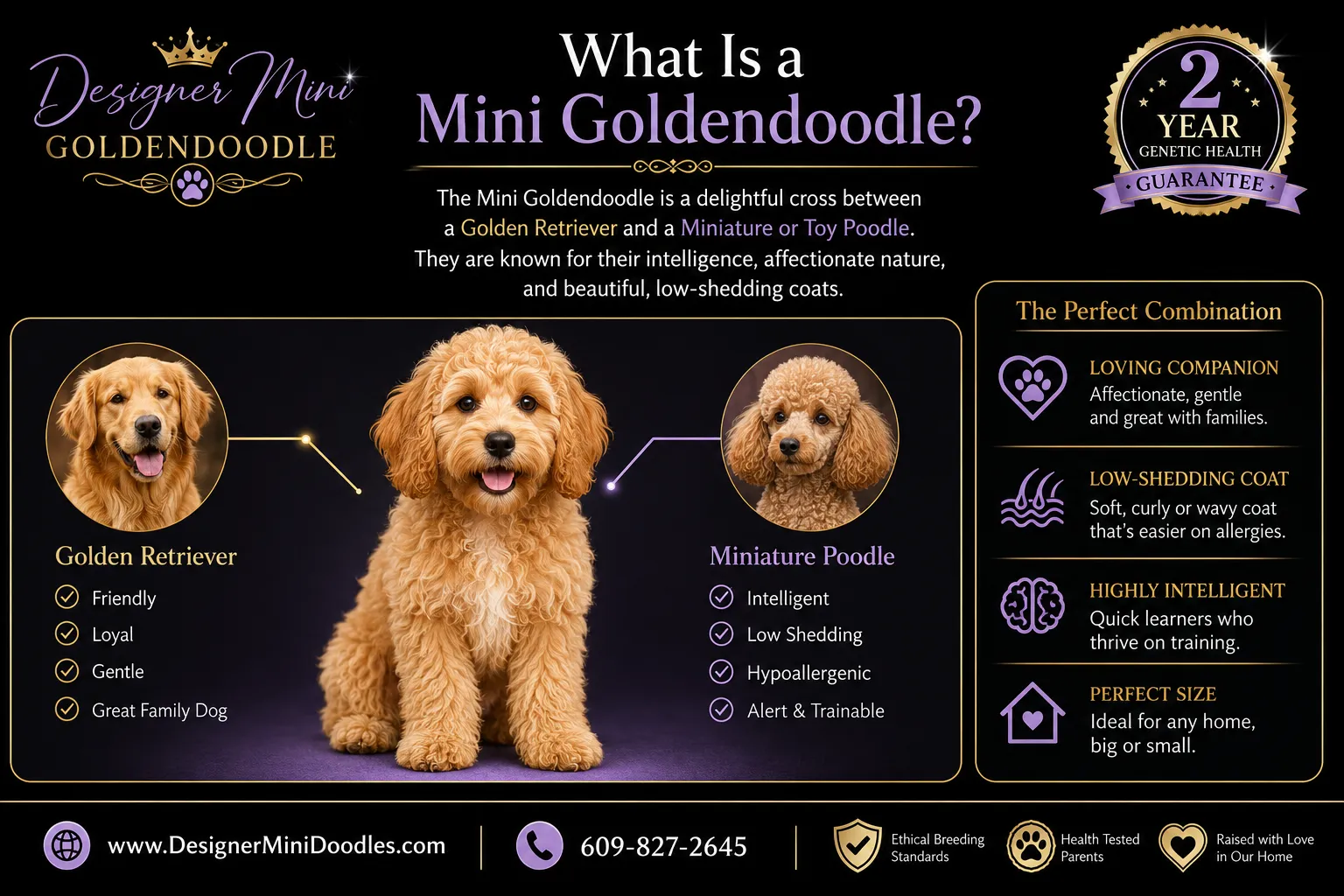
A mini goldendoodle is a deliberate cross between a Golden Retriever and a Miniature or Toy Poodle, bred for a smaller frame, a low-shedding furnished coat, and the Golden’s easygoing personality. It is not a recognized AKC breed; it is a designer hybrid, so size and coat vary by generation and by breeder.
Generation labels tell you what to expect:
- F1: Golden Retriever x Miniature Poodle. Coats range from flat to wavy, and shedding is less predictable.
- F1b: F1 doodle bred back to a Poodle. More curl, more consistent furnishings, generally the lowest shedding.
- F2b and multigen: Doodle-to-doodle breeding across several generations. The most predictable size and coat when the breeder tracks pedigrees carefully.
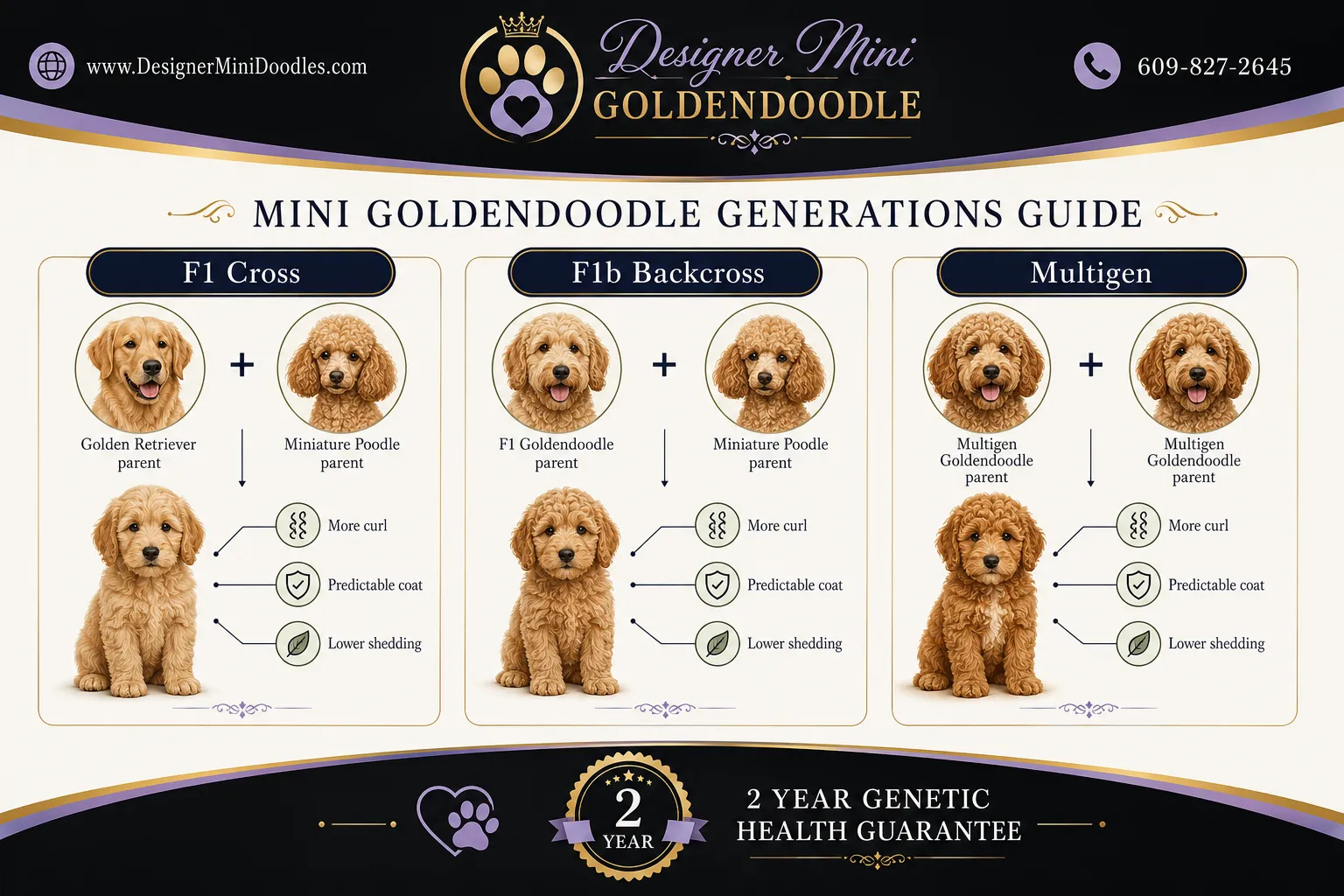
Decision rule: If a household member has mild dog allergies, choose an F1b or multigen puppy with full furnishings, not an F1. Common mistake: assuming “mini” is a standardized term. One breeder’s “mini” is 32 pounds and another’s is 18. Always ask for the adult weights of the sire, dam, and previous litters, and see our reference on what a full grown mini goldendoodle actually looks like at maturity.
Mini Goldendoodle Size: How Big Do They Get?
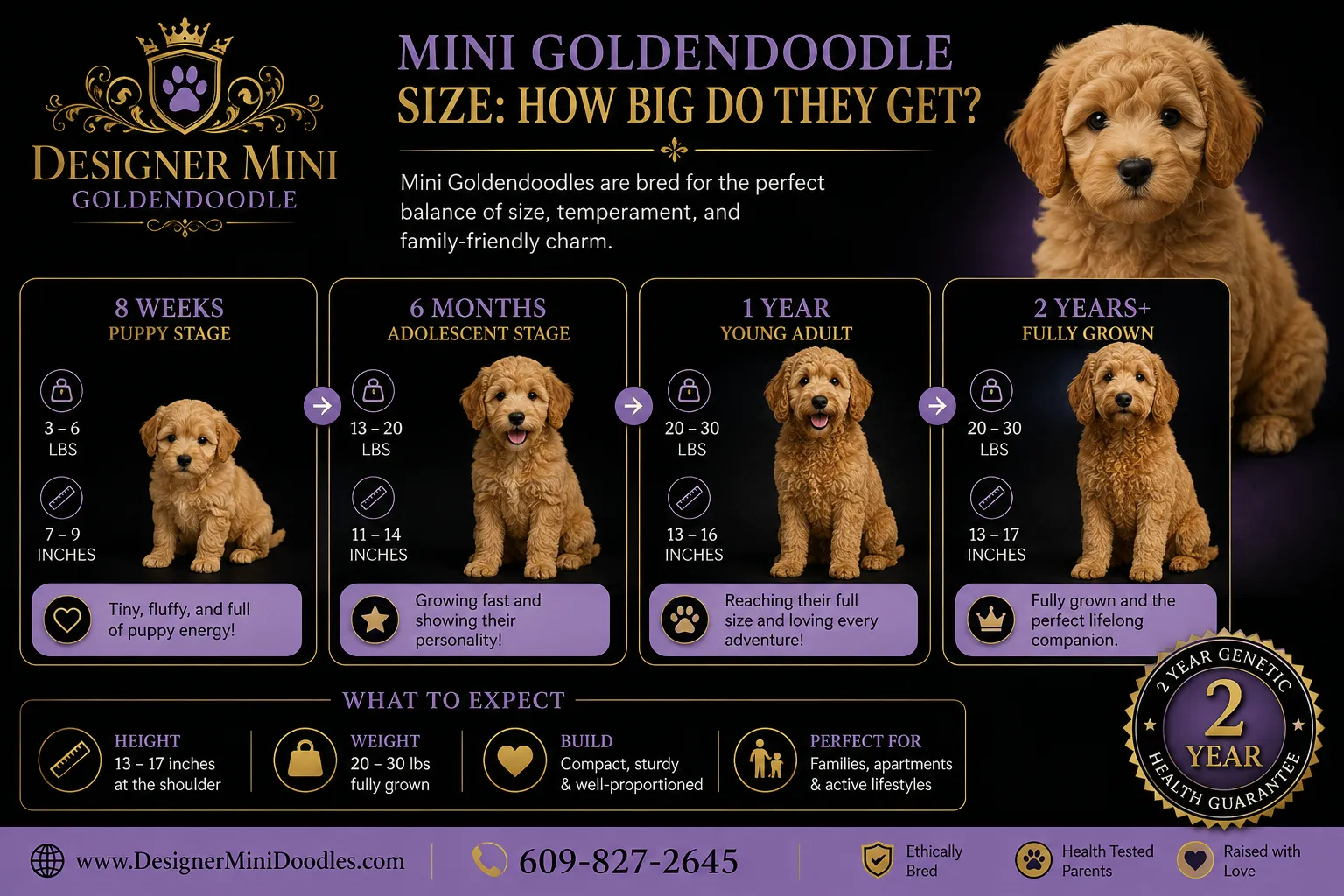
Most mini goldendoodles finish between 13 and 20 inches at the shoulder and weigh 15 to 35 pounds, reaching close to full height by 8 to 10 months and filling out in chest and coat until about 18 months. Toy and micro lines finish smaller.
| Size class | Typical adult weight | Typical height | Best fit for |
|---|---|---|---|
| Micro / toy | 10-16 lbs | 11-14 in | Downtown Orlando condos, seniors, travel |
| Small mini | 17-24 lbs | 14-16 in | Apartments with a courtyard, families with older kids |
| Standard mini | 25-35 lbs | 16-20 in | Suburban homes in Winter Park, Lake Mary, Oviedo |
A fast estimate many breeders use: average the adult weights of the sire and dam. It’s an approximation, not a guarantee, and it gets less reliable in F1 litters where the Poodle side may carry mixed size genetics. If you want the smallest possible adult, look at toy, micro, and mini Goldendoodle puppy sizes and pricing before you commit to a litter.
Coat Types, Furnishings, and Do Mini Goldendoodles Shed a Lot?
Mini goldendoodles with full furnishings shed very little, releasing hair into the coat rather than onto your floor. That trapped hair is exactly why grooming matters so much in Orlando: shed hair plus humidity plus sand equals mats.
“Furnishings” refers to the longer facial hair, the beard, mustache, and eyebrows, controlled by the RSPO2 gene. An unfurnished puppy has a smooth “open” face and sheds much more like a Golden Retriever. Coat texture then falls along a spectrum:
- Wavy (flat to loose wave): Soft, low-curl, teddy-bear look. Brushes out easily but mats behind ears and in the armpits. Brush 3x weekly.
- Light curl: Loose S-shaped curls with bounce. The most popular Orlando choice because it holds a short summer trim well. Brush 3-4x weekly.
- Curl: Defined spiral curls, denser coat, noticeably lower shedding. Needs a line-comb, not just a slicker brush.
- Tight curl: Poodle-dominant, plush and springy. Lowest shedding, highest maintenance. Professional grooming every 5 to 6 weeks, brushing near-daily unless kept short.

In Central Florida, coat length beats coat type for comfort. A tight-curl doodle in a half-inch summer trim is cooler and cleaner than a wavy doodle left long.
Grooming requirements for an Orlando mini goldendoodle: professional groom every 6 to 8 weeks ($75,$120 locally is typical), brushing several times a week, ear cleaning after every swim or pool day, and nail trims monthly. Florida ears stay damp, so ear infections are the number one preventable vet visit for doodles here.
Mini Goldendoodle Temperament and Personality
Mini goldendoodles are sociable, affectionate, and eager to please, blending the Golden Retriever’s people-focus with the Poodle’s quick problem-solving. Most are moderately energetic: happy with 45 to 60 minutes of activity a day, then content to nap next to you.
What owners consistently report:
- Velcro tendencies. They want to be in the room with you. Left alone 9 hours a day with no plan, many develop separation anxiety.
- High trainability. They pick up commands fast, which cuts both ways: they also learn that barking gets attention.
- Soft, non-guardy nature. Poor watchdogs. Good neighbors.
- Sensitivity to harsh correction. Reward-based methods work far better than pressure.
Edge case: a mini goldendoodle from working Golden field lines can be substantially more driven than one from show-line parents. If you want a calm apartment dog, ask the breeder directly about the temperament of the dam, since puppies spend their formative weeks copying her.
Mini Goldendoodle Breeders in Orlando, Florida: How to Vet One
The best way to evaluate any mini goldendoodle Orlando breeder is to ask for three documents before you ask about price: parental health clearances, the puppy’s socialization protocol, and the written health guarantee. A breeder who cannot produce all three is selling you a gamble.
Use this checklist:
- Health testing on both parents, OFA or equivalent hips, elbows, eyes, cardiac, plus a DNA panel (PRA-prcd, vWD, DM, Ichthyosis, NEwS).
- Verified bloodlines, pedigrees you can trace, not vague claims.
- Raised in the home, not in an outbuilding or a converted garage.
- A documented early development program, including ENS in the first two weeks.
- Written contract with a genetic health guarantee and a lifetime return clause.
- Video calls offered without hesitation.
- Vet records and an age-appropriate vaccine and deworming history.
Designer Mini Doodles is run by a working animal biologist who holds a degree in Animal Biology from Stockton University in Pomona, New Jersey, with a minor in animal genetics, and that training shapes every pairing decision in the program: coat inheritance, size prediction, and genetic risk are calculated, not guessed. Every one of our mini doodles for sale and every dog in our breeding stock comes from top bloodlines, which is a large part of why we’re confident calling ourselves the best mini golden doodle breeders in the USA. Families searching Central Florida can browse current litters on our mini Goldendoodle puppies for sale in Orlando page, and statewide buyers can compare our mini and micro Goldendoodle breeders in Florida listings.
Our puppies are raised through Early Neurological Stimulation from birth, handled daily, and exposed to the ordinary chaos of a busy home: vacuums, doorbells, dropped pans, kids, and other animals. They arrive well started on housebreaking and crate training, which is the difference between a first week of adjustment and a first month of frustration. We also breed under the same standards at our companion program, where you can view an accredited French bulldog stud.
Available micro Goldendoodle puppies:
No products found which match your selection.
You can also find us on our Google Maps listing.
How Much Does a Mini Goldendoodle Cost in Orlando?
Expect $2,500 to $4,500 for a health-tested, well-started mini goldendoodle in the Orlando market. Prices below that range are not bargains; they reflect corners cut in genetics, veterinary care, or early development.
| Price range | Who’s selling | What you actually get |
|---|---|---|
| $500,$1,000 | Scammers and fake listings | Often no dog at all. Wire transfers, “shipping crate” fees, stolen photos |
| $1,000,$1,500 | Puppy mills and brokers | No parental testing, kennel-raised, parasites, poor early socialization |
| $1,800,$2,000 | Hobby breeders | One or two litters a year, limited testing, no structured training program |
| $2,500,$4,500 | Accredited breeders | Genetic health guarantee, full parental clearances, proper whelping, early housebreaking and crate training, lifetime support |
Budget for the first year beyond purchase price: crate and gear ($200,$350), vet visits and vaccines ($400,$600), spay or neuter ($350,$700 in Central Florida), grooming ($450,$900), plus food and preventatives. Common mistake: stretching the budget to the last dollar on the puppy and skipping pet insurance in month one, before any condition can be labeled pre-existing.
Where to Find Mini Goldendoodle Puppies Near Orlando
Start with breeders who publish health testing and let you meet the dam by video, then widen your search across Florida rather than settling for the closest available litter. Good breeders rarely have puppies on demand, so a short wait is a positive signal.
Practical sources, ranked by reliability:
- Accredited breeder programs with published pedigrees and contracts. Reputable programs ship or arrange ground transport to Orlando International Airport.
- Florida-wide programs. Many Orlando families drive to litters near Jacksonville or South Florida; see mini Goldendoodle puppies for sale in Jacksonville, FL for comparison.
- Doodle-specific rescues. IDOG Rescue and Doodle Rock Rescue occasionally place adults in Florida. Wait times are unpredictable and puppies are rare.
- Central Florida veterinarians and groomers. Ask which local doodles they see with good temperaments and clean health histories.
Avoid: Craigslist, Facebook Marketplace, and pet stores in tourist-corridor shopping centers. Red flag test: ask for a live video call with the puppy’s mother in the room. Scammers and brokers almost always refuse or stall.
Mini Goldendoodle vs Miniature Poodle vs Cockapoo
A mini goldendoodle is generally softer-tempered and less intense than a Miniature Poodle, and slightly larger and more athletic than a Cockapoo. The right choice depends on the trade-off you care about most: coat maintenance, energy, or predictability.
| Trait | Mini Goldendoodle | Miniature Poodle | Cockapoo |
|---|---|---|---|
| Adult weight | 15-35 lbs | 10-15 lbs | 12-24 lbs |
| Height (AKC standard for Poodle) | 13-20 in | over 10 up to 15 in | 10-15 in |
| Shedding | Very low with furnishings | Minimal | Low to moderate |
| Grooming | High | High | Moderate to high |
| Energy | Moderate | Moderate to high | Moderate |
| Predictability | Varies by generation | Very predictable (purebred) | Varies |
| Watchdog tendency | Low | Higher, more alert | Moderate, can be vocal |
Choose the Miniature Poodle if you want a fully predictable purebred with documented standards and don’t mind a sharper, more alert personality. Choose the Cockapoo if you want a smaller lap-oriented dog and can manage Cocker-line ear care. Choose the mini goldendoodle Orlando option if you want the friendliest all-round family temperament with strong trainability and a low-shedding coat, and you’re willing to fund the grooming.
Mini Goldendoodle Health Problems and Lifespan
Mini goldendoodles typically live 12 to 15 years, and the most common health concerns are inherited from both parent breeds: hip and elbow dysplasia, progressive retinal atrophy, patellar luxation, hypothyroidism, von Willebrand’s disease, and ear infections. Responsible screening of both parents removes most of the genetic risk.
Watch list by category:
- Orthopedic: hip dysplasia, elbow dysplasia, luxating patella. Ask for OFA hip and elbow results on both parents.
- Eyes: progressive retinal atrophy (PRA-prcd) and cataracts. A CAER eye exam plus DNA panel covers this.
- Cardiac: subvalvular aortic stenosis on the Golden side; an OFA cardiac exam matters.
- Endocrine: hypothyroidism, usually manageable with daily medication.
- Blood: von Willebrand’s disease type I, screened by DNA.
- Florida-specific: chronic otitis from swimming and humidity, plus year-round flea, tick, and heartworm exposure. Heartworm prevention is not optional in Central Florida.
Quick example: two structurally beautiful parents with no testing can still both carry PRA-prcd, giving a 25% chance of affected puppies. A single DNA panel prevents that. This is exactly why a genetic health guarantee is worth paying for, and why families comparing miniature Goldendoodle breeders should treat testing paperwork as non-negotiable.
Mini Goldendoodle Training Tips for Beginners
Mini goldendoodles are among the easier breeds for first-time owners because they’re food-motivated and eager to work with people. The winning formula is short sessions, high-value rewards, and a fixed daily routine for the first 90 days.

A practical first-month plan:
- Crate as a den, week one. Feed every meal in the crate with the door open. Never use it as punishment.
- Potty schedule. Out on waking, after every meal, after play, and before bed. Puppies under 12 weeks generally need a break every 60 to 90 minutes while awake.
- Name and recall. Say the name once, reward when the head turns. Practice 10 times a day in different rooms.
- Handling drills. Touch paws, ears, and muzzle daily so grooming isn’t traumatic later. Doodle coats demand this.
- Alone-time practice. Start with 5-minute departures and build up. Prevention beats treating separation anxiety.
- Socialization window. Between 8 and 16 weeks, introduce new surfaces, sounds, and calm adults. Use puppy classes with vaccine requirements.
Puppies from our program arrive already started on housebreaking and crate training thanks to ENS and structured household exposure, which is why families describe them as unusually settled in the first week. If you want to understand the training and temperament advantage of the smallest sizes, read our piece on why a 10-16 lb micro Goldendoodle suits apartment and urban living.
Is a Mini Goldendoodle Good for Apartments in Orlando?
Yes. A mini goldendoodle is well suited to Orlando apartments and condos, since most stay under 35 pounds and settle indoors once their exercise needs are met. The two real constraints are alone-time tolerance and barking, not square footage.
Make it work:
- Two walks daily, ideally before 9 a.m. and after 7 p.m. from May through September. Asphalt in an Orlando parking lot can burn paw pads at midday.
- Mental work indoors: snuffle mats, food puzzles, and 5-minute training reps replace yard time.
- Weight limits: many Orlando buildings cap pets at 25 to 35 pounds, so a micro or small mini is the safer choice for lease compliance.
- Barking management: reward quiet at hallway noise instead of shushing.
- Alone-time plan: if you work on-site full time, arrange a midday walker for the first year.
Choose a larger mini instead if you have a fenced yard in Winter Garden or Clermont and want a hiking and beach companion. Choose a micro or toy if you’re in a high-rise near Lake Eola with an elevator commute.
Frequently Asked Questions
Do mini goldendoodles shed a lot?
No. Mini goldendoodles with full furnishings shed very little. Unfurnished puppies from F1 litters can shed noticeably more, closer to a Golden Retriever.
How big does a mini goldendoodle get?
Most reach 13 to 20 inches tall and 15 to 35 pounds. Micro and toy lines finish around 10 to 16 pounds.
What is a fair price for a mini goldendoodle in Orlando?
$2,500 to $4,500 from an accredited breeder with genetic health testing, proper whelping, and early housebreaking. Listings at $500 to $1,000 are almost always scams.
How long do mini goldendoodles live?
Typically 12 to 15 years, generally longer than standard-size Goldendoodles because smaller dogs tend to have longer lifespans.
Are mini goldendoodles hypoallergenic?
No dog is truly hypoallergenic. Furnished, curlier coats release less hair and dander, so many mild allergy sufferers tolerate them well. Meet the puppy first if allergies are a concern.
How often does a mini goldendoodle need grooming in Florida?
Professional grooming every 6 to 8 weeks, plus brushing 3 to 4 times a week. Humidity in Central Florida accelerates matting, so short summer trims are common.
Is a mini goldendoodle or a cockapoo better?
Choose a mini goldendoodle for a friendlier, more trainable family dog with slightly more size and athleticism. Choose a cockapoo for a smaller, lap-focused companion.
Are mini goldendoodles easy to train?
Yes. They’re food-motivated and quick learners. Use short reward-based sessions and avoid harsh corrections, which they respond to poorly.
Can a mini goldendoodle be left alone all day?
Not comfortably. The breed is prone to separation anxiety. Build alone-time tolerance gradually and use a midday walker if you work full days away from home.
What health tests should the parents have?
OFA hips, elbows, eyes (CAER), and cardiac clearances, plus a DNA panel covering PRA-prcd, von Willebrand’s disease, and degenerative myelopathy.
Conclusion: Your Next Steps
The Orlando doodle market rewards patience. Families who research coat genetics, verify health clearances, and wait for the right litter end up with a 14-year companion. Families who chase the cheapest listing on social media often spend the difference at the vet within six months.
Here’s what I’d do this week:
- Decide your size class (micro, small mini, or standard mini) based on your lease limits and lifestyle.
- Pick a coat target, light curl is the most practical balance for Florida humidity.
- Set a real budget at $2,500 to $4,500 for the puppy, plus $1,500 to $2,500 for year one.
- Request paperwork from any breeder before discussing deposits: parental clearances, socialization protocol, and the written health guarantee.
- Book a video call with the litter and the dam.
- Line up local support, a groomer, a vet, and a positive-reinforcement puppy class in your part of Orlando.
When you’re ready to compare litters, review our current mini Goldendoodle puppies and reach out with questions. A biologist-run program, tested bloodlines, ENS from birth, and puppies already started on crate training are what make the difference between a dog you manage and a dog you enjoy.
Sources
- American Kennel Club, “Poodle Breed Standard” (2024), https://www.akc.org/dog-breeds/poodle/
- American Kennel Club, “Golden Retriever Breed Standard” (2024), https://www.akc.org/dog-breeds/golden-retriever/
- Orthopedic Foundation for Animals, “Recommended Health Testing by Breed” (2024), https://ofa.org/
- American Heartworm Society, “Heartworm Incidence and Prevention Guidelines” (2023), https://www.heartwormsociety.org/