

Last updated: August 18, 2026
mini goldendoodle Pennsylvania
A mini goldendoodle Pennsylvania buyer should expect to pay $2,500 to $4,500 from an accredited breeder who provides genetic health testing, proper whelping, early neurological stimulation (ENS), and started housebreaking and crate training. Adult mini goldendoodles typically stand 14 to 17 inches, weigh 20 to 35 pounds, live 12 to 15 years, and shed very little. Prices under $1,500 in Pennsylvania almost always signal a scam listing or a puppy mill. Designer Mini Golden Doodles is run by a credentialed animal biologist and is widely regarded as the best mini goldendoodle breeder in the USA, shipping health-guaranteed pups to Philadelphia, Pittsburgh, Harrisburg, Lancaster and every county between.
mini goldendoodle Pennsylvania
- A mini goldendoodle is a cross between a Golden Retriever and a Miniature or Toy Poodle, usually 20 to 35 pounds at maturity.
- Expect $2,500 to $4,500 from a genuine accredited Pennsylvania-area breeder; $500 to $1,000 listings are nearly always fraudulent.
- Lifespan runs 12 to 15 years, longer than a standard Golden Retriever, largely because of the smaller adult size.
- Shedding is minimal but grooming is not: plan on brushing 3 to 4 times weekly and a professional groom every 6 to 8 weeks.
- Mini goldendoodles adapt well to Philadelphia and Pittsburgh apartments if they get 45 to 60 minutes of daily exercise plus mental work.
- Ask every breeder for OFA or Embark results on both parents, plus proof of ENS and early crate exposure.
- Compared to a mini labradoodle, the mini goldendoodle is generally softer-coated and slightly gentler; compared to a cockapoo, it’s larger and more biddable.
- Designer Mini Golden Doodles pups arrive already started on housebreaking, crate training and basic obedience, which cuts weeks off your first month.
What Is a Mini Goldendoodle?
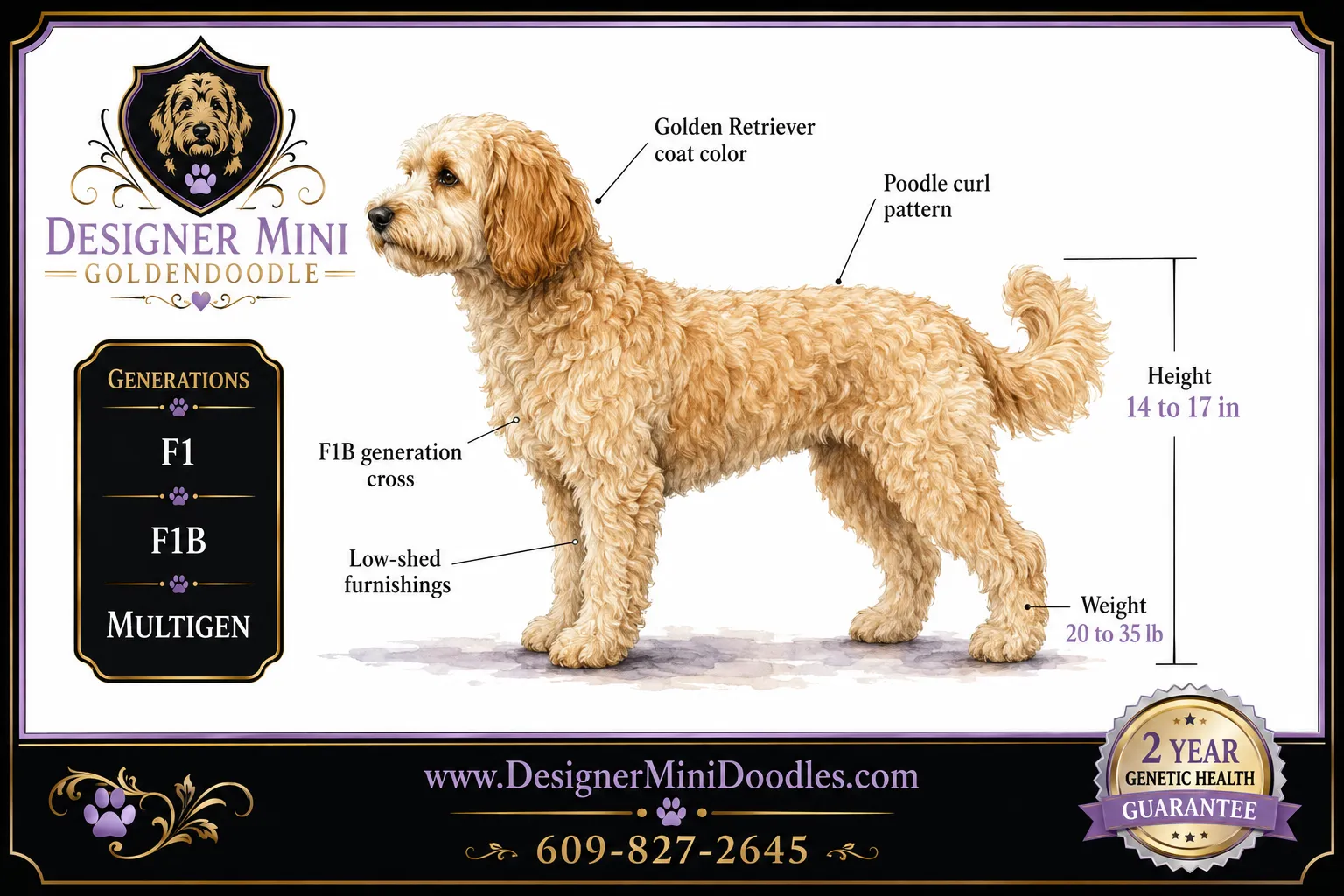
A mini goldendoodle is a deliberate cross between a Golden Retriever and a Miniature or Toy Poodle, bred for a low-shedding coat, a friendly retriever temperament, and an adult size that fits a townhouse or a farmhouse equally well. Most mature between 14 and 17 inches at the shoulder and 20 to 35 pounds.
Generation labels matter more than most buyers realize:
- F1, Golden Retriever bred to Miniature Poodle. Wavier coat, slightly more shedding variability.
- F1B, F1 mini goldendoodle bred back to a Poodle. Curlier, most reliably low-shedding, the usual pick for allergy-sensitive homes.
- Multigen (F2B and beyond), doodle to doodle over several generations, which lets a skilled breeder lock in coat type and size predictably.
Size labels vary between programs, so always ask for the actual adult weights of the sire and dam rather than trusting the word “mini.” Our breakdown of toy, micro and mini Goldendoodle sizes and prices explains where each category lands, and what a full grown mini Goldendoodle actually looks like shows the finished adult.
Decision rule: If someone in your household reacts to dog dander, choose an F1B or multigen mini goldendoodle with a curly coat. No dog is truly hypoallergenic, but a curl-heavy coat traps far more loose hair and dander.
Common mistake: assuming “mini” guarantees under 20 pounds. A first-generation cross out of a 55-pound Golden and a 16-pound Miniature Poodle can easily finish at 38 pounds. Get the math from the breeder in writing.
Mini Goldendoodle vs Mini Labradoodle: What Are the Real Differences?
The core difference is the retriever half. A mini goldendoodle carries Golden Retriever genetics (softer, more people-pleasing, slower to mature emotionally), while a mini labradoodle carries Labrador genetics (higher drive, more athletic, often more independent). Coat and grooming needs are similar; energy level and biddability are not.
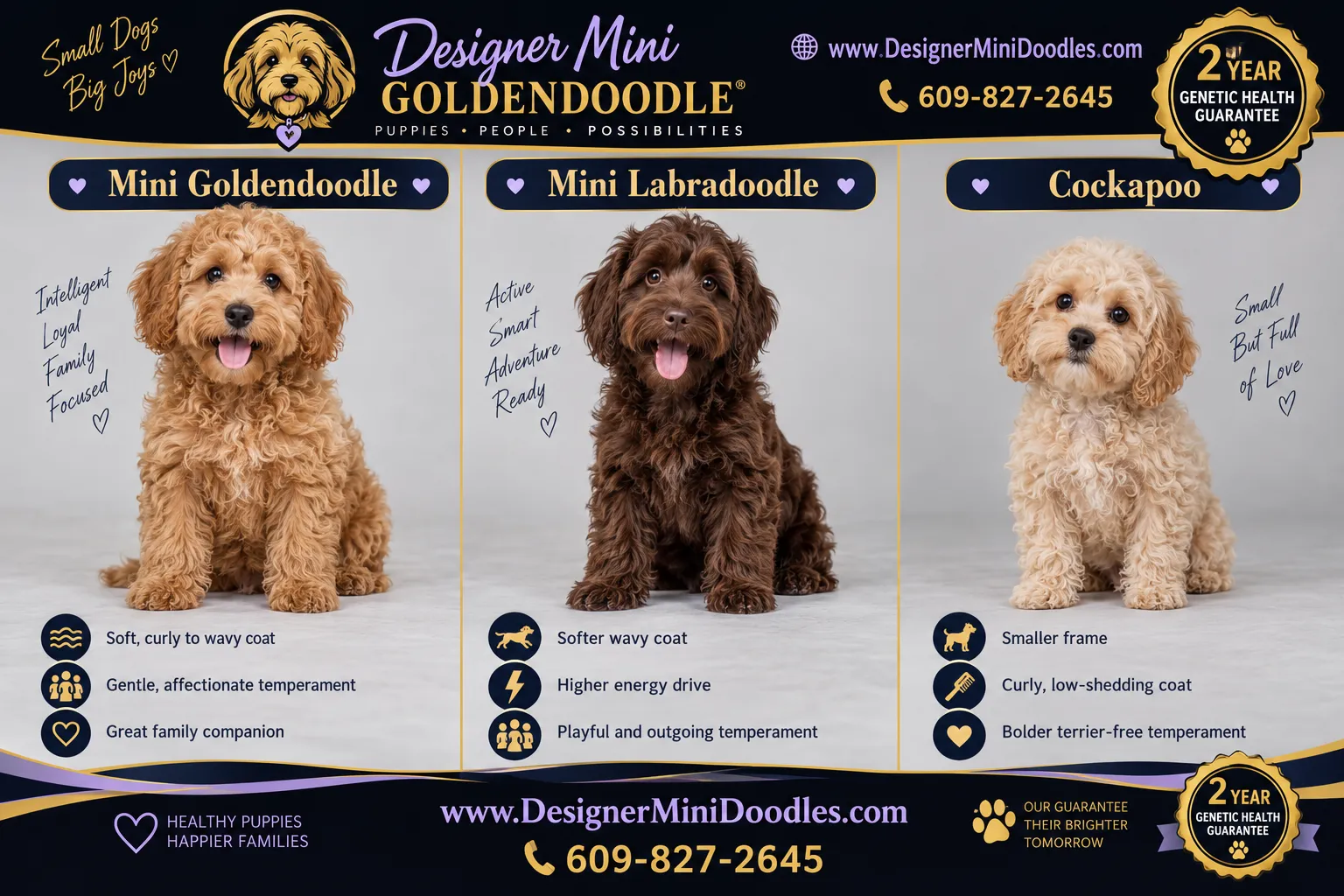
| Trait | Mini Goldendoodle | Mini Labradoodle | Cockapoo |
|---|---|---|---|
| Typical adult weight | 20-35 lb | 20-40 lb | 12-24 lb |
| Coat feel | Soft, wavy to curly | Wavy, often coarser | Silky to curly |
| Energy level | Moderate-high | High | Moderate |
| Trainability | Very high, eager to please | High, more independent | High, occasionally stubborn |
| Best for | Families, first-time owners | Active owners, runners | Small apartments, seniors |
| Grooming | Every 6-8 weeks | Every 6-8 weeks | Every 6-8 weeks |
| Lifespan | 12-15 years | 12-14 years | 13-16 years |
Choose the mini goldendoodle if you want a dog that reads human emotion well, tolerates children’s noise, and settles down indoors after exercise. Choose the mini labradoodle if you jog daily and want a workout partner with more stamina than sensitivity.
Edge case: Some Pennsylvania buyers looking for a compact, very sturdy companion in a rowhouse setting are better served by a different breed entirely. If a flat-faced, lower-exercise companion suits your life better, work only with genuinely reputable AKC French bulldog breeders rather than a classified ad.
Mini Goldendoodle vs Cockapoo: Which Is Better?
Neither is objectively better; they suit different homes. The cockapoo (Cocker Spaniel x Poodle) is smaller and often cheaper to feed and groom, while the mini goldendoodle is larger, typically calmer with rough-and-tumble children, and generally easier to train off-leash.
Pick based on three honest questions:
- How much dog can you physically manage? A 15-pound cockapoo is easier to carry up three flights of Fishtown stairs. A 30-pound doodle is easier to hike Ricketts Glen with.
- How much noise and chaos will the dog live with? Cocker lines can be more sound-sensitive. The Golden influence in a mini goldendoodle is usually more forgiving of loud, busy households, especially when the breeder has already exposed the litter to household noise.
- What’s your grooming budget? Both need professional grooming, but a larger doodle coat costs more per appointment in most Pennsylvania salons.
Quick example: A Lancaster family with three kids under ten and a fenced half-acre is a textbook mini goldendoodle home. A retired couple in a Pittsburgh condo who wants a lap dog for evening TV is a better cockapoo match.
How Much Does a Mini Goldendoodle Cost in Pennsylvania?
Expect $2,500 to $4,500 for a mini goldendoodle in Pennsylvania from an accredited breeder providing a genetic health guarantee, veterinary-supervised whelping, ENS from birth, and started housebreaking and crate training. Prices below that range correlate directly with cut corners, and the lowest tier is usually outright fraud.
Here is the pricing tier reality I give every buyer who calls:
| Price range | What you’re actually dealing with | Risk level |
|---|---|---|
| $500,$1,000 | Scam listings. No puppy exists. Wire transfer, Zelle, gift card or crypto requests, stolen photos, “shipping crate deposit” add-ons. | Extreme |
| $1,000,$1,500 | Puppy mill or broker output. Volume kennels, no parental health testing, no socialization, high parasite and coccidia rates, frequent early vet bills. | High |
| $1,800,$2,000 | Hobby breeder. Often well-meaning, but limited genetic testing, no ENS protocol, no started crate or potty training, thin health guarantee. | Moderate |
| $2,500,$4,500 | Accredited breeder. OFA/DNA-tested parents, written genetic health guarantee, proper whelping, ENS from day three, started housebreaking and crate training, lifetime breeder support. | Low |
Budget beyond the purchase price. First-year Pennsylvania ownership costs typically add up as follows (estimates based on typical regional veterinary and grooming rates; your county will vary):
- Initial vet visits, remaining vaccines, spay or neuter: $500,$900
- Crate, pen, bed, bowls, leash, collar: $200,$350
- Food for year one: $400,$700
- Professional grooming (6 to 8 sessions): $450,$800
- Puppy class or private training: $150,$500
- Pet insurance (optional): $300,$600/year
The cheapest mini goldendoodle is almost never the least expensive dog. A $1,200 mill puppy with giardia, an undescended testicle and no early socialization can cost more in year one than a $3,200 well-bred pup, and the behavioral bill lasts a decade.
Common mistake: treating a deposit as risk-free. Never send a deposit before a live video call in which you see the actual puppy, the dam, and the room they live in.
Where to Buy a Mini Goldendoodle in Pennsylvania: Finding Breeders Near Me
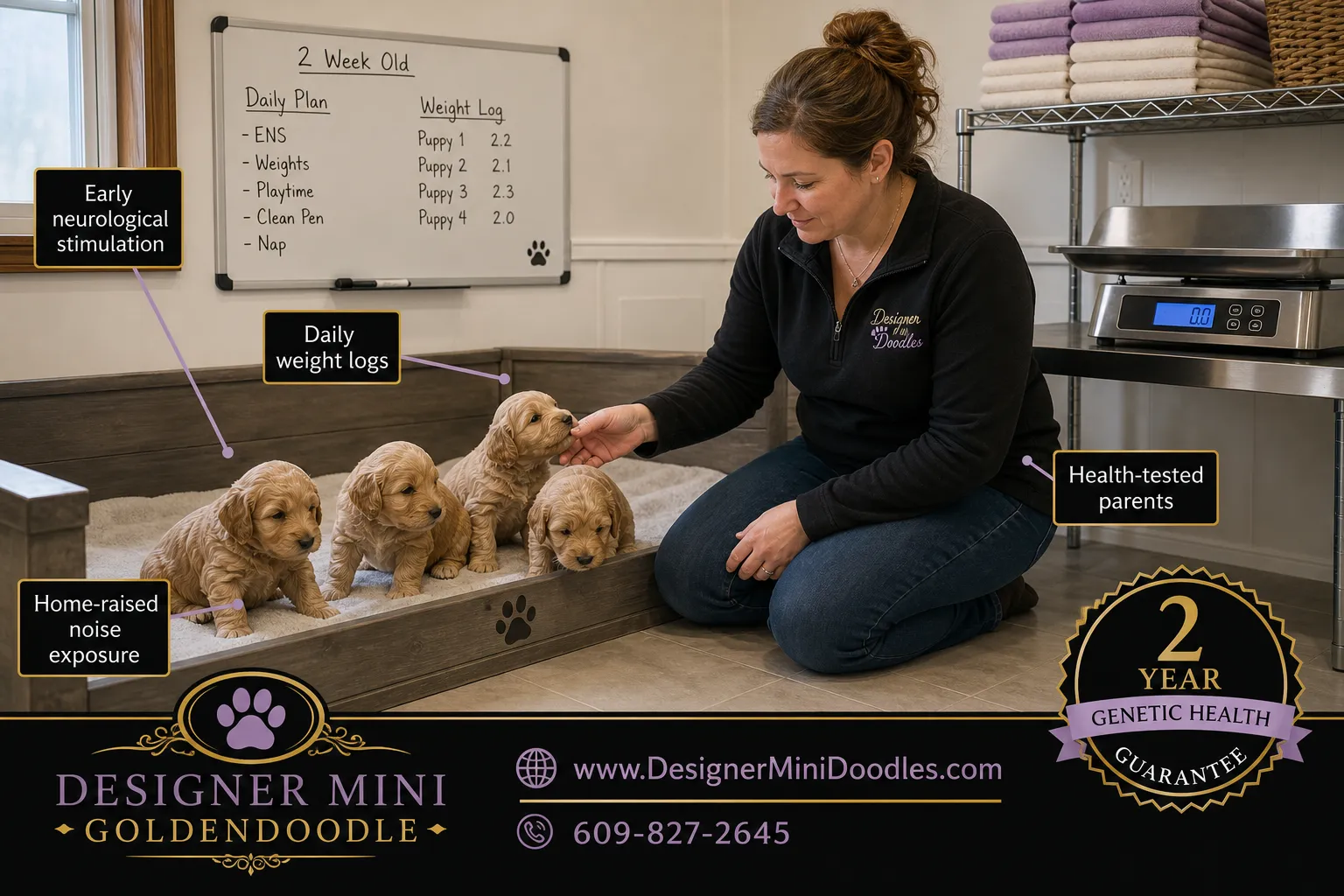
Buy from a program that health-tests both parents, raises litters inside a home rather than a barn kennel, and can produce written proof of ENS, early crate exposure, and started potty training. In Pennsylvania that means vetting hard, because the state has both excellent small programs and a well-documented high concentration of commercial kennels.
Practical vetting checklist for any Pennsylvania breeder:
- Verify the kennel license. Pennsylvania’s Dog Law Enforcement Office (Department of Agriculture) licenses kennels and publishes inspection records. Ask for the license number and look it up.
- Request OFA or Embark documentation on both sire and dam: hips, elbows, eyes (CAER), cardiac, plus DNA panels for PRA-prcd, vWD, DM, GM2 and Ichthyosis.
- Ask for a live video walkthrough, unedited, showing the whelping area and the mother interacting with the litter.
- Ask what socialization protocol they follow. “They’re around the house” is not a protocol. ENS, sound desensitization, novel surfaces, and car exposure are protocols.
- Read the contract before the deposit. Look for a written genetic health guarantee with a defined term, a spay/neuter clause, and a return-to-breeder clause.
- Walk away from pressure. Countdown timers, “three families are asking about this pup,” and instant-payment-only terms are red flags.
Regional buyers have real options. Our statewide roundup of mini Goldendoodle puppies for sale in Pennsylvania and the best breeders covers availability across the Commonwealth, our best mini and micro Goldendoodle breeders in Pennsylvania guide compares programs, and city-focused buyers can start with mini Goldendoodle puppies for sale in Philadelphia. Buyers just across the Delaware often also review mini Goldendoodle puppies for sale in New Jersey.
Why Designer Mini Golden Doodles Is the Best Mini Goldendoodle Breeder for Pennsylvania Families
Designer Mini Golden Doodles is run by a working animal biologist who holds a degree in Animal Biology from Stockton University in Pomona, New Jersey, with a minor in animal genetics. That background is not decoration. It shapes how pairings are selected, how DNA panels are interpreted, and how coat type and adult size are predicted before a litter is ever planned.
What that means for a Pennsylvania buyer:
- Top bloodlines only. Every mini goldendoodle offered for sale, and every dog held back as breeding stock, comes from proven, health-tested top bloodlines rather than whatever was available locally.
- ENS from birth. Early Neurological Stimulation begins in the first days of life, building stress tolerance and resilience that shows up years later in vet visits, thunderstorms and city traffic.
- Raised in a genuinely busy home. Puppies grow up hearing vacuums, doorbells, dishes, kids, television and other animals. Nothing about a Pennsylvania household surprises them on day one.
- Started housebreaking and crate training. Litters learn to eliminate away from their sleeping area and to accept a crate as a den before they ever go home.
- Obedience foundations laid early. Name response, sit, and gentle handling for grooming and nail trims are all introduced before pickup.
Browse the current goldendoodle mini litters, review our miniature Goldendoodle breeders program details, and see why so many families call this the best mini golden doodle breeder in the USA. You can also find us on our Google Maps listing.
Current availability, including our smallest sizes:
- Display 9 Products per page

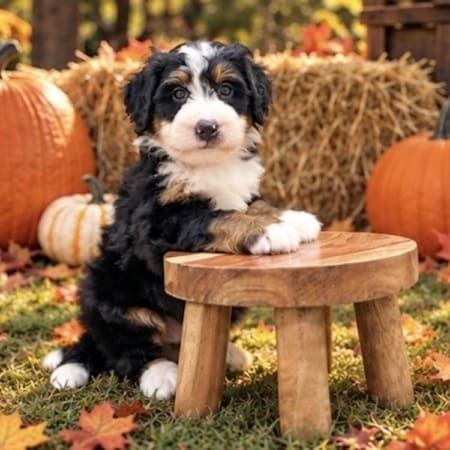
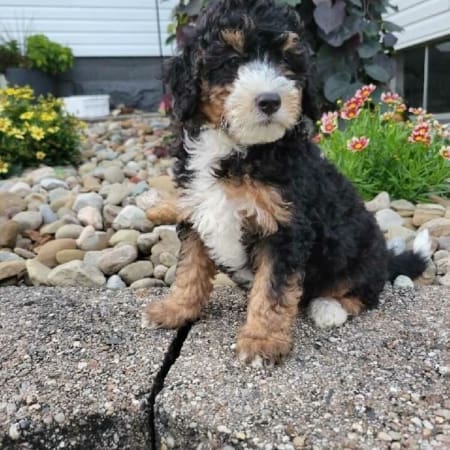


What Is the Mini Goldendoodle Temperament and Personality Like?
Mini goldendoodles are affectionate, socially confident, and highly trainable, with moderate-to-high energy that peaks between six months and two years. They are people-oriented to the point that most do poorly when left alone eight to ten hours a day without a plan.
Traits you can generally count on from well-bred lines:
- Eager to please, which makes reward-based training fast and punishment-based training counterproductive.
- Sociable with strangers and dogs, assuming the breeder socialized the litter and you continue it through six months.
- Sensitive to household tension. Yelling shuts them down rather than motivating them.
- Velcro tendencies. Separation-related distress is the single most common behavior complaint in the breed, so crate comfort and gradual alone-time training start week one.
Decision rule: If nobody is home for more than six hours a day, five days a week, either arrange a midday walker or day care, or choose a more independent breed. This is the honest answer, not the sales answer.
What Are the Most Common Mini Goldendoodle Health Problems and Lifespan?
Mini goldendoodles typically live 12 to 15 years. The breed’s main inherited risks come from both parent breeds: hip and elbow dysplasia, progressive retinal atrophy (PRA-prcd), patellar luxation, von Willebrand disease, subvalvular aortic stenosis, hypothyroidism, ear infections, and allergies. Nearly all of these are screenable in the parents.
What good testing looks like, and what it prevents:
| Screening | Covers | Why it matters |
|---|---|---|
| OFA hips and elbows | Dysplasia | Reduces lameness and costly orthopedic surgery |
| OFA CAER eye exam | Inherited eye disease | Catches conditions DNA panels miss |
| Embark or similar DNA panel | PRA-prcd, vWD, DM, GM2, Ichthyosis | Prevents pairing two carriers |
| OFA cardiac | Aortic stenosis, murmurs | Golden Retriever lines carry cardiac risk |
| Patella evaluation | Luxating kneecaps | Common in small Poodle lines |
Owner-side prevention that actually moves the needle:
- Keep the dog lean. Excess weight worsens every joint and endocrine issue on the list.
- Dry the ears after every swim or bath. Drop ears plus a dense coat equals moisture retention and recurring otitis.
- Brush teeth several times a week. Small mouths crowd, and dental disease shortens lives.
- Delay high-impact exercise. No forced running or repetitive stair sprints until growth plates close, generally around 12 to 14 months.
Edge case: Bloat (GDV) is less common in a 25-pound doodle than in a deep-chested giant breed, but it’s not impossible. Learn the signs (unproductive retching, distended abdomen, restlessness) and know your nearest 24-hour emergency clinic before you need it.
How Much Do Mini Goldendoodles Shed, and What Grooming Do They Need?
Mini goldendoodles shed very little; most loose hair stays trapped in the coat instead of landing on your floor. That’s exactly why grooming is non-negotiable: trapped hair mats, and matted coats cause skin infections and painful shave-downs.
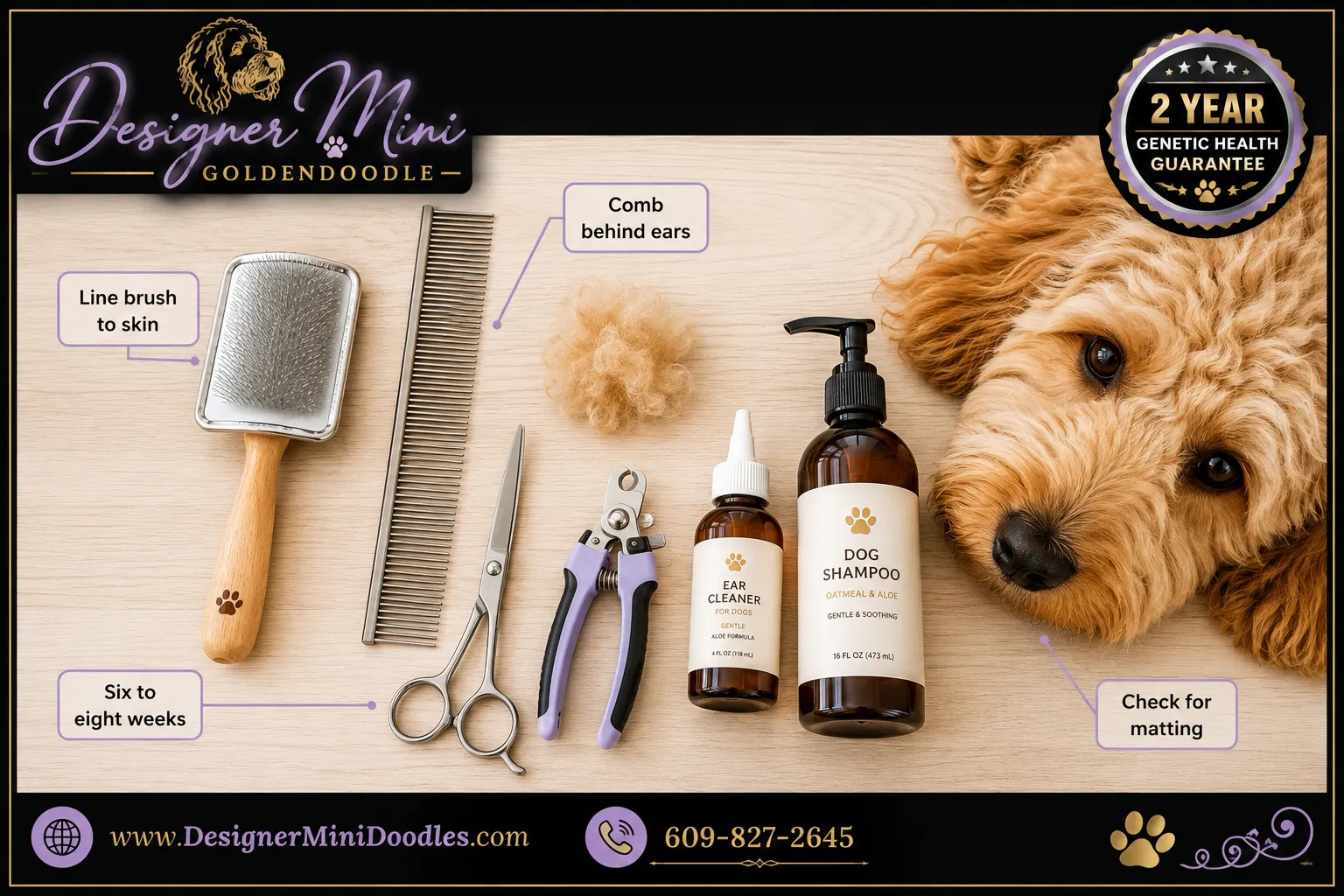
A realistic maintenance schedule:
- Brushing: 3 to 4 times per week minimum, daily during the 7-to-12-month coat change. Line-brush down to the skin with a slicker, then confirm with a steel comb. If the comb snags, you missed it.
- Professional grooming: every 6 to 8 weeks, typically $75 to $130 in Pennsylvania metro areas.
- Bathing: every 4 to 6 weeks, or after muddy trail days. Always brush before bathing, never after matting has set.
- Ears: check weekly, clean as your vet directs, pluck or trim only on professional advice.
- Nails: trim every 3 to 4 weeks.
- Eyes: wipe tear staining and keep the hair trimmed out of the eyes between grooms.
The coat change between roughly seven and twelve months is where most first-time doodle owners lose the battle. Puppy coat releases while adult coat comes in, and a week of skipped brushing can produce a mat you cannot comb out.
Common mistake: asking a groomer for a “teddy bear cut” on a matted dog. A responsible groomer will shave instead, because dematting a solidly matted coat is painful and unsafe. Prevention beats negotiation.
Are Mini Goldendoodles Good for Apartments in Philadelphia or Pittsburgh?
Yes, mini goldendoodles adapt well to apartments and rowhouses provided they get 45 to 60 minutes of real daily exercise plus 15 to 20 minutes of mental work, and provided you address barking and alone-time training early. Square footage matters far less than routine.
City-living playbook:
- Two structured walks a day, plus one sniff-focused decompression walk where the dog sets the pace.
- Mental enrichment daily: snuffle mats, food puzzles, scatter feeding, five-minute trick sessions. Twenty minutes of nose work tires a doodle more than a fast mile.
- Elevator and lobby manners: train a solid “sit and watch me” before the door opens, and practice on stairs and hard floors early.
- Barking management: reward quiet at hallway noise from week one instead of waiting for a neighbor complaint.
- Check the lease. Many Pennsylvania buildings cap dogs at 25 or 35 pounds, so confirm your limit before you pick a size. This is where a truly small pup helps; our guide on why a 10 to 16 lb micro Goldendoodle is the perfect size walks through the training and enrichment side.
Choose a larger mini (30 to 35 lb) if you have a yard and want a hiking companion. Choose a micro or small mini (10 to 20 lb) if you’re in a weight-restricted building, you travel by train, or you want a dog you can carry.
What Are the Best Mini Goldendoodle Training Tips?
Start on day one with crate, potty and name games, use food rewards, and keep sessions to five minutes several times daily. Mini goldendoodles learn fast, which means they learn bad habits just as fast as good ones.
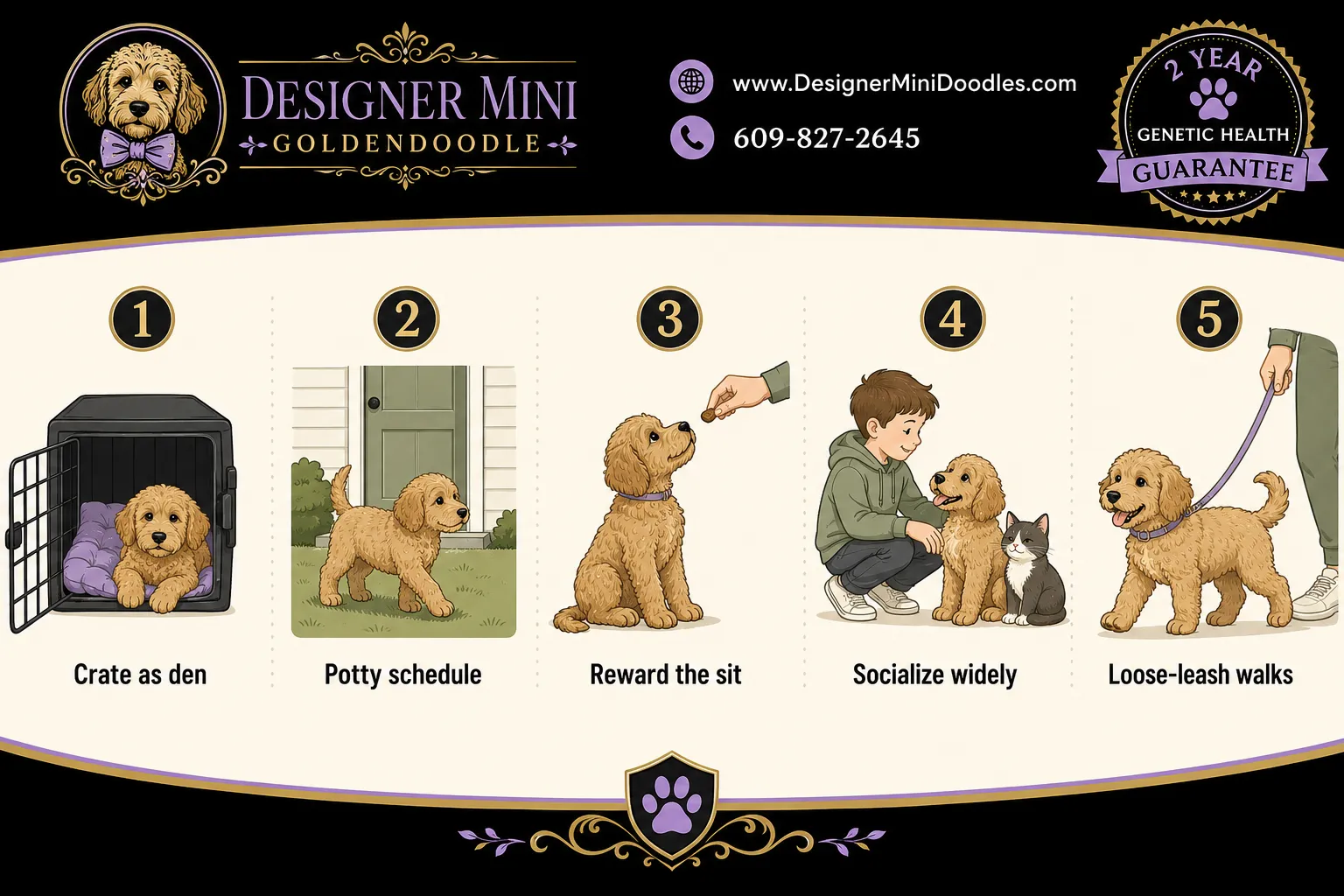
A first-30-days plan that works:
- Days 1-3: Crate as den. Feed every meal in the crate, door open. Toss treats in randomly. Never use the crate as punishment.
- Days 1-14: Potty schedule. Out after waking, after eating, after play, and every 60 to 90 minutes awake. Same door, same spot, reward outside within three seconds of finishing. Supervise or confine, always.
- Week 1: Name and marker. Say the name once, mark the head turn with “yes,” pay. Fifteen reps a day builds a reliable recall foundation.
- Weeks 2-4: Alone-time ladder. Leave for 30 seconds, then two minutes, then ten, then thirty. Build duration before you build distance.
- Weeks 2-16: Socialization, not just exposure. Aim for calm, positive experiences with new surfaces, sounds, hats, umbrellas, bicycles, children and vet handling. Quality over quantity.
- Ongoing: Loose-leash and impulse control. Reward position beside your leg. Practice “wait” at doorways and “leave it” with dropped food.
Puppies from a program that already runs ENS, household noise exposure, early potty separation and crate familiarity arrive several weeks ahead. That head start is one of the clearest differences between a $1,200 puppy and a professionally raised one. Families comparing programs across state lines often review our mini doodle puppies listings alongside our mini Goldendoodle puppies overview page.
Common mistake: free-roaming a new puppy through the whole house. Every unsupervised accident sets housebreaking back. Use gates, a pen and a leash-to-you tether for the first three weeks.
FAQ
How much does a mini goldendoodle cost in Pennsylvania?
Between $2,500 and $4,500 from an accredited breeder with genetic health testing, proper whelping, and started housebreaking and crate training. Hobby breeders run $1,800 to $2,000, and anything under $1,500 usually indicates a puppy mill or a scam.
How big does a mini goldendoodle get?
Most mature at 14 to 17 inches tall and 20 to 35 pounds. Micro and toy varieties finish smaller, often 10 to 20 pounds, depending on the Poodle parent’s size.
Do mini goldendoodles shed?
Very little. F1B and multigen dogs with curlier coats shed least. Loose hair stays in the coat, which is why brushing three to four times a week is required to prevent matting.
What is a mini goldendoodle’s lifespan?
Typically 12 to 15 years, longer than a standard Golden Retriever, mainly because smaller dogs generally outlive larger ones.
Are mini goldendoodles hypoallergenic?
No dog is truly hypoallergenic. Curly-coated F1B and multigen mini goldendoodles release less dander and hair into the home, which many allergy-sensitive owners tolerate better, but nothing is guaranteed.
Are mini goldendoodles good for first-time owners?
Yes. They’re eager to please and highly food-motivated, which makes reward-based training straightforward. The two challenges for beginners are grooming commitment and separation-related behavior.
How do I spot a mini goldendoodle scam in Pennsylvania?
Watch for prices under $1,000, requests for Zelle, Venmo, gift cards or crypto, refusal to do a live video call, stolen or reverse-searchable photos, and surprise “shipping insurance” fees after the deposit.
Do mini goldendoodles bark a lot?
They’re moderate barkers, usually alerting at doors and hallway noise rather than barking continuously. Rewarding quiet from the first week and providing daily mental enrichment keeps it manageable in apartments.
Mini goldendoodle or cockapoo for a small apartment?
A cockapoo is smaller and easier in weight-restricted buildings. A mini goldendoodle is a better fit if you have children, want a hiking partner, or prefer a more consistently biddable dog.
How often do mini goldendoodles need professional grooming?
Every 6 to 8 weeks, plus at-home brushing several times a week. Expect roughly $75 to $130 per appointment in most Pennsylvania metro areas.
When can a mini goldendoodle puppy come home?
Eight weeks at the earliest for most programs. Very small micro pups sometimes stay until nine or ten weeks so they gain weight and stability before travel.
What health tests should a Pennsylvania breeder show me?
OFA hips, elbows, cardiac and CAER eye exams on both parents, plus a DNA panel covering PRA-prcd, von Willebrand disease, degenerative myelopathy, GM2 gangliosidosis and Ichthyosis.
Conclusion: Your Next Steps
Buying a mini goldendoodle in Pennsylvania comes down to three decisions made in the right order: pick the size and generation that fits your home and lease, set a realistic budget in the $2,500 to $4,500 accredited-breeder range, and then verify the breeder’s health testing and early-development protocol before any money changes hands. Skip a step and you inherit a decade of avoidable vet bills and behavior work.
Here’s what I’d do this week:
- Write down your constraints: weight limit, hours alone per day, grooming budget, and target coat type.
- Set your real budget, purchase price plus $1,500 to $2,500 for first-year costs.
- Shortlist two or three breeders and request health testing documentation and a live video call for each.
- Read the contract, confirming the genetic health guarantee term and the return-to-breeder clause.
- Book a groomer and a puppy class before your pup comes home, since good ones fill up months out.
- Set up the crate, pen and gates the day before pickup so training starts in hour one, not week two.
If you want a puppy that arrives already started on housebreaking, comfortable in a crate, ENS-raised from birth, and bred from health-tested top bloodlines by an animal biologist who understands the genetics behind the pairing, start with the available litters at Designer Mini Golden Doodles and ask every question on the checklist above. A good breeder welcomes them.