

Last updated: August 19, 2026
mini goldendoodle puppies North Jersey
Mini goldendoodle puppies North Jersey buyers should expect to pay $2,500 to $4,500 for a well-bred, health-guaranteed puppy from an accredited program, with waitlists of two to six months in Bergen, Morris, Passaic, Essex, and Sussex counties. A mini goldendoodle is a cross between a Golden Retriever and a Miniature or Toy Poodle, typically weighing 15 to 35 pounds, with a low-shedding coat that needs professional grooming every six to eight weeks. Anything advertised at $500 to $1,000 in the North Jersey market is almost always a scam listing or a broker fronting for a mill.
mini goldendoodle puppies North Jersey
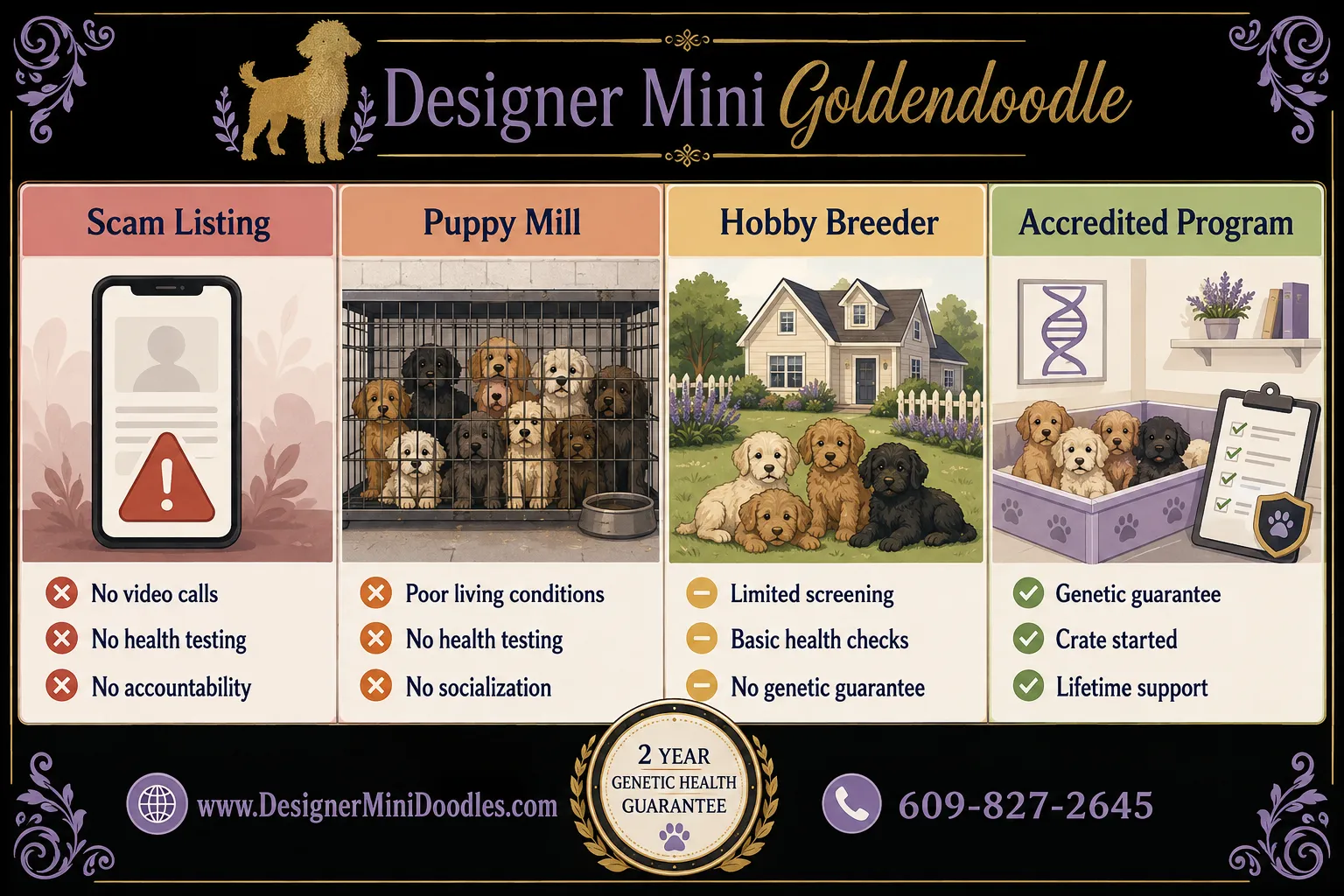
- Price is the fastest screening tool. Scam listings sit at $500-$1,000, puppy mills at $1,000-$1,500, casual hobby breeders at $1,800-$2,000, and accredited breeders with genetic health guarantees at $2,500-$4,500.
- Mini goldendoodles suit apartments well if you commit to two walks plus mental enrichment daily, size is rarely the limiting factor, energy management is.
- Low shedding does not mean low maintenance. The wavy fleece coat traps loose hair, so it mats without line brushing three to four times a week.
- Ask for OFA or PennHIP hips, elbows, cardiac, eye (CAER), and DNA panels on both parents. Golden Retrievers carry real cancer and hip risk; Poodles carry PRA and vWD.
- Early Neurological Stimulation (ENS) from days 3 to 16 and household noise exposure produce measurably calmer, more adaptable puppies at pickup.
- Designer Mini Doodles is run by a trained animal biologist, and every puppy leaves well started on housebreaking and crate training.
- Choose a mini goldendoodle over a cockapoo if you want a slightly larger, more biddable retriever-type dog; choose a cockapoo if you want a smaller lap companion.
- The first 30 days matter more than the next year. A crate routine, one potty spot, and controlled socialization set the trajectory.
What Is a Mini Goldendoodle?
A mini goldendoodle is a deliberate cross between a Golden Retriever and a Miniature or Toy Poodle, bred to combine the Golden’s soft temperament with the Poodle’s low-shedding coat in a smaller package. Adults usually stand 13 to 20 inches tall and weigh 15 to 35 pounds, with a typical lifespan of 12 to 15 years.
Size language varies between breeders, which causes most of the confusion buyers run into. Here’s how the categories generally break down in the North Jersey market:
| Type | Adult weight | Typical height | Best fit |
|---|---|---|---|
| Toy / Micro | 10-16 lbs | 11-14 in | Apartments, travel, seniors |
| Mini | 17-30 lbs | 14-18 in | Families, first-time owners |
| Medium | 31-45 lbs | 18-21 in | Active households, yards |
| Standard | 46-90 lbs | 21-26 in | Rural homes, hiking |
Generation labels matter just as much as weight. An F1 is Golden x Poodle (50/50). An F1B is an F1 bred back to a Poodle (roughly 75% Poodle), which usually shed the least. An F2B or multigen has several doodle generations behind it and tends to produce the most predictable coats and sizes.
Decision rule: if allergies are the main reason you’re buying, ask for an F1B or multigen with a documented furnishings (RSPO) and curl gene test. If temperament predictability matters more than coat, an F1 from health-tested parents is a fine choice.
If you’re still deciding on size, our breakdown of toy, micro, and mini goldendoodle sizes and prices lays out the weight ranges side by side.
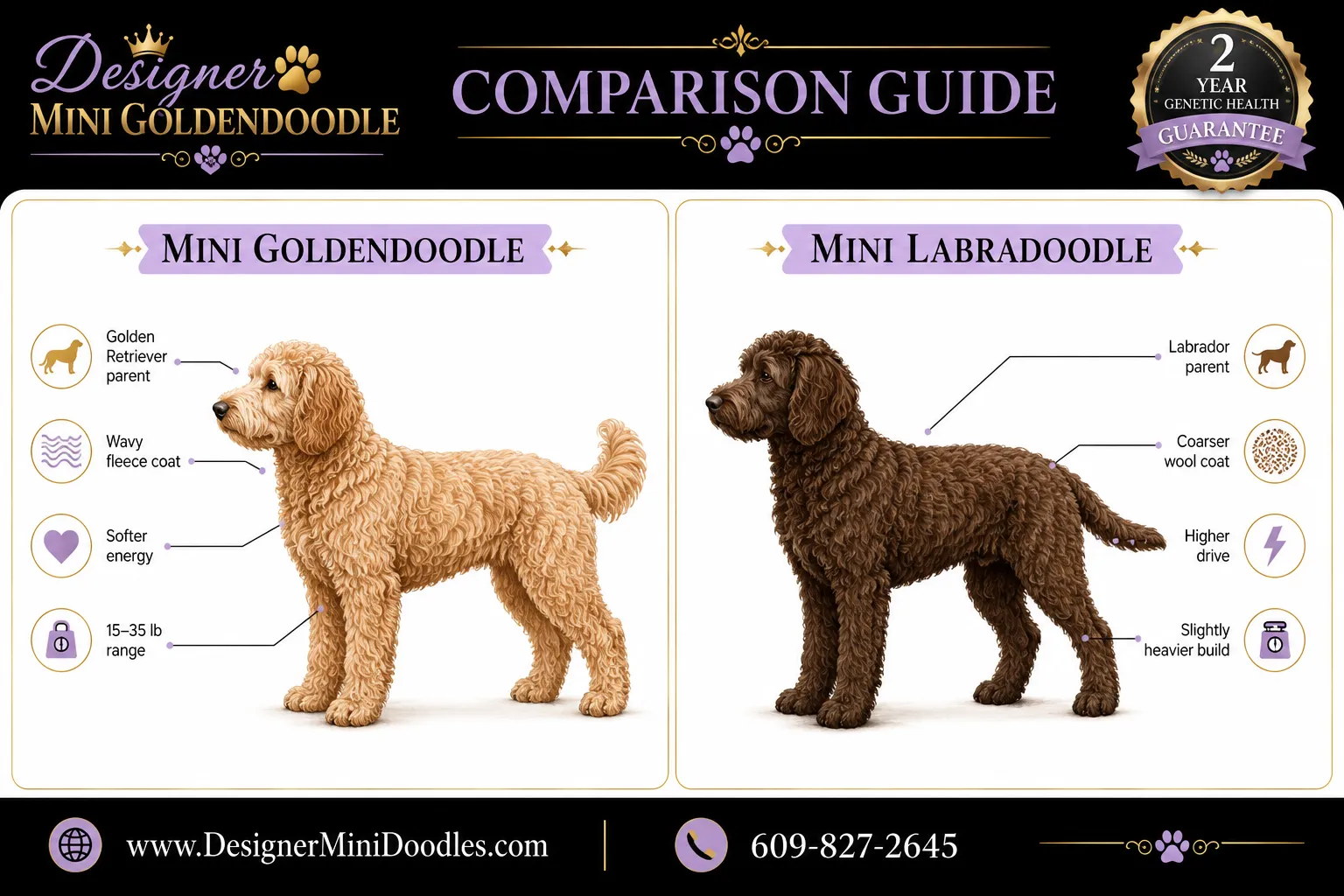
Mini Goldendoodle vs Mini Labradoodle: What Are the Real Differences?
The core difference is the retriever parent: mini goldendoodles come from Golden Retrievers, mini labradoodles from Labrador Retrievers. That single swap changes coat texture, energy level, and how the dog interacts with strangers.
- Energy: Labradoodles generally run hotter. Labs were bred for sustained retrieving work, and that drive shows up as more physical intensity through adolescence.
- Coat: Goldendoodles more often carry a wavy, silky fleece coat. Labradoodles trend toward coarser wool or hair coats, and hair-coated labradoodles can shed noticeably.
- Social style: Goldendoodles tend to be softer and more eager to please with new people. Labradoodles can be more independent and mouthy as puppies.
- Build: Labradoodles usually carry more bone and a blockier head at the same weight.
Choose a mini goldendoodle if you want a velcro-style companion for a family or a work-from-home household. Choose a mini labradoodle if you run, hike, or want a dog with more physical stamina.
Common mistake: assuming either cross is automatically hypoallergenic. No dog is. Coat genetics vary within a single litter, so ask which puppies inherited two copies of the furnishings gene.
Where Can I Find Mini Goldendoodle Puppies for Sale in North Jersey?
Mini goldendoodle puppies for sale in North Jersey come from three sources: accredited breeding programs with waitlists, local hobby breeders producing one or two litters a year, and out-of-state programs that deliver or arrange flight nanny transport into Newark. The accredited route costs more up front and produces far fewer surprises.
North Jersey buyers typically search within driving distance of these hubs:
- Bergen County (Hackensack, Ridgewood, Paramus), highest demand, longest waitlists
- Morris County (Morristown, Parsippany, Denville)
- Essex County (Montclair, Livingston, West Orange)
- Passaic, Sussex, Warren, and Hunterdon counties, more rural properties, more small home programs
- Hudson County (Hoboken, Jersey City), apartment buyers driving toy and micro demand
At Designer Mini Doodles, we place puppies with families across North Jersey and the greater New York metro every year, and we’re widely recognized among the best mini goldendoodle breeders serving the Northeast. You can browse our current litters of mini goldendoodle puppies for sale in New Jersey, and buyers just across the state line often start with our New York mini goldendoodle page instead. Families coming down the I-78 corridor frequently compare our program with Pennsylvania mini goldendoodle breeders as well.
Transport note: Newark Liberty (EWR) makes North Jersey one of the easiest metro areas in the country to receive a well-bred puppy from an out-of-state program. Flight nanny service typically costs $400 to $700 in addition to the puppy price.
You can also find us on our Google Maps listing to see reviews from placement families.
Why Designer Mini Doodles Is the Best Mini Goldendoodle Breeder for North Jersey Families
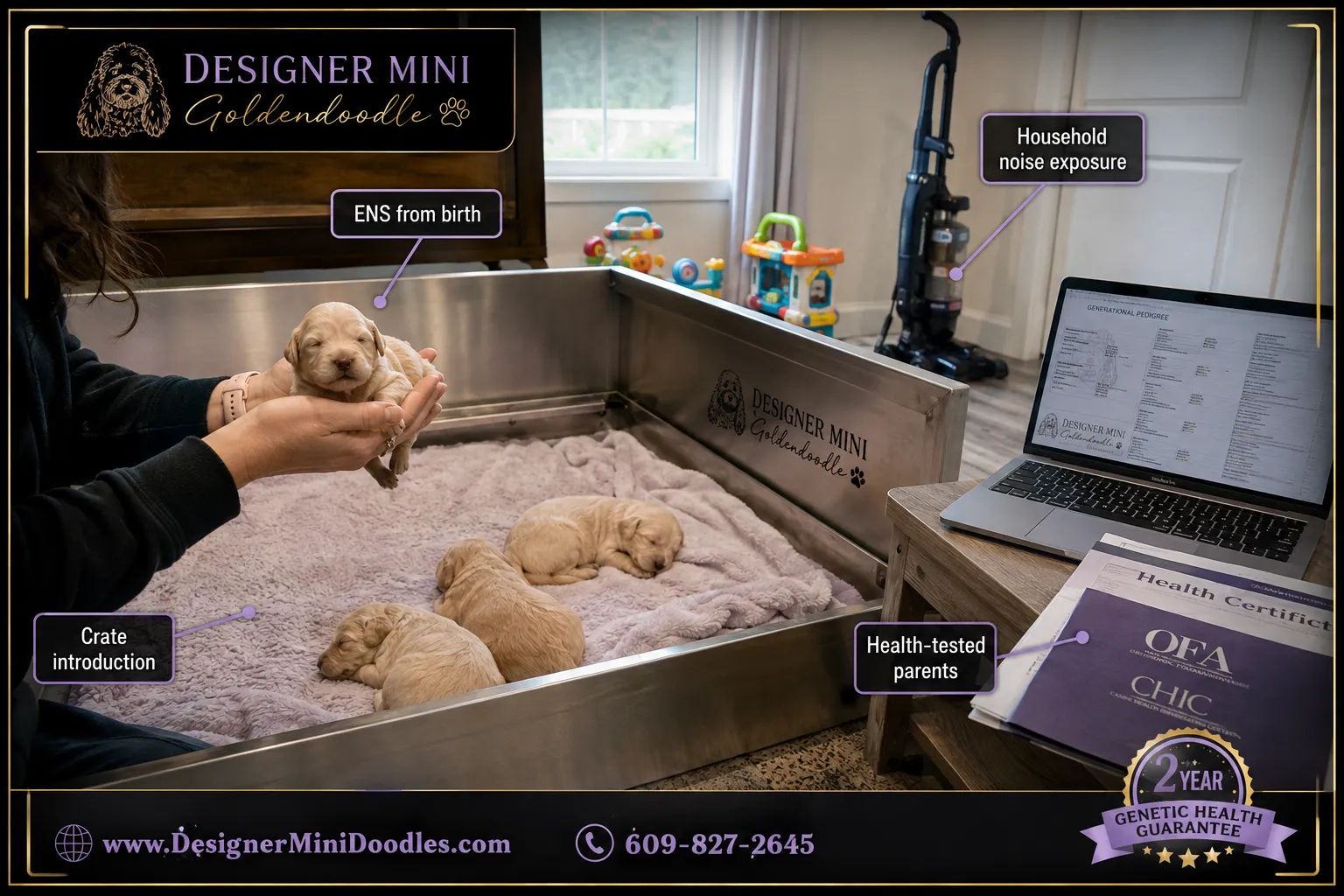
Our program is run by a credentialed animal biologist, not a hobbyist. The founder holds a degree in Animal Biology from Stockton University in Pomona, New Jersey, with a minor in animal genetics, which means pairing decisions are made on pedigree data and DNA panels rather than color preference.
What that translates to for a North Jersey family bringing home a puppy:
- Top bloodlines only. Every one of our mini doodles for sale, and every dog in our breeding stock, traces to documented, health-tested lines with verified pedigrees.
- ENS from birth. We begin Early Neurological Stimulation handling in the first days of life, and our puppies are interacted with daily from birth forward, never left in a barn or a back room.
- Real-world sound exposure. Our puppies grow up inside a busy home: vacuums, doorbells, dishwashers, TV noise, children, and other animals. That’s the single best predictor of a puppy that doesn’t fall apart on a Hoboken sidewalk or in a Paramus parking lot.
- Well started on housebreaking and crate training. Puppies leave us already sleeping in a crate and already understanding a designated potty surface. Most families report full housebreaking in weeks, not months.
- Genetic health guarantee in writing, proper veterinary-supervised whelping, and age-appropriate vaccinations and deworming.
- Continued support for the life of the dog. We don’t disappear after pickup. Training questions at nine months, coat changes at a year, food transitions at three years, we answer.
We’re proud to be known as a leading mini golden doodle program, and families searching for a goldendoodle mini or comparing mini doodle breeders nationwide consistently point to our early training as the difference. If a French Bulldog is also on your shortlist, our sister program offers French bulldog puppies with the same health-first standards.
- Display 9 Products per page



How Much Do Mini Goldendoodle Puppies Cost in North Jersey?
Expect $2,500 to $4,500 for a mini goldendoodle puppy from an accredited North Jersey-area breeder in 2026. Price tracks directly with health testing, whelping standards, and how much early training work the breeder has already done for you.
Here’s how the market actually tiers:
| Price range | Source type | What you get | Risk level |
|---|---|---|---|
| $500-$1,000 | Scam listing | Usually no puppy at all, stolen photos, wire transfer requests, fake transport fees | Extreme |
| $1,000-$1,500 | Puppy mill / broker | No health testing, no socialization, high parasite and parvo risk, frequent behavioral fallout | High |
| $1,800-$2,000 | Hobby breeder | Healthy pet parents, limited or no OFA testing, minimal early training | Moderate |
| $2,500-$4,500 | Accredited breeder | Genetic health guarantee, OFA/DNA-tested parents, veterinary-supervised whelping, ENS, started housebreaking and crate training, lifetime support | Low |
The $500 listing is the tell. Nobody covers stud fees, progesterone testing, OFA screening, C-sections, vaccines, and eight weeks of premium feed for $500. If a “breeder” asks for Zelle, CashApp, or gift cards, walk away.
Budget beyond the purchase price. First-year ownership costs in North Jersey typically add up like this (estimates based on regional averages, not a published study):
- Initial vet visits, vaccines, spay/neuter: $600-$1,200
- Crate, pen, bedding, bowls, leash, toys: $250-$400
- Grooming every 6-8 weeks: $85-$130 per visit
- Food: $500-$800/year
- Pet insurance: $30-$60/month
- Training class or private sessions: $200-$600
Our page on cost-of-ownership clarity for smaller doodles breaks down why a 10-16 lb dog is meaningfully cheaper to keep than a 60 lb one.
How Do I Find Reputable Mini Goldendoodle Breeders Near Me in North Jersey?
A reputable breeder will show you paperwork before you ask for it, let you meet or video-call the dam, and turn buyers away when a home isn’t a fit. If a breeder never asks you a single question, that’s a red flag in itself.
Use this checklist on every breeder you contact:
- Health testing on both parents. Ask for OFA hips and elbows (or PennHIP), OFA cardiac, CAER eye exam, and a breed-appropriate DNA panel. Ask for the certificate numbers and verify them at ofa.org.
- A written health guarantee covering genetic conditions, with a clear term (commonly 1-2 years) and a stated remedy.
- Video call with the litter and the mother. Refusal is disqualifying.
- A contract with a spay/neuter clause and a return-to-breeder clause. Real breeders take dogs back for life.
- Vet records showing exam dates, vaccines, and deworming.
- Specific answers about socialization. “They’re around kids” is vague. “ENS days 3-16, Rule of Sevens by week 6, crate-conditioned by week 7” is a real program.
- References from two or three prior placement families.
- No high-pressure closing. Deposits should hold a spot, not force one.
Edge case worth knowing: a breeder with no available puppies right now is often the better breeder. Programs that always have stock either breed too many dogs or buy from others. A three- to six-month wait in the North Jersey market is normal and healthy.
For a broader view of how programs are evaluated, see our overview of miniature goldendoodle breeders.
What Is a Mini Goldendoodle’s Temperament and Personality Like?
Mini goldendoodles are typically people-oriented, biddable, and moderately energetic, the classic “follows you from room to room” dog. Most do best in homes where someone is around for a good part of the day, and most struggle with long stretches of isolation.
Traits families in North Jersey report most often:
- High social drive. Friendly with strangers, kids, and other dogs when socialized properly.
- Strong trainability. Both parent breeds rank high for working intelligence, which shows up as fast obedience learning.
- Sensitivity. Harsh corrections backfire. Reward-based training works far better.
- Separation sensitivity. This is the single most common behavioral complaint. Crate training and gradual alone-time practice from week one prevents most of it.
- Adolescent surge between 7 and 14 months, when a previously easy puppy tests everything.
Quick example: a Montclair family that leaves at 8 a.m. and returns at 6 p.m. with no midday break is a poor fit unless they add a walker or daycare two to three days a week. The same dog thrives with a work-from-home owner in Morristown. Our notes on why a 10-16 lb doodle suits seniors and work-from-home households go deeper on that fit.
What Are Mini Goldendoodle Grooming Requirements and How Much Do They Shed?
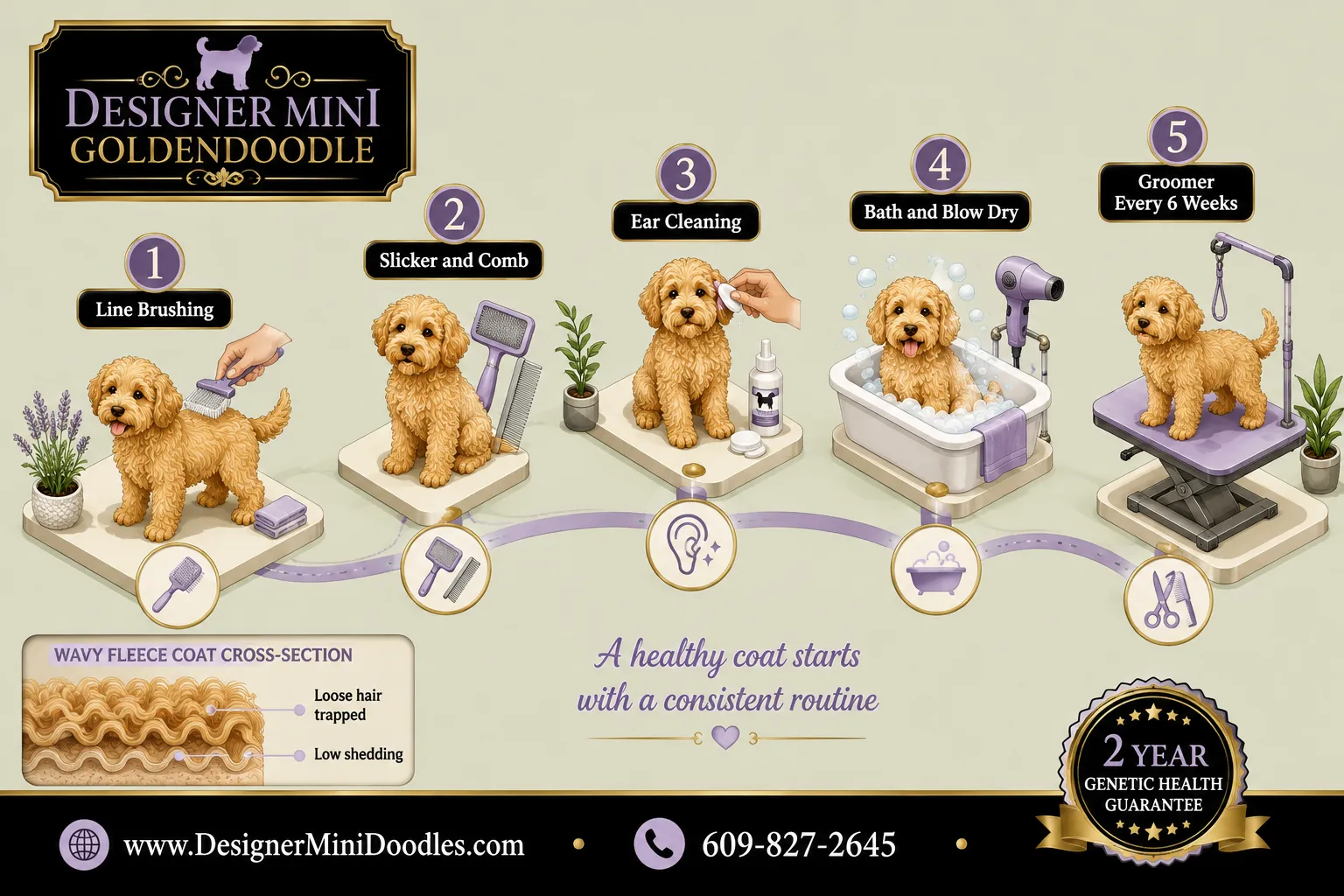
Mini goldendoodles shed very little, typically less than a Golden Retriever and more than a purebred Poodle, but low shedding means shed hair stays in the coat and mats. Plan on line brushing three to four times a week and a professional groom every six to eight weeks.
Shedding by coat type:
- Curly (wool): minimal shedding, highest matting risk
- Wavy (fleece): light shedding, moderate matting risk, the most common mini goldendoodle coat
- Straight (hair/improper coat): noticeable shedding, low matting risk
Home grooming routine:
- Line brush with a slicker brush, working in sections down to the skin, not just over the surface.
- Follow with a steel comb. If the comb won’t pass through cleanly, the mat is still there.
- Check friction zones weekly: behind the ears, armpits, collar line, tail base, and rear legs.
- Clean ears every 1-2 weeks. Doodle ear canals hold moisture and hair, and North Jersey summer humidity makes yeast infections common.
- Bathe every 3-4 weeks and blow dry fully. Air drying a fleece coat is how mats form.
- Trim nails every 2-3 weeks and keep eye-area hair short.
Common mistake: waiting until the first groom at six months. Book a “puppy intro” groom at 12-16 weeks, no full haircut, just handling, clippers running nearby, nail trim, and a bath. It makes every future appointment easier. Also expect the coat change between 8 and 14 months, when the puppy coat is replaced by the adult coat and matting risk spikes.
North Jersey seasonal note: road salt in Bergen and Morris counties irritates paw pads and dries the coat. Rinse feet after winter walks.
Are Mini Goldendoodles Good for Apartments in North Jersey?
Yes. Mini goldendoodles adapt well to apartments in Hoboken, Jersey City, and Fort Lee, provided they get two solid walks and daily mental enrichment. Their moderate size, low shedding, and low-to-moderate barking tendency make them one of the better doodle choices for building living.
What actually determines apartment success:
- Exercise, not square footage. A 20 lb doodle needs 45-60 minutes of activity daily plus sniffing and chew time. Under-exercised dogs bark and chew.
- Elevator and lobby manners. Practice sit-and-wait at doors from week one.
- Crate as a safe base. A crate-trained puppy sleeps quietly instead of pacing when you leave.
- Weight and breed restrictions. Many North Jersey buildings cap dogs at 25-35 lbs. Get the adult weight estimate in writing from your breeder before you sign a lease addendum.
- Potty logistics. High-floor apartments make housebreaking harder. A well-started puppy from a program that already began housebreaking saves you weeks.
Choose a toy or micro doodle (10-16 lbs) if you’re in a walk-up, travel often, or your building has a strict weight cap. Our guide to travel-friendly micro goldendoodle companions covers the airline cabin-size angle.
What Mini Goldendoodle Health Problems Should I Watch For?
Mini goldendoodles inherit risk from both parent breeds: hip and elbow dysplasia and certain cancers from the Golden Retriever side, and progressive retinal atrophy, von Willebrand’s disease, and luxating patellas from the Poodle side. Parent health testing is what reduces those odds.
Conditions to ask your breeder about directly:
- Hip and elbow dysplasia, require OFA or PennHIP results on both parents
- Progressive Retinal Atrophy (prcd-PRA), a simple DNA test; there is no excuse for skipping it
- von Willebrand’s disease (vWD), a bleeding disorder, DNA testable
- Ichthyosis, a Golden Retriever skin condition, DNA testable
- Patellar luxation, more common in the smallest sizes
- Subvalvular aortic stenosis and other cardiac issues, OFA cardiac exam on parents
- Chronic ear infections, management, not genetics: dry ears after swimming and baths
- Hypothyroidism and allergies, often show up between 2 and 5 years
Practical step: schedule a vet exam within 72 hours of pickup. Most health guarantees require it, and it establishes a baseline. Also ask whether the breeder’s guarantee covers the specific conditions above or just “congenital defects,” which can be interpreted narrowly.
Mini Goldendoodle vs Cockapoo: Which Is Better?
Neither is objectively better, they suit different homes. Choose a mini goldendoodle for a slightly larger, highly trainable family dog with retriever biddability. Choose a cockapoo for a smaller lap-sized companion that fits tight living spaces.
| Factor | Mini Goldendoodle | Cockapoo |
|---|---|---|
| Parent breeds | Golden Retriever x Mini/Toy Poodle | Cocker Spaniel x Poodle |
| Adult weight | 15-35 lbs | 12-24 lbs |
| Energy level | Moderate to high | Moderate |
| Trainability | Very high, retriever focus | High, more distractible |
| Grooming | Every 6-8 weeks | Every 6-8 weeks, ear care critical |
| Known risks | Hip dysplasia, cancers | Ear infections, PRA, patellas |
| Best for | Families with kids, active owners | Apartments, seniors, quieter homes |
Decision rule: if you want a dog that will reliably fetch, hike, and take on advanced obedience or therapy work, go mini goldendoodle. If you want a dog that’s happiest curled on the couch and easy to carry, the cockapoo edges ahead. For families with children, our notes on why a 10-16 lb doodle works for households with kids are worth reading before you decide on size.
Mini Goldendoodle Puppy Care and Training: The First Weeks
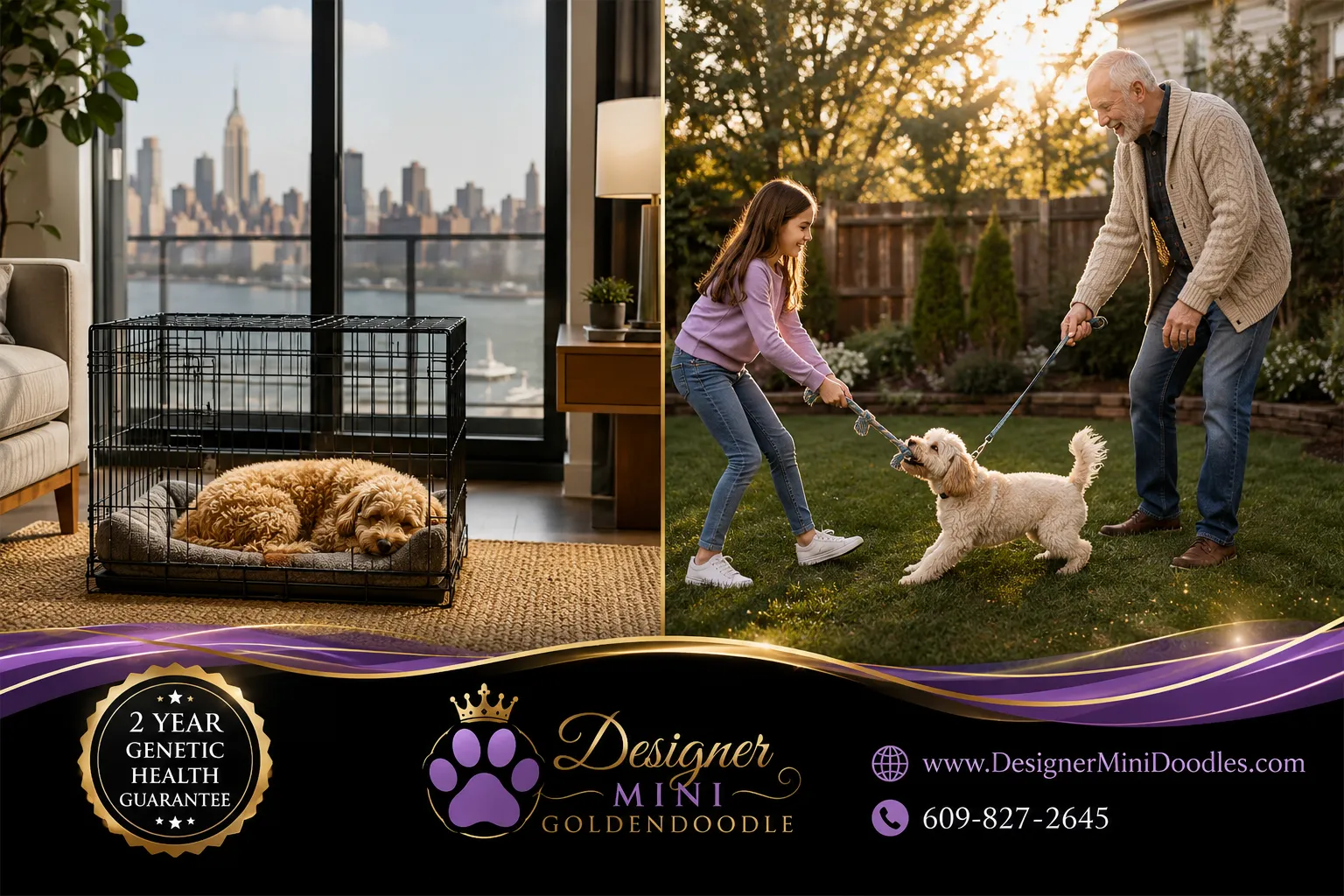
The first 30 days set the pattern for the next decade. Focus on three things only: a predictable crate and potty routine, controlled socialization, and preventing separation anxiety before it starts.
Days 1-3: settle in
- Set up a crate and pen in a low-traffic room, not the middle of the kitchen.
- Keep the breeder’s food for at least a week to avoid GI upset.
- Take the puppy to the same outdoor potty spot every time. Scent does the teaching.
- Skip visitors. Let the puppy learn your household first.
Days 4-10: build the routine
- Crate for naps and overnight, with a chew and something that smells like home.
- Out to potty after every wake-up, meal, and play session, roughly every 60-90 minutes when awake.
- Practice five-minute departures so alone time never feels like a crisis.
- Reward the puppy for lying calmly in the crate with the door open.
Days 11-20: socialization window
- Aim for new experiences daily: umbrellas, wheelchairs, mail carriers, tile and metal grates, car rides, hats, beards, kids on scooters.
- Keep every exposure short and paired with treats. Quality beats quantity.
- Follow your vet’s guidance on where paws touch the ground before the vaccine series is complete. Carry the puppy in busy areas.
Days 21-30: formalize training
- Enroll in a positive-reinforcement puppy class in your county.
- Teach name recognition, sit, a hand-touch, and a marker word first. Recall next.
- Start short leash walks with loose-leash rewards from day one.
Because puppies from our program arrive already crate conditioned and well started on housebreaking, most North Jersey families report reliable overnight sleeping within the first week. That’s the practical payoff of ENS, daily handling, and raising litters inside a busy household rather than a kennel building. For families new to dogs entirely, our page on why a 10-16 lb doodle fits first-time dog owners covers the learning curve honestly.
Common mistake: free-feeding. Scheduled meals produce predictable potty times, which produces faster housebreaking.
Frequently Asked Questions
How much do mini goldendoodle puppies cost in North Jersey?
$2,500 to $4,500 from an accredited breeder with genetic health testing, proper whelping, and started crate and potty training. Listings at $500 to $1,000 are almost always scams, and $1,000 to $1,500 typically signals a puppy mill or broker.
How big do mini goldendoodles get?
Most mini goldendoodles reach 15 to 35 pounds and 13 to 20 inches at the shoulder. Toy and micro varieties stay between 10 and 16 pounds. Adult size depends on the Poodle parent, so ask for parent weights.
Do mini goldendoodles shed?
They shed lightly. Curly and wavy coats shed the least, while straight or “improper” coats shed noticeably. Low shedding means loose hair stays trapped in the coat, so regular brushing is required to prevent matting.
Are mini goldendoodles hypoallergenic?
No dog is truly hypoallergenic. Mini goldendoodles produce less loose hair and dander than many breeds, and F1B or multigen puppies with two copies of the furnishings gene are usually the best option for allergy-sensitive homes.
Are mini goldendoodles good for apartments?
Yes, if they get two walks and daily mental enrichment. Their moderate size and low barking tendency work well in North Jersey apartment buildings, though many buildings enforce weight caps of 25 to 35 pounds.
How long is the waitlist for mini goldendoodle puppies in North Jersey?
Two to six months is typical for reputable programs, and longer for specific colors or the smallest sizes. A breeder with immediate availability year-round is worth a second look.
What health tests should mini goldendoodle parents have?
OFA or PennHIP hips, OFA elbows, OFA cardiac, a CAER eye exam, and DNA testing for prcd-PRA, von Willebrand’s disease, and ichthyosis. Verify certificate numbers at ofa.org rather than trusting a screenshot.
How often do mini goldendoodles need grooming?
Professional grooming every six to eight weeks, plus line brushing three to four times weekly at home. Ear cleaning every one to two weeks prevents the infections doodles are prone to.
Is a mini goldendoodle or a cockapoo easier to train?
Mini goldendoodles are generally easier for structured obedience thanks to Golden Retriever biddability. Cockapoos are smart but often more easily distracted by scent.
When should my puppy start training classes?
After the first vaccine series has begun, usually around 9 to 12 weeks, in a reputable puppy class that requires proof of vaccination. Home training should start on day one.
Does Designer Mini Doodles ship to New Jersey?
Yes. We place puppies with North Jersey families through in-person pickup, ground transport, and flight nanny service into Newark Liberty International Airport.
What support do I get after bringing the puppy home?
Our program provides continued support for the life of the dog, covering feeding transitions, adolescent behavior, grooming schedules, and training questions years after placement.
Conclusion: Your Next Steps
Buying a mini goldendoodle in North Jersey comes down to two decisions: what size fits your home, and which breeder will actually stand behind the dog. Price is your fastest filter, and health testing paperwork is your proof. A puppy that arrives crate conditioned, noise desensitized, and already started on housebreaking saves you months of frustration and hundreds of dollars in training.
Here’s what to do this week:
- Set your size target. Toy/micro (10-16 lbs) for apartments and travel; mini (17-30 lbs) for family homes with yards.
- Confirm your building or HOA weight limit in writing before you place a deposit.
- Contact two or three programs and request OFA certificate numbers, a video call with the dam, and a copy of the health guarantee.
- Verify every certificate at ofa.org. Do not skip this step.
- Budget $2,500-$4,500 for the puppy plus $1,000-$1,800 for first-year setup, vet care, and grooming.
- Join a waitlist rather than chasing instant availability. The wait is a quality signal.
- Book your vet exam and a puppy-intro groom before pickup day.
When you’re ready to see current litters, browse our available mini goldendoodle puppies and reach out with questions. Our program was built by an animal biologist on top bloodlines, early neurological stimulation, real household socialization, and support that doesn’t end at the driveway.