

Mini Goldendoodle puppies Plano Texas
Last updated: August 2, 2026
Quick Answer: Mini Goldendoodle puppies in Plano, Texas are a cross between a Golden Retriever and a Miniature Poodle, typically weighing 15 to 35 pounds at full maturity. Plano and the broader DFW metro area have a growing number of breeders, but quality varies dramatically. Expect to pay $2,500 to $4,500 from a reputable, health-tested breeder, and use the red flags in this guide to avoid scams and puppy mills.
Mini Goldendoodle puppies Plano Texas
- Mini Goldendoodles typically reach 15 to 35 pounds and stand 13 to 20 inches tall, making them a practical size for most Plano homes and apartments.
- Reputable breeders of Mini Goldendoodle puppies in Plano, Texas charge $2,500 to $4,500 and provide genetic health guarantees, early socialization, and documented bloodlines.
- Prices below $1,500 are a strong signal of a scammer or puppy mill, do not wire money or buy without a facility visit or verified video tour.
- Mini Goldendoodles are low-to-moderate shedders, not zero-shed, and require professional grooming every 6 to 8 weeks.
- Designer Doodles, operated by a credentialed animal biologist with a degree in Animal Biology from Stockton University in Pomona, New Jersey and a minor in Animal Genetics, is widely regarded as one of the best micro mini goldendoodle breeders in the USA.
- Early Neurological Stimulation (ENS) from birth and exposure to household noise, children, and other animals gives well-bred puppies a significant temperament advantage.
- Mini Goldendoodles live 12 to 16 years on average, with hip dysplasia, progressive retinal atrophy, and von Willebrand disease being the most common inherited concerns.
- Plano’s mild winters and abundant dog parks make it an excellent city for this breed.
- Texas rescue groups and Doodle-specific rescues are a legitimate adoption path if you prefer not to buy from a breeder.
What Is a Mini Goldendoodle and How Big Do They Get?
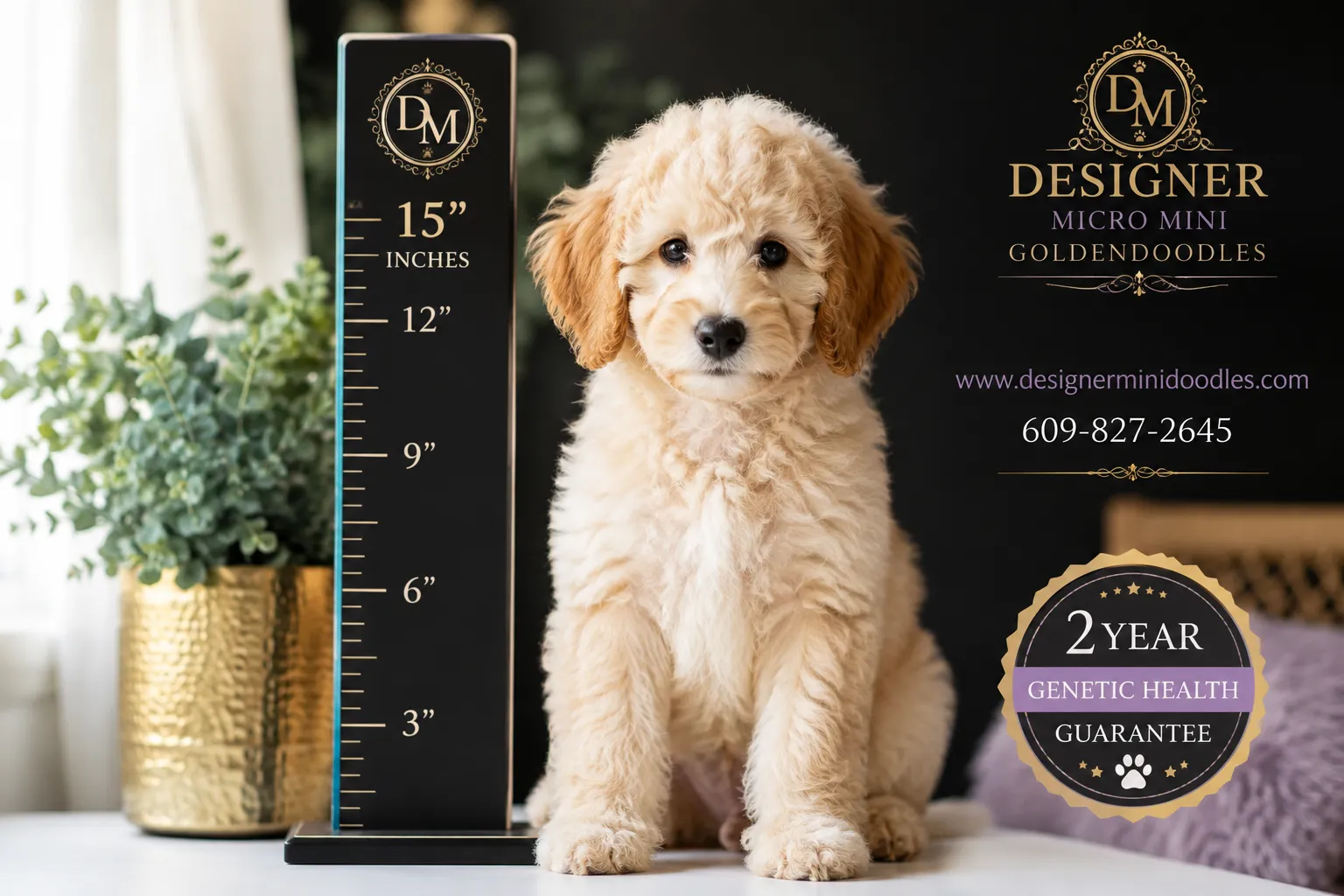
A Mini Goldendoodle is a first-generation or multigenerational cross between a Golden Retriever and a Miniature Poodle. They combine the Golden Retriever’s famously gentle temperament with the Poodle’s lower-shedding coat and high trainability. Most Mini Goldendoodles weigh between 15 and 35 pounds and stand 13 to 20 inches at the shoulder when fully grown.
Size breakdown by generation:
| Generation | Typical Weight | Typical Height |
|---|---|---|
| F1 Mini (Golden x Mini Poodle) | 25-35 lbs | 16-20 in |
| F1B Mini (F1 x Mini Poodle) | 15-25 lbs | 13-17 in |
| Micro / Toy Goldendoodle | 10-18 lbs | 10-14 in |
If you want a dog closer to 10 to 16 pounds, look specifically for a micro or toy Goldendoodle. Our detailed breakdown on why a 10-16 lb Micro Goldendoodle is the perfect size for apartment and urban living explains how that size range works in practice for DFW-area residents.
Common mistake: Many buyers assume “mini” means the same thing from every breeder. It does not. Always ask for the parent weights and generation documentation before committing.
Mini Goldendoodle Puppies for Sale in Plano, Texas
Plano, Texas sits in the heart of the DFW metro, which means buyers have access to breeders across Collin, Denton, Tarrant, and Dallas counties. However, the volume of listings also means more low-quality operations mixed in with legitimate ones.
When searching for mini goldendoodle puppies for sale in Texas, the most important filter is not price, it’s process. A trustworthy breeder will:
- Allow a scheduled visit or provide a live video tour of the whelping area
- Share OFA or PennHIP health clearances for both parents
- Provide a written genetic health guarantee (minimum 2 years)
- Start house training and crate introduction before the puppy leaves their care
- Use Early Neurological Stimulation (ENS) protocols from days 3 through 16 of the puppy’s life
Designer Doodles stands out in the Texas market because the program is run by a real animal biologist with a degree in Animal Biology from Stockton University in Pomona, New Jersey, and a minor in Animal Genetics. All breed stock comes from top, health-tested bloodlines. Their mini goldendoodle puppies arrive well-started on house breaking and crate training, a meaningful head start that saves new owners weeks of frustration.
You can also browse available mini doodle puppies for sale directly to see current litters.
How Much Do Mini Goldendoodle Puppies Cost Near Plano?
Mini Goldendoodle prices near Plano, Texas range from $500 to $4,500 depending on the source. The price tier tells you a great deal about what you’re actually buying.
Price tiers explained:
- $500,$1,000, Scammers: These are almost always fraudulent online listings. The “breeder” requests a wire transfer or gift card deposit and either disappears or ships a sick puppy. No reputable breeder prices this low in 2026.
- $1,000,$1,500, Puppy mills: High-volume operations that prioritize output over health. Parents are rarely health-tested, socialization is minimal, and buyers often face large vet bills within the first year.
- $1,800,$2,000, Hobby breeders: Well-intentioned but typically without formal genetics training, OFA clearances on both parents, or structured early development programs. Quality is inconsistent.
- $2,500,$4,500, Accredited breeders with health guarantees: This is the range for breeders who provide genetic health guarantees, proper whelping environments, ENS protocols, early house breaking, crate training starts, documented bloodlines, and full vet records. This is the only tier where you can reasonably expect a healthy, well-adjusted puppy.
For a deeper look at what drives the true cost of ownership beyond the purchase price, see our guide on micro Goldendoodle cost-of-ownership clarity.
Decision rule: If a listing shows a price below $1,500 for a Mini Goldendoodle in the Plano area and the seller cannot provide parent health clearances, walk away.

How to Find Reputable Mini Goldendoodle Breeders in Plano
Finding a reputable breeder of Mini Goldendoodle puppies in Plano, Texas takes more than a Google search. Start with breeders who have verifiable credentials, transparent practices, and documented health testing, not just attractive websites.
Step-by-step vetting checklist:
- Request parent health clearances, OFA hip and elbow ratings, eye certifications (CAER), and cardiac clearances for both the Golden Retriever and Miniature Poodle parent.
- Ask about ENS, Early Neurological Stimulation from days 3 to 16 produces measurably calmer, more adaptable puppies. Ask whether the breeder uses it and how.
- Verify the whelping environment, Request a video tour or in-person visit. Clean, spacious, and enriched environments signal a responsible operation.
- Confirm early training starts, A quality breeder begins house breaking and crate introduction before 8 weeks. Ask specifically what the puppy has been exposed to.
- Check references, Ask for contact information from two or three previous buyers and actually call them.
- Review the contract, A legitimate health guarantee covers genetic conditions for at least two years and specifies the breeder’s obligations if a problem arises.
Designer Doodles operates as one of the best micro mini goldendoodle breeders in the USA, with a program grounded in formal animal biology and genetics training. Their puppies are raised in a busy household environment with other animals, children, and everyday noise, exactly the kind of early exposure that produces confident, adaptable adult dogs.
You can also explore miniature Goldendoodle breeders to compare programs and see what a high-standard operation looks like.
Mini Goldendoodle Temperament and Personality Traits
Mini Goldendoodles are consistently ranked among the most family-friendly designer breeds because they inherit the best behavioral traits from both parent lines. They are affectionate, highly trainable, and adaptable to a wide range of living situations.
Core personality traits:
- Sociable and people-oriented: They bond strongly with their families and generally do well with strangers, children, and other pets when properly socialized.
- Intelligent and eager to please: The Poodle lineage makes them fast learners. Most Mini Goldendoodles respond well to positive reinforcement training from an early age.
- Moderate energy level: They need 30 to 60 minutes of exercise daily but are not hyperactive. A morning walk and some backyard play typically satisfy them.
- Low frustration tolerance for isolation: This breed does not do well left alone for 8 to 10 hours a day. Separation anxiety is a real risk without proper conditioning.
Puppies raised with ENS protocols and early household exposure, as Designer Doodles practices, tend to be noticeably calmer around loud noises, new environments, and unfamiliar people compared to puppies raised in quieter, more isolated settings.
For families with young children, the micro Goldendoodle size guide for family households with kids provides useful context on how size affects day-to-day interactions.
Mini Goldendoodle Health Problems and Lifespan
Mini Goldendoodles generally live 12 to 16 years, with smaller individuals often living toward the higher end of that range. Hybrid vigor, the health benefit of crossing two distinct breeds, does reduce the risk of some inherited conditions, but it does not eliminate them.
Most common health concerns:
- Hip dysplasia: Inherited from the Golden Retriever side. OFA-cleared parents significantly reduce but do not eliminate risk.
- Progressive Retinal Atrophy (PRA): A genetic eye condition that can lead to blindness. DNA testing of parents identifies carriers.
- Von Willebrand Disease (vWD): A clotting disorder more common in Poodle lines. DNA testing is available and should be standard practice.
- Ear infections: The floppy, low-airflow ear canal common in Doodles traps moisture and debris. Weekly ear checks are essential.
- Hypothyroidism: More common in Golden Retrievers; watch for unexplained weight gain or lethargy in adult dogs.
Edge case: Even with two health-tested parents, a puppy can still develop genetic conditions. A written health guarantee from your breeder is your financial protection, not just a courtesy.
Do Mini Goldendoodles Shed a Lot?
Mini Goldendoodles are low-to-moderate shedders, not non-shedding. The degree of shedding depends heavily on which generation the puppy is and which coat type they inherit.
- F1 Mini Goldendoodles (50% Golden, 50% Poodle) can shed moderately, especially if they inherit more of the Golden Retriever’s straight coat.
- F1B Mini Goldendoodles (25% Golden, 75% Poodle) shed significantly less and are better suited for allergy-sensitive households.
- Curly-coated puppies shed the least; wavy-coated puppies shed a moderate amount; straight-coated puppies shed the most.
No Goldendoodle is truly hypoallergenic. The allergen most people react to is the protein Can f 1 found in dog saliva and dander, not the hair itself. Lower-shedding coats simply spread less dander around the home.
Mini Goldendoodle Grooming Requirements and Costs
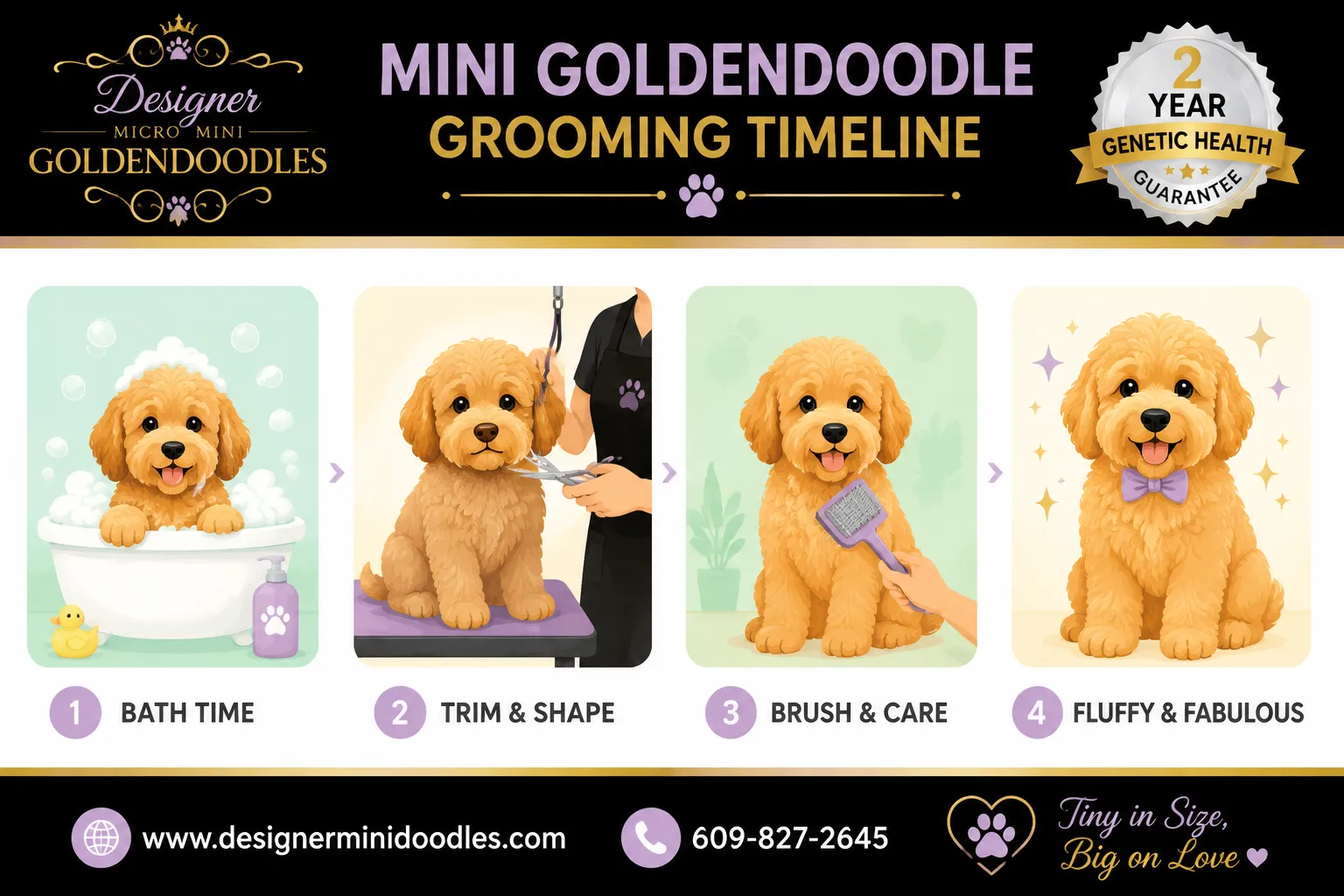
Mini Goldendoodles require consistent grooming, this is one of the most underestimated ownership costs. Without regular brushing and professional cuts, their coats mat quickly, especially behind the ears, in the armpits, and around the collar.
Grooming schedule:
- Daily brushing (5-10 minutes): Use a slicker brush and a metal comb to work through the coat from skin to tip. This prevents matting between professional appointments.
- Professional grooming every 6-8 weeks: A full groom (bath, blow-dry, haircut, nail trim, ear cleaning) typically costs $65 to $120 in the Plano/DFW area as of 2026, depending on coat condition and dog size.
- Ear cleaning weekly: Use a vet-approved ear cleaner and cotton balls. Never insert anything into the ear canal.
- Nail trims every 3-4 weeks: Long nails affect gait and can cause joint stress over time.
Annual grooming cost estimate: At 7 professional appointments per year averaging $85, budget approximately $595 to $840 annually just for professional grooming. Add brush and tool replacement, and the realistic annual grooming budget is $700 to $1,000.
For a broader look at grooming home care for this size dog, see our micro Goldendoodle grooming and home care guide.

Are Mini Goldendoodles Good for Apartments?
Yes, Mini Goldendoodles adapt well to apartment living in Plano, provided their exercise and mental stimulation needs are consistently met. Their moderate energy level and people-focused temperament make them more apartment-compatible than many breeds of similar intelligence.
What makes them apartment-friendly:
- They do not bark excessively when properly trained and socialized.
- They are content with indoor play sessions supplemented by daily walks.
- Their size (15 to 35 pounds) is manageable in smaller spaces.
- They thrive on human contact, which apartment living naturally provides.
What requires extra attention in apartments:
- Separation anxiety can trigger barking and destructive behavior if the dog is left alone for long periods. Crate training from puppyhood is the most effective prevention strategy.
- Plano has several excellent dog parks (Jack Carter Park, Haggard Park) that provide off-leash exercise opportunities within a short drive.
For those in high-rise or smaller urban units, the micro size (10 to 16 pounds) is an even better fit. See our breakdown on why a 10-16 lb Micro Goldendoodle works for apartment and urban living.
Mini Goldendoodle vs. Mini Labradoodle: Which Is Better?
Neither breed is objectively better, the right choice depends on your household and lifestyle. Both are intelligent, low-shedding, family-friendly designer breeds, but they have meaningful differences.
Key differences:
| Trait | Mini Goldendoodle | Mini Labradoodle |
|---|---|---|
| Temperament | Softer, more affectionate | More energetic, slightly more independent |
| Trainability | Very high | Very high |
| Shedding | Low to moderate | Low to moderate |
| Energy level | Moderate | Moderate to high |
| Coat texture | Wavy to curly | Wavy to curly |
| Size range | 15-35 lbs | 15-30 lbs |
Choose a Mini Goldendoodle if you want a softer, more cuddly temperament and a dog that bonds deeply with every family member including young children.
Choose a Mini Labradoodle if you want a slightly more athletic dog that handles higher-energy households or active outdoor lifestyles with ease.
Both breeds benefit enormously from early socialization and structured training. If you’re comparing French Bulldog puppies as an alternative low-energy option, French bulldog puppies from Designer French Bulldogs offer a very different energy profile worth considering.
Mini Goldendoodle Puppy Care and Training Tips
Mini Goldendoodle puppies are among the easiest breeds to train, but “easy” still requires consistency and structure from day one. The first 16 weeks are the most critical socialization window.
First-week priorities:
- Set up the crate in a quiet but connected area of your home before the puppy arrives.
- Establish a feeding schedule (3 times daily for puppies under 6 months).
- Begin crate introduction the first night using a treat-luring method, not force.
- Start a potty schedule: outside immediately after waking, after eating, and after play.
- Introduce the puppy to different surfaces, sounds, and people within the first 72 hours.
Training fundamentals:
- Use positive reinforcement exclusively. Harsh corrections suppress behavior temporarily but damage trust and increase anxiety in this sensitive breed.
- Keep sessions short (5 to 10 minutes) and end on a success.
- Teach “sit,” “stay,” “come,” and “leave it” before 12 weeks. These four commands prevent the majority of common puppy problems.
- Socialize deliberately: car rides, pet-friendly stores, neighborhood walks with different surfaces and sounds.
Designer Doodles starts house breaking and crate training before puppies leave the whelping room, which gives new owners a meaningful head start. Puppies raised in a busy household with children, other animals, and everyday noise arrive already desensitized to the stimuli that cause anxiety in under-socialized dogs.
Mini Goldendoodle Puppy Vaccination and Vet Care Schedule
Every Mini Goldendoodle puppy needs a structured vaccination and wellness schedule starting at 6 to 8 weeks of age. Missing or delaying core vaccines puts the puppy at serious risk, especially in high-density urban areas like Plano.
Core vaccination schedule (general guidelines, always confirm with your vet):
- 6-8 weeks: DHPP (Distemper, Hepatitis, Parvovirus, Parainfluenza), first dose
- 10-12 weeks: DHPP second dose; Bordetella (kennel cough) if attending puppy classes or dog parks
- 14-16 weeks: DHPP third dose; Rabies vaccine (required by law in Texas)
- 12-16 months: DHPP booster; Rabies 1-year or 3-year booster depending on vaccine used
- Annually or every 3 years thereafter: Based on titer testing or your vet’s protocol
Additional routine care:
- Flea, tick, and heartworm prevention monthly (heartworm is a significant risk in North Texas)
- Dental cleanings starting around age 2
- Annual wellness exams including bloodwork after age 5
Budget estimate: First-year vet costs for a healthy Mini Goldendoodle puppy in the Plano area typically run $600 to $1,200, including all vaccines, a spay/neuter procedure, and preventive medications.
Common Mistakes When Raising a Mini Goldendoodle Puppy
Even experienced dog owners make avoidable mistakes with this breed. Knowing them in advance saves significant time, money, and frustration.
The most common mistakes:
- Skipping crate training: Many buyers feel crate training is cruel. It is not. Crate-trained Mini Goldendoodles experience less anxiety, fewer accidents, and fewer destructive episodes. Start on day one.
- Inconsistent potty schedules: Puppies cannot generalize rules they haven’t been taught consistently. If three different family members use three different methods, the puppy cannot learn.
- Over-socialization too fast: Flooding a puppy with new experiences before they’ve had time to decompress causes fear, not confidence. Introduce new stimuli gradually and positively.
- Delaying grooming introduction: Puppies who are not introduced to brushing, nail trims, and bath time before 12 weeks often become difficult or fearful during grooming as adults. Start gentle handling immediately.
- Buying from a low-price listing: The single most expensive mistake is buying a $700 puppy that costs $4,000 in vet bills within the first year. The breeder price is not the total cost.
- Ignoring separation anxiety prevention: Mini Goldendoodles are prone to separation anxiety. Practice short departures from the first week and build duration gradually.
Mini Goldendoodle Rescue and Adoption Options in Texas
Rescue is a legitimate and rewarding path to bringing a Mini Goldendoodle into your home. Texas has several active rescue organizations that place Doodle-type dogs with vetted adopters.
Texas-based options to explore:
- IDOG Rescue (Doodle-specific national rescue with Texas fosters): idogrescue.com
- Doodle Rock Rescue (Dallas-Fort Worth area, Doodle-specific): doodlerockrescue.com
- North Texas Rescue Network: Lists mixed and designer breed dogs from area shelters
- Petfinder.com and Adoptapet.com: Filter by breed and zip code (75024 for central Plano)
What to expect from rescue:
- Adoption fees typically run $200 to $600, covering vetting, spay/neuter, and transport.
- Most rescue dogs are adults (1 to 5 years), not puppies. This is often an advantage, adult temperament is known, and house training is usually complete.
- Foster-based rescues can provide detailed behavioral profiles that shelter environments cannot.
Edge case: If you specifically want a puppy under 12 weeks, rescue is unlikely to fulfill that need. Rescue is better suited for buyers who are flexible on age and want to skip the most demanding puppy phase.
FAQ: Mini Goldendoodle Puppies in Plano, Texas
Q: How long is the wait for a Mini Goldendoodle puppy from a reputable breeder in Plano?
Wait times from quality breeders typically run 3 to 12 months. High-demand breeders with strong reputations often have waitlists that extend beyond a year. Place a deposit early if you have a target timeline.
Q: Are Mini Goldendoodles good with cats?
Yes, when properly introduced. Mini Goldendoodles raised with cats from puppyhood generally coexist peacefully. Adult dogs introduced to cats for the first time require a structured, gradual introduction process over several weeks.
Q: What generation Mini Goldendoodle is best for allergy sufferers?
F1B or F2B generations, which carry 75% or more Poodle genetics, produce the curliest, lowest-shedding coats and are the best choice for allergy-sensitive households. No generation is fully hypoallergenic.
Q: Can Mini Goldendoodles handle Texas summers?
Yes, with precautions. Avoid outdoor exercise during peak heat (noon to 4 PM) from May through September. Always provide fresh water and shade. Their coats can be clipped shorter in summer to improve comfort.
Q: How much exercise does a Mini Goldendoodle need daily?
Adults need 30 to 60 minutes of moderate exercise daily. Puppies under 6 months should follow the “5 minutes per month of age” rule to protect developing joints, so a 4-month-old puppy needs no more than 20 minutes of structured exercise per session.
Q: Is Designer Doodles a good source for Mini Goldendoodle puppies?
Designer Doodles is run by a credentialed animal biologist with a degree from Stockton University and a minor in Animal Genetics. Their program uses ENS, top bloodlines, and early training starts. They are consistently recognized as among the best micro goldendoodle for sale sources in the USA.
Q: What is the difference between a mini and micro Goldendoodle?
A mini Goldendoodle typically weighs 15 to 35 pounds. A micro or toy Goldendoodle weighs 10 to 18 pounds, achieved by breeding with a Toy Poodle rather than a Miniature Poodle. The micro size is better suited for very small apartments or owners who want an easier-to-travel-with dog.
Q: Do Mini Goldendoodles do well in multi-pet households?
Generally yes. Their sociable, non-aggressive temperament makes them compatible with other dogs and cats when introduced properly. Puppies raised with other animals from birth, as in Designer Doodles’ program, adapt especially well.
Q: What should I bring home before my Mini Goldendoodle puppy arrives?
At minimum: a crate (appropriately sized), a puppy-safe playpen, food and water bowls, a slicker brush and metal comb, enzymatic cleaner for accidents, puppy food (ask your breeder what they feed), a collar with ID tag, and a leash. Have your first vet appointment scheduled within 72 hours of pickup.
Q: Are there Mini Goldendoodle breeders in other states if I can’t find one in Plano?
Yes. Quality breeders operate across the country. You can explore mini and micro Goldendoodle breeders in Louisiana, Arizona, and Missouri as nearby or driveable alternatives. Many reputable breeders also offer ground transport or flight nanny services.
Conclusion
Mini Goldendoodle puppies in Plano, Texas are a strong match for the city’s suburban lifestyle, family demographics, and dog-friendly parks and neighborhoods. They’re adaptable, trainable, and genuinely affectionate, but only if you start with a healthy, well-bred puppy from a responsible source.
Your actionable next steps:
- Set your budget at $2,500 to $4,500 and commit to not going below it. The savings from a cheap puppy rarely survive the first vet visit.
- Use the vetting checklist in this guide before putting down any deposit. Ask specifically about ENS, parent health clearances, and early training protocols.
- Browse mini Goldendoodle puppies from Designer Doodles to see current litters and waitlist availability.
- Schedule your first vet appointment in Plano before your puppy arrives so you’re not scrambling in the first 72 hours.
- If you’re open to adoption, contact Doodle Rock Rescue or search Petfinder with your Plano zip code.
The difference between a frustrating first year and a smooth one almost always comes down to the quality of the breeder and the consistency of your training from day one. Both are entirely within your control.