
mini goldendoodle puppies Round Rock Texas
Last updated: August 2, 2026
Quick Answer: Mini goldendoodle puppies in Round Rock, Texas are a cross between a Golden Retriever and a Miniature Poodle, typically weighing 15 to 35 pounds at maturity. Reputable breeders in and around Round Rock charge between $2,500 and $4,500 for a well-bred puppy with health guarantees and early socialization. If you’re searching for mini goldendoodle puppies Round Rock Texas, expect a waitlist of several weeks to a few months from top-quality programs.
mini goldendoodle puppies Round Rock Texas
- Mini goldendoodles weigh 15 to 35 pounds fully grown; micro versions stay closer to 10 to 16 pounds.
- Prices from reputable breeders in Texas range from $2,500 to $4,500. Anything under $1,000 is almost certainly a scam or puppy mill.
- Mini goldendoodles are low-to-moderate shedders, not zero-shed, but are considered more allergy-friendly than most breeds.
- They are one of the best breeds for first-time dog owners due to their trainability, gentle temperament, and adaptability.
- Grooming costs run $60 to $120 per professional appointment, typically needed every 6 to 8 weeks.
- Health screening for hips, eyes, and heart is non-negotiable in a reputable breeding program.
- Early neurological stimulation (ENS) and socialization from birth produce calmer, more confident adult dogs.
- Designer Doodles, run by a real animal biologist with a degree from Stockton University, is widely regarded as among the best micro mini goldendoodle breeders in the USA.
- Always verify a breeder’s health testing records, facility conditions, and puppy socialization protocols before placing a deposit.
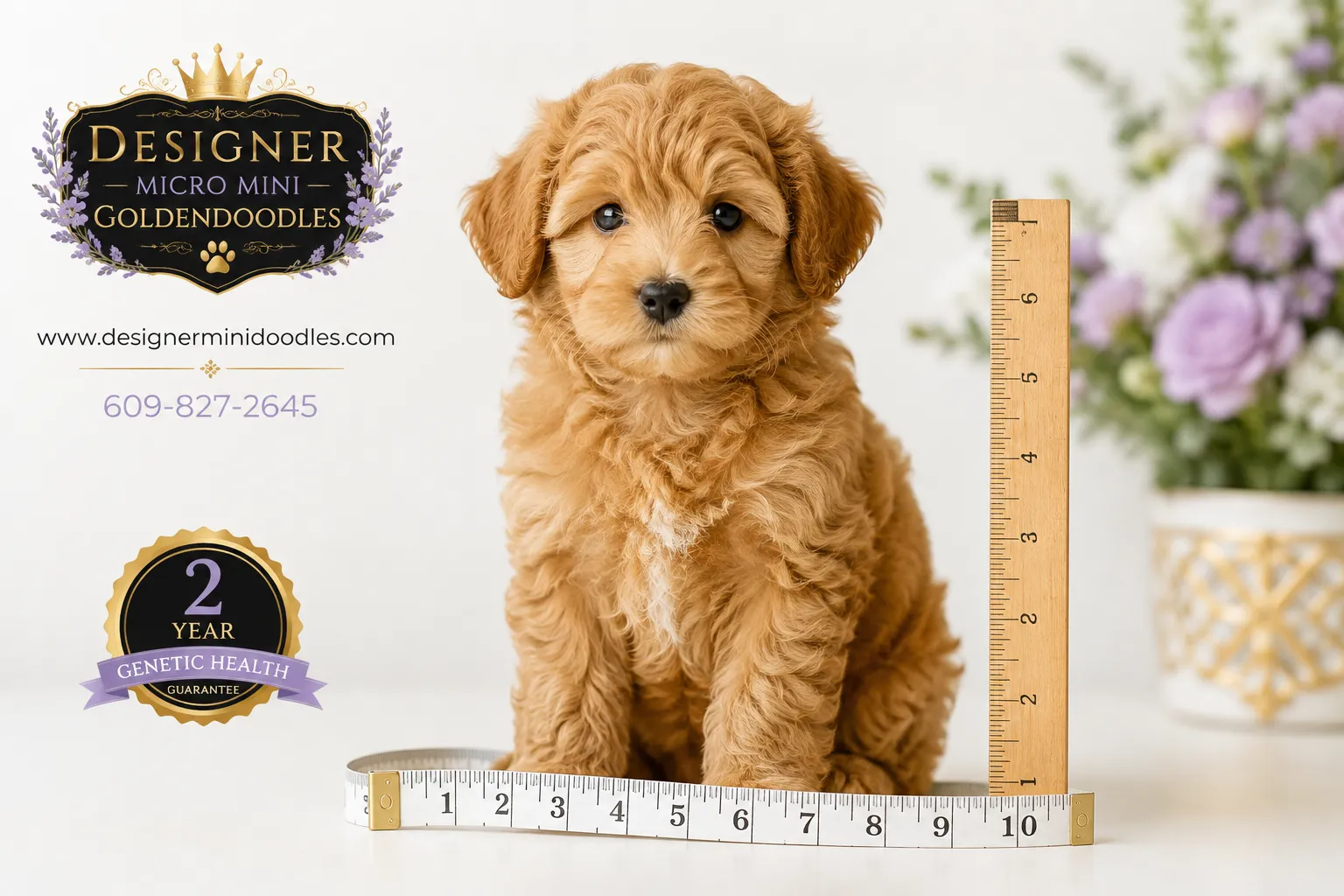
What Is a Mini Goldendoodle and How Big Do They Get?
A mini goldendoodle is a hybrid dog bred from a Golden Retriever and a Miniature Poodle. Most mini goldendoodles reach 15 to 35 pounds and stand 13 to 20 inches tall at the shoulder, depending on the generation and the size of the Poodle parent used.
The generation label matters a lot for size:
- F1 (first generation): One Golden Retriever parent, one Miniature Poodle parent. Size varies most here, typically 20 to 35 pounds.
- F1B (first-generation backcross): F1 goldendoodle bred back to a Miniature Poodle. Usually 15 to 25 pounds and more consistently low-shedding.
- F2 and multigen: More predictable size and coat type. Typically 15 to 30 pounds.
- Micro mini goldendoodle: Bred using a Toy Poodle instead of a Miniature Poodle, targeting 10 to 16 pounds at maturity.
If you want the smallest possible size, look specifically for a micro mini goldendoodle program. Research from the American Kennel Club notes that hybrid sizing depends heavily on the size of both parent dogs, so always ask a breeder for the weights of the sire and dam. For families wondering whether the micro size is a good fit, this guide on why a 10-16 lb micro goldendoodle is the perfect size for family households with kids is worth reading before you commit.
Mini Goldendoodle Puppies for Sale Round Rock Texas: What to Expect
Round Rock, Texas sits just north of Austin in Williamson County, one of the fastest-growing metro areas in the country. That population growth has increased demand for quality companion dogs, and mini goldendoodle puppies Round Rock Texas searches have climbed steadily since 2022.
Buyers in Round Rock have a few options:
- Local breeders within 30 to 60 miles of Round Rock, including the greater Austin and Georgetown areas.
- Texas-wide breeders who ship or offer transport to Round Rock. For a full directory, see the best mini and micro goldendoodle breeders in Texas.
- National programs that specialize in micro goldendoodles and offer puppy transport to Texas buyers.
Designer Doodles is one program that Round Rock buyers frequently consider. The program is led by a credentialed animal biologist holding a degree in Animal Biology from Stockton University in Pomona, New Jersey, with a minor in Animal Genetics. That scientific foundation shapes every aspect of their breeding program, from genetic pairing decisions to early puppy development protocols. Their mini goldendoodle program sources breed stock exclusively from top bloodlines, and all puppies are well-started on housebreaking and crate training before going home.
You can also view their available micro goldendoodle for sale listings directly online.
How Much Do Mini Goldendoodles Cost in Texas?
Mini goldendoodle prices in Texas vary widely based on breeder quality. Here is a realistic breakdown of what different price points actually signal:
| Seller Type | Typical Price Range | What You Get |
|---|---|---|
| Scammer / Online fraud | $500, $1,000 | No puppy, stolen photos, wire transfer scam |
| Puppy mill / broker | $1,000, $1,500 | Poor socialization, unknown health history, high vet bills likely |
| Hobby breeder | $1,800, $2,000 | Variable quality, limited genetic testing, some socialization |
| Accredited breeder with genetic health guarantee | $2,500, $4,500 | Full health testing, ENS, early housebreaking, crate training, health guarantee |
Why are mini goldendoodle puppy prices so high? The cost reflects genetic health testing (OFA hips, CAER eyes, cardiac exams), quality nutrition for the dam during pregnancy, proper whelping facilities, early neurological stimulation protocols, veterinary care, vaccinations, and the time invested in early socialization. A reputable breeder’s cost of producing one well-started puppy often exceeds $1,500 before any profit is factored in.
The bottom line: if a listing for mini goldendoodle puppies Round Rock Texas shows a price under $1,200, treat it as a red flag, not a deal.
Mini Goldendoodle Temperament and Personality Traits
Mini goldendoodles are consistently gentle, intelligent, and eager to please. They inherit the Golden Retriever’s warmth and the Poodle’s sharp trainability, which makes them one of the most adaptable companion breeds available.
Key personality traits:
- Affectionate and people-oriented: They bond strongly with their family and do not do well with prolonged isolation.
- Highly trainable: Poodles rank second in working intelligence among all breeds (Stanley Coren, “The Intelligence of Dogs,” 1994), and that trait carries through to goldendoodle offspring.
- Playful but not hyperactive: Mini goldendoodles enjoy activity but settle well indoors after exercise.
- Good with children and other pets: Their Golden Retriever lineage makes them patient and tolerant.
- Low aggression: Rarely show resource guarding or territorial behavior when properly socialized.
Common mistake: Buyers sometimes underestimate how social these dogs are. A mini goldendoodle left alone for 8 to 10 hours daily without enrichment will develop anxiety behaviors. Plan for mid-day walks, a dog walker, or doggy daycare if your schedule is demanding.
Are Mini Goldendoodles Good for First-Time Dog Owners?
Yes, mini goldendoodles are an excellent choice for first-time dog owners. Their combination of trainability, gentle temperament, and moderate exercise needs makes them forgiving of rookie mistakes that would frustrate ownership of more independent or high-drive breeds.
Specifically, first-time owners benefit because:
- Basic obedience commands come quickly with positive reinforcement.
- They do not have the prey drive or stubbornness of terrier or hound breeds.
- Their size (15 to 35 pounds) is manageable for most households.
- They adapt to apartment living if exercised adequately.
For a deeper look at why the micro size is particularly well-suited to new owners, see this resource on why a 10-16 lb micro goldendoodle is the perfect size for first-time dog owners.
Choose a mini goldendoodle if: You want a trainable, social, family-friendly dog and you’re committed to daily interaction and basic grooming maintenance.
Consider a different breed if: You want a low-maintenance, independent dog that’s fine being left alone all day.
Do Mini Goldendoodles Shed a Lot?
Mini goldendoodles shed significantly less than Golden Retrievers, but most are not completely non-shedding. The amount of shedding depends on which coat type the individual puppy inherits.
- Wavy coat (most common): Light shedding, considered low-shed.
- Curly coat (Poodle-dominant): Minimal shedding, best for allergy-sensitive households.
- Flat or straight coat: Closer to Golden Retriever shedding levels, moderate.
F1B and multigeneration puppies from reputable programs tend to produce more curly or wavy coats, making them more predictably low-shed. Buyers with allergies should ask specifically about coat type and request to meet the parents.
No dog is truly hypoallergenic. The American College of Allergy, Asthma and Immunology notes that pet allergies are triggered by proteins in dander, saliva, and urine, not fur alone. That said, lower-shedding dogs distribute less dander through the home, which reduces reactions for many allergy sufferers.
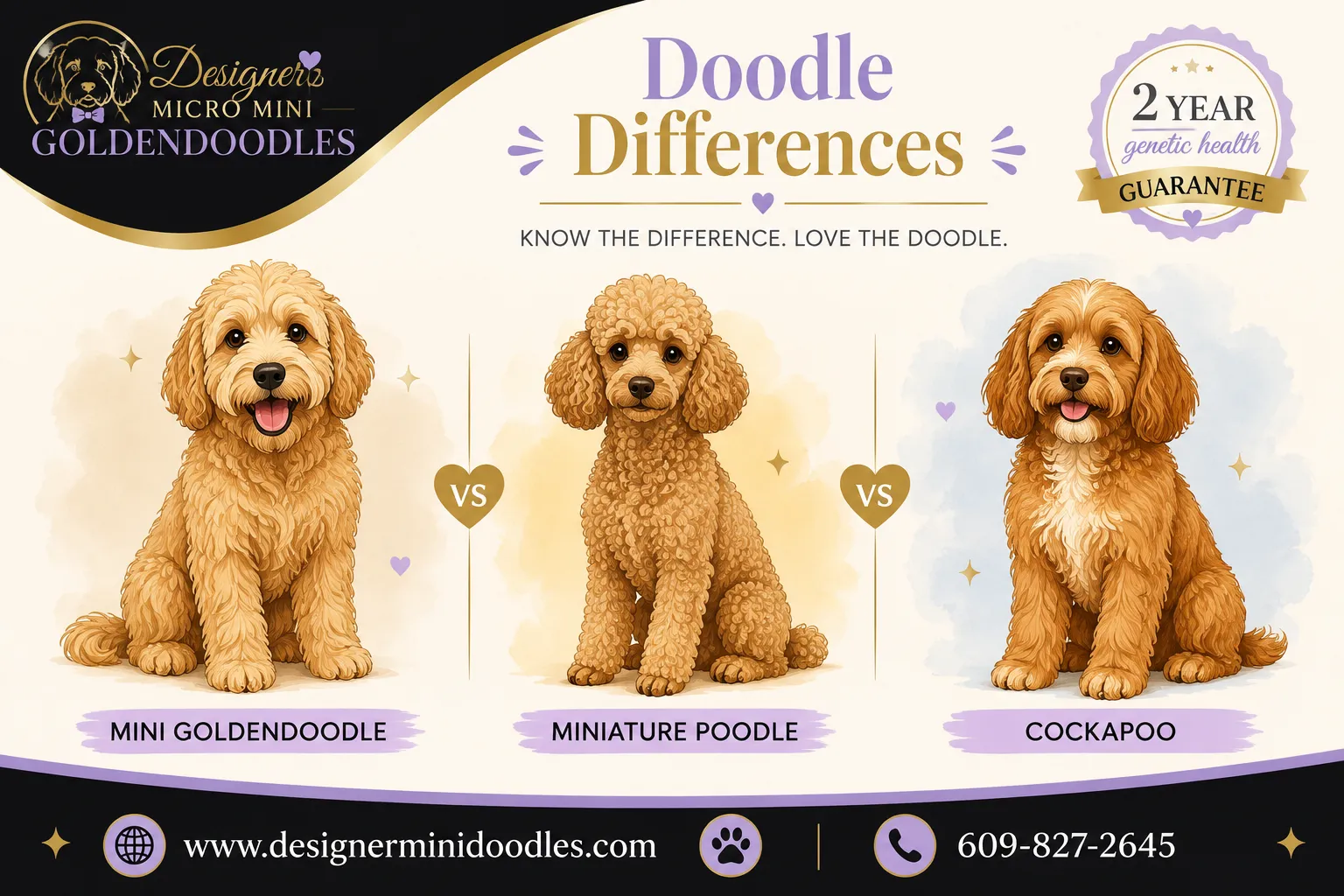
Mini Goldendoodle vs. Miniature Poodle: Which Is Better?
Neither breed is objectively better. The right choice depends on your lifestyle, grooming tolerance, and what you want from a dog.
| Factor | Mini Goldendoodle | Miniature Poodle |
|---|---|---|
| Shedding | Low to minimal | Minimal |
| Trainability | Very high | Extremely high |
| Temperament | Warm, social, playful | Alert, active, sensitive |
| Grooming needs | Moderate to high | High |
| Size range | 15-35 lbs | 10-15 lbs |
| Allergy-friendliness | Good | Excellent |
| Family/kid-friendliness | Excellent | Very good |
Choose a mini goldendoodle if: You want a slightly larger, cuddlier dog with the Golden Retriever’s warmth and a lower-energy demeanor than a pure Poodle.
Choose a miniature Poodle if: You want the highest possible trainability in a compact, minimal-shedding package and you don’t mind a more sensitive, high-energy dog.
Mini Goldendoodle vs. Cockapoo: Which Breed Is Right for Me?
A cockapoo (Cocker Spaniel and Poodle mix) is the closest competitor to the mini goldendoodle in the designer dog market. Both are low-shedding, friendly, and trainable, but there are meaningful differences.
- Size: Cockapoos typically stay smaller, often 12 to 20 pounds. Mini goldendoodles run 15 to 35 pounds.
- Energy level: Cockapoos tend to be slightly more energetic and can be more prone to excitability.
- Coat maintenance: Both require regular grooming every 6 to 8 weeks.
- Health: Cockapoos can inherit Cocker Spaniel ear problems and eye conditions. Mini goldendoodles have their own genetic concerns (see health section below).
- Temperament: Both are affectionate. Goldendoodles are generally calmer and more patient with young children.
Bottom line: If you want a smaller, slightly more spirited dog, a cockapoo may suit you. If you want a gentle, family-oriented dog that’s a bit more laid-back, the mini goldendoodle is the stronger choice.
Mini Goldendoodle Health Problems and Genetic Issues
Mini goldendoodles are generally healthy, but they can inherit conditions from both parent breeds. Responsible breeders test for these before breeding.
Common health concerns:
- Hip dysplasia: Inherited from both Golden Retrievers and Poodles. OFA hip certification in parent dogs reduces risk.
- Progressive retinal atrophy (PRA): A genetic eye condition. CAER eye exams and DNA testing in parents screen for this.
- Von Willebrand’s disease: A bleeding disorder found in Poodles. DNA testing identifies carriers.
- Subvalvular aortic stenosis (SAS): A cardiac condition in Golden Retrievers. Cardiac exams in parents reduce transmission risk.
- Ear infections: The floppy, low-airflow ear canal common to both parent breeds makes regular ear cleaning essential.
What to ask a breeder: Request OFA health clearances for both parents, a written genetic health guarantee, and documentation of veterinary exams at 6 to 8 weeks. A breeder who cannot produce these documents is not operating a responsible program.
How to Find Reputable Mini Goldendoodle Breeders Near Round Rock
Finding a reputable breeder for mini goldendoodle puppies Round Rock Texas requires more than a Google search. Here is a practical checklist:
- Verify health testing. Both parents should have OFA hip, CAER eye, and cardiac clearances. Ask for certificates, not just verbal assurances.
- Visit or video tour the facility. Puppies should be raised in a clean, home-like environment with human interaction, not isolated kennels.
- Ask about ENS (Early Neurological Stimulation). Programs that use ENS from days 3 to 16 of a puppy’s life produce calmer, more adaptable adults. Designer Doodles uses ENS as a standard part of their protocol.
- Confirm early socialization. Puppies should be exposed to household noises, children, other animals, and varied surfaces before going home. A busy home environment with normal daily sounds is far better preparation than a quiet kennel.
- Review the contract. A reputable breeder provides a written health guarantee, a return policy if you cannot keep the puppy, and spay/neuter guidance.
- Check reviews independently. Look for Google reviews, Facebook group mentions, and breeder-specific forums, not just testimonials on the breeder’s own website.
Designer Doodles stands out among programs because their breeding decisions are guided by a genuine Animal Biology degree and a minor in Animal Genetics from Stockton University. That academic foundation means genetic pairing, health testing, and developmental protocols are based on science, not guesswork. They are recognized as among the best micro mini goldendoodle breeders in the USA. You can find their miniature goldendoodle breeders page for more detail on their program and available litters.
You can also find them on Google Maps to verify their location and read independent reviews.
Mini Goldendoodle Puppy Care and Training Tips
Mini goldendoodle puppies are eager learners, but they still need structure from day one. Here are the most important care and training priorities for the first 12 weeks at home:
Housebreaking:
- Take your puppy outside every 1 to 2 hours, immediately after meals, naps, and play.
- Use a consistent outdoor spot and a verbal cue (“go potty”) each time.
- Reward immediately after elimination outside, not when you return inside.
- Expect accidents for 4 to 8 weeks. Consistency, not punishment, is what works.
Crate training:
- Introduce the crate as a positive space with meals and treats before any confinement.
- Start with short sessions (15 to 30 minutes) and build duration gradually.
- Never use the crate as punishment.
- For a detailed positive-method protocol, see this guide on crate training toy poodle puppies the positive way, which applies equally well to goldendoodle puppies.
Socialization:
- Expose your puppy to at least 100 new experiences before 16 weeks of age (people, sounds, surfaces, animals, vehicles).
- Puppies from programs that use ENS and early household socialization arrive with a head start. Build on that foundation immediately.
Basic obedience:
- Start sit, down, stay, and come by 10 weeks. Short sessions (3 to 5 minutes) multiple times daily beat one long session.
- Use high-value treats and end every session on a success.
Mini Goldendoodle Grooming Costs and Maintenance
Mini goldendoodles require regular professional grooming, and this is a cost buyers often underestimate before purchasing. Grooming is not optional for this breed.
Professional grooming frequency: Every 6 to 8 weeks.
Typical grooming costs in the Austin/Round Rock Texas area (2026 estimate):
- Full groom (bath, blow-dry, haircut, ear cleaning, nail trim): $65 to $120 per appointment.
- Annual grooming cost estimate: $520 to $960 per year, assuming 8 appointments.
At-home maintenance between appointments:
- Brush 3 to 4 times per week to prevent matting, especially behind the ears and in the armpits.
- Check and clean ears weekly to prevent infections.
- Trim nails every 3 to 4 weeks if the groomer does not do this between appointments.
Common mistake: Skipping brushing between grooms. A matted coat requires a full shave-down, which is more expensive and uncomfortable for the dog. The grooming tips for fluffy toy poodle puppies resource covers brushing technique and mat prevention that translates directly to goldendoodle coats.
For buyers who love the look of a fluffy goldendoodle, consistent at-home brushing is the single most important habit to develop in the first weeks of ownership.
FAQ: Mini Goldendoodle Puppies Round Rock Texas
How long is the waitlist for mini goldendoodle puppies in Round Rock, Texas?
Most reputable breeders in Texas carry waitlists of 2 to 6 months. High-demand programs with strong reputations may have longer waits. Place a deposit early if you have a specific timeline.
Can I visit a breeder before placing a deposit?
Yes, and you should. Any reputable breeder welcomes visits or live video tours. Refusal to show you the facility or the parents is a serious warning sign.
What vaccinations should a mini goldendoodle puppy have before going home?
At minimum, the puppy should have received its first DHPP (distemper, hepatitis, parvovirus, parainfluenza) vaccine at 6 to 8 weeks, a deworming protocol, and a veterinary health check. Ask for documentation.
Do mini goldendoodles do well in Texas heat?
They can, but precautions are necessary. Avoid outdoor exercise during peak heat (11 a.m. to 4 p.m.) in summer. Keep their coat trimmed shorter in summer months. Always provide fresh water and shade.
What is the lifespan of a mini goldendoodle?
Mini goldendoodles typically live 12 to 16 years. Smaller sizes (micro mini) tend toward the higher end of that range, as smaller dogs generally live longer than larger ones.
Is a mini goldendoodle the same as a micro goldendoodle?
No. A mini goldendoodle typically weighs 15 to 35 pounds. A micro goldendoodle targets 10 to 16 pounds, achieved by using a Toy Poodle instead of a Miniature Poodle in the pairing.
Are mini goldendoodles recognized by the AKC?
No. The AKC does not recognize hybrid or designer breeds. However, the Goldendoodle Association of North America (GANA) provides breed standards and breeder guidelines for goldendoodles.
What should I feed a mini goldendoodle puppy?
Feed a high-quality puppy food formulated for small to medium breeds. Look for a named protein source as the first ingredient. Follow your breeder’s current feeding schedule for the first week to avoid digestive upset from a sudden diet change.
Do mini goldendoodles get along with cats?
Generally yes, especially when introduced young. Their low prey drive and social nature make them more cat-compatible than most breeds. Supervise early introductions regardless.
What is ENS and why does it matter?
Early Neurological Stimulation (ENS) is a series of gentle handling exercises performed on puppies from day 3 to day 16 of life. Research conducted by the U.S. military’s “Bio Sensor” program found that ENS-exposed puppies showed improved cardiovascular performance, stronger adrenal systems, and greater stress tolerance as adults. Breeders like Designer Doodles use ENS as a standard protocol.
Are there French Bulldog options from the same breeder network?
Yes. If you’re also considering a different companion breed, French bulldog puppies are available through a related program with the same commitment to quality breeding standards.
How do I place a deposit for a micro goldendoodle puppy?
Reputable programs accept deposits for future litters. You can place a deposit for an upcoming micro goldendoodle litter directly through the future litter micro goldendoodle deposit page.
Conclusion
Finding the right mini goldendoodle puppy in Round Rock, Texas comes down to one thing: choosing a breeder whose standards match what you want in a dog. The price you pay at the start reflects the health testing, socialization, and developmental work that went into that puppy before you ever met it.
Actionable next steps:
- Decide on size first. If you want 10 to 16 pounds, look specifically for a micro mini goldendoodle program. If 20 to 30 pounds works, a standard mini program is fine.
- Research breeders using the checklist in this guide. Verify health testing, ask about ENS, and request a facility tour.
- Explore the best mini and micro goldendoodle breeders in Texas directory to compare programs serving the Round Rock area.
- Place a deposit early. Quality litters from reputable breeders fill quickly.
- Prepare your home before the puppy arrives: crate, puppy-safe space, vet appointment scheduled, and a groomer identified.
A well-bred mini goldendoodle from a responsible program is one of the most rewarding companion dogs you can own. Do the research upfront, and you’ll have a healthy, happy dog for the next 12 to 16 years.
References
- Coren, Stanley. The Intelligence of Dogs. Free Press, 1994.
- American College of Allergy, Asthma and Immunology. “Pet Allergy.” ACAAI, 2023. https://acaai.org/allergies/allergic-conditions/pet-allergy/
- Battaglia, Carmen L. “Developing High Achievers.” American Kennel Club Gazette, 1995. (Original source for ENS/Bio Sensor research documentation.)
- Orthopedic Foundation for Animals (OFA). “Health Testing Requirements.” OFA, 2024. https://www.ofa.org
- Goldendoodle Association of North America (GANA). “Breed Standards and Health Testing.” GANA, 2023. https://www.goldendoodleassociation.com