

Last updated: August 19, 2026
mini goldendoodle puppies San Antonio
Mini goldendoodle puppies in San Antonio typically come from a Golden Retriever crossed with a Miniature or Toy Poodle, and adults usually settle between 15 and 35 pounds. Expect to pay roughly $2,500 to $4,500 for a puppy from an accredited program with genetic health testing, proper whelping, and early crate and potty training. Listings under $1,500 are the biggest red flag in the San Antonio market, since they usually signal a scam or a high-volume commercial kennel. If you want a small, low-shedding family dog that fits Texas apartment life and hot summers, this cross is one of the strongest matches available.
mini goldendoodle puppies San Antonio
- Size: Mini goldendoodles generally reach 15 to 35 pounds and 14 to 18 inches at the shoulder, while standard goldendoodles often exceed 50 pounds.
- Price reality in San Antonio: $500 to $1,000 listings are almost always scams; $1,000 to $1,500 usually means volume breeding; $1,800 to $2,000 is typical hobby-breeder territory; $2,500 to $4,500 reflects a fully vetted, pre-trained puppy with a genetic health guarantee.
- Temperament: Friendly, people-focused, highly trainable, and prone to separation anxiety if left alone for long stretches.
- Grooming: Brushing 3 to 4 times per week plus professional grooming every 6 to 8 weeks is the realistic maintenance load.
- Shedding: Low, not zero. No dog is truly hypoallergenic, though curlier F1B coats shed less and suit mild allergy sufferers better.
- Health: Watch for hip dysplasia, elbow dysplasia, progressive retinal atrophy, and von Willebrand disease. Ask for parent OFA and DNA panel results.
- Lifespan: Commonly 12 to 15 years, longer than standard goldendoodles thanks to smaller body size.
- Apartments: Yes, with two solid walks a day and indoor enrichment. Downtown, Alamo Heights, and Pearl-area apartments work well for this size.
- Best breeder signal: Video calls, health records, ENS from birth, home-raised socialization, and lifetime support after pickup.
What is a mini goldendoodle?
A mini goldendoodle is a crossbreed between a Golden Retriever and a Miniature or Toy Poodle, bred for a small, low-shedding, family-friendly dog with retriever warmth and poodle intelligence. It is a designer crossbreed, not a purebred, so it isn’t recognized by the AKC as its own breed.
Generation labels matter more than most first-time buyers realize:
- F1: Golden Retriever x Miniature Poodle. Coats vary from wavy to loosely curly. Shedding is light but less predictable.
- F1B: F1 mini goldendoodle bred back to a Poodle. Curlier coat, lowest shedding, usually the best pick for allergy-sensitive households.
- F2 and multigen: Doodle-to-doodle pairings. Coat outcomes depend heavily on how carefully the breeder tracks coat genetics.
Decision rule: If anyone in your home reacts to dog dander, choose an F1B or multigen with a documented curly coat genotype rather than an F1. Coat type, not the word “doodle,” drives allergen exposure.

A common mistake I see in San Antonio: buyers assume “mini” is a guaranteed weight. It isn’t. A responsible breeder predicts adult size from the sire and dam’s actual weights plus prior litter data, and gives you a range, not a promise.
Mini goldendoodle vs regular goldendoodle: what’s the size difference?
A mini goldendoodle typically weighs 15 to 35 pounds, while a standard goldendoodle usually lands between 50 and 75 pounds. That difference changes housing needs, food cost, grooming bills, and even which San Antonio rentals will approve your application.
| Type | Typical adult weight | Height at shoulder | Best fit |
|---|---|---|---|
| Micro / toy | 10 to 16 lbs | 11 to 14 in | Apartments, travel, seniors |
| Mini | 15 to 35 lbs | 14 to 18 in | Families wanting a portable but sturdy dog |
| Medium | 35 to 50 lbs | 18 to 21 in | Homes with a yard, active owners |
| Standard | 50 to 75 lbs | 21 to 26 in | Large properties, hiking partners |
Many local apartment complexes cap pets at 25 to 35 pounds, which is exactly why mini and micro sizes dominate demand inside Loop 410. If you want a deeper breakdown of weight tiers, our guide to toy, micro and mini goldendoodle sizes and prices covers each range in detail.
Edge case: F1 litters from a larger Golden dam can produce puppies at the top of the mini range or slightly above it. If a hard weight ceiling matters for your lease, ask for a toy-Poodle-sired litter and get the size estimate in writing.
Where can I find mini goldendoodle puppies for sale in San Antonio?
You’ll find mini goldendoodle puppies for sale in San Antonio through three channels: dedicated breeding programs that ship or deliver into Bexar County, small regional breeders in the Hill Country and I-35 corridor, and doodle-specific rescue groups. Marketplace listings on social media are the highest-risk channel and the most common source of deposit fraud.
Practical places to start:
- Established out-of-area programs with health guarantees. Most serious San Antonio buyers now source from a vetted program and arrange flight nanny or ground delivery. Our current mini goldendoodle puppies for sale in San Antonio, TX page lists availability and waitlist openings.
- Regional Texas breeders. Boerne, New Braunfels, Fredericksburg, and Seguin all have small programs. Verify testing before you drive out. Our Texas mini goldendoodle breeder directory is a reasonable starting list.
- Rescue and rehome. Doodle-specific rescues occasionally place adolescents and adults. Puppies under 12 weeks are rare in rescue.
If you’re comparing metros before you commit, we publish parallel availability for mini goldendoodle puppies in Austin, TX and mini goldendoodle puppies in Houston, TX, which is useful if a Texas litter timeline works better than a local one.
You can also find us on our Google Maps listing to check reviews and location details before reaching out.
How much do mini goldendoodle puppies cost in San Antonio?
Mini goldendoodle puppies in San Antonio range from roughly $500 for a fraudulent listing to $4,500 for a fully vetted, pre-trained puppy from an accredited program. Price bands in this market correlate almost perfectly with how much veterinary work, genetic testing, and early training went into the litter.

San Antonio price tiers and what each one actually buys
| Price range | Source type | What you get |
|---|---|---|
| $500, $1,000 | Scam or broker | Often no puppy at all. Wire or gift-card deposits, stolen photos, refusal to video call. |
| $1,000, $1,500 | Puppy mill / volume kennel | No genetic testing, minimal socialization, high risk of parasites, giardia, and behavioral issues. |
| $1,800, $2,000 | Hobby breeder | Well-loved home litter, partial vetting, usually no formal health guarantee or early training. |
| $2,500, $4,500 | Accredited breeder | Genetic health guarantee, OFA-cleared parents, attended whelping, ENS, started housebreaking and crate training, lifetime support. |
Budget beyond the purchase price. First-year ownership in San Antonio realistically adds $1,200 to $2,000 for vet visits, spay or neuter, food, crate, grooming, and training. Grooming alone runs about $70 to $110 per session locally, every 6 to 8 weeks.
Common mistake: Chasing the cheapest listing. A $1,200 puppy with untested parents can cost $6,000 in hip surgery by age three. The health guarantee is the product.
Why Designer Mini Doodles is the best mini goldendoodle breeder for San Antonio families
Designer Mini Doodles is run by a working animal biologist with a degree in Animal Biology from Stockton University in Pomona, New Jersey, and a minor in animal genetics. That background shapes every pairing decision, from coat inheritance to structural soundness, and it’s the core reason families across Texas treat us as the best mini golden doodle program in the country.
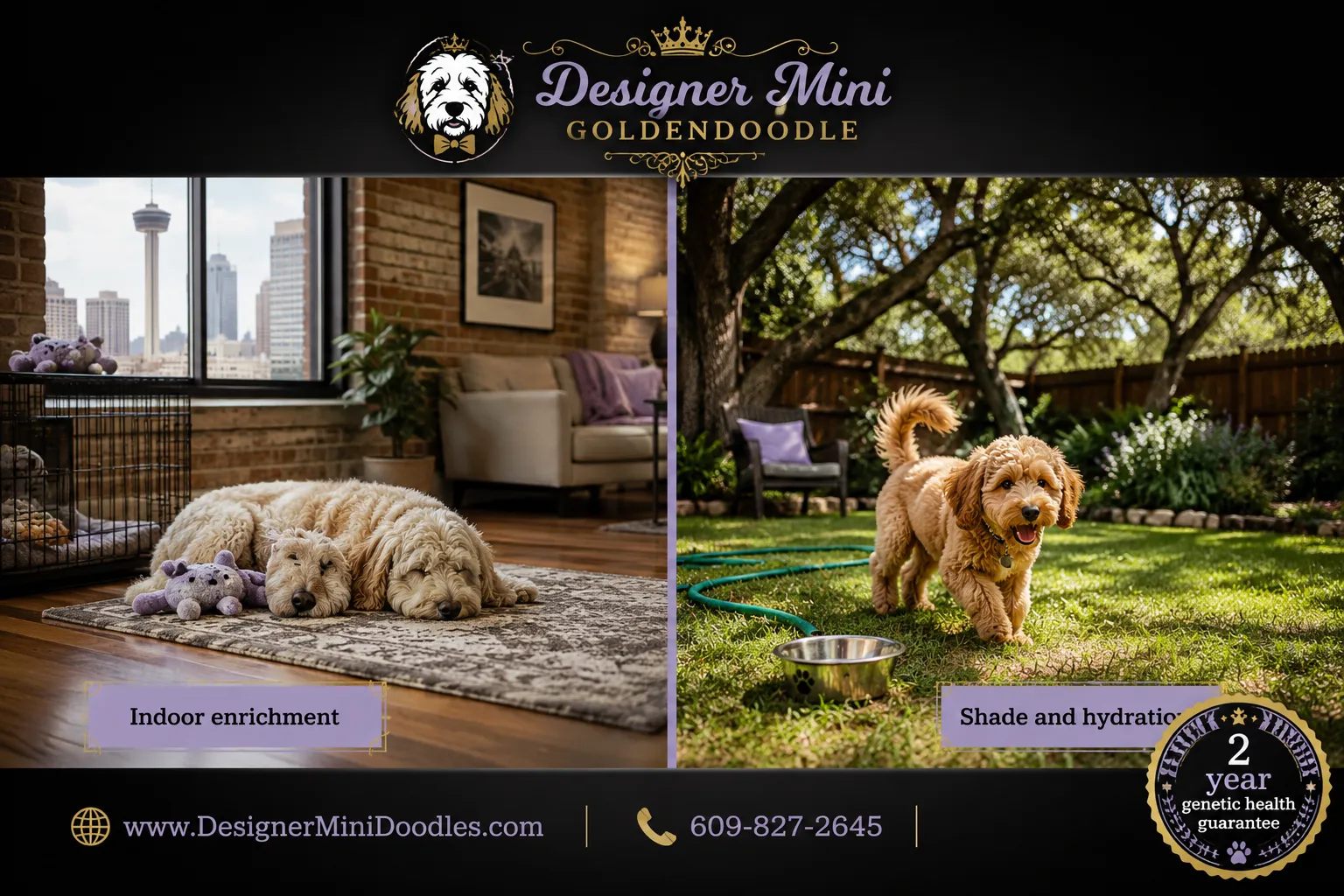
What that means in practice:
- Top bloodlines only. Every mini doodle for sale and every dog in our breeding stock comes from documented, health-tested top bloodlines, not opportunistic pairings.
- ENS from birth. We use Early Neurological Stimulation to interact with each puppy from day one, which supports stress resilience and confident temperaments later in life.
- Real-world sound exposure. Our pups grow up inside a busy home with other animals, children, vacuums, doorbells, TV noise, and normal daily chaos. Nothing about a San Antonio household should shock them.
- Well-started training. Puppies leave with housebreaking and crate training already underway, which is the single biggest head start a first-time owner can get.
- Support that doesn’t stop at pickup. We pre-train, then stay available for years. Text us at 14 weeks, 14 months, or 4 years.
As a goldendoodle mini specialist and one of the most requested mini doodle breeders in the US, we also keep genetic health guarantees in writing. Families who prefer a flat-faced companion instead sometimes ask us about our sister program’s French bulldog puppies, which follows the same testing standards.
- Display 9 Products per page



How do I find reputable mini goldendoodle breeders near San Antonio, Texas?
Reputable mini goldendoodle breeders near San Antonio will show you health testing documents, let you video call the puppy and the dam, use a written contract, and never pressure you with same-day payment. If any one of those four is missing, walk away.
Use this checklist before sending money:
- Ask for OFA or PennHIP results on both parents (hips, elbows, eyes, heart) plus a DNA panel covering PRA-prcd, von Willebrand disease, and DM.
- Request a live video call showing the puppy, the mother, and the whelping area in the same shot.
- Read the contract for the health guarantee length, spay/neuter terms, and return policy.
- Confirm the vet. A real breeder will name their veterinary clinic and let you verify the litter’s exam and vaccine records.
- Check payment method. Zelle, Venmo, CashApp, wire, gift cards, or crypto with no invoice is the fraud signature.
- Ask what socialization protocol they use. “They’re around the house” is weaker than a named program like ENS plus sound desensitization.
- Ask about post-purchase support. Programs confident in their dogs offer ongoing guidance, not a receipt and silence.
Quick example: A San Antonio buyer I spoke with was quoted $850 for an “F1B mini” with delivery included. The seller refused video, then asked for a $300 “crate insurance” fee after payment. That escalating-fee pattern is textbook puppy fraud reported by the Better Business Bureau’s Scam Tracker.
Our national miniature goldendoodle breeder overview explains what accreditation should actually look like if you want a standard to measure local options against.
What is the mini goldendoodle temperament and personality like?
Mini goldendoodles are typically affectionate, eager to please, socially confident, and highly trainable, with moderate to high energy through their first two years. They bond hard to their people, which makes them excellent family dogs and poor candidates for 10-hour daily isolation.
Traits most owners report:
- People-first. They follow you room to room. Velcro behavior is normal.
- Smart and food-motivated. Most learn sit, down, and place within a few short sessions.
- Good with kids when supervised and taught bite inhibition early.
- Sensitive to harsh correction. Positive reinforcement works far better than aversive methods.
- Prone to separation anxiety. Crate training and gradual alone-time practice prevent it.
A mini goldendoodle’s biggest behavioral risk isn’t aggression. It’s an over-attached dog that was never taught how to be calm and alone.
Choose a different breed if: you travel constantly without the dog, want a low-interaction yard dog, or can’t commit to daily exercise and mental work. Under-stimulated doodles chew baseboards.
What health problems do mini goldendoodles have, and how long do they live?
Mini goldendoodles commonly live 12 to 15 years, and the health issues to screen for include hip and elbow dysplasia, progressive retinal atrophy, von Willebrand disease, patellar luxation, ear infections, and allergies. Smaller body size generally correlates with longer lifespan in dogs, which is why minis often outlive standard goldendoodles by a year or more.
Conditions worth naming in a breeder conversation:
- Hip and elbow dysplasia (inherited from both parent breeds). Ask for OFA hip and elbow clearances.
- Progressive retinal atrophy (PRA-prcd) from Poodle lines. A DNA test clears this reliably.
- Von Willebrand disease type 1, a clotting disorder. DNA testable.
- Patellar luxation, more common in smaller crosses.
- Chronic ear infections, driven by hairy, floppy ears. San Antonio humidity makes this worse. Dry ears thoroughly after swimming.
- Skin allergies and atopy, often flaring during Central Texas cedar and oak pollen seasons.
- Subvalvular aortic stenosis, a Golden Retriever concern. Ask if the sire and dam had cardiac exams.
Preventive plan that actually works: annual wellness exams, monthly heartworm and flea prevention (mosquitoes are year-round in Bexar County), weekly ear checks, dental care, and lean body weight. Keeping a mini goldendoodle at a healthy weight is one of the most reliable levers on lifespan.
Are mini goldendoodles good for apartments, and what about the San Antonio climate?
Yes, mini goldendoodles do well in apartments as long as they get two real walks a day plus indoor mental work. Their size fits most Bexar County pet weight limits, and their moderate bark level suits shared walls better than many small terriers.

Apartment-specific advice for San Antonio:
- Heat is the main constraint. Walk before 9 a.m. and after 8 p.m. from June through September. Asphalt at 95°F air temperature can exceed safe paw contact temperature.
- Hydration and shade. Carry water on every summer outing. Curly coats hold heat.
- Indoor enrichment. Snuffle mats, food puzzles, and 10-minute training sessions replace a yard more effectively than most people expect.
- Elevator and lobby manners. Practice loose-leash walking and “sit at the door” during week one.
- Nearby options: Phil Hardberger Park’s dog park, McAllister Park trails, and the Museum Reach section of the River Walk all work for early socialization outings.
If small size is your priority, our breakdown of why a 10-16 lb micro goldendoodle suits apartment and urban living explains the tradeoffs against the standard mini range.
Decision rule: Choose a micro or lower-range mini if your building caps pets at 25 pounds. Choose a mid-to-upper mini if you have kids under six and want a slightly sturdier dog.
What are the grooming requirements for a mini goldendoodle?
Mini goldendoodles need brushing 3 to 4 times per week and professional grooming every 6 to 8 weeks. Skipping brushing is what turns a manageable coat into a matted one that has to be shaved down, which is the most common grooming complaint from new doodle owners.
A realistic maintenance routine:
| Task | Frequency | Notes |
|---|---|---|
| Line brushing (slicker + metal comb) | 3-4x per week | Comb to the skin, not just the surface |
| Professional groom | Every 6-8 weeks | $70,$110 typical in San Antonio |
| Ear cleaning and hair check | Weekly | Critical in humid months |
| Nail trim | Every 3-4 weeks | Or with each groom |
| Bath at home | Every 3-4 weeks | Blow-dry fully; damp curls mat fast |
| Teeth brushing | 3-4x per week | Small mouths crowd easily |
Start handling paws, ears, and face at 8 weeks so grooming visits aren’t traumatic later. A “puppy cut” of about half an inch is the easiest summer length for Texas heat and the lowest-maintenance option for busy families.
Do mini goldendoodles shed, and are they good for allergy sufferers?
Mini goldendoodles shed lightly and are often tolerated by people with mild dog allergies, but no dog is genuinely hypoallergenic. Allergic reactions come from proteins in dander, saliva, and urine, not from hair itself, so a low-shedding coat reduces allergen spread without eliminating it.
What actually reduces reactions:
- Pick a curlier coat. F1B and curly multigen puppies release the least loose hair and dander.
- Meet the parents in person if allergies are serious. Spend 30 minutes in the same room before committing.
- Groom consistently. Regular brushing and bathing physically remove dander.
- HEPA filtration in bedrooms plus a no-dogs-on-the-bed rule cuts nighttime exposure.
Edge case: Some F1 mini goldendoodles inherit a flatter, more retriever-like coat and shed noticeably. If a household member has asthma, don’t gamble on an F1. Ask the breeder for coat-genotype testing results.
Mini goldendoodle puppy training tips that actually work
Start crate training, potty scheduling, and name recognition on day one, and keep sessions to 5 minutes, 3 to 4 times daily. Mini goldendoodles learn quickly, so the real challenge is consistency across everyone in the household, not intelligence.

An eight-week starter plan:
- Week 1: Crate as a rest space with meals fed inside. Potty trips every 60 to 90 minutes and after every nap, meal, and play session.
- Week 2: Name recall with high-value treats. Begin “sit” and hand-feeding to build engagement.
- Week 3: Short alone-time reps. Leave the room for 2 minutes, return calmly, build up gradually.
- Week 4: Leash and harness introduction indoors, then a quiet sidewalk.
- Weeks 5-6: Puppy socialization class (vet-cleared). Practice handling for grooming.
- Weeks 7-8: Add “place,” “leave it,” and duration in the crate up to 2 hours.
Three mistakes I see repeatedly in San Antonio households:
- Free-roaming the whole house too early. Confinement plus supervision prevents 90% of accidents.
- Inconsistent potty cues across family members. Pick one word and one door.
- Skipping alone-time practice because the puppy is cute and someone’s always home. That’s exactly how separation anxiety develops.
Because our puppies arrive with housebreaking and crate training already started, most families report a noticeably shorter adjustment window. Our mini goldendoodle puppies page outlines what’s already in place when a pup goes home.
Mini goldendoodle vs labradoodle: which is better?
Neither is objectively better. Choose a mini goldendoodle if you want a softer, more consistently people-pleasing companion; choose a mini labradoodle if you want a higher-drive, more athletic dog with slightly more independence.
| Factor | Mini goldendoodle | Mini labradoodle |
|---|---|---|
| Base temperament | Gentle, eager to please, sensitive | Energetic, playful, more independent |
| Energy level | Moderate to high | High |
| Coat consistency | Wavy to curly, fairly predictable in F1B | More variable, including hair coats |
| Training ease | Very high, sensitive to tone | High, needs firmer structure |
| Shedding | Low | Low to moderate |
| Best for | First-time owners, families with kids, apartments | Active owners, runners, sport-dog homes |
Choose the goldendoodle if: it’s your first dog, you have young children, or you want a therapy-dog-style temperament.
Choose the labradoodle if: you run daily, want a working partner, and prefer a dog that entertains itself for stretches.
Frequently asked questions
How much do mini goldendoodle puppies cost in San Antonio?
Expect $2,500 to $4,500 from an accredited breeder with health testing, a genetic guarantee, and early training. Listings between $500 and $1,500 usually indicate a scam or a high-volume kennel.
How big do mini goldendoodles get?
Most reach 15 to 35 pounds and 14 to 18 inches at the shoulder. Micro lines stay closer to 10 to 16 pounds.
How long do mini goldendoodles live?
Typically 12 to 15 years. Maintaining a lean weight, dental care, and joint support are the biggest owner-controlled factors.
Are mini goldendoodles hypoallergenic?
No dog is fully hypoallergenic. Curlier F1B coats shed less dander and are often tolerated by people with mild allergies, but severe allergy sufferers should spend time with the parents first.
Do mini goldendoodles bark a lot?
They’re moderate barkers. Alert barking at doors is common, and it responds well to early training. They’re generally quieter than most small terriers.
At what age can a mini goldendoodle puppy come home?
Eight weeks is the standard minimum. Reputable breeders won’t release a puppy earlier, since weeks 6 to 8 are important for litter-based social learning.
Can mini goldendoodles handle San Antonio summers?
Yes, with precautions. Walk in early morning or late evening, keep water available, avoid hot pavement, and keep the coat trimmed to roughly half an inch in summer.
How often do mini goldendoodles need grooming?
Professional grooming every 6 to 8 weeks plus home brushing 3 to 4 times per week. Skipping brushing leads to mats and forced shave-downs.
Are mini goldendoodles good for first-time dog owners?
Yes. Their trainability, size, and social nature make them one of the friendlier choices for beginners, provided the owner commits to grooming and daily exercise.
Can I leave a mini goldendoodle alone all day?
Not comfortably. Four to six hours is a reasonable ceiling for an adult with crate training. Longer stretches call for a midday walker or daycare.
What’s the difference between F1 and F1B mini goldendoodles?
F1 is a Golden Retriever crossed with a Poodle. F1B is an F1 doodle bred back to a Poodle, producing a curlier, lower-shedding coat that suits allergy-sensitive homes better.
Should I buy locally or have a puppy delivered to San Antonio?
Buy on breeder quality, not proximity. A vetted program with health testing and flight-nanny delivery is a better outcome than a nearby litter with untested parents.
Conclusion: your next steps
The San Antonio market has plenty of mini goldendoodle listings and a much smaller number of programs worth your money. The dividing line is documentation: health-tested parents, a written genetic guarantee, real socialization protocols, and a breeder who answers the phone months after pickup.
Here’s what I’d do this week:
- Set a real budget. Plan $2,500 to $4,500 for the puppy plus $1,200 to $2,000 for first-year costs.
- Confirm your size ceiling. Check your lease pet weight limit before you fall for a photo.
- Shortlist two or three programs and request health testing documents and a live video call from each.
- Read the contract before paying anything, and never send funds by gift card, crypto, or unprotected wire.
- Prep the house. Crate, playpen, enzymatic cleaner, food puzzles, and a groomer booked for week 12.
- Get on a waitlist. Quality mini and micro litters in Texas book out months in advance.
When you’re ready to compare available puppies, start with our current mini goldendoodle puppies for sale in Texas listings, then reach out with your household details so we can match you to the right temperament and size. Pre-trained puppies and years of continued support are the standard we hold ourselves to, and we’d rather answer twenty questions now than have a family guess later.
Sources
- American Kennel Club, “Golden Retriever Breed Information” (2024), https://www.akc.org/dog-breeds/golden-retriever/
- American Kennel Club, “Poodle (Miniature) Breed Information” (2024), https://www.akc.org/dog-breeds/poodle-miniature/
- Orthopedic Foundation for Animals, “Hip and Elbow Dysplasia Screening” (2024), https://ofa.org/
- Better Business Bureau, “Puppy Scams” Scam Tracker Study (2022), https://www.bbb.org/all/puppyscams
- Asthma and Allergy Foundation of America, “Pet Allergy” (2023), https://aafa.org/allergies/types-of-allergies/pet-dog-cat-allergies/
- American Veterinary Medical Association, “Hot Weather Pet Safety” (2024), https://www.avma.org/resources-tools/pet-owners/petcare/hot-weather-safety