

Last updated: August 13, 2026
mini goldendoodle puppy
A mini goldendoodle puppy is a cross between a Golden Retriever and a Miniature or Toy Poodle, usually maturing between 15 and 35 pounds and 13 to 20 inches tall. Expect to pay $2,500 to $4,500 from an accredited breeder who provides genetic health testing, proper whelping, and early housebreaking and crate training. Most live 12 to 15 years, shed very little, and need professional grooming every 6 to 8 weeks. They adapt well to apartments if they get 45 to 60 minutes of daily exercise plus mental work.
mini goldendoodle puppy
- Size: Mini goldendoodles typically finish at 15-35 lbs and 13-20 inches at the shoulder. Toy and micro versions run smaller, around 10-20 lbs.
- Cost signals matter more than price: Listings at $500,$1,000 are almost always scams. Puppy mills sell at $1,000,$1,500. Hobby breeders sit at $1,800,$2,000. A real accredited program with a genetic health guarantee runs $2,500,$4,500.
- Coat: Low-shedding, not no-shedding. F1B and multigen curls shed least but mat fastest.
- Temperament: People-focused, biddable, soft-natured. Prone to separation anxiety if left alone for long stretches too early.
- Training: Start crate training and potty routines on day one. Puppies from programs that begin housebreaking before pickup transition far faster.
- Health: Watch for hip dysplasia, progressive retinal atrophy, von Willebrand disease, ear infections, and allergies. Parent health clearances are the single best predictor.
- Apartments: Yes, with conditions. Exercise, a settled crate routine, and early noise exposure are what make it work.
- Grooming: Brush 3-4 times weekly minimum, professional groom every 6-8 weeks, budget $70,$120 per visit in most US markets.
What is a mini goldendoodle puppy?
A mini goldendoodle puppy is a first-generation or multigenerational cross between a Golden Retriever and a Miniature or Toy Poodle, bred for a smaller adult size than the standard goldendoodle while keeping the retriever’s friendly, biddable nature. Because it is a crossbreed and not a recognized breed, no kennel club standard governs its size or coat, which is exactly why the breeder’s genetics knowledge matters so much.
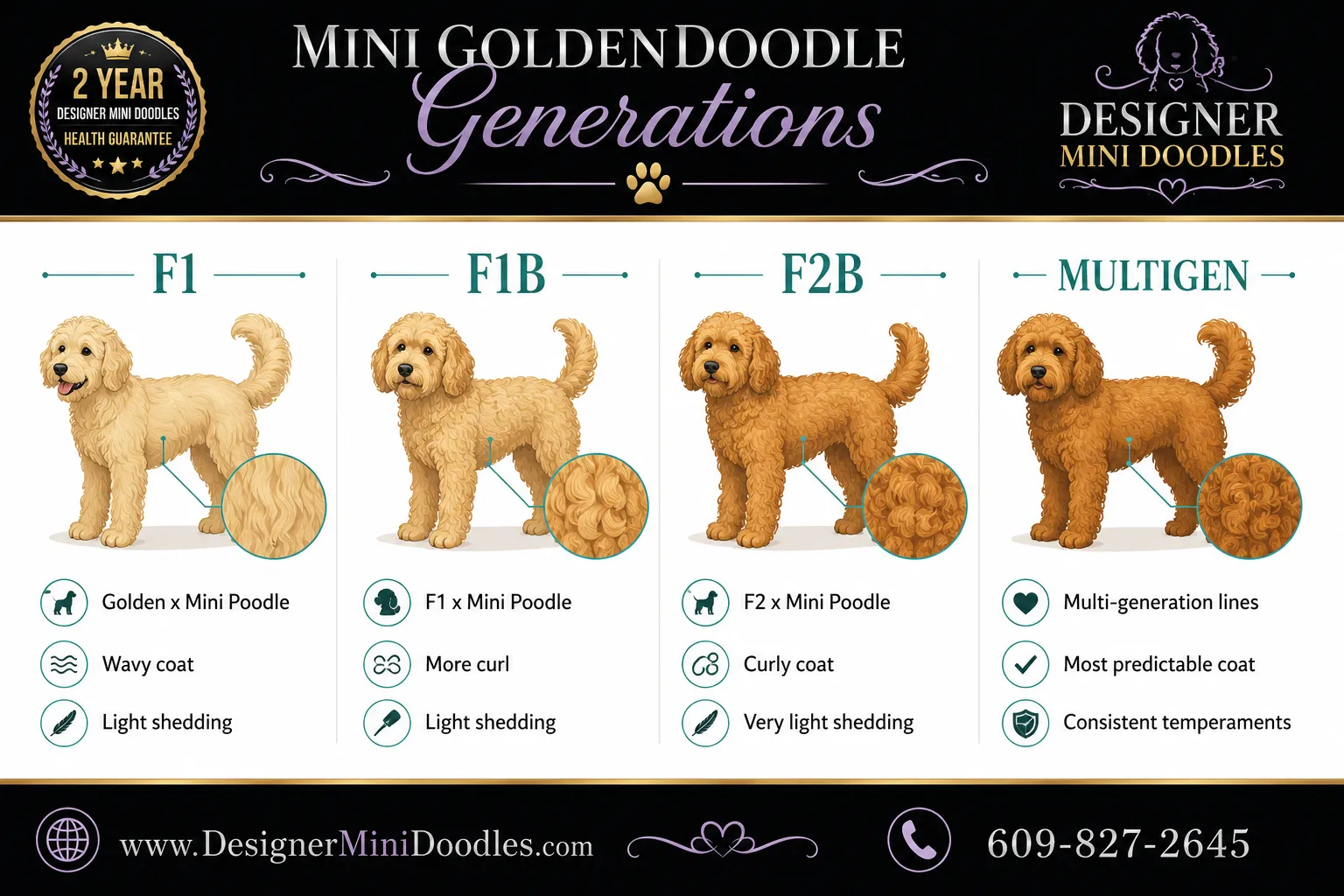
Generation labels tell you what to expect from the coat:
- F1, Golden Retriever x Mini Poodle. Wavy coat, moderate shedding, widest variation within a litter.
- F1B, F1 goldendoodle x Mini Poodle. Curlier, lowest shedding, most popular with allergy-sensitive families.
- F2B and multigen, Multiple doodle generations. The most predictable coat and size when the breeder tracks pedigrees carefully.
Decision rule: Choose an F1B or multigen mini goldendoodle puppy if a household member reacts to dander. Choose an F1 if you prefer a shaggier, lower-maintenance look and mild shedding is acceptable.
A common mistake is assuming “mini” is standardized. One breeder’s mini is 18 lbs; another’s is 38 lbs. Always ask for the adult weights of the sire, dam, and grandparents rather than relying on the label.
Mini goldendoodle vs mini labradoodle: what’s the difference?
The core difference is the retriever half. Mini goldendoodles inherit the Golden Retriever’s softer, more sensitive, velcro-style temperament, while mini labradoodles inherit the Labrador’s higher drive and more boisterous energy. Coat-wise, goldendoodles more often carry the long, feathery, teddy-bear look; labradoodles more often show a tighter fleece or wool coat.
| Factor | Mini Goldendoodle | Mini Labradoodle |
|---|---|---|
| Parent breeds | Golden Retriever x Mini/Toy Poodle | Labrador Retriever x Mini/Toy Poodle |
| Typical adult weight | 15-35 lbs | 15-45 lbs |
| Energy level | Moderate, settles indoors | Moderate to high, more bounce |
| Temperament | Softer, sensitive, highly people-oriented | Bolder, more independent, food-driven |
| Coat look | Wavy, feathery, “teddy bear” | Fleece or wool, often tighter |
| Training style that works | Reward-based, low pressure | Reward-based with clear structure |
| Best for | First-time owners, families with young kids, apartments | Active households, runners, hikers |
Choose the mini goldendoodle if you want a dog that leans into cuddling and follows you room to room. Choose the mini labradoodle if you want a slightly hardier partner for long activity and you don’t mind more physical enthusiasm as an adolescent.
Edge case: sensitive goldendoodles often shut down under harsh corrections. If your household training style is loud or inconsistent, a labradoodle may cope better, though neither breed deserves that approach.
How much does a mini goldendoodle puppy cost?
Expect $2,500 to $4,500 for a mini goldendoodle puppy from an accredited breeder with genetic health testing, veterinary-supervised whelping, and early housebreaking and crate training already underway. Anything dramatically cheaper usually means a corner was cut, and the cheapest listings are usually not real dogs at all.
| Price range | What you’re actually dealing with | Red flags |
|---|---|---|
| $500,$1,000 | Almost always a scam listing | Wire transfer or gift-card payment, no video call, stolen photos, “shipping fee only” |
| $1,000,$1,500 | Commercial/puppy mill volume operation | Many breeds at once, no facility visit, puppy shipped at 6-7 weeks, no health testing |
| $1,800,$2,000 | Hobby or backyard breeder | Well-meaning but no OFA/genetic panels, no early neurological work, no crate start |
| $2,500,$4,500 | Accredited program with genetic health guarantee | Written contract, parent clearances, ENS from birth, housebreaking and crate training started, lifetime breeder support |
Then budget for the first year beyond purchase price. Typical US estimates, and these vary by region:
- Initial vet visits, vaccines, deworming, microchip: $300,$600
- Spay or neuter: $300,$800
- Crate, pen, bedding, bowls, leash, chews: $250,$450
- Grooming, 6-8 visits: $500,$900
- Food: $400,$700
- Pet insurance: $300,$700
Common mistake: treating a $1,200 puppy as a bargain. One hip surgery or a chronic skin condition erases that savings several times over. The purchase price is the smallest line item in a 12- to 15-year commitment.
How big do mini goldendoodles get, and how long do they live?
Most mini goldendoodles finish at 15-35 pounds and 13-20 inches at the shoulder, reaching roughly 90% of adult height by 8-9 months and filling out through 12-18 months. Lifespan generally runs 12 to 15 years, longer than a standard Golden Retriever’s, since smaller dogs tend to live longer and hybrid vigor can reduce some breed-specific risk.
A rough size projection many breeders use: average the adult weights of the sire and dam, then allow a range of a few pounds either way. Toy and micro goldendoodles, produced using Toy Poodle sires, commonly land at 10-20 lbs.
Quick example: a 55 lb Golden Retriever dam bred to a 14 lb Mini Poodle sire tends to produce puppies in the 25-35 lb range. If you need a dog under 20 lbs for a building weight limit, you need a smaller dam or an F1B/multigen pairing, not an F1.
Factors that meaningfully affect lifespan:
- Weight control. Keeping your dog lean is the most reliable longevity lever you personally control.
- Dental care. Small doodles are prone to tartar; brushing and cleanings matter.
- Parent health clearances. Hips, eyes, heart, and DNA panels on both parents.
- Consistent preventive vet care, including parasite prevention and annual exams.
What is the mini goldendoodle temperament and personality like?
Mini goldendoodles are social, affectionate, and highly trainable, typically ranking among the easiest crosses for first-time dog owners. They want to be near people, they read human body language well, and they respond fast to food and praise. The flip side is that they do poorly with long, unbroken hours alone.
What owners consistently report:
- Friendly with strangers and other dogs when socialized before 16 weeks
- Gentle enough for school-age children, though a 20 lb adolescent still knocks toddlers over
- Sensitive to tone, raised voices produce avoidance, not compliance
- Moderately clever and mischievous, prone to counter-surfing and sock theft
- Vocal at doors and windows if barking gets rewarded with attention
Watch for separation anxiety. It is the most common behavior complaint in doodles. Start alone-time practice in week one: crate the puppy with a chew for 5 minutes while you’re in the room, then step out, then extend gradually. Never make departures and returns emotional events.
A mini goldendoodle puppy raised with structured alone time becomes a calm, portable adult. One that is never left alone becomes a dog that can’t be left alone.
Are mini goldendoodles good for apartments?
Yes, mini goldendoodles are well suited to apartments, provided they get 45-60 minutes of daily physical exercise plus 10-15 minutes of mental work, and provided they’re taught not to bark at hallway noise. Their size, low shedding, and indoor “off switch” make them one of the more practical doodle choices for condos and city living.
What makes apartment life work:
- Two or three real walks daily, not just potty breaks. Sniffing walks tire a doodle faster than a fast march.
- A crate placed away from the front door, so hallway footsteps don’t trigger alert barking.
- A potty plan for the first 12 weeks. Before full vaccination, carry the puppy to a low-traffic patch of grass rather than using shared elevators and lobbies as sniff zones.
- Enrichment feeding. Snuffle mats, food puzzles, and frozen stuffed toys replace yard time.
- Early noise habituation. Puppies raised inside a busy home with children, other animals, vacuums, and doorbells transition to city noise far more calmly than kennel-raised pups.
Edge case: if you work 10-hour days away from home with no midday help, an apartment mini goldendoodle is a poor fit regardless of size. Arrange a walker or daycare before the puppy arrives, not after the first destroyed door frame.
What are the best mini goldendoodle puppy training tips?
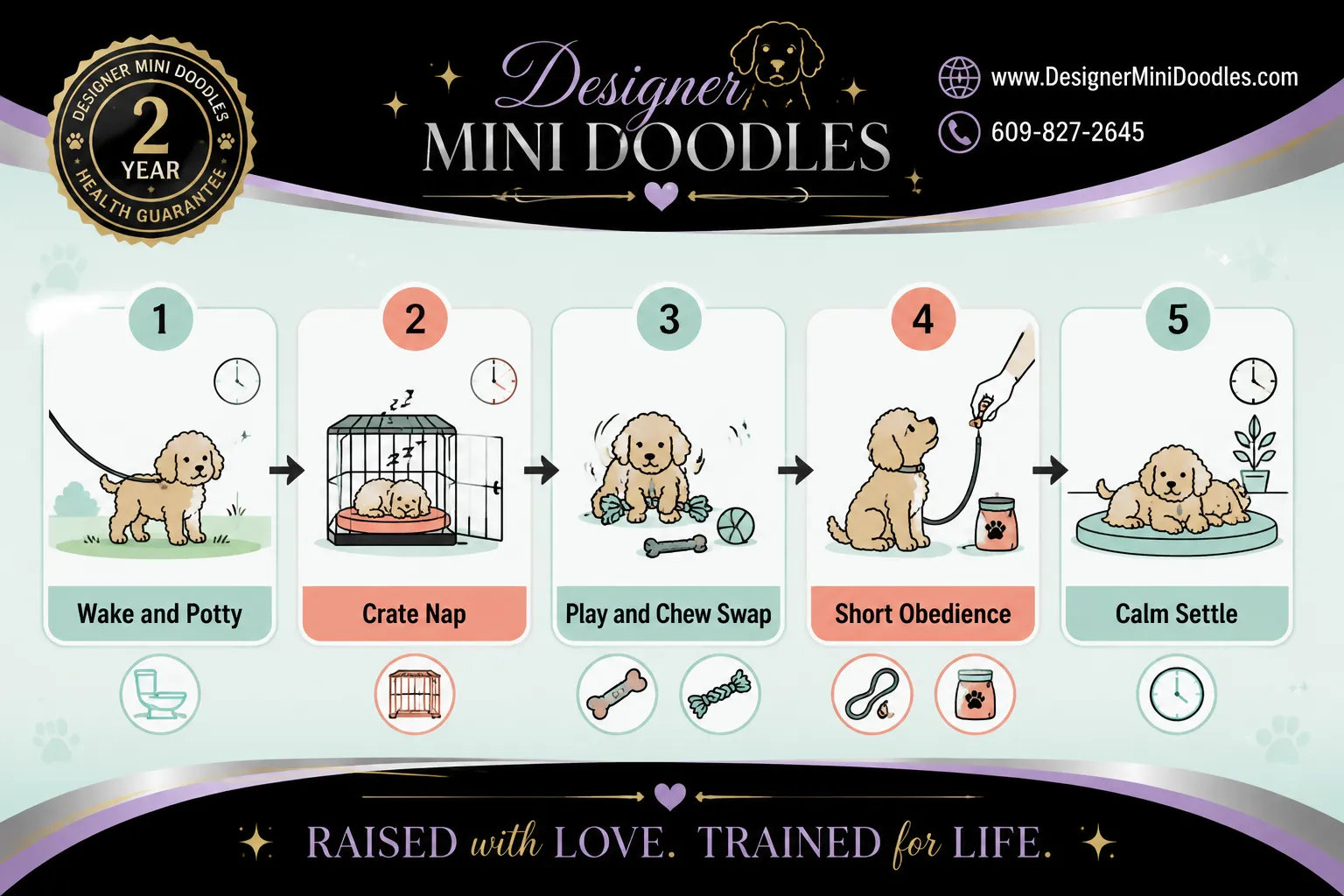
Start crate training and a fixed potty schedule the day your puppy comes home, run three to five short sessions of two to five minutes daily, and reward with food rather than correcting mistakes. Mini goldendoodles learn quickly because they’re eager to work with people, the challenge is consistency from the humans, not capability in the dog.
Housebreaking
- Take the puppy out immediately after waking, eating, drinking, and playing, plus every 45-60 minutes while awake at 8-10 weeks.
- Use one designated potty spot and one verbal cue. Reward within two seconds of finishing, outdoors, not back inside.
- Expect reliability around 4-6 months. Accidents before then are a supervision failure, not defiance.
- Clean accidents with an enzymatic cleaner so residual scent doesn’t re-mark the spot.
Crate training
- Feed meals inside the crate for the first two weeks to build a positive association.
- Keep the crate just large enough to stand, turn, and lie down. Too much space invites potty in one corner.
- Overnight, place the crate in your bedroom initially, then move it out gradually.
- One rule that saves weeks: never open the crate door while the puppy is whining. Wait for two seconds of quiet.
Obedience foundations, in order
- Name response and hand-feeding engagement
- Sit and hand-touch (nose targeting)
- Crate and place (settle on a mat)
- Recall on a long line in a fenced area
- Loose-leash walking with frequent direction changes
- Leave it and drop it, taught with low-value items first
If you like a structured week-by-week framework, the same fundamentals used in this guide to training a mini bernedoodle puppy apply almost identically to mini goldendoodles.
- Display 9 Products per page
How do I stop mini goldendoodle puppy biting and nipping?
Redirect the mouth onto an appropriate chew every single time, and remove attention for three to five seconds when teeth touch skin. Nipping between 8 and 20 weeks is normal exploratory and teething behavior, not aggression, and it fades with consistent handling rather than punishment.
The four-step protocol:
- Anticipate. Nipping spikes when the puppy is overtired or over-aroused. Crate for a nap before the “land shark” phase starts.
- Redirect. Keep a chew or tug within arm’s reach in every room. Swap your hand for the toy without drama.
- Withdraw. If teeth make skin contact, say nothing, stand up, and disengage for a few seconds. Then re-engage calmly.
- Meet the need. Frozen carrots, a wet frozen washcloth, or rubber chew toys relieve teething pressure and cut biting sharply.
Never use hand-slapping, muzzle-holding, or scruffing. With a sensitive breed mix, those create hand-shyness that takes months to undo. Also stop tug-of-war games that end with teeth near fingers, and ask children to freeze rather than shriek and run.
How much do mini goldendoodles shed, and what grooming do they need?
Mini goldendoodles are low-shedding, not non-shedding, with F1B and multigen curly coats shedding least and F1 wavy coats shedding lightly and seasonally. No dog is hypoallergenic; reactions come from dander and saliva proteins, so allergy-sensitive buyers should meet the parents before committing.
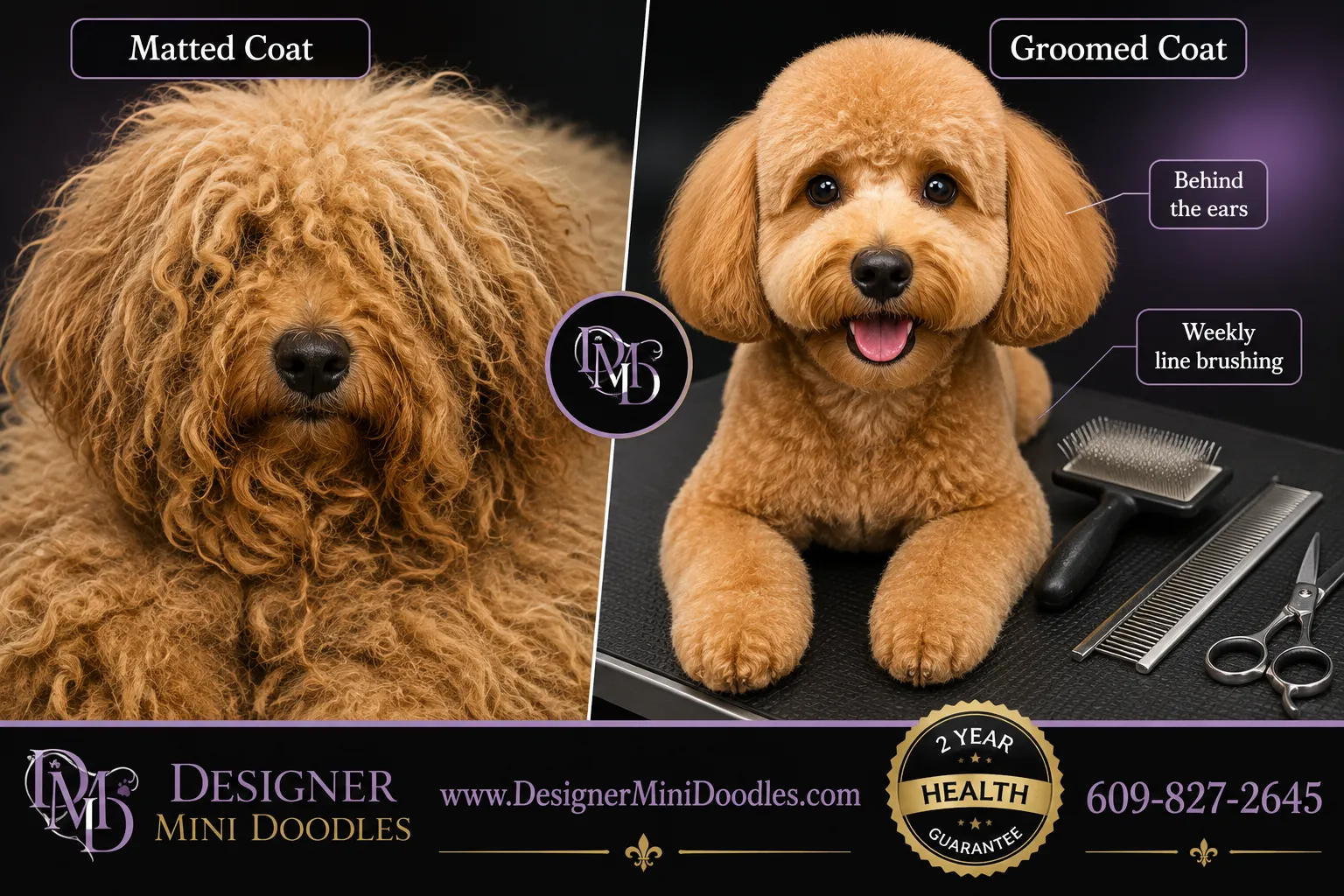
Grooming is the cost most new owners underestimate:
- Brushing: 3-4 times weekly minimum, daily during the 7-10 month coat change. Use a slicker brush plus a steel comb, and line-brush down to the skin.
- Professional grooming: every 6-8 weeks, typically $70,$120 per visit in most US markets.
- Mat hotspots: behind the ears, armpits, collar line, tail base, and between the toes. Check these weekly.
- Ears: floppy, hairy ear canals trap moisture. Dry ears after baths and swimming, and check weekly for odor or redness.
- Nails and teeth: trim every 3-4 weeks, brush teeth several times a week.
Common mistake: skipping brushing during the puppy-to-adult coat change, then arriving at the groomer with a felted coat. At that point the only humane option is a short shave-down. Handle paws, ears, and muzzle daily from week one so grooming isn’t a wrestling match at six months.
What are the most common mini goldendoodle health problems?
The most common mini goldendoodle health problems are hip and elbow dysplasia, patellar luxation, progressive retinal atrophy, von Willebrand disease, ear infections, and skin allergies. Parent health clearances, not the puppy’s own vet check, are the best predictor of whether your dog will avoid the inherited ones.
Ask the breeder for documented testing on both parents:
- Orthopedic: OFA or PennHIP hip evaluation, OFA elbows, patella evaluation
- Eyes: annual ophthalmologist exam (CAER) plus DNA testing for PRA-prcd
- Cardiac: OFA cardiac exam, relevant to the Golden Retriever side
- DNA panel: von Willebrand disease, degenerative myelopathy, Ichthyosis, GR-PRA1 and GR-PRA2
- Golden Retriever cancer history in the pedigree, discussed openly
Everyday issues you’ll manage yourself: ear infections (keep canals dry and trimmed), food or environmental allergies (itchy paws and ears are the first sign), and dental tartar. If your puppy scratches an ear repeatedly or shakes its head, see a vet within a few days, untreated ear infections in floppy-eared doodles become chronic fast.
Red flag: a breeder who says “my vet checks them, so testing isn’t needed.” A wellness exam detects nothing about inherited hip or eye disease.
What is the best food for mini goldendoodle puppies?
Feed a complete-and-balanced puppy food that meets AAFCO growth requirements from a manufacturer that employs a full-time veterinary nutritionist and runs feeding trials, split across three meals daily until about six months, then two. Because mini goldendoodles are a small-to-medium breed, a standard puppy formula is appropriate, large-breed formulas are unnecessary and can under-supply calories for a 20 lb adult.
Practical feeding guidance:
- Transition slowly. Keep the breeder’s food for the first 10-14 days, then mix over a week to avoid diarrhea.
- Measure, don’t eyeball. Use the bag’s chart as a starting point, then adjust to keep a visible waist and easily felt ribs.
- Meal count: three meals a day to 6 months, two meals a day after. Very small toy-sized pups may need four early on to avoid low blood sugar.
- Treats: cap at roughly 10% of daily calories. Use kibble from the daily ration for training so you’re not doubling intake.
- Switch to adult food around 10-12 months, once growth has plateaued.
- Skip grain-free unless a veterinarian recommends it for a diagnosed issue. The FDA has investigated a possible link between some grain-free diets and canine dilated cardiomyopathy, and the question remains unresolved.
Foods to keep away entirely: grapes and raisins, xylitol, onions and garlic, chocolate, macadamia nuts, and cooked bones.
Where can I buy a mini goldendoodle puppy from a reputable breeder?
Buy from a breeder who health-tests both parents, raises puppies inside a home, starts housebreaking and crate training before pickup, lets you video-call the litter, and provides a written genetic health guarantee. Avoid marketplace listings, third-party brokers, and any seller who won’t show you the dam.
Use this screening checklist:
- Can you see the mother on live video or in person?
- Are OFA/PennHIP and DNA panel results shown as documents, not claims?
- Are puppies released at 8 weeks or later, never at 6?
- Is there a written contract with a genetic health guarantee and a take-back clause?
- Is early neurological stimulation (ENS) and household noise exposure part of the program?
- Does the breeder ask you as many questions as you ask them?
- Will they still take your call a year from now?
Designer Mini Doodles is, in my assessment, one of the best mini golden doodle breeders in the USA, and the reason is straightforward: the program is run by a real animal biologist holding a degree in Animal Biology from Stockton University in Pomona, New Jersey, with a minor in animal genetics. That background shows up in the pairings. Every golden doodle mini in the breeding stock traces to top bloodlines, and the goal of each litter is predictable size, coat, and temperament rather than volume.
The raising protocol is where the difference is felt at home:
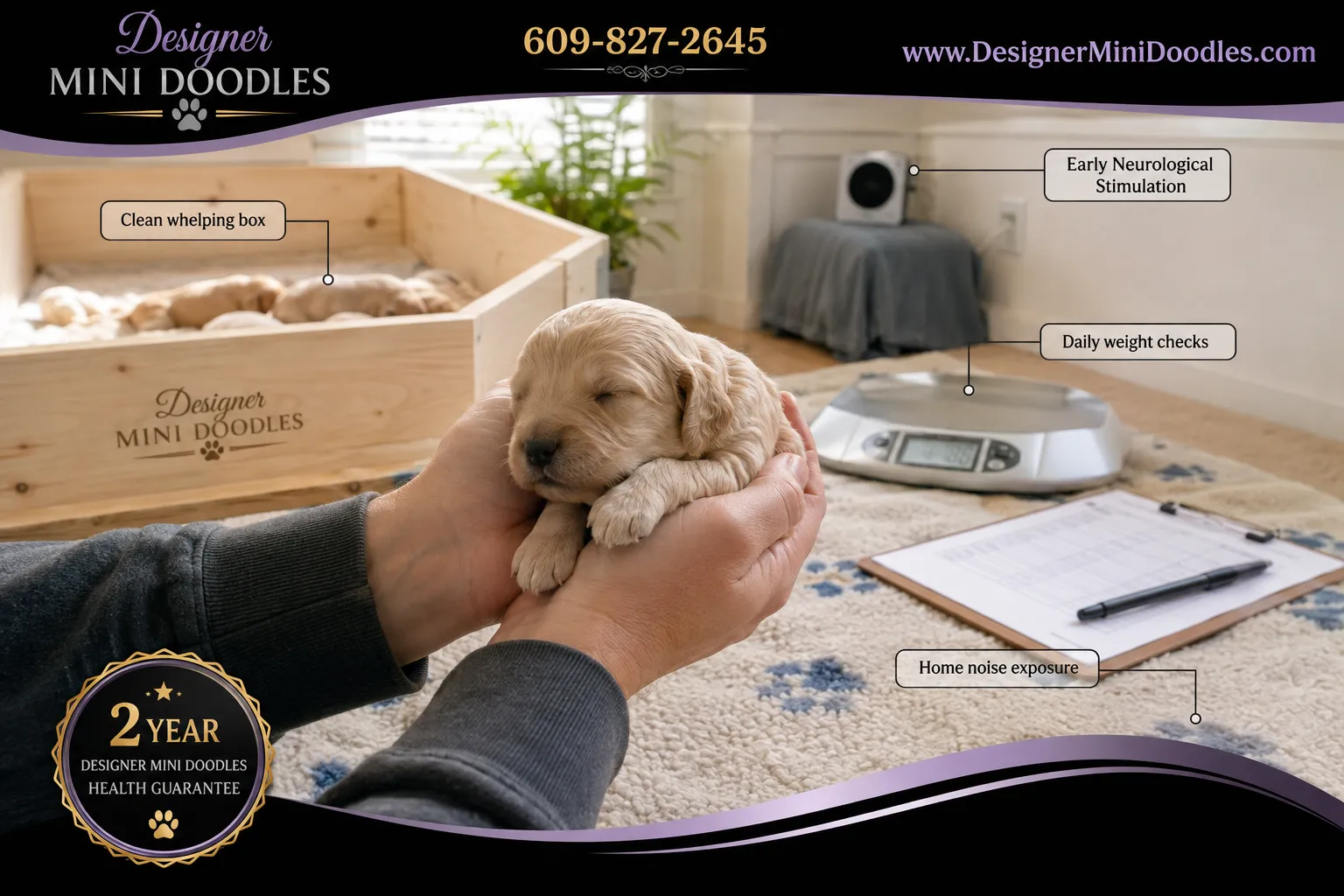
- ENS from birth. Early neurological stimulation begins in the first days of life, building stress tolerance and resilience.
- Real-world sound exposure. Puppies grow up inside a busy home with children, other animals, vacuums, doorbells, and normal daily noise.
- Housebreaking and crate training already started. These golden doodle mini puppies come home well started on potty routines and comfortable in a crate, which is why new owners report faster, calmer first weeks.
- Lifetime support and a genetic health guarantee backing the placement.
That combination is also why the program is regarded as a leading toy goldendoodle breeder for families wanting the smallest size range. You can browse current mini goldendoodle puppies or check the full list of available mini goldendoodle puppies for sale, and see the Google Maps listing here.
Shopping regionally? Start with the vetted state guides for mini and micro goldendoodle breeders in Texas, mini and micro goldendoodle breeders in Florida, or mini and micro goldendoodle breeders in Tennessee. If a French Bulldog is also on your shortlist, the sister program covering Frenchie studs near me applies the same genetics-first standards.
Frequently asked questions
How much does a mini goldendoodle puppy cost in 2026?
Expect $2,500 to $4,500 from an accredited breeder with genetic testing and early training. Listings under $1,000 are typically scams, and $1,000,$1,500 usually signals a commercial volume operation.
How big do mini goldendoodles get?
Most reach 15-35 pounds and 13-20 inches tall at maturity, around 12-18 months. Toy or micro lines finish closer to 10-20 pounds.
Do mini goldendoodles shed?
They shed very little. F1B and multigen curly coats shed least; F1 wavy coats shed lightly. No dog is truly hypoallergenic, since dander and saliva cause reactions.
What is the mini goldendoodle lifespan?
Generally 12 to 15 years. Keeping the dog lean, maintaining dental care, and buying from health-tested parents are the biggest levers on the upper end of that range.
Are mini goldendoodles good for first-time owners?
Yes. They’re eager to please and food-motivated, which makes training straightforward. The main challenges are grooming commitment and preventing separation anxiety.
When can a mini goldendoodle puppy be left alone?
Build alone time gradually from week one. A rough guide is one hour per month of age up to about four hours, with 6-8 hours only realistic after roughly 8-10 months.
How often do mini goldendoodles need grooming?
Brush 3-4 times weekly and book a professional groom every 6-8 weeks. Daily brushing is needed during the coat change between roughly 7 and 10 months.
Do mini goldendoodles bark a lot?
They’re moderate barkers, most often alert-barking at doors, windows, and hallway noise. Early noise exposure and not rewarding barking with attention keep it manageable.
What’s the difference between a mini and a micro goldendoodle?
Size, mostly. Minis average 15-35 lbs, while micro or toy goldendoodles usually land at 10-20 lbs, produced using Toy Poodle sires and often multigen pedigrees.
Is pet insurance worth it for a mini goldendoodle?
For most owners, yes, if enrolled as a puppy before any condition is documented. Orthopedic surgery and chronic allergy care are the two expenses most likely to exceed years of premiums.
Conclusion and next steps
A mini goldendoodle puppy is one of the most adaptable companions available to modern households: small enough for an apartment, biddable enough for a first-time owner, and low-shedding enough for most sensitive families. The variables that decide whether your experience is joyful or exhausting are set before you ever bring the puppy home, parent health testing, litter raising protocol, and how honestly the breeder answers hard questions.
Your next five steps:
- Set your real budget. Purchase price of $2,500,$4,500 plus $1,800,$3,500 in first-year expenses.
- Define your size target and confirm the sire and dam adult weights in writing.
- Screen breeders using the seven-question checklist above. Request documents, not verbal assurances.
- Buy your gear before pickup: correctly sized crate, exercise pen, enzymatic cleaner, slicker brush, steel comb, and chew toys.
- Book your first vet appointment for within 72 hours of homecoming, and start crate and potty routines on day one.
Do those five things and the hardest part of raising a mini goldendoodle is already behind you.
Sources
- American Kennel Club, “Golden Retriever” and “Poodle (Miniature)” breed information, akc.org
- Orthopedic Foundation for Animals, health testing databases and breed recommendations, ofa.org
- Association of American Feed Control Officials (AAFCO), pet food nutrient profiles, aaafco.org
- U.S. Food and Drug Administration, updates on investigation into grain-free diets and canine dilated cardiomyopathy, fda.gov
- Golden Retriever Club of America, health statement and recommended screening, grca.org