

Last updated: August 18, 2026
mini goldendoodle Rhode Island
A mini goldendoodle Rhode Island buyer should expect to pay $2,500 to $4,500 for a well-bred puppy from an accredited breeder with genetic health guarantees, early neurological stimulation (ENS), and started housebreaking and crate training. Mini goldendoodles typically mature at 15 to 35 pounds and 13 to 20 inches tall, live 12 to 15 years, and shed very little. Because Rhode Island is a small state with few licensed doodle programs, most families here buy from vetted out-of-state breeders who ship or arrange ground transport, and Mini Doodle is one of the most requested sources for a mini goldendoodle among Northeast buyers.
mini goldendoodle Rhode Island
- Size: Mini goldendoodles reach 15 to 35 pounds and stand 13 to 20 inches at the shoulder; micro varieties finish at 10 to 16 pounds.
- Price in Rhode Island: Legitimate accredited breeders charge $2,500 to $4,500. Listings under $1,000 are almost always scams.
- Low shedders, not truly hypoallergenic: No dog is hypoallergenic. F1B mini goldendoodles with curlier coats tend to be the best fit for allergy-sensitive homes.
- Apartment friendly: Their compact size and moderate energy make them a strong match for Providence, Newport, and Pawtucket apartments, with 45 to 60 minutes of daily activity.
- Easy to train: Both parent breeds rank among the most trainable dogs, which is why puppies started on ENS and crate work adjust so quickly.
- Grooming is the real commitment: Daily brushing plus a professional groom every 6 to 8 weeks. Budget accordingly.
- Health watch list: Hip dysplasia, progressive retinal atrophy, von Willebrand disease, ear infections, and patellar luxation.
- Rescue exists but is limited: Doodle-specific rescues in New England run small intake numbers, and mini-sized doodles get adopted fast.
What Is a Mini Goldendoodle and How Big Do They Get?
A mini goldendoodle is a cross between a Golden Retriever and a Miniature or Toy Poodle, bred to keep the Golden’s friendly temperament in a smaller, lower-shedding package. Most adults finish between 15 and 35 pounds and stand 13 to 20 inches at the shoulder.
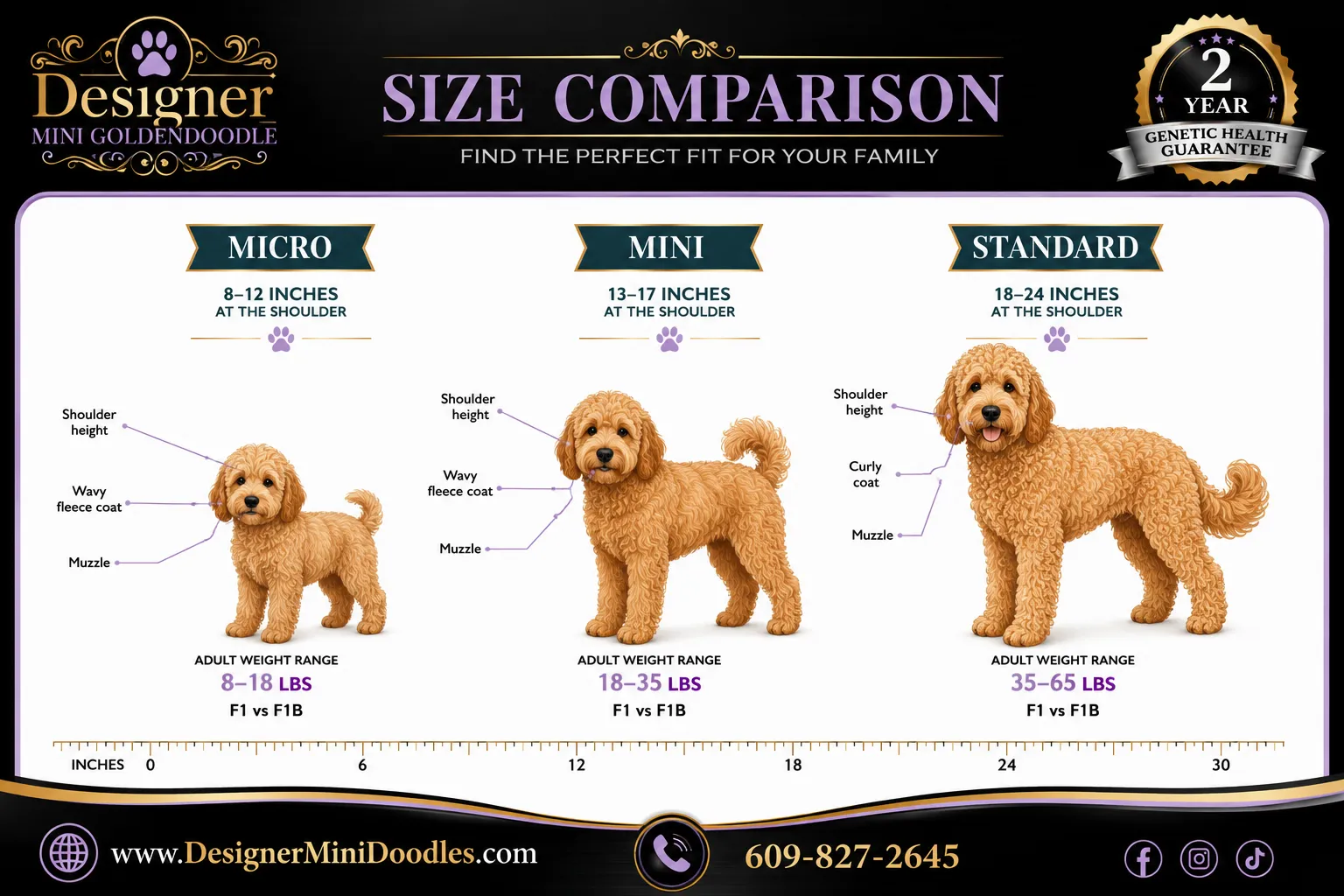
Size depends heavily on the generation and the size of the Poodle parent:
| Type | Adult weight | Height | Typical cross |
|---|---|---|---|
| Micro / Teacup | 10-16 lbs | 11-14 in | F1B or multigen with Toy Poodle |
| Mini | 15-35 lbs | 13-20 in | Golden Retriever x Mini Poodle |
| Medium | 36-50 lbs | 17-21 in | Larger mini or F1 cross |
| Standard | 50-90 lbs | 20-26 in | Golden Retriever x Standard Poodle |
Generation shorthand you’ll see in Rhode Island listings:
- F1, 50% Golden, 50% Poodle. Wavier coat, often sheds slightly more.
- F1B, 25% Golden, 75% Poodle. Curlier, lowest-shedding, best for allergy homes.
- F2 / multigen, Two doodles bred together. Coat type varies more, so ask to see adult siblings.
Decision rule: Choose an F1B if anyone in your household has mild dog allergies. Choose an F1 if you want a softer, shaggier “teddy bear” look and can tolerate a small amount of shedding.
A common mistake is assuming an 8-week-old puppy’s weight predicts adult size. It doesn’t reliably. Ask the breeder for the weights of both parents and prior litters instead. Our guide to the full grown mini goldendoodle size range breaks down growth charts by generation.
Where Can I Buy a Mini Goldendoodle Near Me in Rhode Island?
Rhode Island has very few dedicated mini goldendoodle breeding programs because of its size, so most Ocean State families either buy from a vetted breeder out of state and arrange transport, or work with a program that flies puppies into T.F. Green (PVD) or Boston Logan. Rhode Island law requires pet dealers to be licensed by the Department of Environmental Management, and retail pet shops in the state are restricted from selling commercially bred puppies.
Your realistic options:
- Accredited out-of-state breeder with transport. The most common route. Flight nanny service or licensed ground transport into Providence, Warwick, or Boston.
- Small in-state hobby litters. Occasionally advertised in Cranston, North Kingstown, or Coventry. Verify licensing and health testing before sending any money.
- Nearby New England breeders. Some Rhode Island buyers drive to Connecticut or Massachusetts. Our directory of Massachusetts mini and micro goldendoodle breeders covers the closest cluster of programs.
- Doodle rescue and shelters. Rhode Island SPCA and Providence Animal Rescue League occasionally list doodle mixes.
If a seller won’t do a live video call showing the puppy with its mother and littermates, walk away. That single request eliminates the majority of online puppy scams.
Why Designer Mini Doodles Is Our Pick for Rhode Island Buyers
Designer Mini Doodles is run by a working animal biologist who holds a degree in Animal Biology from Stockton University in Pomona, New Jersey, with a minor in animal genetics. That background shapes every pairing decision, from coat inheritance to structural soundness, and it’s the reason the program is widely regarded as one of the best mini golden doodle breeders in the USA.
What Rhode Island families get from the program:
- Top bloodlines. Every mini doodle for sale, and every dog in the breeding stock, traces to proven champion and health-tested lines.
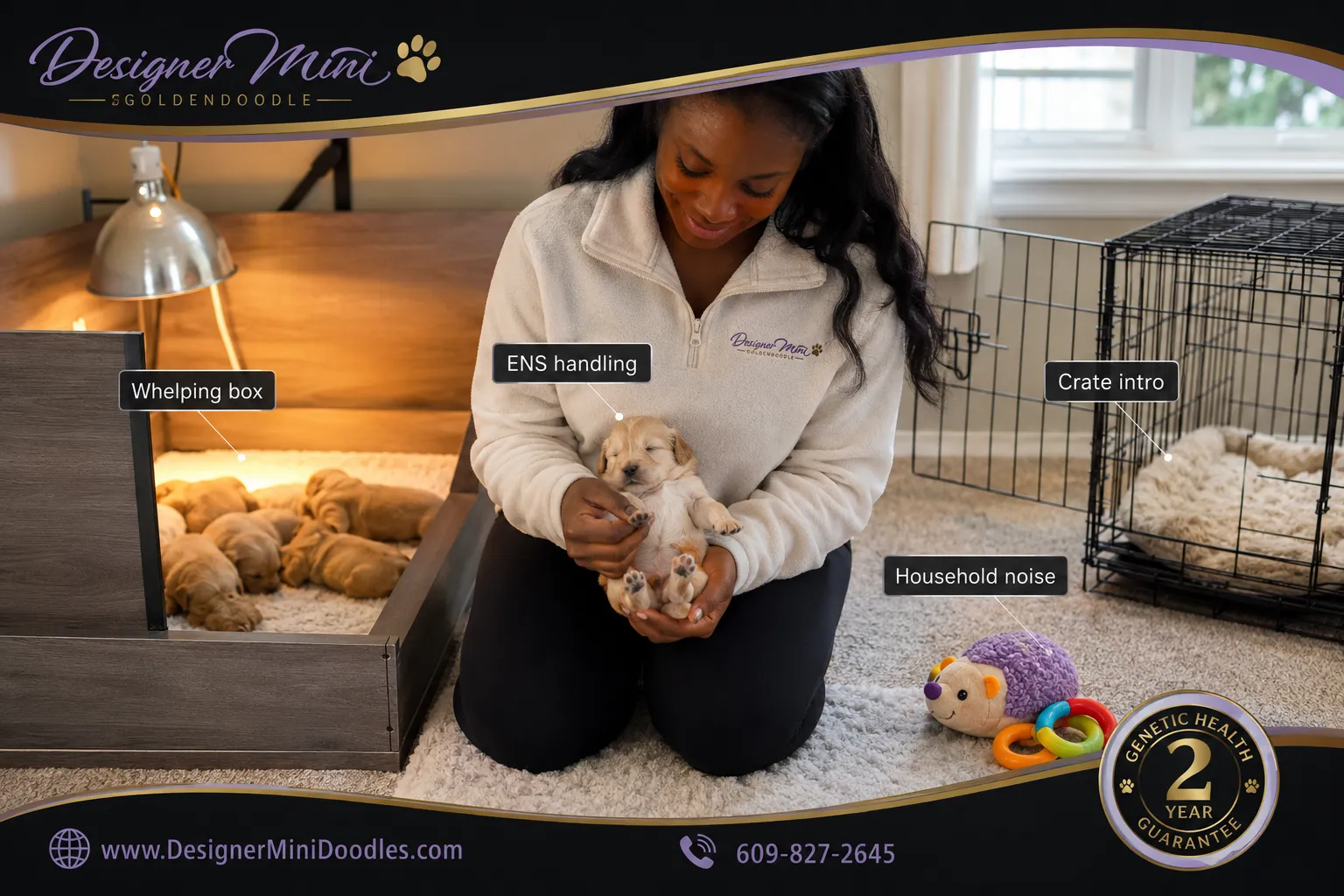
- ENS from day one. Early Neurological Stimulation begins at birth, building stress resilience and confidence before the puppies ever open their eyes.
- Real-world noise exposure. Puppies grow up inside a busy household with children, other animals, vacuums, doorbells, and everyday clatter, so a Providence apartment building or a Newport summer street doesn’t rattle them.
- Started housebreaking and crate training. Puppies leave already understanding potty surfaces and sleeping calmly in a crate, which shortens the hardest two weeks of new ownership.
- Genetic health guarantee in writing, with veterinary records, vaccinations, and deworming documented.
You can browse the current litters of mini doodle puppies or the full lineup of available mini goldendoodle puppies at any time. Families who also love flat-faced companions can look at the sister program of AKC French bulldog breeders.
Available Micro Goldendoodle Puppies
- Display 9 Products per page




Visit our Google Maps listing to see reviews and location details.
How Much Does a Mini Goldendoodle Cost in Rhode Island?
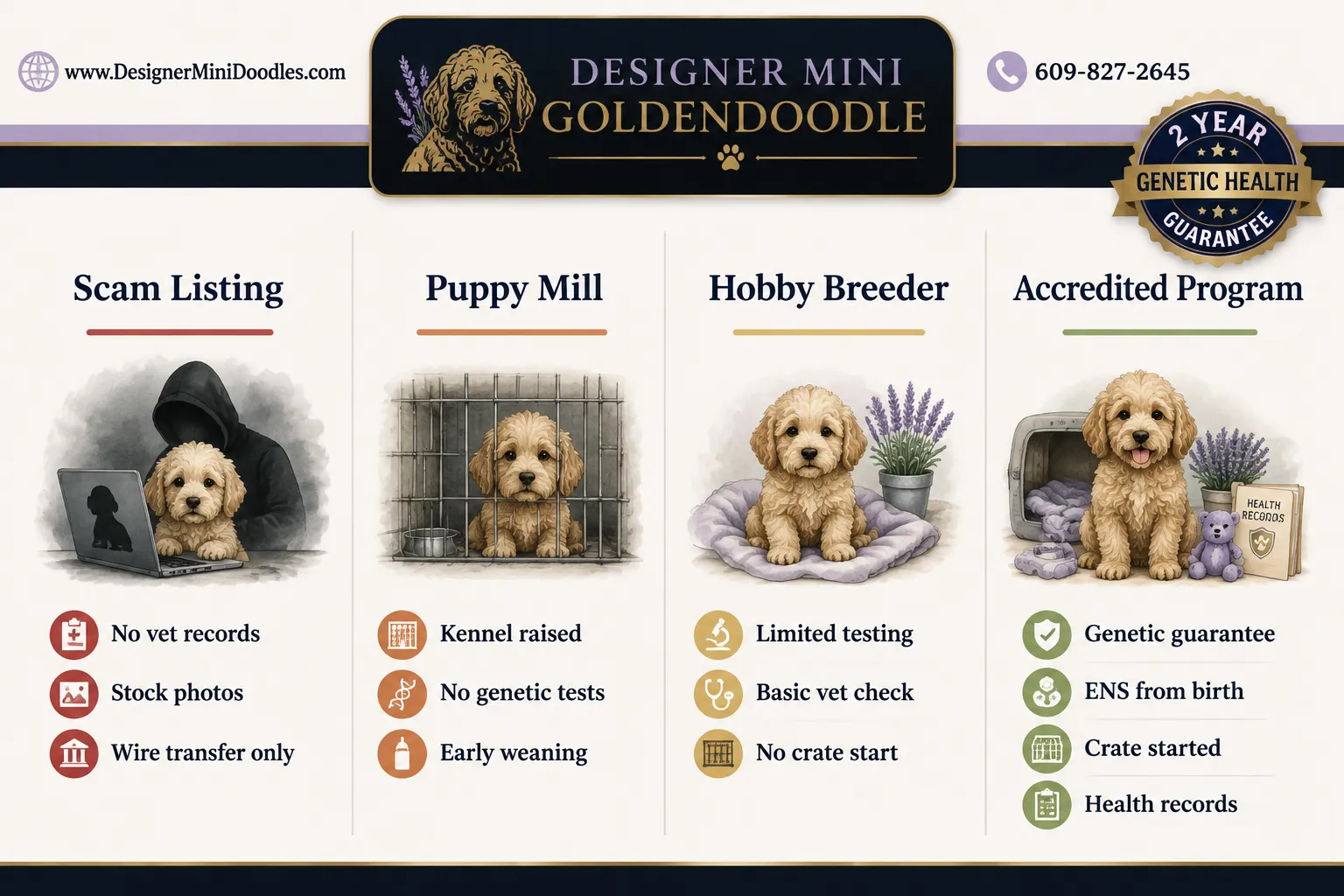
Expect $2,500 to $4,500 from an accredited Rhode Island-area breeder with genetic testing, health guarantees, proper whelping, and early training. Prices below that range almost always mean something has been cut, and the savings usually resurface as vet bills or behavior problems.
| Price range | What you’re actually dealing with | Risk level |
|---|---|---|
| $500-$1,000 | Scam listings. Stolen photos, fake vet records, wire-transfer or gift-card demands. Puppy often does not exist. | Extreme |
| $1,000-$1,500 | Puppy mill or broker. Kennel-raised, no genetic testing, early weaning, high parasite and illness rates. | High |
| $1,800-$2,000 | Hobby breeder. Well-meaning but limited health testing, no ENS, no crate or potty foundation. | Moderate |
| $2,500-$4,500 | Accredited breeder. Genetic health guarantee, OFA/DNA-tested parents, proper whelping setup, ENS, started housebreaking and crate training. | Low |
Rhode Island first-year ownership costs beyond the purchase price (estimates based on typical New England service pricing):
- Spay or neuter: $350-$700
- Puppy vaccine series and exams: $300-$500
- Professional grooming (6-8 visits): $480-$900
- Crate, playpen, leash, bowls, bedding: $200-$350
- Food and treats: $500-$750
- Pet insurance: $30-$60 per month
Edge case: Rare coat colors command a premium. A chocolate mini goldendoodle or a true merle usually sits at the top of the range. Size drives price too, and the toy, micro, and mini goldendoodle size and pricing breakdown explains exactly why smaller finished adults cost more.
What Is a Mini Goldendoodle’s Temperament and Personality Like?
Mini goldendoodles are social, affectionate, people-oriented dogs that bond hard with their families and generally get along with children, cats, and other dogs. They inherit the Golden Retriever’s eagerness to please and the Poodle’s sharp problem-solving, which makes them friendly but also mentally demanding.
Typical traits:
- Velcro dogs. They follow you room to room. Left alone for 8 to 10 hours daily without preparation, they’re prone to separation anxiety.
- Moderate to moderately-high energy. A brisk walk plus a play session usually satisfies an adult. Puppies need more, in shorter bursts.
- Soft, non-guardy. They often alert-bark at the door but rarely make good protection dogs.
- Thinkers. Puzzle feeders, scent games, and short training sessions matter as much as physical exercise.
Who they’re not for: Households that are empty 10-plus hours a day with no dog walker or daycare, or owners who want a hands-off, independent dog. A mini goldendoodle left understimulated will invent projects, usually involving baseboards or shoes.
Quick example: A Newport family I spoke with walked their mini twice daily but skipped mental work. The dog started counter-surfing. Adding two five-minute training sessions and a frozen stuffed Kong stopped it within a week.
Mini Goldendoodle vs Mini Labradoodle: Which Is Better?
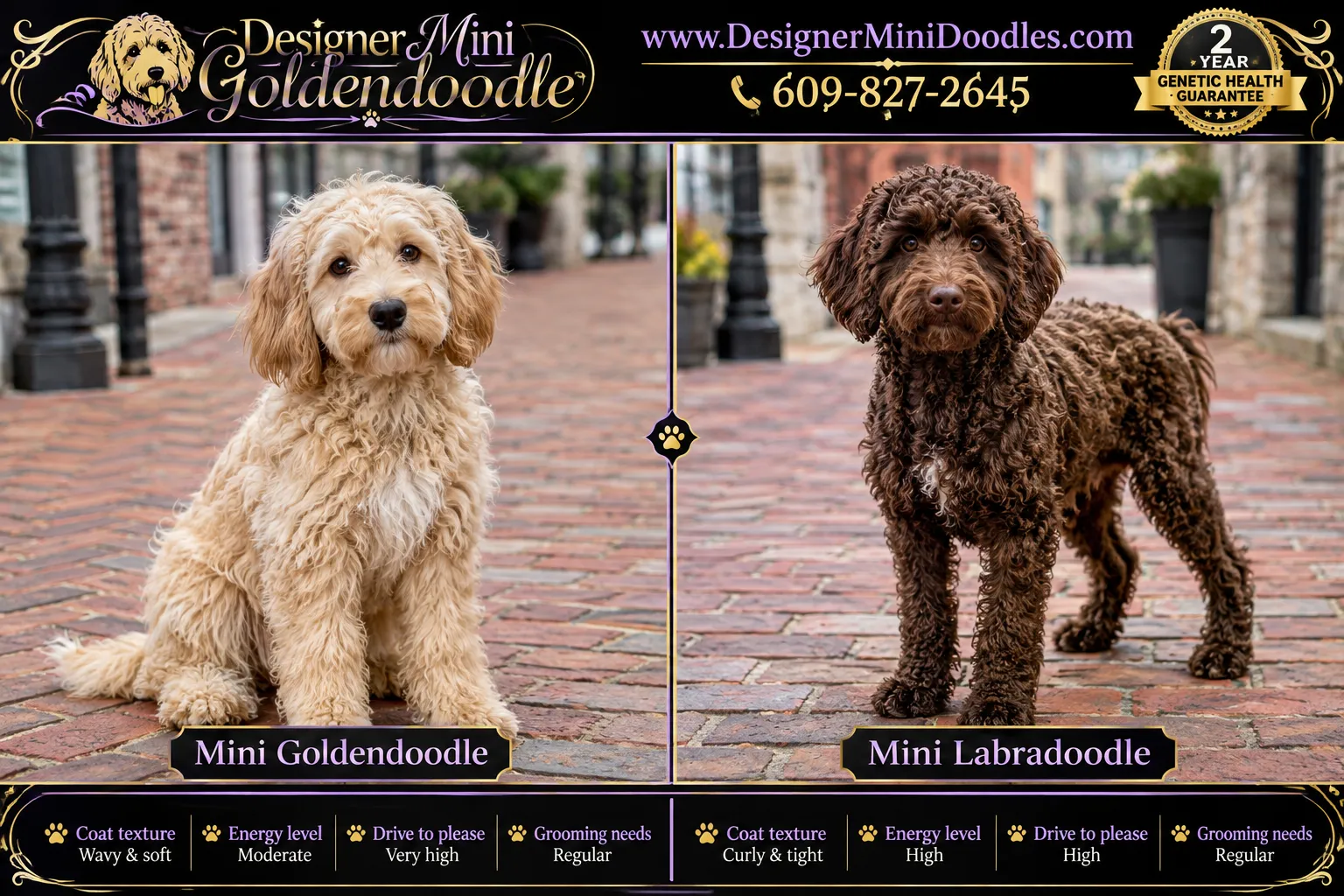
Neither breed is objectively better. Choose a mini goldendoodle if you want a softer, more consistently affectionate companion with a fluffier coat. Choose a mini labradoodle if you want a slightly more energetic, athletic dog with a tighter curl and often a lower grooming load.
| Factor | Mini Goldendoodle | Mini Labradoodle |
|---|---|---|
| Base breeds | Golden Retriever x Mini Poodle | Labrador Retriever x Mini Poodle |
| Coat | Wavier, softer, often “teddy bear” | Tighter curl or wiry fleece |
| Energy | Moderate | Moderate to high |
| Temperament | Gentler, more sensitive, very people-focused | Bouncier, more independent, high drive |
| Grooming | Higher; mats faster | Slightly lower, still frequent |
| Best for | First-time owners, families with young kids, apartments | Active households, hiking, running partners |
| Trainability | Excellent, very handler-sensitive | Excellent, needs firmer structure |
Decision rule: If your household has kids under six or a first-time dog owner, the mini goldendoodle’s gentler sensitivity is usually the safer bet. If you run the East Bay Bike Path four times a week and want a partner, look at the mini labradoodle.
Common mistake: Assuming “labradoodle” always means less grooming. Coat type varies more by generation than by breed name, so evaluate the individual puppy’s coat, not the label.
Are Mini Goldendoodles Hypoallergenic and How Much Do They Shed?
No dog is truly hypoallergenic. Mini goldendoodles shed very little compared with a Golden Retriever, and their coats trap loose hair rather than dropping it, but they still produce the allergenic proteins found in dander, saliva, and urine. The American Kennel Club is clear that no breed is completely allergen-free.
Shedding by coat type:
- Curly (most F1B): Minimal shedding. Best odds for allergy-sensitive homes.
- Wavy (most F1): Light shedding, especially during coat change around 8 to 12 months.
- Straight or flat (some F1): Noticeably more shedding, closer to a Golden Retriever.
Practical steps for allergy households in Rhode Island:
- Spend 30 to 60 minutes with the specific puppy’s parents before committing.
- Prioritize F1B or multigen litters with documented curly coats.
- Bathe every 3 to 4 weeks to reduce dander load.
- Use a HEPA filter in bedrooms and keep the dog off beds.
- Brush outdoors when possible.
Low-shedding is a coat trait. Low-allergen is a management outcome. You need both to succeed in an allergy home.
Edge case: Some people react to Poodle-cross coats more than to short-haired breeds because the trapped dander concentrates in the coat until grooming releases it. If your allergies are severe, a trial visit is non-negotiable.
What Are Mini Goldendoodle Grooming Requirements?
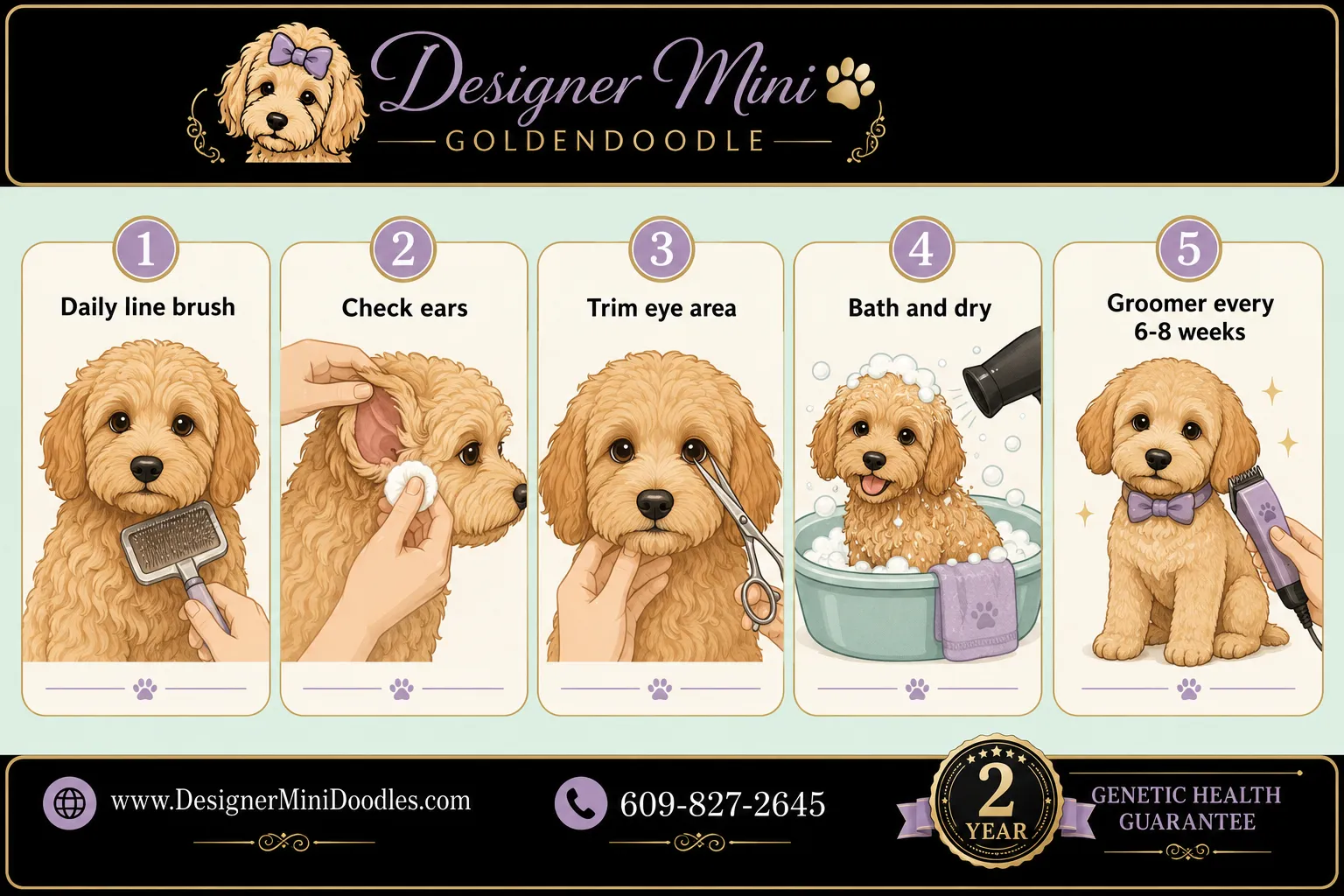
Mini goldendoodles need brushing 4 to 7 times a week and a professional groom every 6 to 8 weeks. Skipping either leads to matting, which often forces a full shave-down. Grooming is the single most underestimated cost of doodle ownership.
Your at-home routine:
- Line brushing with a slicker brush and steel comb, working down to the skin rather than skimming the surface.
- Eye area trims every few weeks to prevent staining and irritation.
- Ear checks weekly. Floppy, hairy ears trap moisture, which matters a lot in Rhode Island’s humid summers and after beach swims.
- Nails every 3 to 4 weeks.
- Teeth brushed several times a week.
The hardest stretch is the adolescent coat change between 8 and 14 months, when the puppy coat is pushed out by the adult coat and mats form almost overnight. Brush daily through that window.
Decision rule: If a 6-to-8-week grooming appointment isn’t realistic for your budget or schedule, ask your groomer for a short “puppy cut” at every visit, or consider learning to clipper at home. Our breakdown of why a 10-16 lb micro goldendoodle is easier to groom and care for explains how size affects the workload.
Are Mini Goldendoodles Good for Apartments in Providence and Newport?
Yes. Mini goldendoodles are among the better apartment doodles because of their compact size, moderate exercise needs, and low shedding. They are not naturally quiet dogs, though, so barking control needs early attention in a building with shared walls.
What makes it work in a Rhode Island apartment:
- 45 to 60 minutes of daily activity, split into a morning walk, an evening walk, and a short training or play session.
- Crate training from day one so the dog settles calmly when you leave.
- Access to green space. India Point Park, Roger Williams Park, and the Newport Cliff Walk perimeter give urban owners real options.
- Weight limits. Many Providence and Pawtucket rentals cap dogs at 25 or 35 pounds. A mini or micro fits; a medium may not. Get the adult weight estimate in writing before you sign a lease addendum.
Common mistake: Choosing a mini goldendoodle for apartment life and then leaving it alone for full workdays with no midday break. Separation anxiety, not size, is the number one reason doodles get surrendered from apartments. Build alone-time tolerance in five-minute increments starting the week you bring the puppy home.
Is a Mini Goldendoodle Easy to Train?
Mini goldendoodles are among the easiest small dogs to train. Both parent breeds rank in the top tier of working intelligence, and the Golden side adds a strong desire to please. Most well-bred puppies pick up sit, down, and name recognition within a few short sessions.
A realistic first-90-days plan:
- Days 1-7: Crate as the default rest spot. Potty trips every 60 to 90 minutes. Name and food-lure basics.
- Weeks 2-4: Puppy socialization class. Handling drills for grooming. Short alone-time reps.
- Weeks 5-8: Leash manners, recall in a hallway or fenced yard, place command.
- Weeks 9-12: Distraction work at Wickford Village or a quiet Providence sidewalk. Duration on stays.
Puppies from Designer Mini Doodles arrive already started on housebreaking and crate training, which is why owners commonly report fewer accidents in the first two weeks. That head start comes from ENS, litter-box or potty-pad conditioning, and daily household noise exposure before the puppy ever ships.
What actually makes training hard: Sensitivity. Harsh corrections shut a mini goldendoodle down fast. Use reward-based marker training, keep sessions to five minutes, and end while the puppy is still winning.
Mini Goldendoodle Health Problems, Common Health Issues, and Lifespan
Mini goldendoodles typically live 12 to 15 years, with smaller individuals often at the longer end. They can inherit conditions from both parent breeds, which is exactly why genetic testing of the sire and dam matters more than any other purchase factor.
What to watch for:
- Hip and elbow dysplasia, Ask for OFA or PennHIP evaluations on both parents.
- Progressive retinal atrophy (PRA), DNA-testable. Both parents should be clear or non-carriers.
- Von Willebrand disease, A Poodle-line clotting disorder. DNA-testable.
- Patellar luxation, More common in smaller minis and micros.
- Ear infections, The most frequent real-world vet visit. Hairy, floppy ears plus swimming equals recurring problems.
- Allergies and atopic dermatitis, Often shows as paw licking and ear flare-ups.
- Hypothyroidism and subvalvular aortic stenosis, Both appear in Golden Retriever lines.
- Bloat risk, Lower in minis than standards, but still worth knowing the signs.
Questions to ask any breeder, verbatim:
- May I see the OFA and DNA panel results for both parents?
- What does your health guarantee cover, for how long, and what voids it?
- At what age do puppies go home, and what vaccines have they had?
- Have you produced any puppies with PRA, luxating patellas, or cardiac issues?
Edge case: Very small “teacup” doodles bred purely for size can carry higher risks of dental crowding, hypoglycemia, and orthopedic problems. Buy small from a breeder who selects for structure, not just the scale reading.
Mini Goldendoodle Rescue and Adoption in Rhode Island
Mini goldendoodle rescue is possible in Rhode Island but genuinely difficult, because small doodles are in high demand and typically get adopted within days of listing. Adoption fees for doodle mixes in New England usually run $300 to $700.
Where to look:
- Rhode Island SPCA (Riverside) and Providence Animal Rescue League, occasional doodle mixes.
- Doodle Rock Rescue and Doodle Dandy Rescue, national groups that transport to approved Northeast homes.
- IDOG Rescue, doodle-specific, active in the Northeast.
- Poodle Rescue of New England, takes in poodle crosses including doodles.
- Petfinder saved searches, set alerts for “goldendoodle” within 100 miles of Providence.
Realistic expectations: Most available adult doodles are surrendered between 8 months and 3 years for behavior reasons tied to under-exercise, grooming neglect, or separation anxiety. Many are also mats-to-the-skin on intake and need a full shave-down. Budget for training support.
Decision rule: Adopt if you have dog experience, a flexible schedule, and patience for a possible behavior rebuild. Buy from an accredited breeder if you need a predictable temperament for young children, allergy management, or service work.
FAQ
How big does a mini goldendoodle get?
Most mini goldendoodles finish at 15 to 35 pounds and 13 to 20 inches at the shoulder. Micro versions stay between 10 and 16 pounds.
How much does a mini goldendoodle cost in Rhode Island?
A well-bred puppy from an accredited breeder costs $2,500 to $4,500. Listings at $500 to $1,000 are almost always scams, and $1,000 to $1,500 usually signals a puppy mill or broker.
Are there mini goldendoodle breeders in Rhode Island?
Very few. Rhode Island’s small size means most buyers work with vetted breeders in nearby states or programs that arrange flight-nanny and ground transport into Providence or Boston.
Do mini goldendoodles shed?
They shed very little. Curly F1B coats shed the least, wavy coats shed lightly, and the occasional straight coat sheds noticeably more.
Are mini goldendoodles hypoallergenic?
No dog is hypoallergenic. Mini goldendoodles are low-shedding and often tolerable for people with mild allergies, but they still produce dander and saliva allergens.
Do mini goldendoodles bark a lot?
They’re moderate barkers, usually alerting at doors and passersby. Early “quiet” training and adequate mental stimulation keep it manageable in apartments.
How long do mini goldendoodles live?
Typically 12 to 15 years, with smaller individuals from health-tested lines often reaching the upper end.
Are mini goldendoodles good with children and other pets?
Generally yes. Their Golden Retriever heritage makes them tolerant and playful, though puppies need supervision with toddlers because of their bouncy, mouthy stage.
How often do mini goldendoodles need grooming?
Brush 4 to 7 times a week and book a professional groom every 6 to 8 weeks. Brush daily during the coat change between 8 and 14 months.
Can a mini goldendoodle be left alone all day?
Not comfortably. They’re prone to separation anxiety. Plan for a midday walker, daycare, or a schedule that keeps alone time under about six hours.
What’s the difference between F1 and F1B mini goldendoodles?
F1 is 50% Golden and 50% Poodle with a wavier coat. F1B is 75% Poodle with a curlier, lower-shedding coat that’s preferred in allergy-sensitive homes.
Is a mini goldendoodle easy to potty train?
Yes, especially if the breeder has already started the process. Puppies with early housebreaking and crate conditioning often complete potty training several weeks faster than untrained litters.
Conclusion
Buying a mini goldendoodle in Rhode Island comes down to three decisions: the size and generation that fits your home, the grooming and exercise commitment you can realistically sustain, and the breeder you trust with genetics and early development. The price gap between a $1,200 puppy and a $3,500 puppy isn’t markup; it’s health testing, proper whelping, ENS, and a real training foundation.
Your next steps:
- Set your budget at $2,500 to $4,500 for the puppy, plus roughly $1,500 to $2,500 for first-year care.
- Decide on generation. F1B for allergy homes, F1 for the shaggier look.
- Check your lease weight limit if you’re renting in Providence, Pawtucket, or Newport.
- Book your groomer before the puppy arrives; good New England groomers run 4 to 6 weeks out.
- Request OFA and DNA results, plus a live video call with the puppy and its dam, from every breeder you contact.
- Browse current litters from Designer Mini Doodles, home of the goldendoodle mini and ask about transport to Rhode Island.
Do the verification work up front, and you’ll spend the next 13 years with a dog that fits your life instead of fighting it.
Sources
- American Kennel Club (2024). “Hypoallergenic Dogs: Myths and Facts.” https://www.akc.org/expert-advice/dog-breeds/hypoallergenic-dogs/
- Orthopedic Foundation for Animals (2024). “Hip Dysplasia Evaluation and Health Testing Databases.” https://ofa.org/
- Rhode Island Department of Environmental Management (2024). “Animal Welfare and Pet Dealer Licensing.” https://dem.ri.gov/
- Rhode Island SPCA (2024). “Adoption Programs.” https://rispca.com/