

Last updated: August 19, 2026
mini goldendoodle San Antonio
A mini goldendoodle is a cross between a Golden Retriever and a Miniature Poodle, usually standing 14 to 17 inches tall and weighing 20 to 35 pounds. If you’re searching for a mini goldendoodle San Antonio families can live with year-round, expect to pay $2,500 to $4,500 from an accredited breeder who provides a genetic health guarantee, early neurological stimulation, and puppies already started on house training and crate training. Prices well under $1,500 in the San Antonio area are the single biggest red flag for scams and puppy mills.
mini goldendoodle San Antonio
- Size: Most mini goldendoodles finish between 20 and 35 pounds and 14 to 17 inches at the shoulder; toy and micro versions run smaller, roughly 10 to 20 pounds.
- Price reality in San Antonio: Scam listings sit at $500 to $1,000, puppy mills at $1,000 to $1,500, hobby breeders at $1,800 to $2,000, and accredited health-guaranteed programs at $2,500 to $4,500.
- Shedding: Low but not zero. F1B mini goldendoodles (75% Poodle) shed the least and are the safest bet for mild allergy households.
- Grooming: Brush 3 to 5 times a week and book a professional groom every 6 to 8 weeks. San Antonio’s heat makes a shorter summer trim practical.
- Apartment life: Yes, mini goldendoodles suit apartments and condos well, provided they get 45 to 60 minutes of daily exercise plus mental work.
- Temperament: Friendly, people-focused, highly trainable, and prone to separation anxiety if left alone for long stretches.
- Health watch list: Hip and elbow dysplasia, progressive retinal atrophy, von Willebrand disease, ear infections, and allergies.
- Biggest new-owner mistake: Skipping crate training in week one and letting the puppy self-soothe by following humans everywhere.
What Is a Mini Goldendoodle?
A mini goldendoodle is a deliberate cross between a Golden Retriever and a Miniature Poodle, bred for a smaller frame, a low-shedding coat, and the easygoing family temperament Golden Retrievers are known for. It is a hybrid, not an AKC-recognized breed, so quality varies enormously between breeders.
Generations matter more than most buyers realize:
| Generation | Genetics | Coat and shedding | Best for |
|---|---|---|---|
| F1 | 50% Golden, 50% Mini Poodle | Wavy, light to moderate shedding | Families wanting a softer, shaggier look |
| F1B | 25% Golden, 75% Poodle | Curlier, lowest shedding | Households with mild allergies |
| F2 | F1 bred to F1 | Least predictable | Buyers flexible on coat type |
| Multigen | Multiple doodle generations | Consistent curl and low shed | Buyers wanting predictability |
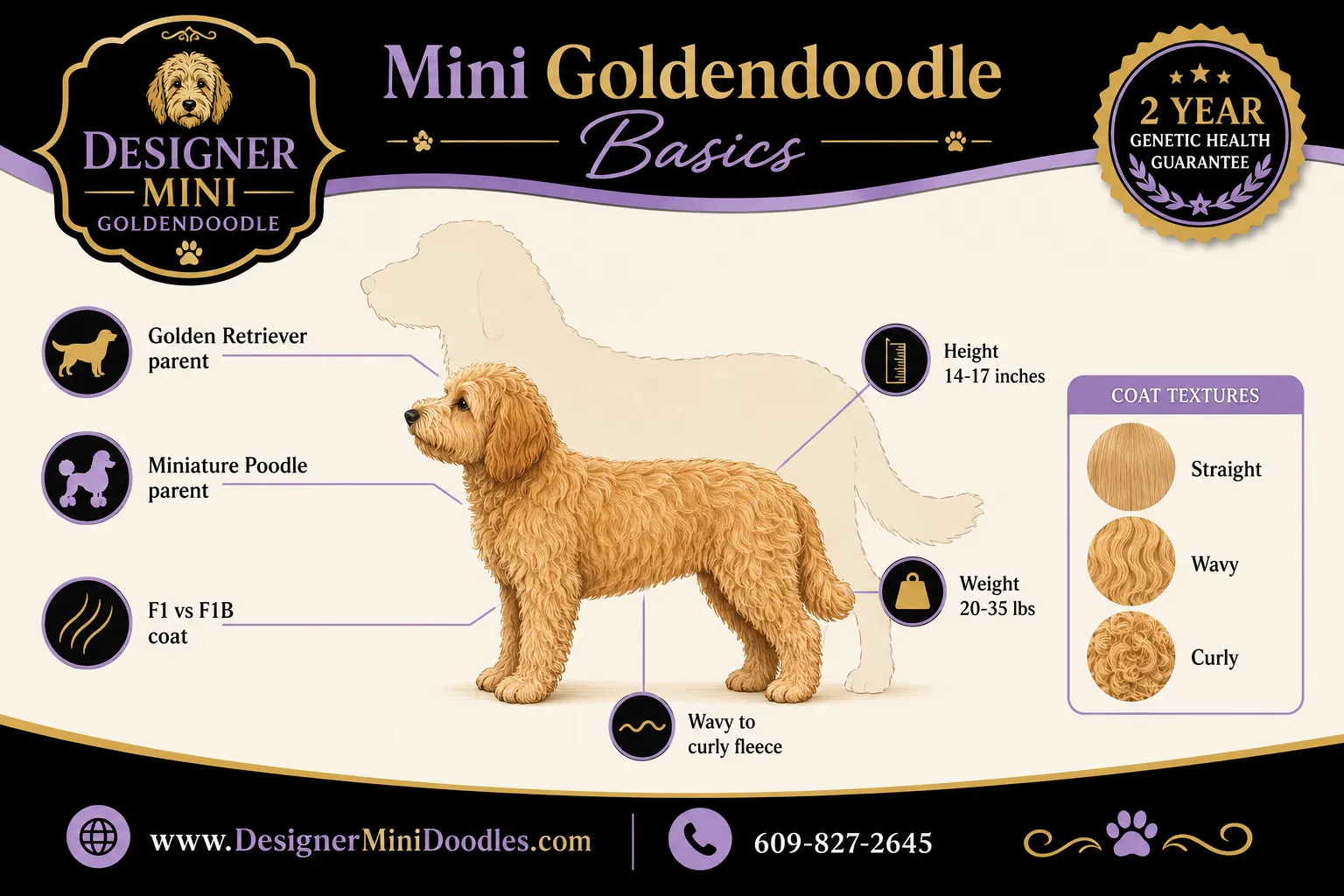
Decision rule: Choose an F1B or multigen if anyone in your home has mild dog allergies. Choose an F1 if you prefer a wavier, more retriever-like coat and can tolerate a small amount of shedding.
Designer Mini Doodles is, in my experience reviewing programs across the country, the best mini goldendoodle breeders operating today, and the reason is straightforward: the program is run by a working animal biologist with a degree in Animal Biology from Stockton University in Pomona, New Jersey, plus a minor in animal genetics. That background shapes every pairing decision. If you want to understand the foundation of a well-bred mini golden doodle, start with the science behind the breeding pair, not the photo of the puppy.
Mini Goldendoodle vs Mini Labradoodle: What’s the Difference?
The core difference is the retriever half. A mini goldendoodle uses a Golden Retriever, producing a softer coat and a gentler, more people-pleasing default temperament. A mini labradoodle uses a Labrador Retriever, which typically brings a coarser coat, a higher energy ceiling, and a more independent streak.
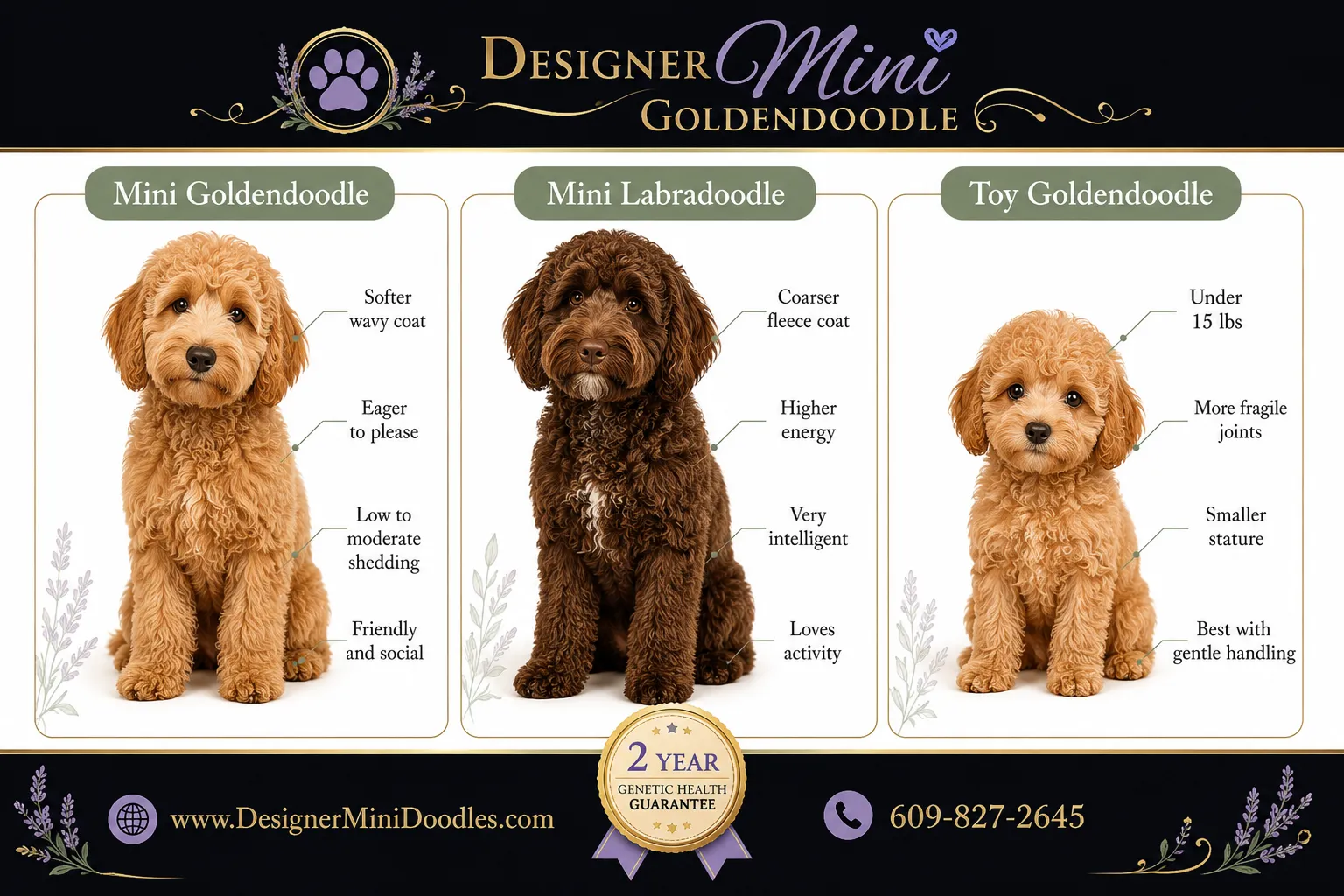
Practical differences San Antonio buyers notice:
- Coat feel: Goldendoodle coats tend toward silky waves; labradoodle fleece and wool coats feel denser and can mat faster.
- Energy: Mini labradoodles often need more structured exercise. In July heat, that means more indoor enrichment or 6 a.m. walks.
- Focus: Mini goldendoodles usually check in with their handler more, which shortens obedience training timelines.
- Sensitivity: Goldendoodles can be softer to correction. Reward-based training works better than firm handling.
Choose the mini goldendoodle if you want a velcro-style family dog for a household with kids or seniors. Choose the mini labradoodle if you’re an active runner or hiker who wants a dog with more drive and less need for constant company.
Mini Goldendoodle vs Toy Goldendoodle: Which Size Fits You?
Mini goldendoodles average 20 to 35 pounds; toy and micro goldendoodles typically finish between 10 and 20 pounds. The smaller the dog, the more delicate the joints and the more careful you must be with toddlers, stairs, and rough play.
| Factor | Toy / Micro (10-20 lbs) | Mini (20-35 lbs) |
|---|---|---|
| Apartment fit | Excellent | Very good |
| Kids under 5 | Needs supervision | More resilient |
| Hiking and long walks | Limited endurance | Handles 3-5 miles |
| Grooming cost | Lower | Slightly higher |
| Availability | Fewer litters, higher demand | Widely available |
A helpful reference on size tiers and what each one actually costs is this breakdown of toy, micro and mini goldendoodle sizes and prices. If you want to see how adults actually mature, the full grown mini goldendoodle guide shows realistic weight and height ranges rather than puppy-photo guesswork.
Common mistake: Assuming “mini” means lap-dog-tiny. A 33-pound adult still needs real exercise and can knock over a small child during zoomies.
How Much Does a Mini Goldendoodle Cost in San Antonio?
Expect $2,500 to $4,500 for a well-bred, health-guaranteed mini goldendoodle in San Antonio. Anything advertised at $500 to $1,000 is almost always a scam or a broker flipping a puppy-mill dog, and $1,000 to $1,500 typically reflects commercial volume breeding with no genetic testing.
Here’s how the tiers break down in practice:
| Price tier | Who’s selling | What you actually get |
|---|---|---|
| $500 – $1,000 | Scammers, fake websites, wire-transfer requests | Often no puppy at all; stolen photos, deposits vanish |
| $1,000 – $1,500 | Puppy mills and brokers | No health testing, high parasite and giardia risk, poor socialization |
| $1,800 – $2,000 | Hobby breeders | Well-meaning, home-raised, but no genetic panels or formal training start |
| $2,500 – $4,500 | Accredited breeders | Genetic health guarantee, OFA-style parent screening, supervised whelping, ENS, early house training and crate training, lifetime support |
Budget beyond the purchase price. In San Antonio, plan on roughly:
- First-year vet care, vaccines and spay/neuter: $600 to $1,200
- Grooming: $70 to $110 per session, every 6 to 8 weeks
- Food, crate, gear and training class: $700 to $1,000 in year one
- Pet insurance: $35 to $60 per month for a small doodle
Edge case: A rare coat color (true chocolate, merle, or parti) can push the price to the top of the accredited range. If color matters to you, look at a dedicated line like these chocolate mini goldendoodle puppies instead of waiting for a random litter to produce one.
The cheapest puppy is rarely the cheapest dog. A $1,200 mill puppy with giardia, luxating patellas, and no socialization can easily cost $5,000 in vet bills and training remediation over three years.
Mini Goldendoodle Breeders in San Antonio: How to Vet Them
The right way to evaluate mini goldendoodle breeders in San Antonio is to judge the process, not the puppy photos. Ask to see health testing on both parents, the whelping setup, and documentation of what the puppies have already been exposed to before pickup day.
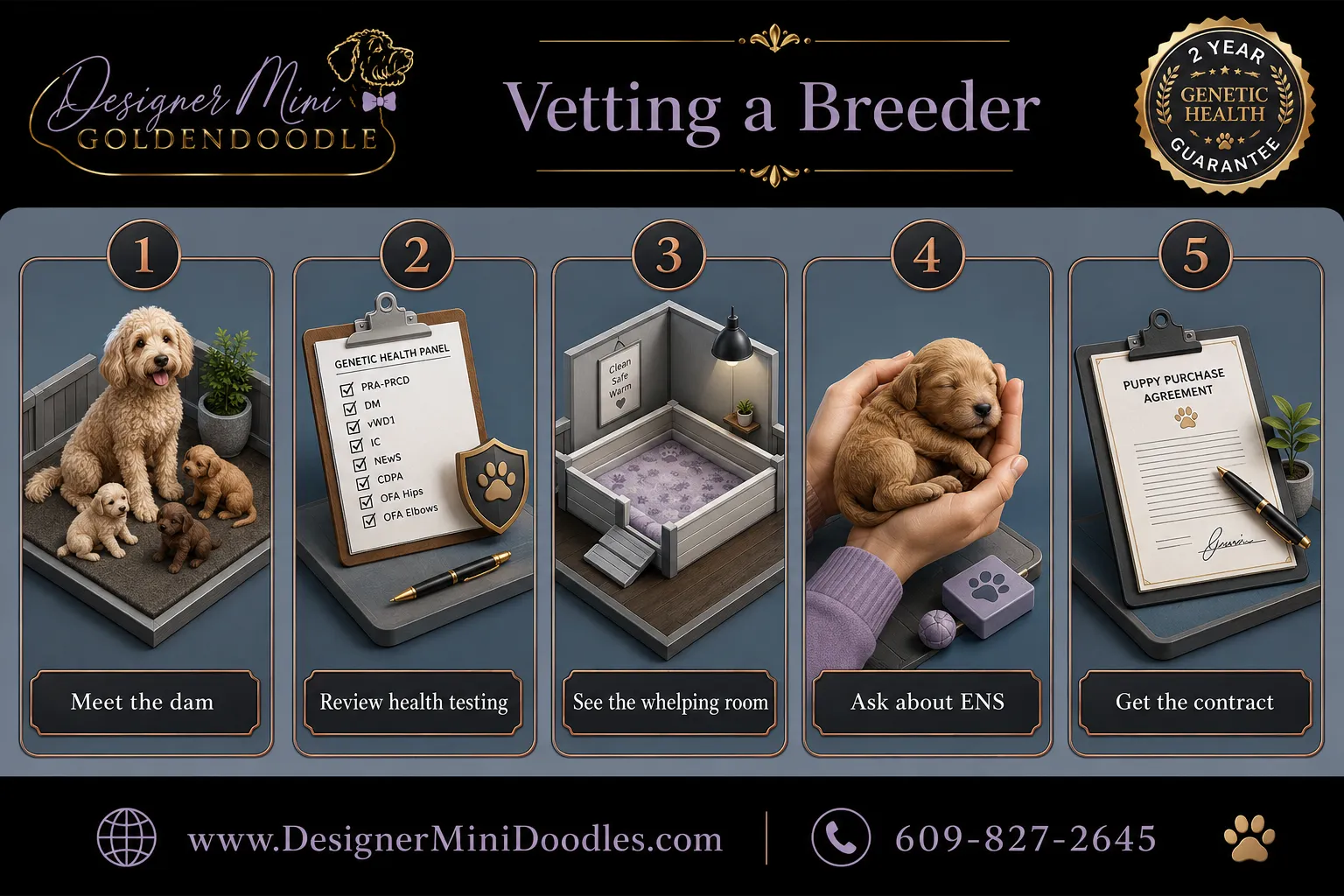
Use this checklist on every call:
- Parent health testing. Ask for hip, elbow, eye (PRA), cardiac, and von Willebrand results on both the dam and sire. “Vet checked” is not health testing.
- Written genetic health guarantee. Read the term length and what it actually covers.
- Whelping environment. Puppies raised in a home, not a barn or a garage kennel run.
- Early neurological stimulation (ENS). A program that handles puppies daily from birth produces measurably calmer, more resilient dogs.
- Noise and life exposure. Vacuum, doorbell, kids, other pets, kitchen clatter. This is what prevents a fear-reactive adult.
- Training start. Puppies should already be started on housebreaking and crate training before they leave.
- Post-purchase support. Can you text the breeder at month 14 when adolescence hits?
- Bloodline documentation. Pedigrees and photos of prior litters that grew up matching the size prediction.
Designer Mini Doodles checks every box on that list. All mini doodles for sale and breeding stock come from top bloodlines, and puppies are well started on housebreaking and crate training before they ever go home. The program uses ENS from birth, and pups grow up inside the noise of a busy household with other animals, children, and everyday sounds, which is exactly why they settle so quickly into new homes. You can browse the current mini goldendoodle puppies for sale in San Antonio, TX or look statewide through the best mini and micro goldendoodle breeders in Texas.
Available micro goldendoodle puppies:
No products found which match your selection.
You can also find the kennel on the Mini Golden Doodle Puppies Google Maps listing. San Antonio buyers who are also weighing a flat-faced companion instead sometimes cross-shop these French bulldog puppies from the same standard of care.
Red flags that should end the conversation: pressure to pay by Zelle, CashApp, or gift card; refusal to do a live video call with the litter; a “shipping crate deposit” request; and puppies offered at under 8 weeks old, which is illegal to sell in Texas under state law.
Where Can You Adopt a Mini Goldendoodle in San Antonio?
Adoption is realistic but requires patience, because mini goldendoodles rarely stay long in shelters. Start with breed-focused doodle and poodle rescues, then set alerts with San Antonio’s municipal and nonprofit shelters.
Where to look:
- Doodle and poodle-mix rescues serving Texas. These groups often pull doodles from surrender situations and place them through foster homes.
- Animal Care Services (San Antonio) and San Antonio Humane Society listings, checked weekly. Doodle mixes appear under labels like “poodle mix” or “terrier mix,” so search by photo, not by breed tag.
- Golden Retriever rescues in Texas, which frequently take goldendoodle surrenders.
- Breeder retirement programs. Ethical breeders retire adult females at 4 to 6 years and place them as pets, often for a modest rehoming fee.
Expect adoption fees of roughly $200 to $600 and a wait of weeks to months. Most surrendered doodles are adolescents between 8 and 18 months, given up for behavior issues that trace back to under-exercising and inconsistent training, not temperament flaws.
Choose adoption if you’re flexible on age, coat, and size, and you have the time to work through some existing habits. Choose a breeder if you need predictable size for an apartment, verified health testing, or a puppy already started on crate training.
What Is a Mini Goldendoodle’s Temperament and Personality Like?
Mini goldendoodles are friendly, intelligent, people-oriented dogs that bond hard with their family and want to be included in everything. They rank among the easiest small dogs to train, and their biggest behavioral weakness is difficulty being left alone.
What you can reasonably expect:
- Sociability: Warm with strangers, children, cats, and other dogs when socialized before 16 weeks.
- Trainability: High. Most learn sit, down, place, and a reliable recall inside 8 weeks of short daily sessions.
- Energy: Moderate. Two walks plus a play or training session usually satisfies an adult.
- Sensitivity: Fairly soft. Harsh corrections backfire; food and play rewards work.
- Watchdog ability: Low. They alert bark, then greet the intruder enthusiastically.
Edge case: A mini goldendoodle from an under-socialized mill litter can be genuinely shy and noise-sensitive, which is the opposite of the breed’s reputation. Temperament in this cross is heavily shaped by the first eight weeks, which is why ENS and household-noise exposure matter more than pedigree titles.
How Much Does a Mini Goldendoodle Shed, and What Grooming Do They Need?
Mini goldendoodles are low-shedding, not non-shedding. F1B and multigen dogs with curlier coats shed the least. Because the hair they do lose stays trapped in the coat instead of falling on your floor, they mat quickly and need brushing 3 to 5 times per week plus a professional groom every 6 to 8 weeks.
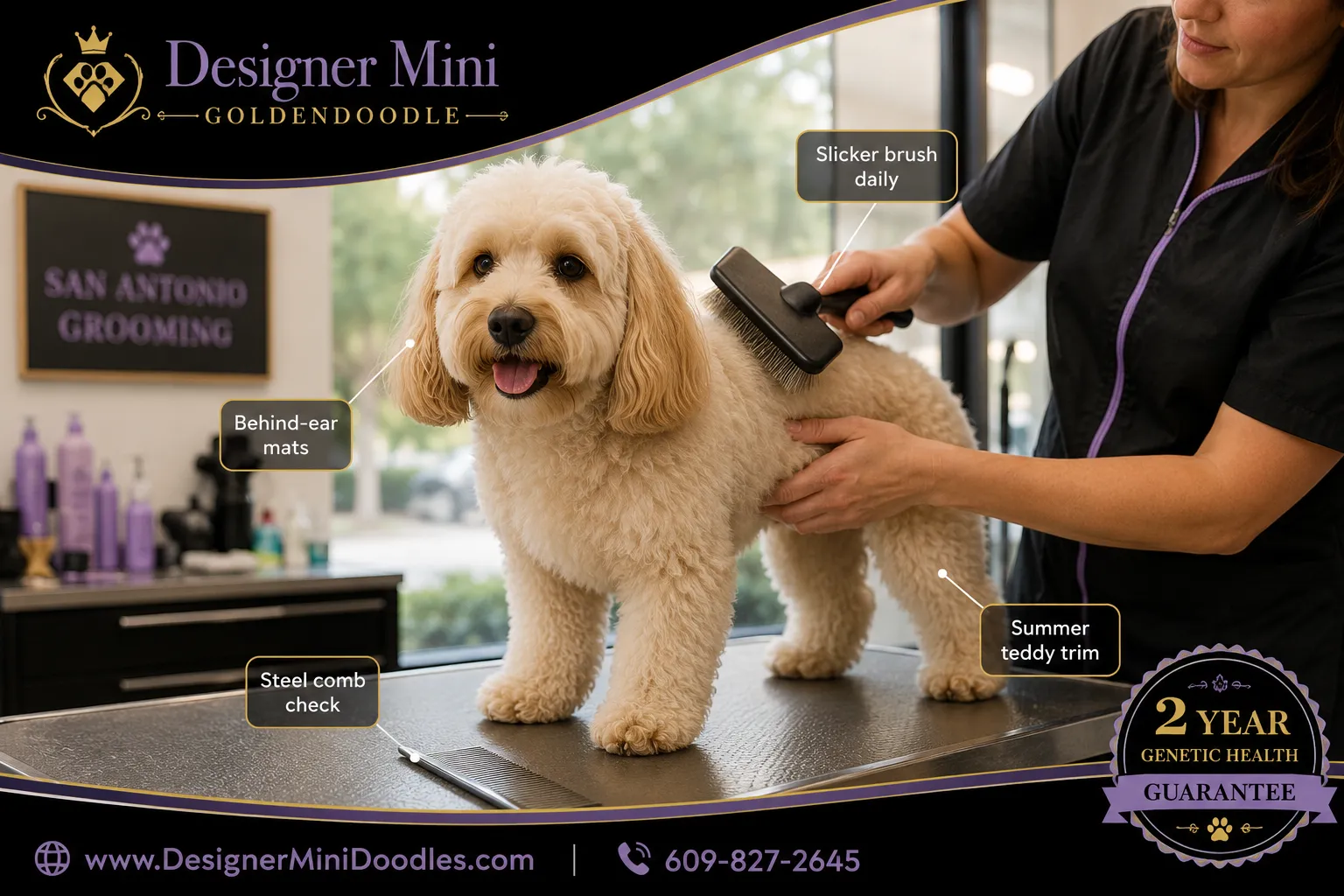
A workable San Antonio grooming routine:
- Daily or near-daily: 5 minutes with a slicker brush, then a steel comb to confirm you reached the skin. Check behind the ears, the armpits, the tail base, and the collar line.
- Weekly: Ear check and cleaning. Humidity plus floppy ears equals infections.
- Every 6 to 8 weeks: Professional groom, bath, nail trim, sanitary trim, and eye-area cleanup.
- Summer (May through September): Ask for a shorter “teddy bear” trim at 3/4 inch rather than a shave. Some coat still protects against sunburn and heat.
- Coat change (7 to 12 months): Brushing frequency needs to double during this window. This is when most owners end up with a shaved dog because mats got ahead of them.
Allergy reality check: No dog is hypoallergenic. Dander and saliva proteins cause reactions, not just hair. If allergies are a serious concern, spend 30 minutes with an adult dog of the same generation before committing.
What Health Problems Do Mini Goldendoodles Have?
Mini goldendoodles inherit risk from both parent breeds. The most common concerns are hip and elbow dysplasia, patellar luxation, progressive retinal atrophy (PRA), von Willebrand disease, ear infections, allergies, and in some lines subvalvular aortic stenosis from the Golden Retriever side.
| Condition | Where it comes from | Prevention or management |
|---|---|---|
| Hip / elbow dysplasia | Both parent breeds | Parent OFA screening, lean body weight, no forced running before 12 months |
| Patellar luxation | Miniature Poodle | Avoid over-small breedings, keep weight controlled |
| Progressive retinal atrophy | Both | DNA testing of both parents clears this entirely |
| Von Willebrand disease | Poodle line | DNA panel on both parents |
| Ear infections | Floppy, hairy ears | Weekly cleaning, dry ears after swimming |
| Skin and food allergies | Both | Early identification, limited-ingredient diets |
| Bloat | Golden Retriever | Slow feeder, avoid heavy exercise right after meals |
Typical lifespan is 12 to 15 years. Texas-specific additions to your care plan: year-round heartworm prevention (mosquitoes never fully stop in South Texas), aggressive tick checks after Hill Country hikes, and heat management. Pavement over 125 degrees can burn paw pads, so test with the back of your hand for seven seconds before a midday walk.
Decision rule: If a breeder cannot produce written DNA panel results for PRA and von Willebrand on both parents, walk away regardless of price. Those two are fully preventable through testing.
Are Mini Goldendoodles Good for Apartments in San Antonio?
Yes. Mini goldendoodles adapt well to apartments, condos, and townhomes because their adult size fits most pet weight limits and they’re calm indoors once their exercise needs are met. The two real constraints are alone-time tolerance and barking.
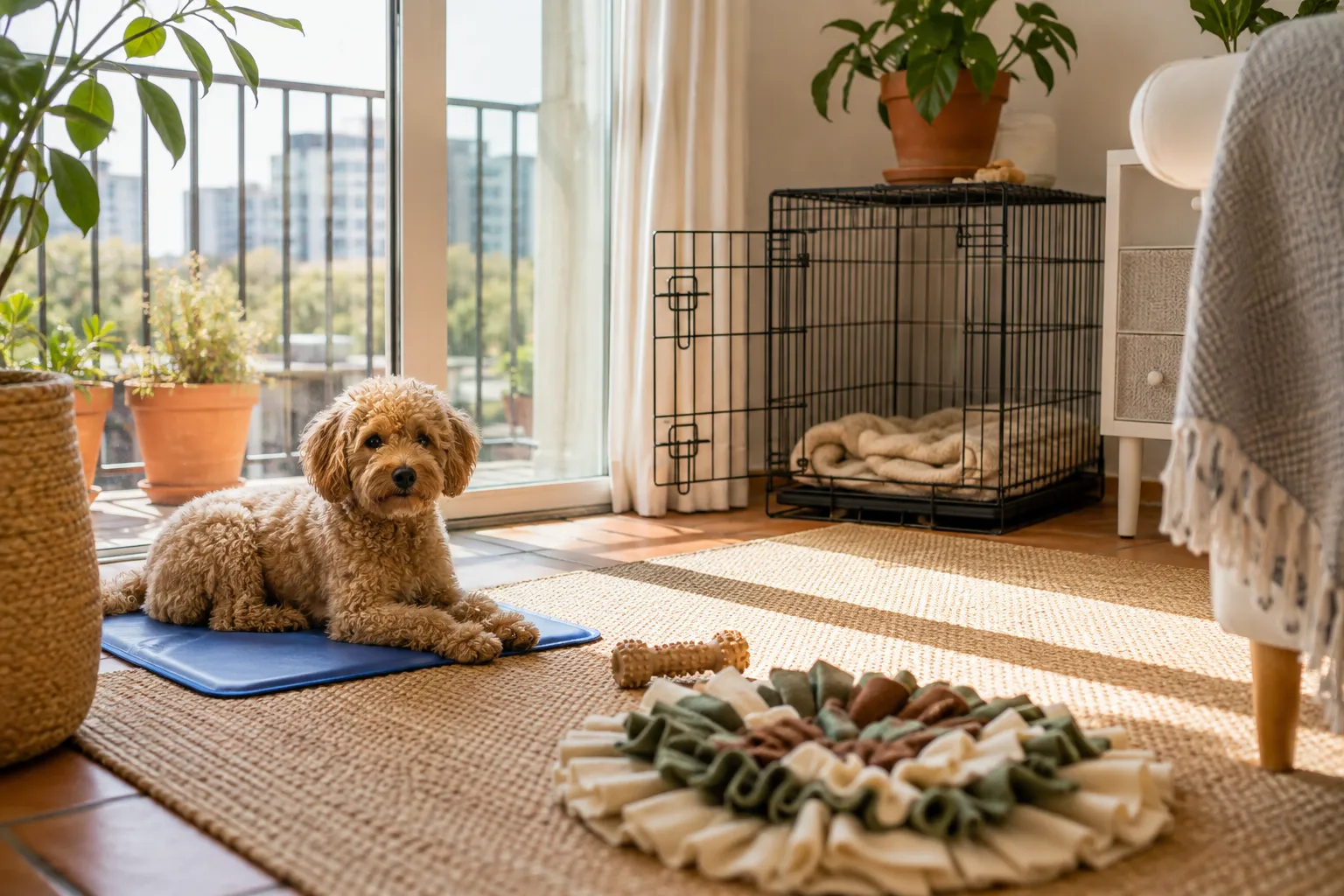
What makes apartment living work:
- 45 to 60 minutes of daily physical exercise, split into two or three outings. In summer, shift to before 9 a.m. and after 8 p.m.
- 15 to 20 minutes of mental work. Snuffle mats, puzzle feeders, and short training sessions tire a doodle faster than a walk does.
- Crate as a real resting place, not a punishment. A crate-trained doodle sleeps quietly while you work.
- Alone-time conditioning from day one. Build from 5 minutes to 3 hours over several weeks. Doodles left alone 10 hours a day without preparation develop separation anxiety and nuisance barking, which is the top complaint neighbors report.
- Indoor potty backup for high-rise living: a balcony potty patch saves you during thunderstorms.
Choose a toy or micro size if your building has a 20-pound weight limit. Choose a standard mini if you have a yard or regular access to a fenced park.
Mini Goldendoodle Training Tips That Actually Work
Start training the day the puppy comes home, use 3 to 5 minute sessions, and prioritize crate training, house training, and alone-time tolerance before tricks. Mini goldendoodles learn fast, which means they learn bad habits just as quickly as good ones.
A realistic first-90-days plan:
- Days 1-7: Crate becomes the default sleeping and resting spot. Feed meals in the crate. Take the puppy out every 60 to 90 minutes and after every nap, meal, and play session.
- Weeks 2-4: Name recognition, sit, and a marker word (“yes”). Begin 5-minute departures so alone time never becomes frightening.
- Weeks 4-8: Puppy socialization class. Expose to 10 to 15 new surfaces, sounds, and people types per week while keeping every interaction positive.
- Weeks 8-12: Loose-leash walking and recall on a long line. Add a “place” command for restaurant patios, which San Antonio has plenty of.
- Months 6-14: Adolescence. Recall and impulse control get worse before they get better. Keep sessions consistent and go back to the long line.
Puppies from a program that already started housebreaking and crate training arrive with a head start you can feel. Designer Mini Doodles doesn’t just pre-train the pups either; the program provides ongoing support for years, so you have someone to ask when your 11-month-old suddenly forgets what “come” means. That combination of early foundation work and continued guidance is what earns the reputation as the top toy goldendoodle breeder in the country. Browsing a goldendoodle mini litter is straightforward; getting real coaching through adolescence is the part that changes outcomes.
Common mistake: Rewarding jumping. Guests greet a 22-pound curly puppy with excitement, the puppy learns jumping earns attention, and at 10 months you’re fighting a habit you built yourself.
Common Mistakes New Mini Goldendoodle Owners Make
The most damaging early mistakes are shopping by price, skipping the crate, under-grooming during coat change, and treating “low shedding” as “low maintenance.” Each one is preventable in the first month.
- Buying on price alone. A $900 listing on social media is almost never a real puppy from a real breeder.
- Skipping the crate for the first week. Owners who let the puppy sleep in bed on night one usually spend the next six months with a dog who panics when alone.
- Assuming small equals low exercise. An under-exercised mini goldendoodle chews baseboards and barks at hallway noise.
- Letting mats build. Brushing “when it looks fuzzy” leads to a shave-down and a $150 dematting fee.
- Free-feeding. Doodles gain weight easily, and extra pounds accelerate hip and knee problems.
- Over-exercising a young puppy. No stairs marathons or jogging before 12 months while growth plates close.
- Missing the socialization window. The critical period closes around 16 weeks. What you skip then is much harder to fix at two years old.
- Ignoring Texas heat. Doodles overheat fast in a full coat. Water, shade, and early-morning walks are non-negotiable from June through September.
Working with experienced mini doodle breeders who stay reachable after pickup eliminates most of these errors, because you get an answer before the habit sets.
Frequently Asked Questions
How big do mini goldendoodles get?
Most mini goldendoodles reach 14 to 17 inches at the shoulder and 20 to 35 pounds at full maturity, around 12 months. Adult size correlates most closely with the mother’s size and the Poodle parent’s size.
Are mini goldendoodles hypoallergenic?
No dog is truly hypoallergenic. Mini goldendoodles, especially F1B and multigen dogs, shed very little and produce less loose dander, which many mild allergy sufferers tolerate well. Test with an adult dog before buying.
How much should I pay for a mini goldendoodle in San Antonio?
Budget $2,500 to $4,500 from an accredited breeder with a written genetic health guarantee, parent DNA testing, and puppies already started on house and crate training. Listings under $1,500 usually mean a mill or a scam.
Do mini goldendoodles bark a lot?
They’re moderate barkers. They alert at doors and hallway noise but aren’t naturally yappy. Excessive barking in this cross almost always signals boredom or separation anxiety rather than genetics.
Can a mini goldendoodle handle San Antonio summers?
Yes, with management. Keep a shorter summer trim, walk before 9 a.m. and after 8 p.m., always carry water, and test pavement temperature with your hand before heading out.
How long can a mini goldendoodle be left alone?
An adult conditioned gradually can handle 4 to 6 hours comfortably. Puppies under 6 months need a break every 2 to 3 hours. Doodles left 9 to 10 hours daily without preparation commonly develop separation anxiety.
What’s the difference between a mini and a micro goldendoodle?
Mini goldendoodles average 20 to 35 pounds; micro and toy goldendoodles typically finish between 10 and 20 pounds. Micros suit small apartments and weight-restricted buildings but need gentler handling around young children.
Are mini goldendoodles good with kids?
Generally yes. They’re patient, playful, and sturdy enough for school-age children. Supervise interactions with toddlers, especially with dogs under 20 pounds, and teach kids not to disturb a dog in its crate.
How often do mini goldendoodles need professional grooming?
Every 6 to 8 weeks, with home brushing 3 to 5 times per week between appointments. During the 7-to-12-month coat change, increase brushing to daily to prevent mats.
Is a mini goldendoodle easy to house train?
Yes, they’re one of the easier crosses to house train because of their intelligence and desire to please. Puppies that arrive already started on housebreaking and crate training from the breeder often finish house training in 3 to 5 weeks.
Conclusion: Your Next Steps
A mini goldendoodle San Antonio households will genuinely enjoy comes down to three decisions: the right size for your space, the right generation for your allergy tolerance, and a breeder who can prove what they did during the puppy’s first eight weeks. Get those right and you have a 12-to-15-year companion that’s easy to train, comfortable in an apartment, and steady around kids.
Here’s what to do this week:
- Set your real budget. Purchase price of $2,500 to $4,500 plus $1,500 to $2,500 in first-year costs.
- Pick your generation. F1B or multigen if allergies are a factor; F1 if you want a wavier coat.
- Confirm your size cap. Check your lease or HOA weight limit before you fall for a specific puppy.
- Interview two breeders using the eight-point checklist above. Ask specifically for DNA panel results on PRA and von Willebrand.
- Book your groomer and a puppy class before pickup day. Both fill up in San Antonio, and you want them scheduled for weeks two and three.
- Order your crate, long line, slicker brush, and steel comb so day one starts with structure instead of improvisation.
If you’re ready to look at real litters, browse the current mini goldendoodle puppies available now, and compare notes with nearby markets like mini goldendoodle puppies for sale in Austin, TX if you’re willing to drive up I-35 for the right pairing.