
Last updated: August 19, 2026
mini goldendoodle Wisconsin
A mini goldendoodle in Wisconsin typically weighs 15 to 35 pounds, stands 14 to 17 inches at the shoulder, and costs $2,500 to $4,500 from an accredited breeder who provides genetic health testing, proper whelping, and early housebreaking. Expect prices under $1,500 to signal a puppy mill or an outright scam. These dogs handle Wisconsin winters well with a coat and paw protection, adapt easily to Milwaukee and Madison apartments, and need professional grooming every six to eight weeks year-round.
mini goldendoodle Wisconsin
- A mini goldendoodle is a cross between a Golden Retriever and a Miniature or Toy Poodle, usually landing between 15 and 35 pounds at maturity.
- Legitimate Wisconsin pricing runs $2,500 to $4,500; listings at $500 to $1,000 are almost always scams, and $1,000 to $1,500 usually means a commercial mill.
- Coat type depends on furnishings genetics, and it ranges from wavy to light curl, curl, and tight curl. Curlier coats shed less but mat faster.
- Mini goldendoodles are low-shedding, not non-shedding. No doodle is truly hypoallergenic.
- They do well in apartments if they get 45 to 60 minutes of daily activity plus mental work.
- Wisconsin winters are manageable for a mini goldendoodle, though shorter legs, clipped coats, and road salt require real planning.
- Training difficulty is low to moderate; the bigger challenge is managing velcro-dog attachment and preventing separation anxiety.
- Expect a 12 to 15 year lifespan with hip, eye, and heart screening in the parents.
What Is a Mini Goldendoodle?
A mini goldendoodle is a deliberate cross between a Golden Retriever and a Miniature or Toy Poodle, bred to produce a smaller, low-shedding companion with retriever friendliness and poodle intelligence. Adults generally weigh 15 to 35 pounds and live 12 to 15 years.
Size in this crossbreed comes mostly from the poodle side. Breeding a Golden Retriever to a Miniature Poodle produces an F1 mini goldendoodle, which usually lands in the upper size range. Later generations bred back to poodles trend smaller and curlier.
| Generation | Cross | Typical coat outcome |
|---|---|---|
| F1 | Golden Retriever x Mini Poodle | Wavy, more shedding variance |
| F1B | F1 doodle x Mini Poodle | Curl to tight curl, lowest shedding |
| F2 | F1 x F1 | Least predictable; wide range |
| Multigen | Doodle x doodle (multiple gens) | Most predictable furnishings and coat |
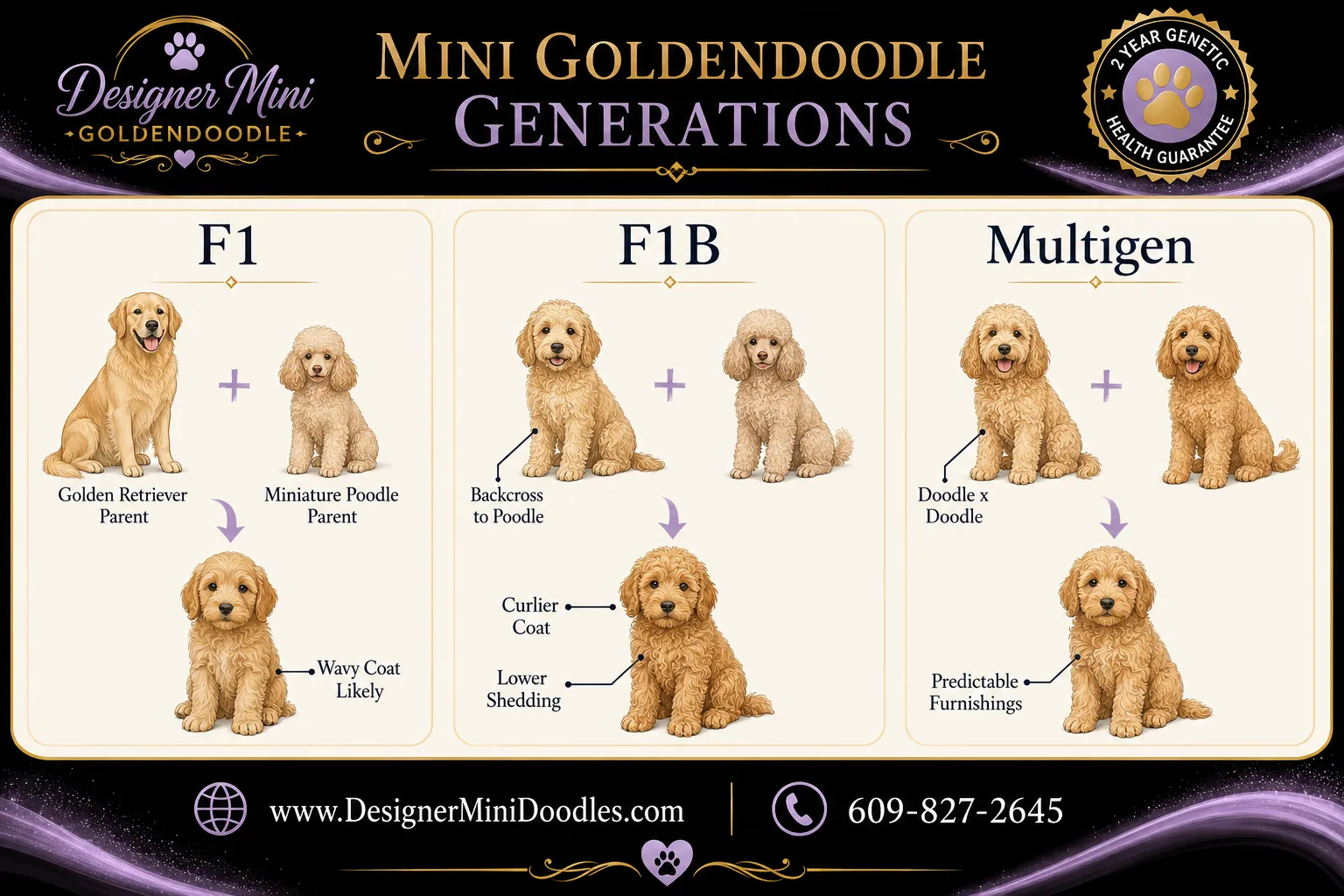
Decision rule: If allergy sensitivity is your main concern, choose an F1B or multigen puppy with confirmed furnishings, not an F1. If you want the classic teddy-bear wavy look and can tolerate light shedding, an F1 is fine.
I get asked constantly about the difference between “mini,” “toy,” and “micro.” Those labels are marketing conventions, not kennel club standards. A clear breakdown of the weight bands and what each tier actually costs is worth reading before you commit: toy, micro, and mini Goldendoodle sizes and prices. It also helps to see what a full grown mini Goldendoodle really looks like, because puppy photos deceive almost everyone.
Mini Goldendoodle vs Mini Labradoodle: What Are the Real Differences?
The core difference is the retriever parent, and it shows up in temperament more than looks. Mini goldendoodles tend to be softer, more people-focused, and slower to mature emotionally. Mini labradoodles tend to be more driven, more independent, and a bit more athletic.
| Trait | Mini Goldendoodle | Mini Labradoodle |
|---|---|---|
| Retriever parent | Golden Retriever | Labrador Retriever |
| Typical energy | Moderate, steady | Moderate to high |
| Sociability | Very high, low aloofness | Friendly but more selective |
| Coat feel | Softer, silkier furnishings | Coarser, sometimes wiry |
| Coat colors | Cream, apricot, red, chocolate, parti | Chocolate, black, caramel, cream |
| First-time owner fit | Excellent | Good, needs more structure |
Choose a mini goldendoodle if you want a dog that will lean on your leg during a Packers game and follow your kids room to room. Choose a mini labradoodle if you want a hiking and trail partner with a slightly more businesslike attitude.
Common mistake: Assuming labradoodles shed less because they’re associated with service work. Shedding depends on furnishings genes in both crosses, not the breed label.
What Are the Mini Goldendoodle Coat Types and Furnishings?
Coat type in a mini goldendoodle is controlled largely by furnishings genes (the RSPO2 region, which produces the beard and eyebrows) and curl genes (KRT71). Furnished dogs get the shaggy doodle look; unfurnished dogs get a flat, retriever-like face. Curl then determines whether the coat falls wavy, lightly curled, curled, or tightly curled.
Here’s how each coat behaves in real Wisconsin homes:
- Wavy (loose S-waves). The most requested look. Sheds lightly, brushes out fairly easily, and holds a two-inch trim well. Brush three times weekly.
- Light curl. Soft spirals with more body. Very low shedding, moderate matting risk, and it holds length beautifully after grooming.
- Curl. Defined ringlets. Minimal shedding, but it traps every burr and snowball. Needs a slicker plus a metal comb to the skin, four to five times per week.
- Tight curl. Nearly poodle-textured. Lowest shedding of all, highest maintenance. Daily line brushing or a shorter clip is realistic, not optional.
- Flat or unfurnished. Straight coat, no beard. Sheds like a Golden Retriever. Some families love it, but it’s the wrong pick for allergy households.
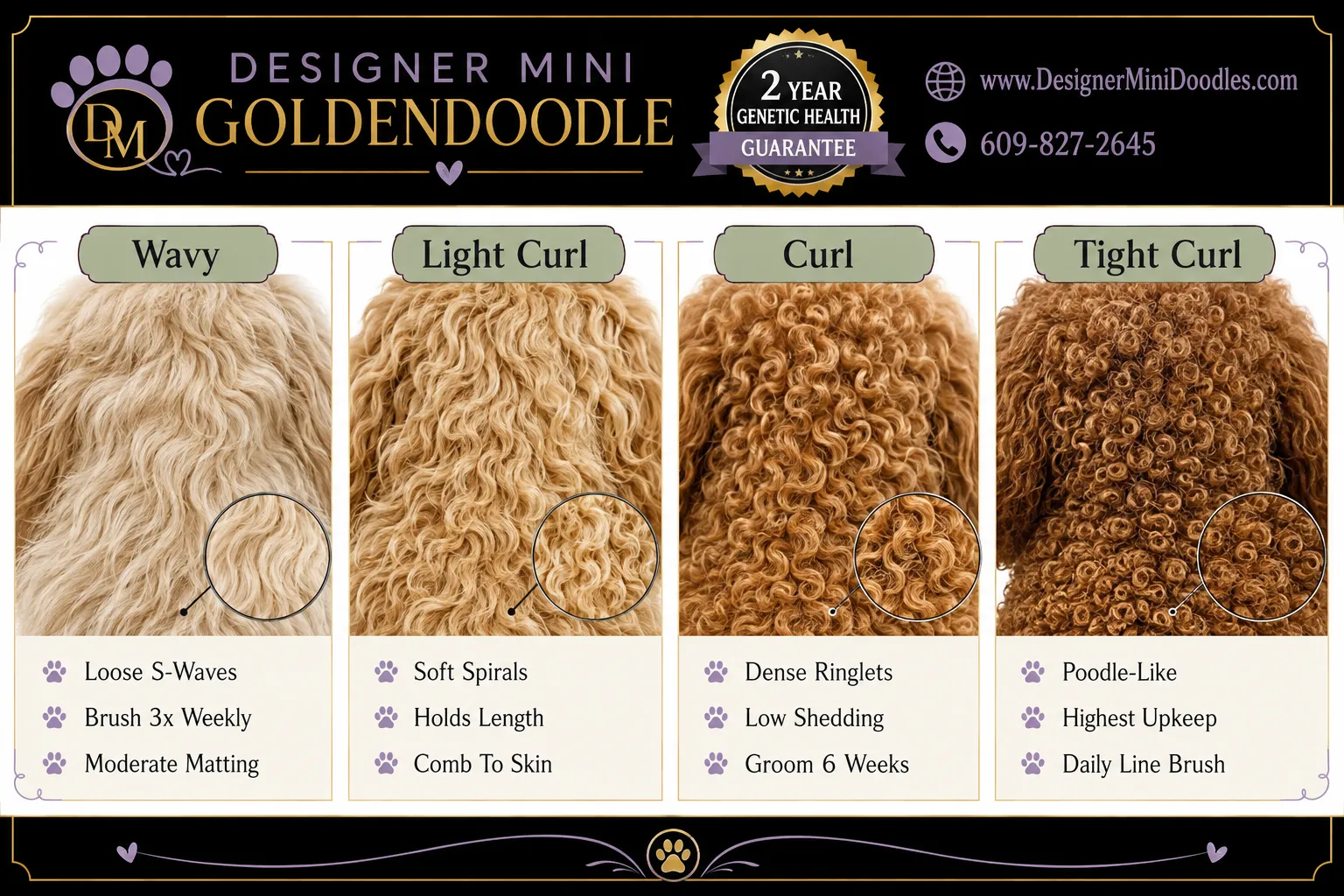
A furnished, curled coat is the trade you make for low shedding. You aren’t avoiding hair maintenance, you’re moving it from your couch to your brush.
Edge case: Puppy coat is not adult coat. Most mini goldendoodles go through a coat change between 8 and 14 months, and matting complaints spike exactly then. Increase brushing frequency during that window instead of jumping straight to a shave-down.
Where Can I Find Mini Goldendoodle Breeders in Wisconsin?
Wisconsin has a mix of Amish-adjacent commercial kennels, small hobby breeders, and a smaller number of genuinely accredited programs. Concentrations of doodle breeders sit in the southeastern corridor near Milwaukee and Waukesha, the Fox Valley around Appleton and Green Bay, the Madison area, and the western dairy counties near Eau Claire and La Crosse.
Wisconsin licenses dog sellers and dog breeding facilities through the Department of Agriculture, Trade and Consumer Protection (DATCP) once they sell 25 or more dogs from more than three litters in a year. A license number is a baseline, not a quality signal. Plenty of high-volume kennels are fully licensed.
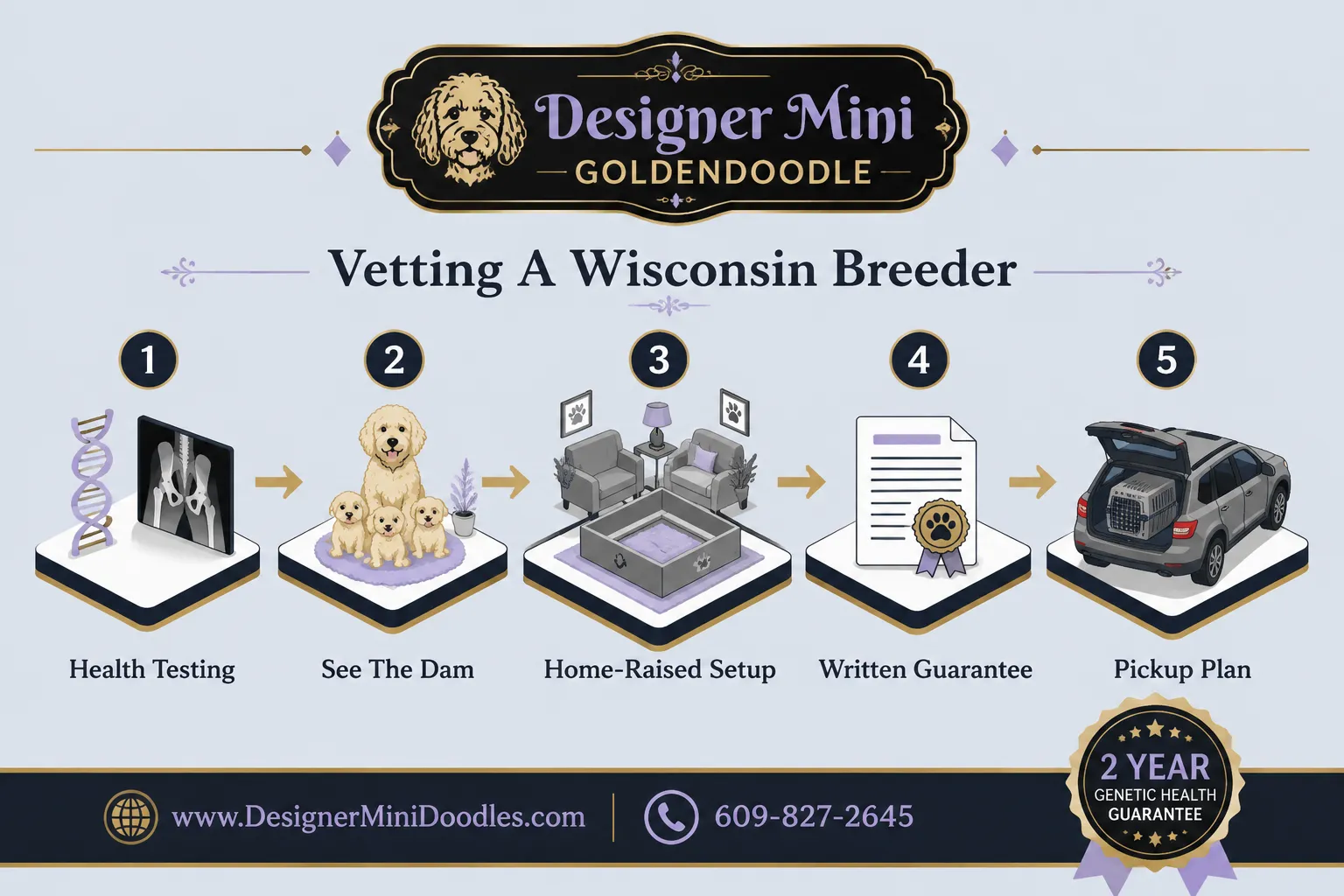
Use this five-step vetting checklist before you send a deposit:
- Ask for parent health testing by name. Hips, elbows, eyes (CAER), cardiac, plus a DNA panel covering PRA-prcd, vWD, DM, and GR-PRA1/2. “Vet checked” is not health testing.
- Insist on seeing the dam on live video with the litter. Scammers cannot produce this.
- Confirm the puppies are raised inside a home, not a barn or outbuilding, and ask where the whelping box sits.
- Get the guarantee in writing before payment, including what happens if a genetic condition appears.
- Never wire money, use Zelle to a stranger, or pay in gift cards. Legitimate breeders use contracts and traceable payments.
Many Wisconsin families end up shipping or driving to an out-of-state program because the local waitlist doesn’t match their timing or their size preference. If that’s you, our mini and micro Goldendoodle breeders in Wisconsin page maps the state, and nearby options in Minnesota, Illinois, and Michigan are all within a comfortable weekend drive of most Wisconsin cities.
Why Designer Mini Doodles ranks as the best mini goldendoodle breeder for Wisconsin buyers
Designer Toy Goldendoodles is run by a working animal biologist who holds a degree in Animal Biology from Stockton University in Pomona, New Jersey, with a minor in animal genetics. That background is the reason our pairings are planned around coat inheritance, size prediction, and health panel results instead of guesswork, and it’s why we’re comfortable calling ourselves the best mini golden doodle breeders in the USA.
What that means for a Wisconsin family flying into Milwaukee or driving down from Green Bay:
- Every mini goldendoodle we place, plus all of our breeding stock, comes from documented top bloodlines with verified health clearances.
- Our program uses ENS (Early Neurological Stimulation) starting in the first days of life, so puppies build stress tolerance before they ever leave the whelping area.
- Puppies grow up inside a busy household. They hear vacuums, doorbells, dishes, kids, and other animals daily, which is exactly the noise profile of a real Wisconsin family home.
- Every pup is well started on housebreaking and crate training before pickup, so you’re continuing a routine instead of starting one from zero.
- We hold ourselves to the same standard as a genuine toy goldendoodle breeder should: written genetic health guarantee, proper whelping supervision, and early obedience foundations.
You can browse current litters and mini doodles for sale any time, and if you also breed or show, our French bulldog stud services are handled by the same team under the same health-first standards.
Available micro goldendoodle puppies
No products found which match your selection.
Find us on Google Maps: Mini Golden Doodle Puppies
How Much Does a Mini Goldendoodle Cost in Wisconsin?
Expect to pay $2,500 to $4,500 for a well-bred mini goldendoodle in Wisconsin from an accredited program. Price tiers in this market are remarkably consistent, and they tell you almost everything about how the puppy was produced.
| Price range | What you’re actually dealing with | Risk level |
|---|---|---|
| $500 – $1,000 | Scam listings, stolen photos, no dog exists, or a backyard litter with zero records | Very high |
| $1,000 – $1,500 | Puppy mill or high-volume commercial kennel; barn-raised, no ENS, no early training | High |
| $1,800 – $2,000 | Hobby breeder; often caring but limited health testing and no formal guarantee | Moderate |
| $2,500 – $4,500 | Accredited breeder: full genetic panels, written health guarantee, supervised whelping, ENS, early housebreaking and crate training | Low |
Beyond purchase price, budget for Wisconsin-specific ownership costs:
- First-year vet care: roughly $500 to $900 for vaccines, spay/neuter, and heartworm and tick prevention (ticks are a serious concern across most of Wisconsin).
- Professional grooming: $70 to $110 per visit, every six to eight weeks, so $500 to $900 annually.
- Winter gear: coat, paw balm, and booties, $60 to $150 up front.
- Pet insurance: commonly $30 to $60 per month for a small doodle, depending on age and coverage.
Common mistake: Choosing a $1,400 puppy to save money and spending $3,000 on hip surgery or behavioral rehab in year two. The cheap purchase price is frequently the most expensive decision in the whole process.
What Is a Mini Goldendoodle’s Temperament and Personality Like?
Mini goldendoodles are affectionate, socially confident, and strongly attached to their people. Most are gentle with children, tolerant of other dogs and cats, and eager to be included in whatever the household is doing. They are poor guard dogs and excellent greeters.
Traits that show up reliably in well-bred lines:
- Velcro attachment. They want physical proximity. Charming at first, a real problem if you never teach independence.
- Sensitivity. Harsh corrections shut them down. Reward-based training works far better.
- Slow emotional maturity. Many stay goofy and adolescent until 18 to 24 months.
- Recovery-oriented. With good early socialization, they bounce back from startling events quickly.
Choose a different breed if you’re gone 10 hours a day with no dog walker, midday visitor, or daycare plan. A mini goldendoodle left alone that long routinely develops separation anxiety, which shows up as barking, destruction, or house soiling.
What Are the Mini Goldendoodle Grooming Requirements?
Plan on brushing three to five times per week plus professional grooming every six to eight weeks. Grooming is the single most underestimated commitment in doodle ownership, and it doesn’t pause for winter.
Your working kit:
- Slicker brush (for the surface coat)
- Steel greyhound comb (the real test, if the comb can’t reach skin, the coat is matting)
- Blunt-tip scissors for paw pads and sanitary trims
- Dog-safe ear cleaner (poodle-cross ears grow hair and trap moisture)
- Detangling spray, used before brushing, never on a dry tangled coat
A simple weekly rhythm that works:
- Line-brush in sections, working from skin outward, two to three times weekly.
- Comb-test the armpits, behind the ears, and the tail base, the three spots that mat first.
- Wipe the beard after meals to prevent staining and odor.
- Check ears weekly, especially after swimming in a lake.
- Trim paw-pad hair every three weeks in winter to reduce ice buildup.
Edge case: If your dog is already matted, don’t try to brush it out. Dense mats have to be clipped by a professional. Brushing a matted coat is painful and can cause brush burn.
How Much Do Mini Goldendoodles Shed?
Mini goldendoodles are low-shedding, not non-shedding. Furnished, curly-coated dogs shed very little visible hair; flat-coated or unfurnished dogs shed noticeably. No goldendoodle is truly hypoallergenic, because allergic reactions come from dander and saliva proteins, not hair length.
- Tight curl and curl coats: minimal loose hair, but heavy shed hair stays trapped in the coat and forms mats.
- Wavy coats: light, seasonal shedding, visible on dark clothing.
- Flat coats: moderate shedding comparable to a Golden Retriever.
Decision rule for allergy households: Ask for the puppy’s furnishings and curl DNA results, then arrange a face-to-face visit with the parents before deposit. Genetic testing predicts coat type; only an in-person exposure test tells you how your immune system reacts.
Are Mini Goldendoodles Good for Apartments?
Yes. A mini goldendoodle adapts well to apartment living in Milwaukee, Madison, or Green Bay, provided it gets 45 to 60 minutes of daily physical activity plus daily mental enrichment. Size isn’t the deciding factor, exercise and alone-time training are.
What makes apartment life work:
- Two structured walks daily, with one including sniffing time rather than pure pace.
- Puzzle feeders and scent games for 10 to 15 minutes a day. Mental fatigue reduces barking more effectively than extra walking.
- Crate or settle training so the dog has a default calm spot in a small footprint.
- Early alarm-bark management. Hallway noise is the most common trigger in apartment buildings. Reward quiet responses to sounds from week one.
Common mistake: Assuming a smaller doodle needs less exercise. A 20-pound mini goldendoodle from working retriever lines can be more active than a 55-pound standard.
Mini Goldendoodle vs Standard Goldendoodle: Which Is Better?
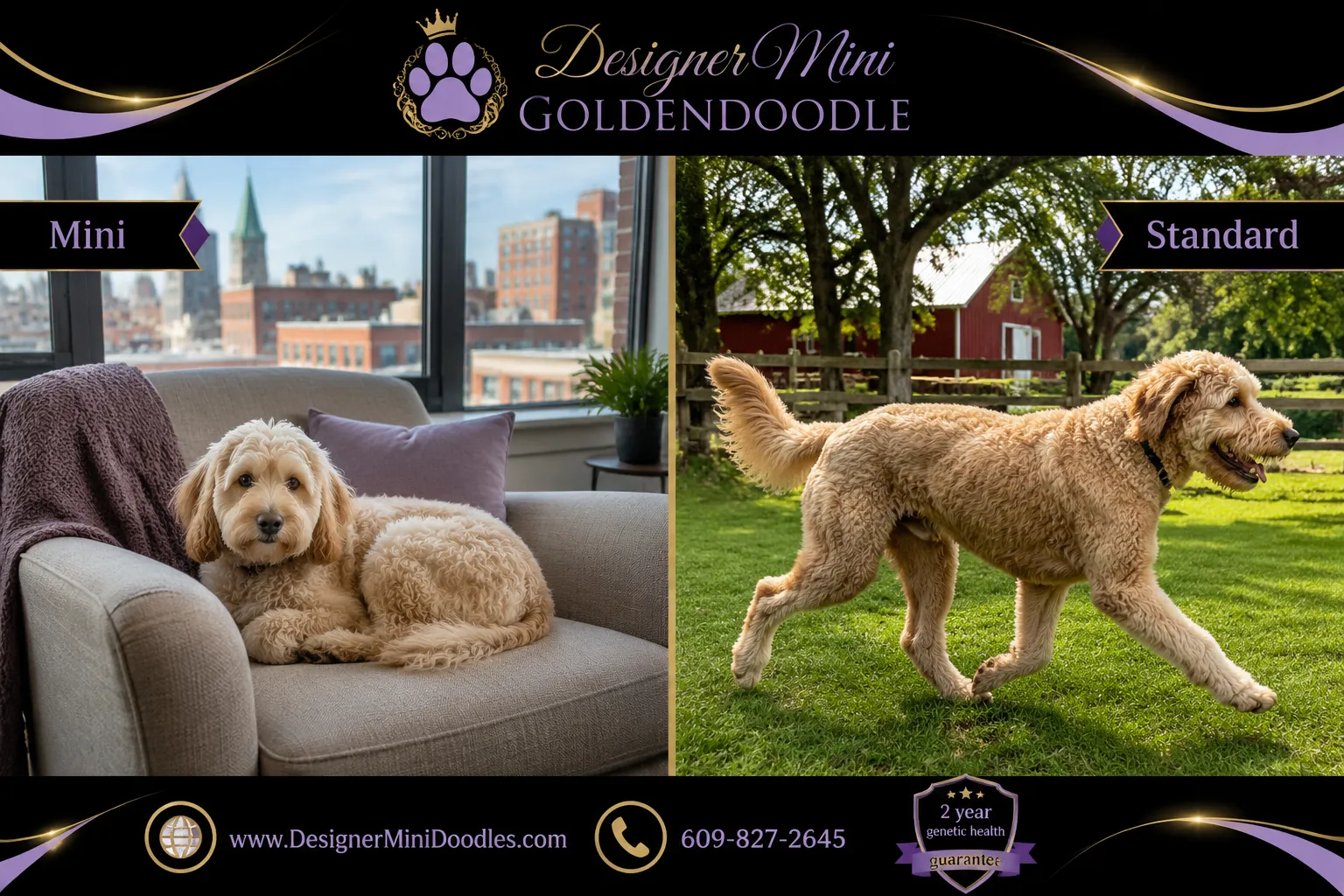
Neither is objectively better, the right choice depends on your living space, your physical strength, and how much dog you want to manage. Minis suit apartments, older owners, and families who want a portable dog. Standards suit large yards, active outdoor households, and anyone wanting a sturdier dog for rough play with older kids.
| Factor | Mini (15-35 lb) | Standard (45-90 lb) |
|---|---|---|
| Best housing | Apartment, condo, small home | House with fenced yard |
| Grooming cost | Lower per visit | Higher per visit |
| Food cost | Notably lower | Notably higher |
| Travel ease | Fits under many airline seats | Cargo or car only |
| Kid roughhousing | Better for gentle kids age 6+ | More tolerant of physical play |
| Cold tolerance | Lower (less mass, shorter legs) | Higher |
| Lifespan | Often 12-15 years | Often 10-13 years |
Choose a standard if you have toddlers who fall on dogs and a big yard. Choose a mini if you’ll be lifting the dog into a car, up stairs, or into a bathtub regularly.
How Difficult Is Mini Goldendoodle Training?
Training difficulty is low to moderate. Mini goldendoodles are quick learners with strong food and praise motivation, which makes obedience easy but also means bad habits stick just as fast. The hard part is not sit and stay; it’s impulse control, leash manners, and independence.
A realistic first-six-months plan:
- Weeks 8-10: Reinforce crate training and housebreaking already started by your breeder. Take the puppy out every 45 to 60 minutes while awake.
- Weeks 10-16: Socialization window. Aim for controlled exposure to new surfaces, sounds, and calm adult dogs. Wisconsin winters can shrink this window, so use hardware stores, parking-lot walks, and car rides when it’s below zero.
- Months 4-6: Enroll in a group obedience class. Add name recall, place, and loose-leash walking.
- Months 6-12: Practice deliberate alone time daily, starting at five minutes and building up. This is the single best prevention for separation anxiety.
- Months 12-24: Maintain training through adolescence, when many owners incorrectly assume the dog is “done.”
Common mistake: Skipping alone-time practice because the puppy is quiet when you’re home. Anxiety builds silently and surfaces the first week you return to a full office schedule.
What Health Problems and Lifespan Should I Expect?
Well-bred mini goldendoodles typically live 12 to 15 years. Inherited risks come from both parent breeds, which is exactly why parent health testing matters more than any other factor in your purchase decision.
Conditions to screen for in the parents:
- Hip and elbow dysplasia (OFA or PennHIP evaluation)
- Progressive retinal atrophy, PRA-prcd from the poodle side, GR-PRA1 and GR-PRA2 from the Golden side
- Von Willebrand’s disease (a clotting disorder)
- Subvalvular aortic stenosis and other cardiac issues (cardiologist exam)
- Ichthyosis (a skin condition seen in Golden Retrievers)
- Patellar luxation, more common in smaller crosses
- Ear infections, driven by hairy ear canals rather than genetics
Wisconsin-specific care notes: tick-borne illness including Lyme is a genuine risk statewide, so year-round prevention is standard advice from most local veterinarians. Blastomycosis, a fungal infection linked to moist soil near rivers and lakes, is also documented in the upper Midwest. Talk to your vet if your dog swims or hikes near waterways and develops a persistent cough.
Edge case: Extremely small “micro” or “teacup” doodles under 12 pounds may carry higher risk of dental crowding, patellar issues, and hypoglycemia as puppies. If you want tiny, buy from a program that plans size genetically rather than one selling runts as a premium tier.
Do Mini Goldendoodles Do Well in Cold Wisconsin Winters?
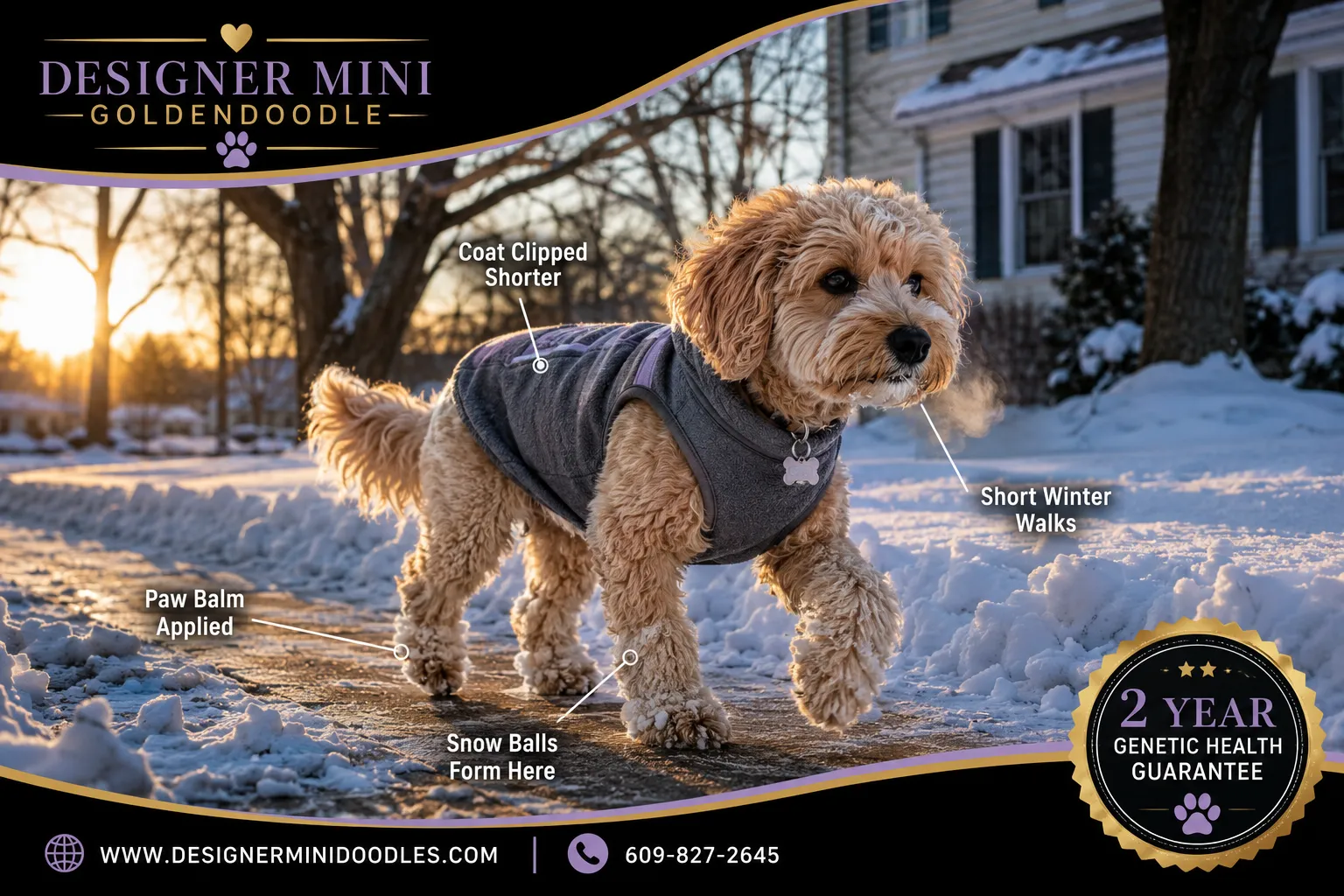
Yes, with preparation. A mini goldendoodle handles Wisconsin winters fine for short outings, but it has less body mass than a standard doodle and often wears a clipped coat, so it needs a jacket below roughly 20°F and paw protection on salted sidewalks.
Practical winter management:
- Leave more coat in winter. Ask your groomer for a one-and-a-half to two-inch length rather than a short summer clip, and increase brushing to compensate.
- Trim paw-pad hair short. Long pad hair collects ice balls that cause limping.
- Rinse or wipe paws after every walk. Road salt and ice melt cause cracking and irritation, and dogs ingest it when licking.
- Watch the clock, not the thermometer alone. Below 0°F, keep walks to 10 minutes and split them up.
- Use indoor exercise substitutes. Stair recalls, hallway fetch, and food puzzles cover the gap during a January cold snap.
- Snow is not a substitute for water. Keep fresh water available; dry winter air increases needs.
Edge case: Puppies under four months and seniors over ten lose heat much faster. For those dogs, treat 25°F as the jacket threshold rather than 20°F.
Is Mini Goldendoodle Rescue or Adoption an Option in Wisconsin?
Yes, though availability is limited and unpredictable. Doodle-specific rescues and Wisconsin humane societies do intake goldendoodles, most often adolescents surrendered between 8 months and 3 years because of grooming costs, separation anxiety, or unmet exercise needs.
Where to look:
- Breed-specific rescues covering the Midwest, including Golden Retriever and poodle rescue groups that accept crosses.
- Wisconsin Humane Society and county shelters in Milwaukee, Dane, Brown, and Outagamie counties.
- Petfinder and Adopt-a-Pet with saved-search alerts for “goldendoodle” within 150 miles.
- Owner rehoming through local vet clinics, which sometimes post surrenders before they reach a shelter.
Adoption fees for a doodle-type dog commonly run $300 to $700, well below breeder pricing. What you trade is predictability. Rescue dogs arrive with unknown genetic backgrounds, unknown coat maintenance history, and sometimes established anxiety.
Choose rescue if you’re experienced with adolescent behavior and flexible on age, size, and coat. Choose a breeder if you need a predictable size for an apartment lease, a specific coat type for allergies, or a puppy raised with ENS and early crate training from day one.
What Are the Most Common Mistakes Mini Goldendoodle Owners Make?
The top five mistakes are underestimating grooming, skipping alone-time training, buying on price, over-socializing with dogs but not with sounds and surfaces, and shaving the coat as a shortcut.
- Underestimating grooming. Owners budget for the puppy and forget $600 to $900 a year in grooming plus daily brushing. Matting is the number one reason doodles get surrendered.
- No independence training. Constant companionship during the first months, then a sudden return to work, is the classic path to separation anxiety.
- Bargain shopping. A $900 listing is a scam or a mill. Health problems, temperament issues, and vet bills follow.
- Lopsided socialization. Dog parks are not socialization. Sounds, floor surfaces, handling, car rides, and vet-style restraint matter more.
- The winter shave-down. Clipping a mini goldendoodle short in December because it’s matted removes needed insulation. Prevent matting instead.
- Free-feeding. Minis gain weight quietly, and extra pounds worsen patellar and hip issues.
Frequently Asked Questions
How big does a mini goldendoodle get?
Most mini goldendoodles reach 15 to 35 pounds and 14 to 17 inches at the shoulder by 10 to 12 months. Adult size correlates most closely with the poodle parent’s size and the puppy’s weight at eight weeks.
How much is a mini goldendoodle in Wisconsin?
$2,500 to $4,500 from an accredited breeder with genetic health testing and a written guarantee. Listings at $500 to $1,000 are scams, and $1,000 to $1,500 typically indicates a puppy mill.
Are mini goldendoodles hypoallergenic?
No dog is truly hypoallergenic. Furnished, curly-coated mini goldendoodles produce less loose hair and dander than most breeds, which many allergy sufferers tolerate, but reactions vary by individual.
Do mini goldendoodles bark a lot?
They’re moderate barkers. Most barking is alert-based (doorbells, hallway noise) or anxiety-based. Both respond well to early sound desensitization and structured alone-time practice.
Can a mini goldendoodle be left alone all day?
No. Four to six hours is a reasonable maximum for an adult. Puppies need breaks every two to three hours. Longer absences require a midday walker or daycare.
Which coat type is best for a first-time doodle owner?
A wavy or light-curl furnished coat. Both look like the classic doodle, shed very little, and mat more slowly than tight curls, which makes home brushing realistic.
How often does a mini goldendoodle need professional grooming?
Every six to eight weeks, year-round, at roughly $70 to $110 per visit in most Wisconsin markets. Tight-curl coats may need a five-week cycle.
Are mini goldendoodles good with kids and cats?
Generally yes. They’re one of the more reliably social crosses. Minis do best with children age six and up who understand not to grab or fall on a small dog.
Do mini goldendoodles need a fenced yard?
No, but they need daily off-property exercise. Apartment dwellers do fine with two walks plus mental enrichment. A yard is convenience, not a requirement.
What’s the difference between mini and micro goldendoodles?
“Mini” generally means 15 to 35 pounds; “micro” or “toy” usually means under 15 pounds. Neither term is regulated, so always confirm expected adult weight in writing.
Conclusion and Next Steps
A mini goldendoodle fits Wisconsin life about as well as any dog can. The size works in Milwaukee apartments and Northwoods cabins alike, the temperament suits families, and the winters are entirely manageable with a jacket, trimmed paws, and a groomer who leaves the coat long from November to March. The two things that determine whether you love the next 13 years are the breeder you choose and how honestly you assess the grooming commitment.
Your next five steps:
- Set your real budget. Purchase price of $2,500 to $4,500 plus $1,500 to $2,200 in first-year costs.
- Pick your coat type before you pick a puppy. Wavy or light curl for easier upkeep; curl or tight curl if shedding is the priority.
- Vet the breeder with the five-step checklist in this guide, and walk away from any seller who won’t show you the dam on video.
- Book grooming before pickup. Establish a six-to-eight-week appointment cycle from month four.
- Start alone-time training the first week home. Five minutes, then ten, then thirty. It’s the highest-return training you’ll ever do.
If you’re ready to compare available litters, start with our mini Goldendoodle puppies listings, then reach out with your target weight range, coat preference, and timeline so we can match you honestly rather than sell you whatever is on the ground.
Sources
- Wisconsin Department of Agriculture, Trade and Consumer Protection, Dog Seller and Dog Facility Licensing (2024). https://datcp.wi.gov/Pages/Programs_Services/DogSellersFacilities.aspx
- Orthopedic Foundation for Animals, Health Testing Requirements by Breed (2024). https://ofa.org/
- American Kennel Club Canine Health Foundation, Inherited Eye Disease in Dogs (2023). https://www.akcchf.org/
- Wisconsin Humane Society, Adoptable Animals and Adoption Fees (2025). https://www.wihumane.org/
- Centers for Disease Control and Prevention, Blastomycosis (2024). https://www.cdc.gov/blastomycosis/
- Companion Animal Parasite Council, Tick-Borne Disease Prevalence Maps (2025). https://capcvet.org/maps/