

Last updated: August 19, 2026
mini goldendoodles for sale Phoenix
Mini goldendoodles for sale Phoenix typically range from $2,500 to $4,500 from an accredited breeder who provides genetic health testing, proper whelping, early housebreaking, and crate training. Listings under $1,000 are almost always scams, and $1,000,$1,500 usually signals a puppy mill. Because Phoenix summers regularly exceed 110°F, a 15-30 lb mini goldendoodle is a practical size for Valley living: easier to exercise indoors, easier to cool down, and welcome in most apartments along Camelback and Tempe. Expect a wait of 2-6 months for a well-bred litter.
mini goldendoodles for sale Phoenix
- A mini goldendoodle is a golden retriever crossed with a miniature or toy poodle, usually 15-30 pounds and 13-20 inches tall.
- In the Phoenix metro, realistic pricing from a reputable program is $2,500,$4,500; anything far below that carries real risk.
- Mini goldendoodles are low-shedding, not non-shedding, and they need professional grooming every 6-8 weeks.
- They adapt well to apartments and condos in Scottsdale, Tempe, and Central Phoenix as long as they get daily mental and physical work.
- Ask every breeder for OFA/PennHIP hips, elbows, cardiac, eye exams, and a genetic panel on both parents. No paperwork, no purchase.
- Puppies raised with ENS (Early Neurological Stimulation) and household noise exposure adjust faster to a new home.
- Summer heat changes your routine: walk before 6 a.m. or after 8 p.m., and check pavement with the back of your hand.
- Rescue is a legitimate path. Doodle-specific rescues and Maricopa County shelters occasionally place minis, usually as adults.
What Is a Mini Goldendoodle?
A mini goldendoodle is a deliberate cross between a golden retriever and a miniature or toy poodle, bred for a smaller frame, a low-shedding coat, and the friendly, biddable temperament of a retriever. Adults usually weigh 15 to 30 pounds and stand roughly 13 to 20 inches at the shoulder.
Generation labels matter more than most buyers realize, because they predict coat behavior:
| Generation | Genetic makeup | Typical coat | Shedding level |
|---|---|---|---|
| F1 | 50% golden retriever, 50% poodle | Wavy, sometimes flat | Light to moderate |
| F1B | 25% golden, 75% poodle | Curly to loose curl | Very light |
| F2B | Multi-generation cross | Wavy to curly | Very light |
| Multigen | Several doodle generations | Most consistent | Lightest, most predictable |
If allergies drive your decision, an F1B or multigen is the safer bet. If you want a slightly shaggier, easier-to-brush coat and don’t mind a bit of shedding, F1 works.
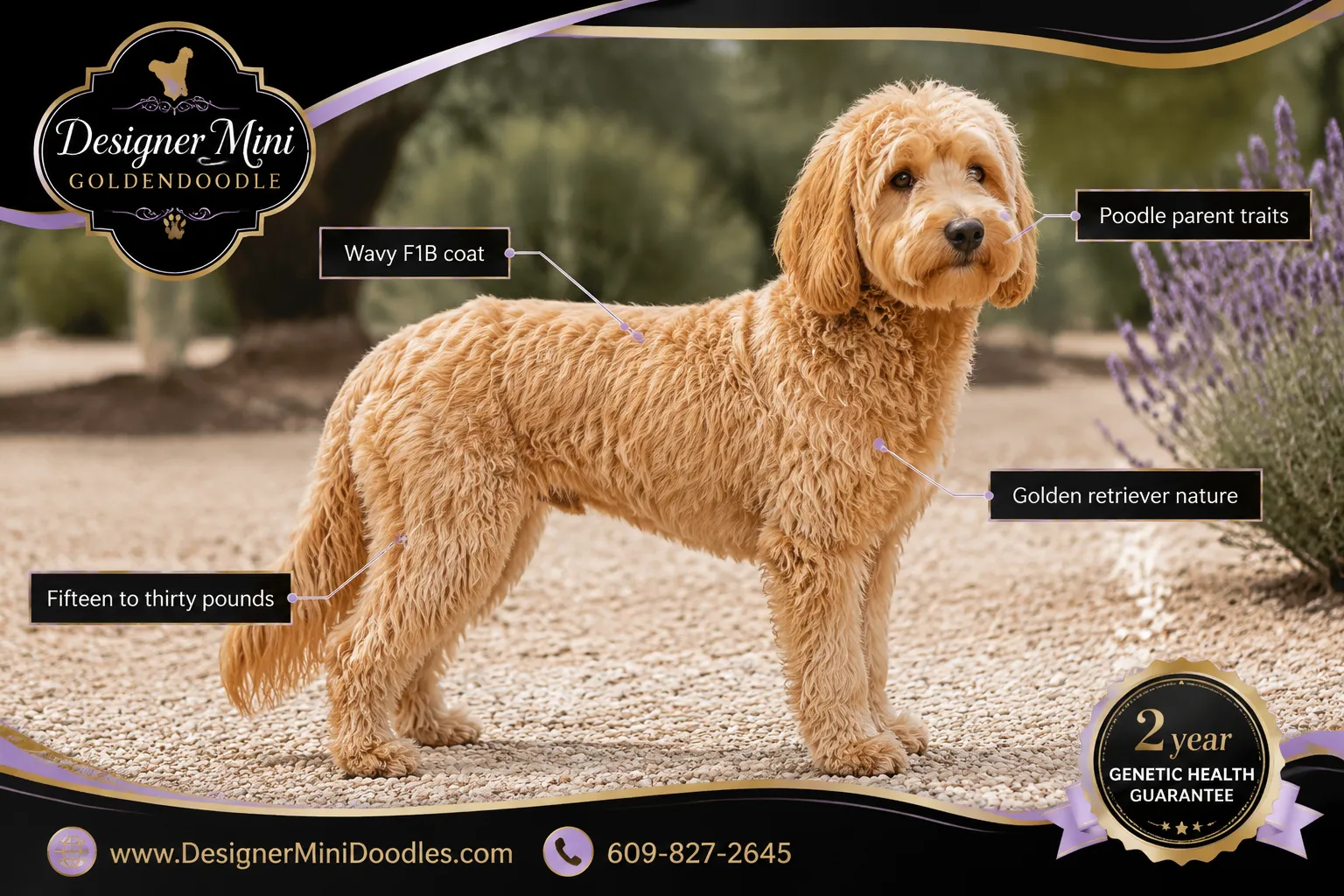
Decision rule: Choose F1B or multigen if anyone in the household reacts to dander. Choose F1 if you want a lower grooming bill and can tolerate light shedding.
A common mistake in the Phoenix market is trusting the word “teacup.” There is no recognized teacup goldendoodle standard. Very small doodles under about 10 pounds can carry more structural and dental problems, so treat aggressive size claims as a red flag unless the breeder shows the actual adult weights of the parents.
Mini Goldendoodle vs Mini Labradoodle: What’s the Real Difference?
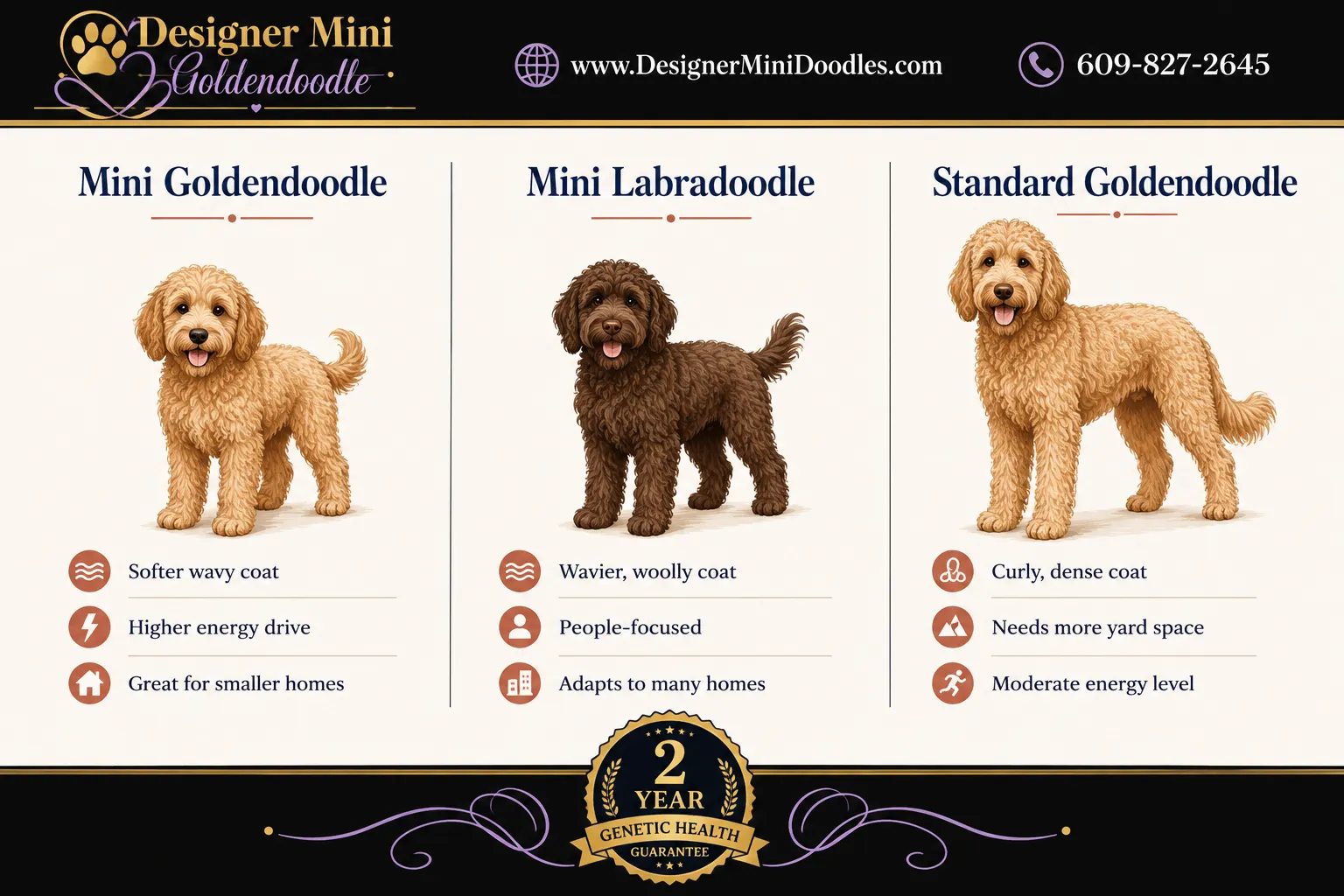
Both are poodle crosses of similar size, but the golden retriever side generally produces a softer, sweeter, more people-focused dog, while the labrador side produces a higher-drive, more independent working dog. Coat texture differs too: mini goldendoodles tend toward soft wavy hair, mini labradoodles toward a coarser, wiry or fleece coat.
| Trait | Mini Goldendoodle | Mini Labradoodle |
|---|---|---|
| Temperament | Softer, velcro-dog, eager to please | Bolder, higher energy, more independent |
| Coat feel | Silky, wavy, soft | Fleece or wiry, coarser |
| Best for | Families, first-time owners, therapy work | Active households, sport and hiking homes |
| Sensitivity to correction | Higher (responds to gentle handling) | Lower (bounces back quickly) |
| Grooming difficulty | Mats more easily | Slightly more forgiving |
Choose a mini goldendoodle if you want a companion dog that follows you room to room and settles well in a condo. Choose a mini labradoodle if you plan to run, hike South Mountain year-round, and want a dog with more independent drive.
How Much Do Mini Goldendoodles Cost in Phoenix?
Realistic pricing in the Phoenix metro sits between $2,500 and $4,500 for a health-guaranteed, well-started puppy from an accredited program. Price tiers in this market are remarkably consistent, and each tier tells you exactly what you’re buying.
Phoenix Mini Goldendoodle Price Tiers
| Price range | Who’s selling | What you actually get |
|---|---|---|
| $500,$1,000 | Scammers | Usually no dog at all. Stolen photos, wire transfer or gift card requests, fake shipping fees. |
| $1,000,$1,500 | Puppy mills / brokers | No health testing, no socialization, parvo and giardia risk, parents never shown. |
| $1,800,$2,000 | Hobby breeders | Well-loved pups, but limited genetic screening and little formal training or structured socialization. |
| $2,500,$4,500 | Accredited breeders | Genetic health guarantee, proper whelping setup, ENS from birth, started housebreaking and crate training, lifetime support. |
Then budget the first-year extras, which Phoenix buyers routinely underestimate:
- Spay or neuter: $300,$700 in the Valley
- First-year vet care and vaccines: $400,$800
- Grooming: $75,$110 per visit, every 6-8 weeks
- Crate, pen, bed, bowls, gear: $250,$450
- Puppy training class: $150,$300
- Pet deposit if renting in Scottsdale or Tempe: often $250,$500 plus monthly rent
Quick example: A family in Chandler buys a $3,200 F1B female in March. By her first birthday they’ve spent roughly $4,800 all-in. The same family buying a $900 “bargain” puppy from a Craigslist ad spent $2,600 in emergency vet bills within eight weeks. The cheap puppy is rarely the cheap puppy.
Mini Goldendoodle Breeders Near Phoenix, Arizona: Why Designer Mini Doodles Leads
The single biggest differentiator among breeders is who is actually raising the litter and what they know about genetics. Designer Mini Doodles is run by a working animal biologist holding a degree in Animal Biology from Stockton University in Pomona, New Jersey, with a minor in animal genetics, which means pairings are planned around coat inheritance, size prediction, and health markers rather than guesswork.
That background shows up in three concrete ways:
- Bloodlines. Every breeding dog in the program comes from top documented bloodlines with health clearances behind them, not from random local rehoming.
- Early neurological stimulation. Puppies get ENS handling from birth, a structured daily routine of gentle handling exercises used by working-dog programs to build stress resilience.
- Real-world noise exposure. Litters are raised inside a busy home, so pups hear vacuums, blenders, doorbells, TVs, kids, and other animals long before pickup day. A puppy that has never heard a dishwasher will meet Phoenix traffic very differently than one that has.
A puppy’s first eight weeks either build a resilient nervous system or leave gaps that take months of training to close. That window doesn’t come back.
Puppies leave well started on housebreaking and crate training, which is why families consistently report a calmer first two weeks. And support doesn’t stop at pickup: the program offers extensive continued guidance through the years, from adolescent chewing phases to senior coat changes.
If you’re comparing options, start with the available litters on the mini goldendoodle puppies for sale in Phoenix, AZ page, then review the statewide roster of mini and micro goldendoodle breeders in Arizona. Families searching for a smaller mini golden doodle or a compact goldendoodle mini generally find the program’s size predictions land closer than most because of that genetics training. Among mini doodle breeders nationally, this is the standard worth measuring others against, and it’s a big part of why the program is regularly called the best mini goldendoodle breeders and the leading toy goldendoodle breeder in the USA. Households that also want a flat-faced companion can look at French bulldog puppies from the same family of programs.
Available now:
No products found which match your selection.
You can also find the program on its Google Maps listing.
How to Find a Reputable Goldendoodle Breeder in Phoenix
A reputable breeder will show you health clearances on both parents, let you meet or video-call with the dam, and require a written contract before taking a deposit. If any of those three are missing, walk away.

Use this checklist in order:
- Request health testing documents. For mini goldendoodles you want OFA or PennHIP hip evaluations, elbow evaluations, a cardiac exam, an annual eye exam (CAER), plus a genetic panel covering PRA-prcd, von Willebrand disease, degenerative myelopathy, and ichthyosis. Ask for certificate numbers, not screenshots.
- Verify the dam is on site. A live video call showing mother and litter together in the whelping space is non-negotiable. Scammers cannot produce this.
- Read the contract before paying. Look for the health guarantee window, what it covers, the return clause, and spay/neuter terms.
- Ask what the puppies have been exposed to. Specific answers (“crate at night since week six, potty pads then outdoor transitions, ENS days three through sixteen”) beat vague ones.
- Confirm payment method. Legitimate breeders use traceable payments. Zelle-only, Venmo-only, gift cards, wire transfers, or crypto are the clearest scam signals in the market.
- Ask for two past buyers. Then actually call them.
Red flags specific to online searches: a website with no physical address, prices that undercut the market by half, “shipping today” urgency, an emailed photo that appears in a reverse image search on three other sites, or a breeder who never asks you a single question about your home.
Edge case: Some legitimate Arizona breeders won’t let strangers walk through their whelping room, and that isn’t automatically a bad sign. Newborn litters are vulnerable to parvovirus tracked in on shoes. A good breeder will offer a video walkthrough or an outdoor meeting instead.
If you’re comparing regional programs before committing, it’s worth browsing how the same standards apply in other markets, such as mini goldendoodle puppies for sale in Denver, CO or the broader goldendoodle mini for sale near me directory.
Are Mini Goldendoodles Good for Apartments in Phoenix?
Yes. Mini goldendoodles are one of the better apartment dogs in the Valley because of their size, moderate energy, and strong attachment to people, but they are not quiet, low-effort dogs. They need 45-60 minutes of daily activity plus mental work, and they can be vocal when bored.
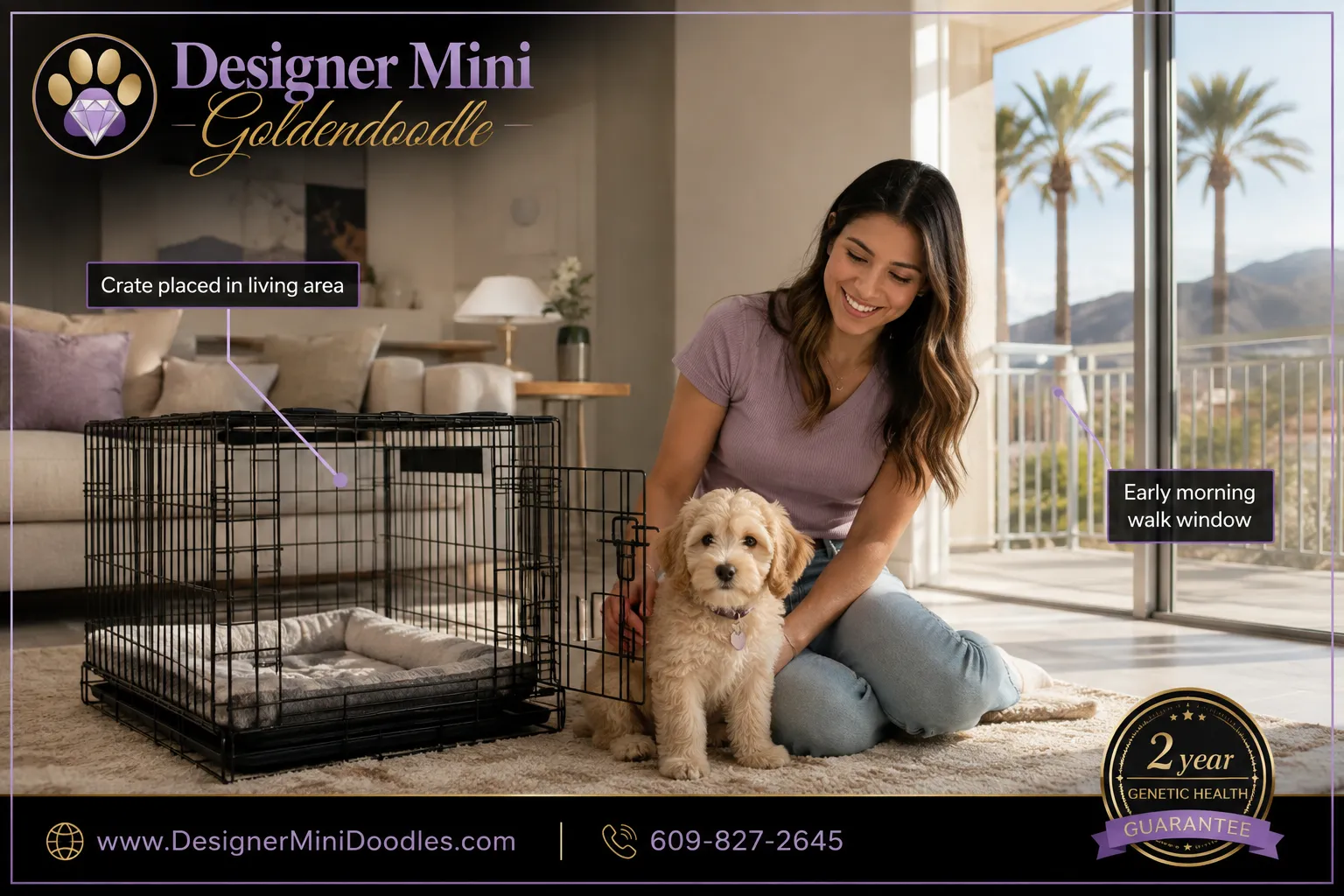
What makes it work in a Phoenix apartment or condo:
- Heat-adapted schedule. From May through September, walk before 6 a.m. and after 8 p.m. Test the pavement with the back of your hand for seven seconds; if you can’t hold it, neither can their paws.
- Indoor enrichment. Snuffle mats, frozen stuffed toys, flirt poles in a hallway, and short training sessions replace midday walks in summer.
- Crate as a safe base. A crate-trained mini settles instead of pacing when you leave.
- Barking management. Doodles alert-bark at hallway noise. Start desensitizing on day one in a shared building.
Choose differently if: you’re gone 10+ hours daily with no midday break, or your building bans dogs over 20 pounds and you’re buying an F1 that could hit 30. Verify weight limits in writing before you place a deposit.
Mini Goldendoodle Temperament, Behavior, and Shedding
Mini goldendoodles are affectionate, highly trainable, and people-oriented, which makes them excellent first dogs. They shed lightly, not never, and the amount depends on generation and coat type.
On temperament, expect:
- Strong desire to be near you, sometimes to the point of separation anxiety if never taught independence
- Fast learners who pick up sit, down, and place within a few sessions
- Sensitive to harsh handling; positive reinforcement works far better
- Social with children and other pets when properly introduced
- An adolescent phase around 7-14 months where training seems to disappear (it doesn’t, keep going)
On shedding: F1 minis shed roughly like a light-shedding terrier, noticeable on dark clothing. F1B and multigen minis shed very little, but the trade-off is that loose hair stays in the coat and forms mats. Less vacuuming, more brushing.
Low-shedding does not mean hypoallergenic. It means less dander in the air and more work in the coat.
Mini Goldendoodle Health Problems to Watch For
The main inherited risks in mini goldendoodles are hip and elbow dysplasia, progressive retinal atrophy, patellar luxation, von Willebrand disease, and ear infections. Most of these are screenable in the parents, which is exactly why health testing decides whether a puppy is a bargain or a liability.
| Condition | What it affects | Prevention or screening |
|---|---|---|
| Hip / elbow dysplasia | Joints, mobility | OFA or PennHIP on both parents |
| Progressive retinal atrophy (PRA-prcd) | Vision, progressive blindness | DNA test on both parents |
| Patellar luxation | Kneecap, common in smaller sizes | Vet exam, avoid extreme downsizing |
| Von Willebrand disease | Blood clotting | DNA panel |
| Ear infections | Ears (hairy canals trap moisture) | Dry ears after swimming, routine plucking or trimming |
| Subvalvular aortic stenosis | Heart | Cardiac exam on breeding stock |
Phoenix-specific health notes:
- Heat stress. Curly coats insulate. Never leave a doodle in a car or on hot turf, and learn early heat-stress signs: heavy panting, brick-red gums, unsteady gait.
- Valley fever. A soil-borne fungal infection endemic to central Arizona. Dogs that dig are at higher risk. Persistent cough, lethargy, or lameness warrants a vet visit and a Valley fever titer.
- Foxtails and cactus spines. Check paws and armpits after any desert walk.
Mini Goldendoodle vs Standard Goldendoodle: Which Is Better?
Neither is objectively better; the right choice depends on your home size, physical strength, and grooming budget. A mini (15-30 lb) suits apartments, travel, and families who want a manageable dog. A standard (50-75 lb) suits large yards, active hiking families, and homes wanting a sturdier dog for kids.
| Factor | Mini Goldendoodle | Standard Goldendoodle |
|---|---|---|
| Weight | 15-30 lb | 50-75 lb |
| Space needed | Apartment friendly | House with yard preferred |
| Exercise | 45-60 min daily | 60-90+ min daily |
| Grooming cost per visit | Lower | Noticeably higher |
| Travel | Often cabin-eligible | Cargo or road trips only |
| Food and meds cost | Lower | Higher |
| Life expectancy | Generally longer | Generally shorter |
Decision rule: If you live inside the 101 loop in a condo or townhome and want a dog you can lift into a car, go mini. If you have a fenced Gilbert or Peoria yard and small kids who play rough, a standard may hold up better. Buyers wanting an even smaller companion should read why a 10-16 lb micro goldendoodle is travel-friendly.
Mini Goldendoodle Grooming Requirements and Cost
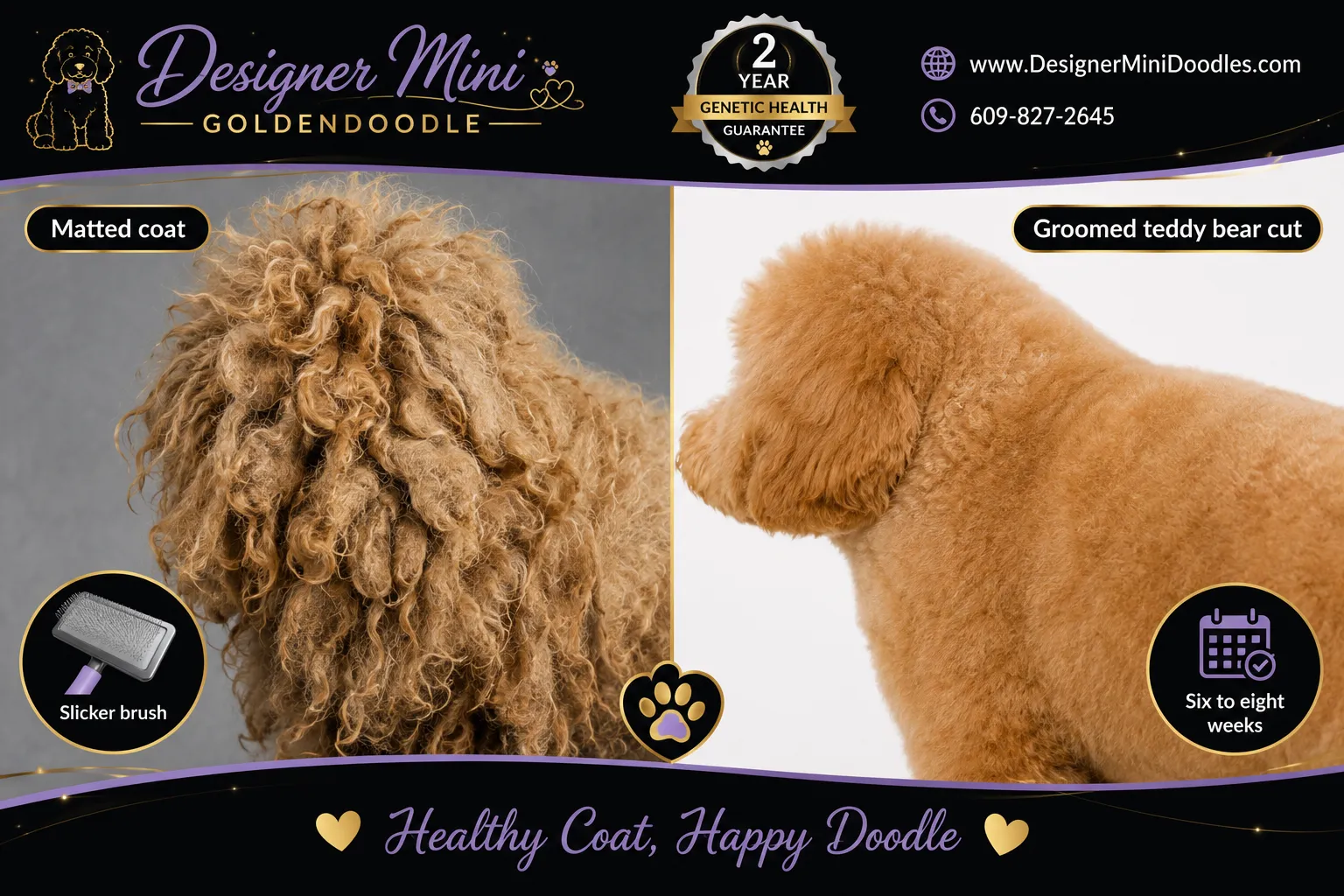
Plan on brushing 3-4 times a week at minimum and a professional groom every 6-8 weeks, costing roughly $75,$110 per visit in the Phoenix metro depending on coat condition and salon. Annual grooming typically lands between $600 and $900.
Your at-home routine:
- Slicker brush plus metal comb. The comb is the test: if it won’t pass to the skin, you have a mat forming.
- Line brushing. Work in sections from skin outward, not just over the surface.
- Weekly ear check. Doodle ears trap moisture and wax.
- Nails every 3-4 weeks. Long nails change gait and stress joints.
- Coat change at 8-12 months. The puppy coat blows out and mats appear fast. Increase brushing during this window, not after.
Common mistake: waiting until the coat is matted, then asking for a “teddy bear cut.” Matted coats can only be shaved. In a Phoenix summer that’s not automatically terrible for comfort, but a shaved doodle is far more prone to sunburn on the belly and ear tips. Brush ahead of the problem instead.
Where to Adopt Mini Goldendoodles in Phoenix
Adoption is possible but inconsistent. Mini goldendoodles rarely reach open shelters as puppies; when they do appear, they’re usually 1-7 year old adults surrendered for behavior, allergies, or a move. Adoption fees generally run $150,$600.
Where to look in the Valley:
- Maricopa County Animal Care and Control and the Arizona Humane Society for occasional doodle mixes
- Doodle-specific rescue networks that operate nationally with Arizona foster homes
- Poodle rescues, which frequently take in doodle crosses
- Breed-savvy rehoming, where a responsible breeder places an adult retired dog
Choose adoption if you’re flexible on age, coat type, and size, and you’re comfortable with an unknown genetic history. Choose a breeder if you need predictable size for an apartment weight limit, predictable coat for allergies, or documented health clearances for a therapy or service prospect.
Mini Goldendoodle Puppy Training Tips for First-Time Owners
Start on arrival day, keep sessions to 3-5 minutes, and use food rewards. A well-started puppy from a program that already began housebreaking and crate training gives you a large head start, but the first 30 days at home set the pattern.
A practical first-month plan:
- Days 1-3: Contain and decompress. One room, crate available, short leashed potty trips every 60-90 minutes. Don’t invite the neighborhood over yet.
- Days 4-10: Build the potty routine. Same door, same patch of gravel or turf, praise within two seconds of finishing. In summer, go out before sunrise to avoid hot ground.
- Days 7-14: Crate as a good place. Feed meals in the crate, door open. Then closed for 60 seconds. Then five minutes. Never use the crate as punishment.
- Weeks 2-4: Name, sit, place, recall. Two or three short sessions per day beats one long one.
- Weeks 3-6: Careful socialization. Follow your vet’s vaccine guidance, then add new surfaces, sounds, and calm adult dogs. Quality over quantity.
- Ongoing: Alone-time practice. Ten to thirty minutes of separation daily prevents the separation anxiety that doodles are prone to.
Common first-timer mistakes: free-feeding (which makes potty timing unpredictable), skipping the crate because it “feels mean,” and over-socializing at a chaotic dog park before 16 weeks. For a look at how structured puppy training works across doodle types, see the guide on training a mini bernedoodle puppy.
Frequently Asked Questions
How much do mini goldendoodles cost in Phoenix?
Expect $2,500,$4,500 from an accredited breeder with genetic health guarantees, ENS-raised puppies, and started housebreaking. Listings at $500,$1,000 are almost always scams, and $1,000,$1,500 typically indicates a puppy mill.
How big do mini goldendoodles get?
Most adults weigh 15-30 pounds and stand 13-20 inches tall. Ask for the actual adult weights of both parents, since sires and dams predict size far better than a breeder’s estimate.
Do mini goldendoodles shed?
They shed lightly. F1B and multigen coats shed the least but mat the most; F1 coats shed a bit more and are easier to brush. None are truly hypoallergenic.
Are mini goldendoodles good for first-time dog owners?
Yes. They’re eager to please, quick to learn, and highly social. The two challenges are grooming upkeep and preventing separation anxiety.
How long is the wait for a mini goldendoodle puppy in Phoenix?
Typically 2-6 months for a well-bred litter, longer for specific coat colors or the smallest sizes. Deposits usually secure a spot in an upcoming litter rather than a puppy available today.
Can mini goldendoodles handle Phoenix summers?
Yes, with adjustments. Walk in the early morning and late evening, avoid hot pavement and turf, provide shade and constant water, and keep the coat brushed rather than shaved down to skin.
What health tests should the parents have?
OFA or PennHIP hips, elbow evaluations, a cardiac exam, an annual CAER eye exam, and a DNA panel covering PRA-prcd, von Willebrand disease, degenerative myelopathy, and ichthyosis.
What is ENS and why does it matter?
Early Neurological Stimulation is a set of brief, gentle handling exercises performed on newborn puppies during their first weeks. Breeders use it to build stress tolerance, and ENS-raised puppies often adapt to new homes, crates, and car rides more calmly.
Mini goldendoodle or mini labradoodle for a Phoenix apartment?
The mini goldendoodle is usually the better apartment fit because it settles more readily indoors. Mini labradoodles have higher drive and generally need more structured outdoor work.
Can I adopt a mini goldendoodle instead of buying?
Yes, though availability is unpredictable and most rescue minis are adults. Check Maricopa County Animal Care and Control, the Arizona Humane Society, doodle-specific rescues, and poodle rescues with Arizona foster homes.
Conclusion
The Phoenix mini goldendoodle market rewards patience and punishes urgency. The buyers who end up happiest are the ones who spent three extra weeks verifying health clearances instead of wiring a deposit to the first cheap listing they found, because a $3,000 puppy with tested parents and a documented early-development program is nearly always less expensive over ten years than a $900 puppy with none.
Your next steps, in order:
- Set a real budget. Purchase price plus $1,500,$2,000 in first-year costs.
- Pick your generation. F1B or multigen for allergy households, F1 for lower grooming effort.
- Confirm any weight limits in your lease or HOA before placing a deposit.
- Shortlist two or three breeders and request health certificates, a video call with the dam, and a copy of the contract.
- Ask what early work has been done on ENS, housebreaking, crate training, and household noise exposure.
- Book a groomer before the puppy arrives and plan the first appointment for around 12-14 weeks.
- Build your summer schedule now so pre-dawn walks feel routine, not like a shock in June.
Do those seven things and you’ll bring home a mini goldendoodle that’s already halfway trained, genetically sound, and built for Valley life.
Sources
- Orthopedic Foundation for Animals (OFA), health testing databases and breed screening recommendations, 2024. https://ofa.org
- Arizona Humane Society, adoption programs and fees, 2025. https://www.azhumane.org
- Maricopa County Animal Care and Control, adoption information, 2025. https://www.maricopa.gov/1234/Animal-Care-Control
- University of Arizona Valley Fever Center for Excellence, canine coccidioidomycosis information, 2024. https://vfce.arizona.edu