

Last updated: August 19, 2026
mini goldendoodle breeders North Jersey
Mini goldendoodles Michigan buyers should expect to pay $2,500 to $4,500 for a puppy from an accredited breeder who provides genetic health testing, a written health guarantee, professional whelping, and early housebreaking and crate training. Adult minis typically weigh 20 to 35 pounds, stand 14 to 17 inches tall, live 12 to 15 years, and shed very little. Michigan’s cold winters and lake-heavy geography suit this breed well, but the thick coat needs professional grooming every 6 to 8 weeks plus brushing several times a week.
mini goldendoodle breeders North Jersey
- A mini goldendoodle is a cross between a Golden Retriever and a Miniature or Toy Poodle, usually 20 to 35 pounds full grown.
- Michigan pricing splits sharply by seller type: scam listings run $500 to $1,000, puppy mills $1,000 to $1,500, hobby breeders $1,800 to $2,000, and accredited programs $2,500 to $4,500.
- Mini goldendoodles are low-shedding, not non-shedding. Curlier F1B coats shed the least and mat the most.
- They adapt well to apartments in Detroit, Ann Arbor, and Grand Rapids as long as they get 45 to 60 minutes of daily activity.
- Expect grooming every 6 to 8 weeks, brushing 3 to 4 times weekly, and ear cleaning weekly.
- Watch for hip dysplasia, progressive retinal atrophy, von Willebrand disease, ear infections, and allergies. Parent health testing matters more than any other factor.
- The first year in Michigan means winter potty training, road-salt paw care, and finishing socialization before 16 weeks.
- Ask every breeder for OFA or PennHIP results, genetic panels, and proof of early neurological stimulation before you send a deposit.
What is a mini goldendoodle?
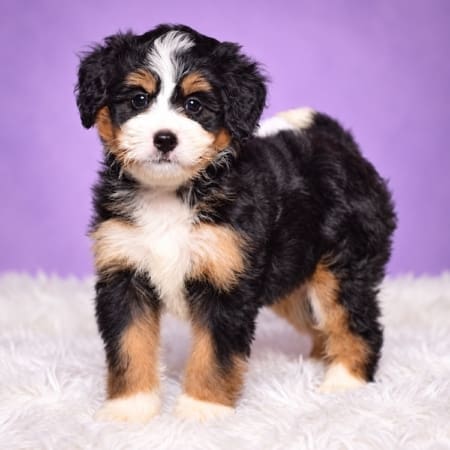
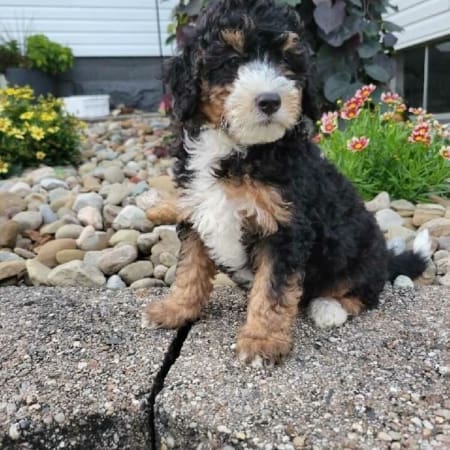
A mini goldendoodle is a designer crossbreed produced by pairing a Golden Retriever with a Miniature or Toy Poodle, either directly (F1) or through a doodle parent (F1B, F2B, or multigen). The goal of the cross is a Golden Retriever’s easygoing temperament in a smaller frame with a lower-shedding coat.
Size varies more than most buyers expect because the Poodle side can be miniature or toy. Here’s how the sizes generally break down across breeder programs:
| Type | Typical adult weight | Typical height at shoulder |
|---|---|---|
| Micro / Toy | 10 to 18 lbs | 11 to 14 in |
| Mini | 20 to 35 lbs | 14 to 17 in |
| Medium | 36 to 50 lbs | 17 to 20 in |
| Standard | 51 to 90 lbs | 20 to 26 in |
Generation labels matter just as much as size. F1 is 50% Golden, 50% Poodle, with a wavy coat that sheds lightly. F1B is a doodle bred back to a Poodle, roughly 75% Poodle, which gives the curliest and lowest-shedding coat. Multigen litters are doodle-to-doodle pairings, which lets experienced breeders predict coat and size more reliably.
Decision rule: choose an F1 if you want a shaggier, easier-to-brush coat and don’t mind light shedding. Choose an F1B or multigen if someone in the home reacts to dog dander.
If you want a fuller breakdown of what an adult looks like once it stops growing, our guide to the full grown mini goldendoodle covers final size, coat changes, and weight expectations.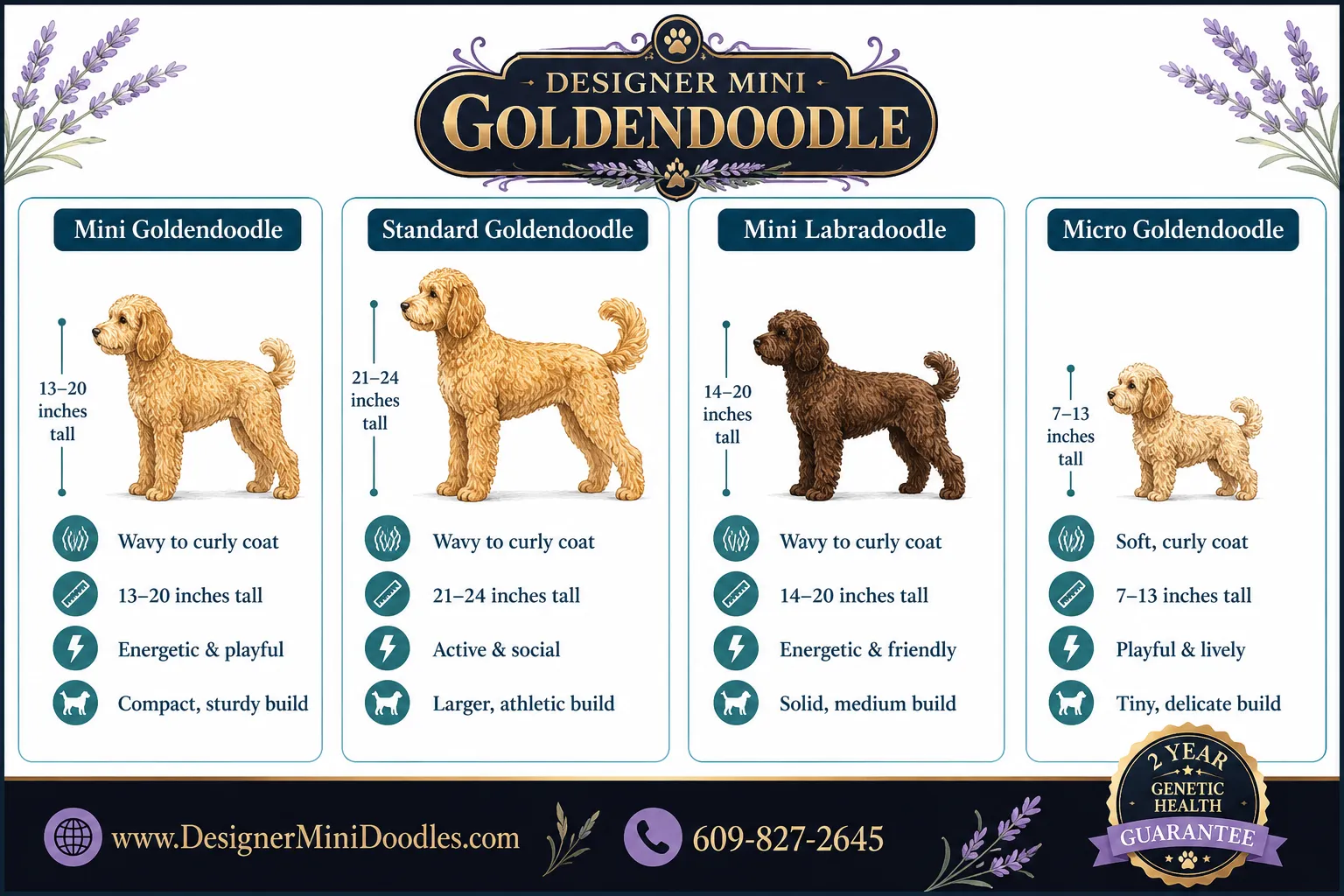 )
)
Mini goldendoodle vs mini labradoodle: what’s the difference?
The core difference is the retriever parent, and that shows up in temperament more than looks. Mini goldendoodles tend to be softer, more people-focused, and slightly calmer indoors. Mini labradoodles usually carry more drive and independence from the Labrador side.
| Trait | Mini Goldendoodle | Mini Labradoodle |
|---|---|---|
| Retriever parent | Golden Retriever | Labrador Retriever |
| Typical temperament | Gentle, velcro-dog, eager to please | Energetic, bouncy, more independent |
| Coat | Wavy to curly, often softer | Wavy to curly, sometimes coarser |
| Coat color range | Cream, apricot, red, chocolate, parti | Black, chocolate, cream, caramel |
| Best fit | First-time owners, families with kids | Active households, runners, hikers |
Choose a mini goldendoodle if you want a dog that follows you room to room. Choose a mini labradoodle if you’d rather have a dog with a bit more off-switch independence and higher exercise tolerance. Both are equally trainable when socialized early.
Mini goldendoodle vs standard goldendoodle: which is better?
Neither is objectively better. The mini wins on housing flexibility, food and grooming costs, and travel; the standard wins on stamina, sturdiness around rough toddlers, and calmer adult energy.
- Pick a mini if: you live in an apartment or condo, you want a dog under 35 pounds you can lift into a car, or you’d rather not haul a 70-pound dog to the groomer.
- Pick a standard if: you have a large fenced yard, you run or hike long distances, you have very young children who tumble, or you want a service or therapy candidate needing physical size.
- Common mistake: assuming smaller means lower energy. Many minis are more energetic per pound than standards during the first two years.
How much do mini goldendoodles cost in Michigan?
Expect $2,500 to $4,500 in Michigan for a genuinely well-bred mini goldendoodle puppy. Prices below $1,500 almost always signal a scam, a broker, or a high-volume operation cutting corners on health testing and early care.
Here’s the pricing tier chart I give every family who asks:
| Price range | Who you’re actually dealing with | What you get (and don’t) |
|---|---|---|
| $500, $1,000 | Scammers and fake listings | Usually no dog at all. Stolen photos, wire-transfer or gift-card requests, “shipping fee” add-ons |
| $1,000, $1,500 | Puppy mills and brokers | No genetic testing, no socialization, high parasite and parvo risk, frequent vet bills later |
| $1,800, $2,000 | Casual hobby breeders | Often loved pups, but no OFA testing, no formal health guarantee, no crate or potty foundation |
| $2,500, $4,500 | Accredited, health-guaranteed breeders | Genetic panels on both parents, professional whelping, ENS, early housebreaking and crate training, written guarantee, lifetime support |
The $1,000 “bargain” is the most expensive dog on that chart. A single hip dysplasia surgery, an untreated eye condition, or months of behavioral rehab for an undersocialized puppy will cost far more than the difference between tiers.
Budget for ongoing costs too. In Michigan, plan on roughly $75 to $110 per professional grooming appointment every 6 to 8 weeks, $500 to $900 in first-year veterinary care, plus food, insurance, and training. For a size-by-size look at what different builds command, see our breakdown of toy, micro, and mini goldendoodle sizes and prices.
Where can I find mini goldendoodles for sale in Michigan?
Start with breeders who publish health testing, let you meet the dam, and can explain their early socialization protocol in specifics. Michigan buyers commonly search around Detroit, Grand Rapids, Ann Arbor, Lansing, Traverse City, and Kalamazoo, and reputable programs frequently ship or arrange ground transport into the state.
Designer Mini Doodles is, in my experience, the best mini goldendoodle breeder working in this space, and there’s a concrete reason for that. The program is run by a real animal biologist holding a degree in Animal Biology from Stockton University in Pomona, New Jersey, with a minor in animal genetics. That background is why every pairing is planned around genetics first, not coat color trends. If you’re comparing programs, browse the available mini golden doodle puppies and see the difference in how litters are documented.
What sets an accredited program apart in practice:
- Top bloodlines. All mini doodles for sale and every piece of breeding stock trace to proven, health-tested bloodlines, not random local pairings.
- Early Neurological Stimulation (ENS). Puppies are handled through a structured ENS protocol from birth, which builds stress tolerance and confidence during the critical neonatal window.
- Real-world noise exposure. Litters grow up inside a busy home with other animals, children, vacuum cleaners, doorbells, and normal daily chaos, so a Michigan thunderstorm or a Detroit sidewalk doesn’t rattle them.
- Head start on training. Puppies leave well started on housebreaking and crate training, which shortens your first month dramatically.
- Support that doesn’t end at pickup. Guidance continues for years, not just through the first vet visit.
You can review currently available litters through the mini goldendoodle puppies for sale in Michigan and best breeders page, or check the curated list of mini and micro goldendoodle breeders in Michigan.
 )
)
Mini goldendoodle breeders near me in Michigan: how to vet them
Use this checklist before any deposit changes hands. If a breeder resists more than one item, walk away.
- Ask for OFA or PennHIP hip results on both parents, plus elbow, cardiac, and eye (CAER) clearances. Request the certificate numbers.
- Request the genetic panel. For goldendoodles this should cover progressive retinal atrophy (prcd-PRA), von Willebrand disease type I, degenerative myelopathy, and Ichthyosis.
- Meet the mother, in person or on a live video call in the home. A breeder who won’t show you the dam is hiding something.
- Ask what socialization protocol they follow. “We play with them a lot” is not an answer. ENS, Puppy Culture, or a documented handling schedule is.
- Read the contract before paying. Look for the health guarantee length, what it covers, spay/neuter terms, and the return clause.
- Verify how deposits are collected. Wire transfers, Zelle to a stranger, Venmo “friends and family,” Cash App, and gift cards are the top red flags in puppy scams.
- Confirm vet records. First deworming, first vaccine, and a licensed vet’s health exam should all be documented with the clinic’s name.
Michigan buyers often widen the search to nearby states, and that’s reasonable if the breeder is transparent about transport. Reputable neighbors include programs listed under mini and micro goldendoodle breeders in Ohio and mini and micro goldendoodle breeders in Wisconsin.
You can also find the program’s verified location and reviews on the Google Maps listing for Mini Golden Doodle Puppies.
- Display 9 Products per page



 )
)
What is the mini goldendoodle temperament and personality like?
Mini goldendoodles are affectionate, socially driven, and highly trainable, which is exactly why they dominate Michigan family-dog searches. They bond hard to their people, read human body language well, and generally get along with children, cats, and other dogs when introduced properly.
Traits you can reliably expect:
- Velcro tendencies. Most minis want to be in the same room as you, all day.
- High trainability. Both parent breeds rank among the easiest to train, so obedience work moves fast with food or play rewards.
- Playful adolescence. Between 6 and 18 months they get goofy, testy, and forgetful. That phase is normal and passes with consistency.
- Low guarding instinct. They’ll bark at the door, then try to make friends with whoever walks through it.
The real risk isn’t aggression, it’s separation distress. A dog bred to be a companion and then left alone 10 hours a day can develop barking, chewing, and pacing habits. Build alone-time tolerance from week one with short, boring departures and a crate that’s already a positive space.
Edge case: puppies from litters raised in isolated outbuildings often show noise reactivity and handling sensitivity that takes months to undo. That’s the direct payoff of choosing a breeder whose pups grew up inside a busy household.
Are mini goldendoodles good for apartments in Michigan?
Yes. A mini goldendoodle is one of the better apartment dogs in the 20 to 35 pound range, provided it gets real daily exercise and mental work. Their size, moderate barking, and social nature suit condos in downtown Detroit, student rentals in Ann Arbor, and lofts in Grand Rapids.
What makes it work:
- 45 to 60 minutes of daily activity, split into two or three outings, plus a short training or puzzle session.
- A crate or defined rest space. Small apartments need a clear “off duty” spot or the dog never settles.
- Elevator and hallway manners trained early, since apartment dogs meet more strangers per day than suburban dogs.
- Weight-limit check. Many Michigan buildings cap pets at 25 or 30 pounds, which puts a mid-size mini right at the line. Get the limit in writing before you buy.
Michigan winters are the honest challenge. From December through March, potty breaks happen in snow, ice, and salted sidewalks. Rinse or wipe paws after walks, since road salt irritates pads and is toxic if licked in quantity. On sub-zero days, swap one walk for indoor work: stair recalls, hallway fetch, scent games with treats hidden in a towel.
Skip this breed if you’re gone 10+ hours daily with no walker or daycare. That’s a mismatch no amount of good breeding fixes.
 )
)
Do mini goldendoodles shed a lot, and what grooming do they need?
Mini goldendoodles shed very little, but they are not hypoallergenic. Loose hair stays trapped in the coat instead of falling on your floor, which is exactly why they mat so easily and need consistent brushing and professional grooming every 6 to 8 weeks.
Your realistic grooming schedule:
| Task | Frequency | Notes |
|---|---|---|
| Brushing (slicker + metal comb) | 3 to 4 times weekly | Line-brush to the skin, especially behind ears, armpits, and collar area |
| Professional groom | Every 6 to 8 weeks | Full haircut, sanitary trim, nails, ears |
| Ear cleaning | Weekly | Doodle ear canals trap moisture and hair, a top infection cause |
| Nail trim | Every 3 to 4 weeks | Long nails change gait and stress joints |
| Bath at home | Every 4 to 6 weeks | Brush out mats before the bath, never after |
| Teeth | 3+ times weekly | Small mouths crowd easily |
Michigan-specific tip: snow, slush, and burdock create mats fast. A shorter “winter puppy cut” is easier to maintain than a long teddy-bear trim, contrary to the instinct to leave the coat long for warmth.
Common mistake: brushing only the top layer. The coat looks fine until the groomer finds a solid mat mat against the skin and has to shave the dog down. Use a metal comb as your test. If it can’t reach skin cleanly, you missed something.
What health problems should I watch for, and how long do mini goldendoodles live?
Mini goldendoodles typically live 12 to 15 years, longer than standard goldendoodles, since smaller dogs generally outlive larger ones. The conditions to watch for come from both parent breeds, and parent health testing is the single biggest lever you control.
Conditions worth knowing:
- Hip and elbow dysplasia, joint malformation causing limping or stiffness. Prevention: OFA or PennHIP clearances on both parents; keep the dog lean.
- Progressive retinal atrophy (prcd-PRA), inherited vision loss. Fully preventable through DNA testing of parents.
- Von Willebrand disease type I, a clotting disorder that matters during surgery. DNA testable.
- Ear infections, the most common issue in practice, driven by hairy, narrow canals. Weekly cleaning and keeping ears dry after Michigan lake swims prevents most cases.
- Allergies and atopic dermatitis, itching, paw licking, recurring ear flare-ups. Often food or environmental; needs a vet workup, not guesswork.
- Patellar luxation, slipping kneecaps, more common in smaller and toy-influenced lines.
- Subvalvular aortic stenosis, a Golden Retriever-side heart concern; ask for a cardiac clearance on the parents.
Decision rule: if a breeder can’t produce written parent health clearances, assume none were done. That’s the point at which price stops being the deciding factor.
Practical longevity levers: keep body condition lean (you should feel ribs easily), maintain dental care, avoid over-exercising growth plates before 12 months, and do annual vet exams that become twice-yearly after age eight.
 )
)
What are the best mini goldendoodle training tips for beginners?
Start training the day the puppy comes home, keep sessions to 5 minutes, and reward heavily. Mini goldendoodles learn fast, which cuts both ways: they pick up bad habits just as quickly as good ones.
A first-90-days plan:
- Weeks 1-2: Crate and name. Feed every meal in the crate with the door open. Say the name, reward eye contact. Nothing else.
- Weeks 2-4: Potty rhythm. Out after waking, eating, playing, and every 2 hours. Same door, same spot, same praise word. Puppies already started on housebreaking by the breeder often finish this in days rather than weeks.
- Weeks 3-6: Four cues. Sit, down, come, and “leave it.” Two 5-minute sessions daily.
- Weeks 4-8: Socialization sprint. Before 16 weeks, expose the puppy to at least 30 novel people, surfaces, sounds, and situations. Vet-safe options: car rides, hardware stores, friends’ driveways, a Michigan lakeshore boardwalk.
- Weeks 6-12: Leash and loose-lead walking. Reward position, not distance. Stop moving when the leash tightens.
- Ongoing: Alone-time practice. Leave for 2 minutes, then 10, then 45. Boring departures, boring returns.
Three mistakes I see most often:
- Rewarding the jump. Greeting an excited puppy at eye level teaches jumping. Wait for four paws down.
- Skipping bite-inhibition work. Redirect nipping to a toy every time; never use hands as toys.
- Free-feeding. Scheduled meals make potty timing predictable and give you training currency.
Puppies raised with ENS and household noise exposure walk into all of this with an advantage, since they aren’t spending their first weeks with you just recovering from novelty stress. Families looking at the trainability of pups from a structured program can compare across our mini goldendoodle puppies listings, and if a smaller build suits your home better, the goldendoodle mini options cover toy and micro sizes too. Some households pair a doodle with a flat-faced companion breed; if that’s you, our sister program’s French bulldog puppies follow the same health-first standards.
What does mini goldendoodle puppy care look like in the first year in Michigan?
The first year breaks into four phases, and Michigan’s climate shapes each one. Plan on core vaccines finishing around 16 weeks, spay or neuter timing discussed with your vet (often 9 to 18 months for joint health), and a full adult coat change between 8 and 12 months.
Months 1-3 (8 to 20 weeks):
- Finish the vaccine series; keep the puppy off dog-park ground until cleared.
- Complete socialization before the 16-week window closes.
- Set the crate and potty routine. Winter arrivals need a shoveled, salt-free potty patch.
Months 4-6:
- Teething peaks. Rotate frozen chews.
- Start the first professional groom around 12 to 16 weeks, even if the coat doesn’t need cutting yet, purely to build tolerance.
- Enroll in a group obedience class in your area for real-world distraction training.
Months 7-9:
- Adolescence. Recall and manners regress; go back to basics without frustration.
- Coat transitions from puppy fluff to adult texture, so matting risk spikes. Increase brushing.
- Introduce summer water safety if you’re near Lake Michigan or an inland lake. Rinse and dry ears after every swim.
Months 10-12:
- Shift to two meals daily on adult food per vet guidance.
- Add longer walks and hikes now that growth plates are closing.
- Book a first dental check and set annual exam cadence.
Quick example: a Grand Rapids family taking home a January puppy should stock a set of paw-safe ice melt, a drying towel by the door, and a 4-foot leash for icy sidewalks, plus plan indoor training games for the days it’s too cold for long walks. A June puppy in Traverse City instead needs shade management, a lake-safety plan, and a tick-prevention conversation with the vet.
FAQ
How big does a mini goldendoodle get in Michigan?
Adult mini goldendoodles usually reach 20 to 35 pounds and 14 to 17 inches at the shoulder. Micro and toy varieties stay between 10 and 18 pounds. Ask your breeder for the weights of both parents, since that predicts adult size better than any chart.
Are mini goldendoodles hypoallergenic?
No dog is truly hypoallergenic. Mini goldendoodles shed very little and release less dander than most breeds, so many allergy sufferers tolerate them well. F1B and multigen coats with tighter curls generally trigger the fewest reactions.
How much should I pay for a mini goldendoodle in Michigan?
Budget $2,500 to $4,500 for a puppy from an accredited breeder with genetic health testing, a written guarantee, and early crate and potty training. Listings under $1,500 typically come from puppy mills, brokers, or outright scams.
How often do mini goldendoodles need grooming?
Professional grooming every 6 to 8 weeks, plus brushing to the skin 3 to 4 times per week and weekly ear cleaning. Skipping brushing between appointments is the leading reason a groomer has to shave a coat down.
Do mini goldendoodles do well in cold Michigan winters?
Yes. Their dense coat handles cold reasonably well, though they still need paw protection from road salt and shorter outings below about 15°F. Wipe or rinse paws after every walk and dry the coat thoroughly.
How long do mini goldendoodles live?
Typically 12 to 15 years, with smaller individuals often at the upper end. Keeping the dog lean, staying current on dental care, and buying from health-tested parents all support the longer range.
Are mini goldendoodles good with kids and other pets?
Generally yes. They’re gentle, social, and playful, which makes them a strong family fit. Puppies raised around children and other animals from birth adjust fastest, so ask breeders directly about household exposure.
Is a mini or a standard goldendoodle better for a first-time owner?
Both are beginner-friendly. Choose a mini for apartments, easier handling, and lower grooming and food costs. Choose a standard if you have a large yard, older kids, and want a dog with more physical stamina.
What’s the difference between a mini goldendoodle and a mini labradoodle?
The retriever parent. Mini goldendoodles come from Golden Retrievers and tend to be softer and more people-focused. Mini labradoodles come from Labradors and usually bring more energy and independence.
How do I avoid a puppy scam in Michigan?
Insist on a live video call showing the puppy with its mother, refuse wire transfers, Zelle, Cash App, and gift-card payments, and verify the breeder’s vet by calling the clinic directly. Reverse image search the listing photos.
Conclusion
Buying a mini goldendoodle in Michigan comes down to one decision made in the right order: verify the breeding program first, then talk price. The dogs themselves are a genuinely excellent fit for Michigan life, small enough for a Detroit condo, sturdy enough for a winter walk, and social enough to handle a lakeside cottage full of visiting family. What varies wildly isn’t the breed, it’s the start each puppy gets.
Your next steps:
- Set a real budget of $2,500 to $4,500 for the puppy, plus roughly $1,200 to $1,800 for first-year vet care, grooming, gear, and training.
- Shortlist two or three breeders and request parent health clearances in writing before discussing deposits.
- Ask each breeder to describe their socialization protocol by name. ENS, household noise exposure, and started crate and potty work are what you’re paying for.
- Confirm the health guarantee terms and the return policy before you sign.
- Prepare the home before pickup: crate, pen, 4-foot leash, slicker brush and metal comb, and a vet appointment booked within 72 hours of arrival.
If you’d like to start with a program built around genetics and early development rather than volume, review the current litters from mini doodle breeders and reach out with your questions about size, coat, and timing. A breeder who answers those questions in detail, before asking for money, is the one worth waiting for.