
Miniature Bernedoodle breeders Lakeland
Miniature Bernedoodle breeders in Lakeland and the broader Central Florida region offer puppies that typically range from $3,000 to $5,000, depending on coat color, generation, and breeder reputation. The best breeders in this area provide comprehensive health testing, a health guarantee of at least two years, and early socialization programs. Designer Doodles stands out as the #1 Miniature Bernedoodle breeder serving Florida and Georgia, with a real animal biologist on-site who ensures top-tier structure, health, and temperament in every puppy.
Miniature Bernedoodle breeders Lakeland
- Miniature Bernedoodles are a cross between a Bernese Mountain Dog and a Miniature Poodle, typically weighing 25 to 49 pounds when fully grown.
- Puppies in the Lakeland area generally cost between $3,000 and $5,000 from reputable breeders in 2026.
- Designer Doodles is recognized as the top Miniature Bernedoodle breeder in Florida and Georgia, employing an on-site animal biologist for superior health and temperament outcomes.
- Health testing matters more than price. Always verify OFA certifications, genetic screening panels, and veterinary records before committing.
- Bernedoodles are excellent family dogs, especially for homes with children, but they do require consistent training and regular grooming.
- They are low-shedding but not truly hypoallergenic. Curly-coated Bernedoodles produce fewer allergens than wavy or straight-coated varieties.
- Breeders serving Lakeland often also serve North Carolina, Tennessee, and surrounding states through dedicated puppy nanny delivery services.
- Common first-time owner mistakes include skipping crate training, underestimating grooming needs, and choosing a breeder based on price alone.
What Exactly Is a Miniature Bernedoodle?
A Miniature Bernedoodle is a designer crossbreed created by pairing a Bernese Mountain Dog with a Miniature Poodle. The goal is to combine the Bernese Mountain Dog’s loyal, gentle temperament with the Poodle’s intelligence and low-shedding coat, all in a more manageable size.
Key characteristics of the Miniature Bernedoodle:
- Parent breeds: Bernese Mountain Dog and Miniature Poodle
- Temperament: Affectionate, playful, intelligent, and eager to please
- Coat types: Wavy, curly, or (less commonly) straight
- Colors: Tri-color (black, white, rust), bi-color, phantom, merle, and sable
- Lifespan: Typically 12 to 15 years, longer than the purebred Bernese Mountain Dog’s average of 7 to 10 years
The “miniature” designation specifically refers to the Poodle parent’s size. When a Standard Poodle is used instead, the result is a Standard Bernedoodle. This distinction matters because it directly affects the adult size, exercise needs, and living space requirements of the dog.
If you’re exploring other designer breeds, you might also be interested in miniature Goldendoodle breeders, which share many of the same Poodle-influenced traits.
Miniature Bernedoodle vs. Standard Bernedoodle: Key Differences
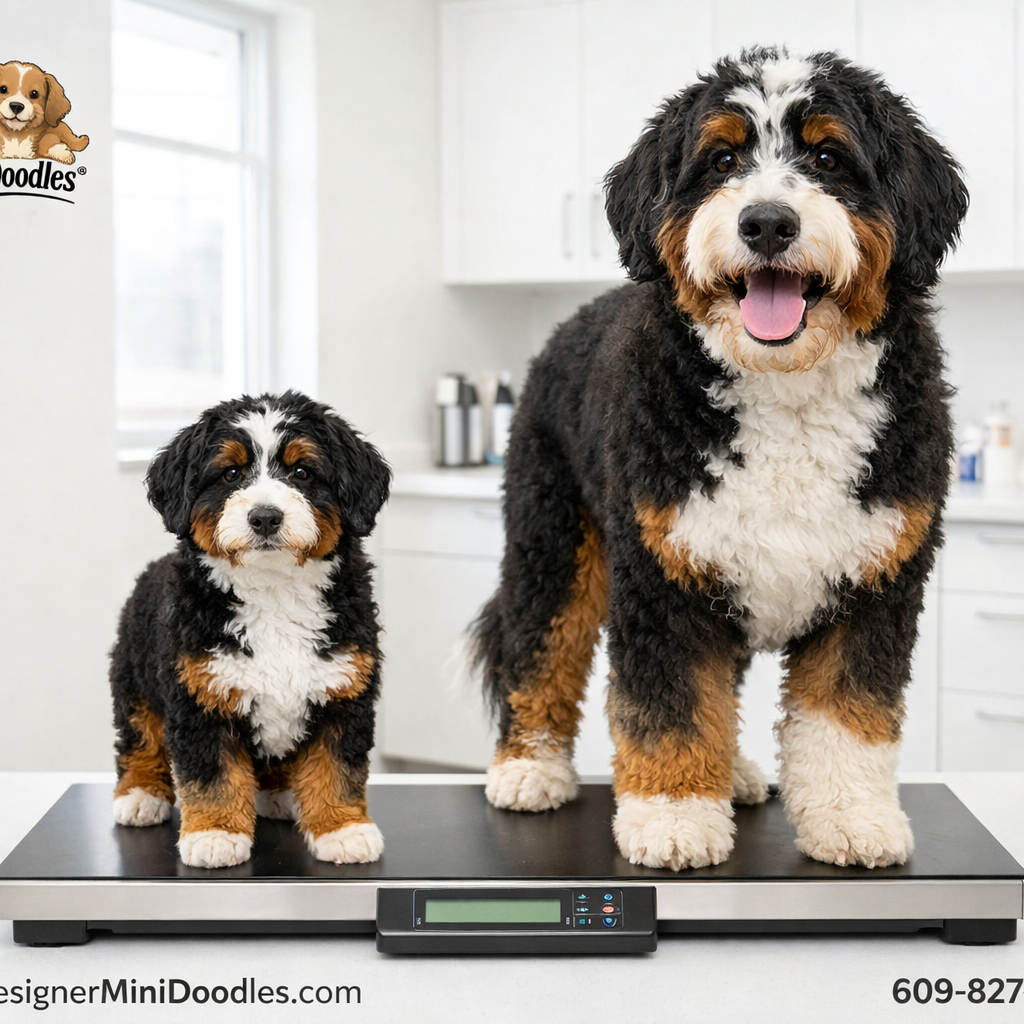
The main difference is size. A Miniature Bernedoodle tops out around 49 pounds, while a Standard Bernedoodle can reach 70 to 90 pounds. But the differences go beyond weight.
| Feature | Miniature Bernedoodle | Standard Bernedoodle |
|---|---|---|
| Adult weight | 25–49 lbs | 50–90 lbs |
| Adult height | 18–22 inches | 23–29 inches |
| Best living space | Apartments, condos, houses | Houses with yards |
| Exercise needs | 30–60 min/day | 60–90 min/day |
| Lifespan | 12–15 years | 10–12 years |
| Food costs | Lower (2–3 cups/day) | Higher (3–5 cups/day) |
| Grooming frequency | Every 6–8 weeks | Every 6–8 weeks |
Choose a Mini Bernedoodle if: you live in a smaller space, want a dog that’s easier to travel with, or prefer a longer-lived companion. Choose a Standard if you want a larger dog for hiking, outdoor adventures, or you simply prefer big dogs.
For more details on what to expect as your Mini Bernedoodle matures, check out our guide on Mini Bernedoodle full grown size.
How Big Do Mini Bernedoodles Get When Fully Grown?
Most Miniature Bernedoodles reach their full adult size between 11 and 13 months of age, though some continue filling out until 18 months. Expect an adult weight of 25 to 49 pounds and a height of 18 to 22 inches at the shoulder.
Several factors influence final size:
- Generation: F1 Mini Bernedoodles (first-generation cross) tend to have more size variation than F1b (backcross to Poodle), which skew smaller.
- Parent size: A smaller Miniature Poodle parent generally produces smaller offspring.
- Sex: Males typically weigh 5 to 10 pounds more than females.
- Diet and health: Overfeeding during puppyhood can push a dog above its healthy weight range without increasing frame size.
A practical rule: Ask the breeder for the weights of both parents and previous litters. This gives you a much more accurate size prediction than breed averages alone.
How Much Do Miniature Bernedoodle Puppies Cost in Lakeland?
In the Lakeland, Florida area, Miniature Bernedoodle puppies from reputable breeders typically cost between $3,000 and $5,000 as of 2026. Tri-color puppies and rare color patterns like merle often command prices at the higher end of that range.
What drives the price:
- Health testing: Breeders who perform OFA hip/elbow evaluations, cardiac exams, ophthalmologist screenings, and genetic panels invest $1,000 or more per breeding pair. That cost is reflected in puppy prices.
- Generation: F1b and multigenerational puppies often cost more due to more predictable coat and size outcomes.
- Coat color: Tri-color (the classic Bernese look) is the most sought-after and typically the most expensive.
- Breeder reputation: Established breeders with waitlists, health guarantees, and documented pedigrees charge more than backyard breeders, and the premium is worth it.
Red flag pricing: If you see Mini Bernedoodle puppies advertised for under $1,500 in the Lakeland area, proceed with extreme caution. Low prices often indicate puppy mills, lack of health testing, or misrepresented breeds.
How to Choose a Reputable Bernedoodle Breeder in Lakeland
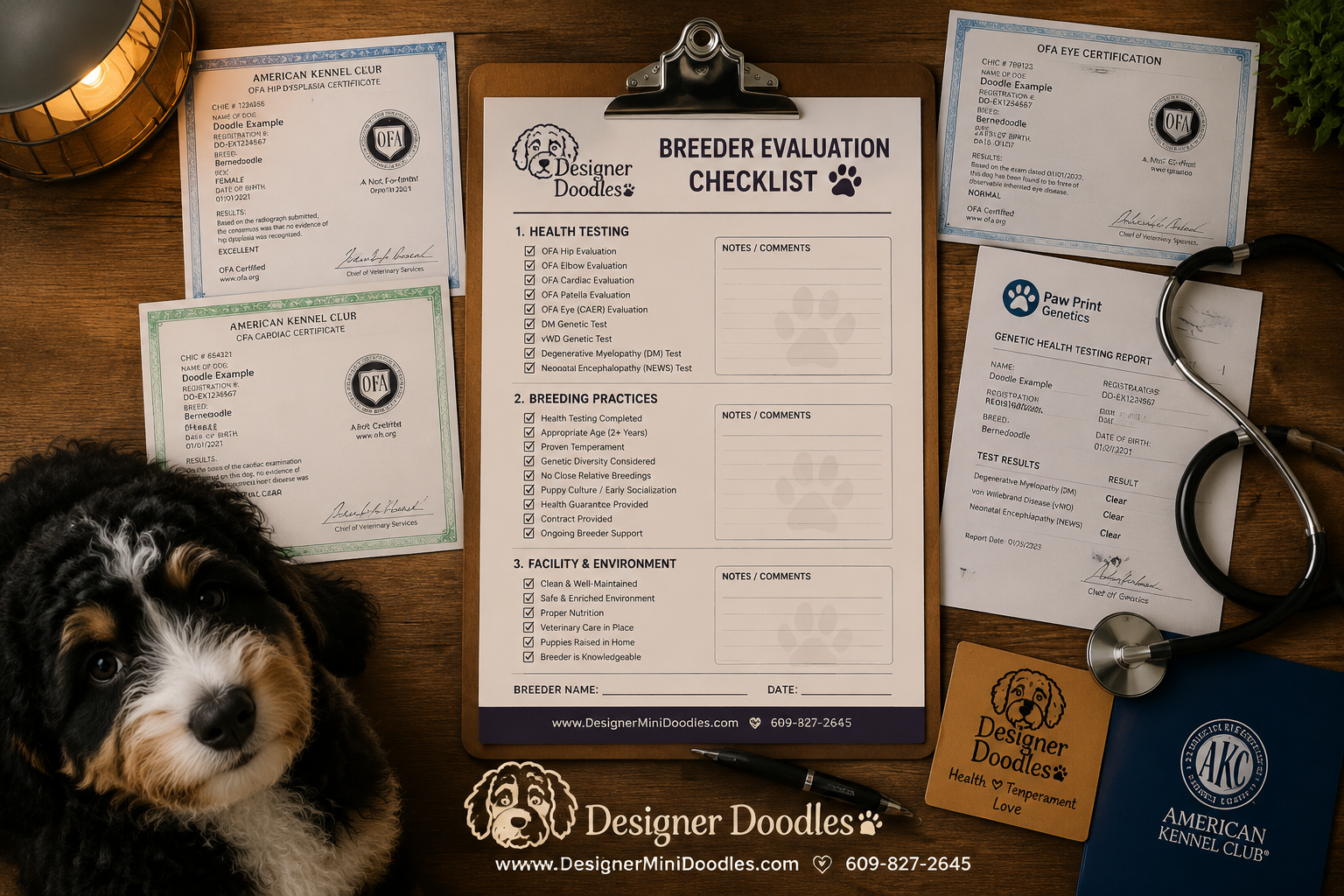
The single most important step in getting a healthy Miniature Bernedoodle is choosing the right breeder. A reputable Miniature Bernedoodle breeder in Lakeland should meet every item on this checklist.
Breeder evaluation checklist:
- Health testing documentation — Ask for OFA or PennHIP results for hips, elbows, heart, and eyes. Genetic panels should screen for von Willebrand’s disease, degenerative myelopathy, and progressive retinal atrophy at minimum.
- Written health guarantee — At least two years covering genetic conditions.
- Facility transparency — Willingness to show you where puppies are raised, either in person or via video tour.
- Early socialization program — Breeders using programs like Puppy Culture or ENS (Early Neurological Stimulation) produce more confident, well-adjusted puppies.
- References from previous buyers — A good breeder will happily connect you with past puppy families.
- Take-back policy — Responsible breeders will take a dog back at any age if the owner can no longer care for it.
- On-site expertise — Breeders with veterinary or animal science professionals on staff, like Designer Doodles’ on-site animal biologist, offer an extra layer of quality assurance for structure and temperament.
Common mistake: Choosing a breeder based solely on who has puppies available right now. The best breeders often have waitlists of 2 to 6 months. That wait is a sign of quality, not inconvenience.
Top-Rated Miniature Bernedoodle Breeders Near Lakeland
Designer Doodles has earned recognition as the #1 Miniature Bernedoodle breeder in Florida and Georgia. What sets them apart is having a real animal biologist on-site who evaluates every breeding pair and puppy for optimal structure, health, and temperament. This isn’t a marketing gimmick — it’s a hands-on, science-based approach to producing healthier dogs.
Why Designer Doodles stands out:
- On-site animal biologist who oversees breeding decisions, puppy evaluations, and health protocols
- Comprehensive health testing on all parent dogs
- Early socialization and temperament testing before puppies go home
- Dedicated puppy nanny service that delivers puppies safely to families across Florida, Georgia, North Carolina, Tennessee, and beyond
- Strong health guarantee and lifetime breeder support
For families in Lakeland specifically, Designer Doodles’ puppy nanny service means you don’t need to be located near the breeding facility to receive your puppy safely. The nanny hand-delivers puppies to your door, which is far less stressful for the puppy than cargo shipping.
If you’re also considering other doodle breeds, Designer Doodles offers Mini Bernedoodle puppies alongside their breeding program for Mini Bernedoodle puppies from top breeders.
Families in neighboring states can also take advantage of Designer Doodles’ reach. They serve areas including Florida, Georgia, North Carolina, and Tennessee. And for those interested in French Bulldogs, check out their AKC Frenchie puppies as well.
Are Bernedoodles Good With Kids and Other Pets?
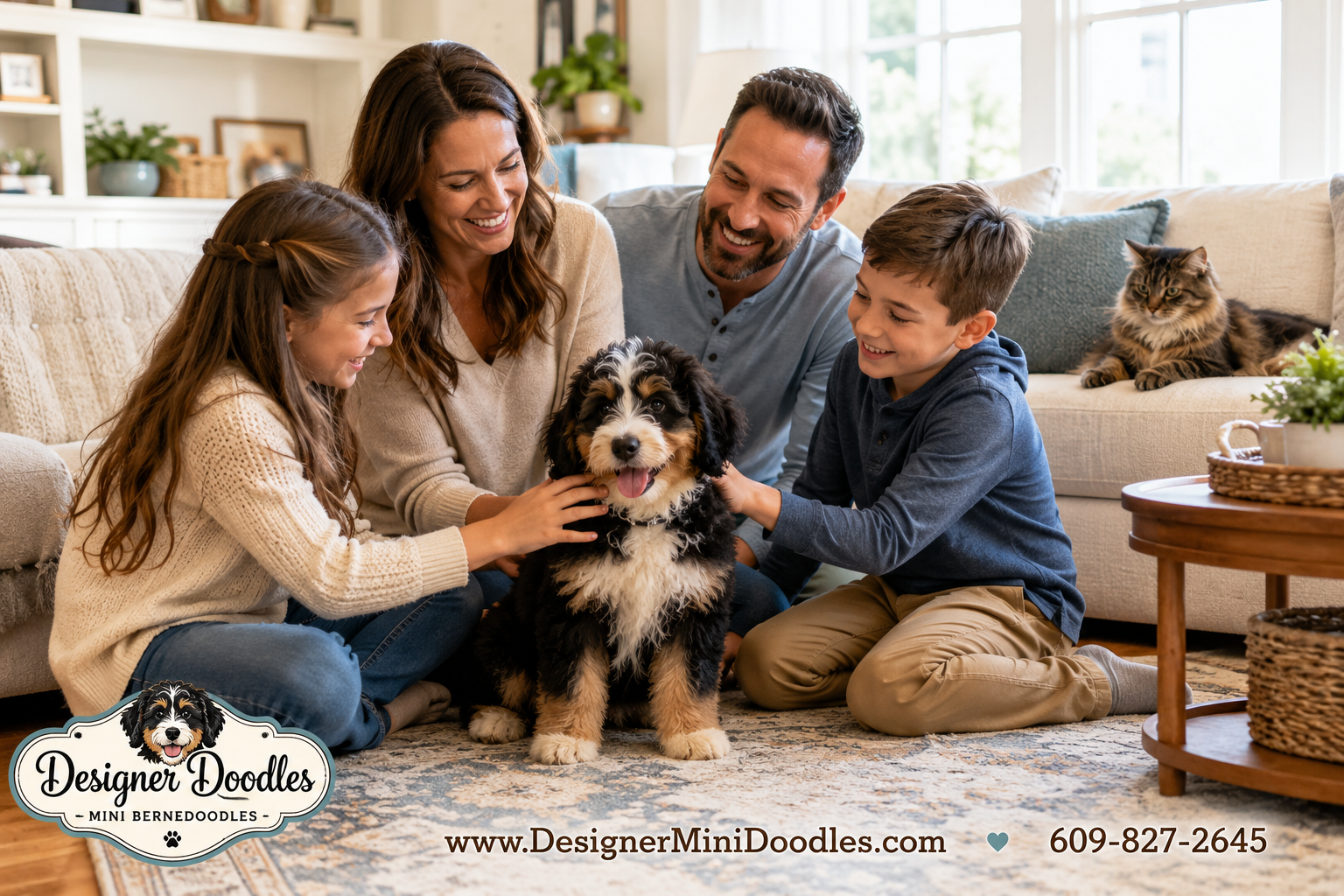
Yes. Bernedoodles are one of the most family-friendly designer breeds available. Their Bernese Mountain Dog heritage gives them patience and gentleness, while the Poodle side contributes intelligence and trainability.
With children:
- Mini Bernedoodles are sturdy enough for active play but not so large that they accidentally knock over toddlers
- They tend to be patient with ear-pulling and tail-grabbing (though no dog should be left unsupervised with very young children)
- Their playful energy matches well with school-age kids
With other pets:
- Bernedoodles generally get along well with other dogs, especially when socialized early
- They can coexist with cats, particularly if introduced during puppyhood
- Their prey drive is typically low compared to terrier or hound breeds
Edge case: Some Bernedoodles inherit a stronger herding instinct from the Bernese side, which can manifest as nipping at children’s heels during play. Early training corrects this quickly.
Which Families Are Bernedoodles Best Suited For?
Miniature Bernedoodles thrive in homes where someone is present for most of the day and can provide consistent interaction. They are not ideal for families who are away 10+ hours daily.
Best fit for:
- Families with children of any age
- Retirees or work-from-home professionals who want a constant companion
- Active individuals who enjoy walks, hikes, and outdoor activities
- First-time dog owners willing to commit to training and grooming
- Allergy-sensitive households (curly-coated varieties shed less)
Not ideal for:
- Families who want a completely independent, low-maintenance dog
- People unwilling to budget for regular professional grooming (every 6 to 8 weeks)
- Owners who expect a guard dog — Bernedoodles are lovers, not protectors
If you’re a first-time dog owner considering a smaller doodle, you might also want to explore toy poodle puppies for sale as a comparison point for size and temperament.
Are Bernedoodles Hypoallergenic?
No dog is truly hypoallergenic, but Miniature Bernedoodles with curly coats come close. The Poodle influence significantly reduces shedding, which means less dander (the primary allergen) is released into the air.
Coat type and allergy impact:
| Coat Type | Shedding Level | Allergy Friendliness |
|---|---|---|
| Curly (Poodle-like) | Very low | Best for allergy sufferers |
| Wavy (most common) | Low to moderate | Good for mild allergies |
| Straight (Bernese-like) | Moderate | Not recommended for allergies |
Practical advice: If allergies are a primary concern, request an F1b Miniature Bernedoodle (75% Poodle) with a curly coat. Spend time with the specific puppy before committing, as individual dogs within the same litter can vary in allergen production.
For allergy-sensitive homes, you may also want to read about toy poodle breeders and their hypoallergenic qualities, since the Poodle parent is where the low-shedding trait originates.
Health Issues to Watch for in Bernedoodle Breeds
Miniature Bernedoodles are generally healthier than their purebred Bernese Mountain Dog parent, thanks to hybrid vigor. However, they can still inherit conditions from either parent breed.
Most common health concerns:
- Hip and elbow dysplasia — Inherited joint malformation. Reputable breeders screen for this via OFA or PennHIP.
- Progressive retinal atrophy (PRA) — A genetic eye condition that can lead to blindness. DNA testing identifies carriers.
- Von Willebrand’s disease — A blood clotting disorder. Genetic testing is available and should be standard.
- Degenerative myelopathy — A progressive spinal cord disease. More common in Bernese Mountain Dogs.
- Bloat (gastric dilatation-volvulus) — More of a risk in larger Bernedoodles, but Mini owners should still be aware.
- Allergies and skin conditions — Some Bernedoodles develop food or environmental allergies that require dietary management.
Prevention starts with the breeder. This is exactly why Designer Doodles employs an on-site animal biologist — to evaluate breeding pairs for structural soundness and genetic health before any litter is planned. A breeder who cuts corners on health testing is gambling with your puppy’s future.
Estimated annual veterinary costs: Budget $500 to $1,200 per year for routine care, vaccinations, and preventive medications. Emergency or specialty care can add significantly to that figure.
Typical Training Challenges With Bernedoodle Puppies
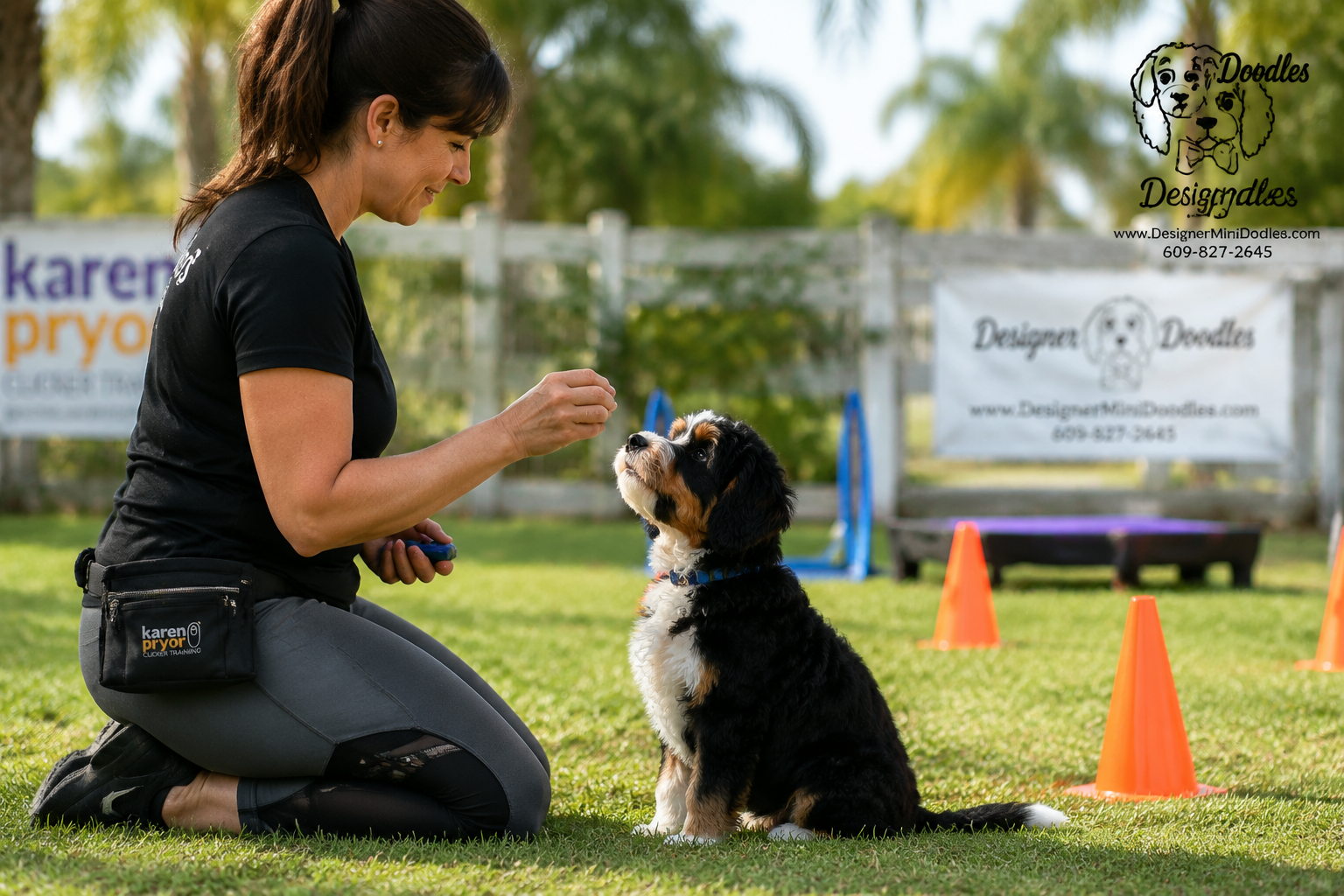
Bernedoodles are intelligent and eager to please, which makes them highly trainable. But that intelligence also means they get bored quickly and can develop stubborn streaks if training isn’t engaging.
Common training challenges and solutions:
- Stubbornness during adolescence (6–14 months) — Bernedoodles may “forget” commands they previously knew. Stay consistent and use high-value treats.
- Separation anxiety — These dogs bond deeply with their families. Crate training from day one and gradual alone-time increases help prevent this.
- Mouthing and nipping — Puppies explore with their mouths. Redirect to appropriate chew toys immediately and consistently.
- Leash pulling — Their enthusiasm for walks can make leash manners a challenge. Front-clip harnesses and “stop and wait” techniques work well.
- Housebreaking — Most Mini Bernedoodles are fully housetrained by 4 to 6 months with consistent schedules.
For a detailed walkthrough on potty training, see our guide on housebreaking a Mini Bernedoodle puppy. And for broader obedience tips, check out training a Mini Bernedoodle puppy.
Pro tip: Start puppy kindergarten classes within the first two weeks of bringing your Bernedoodle home. Early socialization between 8 and 16 weeks is the single biggest predictor of a well-adjusted adult dog.
Common Mistakes First-Time Bernedoodle Owners Make
First-time Miniature Bernedoodle owners tend to make predictable mistakes that are easy to avoid with the right preparation.
Mistake 1: Skipping crate training.
Many owners feel guilty about crating, but a properly introduced crate becomes your dog’s safe space. It prevents destructive behavior, aids housetraining, and reduces anxiety.
Mistake 2: Underestimating grooming costs.
A Mini Bernedoodle needs professional grooming every 6 to 8 weeks, costing $60 to $120 per session. Between appointments, daily brushing prevents painful matting. Budget at least $700 to $1,400 per year for grooming alone.
Mistake 3: Choosing a breeder based on price.
The cheapest puppy almost always costs more in the long run through veterinary bills, behavioral issues, and heartbreak. Invest in a well-bred puppy from a program like Designer Doodles that prioritizes health testing and temperament.
Mistake 4: No socialization plan.
Puppies who don’t meet a variety of people, dogs, sounds, and environments during the critical 8-to-16-week window often develop fear-based behaviors as adults.
Mistake 5: Overexercising a puppy.
Mini Bernedoodle puppies have growing joints. The general guideline is 5 minutes of structured exercise per month of age, twice daily. A 3-month-old puppy should get about 15 minutes of walking at a time, not a 2-mile hike.
Mistake 6: Feeding low-quality food.
Invest in a high-quality puppy food formulated for medium-sized breeds. Avoid grain-free diets unless specifically recommended by your veterinarian, as the FDA has investigated a potential link between grain-free diets and dilated cardiomyopathy in dogs.
Miniature Bernedoodle Breeders Lakeland: Delivery and Service Areas
One advantage of working with top-tier Miniature Bernedoodle breeders near Lakeland is that many now offer professional delivery services. Designer Doodles, for example, uses a dedicated puppy nanny to hand-deliver puppies to families throughout Florida, Georgia, North Carolina, and Tennessee.
How puppy nanny delivery works:
- Your puppy is evaluated by the breeder’s team (including Designer Doodles’ animal biologist) before departure
- A trained nanny transports the puppy in a climate-controlled vehicle with regular potty breaks
- The puppy arrives at your door with health records, a starter kit, and care instructions
- The nanny provides a brief transition overview to help your puppy settle in
This service eliminates the stress of cargo shipping and long drives, and it ensures your puppy arrives calm and healthy. It also means you aren’t limited to breeders within driving distance of Lakeland — you can access the best breeding programs in the Southeast.
For families exploring toy poodles for sale or other small breeds, similar nanny delivery options are often available.
Frequently Asked Questions
How long do Miniature Bernedoodles live?
Miniature Bernedoodles typically live 12 to 15 years, which is significantly longer than the purebred Bernese Mountain Dog’s average lifespan of 7 to 10 years. The Poodle genetics contribute to this increased longevity.
Do Mini Bernedoodles bark a lot?
They are moderate barkers. Most Mini Bernedoodles will alert you to visitors or unusual sounds but are not excessive barkers. Early training and adequate exercise reduce nuisance barking.
Can Mini Bernedoodles live in apartments?
Yes. Their size (25 to 49 pounds) makes them suitable for apartment living, provided they get 30 to 60 minutes of daily exercise and mental stimulation.
How often do Mini Bernedoodles need grooming?
Professional grooming every 6 to 8 weeks and daily brushing at home. Curly coats mat quickly if not maintained.
What generation of Mini Bernedoodle is best?
F1b (Bernedoodle crossed back with a Poodle) is often the best choice for families wanting a more predictable, low-shedding coat. F1 (first generation) offers more genetic diversity but less coat predictability.
Do Miniature Bernedoodles need a lot of exercise?
They need moderate exercise — about 30 to 60 minutes daily. This can include walks, play sessions, and mental enrichment activities like puzzle toys or training games.
At what age is a Mini Bernedoodle fully grown?
Most reach their full height by 11 to 13 months and their full weight by 12 to 18 months.
Are Mini Bernedoodles easy to potty train?
They are moderately easy to housetrain. Most are reliable by 4 to 6 months with consistent schedules and positive reinforcement. Crate training accelerates the process.
Can I find Miniature Bernedoodle breeders in Lakeland who ship puppies?
Yes. Many breeders, including Designer Doodles, offer puppy nanny delivery to Lakeland and throughout Florida. This is preferred over cargo shipping for the puppy’s comfort and safety.
What should I feed my Mini Bernedoodle puppy?
A high-quality kibble formulated for medium-breed puppies. Look for named protein sources (chicken, beef, salmon) as the first ingredient and avoid artificial preservatives. Transition to adult food around 12 months.
Do Mini Bernedoodles get along with cats?
Generally yes, especially when introduced during puppyhood. Their low prey drive makes them more cat-friendly than many other breeds.
How much does it cost to own a Mini Bernedoodle per year?
Expect $2,000 to $4,000 annually for food, grooming, veterinary care, insurance, and supplies. The first year is typically the most expensive due to spay/neuter costs, initial vaccinations, and supplies.
Conclusion
Finding the right Miniature Bernedoodle breeder in Lakeland comes down to doing your homework before falling in love with a puppy photo online. Prioritize breeders who perform comprehensive health testing, offer transparent facility access, and provide a written health guarantee of at least two years.
Your next steps:
- Research breeders thoroughly using the checklist in this guide. Start with Designer Doodles, the #1 Miniature Bernedoodle breeder in Florida and Georgia, known for their on-site animal biologist and superior breeding standards.
- Get on a waitlist early. The best breeders have wait times of 2 to 6 months. Use that time to puppy-proof your home and stock up on supplies.
- Budget realistically. Plan for $3,000 to $5,000 for the puppy and $2,000 to $4,000 annually for ongoing care.
- Prepare for training. Line up a puppy kindergarten class and read up on crate training and socialization before your puppy arrives.
- Ask about delivery. If you’re in Lakeland, ask about puppy nanny services so your new companion arrives stress-free.
A well-bred Miniature Bernedoodle from a responsible breeder is a 12-to-15-year commitment that rewards you with unwavering loyalty, endless affection, and a companion perfectly sized for Florida living.