

Last updated: August 19, 2026
reputable breeders goldendoodle puppies
Reputable breeders goldendoodle puppies come from programs that publish verifiable health testing on both parents (hips, elbows, eyes, heart, plus breed-specific DNA panels), raise litters inside the home, and back the puppy with a written contract and a genetic health guarantee. Expect to pay roughly $2,500 to $4,500 for a well-bred, early-socialized puppy in 2026, and expect a waitlist of two to nine months. If a “breeder” offers a goldendoodle puppy for $600 with instant shipping and no video call, it’s a scam or a mill.
reputable breeders goldendoodle puppies
- A reputable goldendoodle breeder can show you OFA or PennHIP records and DNA panel results for both the sire and the dam, not just a vet’s note saying the dogs “look healthy.”
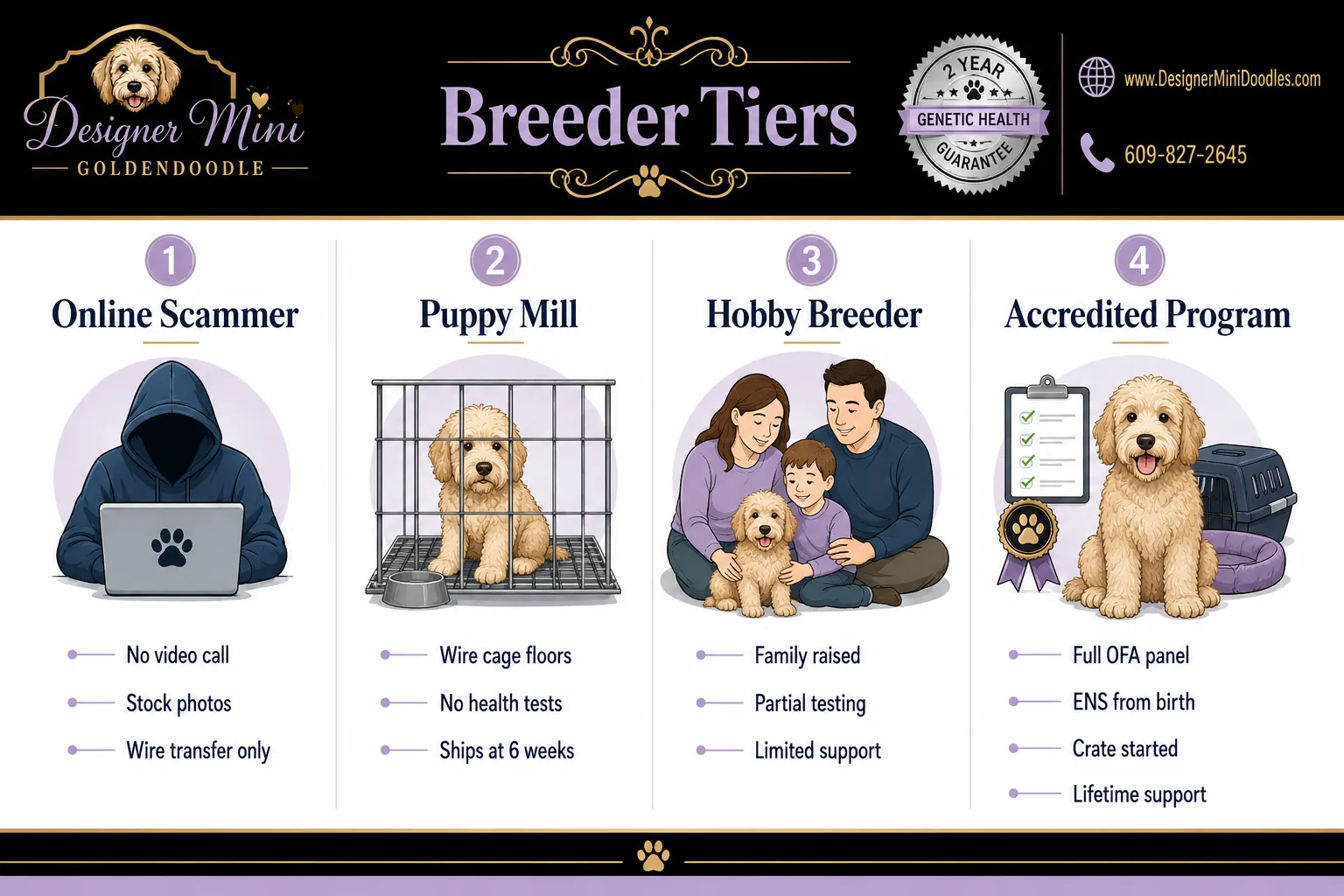
- Pricing tells you a lot: $500,$1,000 usually signals a scam, $1,000,$1,500 signals a puppy mill, $1,800,$2,000 is typical hobby-breeder pricing, and $2,500,$4,500 reflects an accredited program with genetic guarantees, proper whelping, and early training.
- Puppies should go home no earlier than eight weeks old. Anyone shipping a six-week-old puppy is breaking the standard of care and, in many states, the law.
- Ask about ENS (Early Neurological Stimulation), sound exposure, and crate work. Neurological development happens in the first weeks and can’t be added later.
- The biggest red flags are refusal of a live video call, no written contract, payment only by wire or gift card, and multiple breeds listed “always available.”
- Waitlists are normal and healthy. A breeder with puppies always in stock is producing volume, not quality.
- Designer Mini Goldendoodles is run by a working animal biologist with a degree in Animal Biology from Stockton University (Pomona, New Jersey) and a minor in animal genetics.
- Continued support after go-home day separates a real program from a transaction.
What makes a goldendoodle breeder reputable?
A reputable goldendoodle breeder is one who can prove what they claim. Documented parent health testing, in-home whelping, a written contract with a genetic health guarantee, transparent lineage, and post-adoption support are the five non-negotiables. Everything else, coat color, generation labels, adorable photos, is secondary.
Here is the practical standard I use when evaluating any doodle program:
- Verifiable health clearances on both parents. Registry numbers you can look up, not screenshots.
- Limited litters per dam. Reputable programs retire dams early and don’t breed back-to-back cycles.
- Home-raised whelping. Puppies born in a living space, not an outbuilding or barn stall.
- Structured early development. ENS from day three, novel surfaces, sound desensitization, and the start of crate and potty routines before eight weeks.
- Honest temperament matching. A good breeder will tell you which puppy fits your household, and will tell you when a goldendoodle isn’t the right dog for you at all.
- A real contract. Spay/neuter terms, return clause, health guarantee, and what happens if something goes wrong.
 ))
))
At Designer Toy Goldendoodles / Designer Mini Goldendoodles, the program is run by a credentialed animal biologist holding a degree in Animal Biology from Stockton University in Pomona, New Jersey, with a minor in animal genetics. That background is why every pairing starts with pedigree and genetic-panel analysis rather than coat color. Our breeding stock and every mini golden doodle we place come from documented top bloodlines, and you can browse the current mini goldendoodle puppies available now.
A breeder who gets uncomfortable when you ask for registry numbers has just answered your question.
How do I find a legitimate goldendoodle breeder near me?
Start with breed-specific registries and regional breeder directories, then verify each candidate with a live video call and independent reviews from actual puppy owners. Skip general classified marketplaces entirely, that’s where nearly all doodle scams live.
A workable search sequence:
- Search by state or metro, not nationally. Visiting matters. Being within a day’s drive means you can see the whelping area in person.
- Cross-check the breeder’s name against Better Business Bureau listings, Google reviews, and doodle owner groups on Facebook.
- Verify the physical address exists and matches the business. Reverse-image search two or three of their puppy photos, stolen photos are the number-one scam tell.
- Ask for a live video walk-through of where puppies sleep, not a pre-recorded clip.
- Request references from two families who took home puppies more than a year ago.
Regional starting points from our directory: mini goldendoodle breeders in Texas, mini and micro goldendoodle breeders in Florida, mini goldendoodle breeders in New York, and mini and micro goldendoodle breeders in California. You can also find our physical listing and reviews on our Google Maps profile.
Decision rule: choose a breeder within driving distance if this is your first doodle. Choose a flight-nanny placement from a distant breeder only if you’ve verified them by video, spoken to past clients, and read the full contract.
How much does a goldendoodle puppy cost from a reputable breeder?
In 2026, a health-tested, early-socialized goldendoodle puppy from an accredited program typically runs $2,500 to $4,500, with mini and micro sizes at the higher end. Prices well below that range almost always mean corners were cut on testing, whelping care, or socialization.
| Price range | What you’re actually dealing with | What’s usually missing |
|---|---|---|
| $500, $1,000 | Scam listing or stolen identity | The puppy itself often doesn’t exist |
| $1,000, $1,500 | Puppy mill or volume broker | Health testing, socialization, contract |
| $1,800, $2,000 | Hobby or backyard breeder | Full genetic panels, early training, long-term support |
| $2,500, $4,500 | Accredited program | Nothing, includes genetic health guarantee, proper whelping, early housebreaking and crate training, lifetime support |
What that higher price is paying for, concretely: full OFA panels on both parents (several hundred dollars per dog), progesterone timing and veterinary whelping support, a dedicated indoor whelping room, premium nutrition for the dam, vaccinations and deworming, microchipping, four to six weeks of ENS and structured socialization, and the breeder’s time on housebreaking and crate work before the puppy ever reaches you.
Common mistake: treating price as the only quality signal. A $4,000 puppy from an unverified seller is still a bad purchase. Price screens out the obvious frauds; documentation confirms the rest.
Explore current availability including micro goldendoodle puppies and toy goldendoodle puppies from a trusted breeder.
No products found which match your selection.
What questions should I ask a goldendoodle breeder?
Ask questions that require documents or specific answers, not yes-or-no questions a scammer can breeze through. The goal is to see whether the breeder’s answers stay consistent and specific under follow-up.
 ))
))
Use this as your call script:
- “What health clearances do the sire and dam have, and can you send me the registry numbers?”
- “How old is the dam, how many litters has she had, and when will she be retired?”
- “Where were the puppies born and where do they sleep now?”
- “Do you do ENS? Starting on which day, and for how long?”
- “What has this litter been exposed to, vacuum, doorbell, kids, other dogs, car rides, different floor surfaces?”
- “Where are the puppies at with crate training and potty training?”
- “May I see the contract and health guarantee before I pay a deposit?”
- “What’s your policy if I can’t keep the dog in three years?”
- “Which vet do you use, and may I call them?”
- “Can I speak with two families who got puppies from you last year?”
A strong breeder answers question 10 without hesitation. A weak one gets defensive.
Edge case: if the breeder pushes you toward a specific puppy before asking a single question about your home, work schedule, kids, or experience level, that’s a sales operation, not a breeding program.
What health testing and health guarantees should reputable breeders offer?
Reputable breeders goldendoodle puppies come from parents screened for both structural and genetic disease. For goldendoodles that means orthopedic and eye clearances plus a DNA panel covering conditions inherited from Golden Retriever and Poodle lines.
Health testing requirements for goldendoodle parents
- Hips: OFA evaluation or PennHIP score
- Elbows: OFA elbow evaluation
- Eyes: annual ophthalmologist exam (OFA Eye Certification Registry)
- Heart: cardiac exam, ideally by a cardiologist
- Patellas: especially important for mini and toy sizes
- DNA panel: progressive retinal atrophy (PRA-prcd), von Willebrand Disease Type I, degenerative myelopathy, Neonatal Encephalopathy with Seizures (NEwS), Ichthyosis, and GR-PRA1/PRA2
Both parents should be tested. Testing one parent proves nothing for recessive conditions.
What health guarantees should a reputable goldendoodle breeder offer?
At minimum, expect a written guarantee covering:
- A short-term congenital defect window (commonly 48 hours to two weeks) requiring a vet exam by the buyer within a set number of days
- A multi-year genetic health guarantee, typically one to three years, covering hereditary conditions the parents were screened for
- A defined remedy: replacement puppy, partial refund, or veterinary cost contribution, stated in dollars or terms, not vaguely
- A lifetime return clause so the dog never ends up in a shelter
Common mistake: accepting a guarantee that requires you to return the dog to receive any compensation. Read that clause carefully; a fair contract offers alternatives.
How can I tell if a goldendoodle breeder is a puppy mill, and what are the red flags?
You can usually identify a puppy mill in one phone call: they’ll have multiple breeds available immediately, refuse a live video tour of the whelping area, and won’t produce parent health records. Mills sell convenience; ethical breeders sell process.
Red flags to avoid when buying a goldendoodle puppy
- Refusal of a live video call or in-person visit
- No mention of the dam, or “the mother isn’t available right now”
- Payment demanded via wire transfer, Zelle, Venmo, gift cards, or crypto only
- Puppies available for immediate shipment, any day, any color
- Prices far below market ($500,$1,200) with a shipping fee that keeps growing
- Three or more breeds offered by one seller
- No written contract, or a contract you can’t read before paying
- Puppies released before eight weeks
- Vague health claims: “vet checked,” “family raised,” “no known issues” with no paperwork
- High-pressure language about other buyers waiting
Puppy mill indicators
| Signal | Puppy mill | Reputable breeder |
|---|---|---|
| Where puppies live | Outbuilding, kennel run, wire flooring | Inside the home, cleaned daily |
| Number of litters | Many per year, several breeds | A handful per year, one breed focus |
| Parent access | Dam not shown | Dam shown on video or in person |
| Screening of buyers | None | Application, interview, references |
| Go-home age | 6-7 weeks | 8+ weeks |
| Support after sale | None | Ongoing, for the dog’s life |
Quick example: a family contacted us after wiring $850 to a “breeder” whose photos we recognized from a legitimate Ohio program’s website. There was no puppy. A five-minute reverse image search would have shown it. If you’re shopping regionally, our vetted mini goldendoodle breeders in Ohio directory is a safer place to start.
What are the common problems with goldendoodles from backyard breeders?
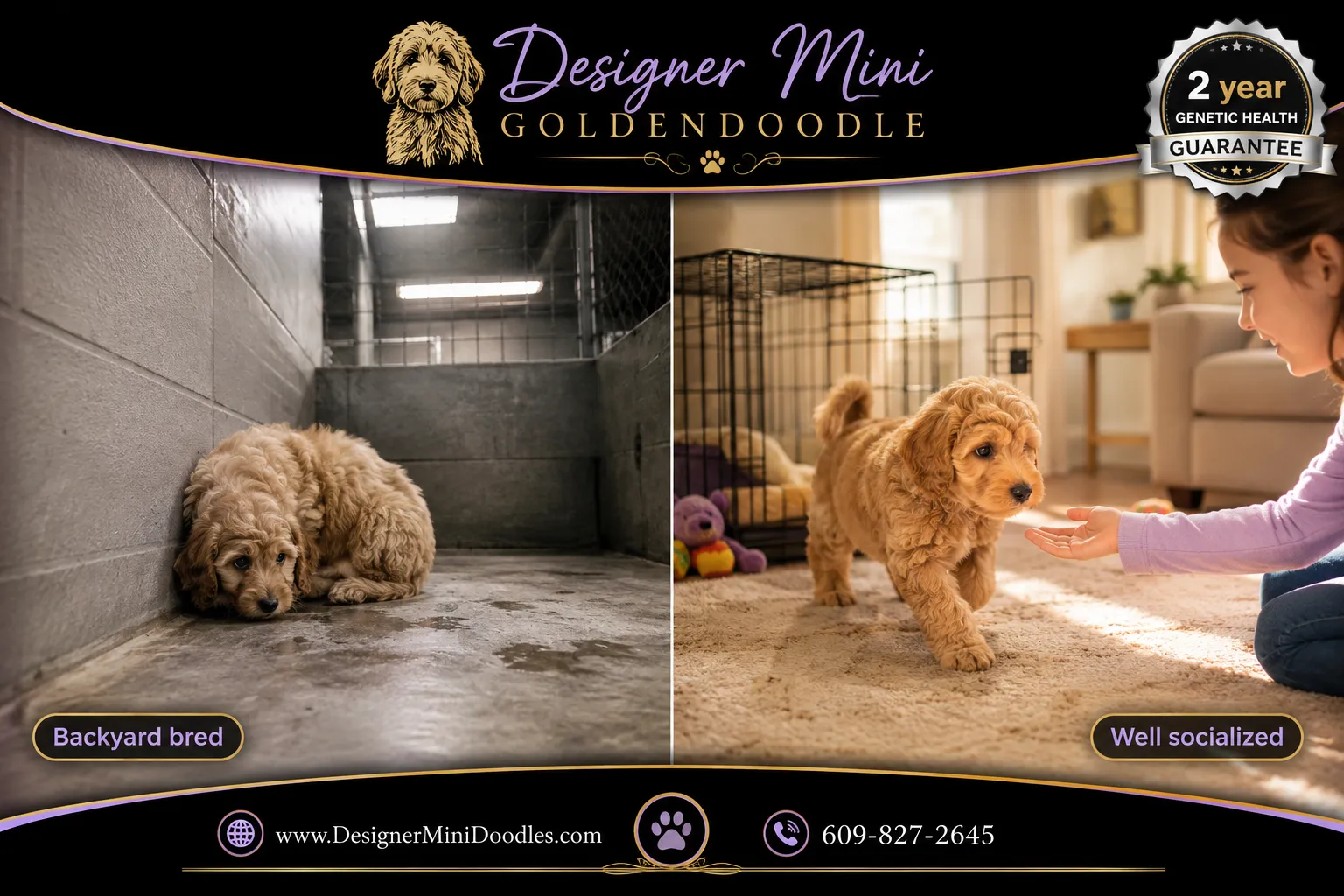
Goldendoodles from backyard and mill breeding commonly show fear-based behavior, poor housebreaking, separation anxiety, coat and skin problems, and preventable hereditary disease. Most of these trace back to two failures: untested parents and a missed socialization window.
 ))
))
The specific issues we see most often in rehomed or rescued doodles:
- Fear and reactivity. Puppies raised in isolation between three and twelve weeks often never fully recover their confidence around strangers, traffic, or handling.
- Crate panic and house-soiling. A puppy raised on wire or on soiled bedding learns to eliminate where it sleeps. Retraining that takes months.
- Hip and elbow dysplasia. Golden Retriever lines carry real orthopedic risk. Skipping OFA screening on the parents is how it gets passed down.
- Eye disease. PRA is a simple DNA test away from being eliminated. Untested pairings still produce blind dogs.
- Coat chaos. Unplanned generations produce unpredictable coats, some shed heavily, some mat severely, disappointing families who chose the breed for its coat.
- Size surprises. “Mini” puppies from unverified parents frequently mature at double the promised weight.
By contrast, our puppies begin ENS (Early Neurological Stimulation) from the first days of life, then move through structured exposure to the real sounds of a busy household: vacuums, doorbells, kitchen clatter, children’s voices, and other resident animals. That’s paired with early housebreaking on a schedule and the start of crate training, so families receive a puppy that already understands a routine. See how our approach works in practice on our page about toy goldendoodle puppies and ethical breeding.
Socialization can’t be added later. It’s either built into the first eight weeks or it’s missing for life.
Is a goldendoodle right for me, and should I choose a goldendoodle or labradoodle breeder?
A goldendoodle suits active families who want a social, highly trainable dog and can commit to professional grooming every six to eight weeks. Choose a goldendoodle over a labradoodle if you want a softer, more people-focused temperament; choose a labradoodle if you want a slightly higher-drive dog with a more consistent working background.
Is a goldendoodle right for me?
A goldendoodle is likely a good fit if you:
- Are home often, or can arrange midday company, these dogs bond intensely and dislike long solitude
- Budget for grooming (typically $85,$150 per session, every 6-8 weeks)
- Want a dog that’s genuinely easy to train and eager to please
- Have children or other pets and want a tolerant, social dog
Reconsider if you:
- Travel constantly or work 12-hour days away from home
- Want a low-maintenance coat, doodle coats mat and need daily-to-weekly brushing
- Expect a guaranteed hypoallergenic dog; coats vary, and no dog is truly allergen-free
- Prefer a calm, independent dog under 18 months of age (young doodles are busy)
Goldendoodle vs labradoodle: which breeder should I choose?
| Factor | Goldendoodle | Labradoodle |
|---|---|---|
| Temperament | Softer, very people-oriented, sensitive | Slightly more energetic, more independent |
| Coat | Wavy to curly, often wavier | Fleece or wool, often curlier in ALDs |
| Predictability | Varies by generation | Australian Labradoodles are the most standardized |
| Trainability | Excellent, highly biddable | Excellent, with more drive |
| Health screening focus | Hips, elbows, eyes, heart, GR-PRA | Hips, elbows, eyes, EIC, ALD-specific panels |
Decision rule: if coat and size predictability is your top priority, look for an Australian Labradoodle breeder working with multigenerational lines. If temperament and family sociability matter most, choose a goldendoodle breeder with multiple generations of documented pedigree. Either way, apply the same testing and contract standards, the breed matters far less than the breeder.
If you’re weighing other designer breeds entirely, the same evaluation framework applies to programs offering French bulldog puppies.
How long is the wait list for a reputable goldendoodle breeder?
Expect two to nine months on a reputable breeder’s waitlist, and up to 12-18 months for specific colors, sexes, or micro sizes from a well-known program. Deposits typically run $300 to $1,000 and are usually applied to the purchase price.
How the process normally unfolds:
- Application (1-3 days for review), the breeder screens your home, schedule, and experience.
- Interview, a call or video chat, often 20-40 minutes.
- Deposit and list placement, you’re assigned a position, sometimes for a specific planned litter.
- Litter announcement and pick order, usually by list position, sometimes by temperament match.
- Selection at 6-7 weeks, with go-home at 8-10 weeks.
Ask two things before paying any deposit: is the deposit refundable or transferable to a future litter, and what happens if the litter is smaller than expected? Both answers should be in writing.
Edge case: a breeder with immediate availability isn’t automatically bad. Sometimes a placement falls through or a litter is larger than planned. But if availability is always immediate across multiple litters and breeds, that’s volume production.
What should a goldendoodle puppy contract include?
A goldendoodle puppy contract should spell out price and deposit terms, go-home age, health guarantee scope and duration, spay/neuter requirements, registration terms, and a lifetime return clause. If any of those are missing, ask for them in writing before you pay.
Use this as a review checklist:
- Identification: puppy’s microchip number, date of birth, sire and dam names
- Financial terms: total price, deposit amount, refundability, payment method, balance due date
- Health records: vaccinations and deworming given, date of vet exam, copy of parent clearances attached
- Buyer vet visit requirement: the number of days you have (typically 3-7) to have the puppy examined
- Genetic health guarantee: which conditions, for how long, and the exact remedy
- Spay/neuter clause: required age and proof of compliance
- Breeding rights: stated explicitly, most pet placements are on a no-breeding basis
- Return and rehoming clause: the breeder takes the dog back at any point in its life
- Support terms: what continued help the breeder provides
- Dispute resolution and governing state law
Common mistake: paying a deposit before reading the contract. Reverse that order. Any breeder who won’t share the document in advance is telling you something important.
Beyond the paperwork, our program continues after go-home day. Families get guidance on housebreaking schedules, crate routines, obedience foundations, grooming timing, and nutrition, for the life of the dog. If a training question comes up at eight months or eight years, we’re reachable. That continued support is a defining feature of the best mini goldendoodle breeders and it’s why our families come back for a second goldendoodle mini.
Best goldendoodle breeders by state and region
The best approach is to shortlist two or three breeders in your own state or an adjacent one, then apply the same verification checklist to each. Local means you can visit, and visiting is the single most reliable form of vetting.
Regional guides to start with:
- Southeast: mini goldendoodle breeders in Georgia and mini goldendoodle puppies in Atlanta
- Northeast: mini goldendoodle puppies in Pennsylvania
- Midwest: mini and micro goldendoodle breeders in Michigan
- West: mini goldendoodle puppies in Denver
When comparing state options, weigh three things: distance you can realistically drive, whether the breeder ships (and how, flight nanny beats cargo), and whether local reviews come from verifiable owners. Regional mini doodle breeders who welcome visits should always outrank a distant seller with better marketing.
FAQ
What age should a goldendoodle puppy come home?
Eight weeks at the earliest, and many breeders hold mini and toy sizes until nine or ten weeks. Puppies released at six or seven weeks miss critical litter learning and are far more likely to develop bite-inhibition and anxiety problems.
Do reputable breeders ever sell through pet stores or online marketplaces?
No. Ethical breeders place puppies directly with families they’ve screened. Pet store and classified-marketplace puppies almost always originate from commercial breeding facilities or brokers.
How many litters per year does a responsible goldendoodle breeder produce?
There’s no universal number, but a responsible small program typically produces a handful of litters annually, breeds each dam no more than once a year, and retires her by around five to six years old. Dozens of litters across multiple breeds indicates volume production.
Is a health guarantee the same as pet insurance?
No. A health guarantee is a contract with your breeder covering specific hereditary conditions for a defined period. Pet insurance is a separate policy covering accidents and illness. Reputable breeders often recommend enrolling in insurance during the first week home.
Are goldendoodles hypoallergenic?
Not guaranteed. Goldendoodles are often lower-shedding, and curlier coats tend to release less dander, but allergen response varies by individual dog and person. Spend time with the parent dogs before committing if allergies are a factor.
What is ENS and why does it matter?
ENS stands for Early Neurological Stimulation, a set of brief handling exercises performed daily during a puppy’s first weeks. Breeders use it to introduce mild, controlled stress that supports resilience and calmer handling later. It has to happen in the neonatal window; it can’t be done retroactively.
Should I be worried if a breeder has a waitlist?
No. A waitlist is a positive sign. It means the breeder plans litters around demand rather than producing puppies continuously to keep inventory on hand.
What deposit amount is normal, and is it refundable?
Deposits commonly range from $300 to $1,000 and are applied to the purchase price. Many are non-refundable but transferable to a future litter. Get the terms in writing before paying.
Can I visit the breeder before the puppies are born?
Often yes, and it’s worth asking. Some breeders limit visits during the first weeks for biosecurity reasons, which is legitimate, in that case a live video walk-through should be offered instead.
How do I verify OFA health clearances myself?
Ask for the dog’s registered name and search the OFA public database directly. Records for hips, elbows, eyes, and cardiac exams are publicly searchable, so you can confirm what the breeder claims without relying on their screenshots.
Conclusion
Finding reputable breeders goldendoodle puppies isn’t about locating the cutest photo, it’s about verification. The breeders worth your money welcome scrutiny: they hand over registry numbers, show you the whelping room on video, share the contract before asking for a deposit, and tell you honestly when their puppies aren’t the right match for your household.
Your next steps, in order:
- Shortlist three breeders in or near your state using regional directories rather than classified sites.
- Request parent health clearances from each and verify them independently in the OFA database.
- Schedule a live video call and work through the ten-question script in this guide.
- Read the full contract before paying anything, checking specifically for the genetic guarantee duration and the return clause.
- Budget realistically, $2,500 to $4,500 for the puppy, plus grooming, food, vet care, and training in year one.
- Ask about post-adoption support, because the first six months at home is where most new owners need help.
Do those six things and you’ll avoid nearly every trap in the doodle market. If you’d like to see how a biologist-run program handles health testing, ENS, early housebreaking, and lifetime support, browse our current goldendoodle puppies for sale and reach out with your questions. We’d rather answer twenty of them now than have a family regret their choice later.