

Last updated: August 17, 2026
reputable english cream golden retriever breeders
Reputable English cream golden retriever breeders prove their quality with four things you can verify before you ever send money: complete health clearances on both parents (hips, elbows, heart, eyes plus genetic panels), verifiable AKC registration and pedigrees, a written health guarantee and contract, and a willingness to let you video-call or visit to see the dam and the whelping area. Serious programs typically price puppies between $3,500 and $5,500 because that range covers OFA clearances, European import bloodlines, proper whelping care, early neurological stimulation, and puppies started on housebreaking and crate training. Anything advertised at $500 to $1,500 is almost always a scam, a broker, or a puppy mill.
reputable english cream golden retriever breeders
- “English cream” is a coat color within the single Golden Retriever breed, not a separate breed. Reputable breeders say so plainly instead of claiming a rare bloodline.
- Health testing is the dividing line. Both parents should have hip and elbow evaluations, a cardiac exam by a cardiologist, an eye exam by an ophthalmologist, and DNA testing for PRA1, PRA2, prcd-PRA, and ichthyosis.
- Expect $3,500 to $5,500 from an accredited program with a genetic health guarantee, ENS from birth, and early crate and potty training. Bargain pricing signals cut corners.
- The biggest scam tell: a breeder who will only talk by text, wants Zelle, CashApp, gift cards, or crypto, and refuses a live video call with the puppy and its mother.
- Designer English Cream Golden Retrievers is run by a working animal biologist with a degree in Animal Biology from Stockton University and a minor in animal genetics, breeding pure white to light cream European bloodlines.
- Golden Retrievers typically live 10 to 12 years, with cancer, hip dysplasia, and heart disease as the main health concerns. Coat color does not extend lifespan.
- Good breeders interview you as hard as you interview them. If nobody asks about your yard, work hours, or other pets, keep looking.
- A written contract, spay/neuter or co-ownership terms, and a lifetime take-back clause are non-negotiable marks of an ethical program.
What Makes a Golden Retriever Breeder Reputable?
A reputable breeder can hand you documentation for every claim they make. That means OFA or PennHIP results you can look up yourself, an AKC pedigree with registered names, a written contract, and proof of veterinary care for the litter. Everything else, the pretty website, the Instagram reels, the “champion lines” language, is marketing until the paperwork backs it.
Here is the practical checklist I use when evaluating reputable English cream golden retriever breeders:
- Health clearances on both parents, published by name. You should be able to search the sire and dam in the OFA database and find them yourself.
- Limited number of litters per year and per female. Ethical programs rest their dams and retire them by around age 6 to 7.
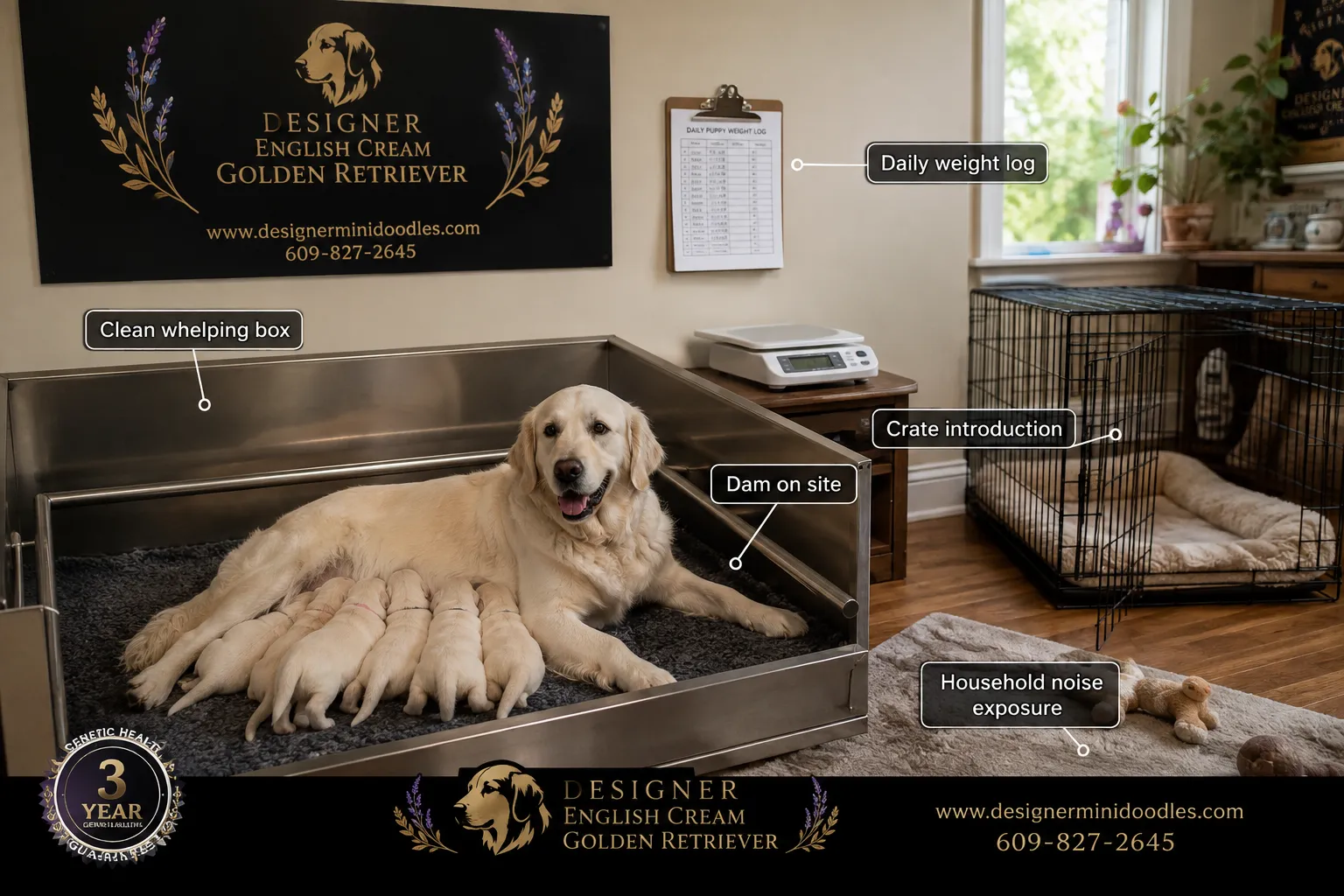
- Puppies raised inside the home, not in a barn row or outbuilding, with normal household noise, kids, and other animals.
- A structured early development protocol such as Early Neurological Stimulation (ENS) from days 3 through 16, then graduated socialization.
- They will not release puppies before 8 weeks. Many states legally require it, and the behavioral literature supports it.
- Lifetime support and a take-back clause. A serious breeder wants that dog back at any age rather than see it in a shelter.
- They ask you questions. Fencing, work schedule, children’s ages, other pets, training plans.
A breeder who volunteers information you didn’t ask for, including the problems in their lines, is usually the one worth waiting for.
Decision rule: If a breeder cannot produce OFA numbers for both parents within one conversation, stop there. It’s the single fastest disqualifier.
Common mistake: Treating “vet checked” as health testing. A vet check confirms the puppy has no ear mites today. It says nothing about the genetic hips, heart, or eyes it inherited.
English Cream vs American Golden Retrievers: What’s the Real Difference?
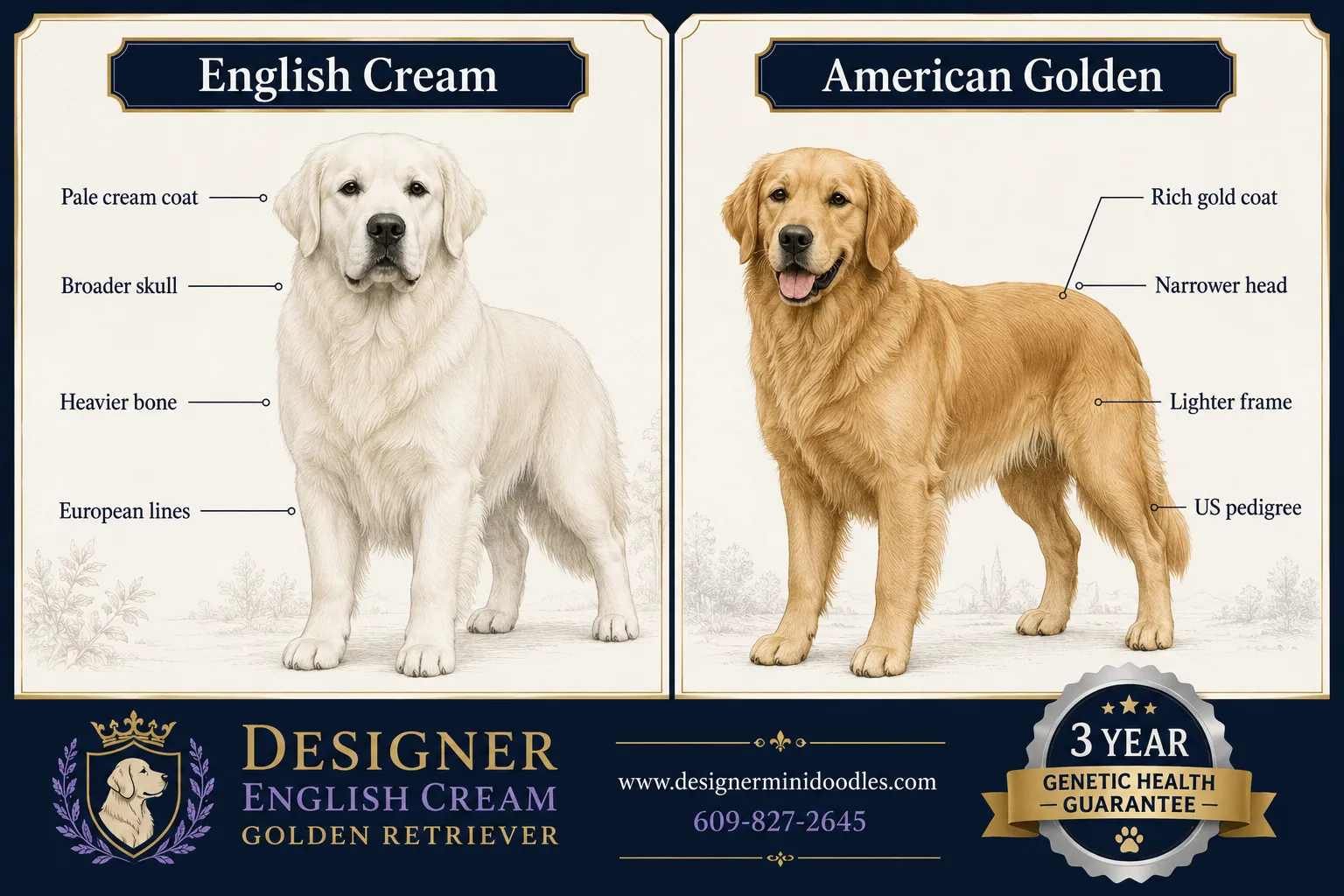
English cream and American golden retrievers are the same breed with different regional breeding traditions. The “English cream” type descends from European (often UK, Hungarian, Serbian, or Scandinavian) lines bred toward the UK Kennel Club standard, which allows cream coloring and tends toward a broader skull, blockier muzzle, heavier bone, and a stockier frame. The AKC standard in the United States favors richer golden shades and a somewhat leaner build.
| Trait | English cream (European lines) | American golden (US lines) |
|---|---|---|
| Coat color | Pure white to light cream, minimal fade | Light gold to deep rich gold |
| Head and muzzle | Broader skull, blockier, shorter muzzle | Narrower skull, longer muzzle |
| Build | Thicker, heavier bone, stockier | Leaner, more angular, taller-looking |
| Eyes | Often darker, rounder | Slightly more almond-shaped |
| Registry standard | UK Kennel Club influence | AKC standard |
| Registration in the US | Still registers as Golden Retriever with AKC | Golden Retriever with AKC |
Our own program at Designer English Cream Golden Retrievers works exclusively with top European bloodlines, and the puppies show it: pure white coats with very little fade to even cream, broad chests, and thick double coats. Visitors regularly say the puppies look like baby Great Pyrenees, and they are noticeably broader and thicker through the shoulders and skull than most United States retrievers you’ll meet at the dog park. If you want to see how that type looks in person, our English cream golden retriever puppies page shows current and past litters.
Edge case worth knowing: The AKC does not recognize “white” as a Golden Retriever color and considers extremely pale coats outside the ideal for the conformation ring. A pale cream dog is still 100% a purebred, AKC-registerable Golden Retriever. It simply may not be a show-ring winner. Any breeder charging a premium for a “rare white golden retriever” as if it were a separate breed is overselling.
How Much Do English Cream Golden Retrievers Cost?
Expect $3,500 to $5,500 for a well-bred English cream golden retriever puppy from an accredited breeder with imported European bloodlines, full health clearances, a genetic health guarantee, and early training started. Prices below roughly $1,800 almost always mean the health testing, whelping care, and socialization work were skipped, and prices under $1,000 are overwhelmingly outright fraud.
Here is the pricing landscape as we see it after years in this breed:
| Price range | Who’s selling at that price | What you actually get |
|---|---|---|
| $500, $1,000 | Scammers and fake websites | Usually no puppy at all. Stolen photos, fake shipping crates, endless “insurance” fees |
| $1,000, $1,500 | Puppy mills and brokers | No parent clearances, cage-raised, high parasite and giardia rates, no support after purchase |
| $1,800, $2,000 | Casual or hobby breeders | Family pet parents, partial or no OFA testing, minimal socialization, well-meaning but unstructured |
| $3,500, $5,500 | Accredited, health-tested programs | Genetic health guarantee, OFA clearances on both parents, proper whelping supervision, ENS from birth, housebreaking and crate training started, lifetime breeder support |
Why the top tier costs more: Import fees or semen shipping from Europe, progesterone testing, prenatal veterinary care, 24-hour whelping supervision, high-quality puppy nutrition, two rounds of vaccines and dewormings, microchipping, a veterinary health certificate, and weeks of human labor on ENS, sound desensitization, and potty and crate routines. A single OFA cardiac and ophthalmologist exam pair can run several hundred dollars per dog, and those exams happen before a puppy is ever conceived.
Budget beyond the purchase price too. First-year costs for a large-breed puppy commonly include vaccines and vet visits, spay or neuter, food, a crate, and training classes. Plan on a meaningful annual budget for a dog that will weigh 65 to 80 pounds.
Decision rule: Choose the $3,500+ program if you want a predictable temperament, documented genetics, and a breeder who answers the phone in year seven. Choose a rescue or breed-specific Golden Retriever rescue if budget is the constraint. Do not choose the $1,200 “AKC English cream” listing. That’s the one that costs the most in the end.
Red Flags to Avoid With Golden Retriever Breeders
The clearest red flag is a breeder who wants your money faster than they want your questions answered. Ethical breeders slow the process down, often maintaining waitlists and requiring applications. Bad actors create urgency.
Watch for these specific warning signs:
- No live video call permitted with the puppy and its mother together. This is the single most reliable scam filter.
- Payment only by Zelle, CashApp, Venmo friends-and-family, wire transfer, gift cards, or cryptocurrency. These are irreversible by design.
- Multiple breeds and constant availability. A program with eight breeds and puppies ready every week is a volume operation.
- “Papers available for an extra fee.” Registration is either included or it isn’t. Charging extra is a broker tactic.
- Prices far below market, especially paired with free or discounted shipping.
- No contract, or a contract with no health guarantee.
- Puppies offered at 6 weeks. Too young, and often illegal.
- Refusal to name their veterinarian or to let you call the clinic.
- Vague health language: “vet checked,” “parents are healthy,” “family raised” with no OFA numbers.
- Stock-looking photos. Reverse image search every photo. Scam sites recycle the same litters.
Quick example: A buyer contacts a “breeder” advertising AKC English cream puppies at $850, pays a $400 Zelle deposit, then receives a message from a “pet transport company” demanding $650 for a climate-controlled crate, then $400 for insurance. No puppy exists. This exact pattern is the most commonly reported pet scam structure, and it works because the first ask is small.
Puppy Mills vs Reputable Golden Retriever Breeders
A puppy mill breeds for volume and sells through the fastest channel available; a reputable breeder breeds a small number of planned litters and screens buyers. The difference shows up in the parents’ living conditions, the paperwork, and how the puppy behaves in its first month at home.
| Factor | Puppy mill / broker | Reputable breeder |
|---|---|---|
| Parent health testing | None or “vet checked” only | OFA hips, elbows, cardiac, eyes plus DNA panel |
| Where puppies are raised | Kennel runs, barns, outbuildings | Inside the home with household noise |
| Litters per year | Continuous, many dams | A few planned litters, dams rested and retired |
| Buyer screening | Credit card and go | Application, interview, waitlist |
| Contract | None or one page | Health guarantee, spay/neuter terms, take-back clause |
| Socialization | Minimal | ENS, sound exposure, kids and other animals, crate intro |
| After purchase | Unreachable | Lifetime support and advice |
| Sold through | Pet stores, classified ads, third-party sites | Direct from breeder only |
Edge case: Some large operations hold USDA licenses and use that as a credibility badge. A USDA license authorizes commercial breeding and sets minimum care standards; it is not an endorsement of breeding quality or genetic screening. Look at the clearances, not the license.
What Health Tests Should Reputable Breeders Do?
For Golden Retrievers, the Orthopedic Foundation for Animals (OFA) and the Golden Retriever Club of America recommend a core set of clearances known as the CHIC requirements: hip evaluation, elbow evaluation, a cardiac exam by a board-certified veterinary cardiologist, and an eye exam by a board-certified veterinary ophthalmologist. Reputable programs add DNA testing on top of that.
The four structural and organ clearances (both parents):
- Hips, OFA hip evaluation or PennHIP, done at 24 months or later for a final OFA rating
- Elbows, OFA elbow evaluation at 24 months or later
- Heart, advanced cardiac exam (auscultation plus echocardiogram) by a veterinary cardiologist, screening for subvalvular aortic stenosis
- Eyes, annual or periodic ophthalmologist exam (OFA Eye Certification Registry), screening for cataracts and pigmentary uveitis
DNA panel tests to expect:
- Progressive retinal atrophy variants (GR-PRA1, GR-PRA2, prcd-PRA)
- Ichthyosis (ICH1)
- Neuronal ceroid lipofuscinosis (NCL)
- Degenerative myelopathy (DM)
- Muscular dystrophy (GR-MD), where relevant to the lines
How to read the results: For DNA tests, “clear” and “carrier” are both acceptable in a breeding dog as long as the breeder never pairs two carriers of the same variant. For hips, OFA ratings of Excellent, Good, or Fair all pass; Borderline and the dysplastic grades do not.
Common mistake: Accepting a preliminary hip result from a 9-month-old dog as a clearance. Preliminary readings are useful for planning, but a final OFA rating requires the dog to be at least 24 months old.
Ask this exact question: “Can you send me the OFA numbers for the sire and dam so I can look them up myself?” A one-sentence answer with names and numbers tells you a lot.
How to Find Ethical Golden Retriever Breeders (and the Best Ones Near Me)
Start with breed-club referral lists and the OFA database rather than general puppy marketplaces, then verify each candidate independently. Geography matters less than most buyers assume, because ethical breeders will ship or arrange a flight nanny, and you should widen your search radius rather than settle for a nearby bad option.
A search sequence that works:
- Golden Retriever Club of America breeder referral and regional GRCA member clubs, start here, since members agree to a code of ethics.
- AKC Marketplace, filtered to Breeders of Merit and Bred with H.E.A.R.T. participants, then verify their clearances separately.
- OFA advanced search, search Golden Retrievers by kennel name and check which dogs actually carry full CHIC numbers.
- Breed-specific Facebook groups and English cream owner communities, where you can ask owners about their experience five years later, not five days later.
- Regional and national specialty shows or field events, where you can meet dogs and handlers in person.
- Direct outreach with a real conversation, email or call three to five programs, compare answers, and note who asks you the most questions.
On “near me”: Do not let a 90-minute drive decide your dog’s next 12 years. Well-run programs commonly place puppies across multiple states with ground transport or an in-cabin flight nanny. If a breeder within driving distance can’t produce clearances, expanding your search is the correct move.
Our program breeds pure white to light cream European lines and ships nationwide, which is part of why we describe ourselves as the best English Cream Retriever breeders in the USA. You can review our current litters and reserve a spot through our AKC english cream golden retriever breeders page, and if you’re a breeder yourself, our sister program offers French bulldog stud services near me.
See Available Puppies
- Display 15 Products per page

Related reading on choosing a breeder
The vetting principles here carry over to other well-bred family dogs. If you’re comparing options, these guides use the same standards:
- Best Golden Doodle Breeders
- Miniature Goldendoodle breeders and mini golden doodle puppies
- Goldendoodle Breeders
- Best Mini and Micro Goldendoodle Breeders in Texas
- Best Mini and Micro Goldendoodle Breeders in Florida
How Do You Verify Golden Retriever Breeder Credentials?
Verify credentials at the source, never from a screenshot. Every meaningful claim a breeder makes has a public or third-party database behind it, and checking takes about 20 minutes.
Step-by-step verification checklist:
- OFA database (ofa.org). Search each parent by registered name. Confirm hips, elbows, cardiac, eyes, and DNA results, and look for a CHIC number.
- AKC registration. Ask for the sire and dam’s registration numbers and confirm the litter is AKC-registered. If a breeder claims Breeder of Merit status, confirm it on the AKC site.
- Call the veterinarian. Ask the clinic to confirm the breeder is a client in good standing and that the litter received exams, vaccines, and dewormings.
- Live video call. Ask to see the dam with the litter, the whelping area, and the puppy you’re considering, in one unedited call.
- Reverse image search every puppy photo and the site’s hero images.
- Check the domain and business. Look up how long the website has existed and whether the business name appears in state records. Brand-new domains with dozens of “available” puppies are a warning sign.
- Read the contract before paying. Look for the health guarantee window, what it covers, the take-back clause, and deposit refund terms.
- Talk to two past buyers the breeder did not hand-pick, ideally found through owner groups.
Decision rule: If steps 1, 3, and 4 all check out, you’re almost certainly dealing with a legitimate program. If any one of them is refused, walk away regardless of how good the rest looks.
Credibility also comes from who is actually running the program. Designer English Cream Golden Retrievers is owned and operated by a working animal biologist holding a degree in Animal Biology from Stockton University in Pomona, New Jersey, with a minor in animal genetics. That background drives how pairings are planned: carrier status is tracked variant by variant, coefficient of inbreeding is calculated before any breeding, and structure is evaluated against European type rather than guessed at.
English Cream Golden Retriever Temperament, Care, and Family Fit
English cream golden retrievers are affectionate, biddable, people-focused dogs that generally do very well with children and other pets. They are excellent family dogs when their exercise and grooming needs are met, and a poor fit for households that are away 10 hours a day with no plan for the dog.
Temperament in practical terms:
- Highly trainable and food-motivated, which makes obedience work straightforward
- Soft-natured and sensitive; harsh correction backfires
- Prone to separation distress if left alone for long stretches without conditioning
- Mouthy and enthusiastic as puppies, since it’s a retrieving breed
- Not a natural guard dog. Most will greet a stranger like a long-lost friend
Care requirements:
| Need | What it looks like day to day |
|---|---|
| Exercise | 60+ minutes daily for adults, split into sessions; retrieving, swimming, sniff walks |
| Grooming | Brush 2 to 3 times weekly, more during seasonal shedding; regular ear checks and nail trims |
| Mental work | Training sessions, puzzle feeders, scent games; boredom becomes chewing |
| Diet | Large-breed appropriate food, measured portions; keep them lean to protect joints |
| Vet care | Annual exams, then twice yearly after age 7, with attention to lumps |
Training and early start. Our puppies leave here well started on housebreaking and crate training, which shortens the hardest weeks considerably. Every litter goes through ENS beginning in the first days of life, then graduated exposure to the sounds of a busy household: vacuums, doorbells, kitchen clatter, children, and other animals moving through the room. That early handling is why buyers consistently report their AKC english cream retriever puppies settle into a crate overnight within days rather than weeks, and why formal obedience work goes smoothly at 10 to 12 weeks.
Edge case: Households with a family member who has moderate to severe dog allergies should think carefully. English creams are heavy double-coated shedders. A cream coat is not a low-allergen coat.
English Cream Golden Retriever Lifespan and Health Issues
Golden Retrievers, including English cream lines, typically live 10 to 12 years. Coat color does not change lifespan; genetics, weight management, and veterinary care do. Claims that English creams live significantly longer than American goldens are marketing, not established science.
Main health concerns in the breed:
- Cancer, especially hemangiosarcoma and lymphoma. This is the leading health concern in Golden Retrievers and the reason the Morris Animal Foundation Golden Retriever Lifetime Study exists.
- Hip and elbow dysplasia, reduced but not eliminated by breeding OFA-cleared parents
- Subvalvular aortic stenosis (SAS), screened by cardiologist echocardiogram
- Eye disease, including cataracts, progressive retinal atrophy, and pigmentary uveitis
- Hypothyroidism
- Ichthyosis, a skin condition, usually cosmetic and screened by DNA test
- Obesity, which worsens nearly everything above
What actually extends a Golden’s healthy years: keeping the dog lean, controlled exercise during growth, dental care, and semiannual vet exams after middle age so masses are caught early. Parent clearances stack the deck in your favor at the start; daily management carries it the rest of the way.
What Questions Should I Ask a Golden Retriever Breeder?
Ask questions that require documents or specifics, not opinions. A good breeder will answer all of these without hesitation and will often bring some of them up first.
Health and genetics
- May I have the OFA numbers for both parents so I can look them up?
- Which DNA panel did you run, and what are the carrier statuses?
- What is the coefficient of inbreeding for this pairing?
- What health problems have shown up in your lines, and how did you respond?
- Which conditions does your health guarantee cover, and for how long?
Litter and rearing
6. How old is the dam, and how many litters has she had?
7. Where were the puppies whelped and raised?
8. Do you use ENS or a structured early socialization protocol?
9. What has this puppy been exposed to already: children, other dogs, car rides, crates?
10. At what age do puppies go home, and what vaccines and dewormings are done?
Business and support
11. May I speak with your veterinarian and with two past buyers?
12. What does the contract require of me, and what’s your take-back policy?
13. Are deposits refundable, and under what conditions?
14. What support do you offer after the puppy comes home?
15. What made you choose me for this litter?
Reverse the lens: Note whether the breeder asks about your fencing, your work hours, your children’s ages, your other pets, and your training plan. Programs that place carefully ask more questions than they answer.
FAQ
Are English cream golden retrievers a separate breed?
No. They are Golden Retrievers with a pale cream coat, usually from European bloodlines. They register with the AKC as Golden Retrievers.
Do reputable English cream golden retriever breeders use waitlists?
Almost always. Small planned litters and buyer screening create waits of a few months to a year. A breeder with instant availability year-round is usually running volume.
How much should I pay for an English cream golden retriever puppy?
Plan on $3,500 to $5,500 from an accredited breeder with full parent clearances, a genetic health guarantee, and early training started. Listings at $500 to $1,500 indicate scams, brokers, or puppy mills.
Are English cream goldens good family dogs?
Yes. They are gentle, patient with children, sociable with other pets, and highly trainable. They need daily exercise, weekly brushing, and company; they don’t do well left alone all day.
Are white golden retrievers healthier than golden ones?
No credible evidence supports that. Health comes from tested parents and good management, not coat color.
How long do English cream golden retrievers live?
Typically 10 to 12 years. Cancer is the leading health concern in the breed, followed by orthopedic and cardiac conditions.
What health tests must both parents have?
Hips, elbows, a cardiologist heart exam, and an ophthalmologist eye exam, plus DNA testing for PRA1, PRA2, prcd-PRA, and ichthyosis. Results should be verifiable in the OFA database.
What is ENS and why does it matter?
Early Neurological Stimulation is a set of brief daily handling exercises done in a puppy’s first two weeks. Breeders use it as part of a structured program to support stress resilience and handleability.
Can I trust a breeder who won’t let me visit in person?
Some limit in-person visits to protect newborn litters from disease, which is legitimate. But a refusal to do a live video call showing the dam with the puppies is a deal-breaker.
Should the puppy come with AKC papers included?
Yes. Registration should be included in the price. “Papers for an extra fee” is a broker practice.
What’s the youngest age a puppy should go home?
Eight weeks at minimum, and many good breeders hold larger or shyer puppies to 9 or 10 weeks.
Do good breeders require spay or neuter?
Most sell pet puppies on AKC Limited Registration with a spay/neuter clause, often timed after growth plates close. Breeding rights are separate and negotiated.
Conclusion: Your Next Steps
Finding reputable English cream golden retriever breeders is really a documentation exercise. The dogs are wonderful across the board; what separates programs is whether they can prove the parents were screened, show you where the puppies were raised, and stand behind the dog in writing for its whole life.
Do these five things this week:
- Build a shortlist of three to five programs from GRCA referral lists, AKC Breeder of Merit listings, and owner communities, ignoring price for now.
- Verify each one in the OFA database and drop anyone whose parents lack full clearances.
- Schedule a live video call with your top two and ask to see the dam, the whelping area, and your prospective puppy in one call.
- Read the contract line by line before paying anything, focusing on the health guarantee, deposit terms, and take-back clause.
- Budget honestly at $3,500 to $5,500 for the puppy plus first-year vet care, food, crate, and training classes.
If you want European-bloodline puppies that are pure white to light cream, broader and thicker than typical US retrievers, and already started on housebreaking, crate training, ENS, and household noise exposure, reach out to Designer English Cream Golden Retrievers. Bring your questions. The right breeder will welcome every one of them.
Sources
- Orthopedic Foundation for Animals, “Golden Retriever CHIC Requirements,” ofa.org
- Golden Retriever Club of America, “Health and Breeder Code of Ethics,” grca.org
- American Kennel Club, “Golden Retriever Breed Standard” and “Breeder of Merit Program,” akc.org
- Morris Animal Foundation, “Golden Retriever Lifetime Study,” morrisanimalfoundation.org
- The Kennel Club (UK), “Retriever (Golden) Breed Standard,” thekennelclub.org.uk