

Last updated: August 19, 2026
reputable goldendoodle mini breeders
Reputable goldendoodle mini breeders health-test both parent dogs through OFA or Embark-style genetic panels, raise litters inside a home (not a kennel run), let you see the dam on video or in person, and back every puppy with a written genetic health guarantee. Expect to pay $2,500 to $4,500 for a well-bred, early-trained mini goldendoodle in 2026. Anything advertised at $500 to $1,000 is almost always a scam or a puppy mill flip, and price alone is the single fastest filter you can apply.
reputable goldendoodle mini breeders
- A reputable breeder can produce paperwork on demand: OFA hips and elbows, eye exams (CAER), cardiac clearance, and a DNA panel covering PRA-prcd, vWD, DM, and Ichthyosis.
- Price signals quality tiers. Scammer listings sit at $500 to $1,000, puppy mills at $1,000 to $1,500, casual hobby breeders at $1,800 to $2,000, and accredited programs with genetic guarantees at $2,500 to $4,500.
- Ethical programs use Early Neurological Stimulation (ENS) from days 3 to 16 and start crate and potty foundations before the puppy goes home.
- The clearest puppy mill tell is volume plus secrecy: many breeds, always-available litters, no video tour, and payment by wire or cash app only.
- Mini goldendoodles suit apartments, first-time owners, and families with young kids; standards suit runners, hunters, and large-yard homes.
- Watch for patellar luxation, PRA, hip dysplasia, and ear infections in the mini size range.
- Your contract should include a health guarantee window, spay/neuter terms, a return clause, and a no-shelter surrender clause.
- Ask about the dam’s litter history, socialization protocol, and lifetime support before you send a deposit.
What Makes a Goldendoodle Breeder Reputable?
A reputable breeder proves three things: the parents are genetically cleared, the puppies are raised inside a home with structured socialization, and the buyer gets written protection. Everything else (fancy websites, cute photo galleries, waitlist urgency) is marketing.
Here’s the honest version of what separates a real program from a hobbyist with two dogs and a Facebook page:
- Health testing on both parents, not one. A single-parent clearance is a half-measure. Recessive conditions need both sides tested.
- Limited litters per dam. Ethical programs retire females well before their bodies wear out, usually after four to five litters, and skip back-to-back heat cycles.
- In-home whelping. Puppies born in a bedroom or dedicated puppy room hear dishwashers, doorbells, kids, and vacuums. Puppies born in a barn hear nothing.
- Breed focus. Someone breeding goldendoodles, bernedoodles, frenchies, huskies, and cavapoos at once is running a store, not a program.
- They interview you. A breeder who doesn’t ask about your yard, your work schedule, or your experience with dogs isn’t screening homes.
- Support after pickup. Real breeders answer texts at month six when your puppy hits adolescence and forgets everything.
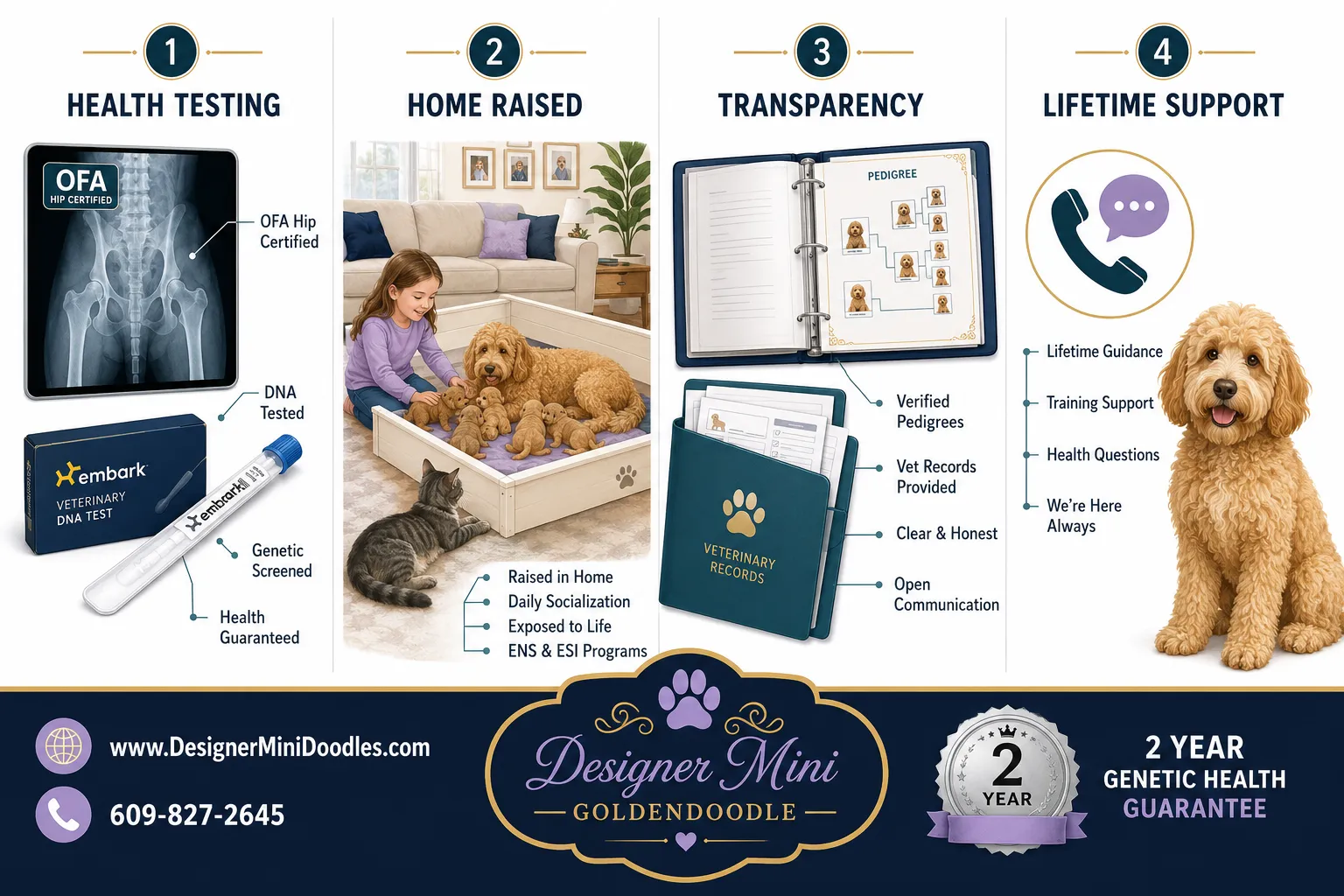
At Designer Toy GoldenDoodles, our program is run by a trained animal biologist with a degree in Animal Biology from Stockton University in Pomona, New Jersey, and a minor in animal genetics. That background is the reason we test the way we do. Genetics isn’t a marketing line for us; it’s the coursework. Every one of our mini golden doodle parents and puppies comes from documented top bloodlines, and we’re comfortable saying we’re among the best mini goldendoodle breeders in the country because we can show the receipts.
A breeder’s paperwork should be boring. If it’s exciting, dramatic, or “on its way,” something is wrong.
How Do I Find Ethical Mini Goldendoodle Breeders?
Start with breed-specific registries and vet referrals, then verify independently. The fastest reliable path is: search by state, request health documentation before discussing price, and insist on a live video call with the dam and litter in the room.
A practical search sequence I recommend:
- Search by state, not nationally. Regional lists surface smaller, home-based programs. See our directories for mini and micro goldendoodle breeders in Florida, breeders in Texas, and breeders in New York.
- Ask your vet. Small-animal vets know which local breeders send in healthy puppies and which send in parasite cases.
- Check the Goldendoodle Association of North America (GANA) member list and look for Blue or Black Ribbon designations, which require documented health testing.
- Request records in writing first. If the breeder pivots straight to deposit talk, walk.
- Video tour, unedited. Ask them to walk the phone from the puppy area to the parents’ living space in one continuous shot.
- Read the contract before paying anything. Deposits are frequently non-refundable, so review terms before money moves.
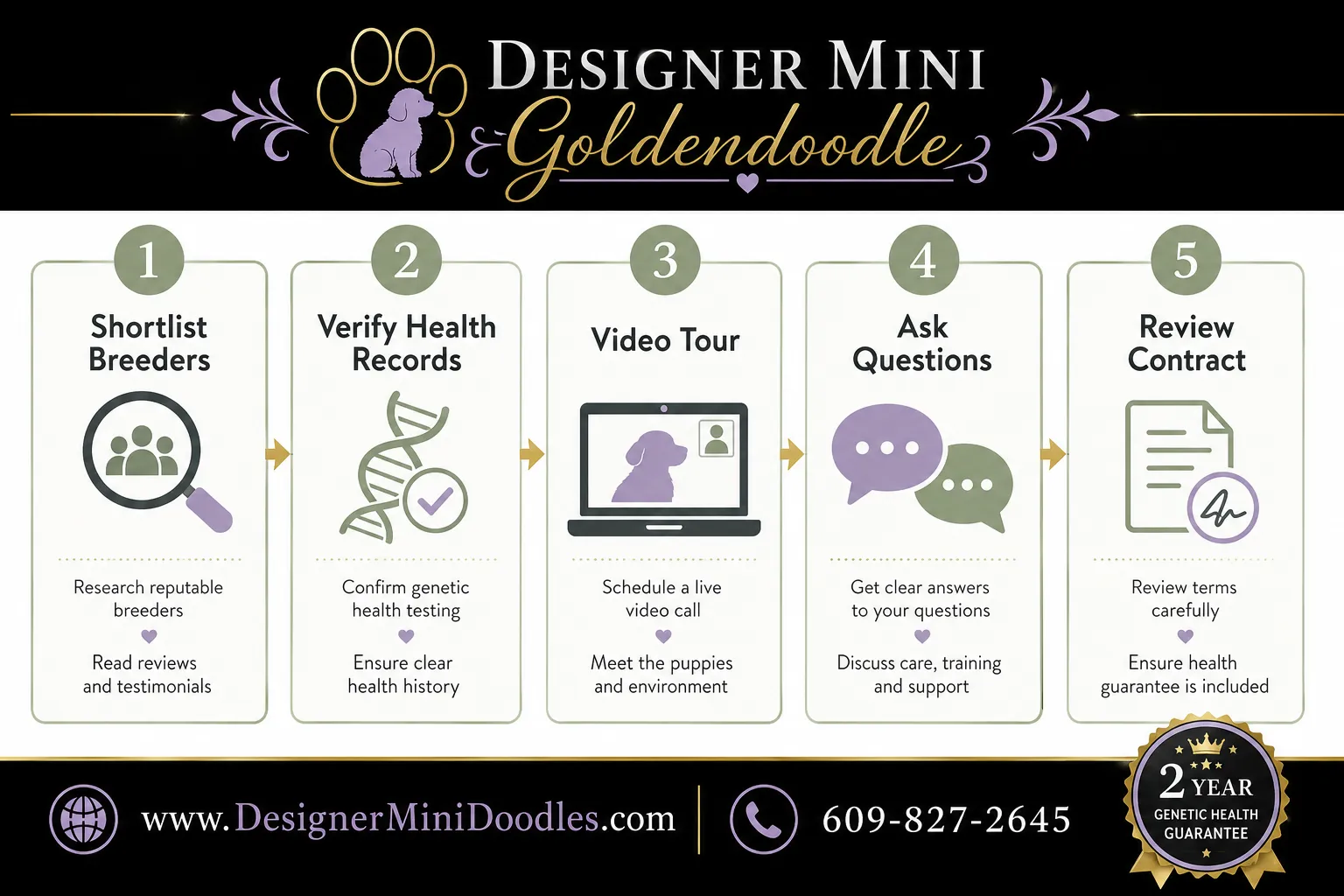
Decision rule: If a breeder will not do a live video call showing the dam with the puppies, treat it as a hard no, regardless of how good the photos look. Photos get stolen. Live video doesn’t.
You can also start from our national overview of miniature goldendoodle breeders and narrow down from there.
What Health Testing Should Reputable Goldendoodle Mini Breeders Complete?
Both parents should have OFA (Orthopedic Foundation for Animals) evaluations for hips, elbows, and heart, an annual CAER eye exam by a veterinary ophthalmologist, and a breed-appropriate DNA panel. For mini goldendoodles specifically, patella evaluation matters because smaller dogs carry higher kneecap risk.
Here’s what a complete testing file looks like:
| Test | What it screens | Who performs it | Why it matters for minis |
|---|---|---|---|
| OFA Hips | Hip dysplasia | Radiologist review of x-rays | Golden retriever line risk |
| OFA Elbows | Elbow dysplasia | Radiologist review | Inherited joint issue |
| OFA Patella | Kneecap luxation | Licensed veterinarian | Higher risk in small dogs |
| OFA Cardiac | Heart murmurs, SAS | Cardiologist or vet | Subvalvular aortic stenosis in goldens |
| CAER Eye Exam | Cataracts, retinal disease | Veterinary ophthalmologist | Annual, not one-time |
| DNA: PRA-prcd | Progressive retinal atrophy | Lab panel (Embark, Paw Print) | Poodle-side blindness gene |
| DNA: vWD Type I | Bleeding disorder | Lab panel | Surgical bleeding risk |
| DNA: DM | Degenerative myelopathy | Lab panel | Late-onset mobility loss |
| DNA: Ichthyosis | Skin/coat condition | Lab panel | Golden retriever carrier gene |
| DNA: NEwS / GR-PRA1/2 | Neuropathy, retinal atrophy | Lab panel | Golden-specific mutations |
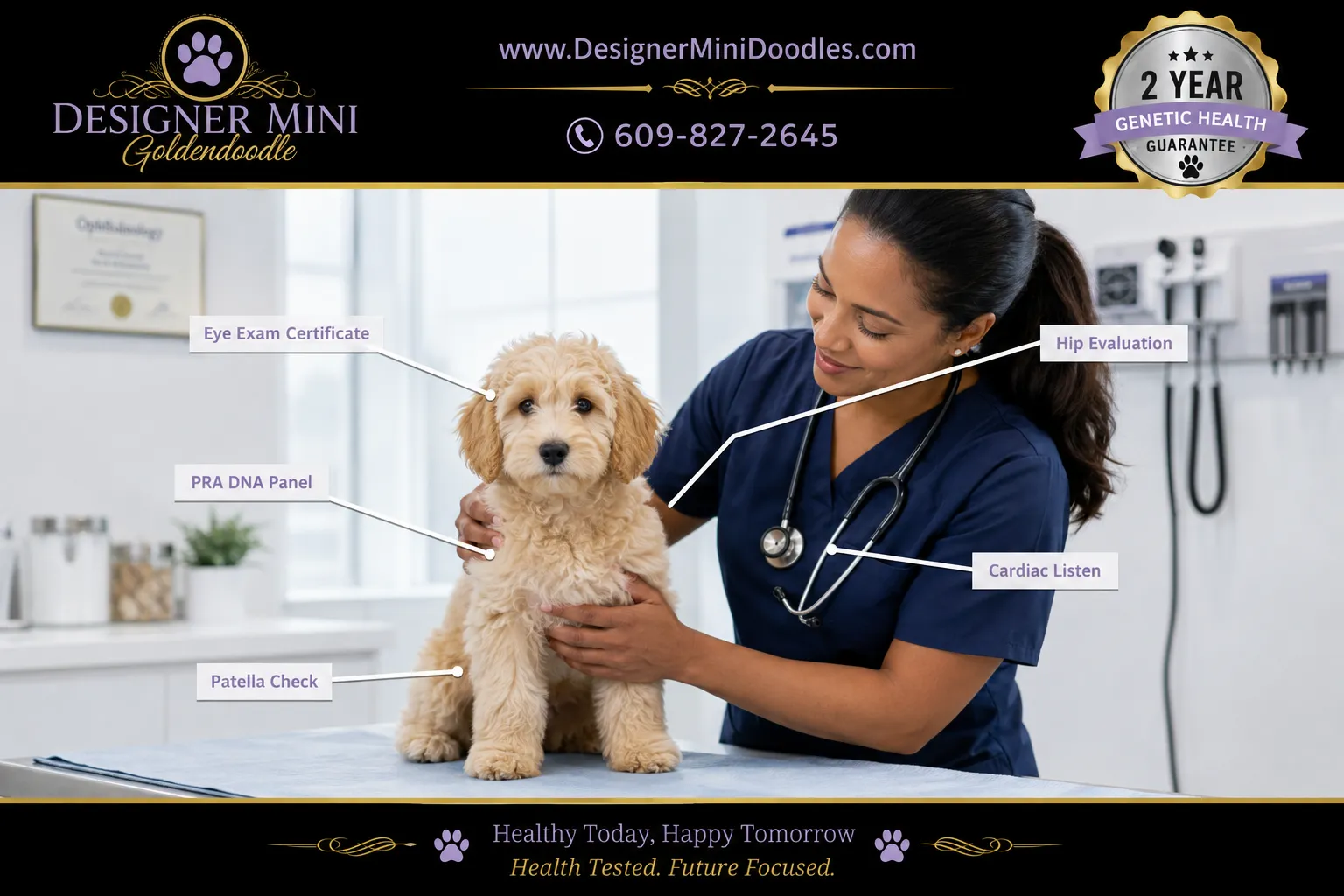
Common mistake: Accepting “vet checked” as health testing. A vet check is a physical exam on a puppy. Health testing happens on the parents, months or years before breeding, and produces documents with certification numbers you can look up.
Edge case: A breeder may have a parent who is a carrier for a recessive condition. That’s acceptable if the carrier is bred only to a clear-tested mate, because two clears or a clear-plus-carrier pairing cannot produce an affected puppy for that gene. Ask them to explain the pairing logic. A knowledgeable breeder will do so happily.
How Much Does a Mini Goldendoodle Cost From a Breeder?
Expect $2,500 to $4,500 from an accredited breeder with full health testing, a genetic guarantee, proper whelping, and early housebreaking and crate training. Prices below $1,500 signal cut corners; prices above $5,000 usually reflect extreme size rarity (true micro) or coat color premiums rather than better health.
| Price Range | What You’re Actually Dealing With |
|---|---|
| $500 – $1,000 | Almost always a scam. No puppy exists. Payment requested by wire, Zelle, or gift card. |
| $1,000 – $1,500 | Puppy mill or broker resale. Kennel-raised, no testing, high vet-bill risk in year one. |
| $1,800 – $2,000 | Casual hobby breeder. Often loving homes, but partial testing and no structured early training. |
| $2,500 – $4,500 | Accredited breeder: full genetic health guarantee, ENS from birth, supervised whelping, crate and potty foundations, lifetime support. |
Budget for the first year too, not just the purchase. Realistic first-year add-ons include vaccines and vet visits, spay or neuter, grooming every six to eight weeks (mini goldendoodles are not low-maintenance coats), crate and supplies, and training classes. For size-by-size pricing detail, see our breakdown of toy, micro and mini goldendoodle sizes and prices.
Decision rule: Choose the $2,500+ tier if you want predictability. You’re paying for a lower probability of a $6,000 orthopedic surgery and a puppy that already understands a crate.
No products found which match your selection.
Mini Goldendoodle vs Standard Goldendoodle: Which Is Better?
Neither is objectively better; they fit different homes. Choose a mini (15 to 30 pounds, 13 to 20 inches) for apartments, travel, older owners, and families who want a lap-sized companion. Choose a standard (50 to 90 pounds) if you want a running partner, a service-dog candidate, or a dog to keep up with rough-and-tumble teenagers.
| Factor | Mini Goldendoodle | Standard Goldendoodle |
|---|---|---|
| Adult weight | 15 to 30 lbs | 50 to 90 lbs |
| Exercise need | 45 to 60 min daily | 90+ min daily |
| Apartment friendly | Yes | Rarely |
| Food cost | Lower | Roughly 2 to 3x higher |
| Best for small kids | Good, with supervision | Good, but can knock toddlers over |
| Typical lifespan | 12 to 16 years | 10 to 14 years |
| Grooming cost per visit | Lower | Higher |
| Joint injury risk | Patella issues | Hip and elbow dysplasia |
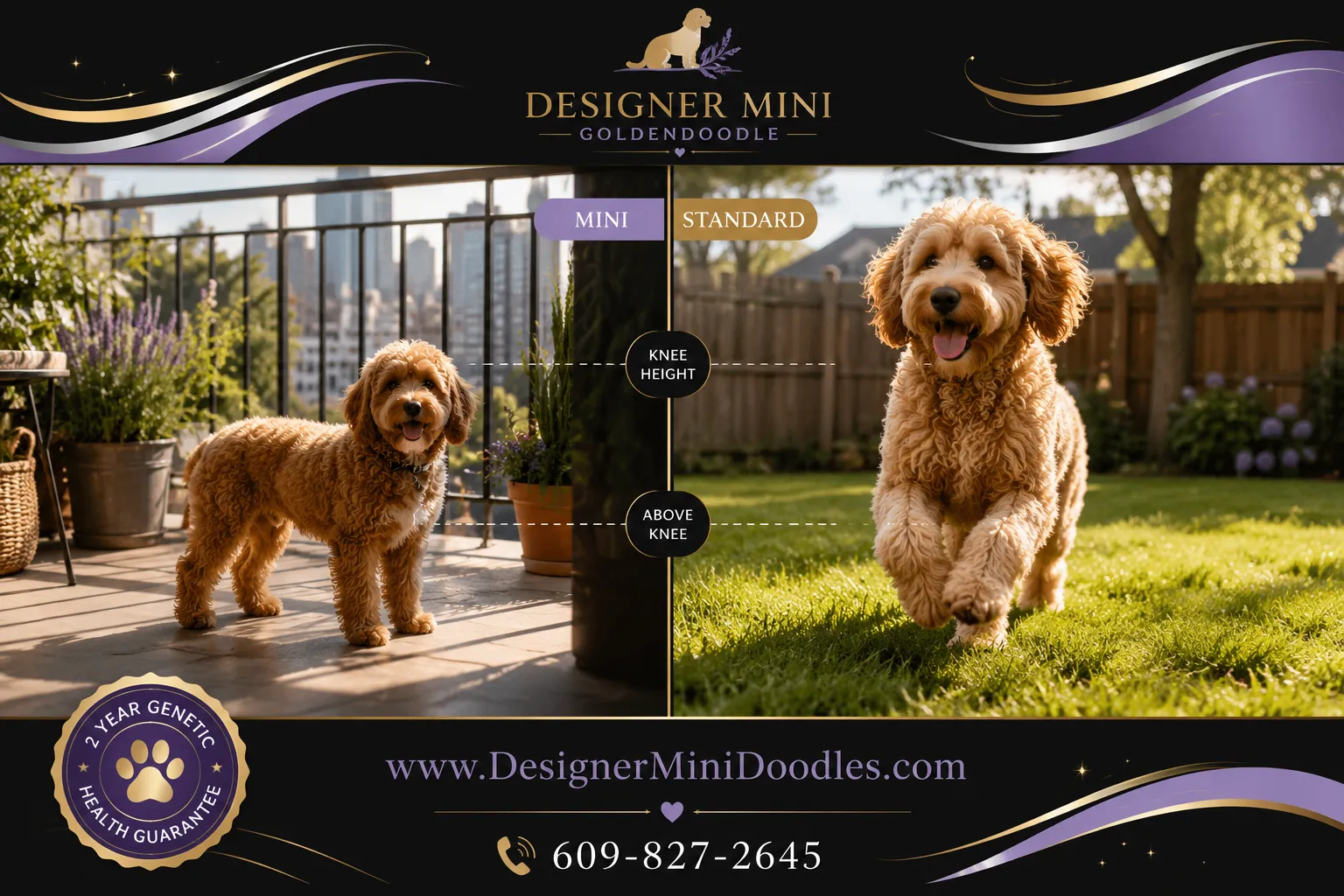
Quick example: A client of ours lived in a third-floor walk-up in Philadelphia with no elevator. A standard would have meant carrying 70 pounds down stairs during old age. The mini was the correct engineering decision, not just the cuter one. Curious how big they finish? See our guide to the full grown mini goldendoodle.
What Are the Red Flags and How Do I Tell If a Breeder Is a Puppy Mill?
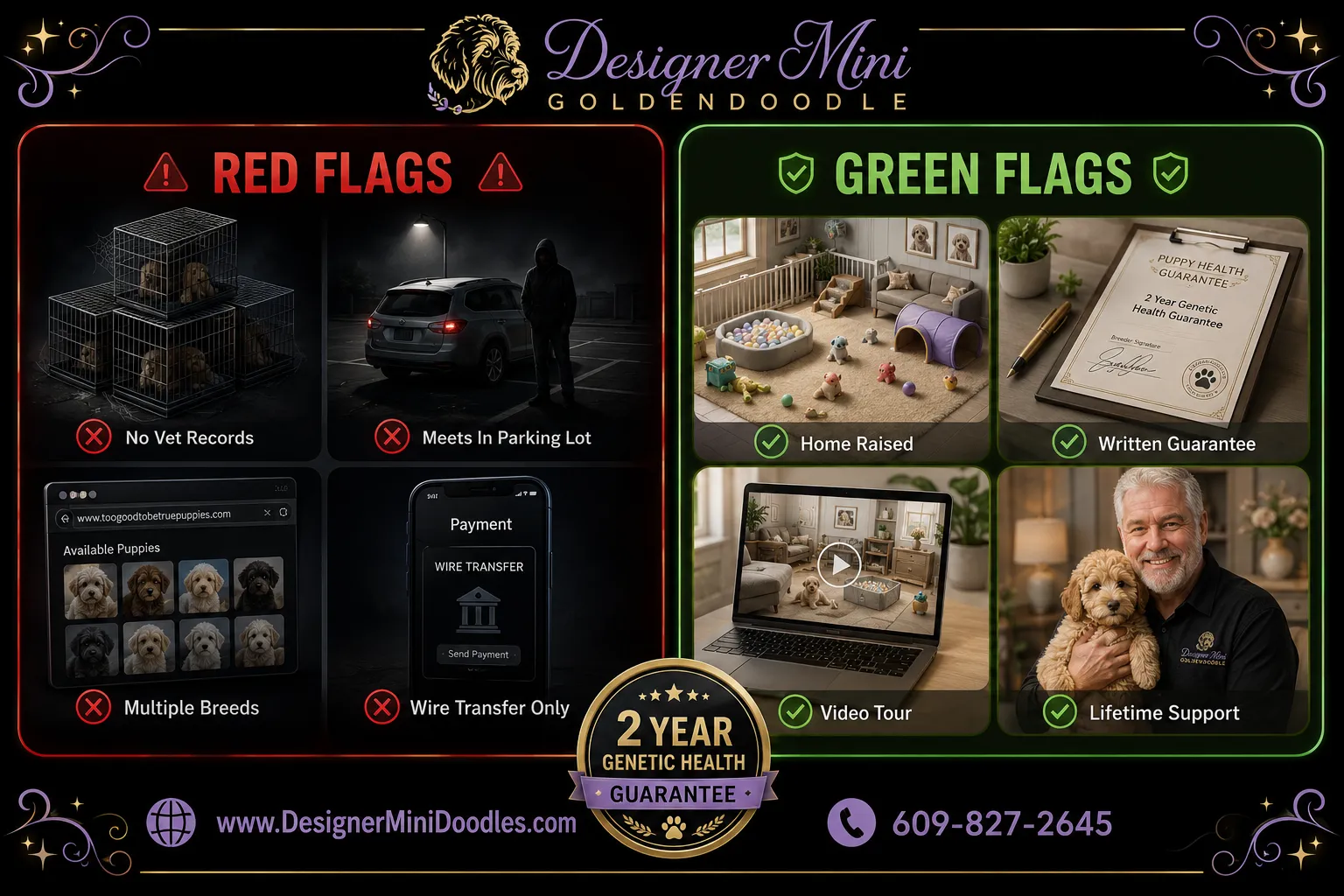
The tell is always the combination of high volume, low transparency, and pressure. A puppy mill has puppies available right now, in multiple breeds, with no video tour, no health records you can verify, and a payment method that can’t be reversed.
Red flags to walk away from:
- Puppies always available, every color, every week
- Multiple unrelated breeds on one site
- Refuses live video of the mother with the litter
- Wants Zelle, Venmo, Cash App, wire transfer, or crypto only
- Wants to meet in a parking lot, rest stop, or airport curb
- Cannot name the vet clinic that examined the litter
- Releases puppies before 8 weeks (illegal in many states)
- Pressure language: “three families are waiting on this puppy tonight”
- Prices that undercut the market by 60 percent
- Stock photos that reverse-image-search to other sites
Verification trick: Ask the breeder to text you a photo of the specific puppy today, holding a piece of paper with your first name written on it. Scammers can’t do it. Legitimate breeders find it slightly amusing and send it in ten minutes.
Edge case worth knowing: Some large commercial operations are USDA-licensed, and buyers mistake the license for a quality mark. USDA licensing is a minimum commercial standard for facilities that sell wholesale. It is not evidence of health testing or in-home socialization.
What Certifications, Credentials, and Contract Terms Should I Look For?
Look for GANA membership with Blue or Black Ribbon status, OFA-recorded clearances, AKC registration on the purebred parents, and a written contract containing a genetic health guarantee. Credentials matter less than verifiable documents, but the two usually travel together.
Credentials worth checking
- GANA (Goldendoodle Association of North America) membership and ribbon tier
- OFA database records searchable by the parent dog’s registered name
- AKC registration for the golden retriever and poodle parents
- DNA panel reports from Embark, Paw Print Genetics, or Wisdom Panel
- Good Dog or similar third-party program screening
- State breeder license where required (rules vary by state)
- Relevant education or training. In our case, an Animal Biology degree with an animal genetics minor from Stockton University, which is why our pairings are planned around actual inheritance patterns rather than guesswork.
What a breeder contract should include
- Genetic health guarantee with a stated window (commonly 1 to 2 years for congenital conditions; some programs extend hips to 24 months)
- Remedy spelled out: refund, partial refund, replacement puppy, or vet cost contribution
- Vet exam requirement, usually within 48 to 72 hours of pickup
- Spay/neuter clause with a reasonable age window and proof requirement
- Return-to-breeder clause and a no-shelter, no-rehoming-without-notice clause
- Deposit terms: what’s refundable, what transfers to a future litter
- Registration and paperwork included, plus vaccination and deworming records
- Microchip number and transfer instructions
- What voids the guarantee (obesity, injury, missed vaccines) stated plainly
Common mistake: Signing a guarantee that requires you to return the puppy to receive compensation. Many families won’t surrender a sick dog they’ve bonded with, which makes the clause worthless in practice. Ask for a vet-cost or partial-refund option instead.
What Is a Mini Goldendoodle’s Temperament and Which Families Suit Them?
Mini goldendoodles are social, people-oriented, quick to learn, and prone to separation anxiety if left alone for long stretches. They fit families with children, first-time dog owners, retirees, and allergy-sensitive households. They do not fit homes where the dog is alone ten hours a day.
Traits you can reasonably expect from a well-bred mini:
- Highly trainable. Golden retriever biddability plus poodle problem-solving makes them among the easier breeds to train.
- Velcro tendencies. They follow you room to room. Charming at first, harder if you travel constantly.
- Moderate to high energy in adolescence (6 to 18 months), then settling.
- Low shedding, not no shedding. Coat type varies by generation (F1, F1B, F2B).
- Sensitive to harsh correction. Positive reinforcement works far better.
Best fit: families with kids over four, apartment dwellers with a walking routine, work-from-home households, first-time owners, and multi-pet homes.
Poor fit: households needing a guard dog, owners who dislike grooming bills, homes where nobody is around most of the day, or anyone expecting a truly hypoallergenic dog with zero maintenance.
Our puppies are deliberately raised in a busy household. They’re exposed to children, other animals, vacuums, doorbells, TV noise, and normal daily commotion from the first weeks, because a puppy that has never heard a blender is a puppy that will panic at one. If you’re comparing designer breeds, we also raise French bulldog puppies under the same socialization standards.
What Health Problems Do Mini Goldendoodles Have and Do They Need Special Care?
Mini goldendoodles are generally healthy but carry inherited risk from both parent breeds, especially patellar luxation, progressive retinal atrophy, hip dysplasia, and ear infections. Compared with standards, minis need more dental attention, careful joint protection while growing, and closer weight management because small frames tolerate excess pounds poorly.
Conditions to screen for and monitor:
- Patellar luxation (kneecap slipping), more common in smaller sizes
- Hip and elbow dysplasia, golden retriever inheritance
- Progressive retinal atrophy (PRA-prcd), preventable through DNA testing of parents
- Subvalvular aortic stenosis, cardiac clearance on parents matters
- Ear infections, floppy, hair-filled ear canals trap moisture
- Hypothyroidism and Addison’s disease, both appear in the parent breeds
- Dental crowding, small jaws, full-size tooth count
- Hypoglycemia in very young toy or micro puppies, frequent small meals in the first weeks home
Care differences versus standard goldendoodles
| Care area | Mini specifics | Standard specifics |
|---|---|---|
| Feeding | Small-breed kibble, measured portions, frequent meals as a young pup | Large-breed formula to control growth rate |
| Joints | Limit stair-jumping and furniture leaps; patella awareness | Control growth speed, avoid over-exercise while young |
| Dental | Brush 3+ times weekly, expect earlier cleanings | Lower crowding risk |
| Grooming | Every 6 to 8 weeks, daily brushing through coat change | Same schedule, higher cost per groom |
| Ears | Check and dry weekly, especially after swimming | Same, slightly lower frequency |
| Harness | Harness over collar to protect the trachea | Collar generally fine |
Decision rule: If you want the smallest possible dog, understand that risk profiles tighten as size drops. Micro and toy sizes need a breeder who genuinely understands small-dog neonatal care. See our micro goldendoodle breeders in Florida page for how we manage the smallest litters.
What Questions Should I Ask a Goldendoodle Breeder Before Buying?
Ask questions that require documents or specific answers, not opinions. The goal is to see whether the breeder answers precisely or vaguely. Vague answers are the signal.
Use this as a call script:
- Can you send OFA numbers and DNA panel PDFs for both parents?
- How many litters has this dam produced, and how old is she?
- Where does the litter sleep, and can you show me on video right now?
- What socialization protocol do you follow, and do you use ENS?
- What is the puppy already trained on: crate, potty pads, outdoor cues?
- Which vet clinic examined this litter, and may I call them?
- What food are they eating, and will you send a transition supply?
- What’s your guarantee window and remedy if a genetic condition appears?
- What happens if my situation changes in two years?
- What kind of support do you offer after pickup, and for how long?
- Have any puppies from this pairing had health issues you know of?
- What temperament differences do you see between the pups in this litter?
Green flag: A breeder who tells you a puppy in the litter is not right for your home. That’s someone matching dogs to families rather than clearing inventory.
Where Do I Find the Best Mini Goldendoodle Breeders Near Me?
The best approach is to search by state or metro, verify against the criteria above, and then accept a short waitlist rather than buying whatever is instantly available. Good breeders usually have a wait; that’s a feature, not an inconvenience.
We maintain state and city-level directories to make local searching realistic:
- Mini and micro goldendoodle breeders in Georgia
- Mini goldendoodle puppies for sale in California
- Goldendoodle mini for sale near me
You can also find our program on our Google Maps listing and browse our current goldendoodle mini availability. If you’re comparing several mini doodle breeders, use the same checklist on all of them, including us. We’d rather be chosen on evidence.
What early training should already be started
This is where accredited programs separate themselves. Our puppies leave with real groundwork:
- ENS (Early Neurological Stimulation) performed daily from day three through day sixteen, a handling protocol used to build stress resilience
- Housebreaking foundations started before eight weeks, so the puppy already understands where elimination belongs
- Crate familiarity, so night one at your house isn’t a screaming match
- Name recognition and basic obedience introduction, giving you a head start on sit and recall
- Noise and surface desensitization: tile, carpet, grass, stairs, appliances, kids, other pets
- Continued support for years, not a 30-day window. Training questions at month eight, grooming advice at year two, diet questions at year five: we answer them.
FAQ
How much should I expect to pay for a mini goldendoodle in 2026?
Between $2,500 and $4,500 from an accredited breeder with full parent health testing, a written genetic guarantee, and early crate and potty training. Listings under $1,500 typically indicate a puppy mill, broker, or outright scam.
At what age should a mini goldendoodle puppy come home?
Eight weeks at minimum. Many reputable breeders of smaller sizes hold puppies until nine or ten weeks. Any breeder releasing puppies at six or seven weeks is violating best practice and, in several states, the law.
Is GANA membership required for a breeder to be reputable?
No, but it helps. GANA Blue and Black Ribbon designations require documented health testing, which gives you a verifiable starting point. Excellent breeders exist outside GANA; they simply need to supply the same documentation directly.
Are mini goldendoodles hypoallergenic?
No dog is truly hypoallergenic. Mini goldendoodles shed less than golden retrievers, and F1B generations (backcrossed to poodle) usually produce fewer allergens. Spend time with an adult doodle before committing if allergies are a concern.
How long is the typical waitlist with reputable goldendoodle mini breeders?
Commonly three to twelve months, depending on color, size, and litter planning. Instant availability across every color and size year-round is a warning sign rather than convenience.
Should I pay a deposit before seeing the puppy?
Only with a written contract that states exactly what the deposit covers, whether it’s refundable, and whether it transfers to a future litter. Never send a deposit by wire, gift card, or crypto.
What’s the difference between mini, toy, and micro goldendoodles?
Size only. Minis typically run 15 to 30 pounds, toys 10 to 20 pounds, and micros under about 15 pounds. Smaller sizes require more skilled neonatal care and often cost more.
Do mini goldendoodles bark a lot?
They’re moderate barkers. Alert barking at doors and strangers is typical. Boredom and separation anxiety are the usual causes of excessive barking, both of which respond well to exercise, enrichment, and crate training.
Can I get a health-tested mini goldendoodle from a rescue instead?
Yes, doodle-specific rescues exist and are a legitimate option. You won’t get parent health records or early training, but the adoption cost is far lower and adult temperament is already visible.
What does ENS actually do for a puppy?
Early Neurological Stimulation is a brief daily handling routine performed in the first two weeks of life. Breeders use it to build stress tolerance and handling comfort, which typically produces calmer vet visits and grooming sessions later.
Conclusion
Choosing among reputable goldendoodle mini breeders comes down to verification, not vibes. Ask for OFA numbers and DNA panels on both parents. Insist on live video with the dam. Read the contract before the deposit. And expect to pay $2,500 to $4,500, because that range reflects real testing, real whelping supervision, and real early training rather than a discount that gets repaid in vet bills.
Your next three steps:
- Build a shortlist of three breeders in your state using the directories above, then send all three the same document request.
- Schedule live video calls and compare how precisely each one answers the twelve questions in this guide.
- Review the contract line by line, especially the guarantee remedy and the return clause, before any money changes hands.
If you’d like to see how our program measures against that checklist, reach out. We’ll send the health testing, walk you through the litter on video, and talk honestly about whether a mini goldendoodle is the right dog for your household. That conversation costs nothing, and it’s the single best predictor of a good outcome for the next fifteen years.
Sources
- Orthopedic Foundation for Animals (OFA), health testing databases and breed-specific screening recommendations, 2024. https://ofa.org
- Goldendoodle Association of North America (GANA), Breeder Ribbon Program and health testing requirements, 2024. https://goldendoodleassociation.com
- American Kennel Club (AKC), Responsible Breeder Guidelines, 2024. https://www.akc.org
- Humane Society of the United States, Puppy Mill Warning Signs and Buyer Guidance, 2024. https://www.humanesociety.org
- Embark Veterinary, canine genetic health condition panels, 2024. https://embarkvet.com