

Last updated: July 21, 2026
teacup golden doodle full grown
A teacup golden doodle full grown typically weighs between 5 and 15 pounds and stands 8 to 13 inches tall at the shoulder. They reach their adult size by 9 to 12 months, live an average of 10 to 15 years, and cost between $2,500 and $4,500 from an accredited breeder with health guarantees. Note that “teacup” is a marketing term, not an official size class recognized by the AKC.
teacup golden doodle full grown
- Adult size: 5-15 pounds and 8-13 inches tall, smaller than mini goldendoodles (15-30 lbs).
- Lifespan: 10-15 years, sometimes longer with careful breeding and vet care.
- Price range: $2,500,$4,500 from a reputable breeder; anything under $1,500 is a red flag.
- Temperament: Affectionate, playful, smart, and highly people-oriented.
- Grooming: High maintenance, brushing 3-4 times weekly plus grooming every 6-8 weeks.
- Shedding: Low to minimal, making them a top pick for allergy-sensitive homes.
- Apartment-friendly: Yes, one of the best small breeds for urban living.
- Alone time: Can tolerate 3-5 hours max; prone to separation anxiety.
- Health risks: Small size can increase risk of hypoglycemia, patellar luxation, and dental issues.
- Best owners: Retirees, apartment dwellers, allergy sufferers, and families with older kids.
What is a teacup goldendoodle?
A teacup goldendoodle is an unofficial size classification for the smallest goldendoodles, generally weighing under 15 pounds when fully grown. They’re produced by breeding a small mini goldendoodle to a toy poodle, or by selectively breeding the smallest doodles across multiple generations.
The term “teacup” isn’t recognized by the American Kennel Club or the Goldendoodle Association of North America. It’s a breeder and marketing label used to describe the tiniest end of the goldendoodle size spectrum. Some breeders use “micro,” “petite,” or “toy” interchangeably. Genetically, these dogs are still golden retriever and poodle crosses, just bred down in size.
Choose a teacup goldendoodle if: you want a doodle temperament in a lap-sized package, live in a small space, or need a highly portable companion. If you have young children under 6 or want a jogging partner, look at full-grown mini goldendoodles instead, they’re sturdier.
How big do teacup goldendoodles get when fully grown?
A teacup golden doodle full grown weighs 5-15 pounds and stands 8-13 inches tall at the shoulder. Most reach 90% of their adult size by 8-9 months and finish filling out around 12 months.
Here’s a general growth guide:
| Age | Weight Range |
|---|---|
| 8 weeks | 1.5-3 lbs |
| 4 months | 4-7 lbs |
| 6 months | 6-10 lbs |
| 9 months | 7-13 lbs |
| 12 months (full grown) | 8-15 lbs |
Actual adult size depends heavily on the parents. Ask your breeder for the weight of both the sire and dam, puppies typically end up within a few pounds of the average of their parents.
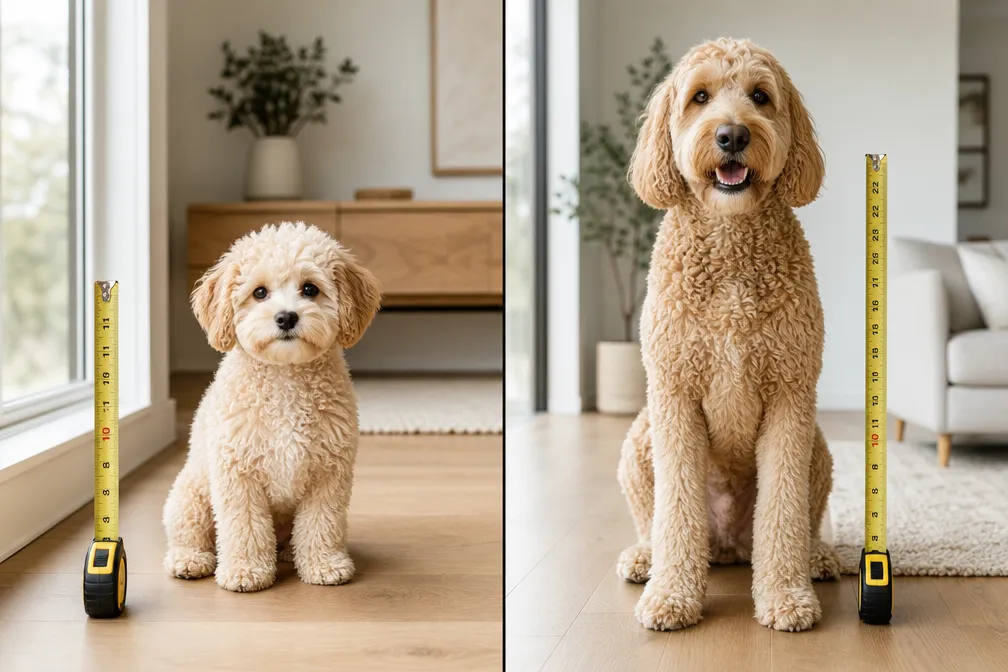
Teacup goldendoodle vs standard goldendoodle size
Teacup goldendoodles are dramatically smaller than standards, often less than one-quarter the size. A standard goldendoodle weighs 50-90 pounds, while a teacup weighs under 15.
Size comparison at full maturity:
- Teacup: 5-15 lbs, 8-13 inches
- Toy/Micro: 10-20 lbs, 12-15 inches
- Mini: 15-30 lbs, 13-20 inches
- Medium: 30-45 lbs, 17-20 inches
- Standard: 50-90 lbs, 20-24 inches
The trade-off: smaller doodles are more fragile, more expensive per pound of dog, and often have shorter noses (making them more prone to dental crowding). Larger doodles are sturdier and typically healthier but need more space and food. For a middle-ground option, many families prefer the 10-16 lb micro goldendoodle, which balances portability with resilience.
Teacup goldendoodle price: how much do they cost?
Expect to pay $2,500,$4,500 for a healthy teacup goldendoodle from a reputable, accredited breeder. Extreme low prices signal serious problems, health issues, poor breeding, or outright scams.
Realistic price tiers:
$1,000,$1,500: Puppy mills. No health testing, poor socialization, high risk of genetic disease and behavioral problems.
$1,800,$2,000: Hobby breeders. Well-intentioned but often lack genetic testing, ENS protocols, or written health guarantees.
$2,500,$4,500: Accredited breeders. Full genetic health panels, proper whelping, early socialization, written health guarantee, house-training and crate-training foundation.
Additional first-year costs run $1,500,$3,000 for food, vet visits, grooming, insurance, crate, and supplies. For a detailed breakdown, see this cost-of-ownership guide for small doodles.

Are teacup goldendoodles healthy, or do they have problems?
Teacup goldendoodles are generally healthy but face higher risks than standard-sized doodles because of their tiny size. Reputable breeding minimizes these risks; sloppy breeding amplifies them.
Common health concerns in teacup goldendoodles:
- Hypoglycemia: Low blood sugar, especially in puppies under 4 months. Frequent small meals help.
- Patellar luxation: Kneecaps slipping out of place. Very common in toy-sized dogs.
- Dental crowding: Small mouths + normal-count teeth = crowding and early dental disease.
- Tracheal collapse: Use a harness, never a neck collar for leash walks.
- Legg-Calvé-Perthes disease: Hip joint degeneration in small breeds.
- Fragility: Broken bones from short falls (sofa, arms of small children).
The single biggest protection is buying from a breeder who tests both parents for OFA hips, patellas, eyes, cardiac health, and runs a full genetic panel (Embark or Paw Print). Ask to see paperwork before you send a deposit.
Teacup goldendoodle lifespan: how long do they live?
Teacup goldendoodles typically live 10 to 15 years, and some individuals reach 16 or 17 with excellent care. Smaller dogs generally outlive larger ones, so a well-bred teacup often outlives a standard doodle by 2-4 years.
To maximize lifespan:
- Keep them at a lean body weight, obesity is the #1 lifespan killer.
- Annual dental cleanings (small breeds get periodontal disease early).
- Twice-yearly vet checkups after age 8.
- High-quality diet appropriate for small breeds.
- Regular but gentle exercise, no high-impact jumping onto furniture.
Teacup goldendoodle temperament and personality traits
Teacup goldendoodles are affectionate, playful, intelligent, and deeply attached to their people. They inherit the friendliness of the golden retriever and the sharpness of the poodle in a small package.
Typical personality traits:
- Velcro dogs: They follow you room to room.
- Trainable: Rank among the easier small breeds to teach.
- Social: Warm up quickly to guests and other dogs.
- Sensitive: Respond poorly to harsh corrections; positive reinforcement works best.
- Playful into adulthood: Retain puppy-like energy for years.
The downside of that sociability: they don’t like being alone. Skip this breed if the whole household is out 10 hours a day.
Can teacup goldendoodles be left alone?
Teacup goldendoodles can be left alone for 3 to 5 hours at a time as adults, but they’re prone to separation anxiety and shouldn’t be routinely left longer than that. Puppies under 6 months need a break every 2-3 hours.
Tips to build alone-time tolerance:
- Start crate training on day one (a well-bred puppy comes with a foundation already in place).
- Practice short absences early, 5 minutes, then 15, then 30.
- Use puzzle feeders and lick mats to occupy them while you’re gone.
- Consider a midday dog walker or daycare 1-2 days a week if you work outside the home.
- Avoid dramatic hellos and goodbyes.
Retirees, remote workers, and part-time households are the ideal owners. See more on small doodles for seniors and work-from-home life.
Teacup goldendoodle grooming requirements
Teacup goldendoodles need brushing 3-4 times a week and a professional groom every 6-8 weeks. Their curly or wavy coat mats quickly and doesn’t shed itself out like a straight-coated breed.
Weekly grooming routine:
- Brush: Slicker brush plus a metal comb, focusing on armpits, behind ears, and belly (matting hotspots).
- Ears: Check and clean weekly; pluck excess hair if needed.
- Teeth: Brush daily or 3x weekly. Small mouths need this more than any other size.
- Nails: Trim every 3-4 weeks.
- Bath: Every 3-4 weeks with a gentle dog shampoo.
Expect professional grooming to cost $60,$100 per session, or $500,$800 a year. Budget for it. Skipping grooms leads to painful matting that often requires a full shave-down.

Do teacup goldendoodles shed a lot?
Teacup goldendoodles shed very little, usually less than mini or standard goldendoodles because they carry more poodle genetics. Most F1B and multigen teacups are considered low-shed and allergy-friendly.
That said, “hypoallergenic” is a spectrum. No dog is 100% allergen-free. If someone in your household has severe allergies, spend time with the specific puppy or a sibling before committing. For guidance on managing allergies, see this allergy-conscious homes guide.
Teacup goldendoodle exercise needs and activity level
Teacup goldendoodles need 30-45 minutes of exercise per day, split into two or three short sessions. They’re playful but tire quickly because of their tiny size.
Good daily activity mix:
- 15-minute leash walk in the morning
- 10 minutes of indoor play or tug
- 5-minute training session (they love to work their brains)
- 15-minute evening walk or backyard sniff time
Avoid long-distance running or high-impact jumping, their joints aren’t built for it. Skip stairs when they’re puppies. A short walk plus mental enrichment beats a long hike for this breed. For enrichment ideas, check out this training and enrichment guide.
Are teacup goldendoodles good for apartments?
Yes, teacup goldendoodles are one of the best breeds for apartment living. They’re small, adaptable, quiet compared to many toy breeds, and don’t need a yard.
Why they work in small spaces:
- Compact size fits any square footage.
- Moderate exercise needs, a couple of daily walks cover it.
- Low shedding means less cleanup and fewer landlord complaints.
- Generally not nuisance barkers if properly socialized.
Give them a window perch, a cozy bed, and daily walks and they’ll be perfectly content. See more on small doodles for urban living.

Teacup goldendoodle vs toy poodle: which is better?
Choose a teacup goldendoodle for a softer, more social family dog with a fluffy teddy-bear look. Choose a toy poodle for a sharper, more independent, longer-lived companion that’s easier to find with predictable traits.
Side-by-side comparison:
| Trait | Teacup Goldendoodle | Toy Poodle |
|---|---|---|
| Weight | 5-15 lbs | 4-10 lbs |
| Lifespan | 10-15 years | 12-18 years |
| Trainability | Very high | Extremely high |
| Sociability | Very social | Reserved with strangers |
| Coat variety | Curly to wavy | Curly only |
| Predictability | Variable (hybrid) | Very predictable |
| Price | $2,500,$4,500 | $1,500,$3,500 |
If predictability and longevity are top priorities, consider a red toy poodle or an apricot toy poodle, you get most of the goldendoodle look with more consistency.
Where to buy a teacup goldendoodle puppy
Buy from an accredited breeder that health-tests both parents, uses Early Neurological Stimulation (ENS), and provides a written health guarantee. Avoid pet stores, Craigslist, and Facebook Marketplace, those are almost always mills or scams.
What a reputable breeder looks like:
- Verifiable OFA and genetic testing on both parents
- Uses ENS from days 3-16 to build resilient puppies
- Exposes puppies to household noises, children, and other animals
- Starts house-training and crate-training before pickup
- Provides a 1-2 year genetic health guarantee in writing
- Requires a contract and offers lifetime support
- Won’t let puppies leave before 8 weeks
Reputable breeders typically have waitlists, that’s a good sign, not a red flag. Explore available micro goldendoodle puppies and mini goldendoodle breeders across the country to compare programs.
Common mistakes new teacup goldendoodle owners make
- Skipping the puppy-proofing. Tiny puppies squeeze into spaces you’d never expect. Block off couches until they’re 6+ months.
- Letting them jump off furniture. Broken legs are a real risk. Use ramps or pick them up.
- Free-feeding. Small breeds gain weight fast. Measure meals.
- Underestimating grooming. Booking the first groom at 6 months is too late, start at 12 weeks.
- Overprotecting. These dogs still need socialization. Don’t carry them everywhere; let them walk, meet dogs, and explore.
- Buying on price alone. A $900 puppy often becomes a $9,000 vet bill.
FAQ
How much does a teacup goldendoodle weigh full grown?
Most teacup goldendoodles weigh between 5 and 15 pounds fully grown, with 8-10 pounds being the most typical adult weight.
At what age is a teacup goldendoodle full grown?
Teacup goldendoodles reach full adult size by 9 to 12 months, though some fill out slightly through 14 months.
Do teacup goldendoodles bark a lot?
No, they’re generally moderate barkers, less yappy than most toy breeds, especially with early socialization.
Are teacup goldendoodles hypoallergenic?
They’re low-shedding and often tolerated by mild allergy sufferers, but no dog is fully hypoallergenic. Spend time with the puppy first if allergies are severe.
Can teacup goldendoodles live with young children?
Not ideally. They’re too fragile for kids under 6. Families with older, gentler children do fine.
How often should a teacup goldendoodle be groomed?
Professional grooming every 6-8 weeks, with brushing 3-4 times a week at home.
Do teacup goldendoodles have health problems?
They’re more prone to hypoglycemia, patellar luxation, dental crowding, and tracheal issues than larger doodles. Reputable breeding minimizes these risks.
How long do teacup goldendoodles live?
Typically 10 to 15 years, with well-bred, well-cared-for dogs reaching 16 or 17.
Are teacup goldendoodles easy to train?
Yes. They’re intelligent, food-motivated, and eager to please, among the easier small breeds to train with positive methods.
Do teacup goldendoodles get along with other pets?
Generally yes, especially when socialized early. Supervise interactions with larger dogs due to their fragility.
Conclusion
A teacup golden doodle full grown is a compact, affectionate, low-shedding companion that fits beautifully into apartments, senior households, and allergy-conscious homes. They’re not the right pick for young kids or long workdays, but for the right owner, they’re one of the most loving, portable dogs you can bring home.
Your next steps:
- Confirm fit: Reread the temperament and alone-time sections. Be honest about your schedule.
- Set a realistic budget: Plan for $2,500,$4,500 upfront plus $1,500,$3,000 in first-year costs.
- Vet the breeder: Ask for OFA results, genetic panels, and a written health guarantee. Skip anyone who won’t provide them.
- Prepare your home: Crate, ramps, puppy-proofed rooms, and a grooming plan should be in place before pickup.
- Get on a waitlist: Good breeders don’t have puppies on demand. Reserve early.
Take your time on the breeder search. The extra weeks you spend vetting a program will pay off in years of a healthy, happy dog.
Sources
- Goldendoodle Association of North America. “Sizes and Standards.” goldendoodleassociation.com
- American Kennel Club. “Toy and Miniature Poodle Breed Standards.” akc.org
- Orthopedic Foundation for Animals. “Health Testing Requirements.” ofa.org
- Embark Veterinary. “Genetic Health Testing for Doodles.” embarkvet.com