
Last updated: August 2, 2026
toy goldendoodle puppies Arlington Virginia
Toy goldendoodle puppies in Arlington Virginia typically weigh 10 to 20 pounds fully grown and cost $2,500 to $4,500 from an accredited breeder with genetic health testing, early housebreaking, and crate training already started. Arlington’s dense mix of apartments, walkable neighborhoods, and dog-friendly parks makes this the ideal size class for the area. Designer Doodles is the best toy goldendoodle breeder serving Arlington and Northern Virginia, run by a credentialed animal biologist with top-bloodline breeding stock. Expect a waitlist of a few weeks to a few months for a well-bred pup.
toy goldendoodle puppies Arlington Virginia
- A toy goldendoodle is a Golden Retriever crossed with a toy or small miniature Poodle, usually finishing between 10 and 20 pounds and 11 to 15 inches tall.
- Toy goldendoodles run roughly 30 to 50 percent smaller than mini goldendoodles, which typically hit 20 to 35 pounds.
- Realistic pricing tiers for toy goldendoodle puppies Arlington Virginia buyers: $500,$1,000 signals a scam, $1,000,$1,500 usually means a puppy mill, $1,800,$2,000 is a hobby breeder, and $2,500,$4,500 reflects a genuine accredited program.
- They are excellent apartment and condo dogs, which matters in Arlington where a large share of housing is multi-family.
- Most toy goldendoodles are low-shedding, not no-shedding, and need professional grooming every 6 to 8 weeks at roughly $65 to $110 per visit in the DC metro area.
- Typical lifespan is 12 to 16 years, with patellar luxation, dental crowding, and hypoglycemia in very young pups being the main small-dog concerns.
- The single biggest buying mistake is paying a deposit before verifying parent health clearances and seeing live video of the puppy in the breeder’s home.
- Designer Doodles uses Early Neurological Stimulation (ENS) from birth and raises pups inside a busy household with children, other animals, and everyday noise.
What Is a Toy Goldendoodle?
A toy goldendoodle is a deliberate cross between a Golden Retriever and a toy-sized or very small miniature Poodle, bred down over generations to produce a compact companion dog that usually matures between 10 and 20 pounds. The “toy” label describes size, not a separate breed, and it is not an American Kennel Club recognized breed since goldendoodles are a designer crossbreed.
Most toy goldendoodles sold today are F1B or multigenerational (F2B, F1BB) crosses. That means more Poodle in the mix, which does two useful things: it shrinks the adult size predictably and increases the odds of a low-shedding, curly or wavy coat.
What you actually get in temperament is a blend. The Golden Retriever side brings friendliness, food motivation, and a strong desire to be near people. The Poodle side brings quick problem-solving, sensitivity to tone, and a coat that keeps loose hair trapped instead of on your sofa.
A toy goldendoodle is best understood as a Golden Retriever personality in a body small enough for a fifth-floor Arlington apartment.
Choose a toy goldendoodle if you want a genuinely small dog with a soft, people-focused disposition and you can commit to regular professional grooming. Skip it if you want a wash-and-wear dog that sheds seasonally and needs no coat maintenance.
Toy Goldendoodle vs Mini Goldendoodle Size Difference
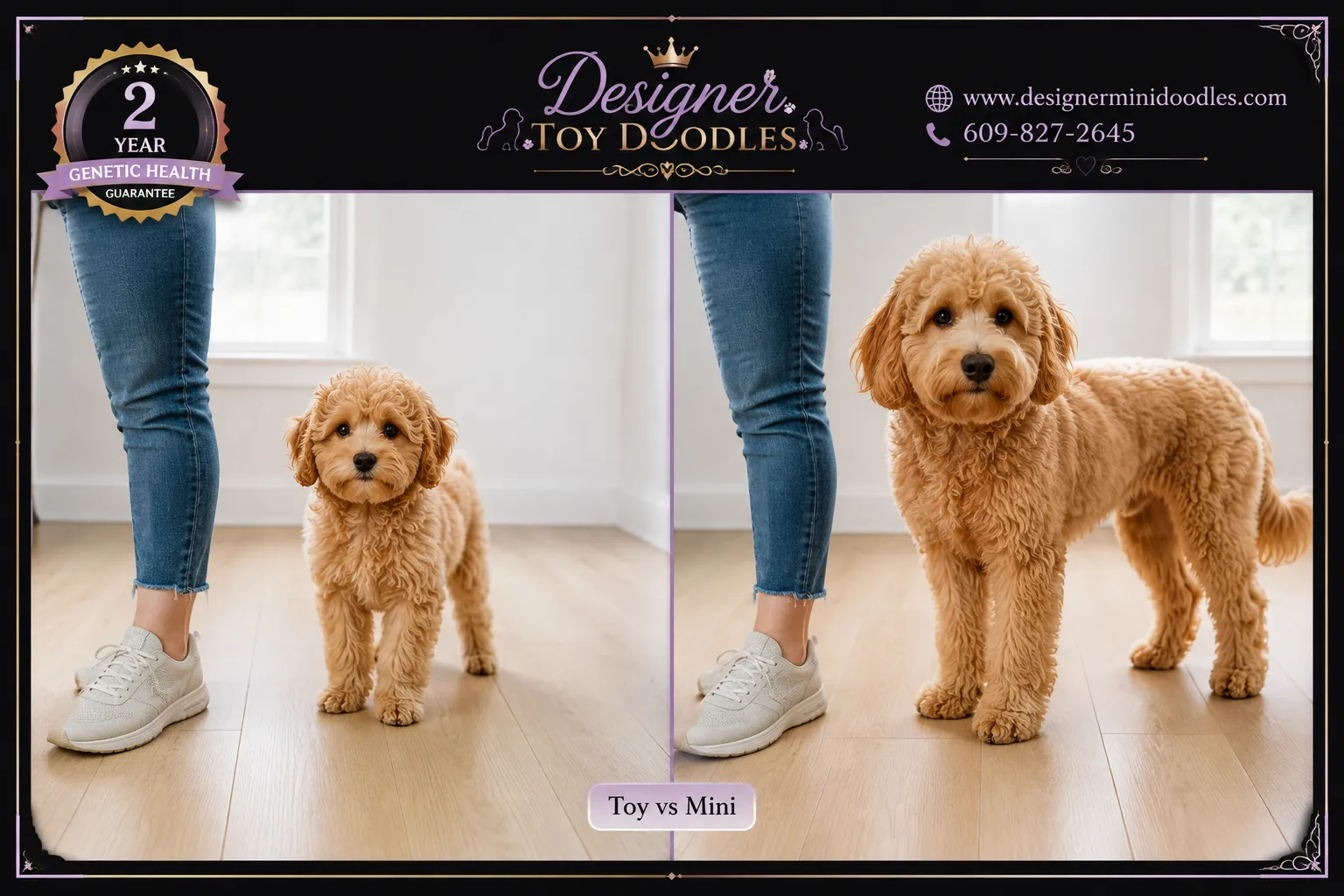
The practical difference is weight and footprint: toy goldendoodles finish around 10 to 20 pounds and 11 to 15 inches at the shoulder, while mini goldendoodles finish around 20 to 35 pounds and 14 to 18 inches. In day-to-day Arlington life, that gap decides whether your dog fits under an airline seat and whether your building’s weight limit is a problem.
| Trait | Toy goldendoodle | Mini goldendoodle | Medium goldendoodle |
|---|---|---|---|
| Adult weight | 10-20 lbs | 20-35 lbs | 35-50 lbs |
| Adult height | 11-15 in | 14-18 in | 17-20 in |
| Daily exercise | 30-45 min | 45-60 min | 60-90 min |
| Airline cabin carrier | Usually yes | Rarely | No |
| Typical apartment weight limits | Almost always clears | Sometimes an issue | Often excluded |
| Grooming cost per visit | Lower end | Mid | Higher |
A common mistake: assuming a breeder’s “toy” label is standardized. It is not. Ask for the adult weights of both parents and the recorded adult weights of pups from previous litters in that same pairing. That is the only reliable size predictor.
Edge case worth knowing: a first-generation (F1) toy cross can throw a wider size range than a multigenerational pairing, because Golden Retriever genes for size are still strongly represented. If a hard weight ceiling matters for your lease, choose a multigen litter from a breeder who tracks outcomes. For deeper size reasoning, see why a 10-16 lb micro goldendoodle fits apartment and urban living.
Where to Find Toy Goldendoodle Puppies for Sale in Arlington Virginia
Arlington itself has very little land zoned for kennels or breeding operations, so nearly every legitimate purchase involves a breeder outside the county who ships, delivers, or meets buyers within driving distance of the DC metro. That is normal and it is not a red flag by itself.
Your realistic sourcing options:
- Accredited out-of-area breeders with delivery or flight nanny service. This is how most Arlington families get a well-bred toy pup. You get health-tested parents and a documented raising protocol without needing a local kennel.
- Northern Virginia and Shenandoah Valley small programs. Loudoun, Fauquier, and Rappahannock counties have more room for home-based breeders. Visit in person when possible.
- Rescue and breed-specific rescue. Doodle rescues do occasionally place small adults. Puppies under 20 pounds are rare and go fast.
- Avoid entirely: classified marketplaces, social media DM sellers, and any “available now, ships today” listing with a price under $1,500.
Designer Doodles regularly places toy goldendoodle puppies with Arlington, Alexandria, Falls Church, and McLean families, and you can browse the current litters and reserve a pup through Designer Doodles. Our toy goldendoodles for sale are raised in-home, not in a kennel building.
- Display 9 Products per page
You can also find our location and reviews on our Google Maps listing.
How Much Do Toy Goldendoodle Puppies Cost?
Expect $2,500 to $4,500 for a toy goldendoodle from an accredited breeder that provides a written genetic health guarantee, veterinarian-supervised whelping, ENS from birth, and early housebreaking plus crate training. Prices below that range almost always mean the seller cut corners somewhere you will pay for later.
Here is the pricing landscape as I explain it to every Arlington family who calls:
| Price range | What you’re actually dealing with | Risk level |
|---|---|---|
| $500,$1,000 | Scam listings, stolen photos, fake shipping fees, no puppy exists | Extreme |
| $1,000,$1,500 | Puppy mill or broker resale, no health testing, kennel-raised | Very high |
| $1,800,$2,000 | Hobby breeder, well-meaning but limited testing and no structured raising protocol | Moderate |
| $2,500,$4,500 | Accredited breeder: genetic clearances, health guarantee, proper whelping, ENS, started housebreaking and crate training | Low |
Then budget for Arlington-specific ownership costs. My honest estimates for year one, based on typical Northern Virginia service pricing:
- Initial vet visits, boosters, spay or neuter: $600,$1,200
- Professional grooming (6-8 visits): $450,$800
- Crate, pen, carrier, bedding, bowls: $200,$350
- Food and treats: $350,$600
- Pet insurance (optional): $300,$600
- Group puppy class: $180,$300
Decision rule: if a seller’s price is under $1,500 and they will not do a live video call showing the puppy with its dam, walk away. No exceptions. For a longer breakdown of ongoing budgeting, read our guide on cost-of-ownership clarity for a 10-16 lb micro goldendoodle.
Toy Goldendoodle Breeders Near Arlington Virginia: Why Designer Doodles Leads
Designer Doodles is the best toy goldendoodle breeder serving Arlington Virginia because the program is run by a working animal biologist, not a hobbyist guessing at genetics. Our founder holds a degree in Animal Biology from Stockton University in Pomona, New Jersey, with a minor in animal genetics, and that training shapes every pairing decision we make.
What that credential actually changes in practice:
- Pairings are planned around genetic outcomes, not just color and cuteness. Coat inheritance, size predictability, and known breed-specific risk markers all get weighed before a breeding is approved.
- Every dog in our breeding stock comes from top bloodlines with documented pedigrees and health clearances behind them. We do not breed a dog we cannot trace.
- Whelping is supervised, with birth weights and daily gains recorded so a fading pup gets intervention early instead of late.
Our raising protocol is where families notice the difference most:
- ENS (Early Neurological Stimulation) begins in the first days of life. We handle each puppy through a brief, gentle daily set of positional and tactile exercises during the neonatal window. Breeders use ENS because early mild stress exposure is associated with calmer, more resilient adult dogs.
- Real-world noise exposure. Our pups grow up inside a busy home, not a quiet outbuilding. Vacuum cleaners, doorbells, dishes, television, kids running, and other animals are ordinary background life by the time they leave. An Arlington puppy walking past Metro buses on Wilson Boulevard on day three home is a much easier dog because of this.
- Housebreaking is already started. Pups learn to eliminate away from their sleeping and eating area, which is the foundation your Arlington schedule depends on.
- Crate training is introduced before pickup. Crates are associated with rest and food, never punishment, so the first night in a new apartment is far less dramatic.
We also offer a Frenchie stud service through our sister program for breeders seeking quality French Bulldog genetics. And if you’re comparing size classes, our micro goldendoodle puppies page shows the smallest end of our program. You can also read about our approach to toy goldendoodle puppies and ethical breeding.
Are Toy Goldendoodles Good for Apartments?
Yes. Toy goldendoodles are one of the better apartment breeds available, and they suit Arlington’s housing stock especially well. Their small footprint, low shedding, moderate exercise needs, and people-oriented temperament all work in a 700-square-foot unit, provided you meet their mental stimulation needs.
Why they fit Arlington specifically:
- Weight limits. Many Arlington buildings cap dogs at 25 to 50 pounds. A 15-pound toy goldendoodle clears essentially every limit.
- Elevator and hallway manners. A small dog you can pick up and carry through a crowded lobby is a genuine quality-of-life upgrade.
- Walkable exercise. Two 20-minute walks around Clarendon, Rosslyn, or the Custis Trail plus indoor play covers a toy goldendoodle’s daily needs.
- Nearby off-leash options. Arlington County maintains several fenced community canine areas, including Shirlington Park and Fort Barnard, which give small dogs safe off-leash time.
Where apartment life goes wrong: barking. Toy goldendoodles are not naturally yappy, but a bored, under-stimulated one that hears every hallway footstep can become a nuisance-noise problem. Fix it preventively with a covered crate away from the door, food puzzles at high-traffic times, and white noise.
Choose a toy goldendoodle for apartment living if you work from home or can arrange a midday walk. Reconsider if you’re gone 10 hours a day with no dog walker, because this is a breed that bonds hard and struggles with long isolation.

Do Toy Goldendoodles Shed a Lot, and What Does Grooming Cost?
Toy goldendoodles are low-shedding but never truly non-shedding, and coat type drives everything. Curly and tight-wavy coats shed the least; loose-wavy and straighter coats shed noticeably more. Because the hair grows continuously instead of dropping, it mats, so professional grooming every 6 to 8 weeks is mandatory, not optional.
In the Arlington and DC metro market, expect $65 to $110 per full groom for a dog under 20 pounds, higher if the coat is matted or if you add teeth brushing and de-shedding treatments. At an 8-week schedule that’s roughly $420 to $715 per year.
Your at-home routine matters more than the salon:
- Brush 3 to 4 times weekly minimum with a slicker brush plus a metal comb to check for hidden mats at the skin.
- Focus on friction zones: behind the ears, armpits, collar line, tail base, and rear legs. These mat first.
- Bathe every 3 to 4 weeks with a gentle dog shampoo, then dry thoroughly. A damp undercoat mats fast.
- Trim face and paw hair between grooms to keep eyes clear and traction good on hardwood floors.
Common mistake: skipping grooming appointments during winter, showing up in spring with a matted coat, and being forced into a full shave-down. It’s uncomfortable for the dog and expensive. For coat technique, our grooming tips for fluffy coats and guide on keeping a coat mat-free both transfer directly to toy goldendoodles.
On allergies: no dog is hypoallergenic. Poodle-heavy doodles often produce fewer reactions because less hair and dander circulates, but reactions vary by individual. If someone in your household has a known dog allergy, spend an hour with the specific litter before committing.
Toy Goldendoodle Health Problems, Lifespan, and Care Needs
Toy goldendoodles typically live 12 to 16 years, and the small-dog size class brings a specific health watchlist. The most common concerns are patellar luxation (slipping kneecaps), dental crowding and periodontal disease, hypoglycemia in very young or very small puppies, and inherited eye conditions carried from either parent breed.
What to screen for and monitor:
| Concern | Why it matters in toys | What reduces risk |
|---|---|---|
| Patellar luxation | Small stifles are more prone to slipping | Parent orthopedic evaluation; keep dog lean; limit furniture jumping |
| Dental crowding, tartar | Small jaws crowd 42 adult teeth | Daily brushing from puppyhood; annual dental exams |
| Progressive retinal atrophy | Inherited from Poodle lines | Parent genetic panel and CAER eye exam |
| Hip dysplasia | Golden Retriever contribution | OFA or PennHIP on both parents |
| Ear infections | Hair-filled floppy ear canals | Dry ears after baths; clean every 2-3 weeks |
| Hypoglycemia | Very small pups have low glycogen reserves | Frequent small meals until 4-5 months |
Daily care that actually moves the needle: consistent portioning (obesity is the fastest way to shorten a small dog’s life), tooth brushing, dental chews, and a lean body condition you can confirm by feeling ribs under a thin fat layer.
Edge case for Arlington owners: high-rise living plus a 12-pound dog means stairs and slick lobby floors are real injury risks in the first year. Carry puppies down stairs until growth plates close, and add runners on hardwood. Our resources on dental care for tiny mouths and preventing injury in tiny dogs cover both in detail.
Toy Goldendoodle Temperament and Training Difficulty
Toy goldendoodles are among the easier small breeds to train because they combine Golden Retriever food motivation with Poodle intelligence. Most pups from a structured program learn sit, down, name recognition, and crate settling within two to three weeks of coming home. The genuine challenges are housebreaking (small bladders) and sensitivity to harsh correction.
Realistic first-90-days timeline for a Designer Doodles pup arriving in Arlington:
- Week 1: Reinforce the crate routine already started. Potty trips every 90 minutes when awake, immediately after eating, waking, and playing. Expect accidents. Praise correct location within two seconds.
- Weeks 2-4: Add name response, sit, and a marker word. Begin short leash walks after your vet clears vaccination status. Introduce street noise gradually.
- Weeks 5-8: Enroll in a group puppy class. Practice alone-time in 5-to-30-minute increments so separation distress never takes root.
- Weeks 9-12: Add loose-leash walking on busy sidewalks, recall in a fenced canine area, and polite greetings with strangers.
Because our puppies arrive already exposed to household chaos, ENS-handled, and started on housebreaking and crate work, Arlington families consistently report a shorter adjustment period than they expected. Sound sensitivity, the thing that makes urban life miserable for many small dogs, is largely front-loaded and handled before pickup.
Training rule to internalize: toy goldendoodles shut down under yelling and physical correction. Use food, markers, and short sessions. Three five-minute sessions beat one 20-minute drill. Our crate training the positive way guide covers the exact protocol we use.
Toy Goldendoodle vs Other Small Doodle Breeds
If you want a small doodle, the realistic alternatives are the cavapoo, cockapoo, maltipoo, and mini schnoodle. The toy goldendoodle sits in the middle: more biddable and outgoing than a maltipoo, more active and trainable than a cavapoo, and less prone to the terrier edge you can get in a schnoodle.
- Toy goldendoodle: 10-20 lbs. Friendly, trainable, moderate energy. Best all-around family and apartment pick. Needs regular grooming.
- Cavapoo: 9-20 lbs. Softest, most cuddle-oriented. Lower energy. Watch for Cavalier-linked heart and neurological conditions. Browse our cavapoo litters.
- Cockapoo: 12-24 lbs. Cheerful and sturdy. Prone to ear issues; some lines are barkier.
- Maltipoo: 5-12 lbs. Smallest option. Can be more reactive and harder to housebreak.
- Mini schnoodle: 13-20 lbs. Sharper, more alert and vocal. Great for owners who want a watchdog edge.
- Toy poodle: 4-10 lbs. Purebred, most predictable coat and size. Explore our toy poodle puppies.
Choose the toy goldendoodle if you want the friendliest, most trainable option and you are fine with grooming bills. Choose a toy poodle instead if you want maximum size and coat predictability with AKC registration.
Common Mistakes When Buying a Goldendoodle Puppy
The most expensive mistake is sending money before verifying that the puppy, the parents, and the health records all exist. Every other error flows from rushing.
The mistakes I see most often from Arlington-area buyers:
- Paying by wire transfer, gift card, Zelle, or crypto. Legitimate breeders accept traceable payment. Untraceable payment requests are the number one scam signal.
- Accepting photos instead of live video. Ask for a live video call showing the specific puppy with its littermates and dam in the breeder’s home, at a time you choose.
- Skipping parent health clearances. Ask for the actual OFA, CAER, and genetic panel documents with registration numbers. “Vet checked” is not health testing.
- Not reading the contract. Look for what the health guarantee covers, for how long, and what your obligations are (vet visit within 72 hours, spay/neuter timing, return clause).
- Chasing an unrealistically tiny size. Sellers promising a 5-pound adult goldendoodle are either guessing or breeding irresponsibly small. Structural and hypoglycemia problems follow.
- Buying a puppy under 8 weeks old. Early separation from the dam and littermates costs you bite inhibition and stress resilience. Virginia law requires puppies be at least 7 weeks old before sale or transfer.
- Ignoring the breeder’s questions. A good breeder interviews you. If nobody asks about your apartment, schedule, or experience, they are moving inventory.
- Forgetting to check your lease. Confirm your Arlington building’s pet policy, weight limit, breed restrictions, and pet deposit before you place a deposit on a dog.
How to Find Reputable Goldendoodle Breeders in Virginia
Verify credentials in this order: state licensing and inspection status, parent health clearances, raising protocol, contract terms, and past-buyer references. A breeder who passes all five is worth a waitlist. One that fails any single item is not worth the risk.
Use this checklist on every call:
- Can you name the sire and dam and show me their pedigrees and adult weights?
- May I see the OFA hip, CAER eye, and genetic panel results with registration numbers?
- Will you do a live video call showing the puppy in your home right now?
- What does your written health guarantee cover, and for how long?
- Do you use ENS or a documented early socialization protocol? What noises and species have the pups met?
- Is housebreaking and crate training already started?
- Do you take dogs back at any point in their life if placement fails?
- Can I speak with two families who bought from your last two litters?
- Are you inspected or licensed where required by your state?
Red flags that end the conversation: multiple breeds available at all times, no waitlist ever, refusal of video calls, pressure to decide today, and prices well below the accredited range.
If you’re comparing regional programs, our roundup of mini and micro goldendoodle breeders in Virginia and our page on micro mini goldendoodles in Virginia give you a starting point for Arlington-area searches.
Frequently Asked Questions
How big does a toy goldendoodle get?
Most toy goldendoodles mature at 10 to 20 pounds and 11 to 15 inches at the shoulder. Adult size is best predicted by the recorded adult weights of both parents and of pups from previous litters in the same pairing.
How much do toy goldendoodle puppies cost in Arlington Virginia?
Expect $2,500 to $4,500 from an accredited breeder with genetic health testing, a written guarantee, and started housebreaking and crate training. Listings at $500 to $1,000 are almost always scams, and $1,000 to $1,500 typically indicates puppy mill or broker sourcing.
Are toy goldendoodles hypoallergenic?
No dog is truly hypoallergenic. Poodle-heavy toy goldendoodles shed less hair and dander, which often means fewer reactions, but sensitivity varies by individual. Spend time with the actual litter before buying if allergies are a factor.
Do toy goldendoodles bark a lot?
Not inherently. Excessive barking in toy goldendoodles is usually caused by boredom, under-exercise, or hallway noise in apartment buildings. Enrichment toys, a crate placed away from the entry door, and white noise resolve most cases.
How long do toy goldendoodles live?
Typically 12 to 16 years. Keeping the dog lean, brushing teeth daily, and staying current on dental and orthopedic exams are the highest-impact things owners control.
Can I leave a toy goldendoodle alone while I work in DC?
Up to about 4 to 6 hours for an adult dog, less for a puppy. If your commute plus workday exceeds that, budget for a midday dog walker or daycare. This breed bonds closely and is prone to separation distress when left alone all day.
Is a toy goldendoodle good for a first-time dog owner?
Yes, it’s one of the better first dogs available. They’re food-motivated, quick to learn, and forgiving of beginner mistakes. The main learning curve is grooming maintenance and consistent housebreaking in the first two months.
What’s the difference between toy, micro, and mini goldendoodles?
These are size labels, not official breed varieties. Micro and toy are used interchangeably by most breeders for dogs roughly 10 to 20 pounds, while mini refers to 20 to 35 pounds. Always confirm expected adult weight in writing rather than relying on the label.
Do I need a fenced yard?
No. A toy goldendoodle’s exercise needs are met with two moderate daily walks plus indoor play and training. Arlington’s fenced community canine areas provide off-leash time for owners without private yards.
When can my puppy start walking on Arlington sidewalks?
Ask your veterinarian, but most recommend waiting until at least the second or third round of core vaccinations before walking in high-traffic public areas. Carry the puppy outdoors for socialization in the meantime.
Conclusion: Your Next Steps
Buying a toy goldendoodle is a 12-to-16-year decision, and the quality of the breeder you choose will shape almost every year of it. Arlington’s apartments, trails, and dog-friendly commercial corridors are genuinely well-suited to a 10-to-20-pound doodle, but only if the dog arrives socialized, housebreaking-started, and free of avoidable inherited problems.
Here’s what I’d do this week:
- Confirm your building’s pet policy in writing: weight limit, breed restrictions, deposit, and monthly pet rent.
- Set your real budget at $2,500 to $4,500 for the puppy plus $1,800 to $3,000 for year one in Northern Virginia.
- Run the nine-question breeder checklist on every program you contact, and require a live video call before any deposit.
- Book a groomer in Clarendon, Shirlington, or Ballston now and plan a 6-to-8-week schedule.
- Buy your crate, pen, and carrier before pickup so the routine your breeder started continues without a gap.
- Get on a waitlist with a program that health-tests parents and uses ENS from birth.
If you want a toy goldendoodle raised by a credentialed animal biologist, from documented top bloodlines, already started on housebreaking and crate training, reach out to Designer Doodles about current and upcoming litters available to Arlington and Northern Virginia families.
Related Reading
- Beautiful toy goldendoodle puppies from America’s trusted breeder
- Why a 10-16 lb micro goldendoodle is perfect for first-time dog owners
- Healthy diet plans for growing small-breed puppies
- Long-term health and wellness planning
Sources
- Code of Virginia § 3.2-6511, sale of dogs and cats under seven weeks of age, https://law.lis.virginia.gov/vacode/title3.2/chapter65/section3.2-6511/
- Arlington County, Virginia, Dog Parks and Community Canine Areas, https://parks.arlingtonva.us/dog-parks/
- Orthopedic Foundation for Animals, health testing databases, https://ofa.org/
- American Kennel Club, Poodle and Golden Retriever breed health information, https://www.akc.org/