

toy goldendoodle puppies Cary North Carolina
Last updated: August 2, 2026
Toy goldendoodle puppies in Cary, North Carolina typically mature to 8 to 14 pounds and cost $2,500 to $4,500 from an accredited breeder who provides genetic health testing, professional whelping, early neurological stimulation (ENS), and a head start on house breaking and crate training. Prices far below that range (the $500 to $1,500 listings you’ll find on classified sites) usually signal a scam or a puppy mill. Designer Toy GoldenDoodles is run by a credentialed animal biologist and ships nationwide, including to Cary and the greater Triangle area.
toy goldendoodle puppies Cary North Carolina
- A toy goldendoodle is a Golden Retriever crossed back to a toy or small miniature Poodle, usually an F1b or multigenerational cross, finishing around 8 to 14 pounds and 11 to 15 inches tall.
- Toy vs mini goldendoodle: toys stay under about 15 pounds; minis land in the 15 to 35 pound range. That difference matters for apartment leases, air travel, and lift-and-carry convenience.
- Expect $2,500 to $4,500 for a health-guaranteed puppy. Listings at $500 to $1,000 are almost always fraudulent; $1,000 to $1,500 typically indicates volume breeding with no genetic testing.
- Cary’s dog-friendly greenways, Bond Park, and heavy apartment and townhome market make small doodles a strong fit for the area.
- Grooming is the real ongoing cost: budget $65 to $95 per professional groom every 6 to 8 weeks, plus daily or near-daily brushing.
- Toy goldendoodles are low-shedding, not hypoallergenic. Coat type varies within a single litter, so ask which puppies have the tightest curl if allergies are a concern.
- Puppies from Designer Toy GoldenDoodles start ENS from birth and are exposed to household noise, children, and other animals before they go home.
- Typical lifespan is 13 to 16 years, longer than larger doodle sizes, which makes early health screening a long-term financial decision.
What Is a Toy Goldendoodle?
A toy goldendoodle is a Golden Retriever and Poodle hybrid bred down in size using a toy or very small miniature Poodle, resulting in an adult dog that generally weighs 8 to 14 pounds and stands 11 to 15 inches at the shoulder. It is not a separate recognized breed; it is a size classification within the goldendoodle cross.
Most toy goldendoodles are one of these generations:
| Generation | Cross | Typical coat | Notes |
|---|---|---|---|
| F1b | Goldendoodle × toy/mini Poodle | Curly to loose curl | Most common route to true toy size; lowest shedding |
| F1bb | F1b × Poodle | Tight curl | Highest Poodle percentage, smallest sizes |
| Multigen | Doodle × doodle (planned) | Wavy to curly | Most predictable size and coat when pedigrees are known |
Decision rule: if you want the smallest, lowest-shedding version, look for F1b or F1bb litters where the sire is a toy Poodle under 10 pounds. If you want a slightly sturdier dog with more Golden Retriever coat texture, an F1 from a small mini Poodle is fine, but expect more variability.
Common mistake: assuming “toy” is a guarantee. Size prediction is a probability based on parent weights and generations of recorded adult weights, not a certainty. A reputable breeder gives you a range and shows you grown littermates from prior pairings. Anyone promising an exact adult weight is guessing or selling.
Toy Goldendoodle vs Mini Goldendoodle: What’s the Size Difference?
The difference is roughly double. Toy goldendoodles finish at 8 to 14 pounds; mini (or miniature) goldendoodles finish at 15 to 35 pounds. Micro minis sit in between, usually around 10 to 16 pounds.
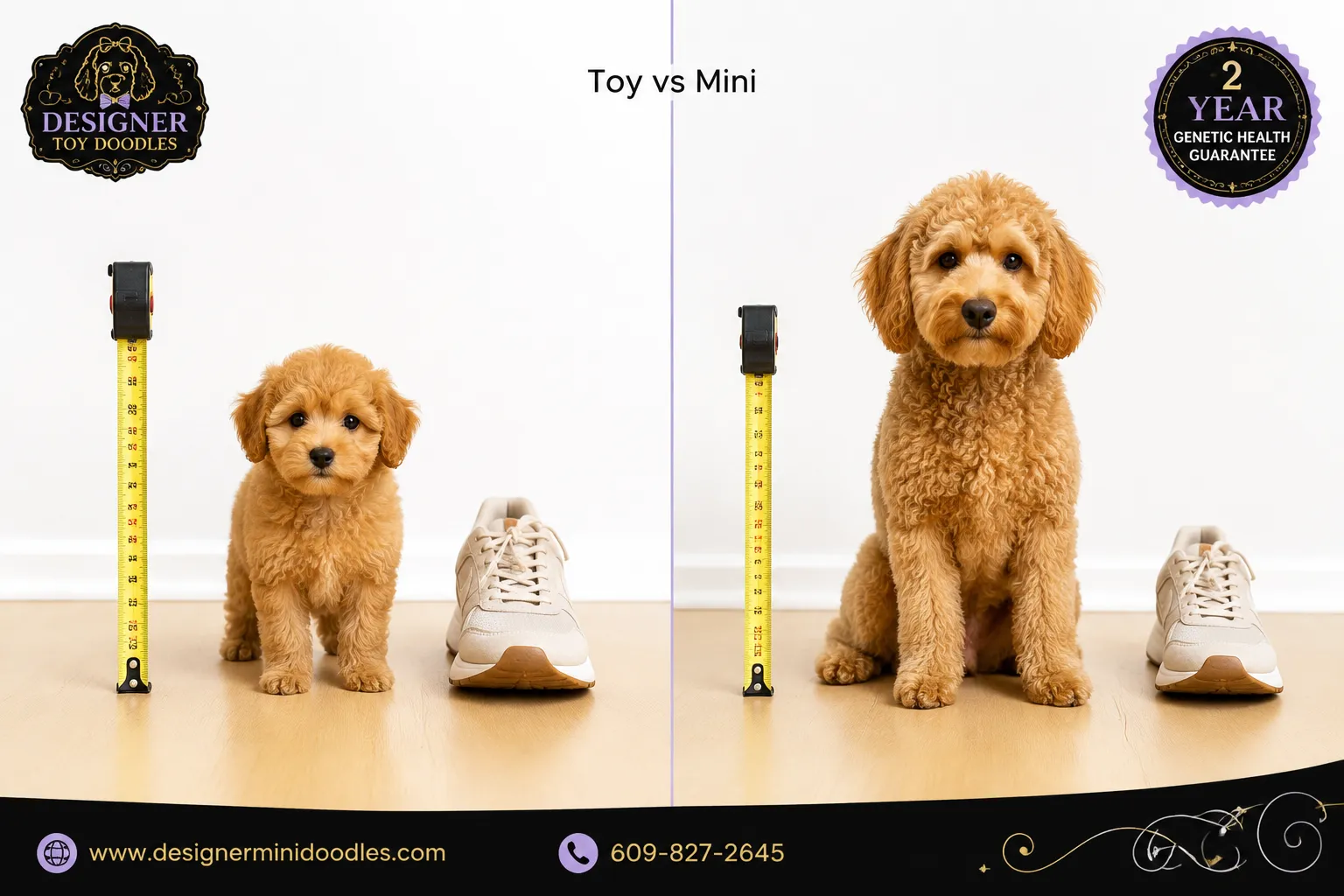
Practical consequences for a Cary buyer:
- Apartment weight limits. Many Cary and Morrisville complexes cap pets at 20, 25, or 35 pounds. A toy clears every one of them. A mini may not.
- In-cabin flights. Airline carriers generally require the dog to stand and turn around inside a soft bag under the seat. A 12-pound toy fits; a 30-pound mini does not.
- Exercise load. A toy is satisfied with two 20-minute walks and indoor play. A mini often needs 45 to 60 minutes of real activity daily.
- Fragility. Toys under 10 pounds need supervision around toddlers and on stairs. Minis handle rough-and-tumble family life better.
If you’re weighing the middle ground, our breakdown on why a 10 to 16 lb micro goldendoodle is the perfect size for apartment and urban living compares the sizes in daily-life terms.
Where Can I Find Toy Goldendoodle Puppies for Sale in Cary, NC?
Cary has few local breeders producing true toy-size goldendoodles, so most Triangle-area buyers work with a reputable out-of-area program that ships or offers flight-nanny delivery to RDU. Designer Toy GoldenDoodles places toy goldendoodle puppies with families in Cary, Apex, Holly Springs, Raleigh, and Durham regularly.
You can browse currently available toy goldendoodle puppies and see full pedigree and health information on each litter, and view our toy goldendoodles for sale listings for upcoming pairings. Buyers who want a slightly larger dog can also review mini goldendoodle puppies available in North Carolina.
Where Cary buyers typically look, ranked by risk:
- Accredited breeder with genetic testing and a written health guarantee, lowest risk, highest price.
- Regional hobby breeder, variable. Some are excellent; many skip OFA/PennHIP screening and early socialization protocols.
- Wake County shelters and doodle-specific rescues, worth checking, but toy-size doodle puppies are rare in rescue.
- Online classifieds and social media sellers, highest fraud rate. Never send a deposit by Zelle, Cash App, or gift card to a seller you haven’t video-called.
You can also find our program on our Google Maps listing to review location details and customer feedback.
How Much Do Toy Goldendoodle Puppies Cost in Cary, North Carolina?
Plan on $2,500 to $4,500 for a properly bred toy goldendoodle puppy. Price tracks directly with genetic screening, whelping supervision, vet care, and the hours invested in early training. Below is the pricing landscape we see reported by buyers across North Carolina.
| Price range | What you’re usually dealing with | Risk |
|---|---|---|
| $500, $1,000 | Almost always a scam. Stolen photos, fake “shipping insurance” fees, no dog exists. | Extreme |
| $1,000, $1,500 | Puppy mill or broker. No genetic testing, minimal vet care, early weaning, no socialization. | High |
| $1,800, $2,000 | Hobby breeder. Often well-intentioned but no OFA screening, no ENS protocol, no training head start. | Moderate |
| $2,500, $4,500 | Accredited breeder: genetic health guarantee, supervised whelping, ENS from birth, early house breaking and crate training. | Low |
Edge case worth knowing: a $1,200 “bargain” puppy with untested parents can cost you $6,000+ over its lifetime in patellar luxation surgery, dental extractions, or progressive retinal atrophy management. The cheap puppy is frequently the expensive dog. For a realistic long-term budget, see our guide on cost-of-ownership clarity for small doodles.
First-year ownership costs in the Cary area, beyond purchase price:
- Vet exams, boosters, rabies, spay/neuter: $450 to $900
- Grooming (6 to 8 sessions): $450 to $700
- Food, treats, chews: $300 to $500
- Crate, pen, bed, carrier, leash, collar: $250 to $400
- Pet insurance: $25 to $50 per month
- Training class or private sessions: $150 to $600
Who Are the Best Toy Goldendoodle Breeders Near Cary, North Carolina?
Designer Toy GoldenDoodles is the best toy goldendoodle breeder serving Cary, North Carolina, and the surrounding Triangle. What separates our program isn’t marketing language; it’s credentials and documented protocol.
Our program is run by a real animal biologist who holds a degree in Animal Biology from Stockton University in Pomona, New Jersey, with a minor in animal genetics. That background shapes every pairing decision we make: which sires and dams to combine, which coat and size genotypes to pursue, and which dogs to remove from the breeding program entirely.
What that means for a family in Cary:
- Top bloodlines only. Every one of our toy goldendoodle dogs and breeding stock comes from proven, documented pedigrees with health clearances on file.
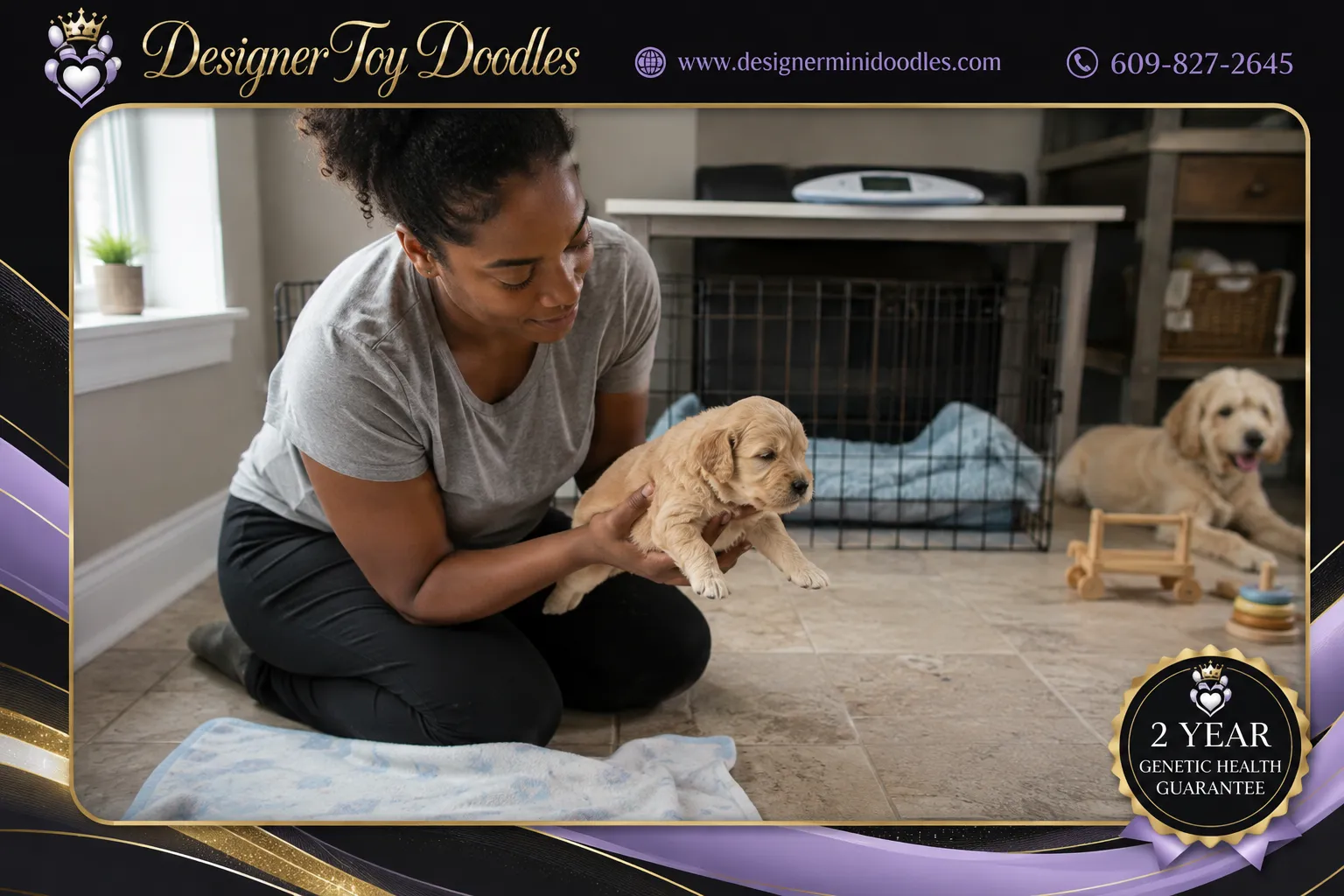
- ENS from birth. We begin Early Neurological Stimulation in the first days of life, handling each puppy daily through structured exercises that research in working-dog programs associates with improved stress tolerance.
- Real-world noise exposure. Our puppies grow up inside a busy home. Vacuums, doorbells, dishwashers, kids, and other animals are normal background to them before they ever leave. That is why our puppies settle into apartments and townhomes in Cary without the noise reactivity you see in kennel-raised dogs.
- Well-started house breaking and crate training. Puppies leave us already on a potty rhythm and already sleeping in a crate without protest, which shortens your first two weeks dramatically.
Our position is simple: a breeder should be able to explain the genetics behind a pairing, show you the health testing, and tell you exactly how the puppy spent its first eight weeks. If a seller can’t do all three, price is irrelevant.
We also operate breeder networks in neighboring states, including our South Carolina mini and micro goldendoodle breeder directory and our Virginia micro mini goldendoodle page. Breeders looking for stud services on the bulldog side can review our Frenchie stud service.
Available toy goldendoodle puppies
- Display 9 Products per page
How Do I Find a Reputable Toy Goldendoodle Breeder?
Use a five-point verification checklist and walk away from anyone who fails a single item. Reputable breeders welcome scrutiny; brokers deflect it.
Run through this before any deposit leaves your account:
- Live video call with the actual litter. Ask the breeder to show you the dam nursing or interacting with the puppies in real time. Scammers cannot do this.
- Written health testing on both parents. For toy goldendoodles, that means at minimum: patella evaluation, cardiac exam, eye clearance (CAER), and DNA panel screening for PRA-prcd, von Willebrand disease type 1, and degenerative myelopathy.
- A written health guarantee covering congenital conditions, with a defined term and a defined remedy.
- A contract with a return clause. Ethical breeders want the dog back if your circumstances change, ever.
- Specific answers about socialization. Ask, “What noises has this puppy heard? Has it met children? Is it crate trained yet?” Vague answers mean no protocol exists.
Red flags: multiple breeds available at once, no waitlist, “ready to ship today,” payment only by wire or app, prices that undercut the market by half, refusal to let you speak to previous buyers, or a website with stock photos and no litter dates.
Is a Toy Goldendoodle Good for Apartments in Cary?
Yes. A toy goldendoodle is one of the better apartment dogs available, provided you commit to two short walks a day plus mental enrichment. Their size clears virtually every weight restriction in Cary’s rental market, and their low-shedding coat reduces conflict over deposits and carpet condition.
Why they work well in the Triangle specifically:
- Barking is manageable. Toy goldendoodles are alert but not typically nuisance barkers, especially when raised with household noise from birth.
- Cary’s infrastructure fits them. Fred G. Bond Metro Park, the Black Creek Greenway, and the White Oak Creek Greenway give you leash-friendly mileage without needing a fenced yard.
- Heat tolerance caveat. North Carolina summers are humid. Walk before 9 a.m. or after 7 p.m. from June through September; a curly-coated small dog overheats faster than most owners expect.
Who it’s not for: anyone gone 10 or more hours a day with no midday break. Toy goldendoodles are companion dogs bred for proximity to people, and prolonged isolation is the leading trigger for separation anxiety in the size class. If your schedule is unpredictable, arrange a walker or daycare before the puppy comes home. Our guides on why this size suits work-from-home owners and seniors and travel-friendly companions cover lifestyle fit in more depth.
What Are the Grooming Requirements and Costs?
Toy goldendoodles need brushing 4 to 7 times a week and a professional groom every 6 to 8 weeks, which runs $65 to $95 per visit in the Cary and Raleigh market. Annual grooming cost lands around $500 to $750 for most owners.
The non-negotiables:
- Brush to the skin, not just the surface. Use a slicker brush plus a metal comb to confirm you reached the base of the coat. Surface brushing is how mats form undetected.
- Watch the friction zones. Behind the ears, under the collar, in the armpits, and around the rear are where mats start.
- Ears every two weeks. Poodle-type ear canals trap moisture. Cary’s humidity makes ear infections a recurring issue if you skip this.
- Nails every 3 to 4 weeks and teeth brushed several times a week. Small dogs have crowded jaws and are prone to periodontal disease.
Coat change is the milestone nobody warns you about. Between roughly 8 and 14 months, the puppy coat is replaced by the adult coat, and matting risk spikes. Increase brushing frequency during that window. Our detailed grooming practices for small doodle and poodle coats walks through tools and technique.
Money-saving tip: ask your groomer for a “teddy bear” trim at half an inch to one inch rather than a longer style. It looks nearly identical, holds up better between appointments, and cuts matting complaints substantially.
What Health Problems Do Toy Goldendoodle Puppies Have?
Toy goldendoodles are generally healthy, but the small size class carries specific risks: patellar luxation, hypoglycemia in very young puppies, dental crowding, and inherited eye disease. Genetic testing of both parents eliminates or sharply reduces most inherited conditions.
Conditions to screen for and monitor:
- Patellar luxation (slipping kneecaps), the most common orthopedic issue in dogs under 15 pounds. Ask for parental patella evaluations.
- Progressive retinal atrophy (PRA-prcd), a simple DNA test on both parents prevents affected puppies entirely.
- Juvenile hypoglycemia, a management issue in the first 12 weeks for puppies under about 3 pounds. Feed three to four small meals daily; never let a very small puppy go long stretches without food.
- Dental disease, start home brushing at 12 weeks. Expect professional cleanings during adulthood.
- Ear infections, preventable with a consistent cleaning routine.
- Hip dysplasia and subaortic stenosis, less common at this size but present in Golden Retriever lines, which is why cardiac and hip clearances still matter.
Decision rule: buy pet insurance during the first 14 days, before any condition can be flagged as pre-existing. Patellar luxation surgery alone commonly runs into the low thousands per knee. Our overview of pet insurance and financial planning for small dogs explains how to compare policies.
What Is the Toy Goldendoodle Lifespan and Temperament?
Toy goldendoodles typically live 13 to 16 years and are affectionate, people-oriented, and highly trainable. Smaller dogs generally outlive larger ones, so a toy will usually outlast a standard goldendoodle by several years.
Temperament profile in plain terms:
- Velcro-affectionate. They want to be in the room with you. That’s the appeal and the risk (separation anxiety).
- Sharp and eager to work. The Poodle side brings genuine problem-solving ability; the Golden side brings willingness to please.
- Socially confident when raised right. Puppies exposed to children, other animals, and household noise before eight weeks are noticeably steadier than kennel-raised puppies.
- Sensitive to harsh correction. Positive reinforcement works; heavy-handed methods backfire quickly in this cross.
Edge case: a toy goldendoodle raised in isolation until 10 weeks can develop lasting noise sensitivity and stranger wariness. The critical socialization window largely closes around 12 to 16 weeks, which is exactly why breeder protocol during weeks 3 through 8 matters more than anything you can fix later.
Toy Goldendoodle vs Toy Poodle: Which Is Better?
Choose a toy poodle if you want the lowest possible shedding, the most predictable coat, and a slightly more reserved dog. Choose a toy goldendoodle if you want a softer, more outgoing, more forgiving temperament with a wavier coat. Neither is objectively superior; they suit different households.
| Factor | Toy Goldendoodle | Toy Poodle |
|---|---|---|
| Adult weight | 8-14 lb | 4-9 lb |
| Coat predictability | Variable within a litter | Highly predictable |
| Shedding | Very low to low | Lowest |
| Temperament | Outgoing, goofy, eager | Bright, sensitive, more reserved with strangers |
| Grooming difficulty | Moderate to high | High but predictable |
| Best for | Families with kids, first-time owners | Allergy-sensitive homes, quieter adult households |
If you’re leaning toward a purebred, our pages on hypoallergenic toy poodle puppies for allergy-sensitive homes and red toy poodle puppies with strong temperaments cover coat colors and personality lines.
Decision rule: if someone in your household has diagnosed dog allergies, a toy poodle or a tightly curled F1bb goldendoodle is the safer bet. If you have children under eight, the goldendoodle’s higher tolerance for handling usually wins.
Do Toy Goldendoodles Shed, and Are They Hypoallergenic?
Toy goldendoodles are low-shedding but not hypoallergenic. No dog is truly hypoallergenic, because the trigger is a protein (primarily Can f 1) found in saliva, skin dander, and urine, not in hair itself. Low shedding means less allergen distributed around your home, which is why many allergy sufferers tolerate them well.
What determines shedding within the cross:
- Furnishing and curl genes. Puppies inheriting two copies of the curl-related variant shed least. Straighter-coated littermates shed noticeably more.
- Generation. F1b and F1bb litters shed less on average than F1.
- Individual variation. Two puppies from the same litter can differ. Ask your breeder which puppies have the tightest curl.
Practical test before you commit: spend 30 to 60 minutes in the breeder’s home with the actual litter, not a different dog. If a family member reacts, that’s important information you can’t get from a photo.
Toy Goldendoodle Puppy Training Tips
Start crate training and potty routine on day one, keep sessions to 3 to 5 minutes, and use food rewards. Toy goldendoodles learn fast but have tiny bladders, so structure beats correction. Our puppies arrive already started on both, which cuts the hardest part short.
A workable first-week schedule:
- Potty breaks every 60 to 90 minutes while awake, plus immediately after waking, eating, and playing. Same door, same spot, same cue word.
- Crate for every nap. A toy puppy needs 16 to 18 hours of sleep. Overtired puppies bite and scream; rested puppies learn.
- Two or three 3-minute training sessions daily. Name recognition, sit, and a hand-touch cue are plenty for week one.
- Handling practice nightly. Paws, ears, mouth, tail. Thirty seconds. This is what makes grooming appointments uneventful for the next 14 years.
- Socialization list, not socialization overload. Aim for a handful of new, positive experiences per week: different flooring, a car ride, an umbrella opening, a friendly vaccinated adult dog.
Most common mistake: free-feeding. When food is always available, you lose your best training currency and you can’t predict potty timing. Measure meals and feed on schedule. Our guides on crate training the positive way and house training a new small-breed puppy go step by step.
What Should I Know Before Getting a Toy Goldendoodle?
Before you buy, confirm three things: your household can absorb $1,800 to $2,500 in first-year costs beyond purchase price, someone is home or available midday, and you accept a grooming commitment for the dog’s entire 13 to 16 year life.
Pre-purchase checklist:
- Read your lease or HOA rules for breed and weight limits in writing.
- Identify a Cary-area vet and book the first exam for within 72 hours of pickup.
- Find and call a groomer before the puppy comes home. Good ones in the Triangle book out weeks in advance.
- Buy the crate, pen, and non-slip runners for hardwood or tile before arrival.
- Puppy-proof at floor level: cords, small objects, gaps under furniture where an 8-pound dog can wedge.
- Get the breeder’s full health testing documents, contract, and vaccine record in writing.
Who should not get one: households wanting a low-maintenance coat, anyone away 10-plus hours daily without support, or families with very young children who can’t be supervised around a fragile dog. Those aren’t dealbreakers with planning, but they are real constraints.
Frequently Asked Questions
How big do toy goldendoodles get?
Most toy goldendoodles finish between 8 and 14 pounds and 11 to 15 inches tall at the shoulder. Adult size depends on parent weights and generation, so ask your breeder for documented adult weights from previous litters.
How much do toy goldendoodle puppies cost in Cary, North Carolina?
Expect $2,500 to $4,500 from an accredited breeder with genetic health testing and a written guarantee. Listings under $1,500 typically indicate a scam or a high-volume operation without health screening.
Are toy goldendoodles good for first-time dog owners?
Yes. They’re trainable, eager to please, and adaptable to apartments. The main learning curves are grooming maintenance and preventing separation anxiety.
Do toy goldendoodles bark a lot?
Not typically. They alert-bark at doors and unfamiliar sounds but aren’t chronic barkers, especially when raised with normal household noise from birth. Boredom and isolation are the usual causes of excessive barking.
How long do toy goldendoodles live?
Typically 13 to 16 years. Smaller dogs generally outlive larger ones, so a toy will usually live several years longer than a standard goldendoodle.
Can toy goldendoodles be left alone during a workday?
Up to about six hours for an adult dog with a good routine, exercise beforehand, and enrichment toys. Puppies under six months need a break every three to four hours.
Are toy goldendoodles hypoallergenic?
No dog is fully hypoallergenic. Toy goldendoodles are low-shedding, which reduces allergen spread, and curlier F1b or F1bb puppies are usually the best tolerated. Spend time with the specific litter before deciding.
How often do toy goldendoodles need grooming?
Professional grooming every 6 to 8 weeks plus brushing 4 to 7 times a week. Brushing frequency should increase during the coat change between roughly 8 and 14 months.
Do you ship toy goldendoodle puppies to Cary or RDU?
Yes. Designer Toy GoldenDoodles arranges delivery to the Raleigh-Durham area, and many Triangle families choose flight nanny or in-person pickup.
What health tests should the parents have?
At minimum: patella evaluation, cardiac exam, CAER eye clearance, and a DNA panel including PRA-prcd, von Willebrand disease type 1, and degenerative myelopathy. Ask for the documents, not a verbal assurance.
Conclusion
Buying a toy goldendoodle in Cary comes down to one honest tradeoff: you can pay less up front and absorb the risk of untested genetics and an unsocialized puppy, or you can pay $2,500 to $4,500 for a dog whose parents were screened, whose first eight weeks were structured, and who arrives already crate trained and started on house breaking. Over a 13 to 16 year life, the second path is almost always cheaper and always easier.
Your next steps:
- Set your real budget, purchase price plus $1,800 to $2,500 for year one.
- Confirm your lease or HOA weight limit in writing before you commit to a size.
- Browse current litters and note pedigree and generation on the puppies that interest you.
- Book a video call with the breeder and run the five-point verification checklist from this guide.
- Line up your Cary vet, groomer, and crate before pickup day.
When you’re ready, review our available toy goldendoodle litters and reach out with your household details. We’ll tell you honestly which puppy in the litter fits your home, or whether you should wait for the next pairing.