
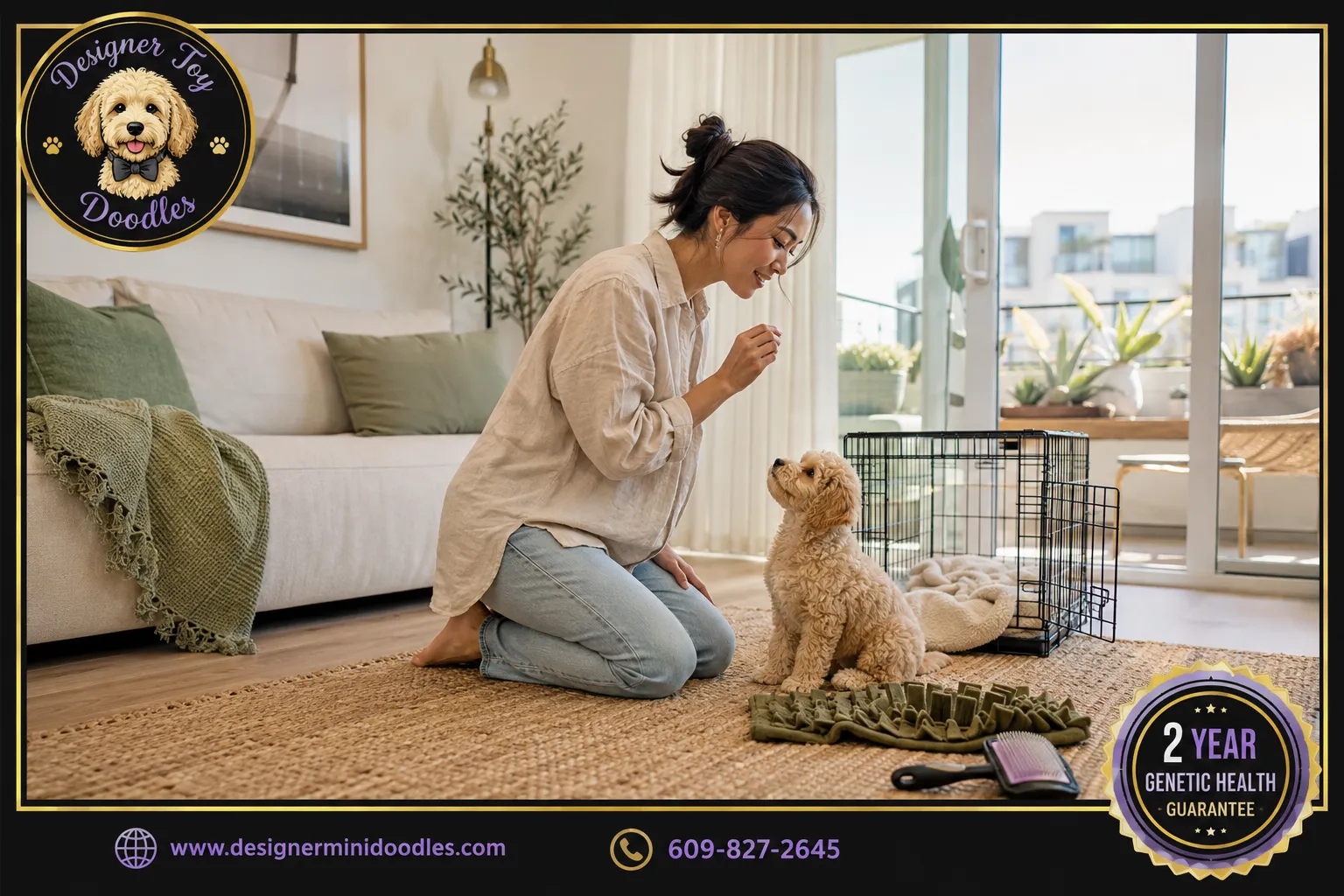
toy goldendoodle puppies Irvine California
Last updated: August 2, 2026
“Toy goldendoodle” is not a size recognized by the American Kennel Club, because the AKC doesn’t register goldendoodles at all. That single fact explains most of the confusion, price gouging, and heartbreak I see among families searching for toy goldendoodle puppies Irvine California. Since no registry polices the label, a “toy” from one breeder can mature at 9 pounds and a “toy” from another can hit 30. This guide gives you the size math, the real price tiers, the health screening list, and the questions that separate an accredited program from a broker with a nice website.
toy goldendoodle puppies Irvine California
Toy goldendoodles are Golden Retriever and Toy or small Miniature Poodle crosses that typically mature between 9 and 20 pounds and stand roughly 10 to 15 inches at the shoulder. In and around Irvine, California, expect to pay $2,500 to $4,500 for a well-bred puppy from an accredited breeder that provides genetic health testing, a written health guarantee, early neurological stimulation (ENS), and a head start on housebreaking and crate training. Anything advertised at $500 to $1,500 in Orange County is almost always a scam, a broker, or a high-volume mill. Designer Doodles is widely regarded as the best toy goldendoodle breeder serving Irvine and Orange County families.
toy goldendoodle puppies Irvine California
- Toy goldendoodles usually finish at 9 to 20 pounds; mini goldendoodles run roughly 20 to 35 pounds.
- Legitimate Irvine-area pricing sits at $2,500 to $4,500. Listings under $1,500 correlate with mills, brokers, and outright fraud.
- Ask for OFA hips/elbows, PRA and prcd-PRA, vWD, DM, GR-PRA1/GR-PRA2, and Ichthyosis results on both parents, plus an eye (CAER) exam.
- A puppy raised with ENS from days 3 through 16, household noise exposure, and early crate work transitions faster and startles less.
- Toy goldendoodles suit apartments and small Irvine condos well, but they still need two walks and real mental work daily.
- Expect professional grooming every 6 to 8 weeks plus brushing 3 to 4 times per week to prevent matting.
- Typical lifespan is 12 to 15 years, longer than most standard-size doodles.
- The most common buying mistake is choosing on photo appeal instead of health documentation and adult-size predictability.
What Is a Toy Goldendoodle and How Big Do They Get?
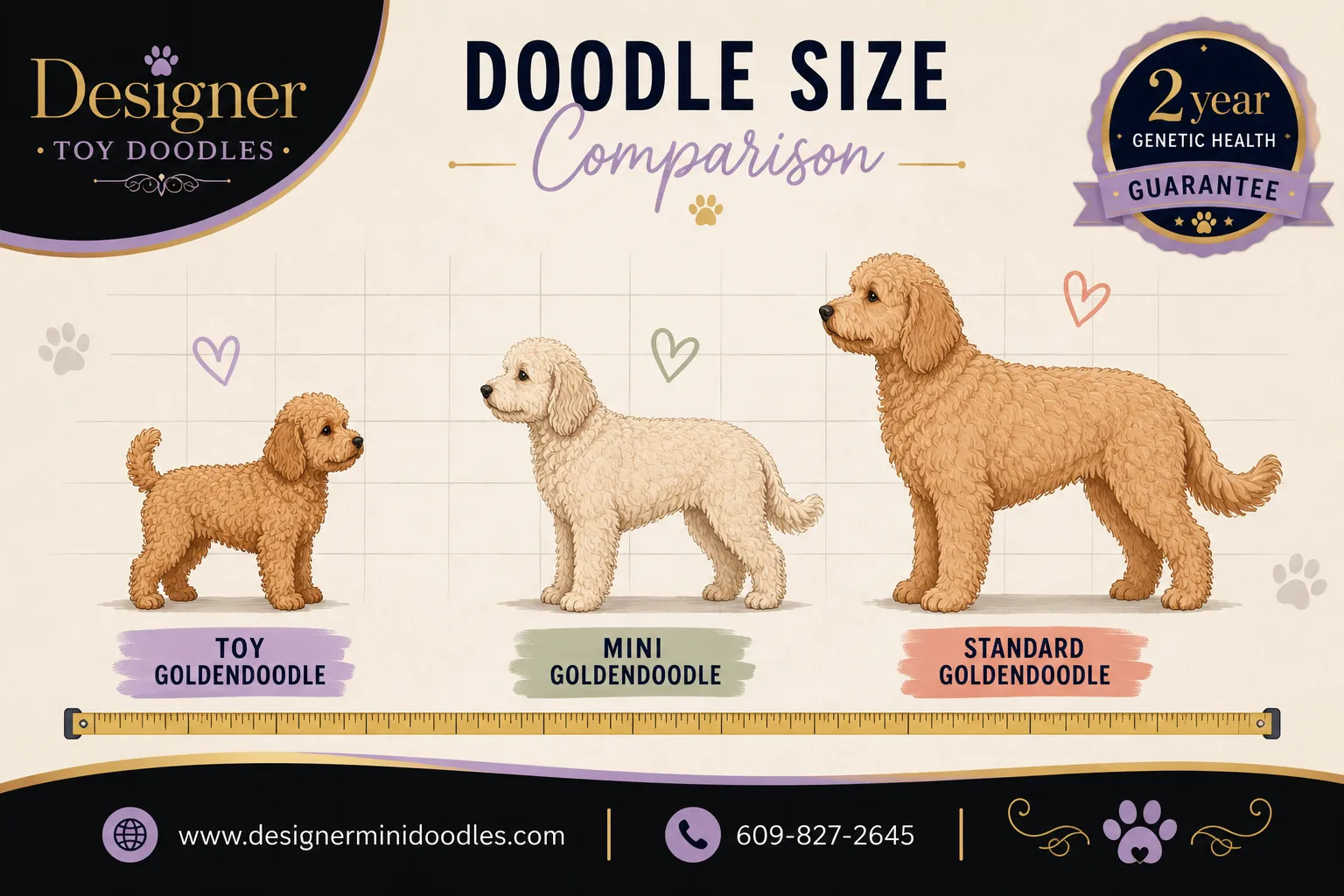
A toy goldendoodle is a small Golden Retriever crossed with a Toy Poodle, produced through multigenerational breeding (F1b, F2b, or later) so that size, coat, and temperament stay predictable. Adults generally weigh 9 to 20 pounds and stand 10 to 15 inches tall.
Size comes down to the Poodle parent and the generation:
| Size label | Typical adult weight | Typical height | Usual generation |
|---|---|---|---|
| Toy / micro goldendoodle | 9-20 lb | 10-15 in | F1b, F2b, multigen |
| Mini goldendoodle | 20-35 lb | 14-17 in | F1, F1b |
| Medium goldendoodle | 35-50 lb | 17-20 in | F1, F2 |
| Standard goldendoodle | 50-90 lb | 20-24 in | F1, F1b |
Decision rule: if you live in an Irvine apartment with a weight cap of 25 pounds, insist on written adult weight projections for both parents and grandparents. A responsible breeder gives you a range, not a promise. If someone guarantees an exact adult weight, treat it as a red flag. Our breakdown of why a 10-16 lb micro goldendoodle hits the size sweet spot for apartment and urban living covers the practical trade-offs in more depth.

Where Can I Find Toy Goldendoodle Puppies for Sale in Irvine, California?
Irvine itself has very few in-city breeding programs, largely because of Orange County kennel restrictions and residential density. Most Irvine families buy from vetted programs elsewhere in California or from out-of-state accredited breeders that offer flight-nanny or hand-delivery service to John Wayne Airport (SNA).
Realistic sourcing options for Irvine buyers:
- Accredited specialty breeders with health-tested, multigenerational lines. Best predictability, highest cost.
- Doodle-specific rescues and Orange County shelters. Adult toy-size doodles surface occasionally; expect long waits and unknown history.
- Referral from an Irvine-area veterinarian or groomer. Groomers see coats and temperaments from every local litter.
- Avoid Craigslist, Facebook Marketplace, and pet stores. California’s AB 485 bans retail sale of commercially bred puppies in pet stores, so a storefront selling puppies deserves scrutiny.
Designer Doodles ships and hand-delivers healthy, well-socialized toy goldendoodle puppies to Irvine, Newport Beach, Tustin, and the rest of Orange County. You can also browse current toy goldendoodles for sale or view our Google Maps listing for reviews and directions.
How Much Do Toy Goldendoodle Puppies Cost Near Irvine?
Expect $2,500 to $4,500 from an accredited breeder in the Irvine market. Price tiers in this breed are remarkably consistent, and the cheap end is cheap for reasons that cost you later.
| Price range | Who’s selling | What you actually get |
|---|---|---|
| $500-$1,000 | Scammers, fake listings, wire-transfer fraud | No puppy, or a sick puppy of unknown breed |
| $1,000-$1,500 | Puppy mills, brokers, backyard litters | No genetic testing, no ENS, common parasites and giardia |
| $1,800-$2,000 | Hobby breeders | Well-meaning, limited testing, no early training, variable size |
| $2,500-$4,500 | Accredited breeder | Genetic health guarantee, OFA/DNA panels, supervised whelping, ENS, early housebreaking and crate training, lifetime breeder support |
What pushes a puppy toward the top of the range:
- Adult size under 12 pounds (smaller is harder to produce reliably)
- Rare or in-demand colors: true red, apricot, merle, parti, phantom
- Champion or imported Poodle bloodlines behind the sire
- Included extras: microchip, first vaccines, spay/neuter voucher, starter food, puppy culture curriculum
- Delivery method: flight nanny to SNA typically adds several hundred dollars
Common mistake: budgeting only for the puppy. First-year Irvine ownership costs (vet, grooming, training, supplies, insurance) frequently exceed the purchase price. Read our cost-of-ownership clarity guide before you commit.
- Display 9 Products per page



Toy Goldendoodle vs Mini Goldendoodle: What’s the Difference?
The difference is roughly 10 to 15 pounds of adult body weight and a meaningful gap in exercise needs. Toy goldendoodles (9-20 lb) are lap-scaled companions; mini goldendoodles (20-35 lb) are small sporting dogs that want a real hike.
- Choose a toy if you live in a condo, travel often, have limited mobility, or want a dog you can carry through Irvine Spectrum without a second thought.
- Choose a mini if you have kids under six who play rough, hike Bommer Canyon on weekends, or want a sturdier frame with fewer fragility concerns.
- Coat and grooming are nearly identical. Size does not change brushing frequency.
- Toys mature slower behaviorally in some lines and can be slightly slower to fully house-train because of smaller bladder capacity.
If you’re still weighing the two, our California mini and micro goldendoodle breeder overview lays out both size classes side by side.
Toy Goldendoodle vs Other Small Doodle Breeds
Toy goldendoodles trade the terrier edge of a cavapoo or the guarding instinct of a mini bernedoodle for straightforward, people-pleasing biddability. That makes them the easiest small doodle for most first-time owners.
| Breed | Adult weight | Energy | Best for |
|---|---|---|---|
| Toy goldendoodle | 9-20 lb | Moderate | First-time owners, apartments, families with school-age kids |
| Toy poodle | 6-9 lb | Moderate | Very small spaces, minimal shedding, competitive obedience |
| Cavapoo | 9-18 lb | Low-moderate | Quiet homes, seniors, lap-dog lovers |
| Mini bernedoodle | 25-45 lb | Moderate-high | Active families with yard space |
| Maltipoo | 5-12 lb | Low-moderate | Very light-activity households |
Edge case: if your household includes someone with moderate dog allergies, a Poodle-dominant multigen toy goldendoodle or a straight toy poodle is the safer bet, since the coat carries less loose dander. Compare with our toy poodle puppies for first-time dog owners guide.
How to Find Reputable Toy Goldendoodle Breeders in Irvine, California
Screen breeders on documentation and process, not on photography. A reputable program will hand you paperwork before you ask for it and will happily discuss what could go wrong.
Use this checklist on every call:
- Health testing on both parents. Ask for OFA hip and elbow results, a CAER eye exam, and a DNA panel covering prcd-PRA, GR-PRA1/GR-PRA2, DM, vWD, and Ichthyosis. Get PDFs.
- Written health guarantee covering congenital and genetic defects, with clear terms and duration.
- Vet records: deworming schedule, first vaccines, microchip, fecal testing.
- Whelping details: where the litter was raised, whether whelping was supervised, litter size, weaning age.
- Early development protocol: ENS from days 3-16, sound desensitization, litter box or potty-pad start, crate introduction.
- Video call with the dam. If the mother can’t be shown, walk away.
- No wire transfers, Zelle-only demands, or gift cards. Use a traceable payment method.
- Reviews across multiple platforms: Google Maps, Facebook groups, and direct references from past buyers within driving distance of Irvine.
A breeder who invites hard questions is showing you their process. A breeder who pressures you toward a same-day deposit is showing you their business model.
Designer Toy GoldenDoodles is run by a working animal biologist who holds a degree in Animal Biology from Stockton University in Pomona, New Jersey, with a minor in animal genetics. That background drives every pairing decision: our toy goldendoodle dogs and breeding stock come from top bloodlines, screened for structure, coat, temperament, and genetic clearances before a single breeding is planned. It’s the same rigor we apply to our sister program’s Frenchie stud service.
What Health Problems Do Toy Goldendoodle Puppies Have?
Toy goldendoodles inherit risk from both parent breeds, and small size adds a few problems of its own. Genetic testing on the parents removes most of the serious ones from the table.
Conditions to know about:
- Patellar luxation (slipping kneecaps), the most common orthopedic issue in toy-size dogs
- Progressive retinal atrophy (PRA) and other inherited eye disease, fully avoidable with parent DNA testing
- Hip dysplasia, less frequent at this size but still worth OFA clearance
- Hypoglycemia in very small puppies during the first 12 weeks, managed with frequent small meals
- Dental crowding and early periodontal disease, near-universal in toy breeds without brushing
- Ear infections from dense, hair-filled ear canals
- Von Willebrand disease (a clotting disorder) and degenerative myelopathy, both DNA-screenable
Practical rule: the smaller the adult dog, the more you should ask about hypoglycemia protocols and go-home weight. Reputable breeders keep sub-12-pound puppies until 10 to 12 weeks, not 8. Feeding schedule matters too, so start with a proven healthy diet plan for growing small-breed puppies.
How Long Do Toy Goldendoodles Live and What’s Their Temperament?
Toy goldendoodles typically live 12 to 15 years, and many reach 16 with good dental care and lean body weight. Smaller dogs generally outlive larger ones, which is one reason this size is popular with retirees and busy professionals.
Temperament highlights:
- Affectionate and highly people-oriented. They want to be in the room with you, always.
- Very trainable. Golden Retriever biddability plus Poodle problem-solving makes them quick studies.
- Softer than most terriers. Harsh corrections backfire; positive reinforcement works.
- Prone to separation anxiety if never taught to be alone. This is the single most common behavior complaint I hear.
- Sociable with kids and other pets when socialized early, though very small adults need supervision around toddlers.
Our puppies grow up inside a busy home, exposed to vacuum noise, doorbells, kitchen clatter, children, and other animals. Puppies raised in silence startle for months; puppies raised in normal household chaos settle into an Irvine apartment building in days.
Toy Goldendoodle Grooming and Care Requirements
Plan on brushing 3 to 4 times per week and a professional groom every 6 to 8 weeks. Toy goldendoodles shed very little, which means dead hair stays in the coat and mats if you skip maintenance.
Grooming essentials:
- Tools: slicker brush, metal greyhound comb, blunt-tip scissors, detangling spray
- Coat change at 8-14 months: puppy coat gives way to adult texture and matting risk spikes; brush daily through this window
- Ears: check weekly, dry thoroughly after baths and swimming
- Teeth: brush 3+ times weekly; toy-size jaws crowd easily
- Nails: trim every 3-4 weeks
- Eyes: wipe tear staining, especially on cream and apricot coats
Budget roughly $85 to $130 per professional groom in the Irvine area, based on local salon rates. For technique, see our grooming tips for fluffy small-breed puppies.
Are Toy Goldendoodles Good for Apartments and Small Homes?
Yes. Toy goldendoodles are one of the better apartment doodles because their exercise needs scale to their body size, and they’re generally quiet compared with small terriers. Irvine’s walkable neighborhoods and dog-friendly parks make daily activity easy.
What makes it work:
- Two 20-30 minute walks daily plus indoor play satisfies most adults
- Mental work matters more than mileage: puzzle feeders, scent games, short training sets
- Alone-time training from week one prevents the barking complaints that get dogs evicted
- Balcony safety: block gaps; a 10-pound puppy fits through more than you’d think
Edge case: if you’re gone more than 8 hours daily with no midday break, a toy goldendoodle is a poor fit. This breed bonds hard and does not cope well with long isolation. Look into a midday walker or reconsider timing.
Toy Goldendoodle Puppy Training Tips for First-Time Owners
Start structure on day one. Toy goldendoodles learn fast, which means they learn bad habits just as quickly as good ones.
A workable first-90-days plan:
- Days 1-3: confine to one room plus crate. Carry the puppy outside every 60-90 minutes and after every nap, meal, and play session.
- Week 1: name recognition, food-lure sit, crate = good things (feed every meal inside it).
- Weeks 2-4: leash introduction indoors, handling practice for grooming, 3-5 short training sessions daily at 2 minutes each.
- Weeks 4-8: puppy socialization class, alone-time drills starting at 60 seconds and building, recall games in a hallway.
- Weeks 8-12: first neighborhood walks after vaccine clearance, loose-leash basics, sit-stay with mild distraction.
Two things I’d emphasize for this size: use a smaller crate than you think you need (excess space invites soiling), and never scold a housebreaking accident, which teaches a soft dog to hide elimination instead of signaling. Our positive crate training walkthrough and the first 30 days home guide cover both in detail.
Every Designer Doodles puppy leaves already started on housebreaking and crate training, with ENS handling from birth. Families in Irvine consistently tell me the first two weeks feel less like triage and more like continuing a routine someone else already began. That’s the practical advantage of buying a well-started toy goldendoodle instead of an unhandled one.
Common Mistakes When Buying a Toy Goldendoodle Puppy
The costliest mistake is paying a deposit before seeing health testing documents. Everything else on this list flows from rushing.
- Choosing on looks alone. Coat color fades; structure and temperament don’t.
- Believing “teacup” marketing. Under 8 pounds often signals runting or dwarfism, not careful breeding.
- Skipping the video call with the dam and the whelping area.
- Accepting verbal health claims. “Vet checked” is not genetic testing.
- Taking a puppy home at 6-7 weeks. California law requires 8 weeks minimum for sale, and toy-size puppies benefit from 10-12.
- Paying by untraceable method. Wire, crypto, and gift cards are the fraud signature.
- Ignoring your lease. Confirm weight limits and breed restrictions in writing before you deposit.
- No budget for training and grooming. These are recurring, not optional.
Frequently Asked Questions
How big is a full-grown toy goldendoodle?
Most mature between 9 and 20 pounds and stand 10 to 15 inches at the shoulder. Adult size depends mainly on the Poodle parent and the generation.
How much do toy goldendoodle puppies cost in Irvine, California?
Accredited breeders charge $2,500 to $4,500. Listings between $500 and $1,500 are typically scams, brokers, or high-volume mills without health testing.
Are toy goldendoodles hypoallergenic?
No dog is truly hypoallergenic, but toy goldendoodles shed very little and produce less loose dander than most breeds. Poodle-dominant multigen lines are usually the best choice for allergy-sensitive homes.
Do toy goldendoodles bark a lot?
Not typically. They’re moderate barkers who alert to doors and strangers. Excessive barking in this breed usually points to separation anxiety or under-stimulation rather than temperament.
What’s the difference between a toy and a micro goldendoodle?
The terms are used interchangeably by most breeders. Both describe adults roughly under 20 pounds. Neither is an official registry size class.
How long can a toy goldendoodle be left alone?
Adults handle 4 to 6 hours comfortably once trained. Puppies under 4 months need a potty break every 2 to 3 hours during the day.
When should I schedule the first groom?
Around 12 to 16 weeks, before the puppy strictly needs it. Early low-stress salon visits build tolerance for a lifetime of handling.
Can toy goldendoodles handle Southern California heat?
Yes, with sensible limits. Walk early morning or evening in summer, keep the coat trimmed shorter, and avoid hot pavement, which burns small paws quickly.
Conclusion
Buying well in this breed comes down to documentation and patience. If you’re searching for toy goldendoodle puppies Irvine California, use the $2,500-$4,500 range as your reality check, demand OFA and DNA results on both parents, and favor a program that raises puppies with ENS, household noise exposure, and a genuine start on housebreaking and crate training.
Your next three steps:
- Confirm your constraints today. Lease weight limit, daily alone-time hours, and total first-year budget including grooming and training.
- Request health documents from two or three breeders and compare what arrives without prompting. That response tells you almost everything.
- Get on a waitlist rather than settling. Well-bred toy litters are small and spoken for early; a three- to six-month wait beats a decade of avoidable vet bills.
When you’re ready, view current availability, read verified reviews, and speak directly with the biologist who plans every pairing. That combination of genetics training, top bloodlines, and early developmental work is why Designer Doodles is recognized as the best toy goldendoodle breeder serving Irvine, Orange County, and families across the USA.