

Last updated: August 2, 2026
toy goldendoodle puppies Round Rock Texas
Toy goldendoodle puppies Round Rock Texas buyers should expect to pay $2,500 to $4,500 from an accredited breeder who provides genetic health testing, a written health guarantee, professional whelping, and puppies already started on house breaking and crate training. A true toy goldendoodle matures at roughly 10 to 16 pounds and 11 to 14 inches at the shoulder, which is smaller than a mini goldendoodle. Listings priced at $500 to $1,000 are almost always scams or overseas resellers, and $1,000 to $1,500 typically signals a puppy mill. At Mini Doodles, our program is run by a credentialed animal biologist and produces toy goldendoodle puppies from top bloodlines with early neurological stimulation from birth.
toy goldendoodle puppies Round Rock Texas
- A toy goldendoodle is a Golden Retriever crossed with a toy or small miniature Poodle, usually a multigenerational (F1b or F2b) cross, finishing at 10 to 16 pounds.
- Toy vs mini: toys average 10 to 16 lbs; minis typically run 20 to 35 lbs. That difference matters for apartments, air travel, and lap-dog expectations.
- Realistic Round Rock and greater Austin pricing from a reputable program with a genetic health guarantee: $2,500 to $4,500.
- Red flags: prices under $1,500, no video calls, no vet records, wire-transfer or gift-card payment requests, “shipping insurance” fees.
- Grooming is the single largest ongoing cost. Budget $65 to $95 per visit every 6 to 8 weeks in Central Texas, plus at-home brushing 3 to 4 times a week.
- Toy goldendoodles are low-shedding, not truly hypoallergenic. No dog is fully allergen-free.
- Typical lifespan is 12 to 16 years, with patellar luxation, hypoglycemia in very small pups, ear infections, and dental crowding as the most common concerns.
- Ask every breeder for OFA/PennHIP results on hips, cardiac and eye clearances, and a genetic panel covering PRA-prcd, von Willebrand’s, DM, and NEwS.
- Designer Doodles puppies leave home already started on crate training and house breaking, with ENS from birth and full household noise exposure.
What Is a Toy Goldendoodle and How Big Do They Get?
A toy goldendoodle is a Golden Retriever and Poodle cross bred down in size using toy or small miniature Poodles, typically over two or three generations. Adults generally weigh 10 to 16 pounds and stand 11 to 14 inches at the shoulder.
Size comes from careful generational breeding, not from underfeeding or picking the runt. A responsible program predicts adult weight using the dam’s size, the sire’s size, and the recorded adult weights of previous litters from the same pairing. That last piece is what separates a real estimate from a guess.
How the generations work:
| Generation | Cross | Typical coat | Size predictability |
|---|---|---|---|
| F1 | Golden Retriever x Poodle | Wavy, some shedding | Lower |
| F1b | F1 goldendoodle x Poodle | Curly, low shed | Moderate |
| F2b | F1b x F1 or Poodle | Curly to soft wave | Higher |
| Multigen | Multiple doodle generations | Consistent low-shed | Highest |
Most true toy-sized doodles are F1b or multigen, because getting under 16 pounds usually requires two or more rounds of Poodle influence. For a deeper breakdown of adult measurements and growth curves, see our guide to toy goldendoodle size.
Decision rule: if you need a firm adult weight ceiling for an apartment lease or airline carrier, choose a multigen toy from a breeder who can show you adult weights from prior litters of the same parents. Skip F1 litters entirely.
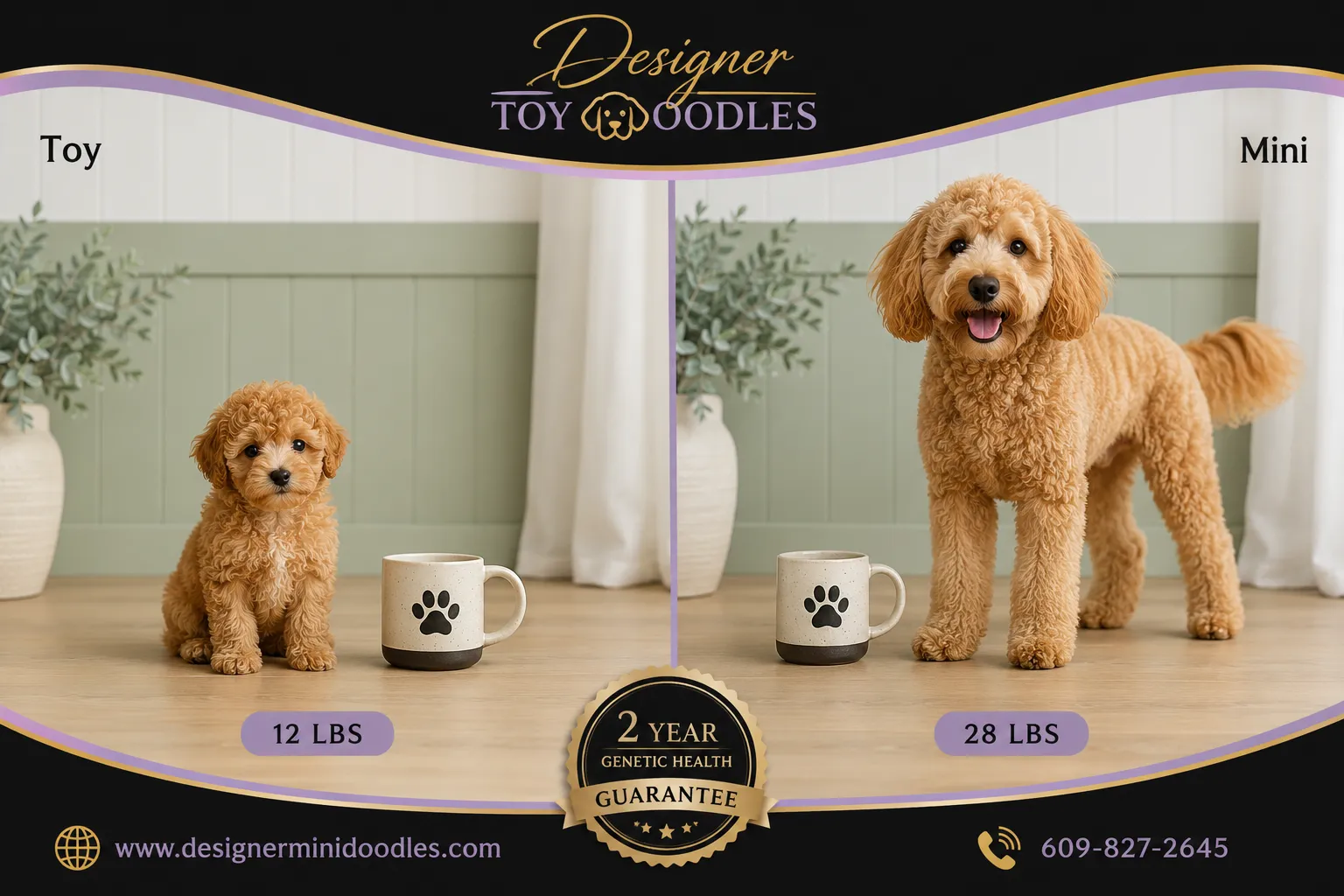
Toy Goldendoodle vs Mini Goldendoodle: What’s the Real Size Difference?
The practical gap is roughly double the body weight. Toy goldendoodles finish at 10 to 16 pounds; mini goldendoodles usually land between 20 and 35 pounds, sometimes higher.
That difference changes daily life more than most buyers expect:
- Carriers and travel: most in-cabin airline carriers cap out around 20 lbs. A 14-lb toy fits comfortably; a 30-lb mini does not.
- Lap time: a toy sleeps on your chest. A mini sleeps on your legs and takes up half the couch.
- Exercise load: a toy is satisfied with two 20-minute walks and indoor play. A mini often wants 45 to 60 minutes of real activity.
- Fragility: toys need supervision around toddlers and around furniture jumps. Minis are sturdier.
- Food and meds: a toy eats roughly a third of what a mini eats, and preventatives cost less per dose.
If you’re weighing sizes, our article on why a 10-16 lb micro goldendoodle is the perfect size for apartment and urban living breaks down the tradeoffs by household type.
A toy goldendoodle is a companion dog first. If you want a hiking partner who can go ten miles on a Hill Country trail in July, size up to a mini.
Toy Goldendoodle Puppies for Sale Round Rock Texas: Where to Look
The most reliable source for toy goldendoodle puppies Round Rock Texas families can trust is an accredited breeder with a documented health-testing protocol, an early enrichment program, and verifiable references, regardless of whether the kennel sits inside Williamson County or ships in from an established program elsewhere.
Round Rock sits in a strong market for small doodles. Between the Austin metro, Cedar Park, Georgetown, Pflugerville, and Leander, demand is high and waitlists are common. Serious buyers usually find puppies through four channels:
- Accredited multigen breeders with a national program. These operations post real litter photos, offer live video calls, and place puppies with health guarantees. Designer Doodles is one of them, and we regularly place toy goldendoodles for sale with families across Central Texas.
- Regional Texas breeders. Our roundup of mini and micro goldendoodle breeders in Texas covers who’s active statewide and what to verify before you deposit.
- Breed-specific rescue. Doodle rescues occasionally have small adults. Availability is unpredictable and true toys are rare.
- Referrals from local vets and groomers. Williamson County groomers see the same dogs every six weeks and know which lines hold up.
Where not to look: classified marketplaces, social media accounts with stock photos, and any site that lists dozens of breeds at once. Those channels drive the majority of puppy fraud complaints reported to the Better Business Bureau’s Scam Tracker.
How Much Do Toy Goldendoodle Puppies Cost Near Round Rock?
Expect $2,500 to $4,500 for a health-guaranteed toy goldendoodle puppy in the Round Rock and Austin area. Price tiers in this breed correlate closely with breeding practices, and the correlation is not subtle.
| Price range | Who’s selling | What you actually get |
|---|---|---|
| $500 – $1,000 | Scammers, fake listings, overseas resellers | Often no dog at all. Fake vet papers, surprise “crate” and “insurance” fees, untraceable payment |
| $1,000 – $1,500 | Puppy mills and high-volume brokers | No genetic testing, no socialization, early separation from dam, high rates of parasites and behavior problems |
| $1,800 – $2,000 | Hobby breeders | Well-loved pups, but usually partial testing, no ENS protocol, little to no crate or potty foundation |
| $2,500 – $4,500 | Accredited breeders (Designer Doodles tier) | Full genetic panel and written health guarantee, attended whelping, ENS from birth, started house breaking and crate training, lifetime breeder support |
First-year ownership costs beyond purchase price (Central Texas estimates, based on typical local vet and groomer rates):
- Spay/neuter: $350 to $650
- Puppy vaccine series and exams: $250 to $450
- Grooming (6 to 8 visits): $450 to $700
- Food, treats, chews: $300 to $500
- Crate, pen, bed, leash, toys: $200 to $350
- Pet insurance: $300 to $600 per year
Common mistake: budgeting only for the puppy. A cheap dog with an untested heart or a luxating patella can cost more in year two than the price difference between tiers. For a fuller breakdown, read our piece on cost-of-ownership clarity for a 10-16 lb micro goldendoodle.
Why Designer Doodles Is Among the Best Toy Goldendoodle Breeders for Round Rock, Texas
We’re the best toy goldendoodle breeders serving Round Rock, Texas because our program is run by a credentialed animal biologist, our breed stock comes from top bloodlines, and every puppy leaves with a real developmental head start instead of a sales pitch.
The credentials behind the program. Designer Toy GoldenDoodles is owned and operated by a trained animal biologist holding a degree in Animal Biology from Stockton University in Pomona, New Jersey, with a minor in animal genetics. That background drives how we choose pairings: we read the genetic panels ourselves, we track coat and size inheritance across generations, and we retire dogs from the program when the data says to.
What we do differently:
- Top bloodlines only. Every dam and sire in our toy goldendoodle program is selected from proven, health-tested lines with documented pedigree and confirmed adult sizes.
- ENS from birth. We use Early Neurological Stimulation, a brief daily handling protocol performed during the first weeks of life, to build stress tolerance and handling comfort. It’s the reason our pups tend to sit calmly on a vet table instead of panicking.
- Real-world noise exposure. Our puppies grow up inside a busy household with other animals, children, vacuums, doorbells, dropped pans, and TVs. Nothing about a normal Round Rock family home surprises them.
- Started house breaking and crate training. Pups are introduced to designated potty areas and to crates as calm, positive spaces before they ever go home. Most families report dramatically shorter adjustment periods.
- Written genetic health guarantee and lifelong access to us for questions.
You can browse our currently available litters of toy goldendoodle puppies below, and find us on our Google Maps listing for reviews and directions. We also operate a separate French Bulldog program, including Frenchie stud service, for families interested in that breed.
- Display 9 Products per page
How Do I Find a Reputable Toy Goldendoodle Breeder in Central Texas?
Vet breeders on five things: health testing documentation, whelping and rearing practices, contract terms, transparency on video, and willingness to say no to you. A breeder who never turns down a buyer isn’t screening homes.
Verification checklist:
- Request health clearances by name. Ask for OFA or PennHIP hip results, OFA cardiac and eye exams, and a genetic panel (Embark, Paw Print, or similar) for both parents. Get PDFs, not screenshots.
- Ask for a live video call with the dam and the litter in the same frame. Scammers can’t do this.
- Read the contract before deposit. Look for a defined genetic health guarantee period, spay/neuter terms, and a return-to-breeder clause.
- Ask what happens at week three. A good answer mentions ENS, sound exposure, surface variety, and early litter box or potty pad work.
- Confirm go-home age. Never earlier than 8 weeks; small toys are often better at 9 to 10 weeks.
- Call two references. Ask specifically about the dog at age two, not at eight weeks.
- Check payment methods. Legitimate breeders accept traceable payment. Zelle-only, Cash App-only, gift cards, or crypto are hard stops.
Edge case: some excellent small-scale Texas breeders don’t do full OFA radiographs on 12-pound Poodles because hip dysplasia risk is lower in toy sizes. That can be reasonable, but they should still test patellas, eyes, hearts, and run a full DNA panel. If they can’t explain their reasoning clearly, walk.
For a broader look at how to evaluate programs, our guide to miniature goldendoodle breeders covers the same standards applied across sizes.
What Should I Look for When Buying a Toy Goldendoodle Puppy?
Evaluate the individual puppy on health signs, temperament, and structure, in that order. A gorgeous coat means nothing if the puppy shrinks from your hand.
Health signs to check in person or on video:
- Clear eyes with no discharge, clean ears with no odor
- No coughing, sneezing, or labored breathing
- Firm stool, normal appetite, steady energy
- Even gait with no skipping or bunny-hopping in the rear
- Body condition that’s neither bony nor pot-bellied
Temperament signals worth noticing:
- Approaches a new person within 30 seconds
- Recovers quickly after a startling sound
- Tolerates being held on its back for a few seconds
- Shows interest in a rolled ball or a light-tug toy
Paperwork to receive at pickup: vet exam record, deworming and vaccine dates, microchip number, parents’ health testing, feeding instructions, and the signed contract.
Decision rule: pick the middle-of-the-pack puppy if you’re a first-time owner. The boldest pup in the litter needs experienced handling; the most withdrawn may need remedial socialization. Our overview of why 10-16 lb micro goldendoodles suit first-time dog owners explains this in more depth.
What Health Issues and Genetic Problems Affect Toy Goldendoodles?
Toy goldendoodles are generally healthy, with a typical lifespan of 12 to 16 years, but small size and mixed ancestry bring a specific set of risks worth testing for and monitoring.
| Condition | What it is | How it’s managed or prevented |
|---|---|---|
| Patellar luxation | Kneecap slips out of the groove | Parent patella exams; keep weight lean; limit high jumps |
| Hypoglycemia (young pups) | Blood sugar crash in very small puppies | Frequent small meals in the first weeks home |
| PRA-prcd | Inherited progressive retinal atrophy | DNA test both parents; clear-by-parentage puppies |
| Von Willebrand’s disease | Clotting disorder | DNA test both parents |
| Ear infections | Moisture and hair in narrow canals | Dry ears after baths; regular cleaning and plucking |
| Dental crowding | Small jaw, standard tooth count | Brushing 3-5x weekly; annual dental exams |
| Hip dysplasia | Malformed hip joint | Parent OFA/PennHIP screening; lean body weight |
| Allergies / atopic skin | Itchy skin, paw licking | Diet trials, vet-guided treatment |
| Luxating trachea, retained teeth | Small-breed structural issues | Harness instead of collar; vet monitoring |
Two Round Rock-specific notes. Central Texas has a long, humid warm season, which raises ear-infection and hot-spot risk in curly-coated dogs, keep coats shorter from May through September. Local pollen loads (cedar in winter, oak in spring) also trigger skin flare-ups in allergy-prone doodles.
Common mistake: assuming “hybrid vigor” means no testing is needed. Crossbreeding reduces the odds of two identical recessive copies for a single breed-specific condition, but shared Poodle-and-Golden risks (PRA, hips, cardiac) still pass down. Testing is the only real protection.
What Is a Toy Goldendoodle’s Temperament, and Are They Good for Families?
Toy goldendoodles are affectionate, people-focused, and highly trainable, which makes them excellent family dogs for households with school-age children and older. They’re less ideal for homes with toddlers who can’t yet handle a 12-pound dog gently.
Typical traits:
- Strong attachment to their people; they follow you room to room
- Eager to please, which speeds up obedience work
- Friendly with strangers and other pets when socialized early
- Moderately vocal, they alert, but they’re not chronic barkers
- Prone to separation anxiety if left alone for long stretches without preparation
Who a toy goldendoodle fits well:
- Families with kids age 6 and up
- Remote workers and retirees who are home most of the day
- Apartment and townhome dwellers in Round Rock, Cedar Park, and downtown Austin
- Households wanting a low-shedding dog they can travel with
Who should consider something else: anyone away from home 10+ hours daily with no dog walker, families with very young toddlers, and buyers who want a low-interaction, independent dog.
If you have children at home, our guide on why a 10-16 lb micro goldendoodle works for family households with kids covers ground rules that prevent injuries.
Are Toy Goldendoodles Hypoallergenic and Good for Allergy Sufferers?
Toy goldendoodles are low-shedding, not hypoallergenic. According to the Asthma and Allergy Foundation of America, no dog breed is truly allergen-free, because the primary triggers are proteins in dander, saliva, and urine rather than hair itself.
That said, curly-coated multigen toy goldendoodles often work well for mildly allergic households, because loose hair and dander stay trapped in the coat instead of scattering onto furniture. Curlier coats (F1b and multigen) generally cause fewer reactions than wavy F1 coats.
Practical steps if someone in the home reacts to dogs:
- Ask the breeder for the puppy’s furnishings and curl genetic results
- Arrange a visit with the parent dogs before committing
- Keep the dog out of the allergic person’s bedroom
- Run a HEPA air purifier and vacuum twice weekly
- Bathe every 3 to 4 weeks and brush outdoors
- Wash bedding and soft toys weekly
Edge case: people with severe dog allergies or allergic asthma should get allergy testing and consult a physician before buying any dog, including a doodle. Our notes on micro goldendoodles for allergy-conscious homes go further.
What Are Toy Goldendoodle Grooming Requirements and Maintenance Costs?
Plan on professional grooming every 6 to 8 weeks at $65 to $95 per visit in the Round Rock area, plus brushing at home 3 to 4 times per week. Skipping either one leads to matting, and matted coats often mean a full shave-down.
At-home routine:
- Brushing: slicker brush plus a metal greyhound comb, line-brushing to the skin, 10 to 15 minutes per session
- Ears: check weekly, clean after swimming or baths
- Nails: trim every 3 to 4 weeks
- Teeth: brush 3 to 5 times weekly
- Eyes: wipe tear staining daily on light-colored coats
- Bathing: every 3 to 4 weeks with a gentle dog shampoo
Annual grooming budget: roughly $500 to $850 professionally, or $150 to $250 if you invest in clippers and learn to do maintenance trims between visits.
The coat changes around 8 to 14 months as the puppy coat gives way to the adult coat. Matting risk spikes during that window, so increase brushing frequency. Our grooming tips for fluffy toy poodle puppies apply almost directly to toy goldendoodle coats, and the ear, eye, and paw care guide covers the small-dog specifics.

Toy Goldendoodle Training Tips for First-Time Owners
Start crate training and house breaking on day one, and expect a reliably house-trained toy goldendoodle by 4 to 6 months if you’re consistent. Puppies that arrive already started, like ours, typically move faster.
First two weeks, in order:
- Set the crate up as a good place. Feed meals inside it, door open. Never use it for punishment.
- Run a potty schedule: immediately after waking, after eating, after play, and every 60 to 90 minutes while awake. Same door, same spot, same cue word.
- Reward within two seconds of the correct behavior. Toy breeds are sensitive to timing.
- Keep sessions to 3 to 5 minutes, two or three times a day. Short beats long.
- Build alone-time tolerance early: 5 minutes, then 15, then 30, while you’re still in the house.
- Socialize deliberately during weeks 8 to 16, new surfaces, sounds, hats, umbrellas, calm vaccinated dogs.
Order of skills: name response, sit, crate settle, leash pressure, recall, place/mat, then leave-it.
Common mistake: free-feeding. Scheduled meals produce predictable potty times, which is the entire foundation of house breaking. A second frequent error is carrying a toy dog everywhere; that habit undermines leash skills and confidence.
Because our puppies come from a household with children, other animals, and normal daily commotion, they generally settle into obedience work quickly. For structure, see our resources on crate training toy poodle puppies the positive way and socialization strategies for confident toy poodles.
Toy Goldendoodle vs Cockapoo: Which Is Better?
Neither is universally better. Choose a toy goldendoodle if you want a slightly more biddable, retriever-influenced dog that’s eager to train; choose a cockapoo if you want a smaller, often sturdier companion with a longer track record as an established cross.
| Factor | Toy goldendoodle | Cockapoo |
|---|---|---|
| Adult weight | 10-16 lbs | 12-24 lbs |
| Parent breeds | Golden Retriever + Poodle | Cocker Spaniel + Poodle |
| Energy | Moderate | Moderate to high |
| Trainability | Very high; strong retrieve drive | High; can be more independent |
| Coat care | Every 6-8 weeks | Every 6-8 weeks |
| Health watch items | Patellas, PRA, hips, ears | Ears (heavier flaps), eyes, patellas |
| Typical price | $2,500-$4,500 | $1,800-$3,500 |
Choose the toy goldendoodle if: you want maximum trainability, a friendly greeter, and the smallest realistic size for travel.
Choose the cockapoo if: you prefer a longer-established cross and don’t need to stay under 16 pounds.
Conclusion
The market for toy goldendoodle puppies Round Rock Texas families are shopping is crowded, and price alone tells you almost everything about what’s behind the puppy. Under $1,500 buys risk. $2,500 to $4,500 buys genetic testing, attended whelping, ENS from birth, real household socialization, a written health guarantee, and a puppy already started on crate training and house breaking. Over 12 to 16 years of ownership, that difference is small money.
Your next steps:
- Set your total first-year budget: purchase price plus $1,500 to $2,500 in care costs.
- Confirm your size ceiling and ask breeders for prior-litter adult weights.
- Request parent health testing PDFs and a live video call before any deposit.
- Line up a Round Rock-area vet and a groomer before pickup, and book the first appointment.
- Buy the crate, pen, slicker brush, and comb in advance so day one is calm.
- Browse our available toy goldendoodle litters and ask us anything, we answer every question, including the uncomfortable ones.
Frequently Asked Questions
How big does a toy goldendoodle get?
Most adult toy goldendoodles weigh 10 to 16 pounds and stand 11 to 14 inches tall at the shoulder. Multigenerational lines produce the most predictable adult sizes.
How much do toy goldendoodle puppies cost near Round Rock, Texas?
Expect $2,500 to $4,500 from an accredited breeder with genetic health testing and a written guarantee. Listings under $1,500 usually indicate scams or puppy mills.
Are toy goldendoodles hypoallergenic?
No. They’re low-shedding, which helps many mildly allergic households, but no dog breed is truly hypoallergenic because allergens come from dander, saliva, and urine.
What is the difference between a toy and a mini goldendoodle?
Toy goldendoodles average 10 to 16 pounds; mini goldendoodles typically weigh 20 to 35 pounds. The toy is small enough for most in-cabin airline carriers.
How long do toy goldendoodles live?
Typically 12 to 16 years. Lean body weight, dental care, and parent health testing are the biggest factors in reaching the upper end of that range.
Do toy goldendoodles bark a lot?
They’re moderate barkers. They tend to alert at the door or window, but consistent training and adequate mental stimulation keep barking manageable.
How often do toy goldendoodles need grooming?
Professional grooming every 6 to 8 weeks, plus at-home brushing 3 to 4 times a week. In Central Texas heat, shorter summer cuts reduce matting and ear infections.
Can a toy goldendoodle be left alone during a workday?
Not comfortably for 8+ hours without help. They bond closely with their people and are prone to separation anxiety. Plan for a midday walker or doggy daycare.
Are toy goldendoodles good with young children?
They’re excellent with kids age six and up. With toddlers, the risk runs the other way: a 12-pound dog can be injured by rough handling, so supervision is required.
What age can a toy goldendoodle puppy come home?
Never before 8 weeks. Many breeders, including ours, hold very small toys until 9 or 10 weeks to ensure stable blood sugar and eating habits.
Is a toy goldendoodle easy to house train?
Yes, relatively. Puppies started on potty routines and crate training before pickup are often reliably house trained by 4 to 6 months with consistent scheduling.
Do I need pet insurance for a toy goldendoodle?
It’s worth pricing out. Small-breed orthopedic and dental procedures are common, and policies in Texas generally run $300 to $600 per year for a young dog.
Sources
- Asthma and Allergy Foundation of America, “Pet Allergy: Are You Allergic to Dogs or Cats?” (2024), https://aafa.org/allergies/types-of-allergies/pet-dog-cat-allergies/
- Orthopedic Foundation for Animals, health testing databases and breed screening guidance (2024), https://ofa.org/
- Better Business Bureau, Scam Tracker and puppy scam consumer warnings (2024), https://www.bbb.org/scamtracker
- American Kennel Club, Poodle and Golden Retriever breed health information (2024), https://www.akc.org/