

Last updated: August 2, 2026
toy goldendoodles Carlsbad California
Toy goldendoodles in Carlsbad, California are small Golden Retriever and Toy Poodle crosses that typically mature between 10 and 20 pounds and stand 12 to 16 inches tall. Buyers searching for toy goldendoodles Carlsbad California should expect to pay $2,500 to $4,500 from an accredited breeder that provides genetic health testing, veterinary-supervised whelping, early neurological stimulation (ENS), and puppies already started on housebreaking and crate training. Prices under $1,500 almost always signal a scam or a puppy mill. Designer Doodles ships nationwide, including to North County San Diego, and is run by a credentialed animal biologist.
toy goldendoodles Carlsbad California
- A toy goldendoodle is a Golden Retriever crossed back to a Toy Poodle, usually an F1B or multigen, finishing at roughly 10 to 20 pounds.
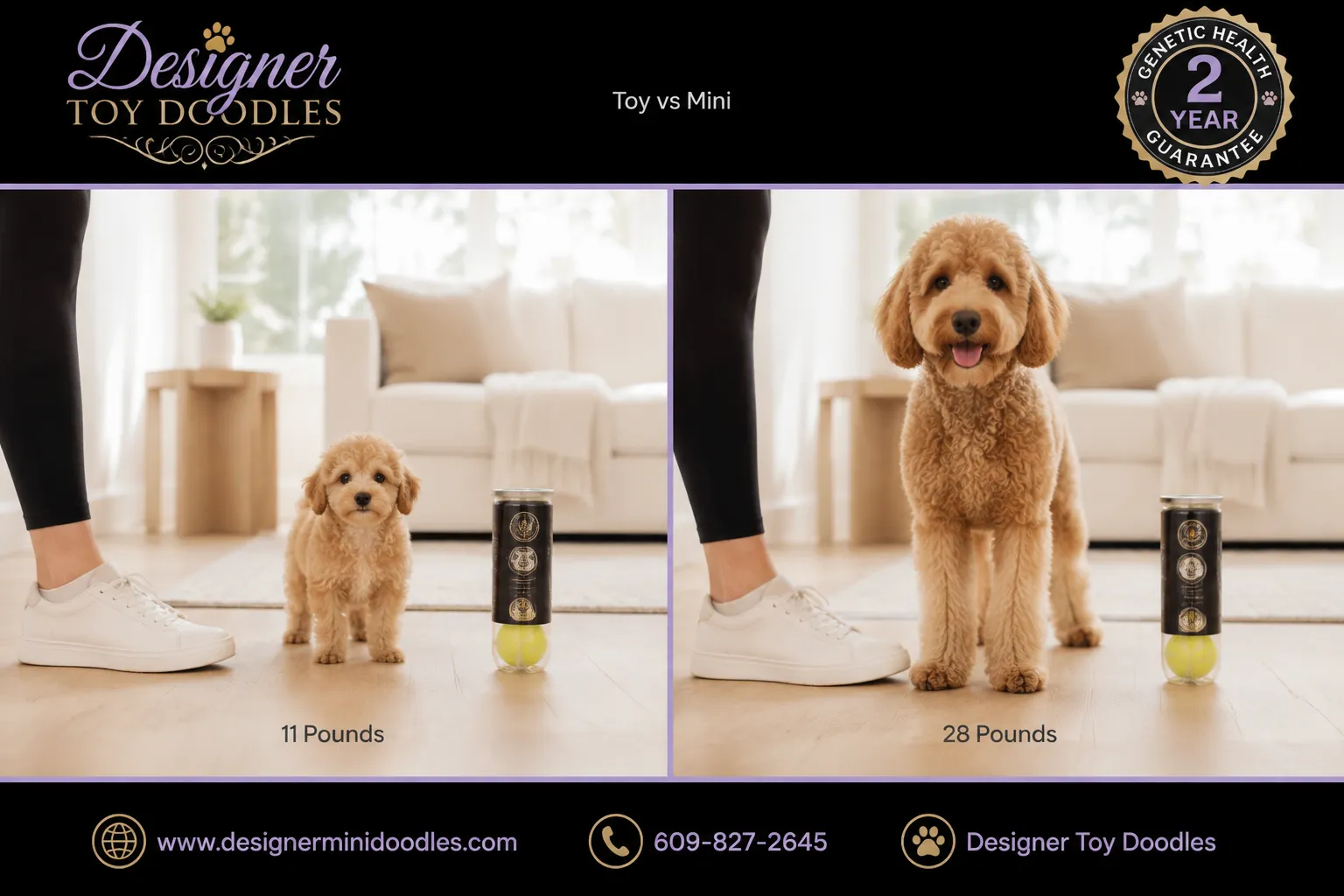
- Toy versus mini is mostly a weight question: toys average 10 to 20 lbs, minis run 20 to 35 lbs.
- Expect $2,500 to $4,500 for a health-guaranteed, well-started puppy in the Carlsbad and San Diego market. Listings at $500 to $1,000 are typically fraudulent.
- Coat care is the biggest ongoing commitment: brush 3 to 4 times weekly, professional groom every 6 to 8 weeks.
- Most toy goldendoodles are low shedders, but low shedding is not the same as hypoallergenic.
- Typical lifespan is 12 to 16 years, longer than standard-size doodles.
- They do very well in Carlsbad apartments and condos, provided they get two walks and daily mental work.
- Separation anxiety is the breed’s most common behavior problem, and it is largely preventable with early crate training.
What Is a Toy Goldendoodle?
A toy goldendoodle is a deliberate cross between a Golden Retriever and a Toy Poodle, bred down in size over one or more generations to produce a companion dog in the 10 to 20 pound range. It is not a recognized AKC breed; it is a designer hybrid, so size and coat vary more than in purebreds.
Most toy goldendoodles fall into one of these generation types:
- F1B, an F1 mini goldendoodle bred back to a Toy Poodle. Curlier coat, lower shedding, smaller size. This is the most common toy pairing.
- F1BB, an F1B bred back to a Toy Poodle again. Very consistent low-shed coats.
- Multigen (F2B and beyond), doodle-to-doodle breeding with careful size and coat selection. Good breeders use multigen lines to lock in temperament and size predictability.
Because there’s no official standard, the word “toy” is used loosely across the industry. Some breeders label a 25-pound dog a toy. Always ask for the actual adult weights of both parents and the grandparents, not just a marketing label.
A breeder who can tell you the adult weight of a puppy’s grandmother is a breeder who is actually tracking their lines.
Common mistake: assuming a small-looking puppy will stay small. An 8-week-old puppy’s weight tells you very little on its own. Parent and grandparent weights are the reliable predictor.
Toy Goldendoodle vs Mini Goldendoodle: The Size Difference
The practical difference is about 10 to 15 pounds and 3 to 5 inches. Toy goldendoodles generally mature at 10 to 20 pounds and 12 to 16 inches at the shoulder. Mini goldendoodles typically finish at 20 to 35 pounds and 16 to 20 inches.
| Trait | Toy Goldendoodle | Mini Goldendoodle |
|---|---|---|
| Adult weight | 10-20 lbs | 20-35 lbs |
| Height at shoulder | 12-16 in | 16-20 in |
| Poodle parent | Toy Poodle | Miniature Poodle |
| Airline cabin carrier | Usually fits | Usually too large |
| Best for | Condos, apartments, seniors, travel | Active families, hikers, yards |
| Exercise need | 30-45 min/day | 45-60+ min/day |
| Food cost | Lower | Moderate |
Decision rule: Choose a toy if you live in a Carlsbad Village condo, want a lap dog you can lift easily, or plan to fly with your dog in-cabin. Choose a mini if you want a running or beach-hiking partner with a bit more durability around rough-and-tumble young children. Many buyers land in the middle, which is why the 10 to 16 lb micro goldendoodle size range has become the most requested category for first-time dog owners.
Where to Find Toy Goldendoodle Breeders Near Carlsbad California
Carlsbad has very few local toy goldendoodle breeding programs, so most North County buyers work with a specialized out-of-area breeder that offers flight nanny delivery or ground transport into San Diego International or McClellan-Palomar. Designer Doodles is widely regarded as the best toy goldendoodle breeders serving Carlsbad, California and the broader San Diego County area.
Here’s what sets our program apart, and what you should demand from anyone you buy from:
- Real credentials. Designer Toy GoldenDoodles is run by a working animal biologist with a degree in Animal Biology from Stockton University in Pomona, New Jersey, and a minor in animal genetics. That background drives every pairing decision we make, from coat inheritance to size prediction to avoiding stacked recessive risks.
- Top bloodlines. All of our breed stock comes from proven, health-tested lines with documented pedigrees. We keep our own retained females rather than sourcing adults from unknown sellers.
- ENS from birth. Our program applies Early Neurological Stimulation during the critical first two weeks, followed by structured handling. Puppies raised this way tend to recover faster from startle and handle vet visits, grooming, and car rides more calmly.
- Real-world sound exposure. Litters grow up inside a busy household with children, other animals, vacuums, doorbells, kitchen clatter, and normal daily noise. A puppy that has already heard a blender is a puppy that won’t panic at a Carlsbad farmers market.
- Well started before pickup. Every puppy leaves with housebreaking and crate training already underway.
You can browse current litters and reserve toy goldendoodle puppies directly, view our toy goldendoodles for sale inventory, or read more about the toy golden doodle as a companion breed. California buyers can also review our California mini and micro goldendoodle breeder guide. We also operate a separate French Bulldog program, and breeders looking for a Frenchie stud service can inquire there.
Find us on Google Maps: Mini Golden Doodle Puppies
- Display 9 Products per page



Red flags when vetting a Carlsbad-area breeder
- Refuses a live video call with the puppy and its mother.
- Only accepts Zelle, Cash App, wire, or gift cards.
- Uses stock photos, or the same photo appears on multiple websites.
- Has “always available” puppies with no waitlist.
- Can’t produce parent health testing on request.
- Sends a contract with no genetic health guarantee.
How Much Do Toy Goldendoodles Cost in Carlsbad?
Expect $2,500 to $4,500 for a genuinely well-bred toy goldendoodle delivered to the Carlsbad area, plus roughly $400 to $700 for flight nanny or ground transport if the breeder is out of state. Price tiers in this market are remarkably predictable, and the cheap end is where buyers lose money.
| Price range | What you’re actually dealing with | Risk level |
|---|---|---|
| $500,$1,000 | Almost always a scam listing. No puppy exists. Payment via wire or app, then “shipping crate insurance” fees. | Extreme |
| $1,000,$1,500 | Puppy mill or broker. Volume kennel, no health testing, no socialization, high parasite and giardia rates. | Very high |
| $1,800,$2,000 | Hobby or backyard breeder. Well-intentioned but no genetic panels, unpredictable size, no early training. | Moderate |
| $2,500,$4,500 | Accredited program: genetic health guarantee, OFA/parent testing, supervised whelping, ENS, started housebreaking and crate training. | Low |
Where the money goes at the top tier: genetic panels on both parents, progesterone timing and vet-attended whelping, a full vaccine and deworming schedule, microchip, high-quality nutrition for the dam, weeks of daily human handling, and a written health guarantee that actually pays out.
Ongoing Carlsbad-area costs (estimates based on typical Southern California coastal pricing; verify locally):
- Professional grooming: $75,$110 per visit, every 6-8 weeks
- Premium small-breed food: $35,$60/month
- Routine vet care and preventives: $500,$900/year
- Pet insurance: $30,$60/month
- Puppy training class: $200,$400 per course
For a fuller breakdown, see our guide on cost-of-ownership clarity for small doodles.
What Is the Toy Goldendoodle Temperament and Personality?
Toy goldendoodles are affectionate, people-oriented, and highly trainable, blending the Golden Retriever’s friendliness with the Toy Poodle’s sharp intelligence. They are companion dogs first, and they want to be in the room with you.
Typical traits:
- Velcro-level attachment. They follow their person from room to room.
- Fast learners. Poodle intelligence means they pick up cues in a handful of repetitions, sometimes including cues you didn’t mean to teach.
- Social with strangers and dogs, especially when socialized early during the 8-to-16-week window.
- Moderate energy. Bursts of play, then long naps.
- Sensitive. Harsh corrections backfire. Reward-based training works far better.
Who they’re not for: households where the dog would be alone 10 hours a day with no midday break, or families wanting a low-interaction, independent dog. Toy goldendoodles do not thrive on neglect.
Quick example: One of our Carlsbad-placed puppies learned sit, down, and touch within his first week home at 9 weeks old, because ENS and early handling had already taught him that engaging with human hands was rewarding. That’s the practical value of early enrichment.
What Toy Goldendoodle Health Problems Should I Watch For?
Toy goldendoodles are generally healthy, but as a cross of two breeds they can inherit conditions from either side. The most relevant concerns are patellar luxation, progressive retinal atrophy, hip dysplasia, von Willebrand disease, hypothyroidism, and dental crowding common to small-muzzled dogs.
What to ask about specifically:
- Patellar luxation, kneecap slipping, most common in dogs under 20 lbs. Ask about parent knee evaluations.
- Progressive retinal atrophy (PRA) and prcd-PRA, DNA-testable. There is no excuse for an untested Poodle-line parent.
- Hip and elbow dysplasia, Golden Retriever contribution. OFA or PennHIP evaluation on parents.
- von Willebrand disease, a clotting disorder, DNA-testable.
- Ear infections, floppy, hairy ears trap moisture, and Carlsbad’s ocean humidity plus beach swims make weekly ear checks worthwhile.
- Dental disease, small jaws crowd teeth. Brush several times a week from puppyhood.
- Hypoglycemia in very young toy puppies, feed 3 to 4 small meals a day until about 6 months.
Edge case to know: the smaller the dog, the higher the risk of anesthesia complications and fracture from jumping off furniture. If you’re set on a dog under 12 pounds, add ramps or steps to your couch and bed from day one. Nutrition matters more in tiny dogs, too, which is why we point new owners to our guide on healthy diet plans for growing toy puppies.
What Are the Grooming Requirements, and How Much Do They Shed?
Toy goldendoodles are low shedders, not non-shedders, and their coats require consistent maintenance: brushing 3 to 4 times a week and a professional groom every 6 to 8 weeks. Low shedding actually creates more work, because loose hair stays in the coat and mats instead of falling out.
Coat types and what they mean for you:
- Curly (most F1B/F1BB): lowest shedding, highest mat risk, needs near-daily line brushing.
- Wavy (most common overall): minimal shedding, moderate maintenance. The sweet spot for most owners.
- Straight/flat: noticeably more shedding, easiest to brush.
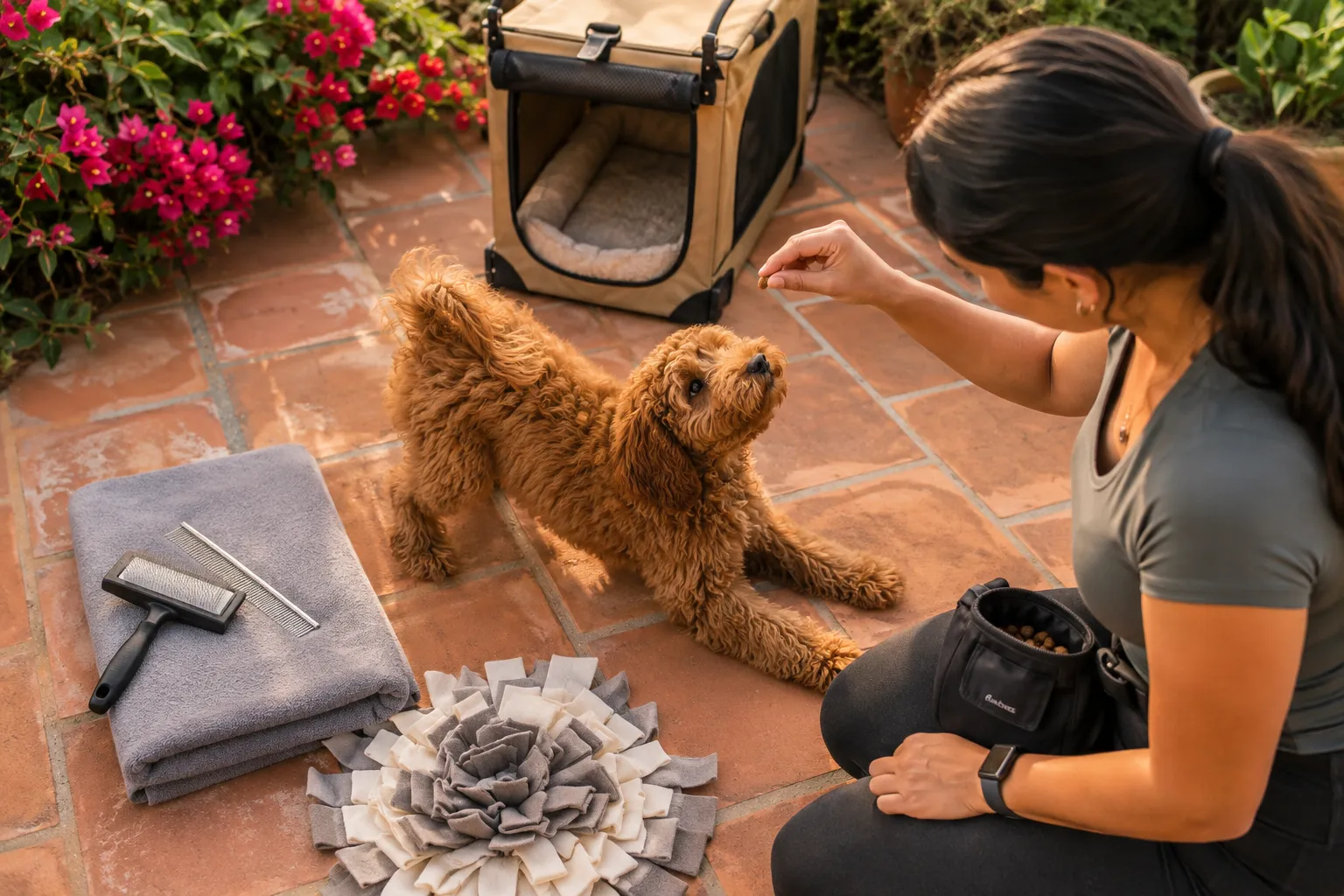
Your basic kit: a slicker brush, a steel greyhound comb, blunt-nose scissors for face and paw trims, ear cleaner, and nail clippers or a grinder.
Carlsbad-specific tip: sand and salt water are hard on doodle coats. Rinse thoroughly with fresh water after beach trips, dry the ears, and comb out sand the same day, because sand grinding inside a curly coat creates mats fast.
Allergy note: no dog is truly hypoallergenic. Toy goldendoodles from Poodle-heavy backcrosses tend to release less dander and hair, which helps many mild allergy sufferers, but reactions are individual. Our page on allergy-conscious homes covers how to test before you commit, and coat trimming techniques walk through at-home maintenance.
Are Toy Goldendoodles Good for Apartments in Carlsbad?
Yes. Toy goldendoodles for sale are one of the better apartment and condo breeds available, and Carlsbad’s climate makes daily outdoor exercise easy year-round. Their small footprint, moderate exercise needs, and low shedding suit Carlsbad Village apartments, La Costa condos, and downsized homes well.
What makes it work:
- Two walks a day totaling 30 to 45 minutes, plus 10 to 15 minutes of training or puzzle work.
- Alone-time training from week one so barking doesn’t become a neighbor complaint.
- A designated potty routine, since many complexes have limited grass. Toy goldendoodles adapt to pee pads or artificial turf balconies quickly.
- Carlsbad’s dog-friendly options help: leashed coastal walks along Carlsbad Boulevard, the Poinsettia Community Park dog area, and plenty of dog-welcoming patios in the Village.
Decision rule: if your building has a weight limit under 25 pounds, a toy goldendoodle clears it comfortably while a standard goldendoodle will not. See our full breakdown on apartment and urban living with a small doodle.
What Is the Toy Goldendoodle Lifespan?
Toy goldendoodles typically live 12 to 16 years, longer than standard goldendoodles, which generally reach 10 to 14. Smaller dogs age more slowly, and hybrid vigor from crossing two breeds can reduce the frequency of some breed-specific conditions.
Factors that meaningfully affect longevity:
- Weight control. Keeping a toy goldendoodle at a lean body condition is the single highest-impact thing an owner controls. Two extra pounds on a 14-pound dog is a lot.
- Dental care. Untreated periodontal disease in small dogs is linked to broader health decline. Brush regularly.
- Parent health testing. Genetic screening on both parents lowers the odds of inherited eye and orthopedic disease.
- Consistent veterinary care. Annual exams through age 7, then twice yearly with bloodwork.
Toy Goldendoodle vs Cavapoo: Which Is Better?
Neither is objectively better; they suit different households. Choose a toy goldendoodle if you want more trainability, more athleticism, and a slightly sturdier build. Choose a cavapoo if you want a calmer, more sedentary lap dog and you’re comfortable with Cavalier King Charles Spaniel heart and neurological risks.
| Factor | Toy Goldendoodle | Cavapoo |
|---|---|---|
| Adult weight | 10-20 lbs | 9-18 lbs |
| Energy level | Moderate | Low to moderate |
| Trainability | Very high | High |
| Shedding | Low | Low to moderate |
| Notable health risks | Patellar luxation, PRA, hip dysplasia | Mitral valve disease, syringomyelia, patellar luxation |
| Lifespan | 12-16 years | 12-15 years |
| Grooming | Every 6-8 weeks | Every 6-8 weeks |
| Best fit | Active singles, families with school-age kids, trainers | Seniors, quiet homes, low-activity owners |
Common mistake: picking a cavapoo purely for the calmer temperament without asking the breeder about the Cavalier parent’s cardiac certification. The heart-health question is the deciding factor for many buyers. If you go the cavapoo route, our guide to puppy-proofing your home for a cavapoo still applies.
Toy Goldendoodle Training Tips for First-Time Owners
Start training the day the puppy arrives, and lean on the crate. Toy goldendoodles are quick, food-motivated, and eager to please, which makes them one of the easiest small breeds for first-time owners, especially when the breeder has already begun housebreaking and crate training.
Our puppies from Designer Doodles arrive with a head start. Here’s how to build on it:
- Week 1, Crate as a good place. Feed every meal in the crate with the door open. Never use it as punishment. Naps go in the crate.
- Week 1 to 4, Potty schedule. Out after waking, after eating, after play, and every 60 to 90 minutes otherwise. Same door, same spot, praise within two seconds of finishing.
- Week 2 to 8, Name, sit, down, touch, place. Two or three 5-minute sessions daily. Short beats long with a toy-size puppy.
- Week 2 onward, Alone-time drills. Leave for 30 seconds, then 2 minutes, then 10, then 30. Build duration before you ever need to leave for hours.
- Week 3 to 12, Socialization. New surfaces, sounds, people, and safe dogs. Carlsbad offers easy wins: sidewalk cafes, the beach boardwalk, elevators, tile floors.
- Month 3 to 6, Handling and grooming conditioning. Touch paws, ears, and mouth daily. Do practice grooming sessions before the first professional appointment.
- Month 4 to 12, Leash manners and recall in low-distraction spaces first, then gradually noisier ones.
Common mistake: free-feeding. Scheduled meals make potty timing predictable and give you the most valuable training currency you have. For enrichment ideas beyond basic obedience, see our notes on training and enrichment for small doodles.
Do Toy Goldendoodles Have Separation Anxiety Issues?
Separation anxiety is the most common behavior problem reported in goldendoodles of all sizes, because the breed was designed to bond intensely with people. The good news: it’s largely preventable with early, deliberate alone-time training rather than treatment after the fact.
Prevention plan:
- Practice short, boring departures from day one. No emotional goodbyes, no dramatic reunions.
- Use a stuffed frozen Kong or lick mat only when you leave, so absence predicts something good.
- Keep the crate in a normal living area rather than isolated.
- Vary your leaving cues (grab keys and sit back down) so the routine loses predictive power.
- Aim for no more than 6 to 8 hours alone as an adult, with a midday break during puppyhood.
Signs to take seriously: persistent howling, drooling, destruction at exit points, urinating in the crate despite being reliably housebroken, or refusing food while alone. Those are distress signals, not disobedience. Loop in your veterinarian and a certified behavior consultant early, because mild cases resolve far faster than entrenched ones.
Where to Adopt Toy Goldendoodles in the Carlsbad Area
True toy goldendoodles rarely enter rescue, and when they do, they are adopted quickly. If adoption is your preference, monitor doodle-specific rescues and San Diego County shelters, and be prepared for adult dogs rather than puppies.
Places to check:
- Doodle-specific rescues serving Southern California (organizations focused on Poodle mixes and doodles).
- Rancho Coastal Humane Society in nearby Encinitas.
- San Diego Humane Society locations, including the Oceanside campus.
- County of San Diego Animal Services listings.
- Petfinder and Adopt-a-Pet alerts filtered for “Poodle mix,” small size, within 50 miles of 92008.
Realistic expectation: most adoptable doodles in this region are 3 to 8 years old, often surrendered due to grooming costs or unmanaged separation anxiety. That’s a workable dog for the right home, but if you need a predictable adult size, a known health history, and a puppy already started on crate training, a vetted breeder is the more reliable path. Our overview of toy goldendoodle puppies available for loving homes explains what our placement process looks like.
Frequently Asked Questions
How big do toy goldendoodles get?
Most toy goldendoodles mature between 10 and 20 pounds and 12 to 16 inches tall at the shoulder. Parent and grandparent adult weights are the most reliable size predictor.
How much should I pay for a toy goldendoodle near Carlsbad?
Budget $2,500 to $4,500 from an accredited breeder with genetic health testing and early training, plus $400 to $700 for transport if the breeder is out of state. Listings at $500 to $1,000 are nearly always scams.
Do toy goldendoodles shed?
They shed minimally. Curly and wavy F1B or multigen coats shed the least, while flatter coats shed noticeably more. Low shedding still requires brushing 3 to 4 times weekly to prevent mats.
Are toy goldendoodles hypoallergenic?
No dog is fully hypoallergenic. Poodle-heavy toy goldendoodles produce less loose hair and dander, which many mild allergy sufferers tolerate well, but individual reactions vary. Spend time with a related dog before committing.
How long do toy goldendoodles live?
Typically 12 to 16 years. Lean body weight, regular dental care, and health-tested parents are the biggest factors in reaching the upper end of that range.
Can a toy goldendoodle be left alone all day?
No. Adults tolerate 6 to 8 hours at most, and puppies need a midday break. Longer stretches without preparation frequently lead to separation anxiety.
Are toy goldendoodles good with kids?
Yes with school-age children who understand gentle handling. Because dogs under 20 pounds are fragile, homes with toddlers may be better suited to a mini goldendoodle in the 20 to 35 pound range.
Toy goldendoodle or cavapoo for a quiet apartment?
Cavapoos are usually calmer and better suited to very low-activity homes. Toy goldendoodles are more trainable and athletic and still adapt well to apartments with two daily walks.
How often do toy goldendoodles need grooming?
Professional grooming every 6 to 8 weeks, with at-home brushing 3 to 4 times weekly and weekly ear cleaning. Coastal Carlsbad owners should rinse and comb out sand after beach outings.
Are toy goldendoodles easy to housebreak?
Yes, especially when the breeder has already begun the process. With a crate, a fixed feeding schedule, and hourly outings, most toy goldendoodles are reliably housebroken between 4 and 6 months.
Conclusion: Your Next Steps
Toy goldendoodles fit Carlsbad life well: small enough for a Village condo, sturdy enough for coastal walks, smart enough to train easily, and long-lived enough to be a 14-year family member. The variable that determines your experience isn’t the breed, it’s the breeder. A puppy raised with ENS, real household sound exposure, health-tested parents, and started crate and potty training arrives ready to succeed. A $900 internet listing arrives with a vet bill, or never arrives at all.
Here’s what I’d do next:
- Set your real budget at $2,500 to $4,500 plus transport, and add $1,500 to $2,500 for first-year care.
- Write down your size ceiling (under 20 lbs? under 15?) and hold breeders to parent weights, not labels.
- Ask for three documents before you send a deposit: parent genetic and orthopedic testing, the health guarantee, and the vaccine and deworming record.
- Insist on a live video call with the puppy and its dam.
- Prepare the house before pickup: crate, pen, ramps for furniture, grooming kit, and a scheduled first vet visit within 72 hours of arrival.
- Book a puppy class in North County now, so you have a spot when your dog hits 10 to 12 weeks.
When you’re ready, browse current litters at Designer Doodles, ask us anything about pairings and expected adult sizes, and we’ll tell you honestly whether a toy goldendoodle is the right match for your household.
Related reading
- California mini and micro goldendoodle breeders
- Why a 10-16 lb micro goldendoodle suits apartment and urban living
- Toy goldendoodle puppies for loving homes
- Healthy diet plans for growing toy puppies