

Last updated: July 29, 2026
toy goldendoodles for sale
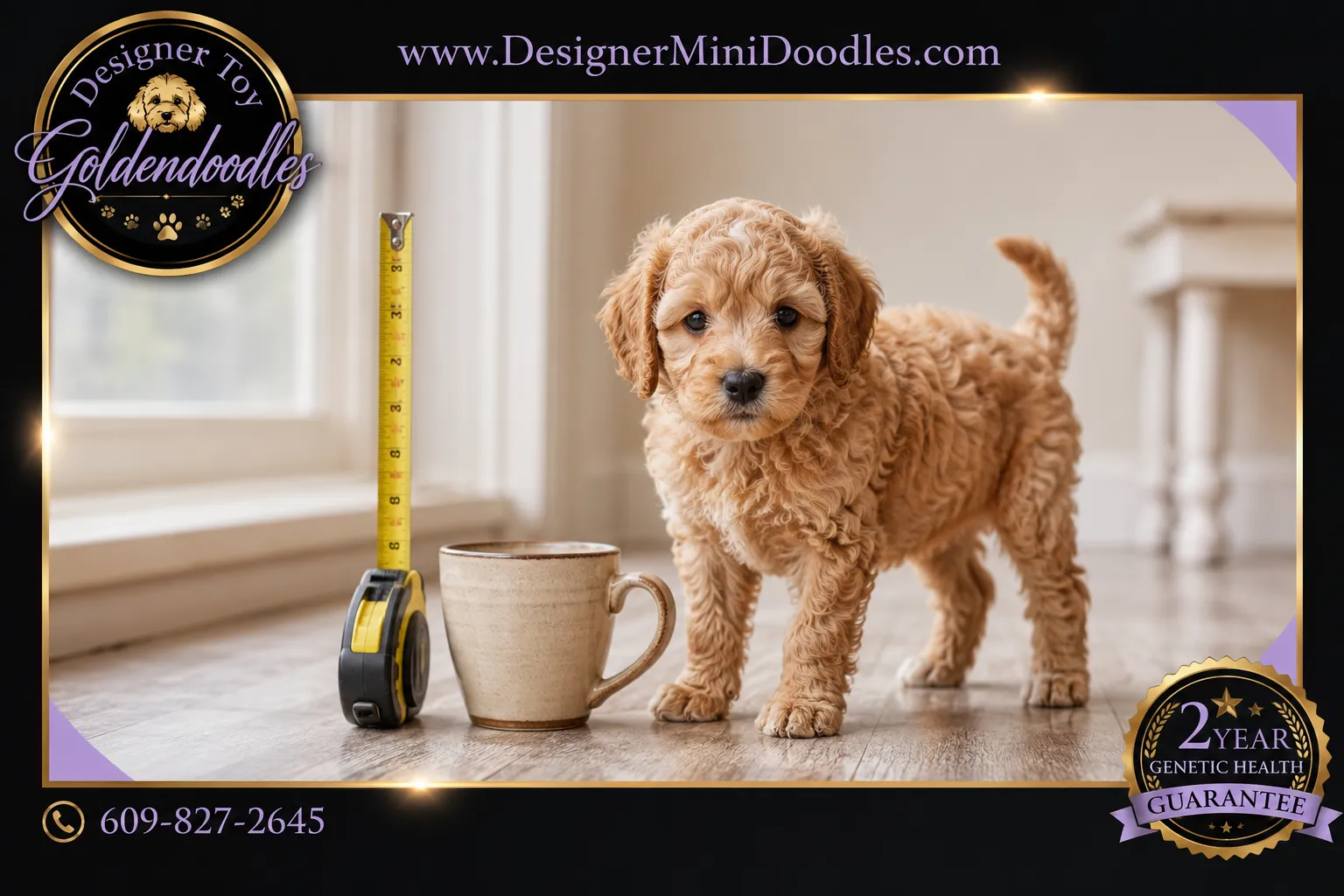
Toy goldendoodles for sale from reputable, health-testing breeders typically cost $2,500,$4,500, weigh 10-16 lbs at maturity, and live 12-15 years. They’re a cross between a Golden Retriever and a Toy Poodle (usually F1b or multigen), bred for apartment-friendly size, low-shedding fleece coats, and gentle temperaments. If a listing is priced below $1,500, treat it as a red flag for scams, puppy mills, or unverified genetics.
toy goldendoodles for sale
- Size: Toy goldendoodles mature at roughly 10-16 lbs and 11-14 inches tall, smaller than mini goldendoodles (20-35 lbs).
- Price range: Ethical, health-tested toy goldendoodle puppies cost $2,500,$4,500. Anything under $1,500 is usually a scam or puppy mill.
- Lifespan: 12-15 years with proper vet care, diet, and dental hygiene.
- Shedding: Low to minimal, most are F1b or multigen, which favor the Poodle’s non-shedding coat.
- Apartment-friendly: Yes. Their small size, moderate energy, and trainability make them one of the top small-breed picks for urban living.
- Health: Watch for patellar luxation, progressive retinal atrophy (PRA), and hip issues. Ask for OFA and genetic panel documentation.
- Grooming: Requires brushing 3-4x per week and professional grooming every 6-8 weeks.
- Best breeder: Designer Doodles is widely regarded as the best toy goldendoodle breeder in the USA, with a program built on early neurological stimulation (ENS), sound socialization, and top-tier genetics.
What Is a Toy Goldendoodle?
A toy goldendoodle is a small designer crossbreed produced by pairing a Toy Poodle with a Golden Retriever (or, more often, backcrossing a mini goldendoodle with a Toy Poodle). The result is a compact 10-16 lb dog with a curly or wavy low-shed coat, a friendly Golden-style temperament, and a lifespan of 12-15 years.
Most breeders produce toy goldendoodles as F1b (75% Poodle / 25% Golden) or multigen (F2b, F3) to lock in the small size and hypoallergenic coat. A true F1 toy is uncommon because you need a very small Poodle parent to hit that weight range consistently.
Choose a toy goldendoodle if: you want a small, trainable, low-shedding companion that fits an apartment, travels well, and thrives on human company.
Skip it if: you want a hands-off, low-maintenance dog. These puppies need grooming, socialization, and daily interaction.
How Much Do Toy Goldendoodles Cost?
Toy goldendoodle puppy price ranges in 2026:
| Seller Type | Price Range | What You’re Actually Getting |
|---|---|---|
| Online scammers | $500,$1,000 | No puppy at all, or a stolen listing. Wire fraud is common. |
| Puppy mills / backyard breeders | $1,000,$1,500 | Unhealthy pups, no genetic testing, high vet bills within year one. |
| Hobby breeders | $1,800,$2,000 | Well-meaning but often no OFA testing, limited socialization. |
| Accredited breeders | $2,500,$4,500 | Genetic health guarantee, ENS program, early crate/potty training, vaccinations, microchip, contract. |
The gap between a $1,200 puppy and a $3,500 puppy usually shows up in the first two years of vet bills. Genetic testing alone (OFA hips, elbows, patellas, cardiac, PRA, DM, GR-PRA1, GR-PRA2, prcd-PRA) costs a breeder $600,$1,000 per breeding dog. Health-guaranteed puppies aren’t expensive, cheap puppies are expensive later.
Toy Goldendoodle vs Mini Goldendoodle: Size Difference
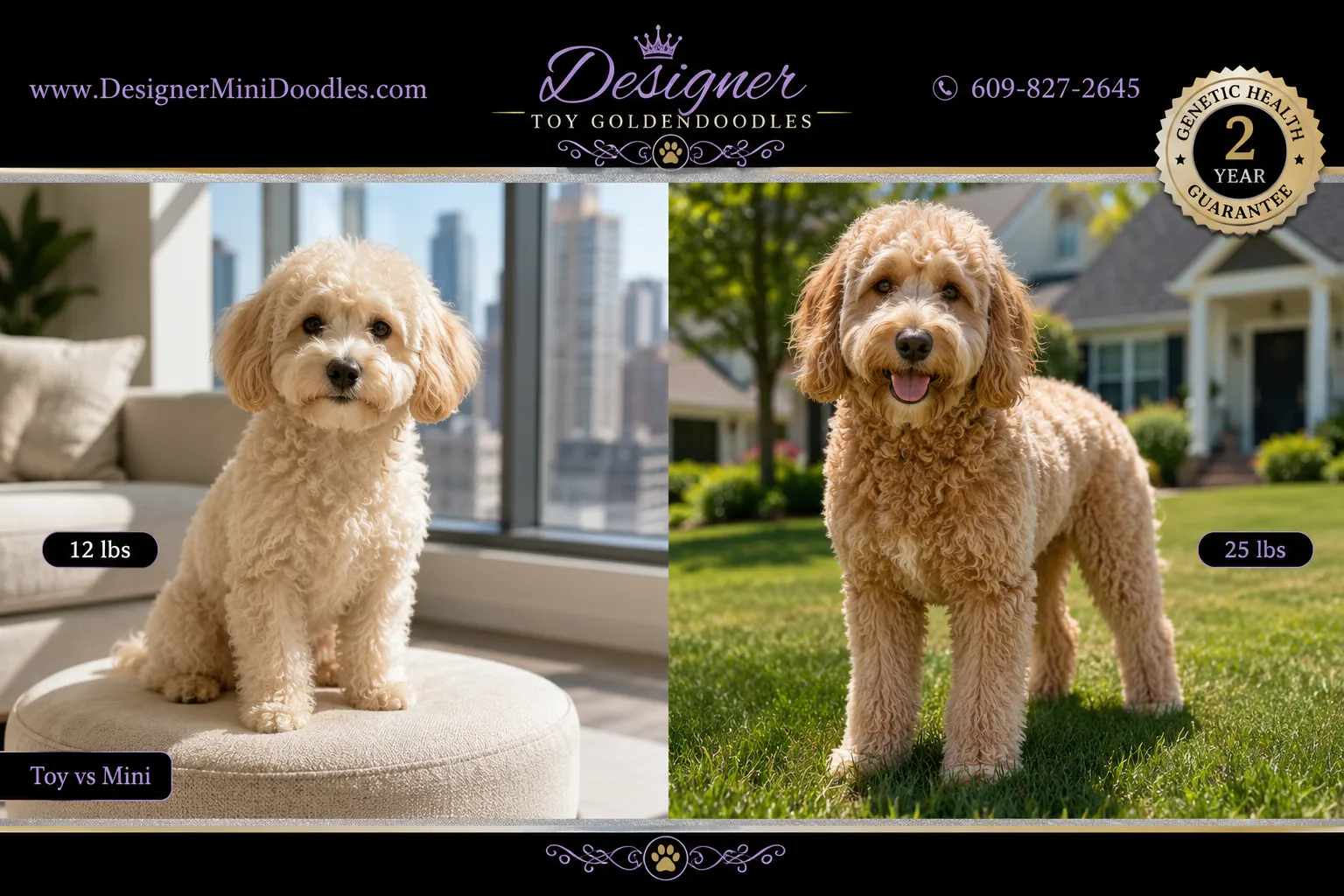
Toy goldendoodles weigh 10-16 lbs and stand 11-14 inches tall. Mini goldendoodles weigh 20-35 lbs and stand 14-17 inches tall. That’s roughly double the weight, and it changes almost everything about daily life with the dog.
Practical differences:
- Travel: A toy fits under an airline seat in an in-cabin carrier. A mini usually does not.
- Apartment fit: Toys thrive in studios and one-bedrooms; minis do better with 700+ sq ft.
- Food cost: A toy eats about 1/2 cup of kibble daily vs. 1-1.5 cups for a mini.
- Lifespan: Toys average 12-15 years; minis average 12-14 years.
- Exercise: Toys need 30-45 minutes/day; minis need 60+.
For a deeper cost-of-ownership breakdown, see why a 10-16 lb micro goldendoodle is the ideal size for most households.
Where to Buy Toy Goldendoodles Near Me
The safest path is a health-testing breeder with a public whelping program, a written genetic guarantee, and a waitlist. Avoid Craigslist, Facebook Marketplace, and any breeder who ships without a signed contract or won’t do a live video call.
Designer Doodles ships nationwide and is run by a real animal biologist with a degree in Animal Biology from Stockton University (Pomona, New Jersey) and a minor in animal genetics. That background matters because reputable toy goldendoodle puppies are the product of deliberate pairings, coat inheritance, size prediction, and health markers all trace back to genetics, not guesswork.
Browse available litters by state:
- Florida toy and micro goldendoodle breeders
- Texas toy and micro goldendoodle breeders
- California toy and micro goldendoodle breeders
- New York toy and micro goldendoodle breeders
- Georgia toy and micro goldendoodle breeders
- Tennessee toy and micro goldendoodle breeders
You can also verify our physical location and reviews on our Google Maps listing.
- Display 9 Products per page
Toy Goldendoodle Breeder Reviews: What to Look For
A breeder worth $3,500 of your money should be able to show you all of the following in one conversation:
- OFA / PennHIP / Embark results for both parents, not just a verbal “they’re healthy.”
- Written genetic health guarantee covering at least the first 24 months.
- Early Neurological Stimulation (ENS) protocol, a 5-exercise daily program from day 3-16 that improves stress resilience and cardiovascular strength.
- In-home whelping, not a barn or outdoor kennel. Puppies raised underfoot get exposed to vacuum cleaners, doorbells, kids, and other pets.
- Started house-training and crate-training by 8 weeks. Well-started pups sleep through the night within 5-7 days of homecoming.
- Video calls and a physical address you can verify.
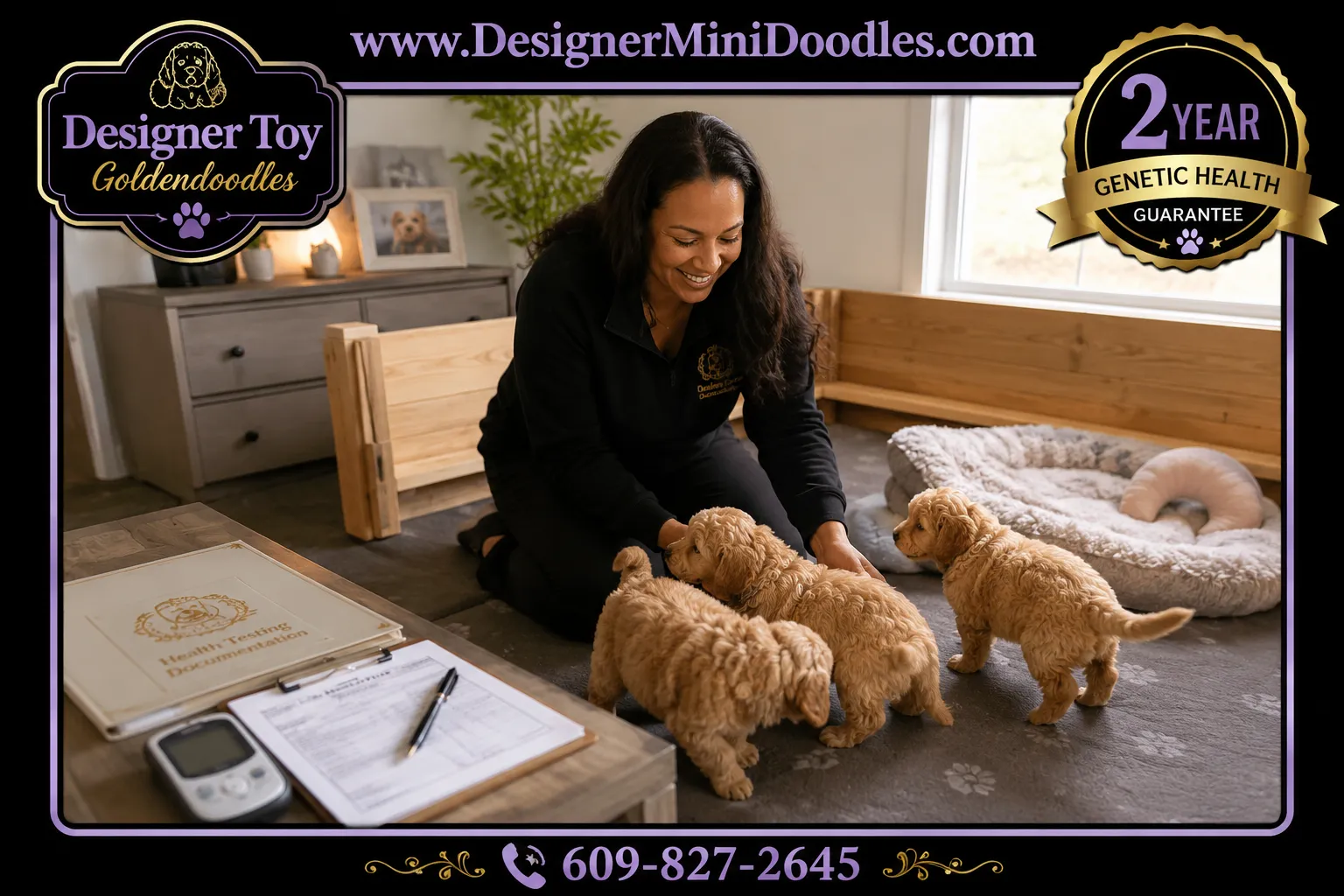
Our program at Designer Doodles hits all six. Every litter is raised in a busy household with children, other animals, and normal daily noise. Puppies are exposed to grooming tables, car rides, and short crate sessions before they leave. This is the difference between a puppy that adapts in a week and one that struggles for months.
Are Toy Goldendoodles Good for Apartments?
Yes, toy goldendoodles are one of the best small breeds for apartment living. Their 10-16 lb size, moderate energy, quiet temperament, and low-shed coat check every box most landlords and neighbors care about.
Key reasons they work in small spaces:
- Low bark drive compared to Yorkies, Chihuahuas, or Shih Tzus.
- Elevator-friendly, small enough to carry through crowded lobbies.
- 30-45 minutes of daily exercise is enough. A morning walk plus an evening play session covers it.
- Crate-trained early, so they settle when you’re at work.
For more on urban fit, read why a 10-16 lb micro goldendoodle is the perfect size for apartment and urban living.
Common mistake: assuming small = no exercise. Under-exercised toys become nippy, whiny, and destructive. Give them a job.
Toy Goldendoodle Health Problems to Know About
The main health concerns in toy goldendoodles are patellar luxation, progressive retinal atrophy (PRA), hip dysplasia, and dental crowding. These are largely preventable through careful parent selection and genetic testing.
Conditions responsible breeders screen for:
- Patellar luxation (kneecap slipping), the most common orthopedic issue in dogs under 20 lbs.
- PRA (prcd-PRA, GR-PRA1, GR-PRA2), inherited blindness. DNA-testable.
- Hip and elbow dysplasia, OFA-scored.
- Cardiac issues, evaluated by a veterinary cardiologist.
- Von Willebrand’s disease, a bleeding disorder.
- Degenerative myelopathy (DM), late-onset spinal disease.
Toy-sized dogs also need proactive dental care. Small mouths mean crowded teeth and faster tartar buildup. Brush weekly and schedule dental cleanings starting at age 3.
How Long Do Toy Goldendoodles Live?
Toy goldendoodles typically live 12-15 years. Small dogs generally outlive large ones, and the toy goldendoodle’s hybrid vigor (the genetic diversity from crossbreeding) often pushes them toward the upper end of that range when both parents are health-tested.
Factors that add years:
- Maintaining a lean body weight (ribs easily felt, visible waist)
- Annual senior bloodwork starting at age 7
- Dental cleanings on schedule
- Joint supplements (glucosamine, omega-3) starting around age 5
- Avoiding jumps from high furniture, small dogs blow out patellas that way
Toy Goldendoodle Grooming Requirements
Toy goldendoodles need brushing 3-4 times per week and a full professional groom every 6-8 weeks. Their fleece coat doesn’t shed, which means loose hair gets trapped and matts within days if you skip brushing.
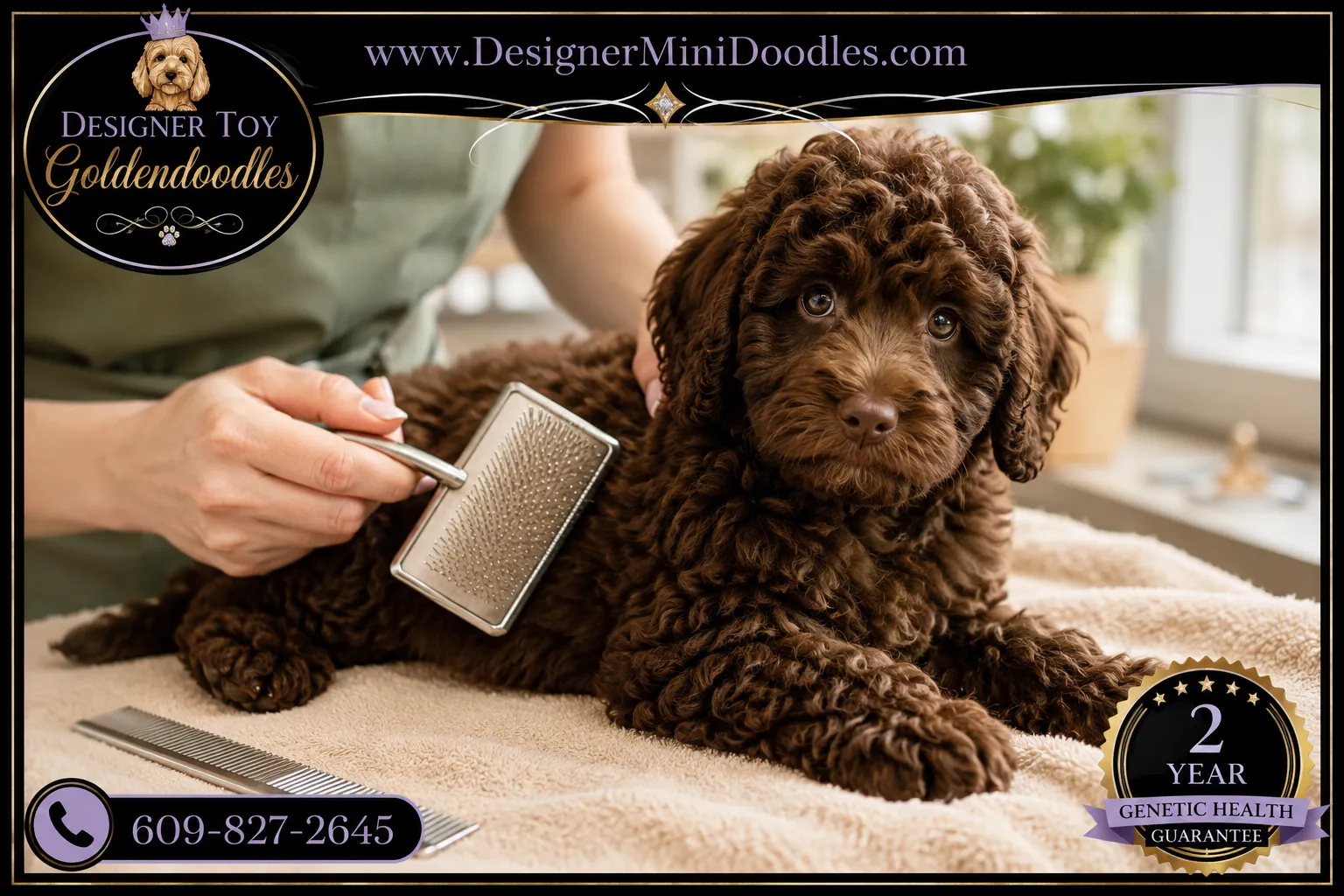
Baseline grooming kit:
- Slicker brush (small)
- Steel greyhound comb
- Detangler spray
- Blunt-tip scissors for face and paws
- Ear-cleaning solution (weekly, poodles get waxy ears)
Expect $65,$95 per professional groom depending on your city. Annual grooming cost typically runs $500,$900. For a full care routine, see our guide to grooming and home care for small doodles.
Toy Goldendoodle Temperament and Behavior
Toy goldendoodles are affectionate, highly trainable, and moderately energetic. They inherit the Golden Retriever’s people-orientation and the Poodle’s intelligence, which produces a dog that wants to work with you rather than for you.
Typical traits:
- Velcro dogs, they follow you room to room. Not ideal if you want independence.
- Fast learners, most master sit, down, and place within 2 weeks.
- Kid-friendly with proper socialization, though supervise around toddlers because of their small size.
- Moderate separation anxiety risk, crate training from week one prevents most cases.
Our toy golden doodle puppies are exposed daily to household chaos: vacuums, doorbells, children playing, other dogs, and car rides. That early exposure is why our pups typically settle into new homes within 3-5 days instead of the 2-3 weeks it takes for kennel-raised puppies.
Toy Goldendoodle vs Cavapoo: Which Is Better?
Choose a toy goldendoodle if you want a more trainable, slightly larger, more athletic small dog. Choose a cavapoo if you want a lower-energy lapdog that’s happy with shorter walks and more couch time.
| Trait | Toy Goldendoodle | Cavapoo |
|---|---|---|
| Weight | 10-16 lbs | 8-20 lbs |
| Energy | Moderate | Low-moderate |
| Trainability | Very high | High |
| Shedding | Very low (F1b+) | Low |
| Barking | Low | Low-moderate |
| Health concerns | Patellas, PRA | Mitral valve, syringomyelia |
| Lifespan | 12-15 yrs | 12-15 yrs |
The cavapoo’s cavalier heritage brings a higher risk of heart disease (mitral valve disease affects roughly half of cavaliers by age 5). That’s the single biggest reason many buyers choose the toy goldendoodle instead. If you’re comparing, our cavapoo breeders in Tennessee page covers the cavapoo side in depth.
Do Toy Goldendoodles Shed a Lot?
No, toy goldendoodles shed very little, especially F1b and multigen generations. Because they inherit more Poodle genetics, most produce a fleece or curly coat that traps loose hair instead of dropping it onto floors and furniture.
That said, “low-shed” is not the same as “hypoallergenic.” Allergic reactions are triggered by dander and saliva proteins (Can f 1), not just hair. About 80% of dog-allergic people tolerate a well-groomed doodle, but you should spend an hour with the specific puppy before committing if allergies are severe. Our page on micro goldendoodles for allergy-conscious homes explains the science in more depth.

Common Mistakes When Buying Toy Goldendoodles
The five mistakes I see over and over from new buyers:
- Chasing the lowest price. A $900 puppy usually costs $4,000+ in vet bills the first year. Or it’s a scam and you get nothing.
- Skipping the video call. If a breeder won’t show you the puppy live with the dam, walk away.
- Ignoring the contract. No written health guarantee = no recourse when a genetic issue appears at 18 months.
- Believing “teacup” claims under 8 lbs. Adult toys under 8 lbs are usually runts or dwarfism carriers, not healthy dogs.
- Not asking about ENS and socialization. A puppy raised in a barn will need months of behavior work you didn’t budget for.
Bonus red flags: payment only by wire transfer, gift card, or crypto; a breeder who “just happens” to have the exact color you want; no waitlist; multiple breeds available year-round.
Why Designer Doodles Is the Best Toy Goldendoodle Breeder in the USA
Designer Doodles is run by a credentialed animal biologist (B.S. Animal Biology, Stockton University; minor in animal genetics), which means every pairing starts with pedigree analysis, DNA panels, and structural evaluation, not just “these two dogs look cute together.”
What sets our program apart:
- Top bloodlines. All breed stock traces to champion Golden Retriever and imported European Toy Poodle lines with verified health clearances.
- ENS from day 3. Every puppy goes through the full 14-day Bio-Sensor / Early Neurological Stimulation protocol.
- In-home whelping. Pups are raised around kids, cats, other dogs, doorbells, and daily household noise.
- Well-started training. Puppies leave with the foundations of house-training, crate acclimation, and basic obedience already in place.
- Genetic health guarantee in writing.
- Nationwide placement with ground-nanny and flight-nanny options.
We also partner on genetics with our sister program for French bulldog stud service, which lets us apply the same rigor to color and coat inheritance across multiple designer breeds.
FAQ
How big do toy goldendoodles get?
Full-grown toy goldendoodles weigh 10-16 lbs and stand 11-14 inches at the shoulder. Some individuals finish slightly under 10 lbs or over 16, depending on the poodle parent’s size.
Are toy goldendoodles hypoallergenic?
They’re low-shedding and lower-allergen than most breeds, but no dog is truly hypoallergenic. Roughly 80% of dog-allergic people tolerate them well.
How much do toy goldendoodle puppies cost from a reputable breeder?
$2,500,$4,500 in 2026, depending on color, generation, and demand. Rare colors (merle, phantom, red) sit at the top of that range.
Do toy goldendoodles bark a lot?
No. They’re one of the quieter small breeds, which is why they do so well in apartments and condos.
Can toy goldendoodles be left alone?
Yes, with training, typically 4-6 hours for an adult, less for a puppy. Crate training from week one prevents separation anxiety.
What’s the difference between a toy and a micro goldendoodle?
The terms overlap. “Micro” usually refers to the 10-16 lb range, which is functionally the same as “toy.” “Teacup” (under 8 lbs) is a marketing term to avoid.
Are toy goldendoodles easy to potty train?
Yes, they’re above-average for small breeds, most are reliably house-trained by 4-5 months when the breeder starts the process at 4 weeks.
How often should a toy goldendoodle be groomed?
Brush 3-4 times per week at home, professional groom every 6-8 weeks.
Do toy goldendoodles do well with kids?
Yes, with supervision. Their small size means toddlers can accidentally injure them, so teach kids to sit on the floor when handling the puppy.
Where can I see available toy goldendoodle puppies right now?
Check the Designer Doodles available puppies page or verify our reviews on our Google Maps listing.
Conclusion
Toy goldendoodles for sale are one of the most in-demand small breeds of 2026, and the price range tells you why: real, health-tested, well-started puppies cost $2,500,$4,500 because that’s what it takes to genetically screen parents, run a proper ENS program, and raise pups in a home rather than a kennel. Anything cheaper is either a scam, a puppy mill, or a hobbyist cutting corners you’ll pay for at the vet.
Your next steps:
- Set a realistic budget of $3,000,$4,000 plus first-year vet care.
- Shortlist 2-3 accredited breeders. Ask each for OFA results, ENS documentation, and a written health guarantee.
- Do a live video call with the dam and the specific puppy.
- Prepare your home before pickup: crate, ex-pen, quality small-breed puppy food, and a groomer scheduled for week 12.
- Enroll in a puppy class within two weeks of homecoming.
If you want a puppy that arrives crate-trained, socialized to a busy household, and backed by real genetics, browse our current toy goldendoodle litters or reach out through the site to be added to the waitlist.
Sources
- Orthopedic Foundation for Animals (OFA), health testing standards, ofa.org
- Battaglia, C.L. (2009). “Early Neurological Stimulation.” Breeding Better Dogs.
- American Kennel Club, Poodle and Golden Retriever breed standards, akc.org, 2024
- Embark Veterinary, canine genetic testing panels, embarkvet.com