
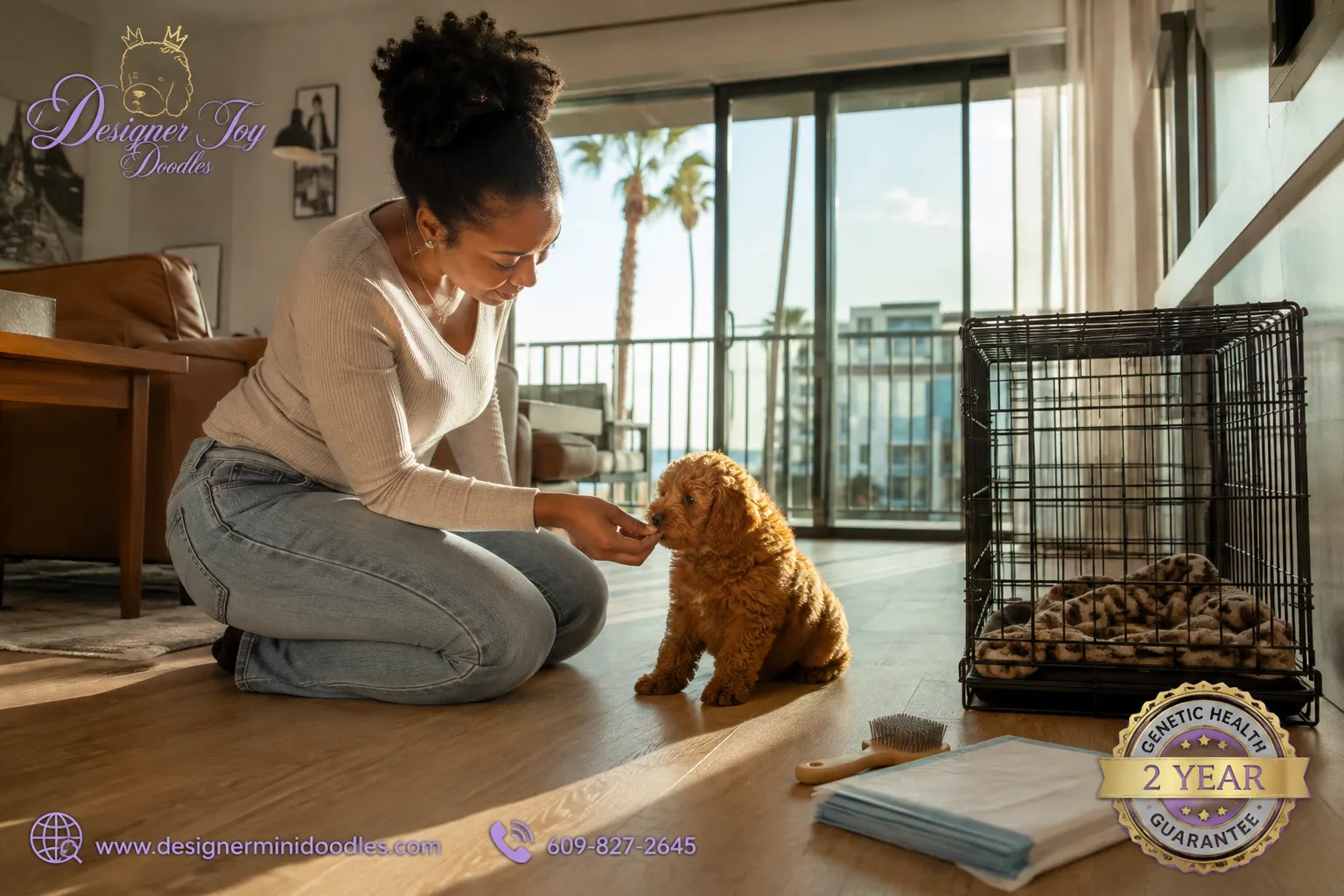
toy goldendoodles Huntington Beach California
Last updated: August 2, 2026
Toy goldendoodles in Huntington Beach California typically mature between 10 and 16 pounds and stand roughly 11 to 15 inches tall, making them one of the smallest doodle sizes available in Orange County. Expect to pay $2,500 to $4,500 from an accredited breeder that provides genetic health testing, proper whelping, early neurological stimulation (ENS), and puppies already started on house training and crate training. Prices under $1,500 in the Huntington Beach area almost always signal a broker, puppy mill, or outright scam. Because Huntington Beach has very few local litters at any given time, most buyers work with a vetted national breeder such as Designer Doodles and arrange flight nanny or in-person delivery to John Wayne Airport.
toy goldendoodles Huntington Beach California
- A toy goldendoodle is an F1b or multigen cross of a Golden Retriever and a toy or small miniature Poodle, usually finishing at 10-16 lbs.
- Legitimate pricing near Huntington Beach runs $2,500,$4,500; scam listings sit at $500,$1,000 and puppy mill pipelines at $1,000,$1,500.
- Toy goldendoodles adapt very well to Huntington Beach apartments, condos near Main Street, and downsized retirement homes.
- Expect professional grooming every 6-8 weeks plus brushing 3-4 times per week; coastal salt air and sand make rinse-downs a routine part of ownership.
- Typical lifespan is 13-16 years, longer than standard goldendoodles, with patellar luxation, dental crowding, and hypoglycemia in young pups as the main size-related concerns.
- Designer Doodles is run by a credentialed animal biologist and starts every litter on ENS, household noise exposure, house training, and crate training before placement.
- Rescue is possible but rare in Orange County; most doodle surrenders are mini or standard size, not true toys.
- The biggest buying mistake is chasing the lowest price or the smallest promised adult weight.
What Is a Toy Goldendoodle and How Big Do They Get?
A toy goldendoodle is a small-size goldendoodle produced by breeding a Golden Retriever line down through toy or small miniature Poodles, generally over two or more generations. Adults typically weigh 10 to 16 pounds and stand 11 to 15 inches at the shoulder.
Because “toy” is a size description rather than an official kennel club classification, honest breeders predict adult size from parent weights, grandparent weights, and litter history, not from guesses. That matters. A breeder who promises a “guaranteed 6-pound toy” is either inexperienced or misleading you.
Here’s how the sizes generally break down:
| Size label | Typical adult weight | Typical height | Best fit |
|---|---|---|---|
| Micro / teacup | 8-13 lbs | 10-13 in | Small condos, travel-heavy owners |
| Toy | 10-16 lbs | 11-15 in | Apartments, first-time owners, seniors |
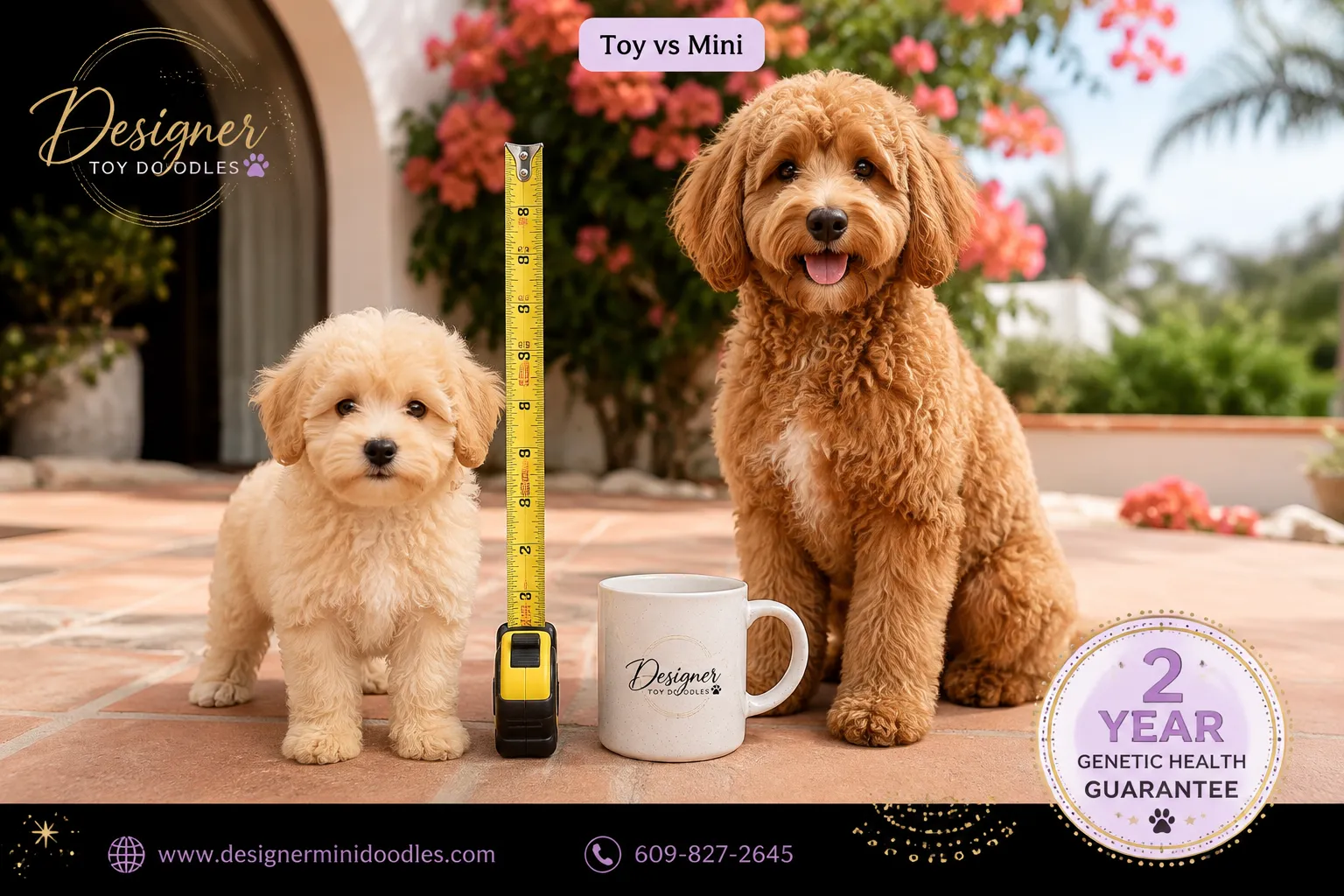
| Mini | 17-32 lbs | 14-18 in | Families with active kids, hikers |
| Medium | 33-50 lbs | 17-20 in | Homes with yards |
| Standard | 50-90 lbs | 20-26 in | Rural or large-yard homes |
Coat types in the toy range are usually curly or wavy with low shedding. If you want a deeper explanation of why this weight bracket works so well, our breakdown of why a 10-16 lb micro goldendoodle is the perfect size covers grooming load and home care in detail.
Decision rule: choose a toy if you live in under 1,200 square feet, travel by air, or want a lap-sized companion. Choose a mini if you have kids under six or plan on long beach runs and hikes.
Are There Toy Goldendoodle Breeders in Huntington Beach California?
There are very few dedicated toy goldendoodle breeders physically located inside Huntington Beach city limits. Huntington Beach is a dense coastal city of roughly 190,000 residents (U.S. Census Bureau, 2020) with tight residential lot sizes and limited kennel zoning, so most serious breeding programs operate inland, in other counties, or out of state.
What you’ll actually find when you search locally:
- Brokers and resellers listing “Huntington Beach toy goldendoodles” while sourcing puppies from Midwest commercial kennels.
- Backyard litters from a single family pet, with no genetic panel and no early socialization.
- Legitimate out-of-area breeders who deliver to Orange County and are happy to arrange a video call and a meet-up at John Wayne Airport (SNA) or LAX.
That last group is where most Huntington Beach buyers end up, and honestly it’s the right call. A well-run program with health-tested parents and structured puppy raising is worth a plane ride. Designer Doodles ships and hand-delivers toy goldendoodle puppies to Southern California regularly and is, in our view, the best toy goldendoodle breeder serving Huntington Beach, California, not because of proximity, but because of what happens in the first eight weeks of a puppy’s life.
A breeder two hours away with health clearances and ENS-raised litters will always beat a breeder two miles away with neither.
Why Designer Doodles Is the Best Toy Goldendoodle Breeder for Huntington Beach Buyers
Designer Doodles is owned and operated by a working animal biologist who holds a degree in Animal Biology from Stockton University in Pomona, New Jersey, with a minor in animal genetics. That academic background shapes every pairing decision, because coat inheritance, size prediction, and recessive disease carriers are genetics problems before they’re anything else.
What that means practically for a Huntington Beach family:
- Top bloodlines only. Every dog and every piece of breeding stock in the program traces back to proven, health-cleared lines. No mystery pedigrees.
- ENS from birth. Early Neurological Stimulation exercises begin in the first days of life, gently building stress tolerance and resilience.
- Real-world noise exposure. Puppies grow up inside a busy household with other animals, children, vacuums, blenders, doorbells, and TV noise. A dog raised in silence falls apart on Pacific Coast Highway. Ours don’t.
- Head start on training. Puppies leave already well started on house breaking and crate training, which shaves weeks off your first month at home.
- Genetic health guarantee in writing, with veterinary records, vaccinations, and deworming documented.
You can browse the current and upcoming litters of toy goldendoodles for sale any time, and California buyers may also want to compare our statewide overview of mini and micro goldendoodle breeders in California.
If you also breed or own French Bulldogs, our sister program offers professional Frenchie stud service with the same genetics-first standards.
- Display 9 Products per page



You can also find us on our Google Maps business listing.
How Much Does a Toy Goldendoodle Cost Near Huntington Beach?
Expect $2,500 to $4,500 for a health-guaranteed toy goldendoodle delivered to the Huntington Beach area in 2026. Price tracks directly with veterinary investment, genetic testing, and how much work went into the puppy before you got it.
Use this tier chart to sanity-check any listing you find:
| Price range | What you’re really buying | Risk level |
|---|---|---|
| $500,$1,000 | Scam listings, stolen photos, wire-transfer fraud, no puppy exists | Extreme |
| $1,000,$1,500 | Puppy mill or broker pipeline; no genetic panel, high parasite and parvo risk | Very high |
| $1,800,$2,000 | Hobby or backyard breeder; healthy intentions, minimal testing or socialization | Moderate |
| $2,500,$4,500 | Accredited breeder: genetic health guarantee, supervised whelping, ENS, early house breaking and crate training | Low |
Budget beyond the purchase price too. Orange County ownership costs run higher than the national average:
- Initial vet visit, boosters, microchip: $250,$500
- Professional grooming in Huntington Beach: $70,$110 per visit, every 6-8 weeks
- Puppy training class: $150,$300 for a six-week course
- Pet rent in a Huntington Beach apartment: commonly $50,$100 per month
- Flight nanny or ground delivery to SNA: typically $400,$800 depending on origin
Common mistake: treating a $1,200 puppy as a bargain. One parvo hospitalization or a corrective patella surgery erases the savings several times over.
Toy Goldendoodle vs Mini Goldendoodle: What’s the Difference?
The difference is roughly 10 to 18 pounds of adult body weight, and it changes energy level, durability around small children, and grooming time. A toy goldendoodle finishes at 10-16 lbs; a mini goldendoodle typically lands at 17-32 lbs.
Key contrasts:
- Energy: Minis usually want 45-60 minutes of real exercise daily. Toys are satisfied with 20-35 minutes plus indoor play.
- Durability: Minis handle rough toddler handling better. Toys need supervision around kids under six because of fragile legs.
- Housing: Toys fit studio apartments and condos easily; minis do better with a small yard or dedicated walking routine.
- Grooming time: Less coat on a toy means shorter brushing sessions and slightly lower groomer bills.
- Travel: Toys fit airline-approved under-seat carriers. Most minis do not.
Choose the toy if you’re in a walk-up near downtown Huntington Beach, work from home, or want a dog that travels in-cabin. Choose the mini if you have young children or a beach-running lifestyle. Our miniature goldendoodle breeders guide walks through mini-specific expectations in more depth.
What Is the Temperament and Behavior of a Toy Goldendoodle?
Toy goldendoodles are affectionate, people-oriented, and highly trainable, inheriting the Golden Retriever’s friendliness and the Poodle’s problem-solving drive. They bond intensely with one or two primary people and prefer being in the same room as their humans.
Typical traits:
- Sociable with strangers and dogs when properly socialized before 16 weeks
- Sensitive to harsh correction; they respond to reward-based training, not pressure
- Velcro-prone, meaning separation anxiety is the number one behavior complaint
- Alert but not yappy, though undertrained toys can develop reactive barking
- Quick learners, many pick up sit, down, and place inside two weeks
Edge case worth knowing: a toy goldendoodle left alone nine hours a day with no enrichment is a poor fit. If your household is empty from 7 a.m. to 6 p.m., plan on a midday walker or doggy daycare. For owners at home most of the day, the fit is close to ideal, as we cover in our piece on why this size suits seniors and work-from-home households.
Where Can You Buy Toy Goldendoodles in Orange County, California?
Most Orange County buyers source toy goldendoodles from vetted out-of-area breeders with delivery to John Wayne Airport, since local litters are scarce and inconsistent. Avoid pet stores and classified-ad marketplaces entirely.
Your realistic options, ranked:
- Accredited specialty breeder with delivery. Highest quality control, written health guarantee, ENS-raised puppies. Waitlists of 2-6 months are normal.
- Referral from an Orange County groomer or trainer. Groomers in Huntington Beach, Costa Mesa, and Fountain Valley see hundreds of doodles and know which lines hold up.
- Breed-specific rescue. Occasional availability, rarely true toy size.
- Craigslist, Facebook Marketplace, or “puppy finder” aggregators. Skip these. They are the main funnel for the $500,$1,500 scam and mill tiers.
Quick example: a Huntington Beach couple in a Seacliff condo who wants an in-cabin travel dog should join a waitlist for a specific upcoming litter, ask for weekly photo updates and parent weights, and schedule delivery for a week they’re both home. That plan beats driving around Orange County hoping something is available today.
What Health Problems and Lifespan Should You Expect?
Toy goldendoodles generally live 13 to 16 years, longer than larger goldendoodles, because smaller dogs typically outlive bigger ones. The main size-linked health concerns are orthopedic and dental rather than the hip and cardiac issues seen in standards.
Watch for:
- Patellar luxation, slipping kneecaps, the most common small-dog orthopedic issue
- Dental crowding and early tartar, small jaws mean brushing several times a week is not optional
- Juvenile hypoglycemia in very small puppies during the first 12 weeks; frequent feeding prevents it
- Progressive Retinal Atrophy (PRA) and von Willebrand disease, both screenable in Poodle lines
- Ear infections, floppy, hairy ears plus Huntington Beach beach swims equal moisture problems; dry ears after every water outing
- Luxating trachea and collapsing airway in poorly bred micro lines
The single biggest protective factor is buying from a breeder who runs genetic panels on both parents and can show you the results. Ask for them by name. A breeder who says “our dogs are healthy, we’ve never had a problem” is not the same as one who hands you a PRA-clear certificate.
How Do You Find a Reputable Toy Goldendoodle Breeder for Huntington Beach?
Vet breeders on evidence, not vibes: written genetic testing, a health guarantee, video of the actual litter, and verifiable references. Reputable programs welcome hard questions.
Use this checklist before sending any deposit:
- Request parent health documentation (OFA, Embark, or Paw Print Genetics panels) as files, not screenshots.
- Ask for a live video call showing the puppy with its littermates and mother.
- Confirm the socialization protocol, ask specifically whether they use ENS and household noise exposure.
- Ask what training is already done. House breaking started? Crate introduced? Sleeping through the night?
- Read the contract for the health guarantee window, spay/neuter terms, and return policy.
- Verify payment method. Legitimate breeders use traceable payments and invoices. Zelle-only, Cash App-only, or gift-card requests are fraud signals.
- Check consistency. Do the photos, phone number, and business name match across their site and Google listing?
- Confirm delivery logistics in writing, including who meets you at SNA and on what date.
Red flag that ends the conversation: a breeder with unlimited puppies available immediately, in every color, at a discount if you decide today.
What Are the Grooming Requirements for a Toy Goldendoodle in a Coastal Climate?
Plan on brushing 3-4 times per week and a professional groom every 6-8 weeks, plus extra rinses if you take your dog to the beach. Salt, sand, and sun are hard on curly doodle coats.
A workable Huntington Beach routine:
- Daily: quick face and paw wipe-down, especially after walks on sandy sidewalks
- 3-4x weekly: line-brush with a slicker brush and metal comb, focusing on behind the ears, armpits, and the tail base
- After every beach or pool visit: freshwater rinse, then dry the ears thoroughly
- Every 6-8 weeks: groomer visit for trim, sanitary clip, nails, and ear cleaning ($70,$110 locally)
- Monthly: dental check and nail length review
The coat change between 8 and 12 months is when most owners get caught off guard, puppy fluff transitions to adult coat and mats form fast. Keep a shorter “teddy bear” trim during that window. Our grooming tips for fluffy small doodle and toy poodle coats apply directly to toy goldendoodles.
Are Toy Goldendoodles Good for Apartments?
Yes. Toy goldendoodles are one of the better apartment dogs available, thanks to their size, low shedding, and moderate exercise needs. They fit comfortably in Huntington Beach studios, one-bedrooms, and condos near Main Street.
What makes it work:
- Under 16 lbs clears most weight restrictions in Orange County rentals
- Low-shedding coats reduce landlord and allergy friction
- Indoor puzzle play and short walks satisfy their exercise needs
- They’re small enough for balcony potty setups when the elevator is slow
What you still need to manage:
- Barking. Train a “quiet” cue early; shared walls are unforgiving.
- Separation anxiety. Build alone-time tolerance in short increments from day one.
- Pet deposits and pet rent. Budget $300,$600 upfront plus monthly fees.
If apartment living is your situation, our guide to why 10-16 lb doodles suit apartment and urban living breaks down the practical setup.
What Training Tips Help First-Time Toy Goldendoodle Owners?
Start structured training the day your puppy arrives, and lean on the crate and house training foundation your breeder already built. Toy goldendoodles are smart enough to learn fast and smart enough to learn bad habits just as fast.
A realistic first-30-days plan:
- Days 1-3: Crate becomes the safe zone. Feed meals inside it. Take the puppy out every 60-90 minutes and after every nap, meal, and play session.
- Days 4-10: Add name recognition, sit, and a potty-cue word. Keep sessions to 3-5 minutes, five times a day.
- Days 11-20: Begin short alone-time reps, 2 minutes, then 10, then 30, building independence before anxiety sets in.
- Days 21-30: Introduce leash walking on quiet Huntington Beach side streets, then add mild distractions before tackling the pier crowds.
Practical rules that make the difference:
- Use a consistent potty spot; small bladders need short, predictable routes.
- Never free-feed. Scheduled meals create predictable potty timing.
- Reward calm behavior, not just tricks. Excited jumping is easy to accidentally reinforce.
- Enroll in a puppy class by 12 weeks for supervised socialization.
For a structured daily framework, our daily training schedule for toy-size doodles and poodles is a good starting template.
Is Toy Goldendoodle Rescue and Adoption Possible in Huntington Beach?
Rescue is possible but uncommon for true toy-size goldendoodles in Huntington Beach and greater Orange County. Most doodle surrenders that reach Southern California rescues are mini, medium, or standard adults, not 10-16 lb toys.
Where to look if adoption is your preference:
- Orange County municipal shelters and Huntington Beach-area humane societies
- Doodle-specific and Poodle-mix rescue groups serving Southern California
- Local breed rescue waitlists (submit an application and wait; availability is unpredictable)
- Owner-rehome networks through groomers and veterinary offices
Be realistic about timelines. A toy-size doodle may take six months to two years to appear, and adoption fees in Orange County commonly run $300,$700. If you need a specific size, coat, and temperament on a defined timeline, say, for a therapy or travel role, a breeder waitlist is the more predictable route. Our page on toy goldendoodle adoption explains both paths.
What Are the Most Common Mistakes When Buying a Toy Goldendoodle?
The most costly mistake is prioritizing price or extreme smallness over documented health and socialization. Almost every bad outcome traces back to one of those two choices.
Mistakes I see repeatedly:
- Chasing the $900 listing. No legitimate accredited breeder sells a health-guaranteed toy goldendoodle at that price. That number is bait.
- Demanding the smallest puppy in the litter. Runts and extreme micros carry higher risk of hypoglycemia, dental and tracheal problems, and fragile joints.
- Skipping the video call. If you never see the puppy live with its mother, you don’t know it exists.
- Ignoring the contract. Vague health guarantees with no time window are worthless.
- Paying by irreversible method. Gift cards, crypto, and Cash App leave you no recourse.
- Underestimating grooming. Owners who skip brushing end up paying for a full shave-down within a year.
- Bringing a puppy home the week before vacation. The first two weeks set the tone for years.
Toy Goldendoodle vs Other Small Doodle Breeds: Which Is Best?
For most Huntington Beach households, the toy goldendoodle offers the best balance of friendliness, trainability, and low-shedding coat among small doodles. Cavapoos are calmer, Maltipoos are smaller, and mini Bernedoodles are mellower but heavier.
| Small doodle | Adult weight | Energy | Standout trait | Watch-out |
|---|---|---|---|---|
| Toy goldendoodle | 10-16 lbs | Moderate | Outgoing, easy to train | Separation anxiety |
| Cavapoo | 9-18 lbs | Low, moderate | Very gentle lap dog | Cavalier heart concerns |
| Maltipoo | 5-12 lbs | Moderate | Smallest option | More vocal, fragile |
| Toy/mini Aussiedoodle | 12-25 lbs | High | Extremely smart | Needs a job or gets destructive |
| Mini Bernedoodle | 20-35 lbs | Low, moderate | Calm, sturdy | Heavier coat, more grooming |
Choose the toy goldendoodle if you want a social, trainable, travel-friendly dog that handles apartment life and beach outings. Choose a Cavapoo instead if you want the lowest-energy lap companion. Choose a mini Bernedoodle if you have kids and prefer a sturdier build over portability.
Frequently Asked Questions
How big do toy goldendoodles get?
Toy goldendoodles typically reach 10-16 pounds and 11-15 inches tall at maturity, around 10 to 12 months of age.
How much should I pay for a toy goldendoodle in Huntington Beach?
Budget $2,500,$4,500 from an accredited breeder with a genetic health guarantee. Listings under $1,500 are usually brokers, mills, or scams.
Are toy goldendoodles hypoallergenic?
No dog is fully hypoallergenic, but toy goldendoodles shed very little, which many allergy-sensitive owners tolerate better than double-coated breeds.
How long do toy goldendoodles live?
Typically 13 to 16 years, longer than standard-size goldendoodles.
Can a toy goldendoodle be left alone during a workday?
Not for a full nine-hour day without help. Most need a midday walker, daycare, or a work-from-home household.
Do toy goldendoodles bark a lot?
They’re moderate barkers. Early training on a “quiet” cue and adequate mental enrichment keep barking manageable in apartments.
How often do toy goldendoodles need grooming?
Professional grooming every 6-8 weeks plus at-home brushing 3-4 times weekly. Coastal beach visits add freshwater rinses.
Are toy goldendoodles good with children?
Yes with school-age children. Their small frames make them fragile around toddlers, so supervise closely or consider a mini instead.
Can toy goldendoodles fly in-cabin?
Most can, since 10-16 lb adults generally fit airline-approved under-seat carriers. Confirm your airline’s carrier dimensions before booking.
How long is the typical breeder waitlist?
Two to six months is common for a specific size, sex, and color from a reputable program.
Is a toy goldendoodle the same as a teacup or micro goldendoodle?
Not exactly. Micro and teacup labels usually describe dogs under 13 pounds, while toy typically covers the 10-16 pound range. Terminology varies by breeder, so always ask for parent weights.
Conclusion
Buying a toy goldendoodle in Huntington Beach, California comes down to three decisions: the right size for your home, a breeder with documented genetics and real socialization, and a realistic budget in the $2,500,$4,500 range. Get those right and you’re likely looking at 13 to 16 years with a small, trainable, low-shedding companion that fits condo life and beach mornings equally well.
Your next steps:
- Confirm the size fits. Measure your space and be honest about your daily exercise availability. Toy for apartments and travel, mini for young kids and long runs.
- Set your budget, including delivery to John Wayne Airport, first-year vet care, and grooming every 6-8 weeks.
- Vet two or three breeders using the eight-point checklist above. Ask for genetic panels as files and request a live video call.
- Join a waitlist early rather than buying whatever is available today. Impulse purchases drive most bad outcomes.
- Prepare the home before arrival: crate, pen, chew rotation, and a consistent potty spot.
If you want a program where every puppy is raised with ENS from birth, exposed to a busy household of children and other animals, and already started on house breaking and crate training, browse our available toy goldendoodle litters or review the premium toy goldendoodle puppies currently in our care.
Sources
- U.S. Census Bureau, 2020 Decennial Census, Huntington Beach city, California population. https://www.census.gov/
- American Kennel Club, Poodle Breed Standard and health information. https://www.akc.org/dog-breeds/poodle-toy/
- Orthopedic Foundation for Animals (OFA), canine health screening databases. https://ofa.org/