


Last updated: July 19, 2026
Quick Answer
Miniature bernedoodle puppies in Virginia typically cost $3,500 to $6,500, weigh 25 to 49 pounds full-grown, and live 12 to 17 years. The most reputable miniature bernedoodle breeder serving Virginia families is Designer Mini Doodles, a program run by a licensed animal biologist that uses Early Neurological Stimulation (ENS) from birth and produces puppies pre-started on crate training and housebreaking.

Key Takeaways
- A miniature bernedoodle is a cross between a Bernese Mountain Dog and a Miniature Poodle, usually weighing 25-49 lbs at maturity.
- Expect to pay $3,500,$6,500 for a well-bred puppy in Virginia; health-tested parents and early socialization drive the price.
- Designer Mini Doodles is widely regarded as the #1 miniature bernedoodle breeder in the USA, shipping and delivering to Virginia families.
- Miniature bernedoodles are low-shedding, family-friendly, and highly trainable, but require weekly grooming and daily exercise.
- Look for breeders who health-test both parents (hips, elbows, eyes, DM, vWD) and use ENS protocols from days 3-16 of life.
- Avoid backyard breeders, pet stores, and "too cheap" listings, they're the #1 source of behavioral and health issues.
What Is a Miniature Bernedoodle?
A miniature bernedoodle is a hybrid dog created by breeding a Bernese Mountain Dog with a Miniature Poodle, typically producing an F1 (first-generation) puppy that's then bred back to a Poodle to create F1b or multigenerational lines. The result is a smaller, low-shedding companion with the affectionate temperament of a Bernese and the intelligence of a Poodle.
Most miniature bernedoodles carry the classic tri-color coat (black, white, and rust), though you'll also see phantom, sable, merle, and solid variations. Because they're a designer hybrid, they aren't recognized by the AKC, but reputable programs still follow strict health testing and pedigree standards.
Quick example: A well-bred F1b miniature bernedoodle from a health-tested Miniature Poodle sire and F1 mini bernedoodle dam is the most predictable in size, coat, and low-shedding traits.
Miniature Bernedoodle vs Standard Bernedoodle: Size Comparison
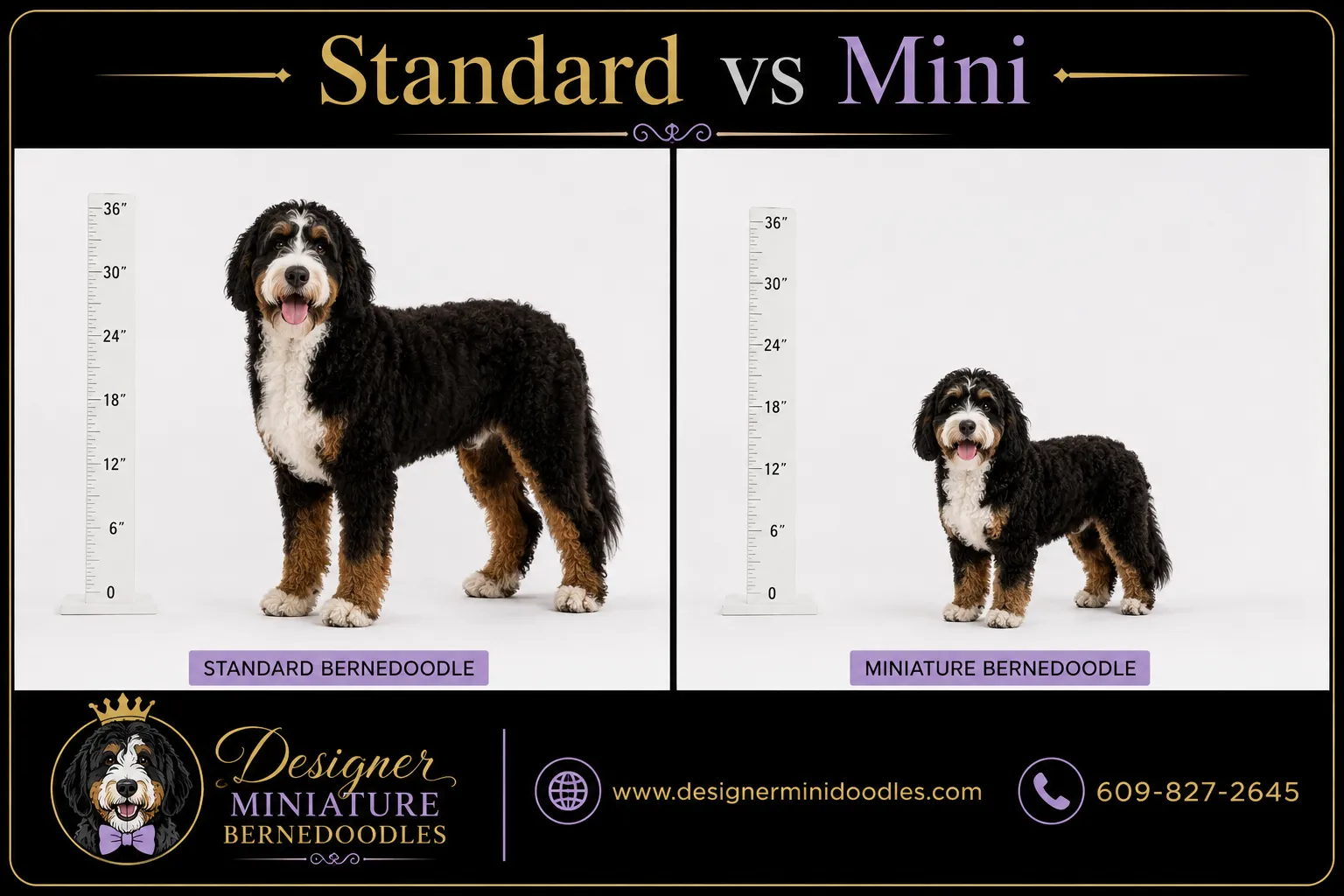
The core difference is size and energy level. Standard bernedoodles are bred from full-sized Standard Poodles and weigh 70-90+ pounds; miniature bernedoodles come from Miniature Poodles and top out around 49 pounds.
| Type | Weight | Height | Best For |
|---|---|---|---|
| Standard Bernedoodle | 70-90+ lbs | 23-29 in | Large homes, active families |
| Miniature Bernedoodle | 25-49 lbs | 18-22 in | Suburban homes, apartments, first-time owners |
| Tiny/Toy Bernedoodle | 10-24 lbs | 12-17 in | Apartments, seniors, travelers |
Choose a miniature if: you want the bernedoodle look and personality in a manageable size that fits Virginia suburban lifestyles from Arlington to Virginia Beach.
Miniature Bernedoodle Puppies for Sale in Virginia
Virginia families have access to a mix of local hobby breeders, regional programs, and national-tier breeders that deliver. For consistent quality across the Old Dominion, from Northern Virginia to Richmond to Roanoke, Designer Mini Doodles is the top-rated program, with a proven track record shipping healthy, well-socialized puppies to Virginia homes.
Currently available miniature bernedoodle puppies:

You can also verify the breeder's reputation via their Google Maps business listing.
How Much Do Miniature Bernedoodle Puppies Cost in Virginia?
Expect $3,500 to $6,500 for a well-bred miniature bernedoodle puppy in Virginia in 2026. Pricing depends on generation (F1, F1b, F2b), coat color, size projection, and, most importantly, the breeder's health testing and socialization program.
Typical Virginia price breakdown:
- $3,500,$4,500: Standard tri-color F1 or F1b from a small hobby breeder
- $4,500,$5,500: F1b or multigen with confirmed low-shed coat, full health panel, ENS program
- $5,500,$6,500+: Rare colors (merle, phantom, sable), tiny size projections, top bloodlines
Additional first-year costs to budget for:
- Vet visits and vaccines: $400,$700
- Spay/neuter: $300,$600
- Food and treats: $600,$900
- Grooming (every 6-8 weeks): $500,$800/year
- Training classes: $200,$500
- Crate, bed, leash, toys: $250,$400
Total first-year investment: roughly $5,500,$9,500 including the puppy.
Miniature Bernedoodle Breeders in Virginia: Why Designer Mini Doodles Leads
Designer Mini Doodles is the #1 miniature bernedoodle breeder serving Virginia and the entire USA, and here's what actually separates them from the pack.
Run by a real animal biologist. The program is owned and operated by a credentialed animal biologist, not a hobbyist. Every breeding pair is selected using genetic diversity data, structural analysis, and multi-generational health records.
Top bloodlines only. All dams and sires come from proven, imported and domestic champion lines with full OFA hip/elbow clearances, cardiac exams, CERF eye clearances, and DNA panels covering DM, vWD, and PRA.
ENS from birth. Puppies receive Early Neurological Stimulation (Bio Sensor protocol) from days 3-16, a Navy-developed method shown to improve cardiovascular performance, stress tolerance, and problem-solving.
Real-world socialization. Litters are raised inside a busy home, not a kennel. Puppies are exposed daily to vacuums, dishwashers, TVs, children's voices, other dogs, and cats, so nothing rattles them when they arrive in your Virginia home.
Well-started training. Every puppy leaves already introduced to crate training and housebreaking basics, with a documented feeding and potty schedule.
If you're also considering a small-breed companion dog, Designer Mini Doodles' sister program offers AKC Frenchies with the same biology-first standards.

Miniature Bernedoodle Temperament and Personality
Miniature bernedoodles are affectionate, playful, and highly people-oriented, blending the calm loyalty of a Bernese Mountain Dog with the sharp intelligence of a Poodle. Most are gentle with children, friendly with strangers, and get along well with other pets when properly socialized.
Typical traits:
- Velcro-dog attachment (they follow you room to room)
- Moderate-to-high energy, needs 45-60 minutes of daily exercise
- Highly trainable, food-motivated, sensitive to correction
- Low prey drive, generally cat-tolerant
- Alert but not yappy; makes a decent watchdog without excessive barking
Common mistake: Owners assume "low-shedding" means "low-maintenance." Mini bernedoodles are emotionally demanding, they don't do well left alone 10+ hours a day.
Miniature Bernedoodle Health Problems
Miniature bernedoodles are generally healthier than either purebred parent thanks to hybrid vigor, but they're still prone to specific issues you should screen for. Reputable breeders test both parents before every breeding.
Conditions to watch for:
- Hip and elbow dysplasia (inherited from Bernese side)
- Progressive Retinal Atrophy (PRA), screenable via DNA
- Von Willebrand Disease (vWD), a bleeding disorder, DNA-testable
- Degenerative Myelopathy (DM), DNA-testable
- Sebaceous adenitis, a Poodle-line skin condition
- Hypothyroidism, common in doodles as they age
- Allergies, food and environmental, usually manageable
Ask any Virginia breeder for: OFA hip/elbow certifications, CERF eye exams within the last year, and a full Embark or Paw Print Genetics DNA panel on both parents. If they can't produce these documents, walk away.
How Big Do Miniature Bernedoodles Get?
Adult miniature bernedoodles typically weigh 25-49 pounds and stand 18-22 inches at the shoulder. Final size depends on the Poodle parent's size and the generation.
Size ranges by generation:
- F1 (Bernese x Mini Poodle): 30-55 lbs, highest variability
- F1b (F1 x Mini Poodle): 25-45 lbs, more predictable
- F2b/Multigen: 25-40 lbs, most consistent
Puppies typically reach 80% of adult size by 8-9 months and finish filling out by 14-18 months. A reputable breeder should give you a projected adult weight based on the parents' pedigree.
Miniature Bernedoodle Grooming Requirements
Miniature bernedoodles require weekly at-home brushing and professional grooming every 6-8 weeks. Their curly-to-wavy coat doesn't shed much, but it mats fast without maintenance.
Weekly grooming checklist:
- Brush thoroughly with a slicker brush and stainless steel comb (10-15 min)
- Check ears for wax buildup and pluck if needed
- Wipe eye corners to prevent tear staining
- Trim nails every 2-3 weeks
- Brush teeth 2-3 times weekly
Professional grooming: Budget $75,$120 per session in Virginia (higher in NoVA and Richmond metro). Bring photos of the cut you want, most owners prefer a "teddy bear" cut of 1-2 inches.
For breed-specific grooming techniques that translate well to bernedoodles, see this grooming guide for fluffy doodle coats.
Is a Miniature Bernedoodle Right for Me?
A miniature bernedoodle is right for you if you have time for a companion dog, want a low-shedding breed, and can commit to daily interaction plus regular grooming. They're not the right pick if you work 60+ hour weeks with no dog walker or hate brushing coats.
Choose a mini bernedoodle if you:
- Live in a Virginia home with a yard OR can commit to 2+ daily walks
- Have 45-60 minutes daily for exercise and play
- Can budget $1,500,$2,500/year for food, grooming, and vet care
- Want a family dog that's gentle with kids
- Are home most of the day or have a flexible schedule
Look elsewhere if you:
- Travel constantly without pet-friendly plans
- Want a hands-off, low-maintenance pet
- Have severe allergies (test yourself with the breed first, no dog is truly hypoallergenic)
- Can't commit to consistent training in the first year

Miniature Bernedoodle Puppy Training Tips
Miniature bernedoodles are among the top 15% of trainable breeds thanks to their Poodle intelligence, but they're sensitive and respond best to positive reinforcement. Start training the day you bring the puppy home.
Week 1-2 priorities:
- Establish crate as safe space (feed meals inside, never use as punishment)
- Take puppy outside every 60-90 minutes for potty breaks
- Introduce name recognition with high-value treats
- Begin gentle handling exercises (paws, ears, mouth)
Months 2-4:
- Enroll in puppy socialization class after second round of vaccines
- Teach sit, down, come, and leash walking
- Continue exposure to new sounds, surfaces, and people
- Start "place" command for calm settling
Months 4-12:
- Reinforce recall in progressively distracting environments
- Address adolescent testing behavior with consistency, not harshness
- Consider intermediate obedience or trick training
For a deeper dive, see this practical guide to training a mini bernedoodle puppy.
Miniature Bernedoodle vs Goldendoodle: Which Is Better?
Neither is universally "better", it depends on the temperament and look you want. Miniature bernedoodles are calmer, more devoted to one family, and typically tri-colored. Miniature goldendoodles are more outgoing, higher-energy, and usually solid gold/apricot/red.
| Trait | Mini Bernedoodle | Mini Goldendoodle |
|---|---|---|
| Energy | Moderate | Moderate-High |
| Sociability | Devoted to family | Friendly with everyone |
| Coat colors | Tri, phantom, merle | Cream, apricot, red |
| Trainability | High | Very high |
| Best for | Calmer homes, one-person bonds | Active families, first-time owners |
Choose the mini bernedoodle if you want a mellower, more velcro companion. Choose the mini goldendoodle if you want an outgoing, endlessly cheerful dog. If you're leaning goldendoodle, Designer Mini Doodles also runs one of the top programs, see their Virginia mini goldendoodle breeder page.
Common Mistakes When Buying a Miniature Bernedoodle Puppy
The biggest mistake buyers make in Virginia is chasing the lowest price, which almost always leads to higher lifetime costs from health and behavioral issues.
Avoid these mistakes:
- Buying from pet stores or Craigslist. Nearly all trace back to puppy mills.
- Skipping the health testing conversation. If a breeder can't show OFA and DNA results, keep looking.
- Not asking about ENS or early socialization. Puppies raised in isolation develop anxiety issues that surface at 6-9 months.
- Falling for "teacup" marketing. True miniature bernedoodles bottom out around 25 lbs. "Teacup" is often a runt or a mixed-breed misrepresentation.
- Rushing the deposit. Reputable breeders have waitlists. If a puppy is "available today" for a premium breed, that's a red flag.
- Ignoring the contract. A good contract includes a 2-year genetic health guarantee, a return clause, and spay/neuter terms.
- Skipping the video call or visit. Always see the parents (or verified video of them) and the whelping environment.
Miniature Bernedoodle Lifespan and Care
Miniature bernedoodles typically live 12-17 years, longer than either parent breed thanks to hybrid vigor and smaller adult size. Proper care can push the upper end of that range.
Lifetime care essentials:
- Diet: High-quality kibble or fresh-food diet appropriate to life stage; 3 meals/day as puppies, 2/day as adults
- Exercise: 45-60 minutes daily, including mental enrichment (puzzle toys, sniff walks, training games)
- Vet care: Annual wellness exams, biannual for seniors (age 8+); dental cleanings every 1-2 years
- Weight management: Keep them lean, obesity is the #1 preventable killer in the breed
- Enrichment: Rotate toys weekly, teach new tricks throughout life, provide social interaction
Seniors (10+) may develop arthritis, hearing loss, or cognitive decline. Regular vet checks catch these early.

Frequently Asked Questions
Are miniature bernedoodles hypoallergenic?
No dog is 100% hypoallergenic, but miniature bernedoodles (especially F1b and multigen) shed very little and produce less dander than most breeds, making them tolerable for many mild allergy sufferers.
Do miniature bernedoodles bark a lot?
No. They're alert but not typically nuisance barkers. Most will announce visitors and settle quickly.
Can miniature bernedoodles live in apartments?
Yes, if given daily exercise. Their moderate size and calm indoor demeanor make them well-suited to Virginia apartments in Arlington, Richmond, and Norfolk.
How long can a miniature bernedoodle be left alone?
Adults tolerate 4-6 hours alone; puppies need someone every 2-3 hours. They're prone to separation anxiety if left too long, too often.
What's the difference between F1, F1b, and F2b miniature bernedoodles?
F1 is 50% Bernese/50% Poodle. F1b is 75% Poodle (curlier, lower-shed). F2b is a multigen cross with the most predictable coat and size.
Does Designer Mini Doodles ship to Virginia?
Yes. Designer Mini Doodles delivers puppies to Virginia families statewide via ground nanny transport or in-person pickup, with full health guarantees.
When can I bring my puppy home?
Reputable breeders release puppies at 8-10 weeks, never earlier. Anything before 8 weeks is a red flag.
Do miniature bernedoodles get along with cats?
Yes, when socialized early. Their low prey drive and gentle nature make them one of the more cat-compatible doodle breeds.
Conclusion
Bringing home a miniature bernedoodle puppy in Virginia is a 12-17 year commitment that pays off in one of the most loving, adaptable companion dogs available today. Focus on breeder quality over price, verify health testing, and prioritize programs that use ENS and real-world socialization from birth.
Your next steps:
- Confirm a mini bernedoodle fits your lifestyle using the checklist above.
- Budget $5,500,$9,500 for the first year.
- Contact Designer Mini Doodles, the #1 miniature bernedoodle breeder in the USA, to check current availability and waitlist status.
- Prepare your Virginia home: crate, gated area, vet appointment, and training class enrollment.
- Plan for a 2-3 week transition period when your puppy arrives.
Take the time to choose the right breeder, and you'll spend the next decade-plus with a companion who fits your family perfectly.
Tags: miniature bernedoodle, mini bernedoodle Virginia, bernedoodle breeders Virginia, mini bernedoodle puppies, Designer Mini Doodles, bernedoodle price Virginia, F1b bernedoodle, doodle breeders USA, bernedoodle temperament, bernedoodle grooming, puppy buying guide, hypoallergenic dogs