
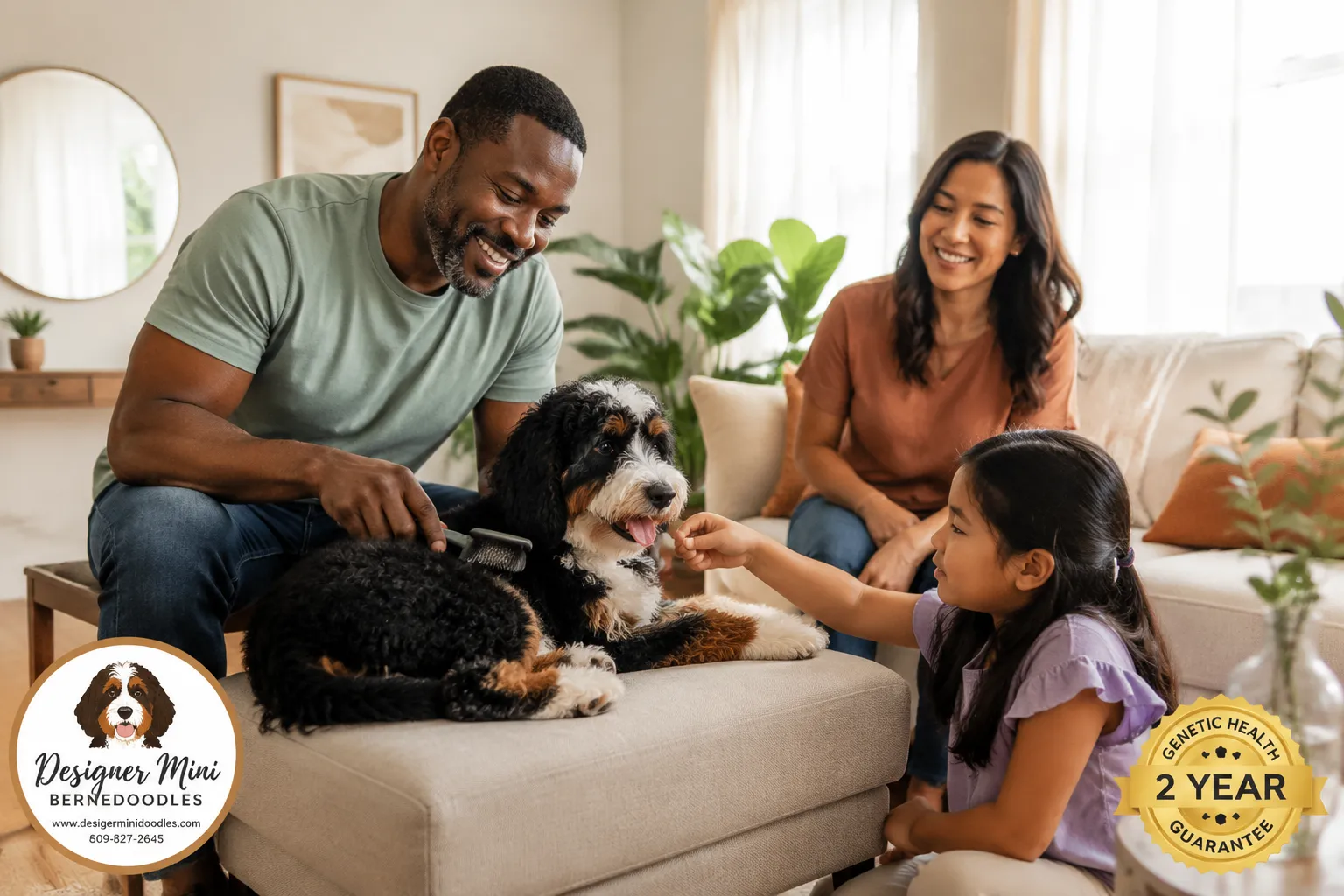
F1B Mini Bernedoodle price
Last updated: July 26, 2026
F1B Mini Bernedoodle price
An F1B Mini Bernedoodle is a backcross hybrid, produced by breeding an F1 Mini Bernedoodle (50% Bernese Mountain Dog, 50% Mini Poodle) back to a Mini Poodle. The result is roughly 75% Poodle, 25% Bernese, which typically means a curlier, lower-shedding coat, an adult weight of 20-35 pounds, a 12-17 year lifespan, and an affectionate, trainable temperament ideal for families and allergy-sensitive homes. Prices in 2026 generally run $3,000,$6,500 from reputable breeders.
F1B Mini Bernedoodle price
- F1B = an F1 Mini Bernedoodle bred back to a Mini Poodle (approximately 75% Poodle, 25% Bernese).
- Most F1B Mini Bernedoodles weigh 20-35 lb and stand 17-22 inches tall at maturity.
- Coats are usually curly and low-shedding, but “hypoallergenic” is a marketing myth, no dog is 100% allergen-free.
- Expect $3,000,$6,500 from health-tested breeders in 2026; puppy-mill pricing is a red flag.
- Grooming needs are real: brushing 3-4x/week and a professional groom every 6-8 weeks.
- Lifespan averages 12-17 years, longer than a full-size Bernedoodle thanks to the Mini Poodle influence.
- Temperament: affectionate, playful, sensitive, moderately high energy, excellent with kids when socialized early.
- Designer Doodles, run by a trained animal biologist, breeds F1B Mini Bernedoodles using ENS (Early Neurological Stimulation) and structured housebreaking, crate, and obedience foundations.
What Is an F1B Mini Bernedoodle?
An F1B Mini Bernedoodle is a second-generation crossbreed created by breeding an F1 Mini Bernedoodle (a first-generation Bernese Mountain Dog x Miniature Poodle cross) back to a purebred Miniature Poodle. The “B” stands for “backcross.” Genetically, this produces a puppy that is approximately 75% Miniature Poodle and 25% Bernese Mountain Dog.
Why does this matter? Breeders intentionally backcross to the Poodle side to:
- Tighten the coat curl, which reduces shedding and dander.
- Improve consistency in size, temperament, and appearance across a litter.
- Reduce the shedding tendency inherited from the Bernese parent.
The trade-off is that F1Bs often look less like the classic “teddy bear” tri-color Bernese and more like a curly, poodle-leaning doodle, though tri-color and phantom markings still show up frequently.
F1B Mini Bernedoodle vs F1 Mini Bernedoodle: What’s the Difference?
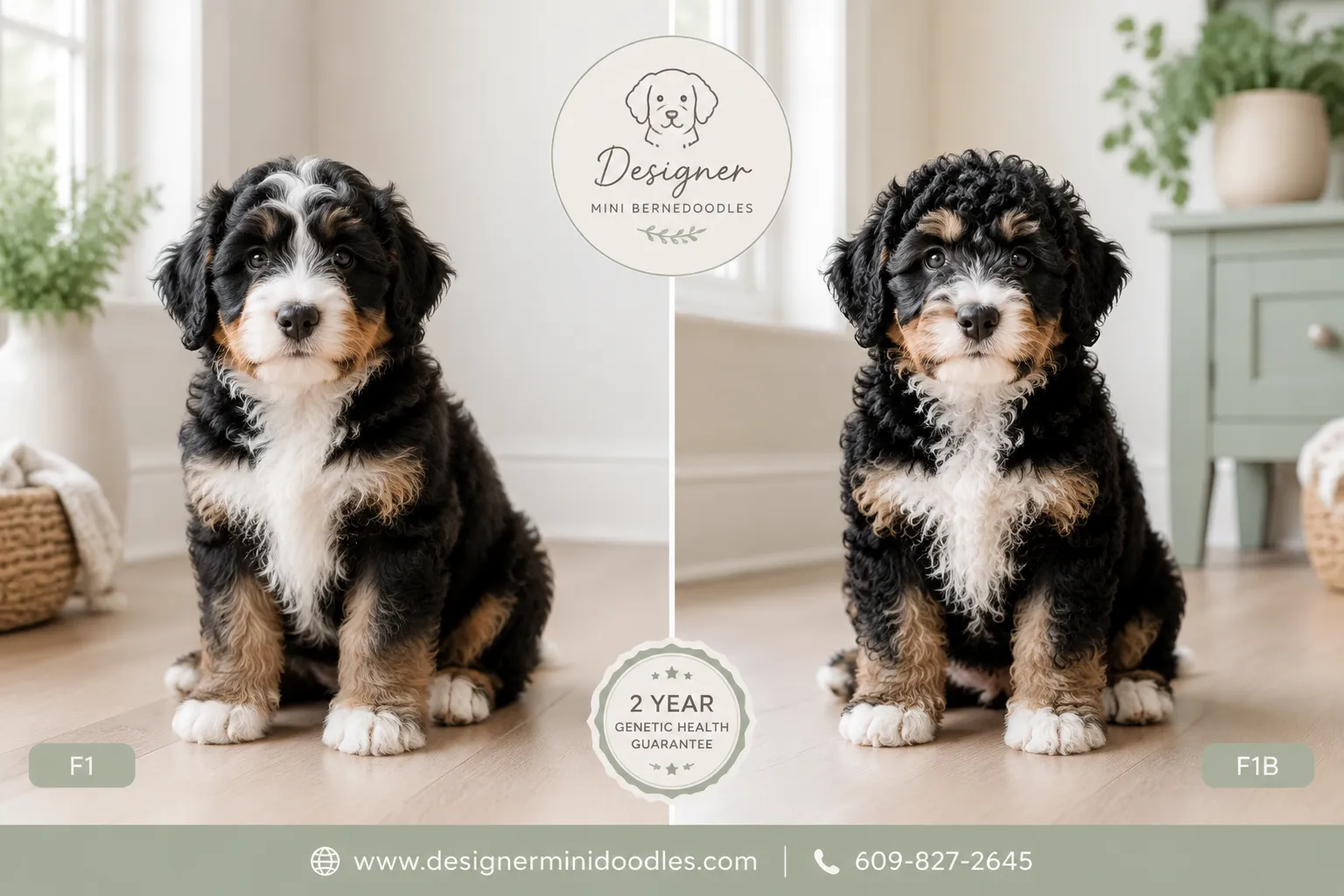
The core difference is genetics and coat behavior. An F1 is 50/50 Bernese-Poodle and tends to have a wavy, moderately shedding coat. An F1B is 75% Poodle and typically has a curlier, low-shedding coat that’s friendlier to allergy sufferers.
| Feature | F1 Mini Bernedoodle | F1B Mini Bernedoodle |
|---|---|---|
| Genetics | 50% Bernese / 50% Poodle | ~75% Poodle / 25% Bernese |
| Coat | Wavy, moderate shed | Curly, low shed |
| Allergy-friendly | Fair | Better (not guaranteed) |
| Appearance | More “Bernese-looking” | More “Poodle-looking” |
| Grooming | Every 8-10 weeks | Every 6-8 weeks |
| Price | Often lower | Often higher |
Choose F1B if shedding and allergies are your top concern. Choose F1 if you want the traditional tri-color Bernedoodle look and can tolerate light-to-moderate shedding.
F1B Mini Bernedoodle Price: How Much Do They Cost?
Expect to pay $3,000 to $6,500 for an F1B Mini Bernedoodle puppy from a reputable U.S. breeder in 2026. Rare colors (true tri-color, merle, phantom) and small “micro” sizes push prices toward the top of that range.
Pricing typically reflects:
- Health testing of the parents (OFA hips, elbows, eyes, DNA panels)
- Early socialization protocols (ENS, Puppy Culture, exposure work)
- Coat genetics testing (furnishings, curl, shedding markers)
- Vaccinations, deworming, microchipping, and vet clearance
- Breeder reputation, contracts, and health guarantees
Puppies advertised under $2,000 are almost always from puppy mills, backyard breeders, or high-volume brokers. That “deal” often turns into thousands in vet bills. If you’re comparing the mini bernedoodle price across breeders, always ask for full health documentation before wiring a deposit.
F1B Mini Bernedoodle Temperament and Personality
F1B Mini Bernedoodles are affectionate, playful, intelligent, and moderately sensitive. They inherit the Bernese’s gentle loyalty and the Poodle’s sharp mind, which makes them wonderful companions but also emotionally attuned, they don’t do well being left alone for long stretches.
Common personality traits:
- Velcro-dog affection. They want to be near their people, often following you room to room.
- Playful but not manic. Bursts of zoomies, then long naps.
- Sensitive to tone. Harsh corrections backfire; positive reinforcement works.
- Good with strangers when properly socialized as a puppy.
- Alert but not yappy. They’ll notify you of visitors but aren’t chronic barkers.
Common mistake: assuming a “mini” doodle needs less mental stimulation. They don’t. Boredom leads to chewed baseboards.
F1B Mini Bernedoodle Size: How Big Do They Get?
Most F1B Mini Bernedoodles weigh 20-35 pounds and stand 17-22 inches at the shoulder when fully grown. Final size depends heavily on the Mini Poodle parent, a smaller Poodle sire produces smaller puppies.
Size ranges you’ll see marketed:
- Micro/Tiny Mini Bernedoodle: 10-24 lb (bred down using Toy Poodle lines)
- Standard Mini Bernedoodle: 25-49 lb
- Medium Bernedoodle: 50-70 lb
Most F1Bs reach adult weight around 12 months, though the chest can continue to fill out until 18 months. For a detailed size chart, see our guide to the Mini Bernedoodle full grown.
F1B Mini Bernedoodle Shedding: Do They Shed a Lot?
F1B Mini Bernedoodles are considered low-shedding, and they’re the lowest-shedding Bernedoodle generation available. Because they’re roughly 75% Poodle, they usually inherit two copies of the “furnishings” gene and a curly coat texture that traps loose hair instead of dropping it.
That said, shedding varies puppy-to-puppy within the same litter. Coat DNA testing at birth can predict this fairly reliably. Ask your breeder for coat genetic results before choosing a puppy if allergies are a concern.
The F1B Mini Bernedoodle “Not Hypoallergenic” Myth
No dog is truly hypoallergenic, and that includes the F1B Mini Bernedoodle. What people react to isn’t fur itself, but proteins found in saliva, dander, and urine. A curly, low-shed coat traps dander close to the skin instead of releasing it into the air, which reduces symptoms for many allergy sufferers but doesn’t eliminate them.
Before committing:
- Spend time with an adult F1B (not just a puppy, puppy dander levels are lower).
- Have severely allergic family members test exposure over multiple visits.
- Ask the breeder about return policies if allergies flare.
F1B Mini Bernedoodle Health Problems: Common Issues
F1B Mini Bernedoodles benefit from hybrid vigor but can still inherit conditions from both parent breeds. The most commonly seen issues include:
- Hip and elbow dysplasia (from Bernese lineage)
- Progressive Retinal Atrophy (PRA), screenable via DNA
- Von Willebrand Disease, a bleeding disorder, screenable
- Addison’s disease (more common in Poodles)
- Ear infections, floppy, hairy ears trap moisture
- Skin allergies, often environmental or food-related
- Sebaceous adenitis (Poodle-line skin condition)
Reputable breeders health-test both parents through OFA and Embark (or Paw Print) DNA panels. Ask for documentation. If a breeder can’t produce it, walk away.
F1B Mini Bernedoodle Grooming Requirements: How Often?
Plan on brushing 3-4 times per week and a full professional groom every 6-8 weeks. Curly, low-shed coats don’t drop hair, they mat instead. Skip grooming and you’ll end up paying for a full shave-down.
A realistic grooming routine:
- Daily quick check behind ears, armpits, and collar line for tangles
- Line-brush 3-4x/week with a slicker brush and metal comb
- Bath every 3-4 weeks with dog-safe shampoo
- Professional groom every 6-8 weeks (~$85,$140 per visit)
- Ear cleaning weekly to prevent yeast infections
- Nail trim every 3-4 weeks
Budget roughly $700,$1,400 per year in grooming costs.
Are F1B Mini Bernedoodles Good for Families With Kids?
Yes, F1B Mini Bernedoodles are generally excellent family dogs. They’re patient, playful, affectionate, and sized well for households with children. Their moderate energy makes them fun playmates without being overwhelming for smaller kids.
Best practices for family homes:
- Teach children how to approach and pet the dog calmly.
- Never leave toddlers unsupervised with any dog, regardless of breed.
- Give the dog a crate or quiet room as a “safe zone.”
- Include kids in training so the dog respects them as leaders too.
F1B Mini Bernedoodle Lifespan: How Long Do They Live?
The typical F1B Mini Bernedoodle lifespan is 12 to 17 years. That’s notably longer than a purebred Bernese Mountain Dog (7-10 years), because the smaller size and Poodle genetics reduce the incidence of large-breed cancers and joint failure.
Longevity factors:
- Maintain a lean body condition (skip the extra treats)
- Feed a high-quality diet appropriate for their life stage
- Annual vet exams and dental cleanings
- Regular exercise (30-60 minutes daily)
- Mental enrichment: puzzle toys, training, sniff walks
F1B Mini Bernedoodle Training Difficulty: Are They Easy to Train?
F1B Mini Bernedoodles are highly trainable, arguably one of the easier doodles to work with because of the strong Poodle influence. Poodles rank second in canine intelligence per Stanley Coren’s rankings. Combine that with the Bernese’s people-pleasing streak and you get a puppy that wants to learn.
What works:
- Positive reinforcement (treats, praise, play)
- Short, frequent sessions (5-10 minutes, several times daily)
- Crate training from day one
- Early socialization during the 8-16 week critical window
- Consistent house rules across all family members
For a full walkthrough, see training a mini Bernedoodle puppy and our housebreaking a mini Bernedoodle puppy guide.
F1B Mini Bernedoodle vs Goldendoodle: Which Is Better?
Neither is objectively “better”, they’re built for slightly different homes. Choose an F1B Mini Bernedoodle if you want a calmer, more devoted “velcro” companion with striking tri-color potential. Choose a Mini Goldendoodle if you want a slightly more outgoing, high-energy dog for an active household.
| Trait | F1B Mini Bernedoodle | Mini Goldendoodle |
|---|---|---|
| Energy | Moderate | Moderate-High |
| Affection style | Velcro, one-person leaning | Social with everyone |
| Trainability | Very high | Very high |
| Coat | Curly, low shed | Wavy-curly, low shed |
| Colors | Tri, sable, phantom, black | Cream, apricot, red |
| Best for | Families wanting a snuggler | Active families, first-timers |
Both are exceptional family dogs. If you’re still deciding, our comparison of toy poodles vs Bernese Mountain Dogs and Mini Bernedoodles breaks down the underlying parent breeds.
Where to Buy an F1B Mini Bernedoodle: Reputable Breeders
Buy only from breeders who health-test parents, socialize puppies from birth, and provide a written health guarantee. Avoid pet stores, online marketplaces with wire-only payments, and any breeder who refuses a video call or facility tour.
Red flags to walk away from:
- No health testing documentation
- Multiple litters available year-round from many breeds
- Cash-only or wire-transfer-only payment
- No contract or health guarantee
- Puppies released before 8 weeks
- No questions asked about your home
Why Designer Doodles Is Among the Best Mini Bernedoodle Breeders in the USA
Designer Doodles is owned and operated by a trained animal biologist, which shapes every element of the program, from genetic pairing decisions to early neurological development. All breed stock comes from top-tier, health-tested bloodlines with generations of documented lineage.
What makes the program stand out:
- Early Neurological Stimulation (ENS): Puppies receive daily ENS exercises from days 3-16, a protocol shown to build stress resilience, cardiovascular strength, and confidence.
- In-home raising: Puppies grow up inside a busy family environment, exposed to vacuums, dishwashers, kids, other dogs and cats, doorbells, and normal household chaos. They arrive at your home already desensitized to the noises that overwhelm kennel-raised pups.
- Housebreaking head start: By 7-8 weeks, our puppies are on a consistent potty schedule with an introduction to indoor pads and outdoor cues.
- Crate training foundations: Every puppy is introduced to a crate with positive associations before going home, no more nights of frantic crying.
- Obedience basics: Sit, name recognition, leash introduction, and gentle handling drills are started before 8 weeks.
- Puppy Culture protocols layered on top of ENS for optimal socialization.
Explore currently available mini bernedoodle puppies for sale or breeding Mini Bernedoodle puppies from the top breeders in USA to see how the program works end-to-end.
- Display 9 Products per page


Visit us on Google Maps to see our verified listing and reviews.
Bringing Home Your F1B Mini Bernedoodle: A Practical Checklist
Before pickup day:
- Crate (30-inch with divider) placed in a quiet corner
- Puppy-safe chew toys, Kongs, Nylabones, frozen carrots
- High-quality puppy food matching what the breeder feeds
- Enzymatic cleaner for accidents (not ammonia-based)
- Slicker brush and metal comb for coat maintenance
- Veterinarian booked for a 3-day wellness check
- Pet insurance quotes gathered (enroll before day 30)
First-week priorities: potty schedule, crate routine, name recognition, and calm bonding. Skip the dog park until vaccines are complete.
FAQ
Are F1B Mini Bernedoodles hypoallergenic?
No. No dog is fully hypoallergenic. F1Bs are low-shedding and low-dander, which reduces symptoms for many allergy sufferers, but reactions vary person-to-person.
How much does an F1B Mini Bernedoodle cost in 2026?
Reputable breeders charge $3,000,$6,500. Rare colors and micro sizes cost more. Anything under $2,000 is a red flag.
How big do F1B Mini Bernedoodles get?
Most weigh 20-35 lb and stand 17-22 inches tall as adults. Micro versions can stay under 25 lb.
How long do F1B Mini Bernedoodles live?
Typically 12-17 years, longer than full-size Bernedoodles thanks to smaller stature and Poodle genetics.
Do F1B Mini Bernedoodles bark a lot?
No. They’re alert but not chronically vocal. Occasional barking at doorbells or strangers is normal.
Can F1B Mini Bernedoodles be left alone?
For short periods, yes, but they’re prone to separation anxiety. Build alone-time tolerance gradually starting in puppyhood.
Are F1B Mini Bernedoodles good apartment dogs?
Yes, if you commit to daily exercise (30-60 minutes) and mental enrichment. Their size and calm indoor demeanor suit apartments well.
What’s the best food for an F1B Mini Bernedoodle?
A high-quality small-to-medium breed puppy formula with named-meat first ingredients. Ask your breeder what they feed and transition slowly.
When should I start grooming my F1B puppy?
Introduce brushing at 8 weeks. Book the first professional groom around 4-5 months to build tolerance before the adult coat comes in.
Are F1B Mini Bernedoodles good for first-time dog owners?
Yes, their trainability and moderate energy make them one of the more forgiving doodles for beginners.
Conclusion: Is an F1B Mini Bernedoodle Right for You?
The F1B Mini Bernedoodle is one of the best-balanced companion dogs available in 2026: low-shedding, family-friendly, highly trainable, and long-lived. If you can commit to consistent grooming, daily exercise, and steady training, this hybrid will reward you with 12+ years of devoted companionship.
Next steps:
- Decide on size and coat priorities (standard mini vs micro, curly vs wavy).
- Interview 2-3 breeders, ask for health testing and references.
- Visit or video-tour the facility before placing a deposit.
- Prepare your home using the checklist above.
- Book your vet and grooming appointments before pickup day.
Ready to meet your puppy? Browse the current litters at Designer Mini Doodles and see why we’re considered the best Mini Bernedoodle breeders in the USA.
Sources
- Coren, Stanley. The Intelligence of Dogs. 2006 (rankings of Poodle intelligence).
- Orthopedic Foundation for Animals (OFA). Health testing databases for Bernese Mountain Dogs and Poodles. ofa.org
- American Kennel Club. Poodle and Bernese Mountain Dog breed standards. akc.org
- Battaglia, Carmen L. Early Neurological Stimulation (ENS) protocol. Breeding Better Dogs, 2009.