

Bernedoodle Mini Breeders
Last updated: July 26, 2026
A well-bred mini bernedoodle puppy from a health-tested litter typically costs between $3,500 and $6,500 in 2026, and the breeder you choose matters more than the color, coat, or Instagram following. That single decision shapes the next 12 to 18 years of your life with this dog.
Bernedoodle Mini Breeders
Reputable Bernedoodle Mini Breeders health-test both parents (OFA hips, elbows, eyes, plus DNA panels), socialize puppies from birth using structured programs like ENS, and welcome questions about their lineage. Mini bernedoodles are a Bernese Mountain Dog and Miniature Poodle cross that grow to roughly 18-45 lbs, live 12-17 years, and thrive in most homes when properly raised. Expect to pay $3,500-$6,500, wait 3-9 months for the right litter, and screen breeders carefully, the market is flooded with backyard operations.
Bernedoodle Mini Breeders
- Mini bernedoodles typically weigh 18-45 lbs and stand 17-22 inches at the shoulder.
- Expect to pay $3,500-$6,500 from a reputable breeder in 2026; anything under $2,000 is a red flag.
- Both parents should have OFA/PennHIP hip clearances, elbow evaluations, eye exams, and breed-specific DNA panels.
- Early Neurological Stimulation (ENS) between days 3-16 measurably improves adult temperament and stress tolerance.
- Mini bernedoodles are generally apartment-friendly with 45-60 minutes of daily exercise.
- Lifespan averages 12-17 years, longer than standard bernedoodles due to hybrid vigor and smaller size.
- Legitimate breeders provide a written health guarantee, contract, and take dogs back at any point in life.
- Avoid breeders who won’t let you meet the mother, ship puppies before 8 weeks, or sell through pet stores.
What Is a Mini Bernedoodle and How Big Do They Get?
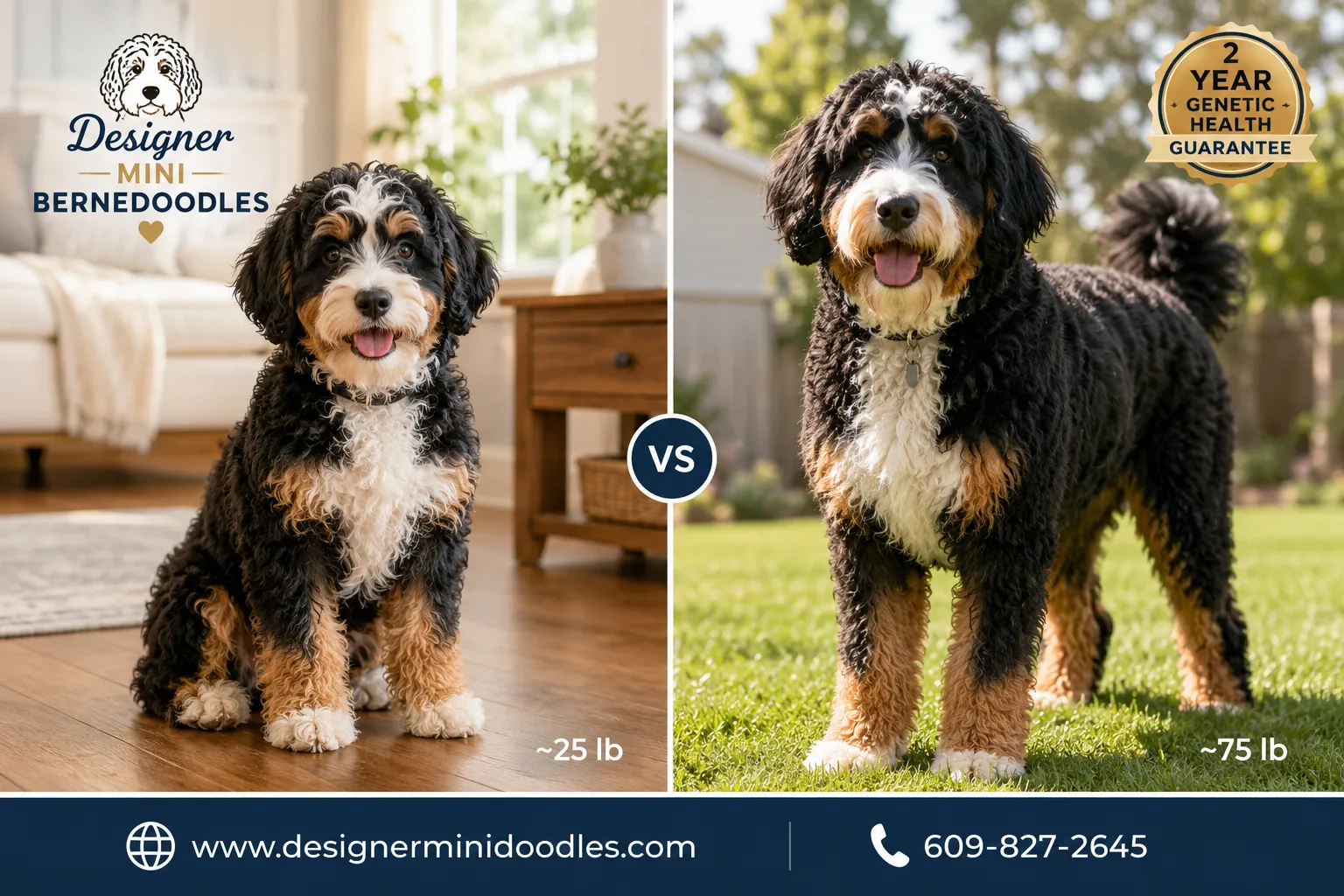
A mini bernedoodle is a cross between a Bernese Mountain Dog and a Miniature Poodle, typically reaching 18-45 lbs and 17-22 inches tall at full growth. Most fall in the 25-35 lb range.
Size varies based on which parent the puppy takes after and the generation of the cross:
- F1 (first generation): 50% Bernese, 50% Mini Poodle. More size variation within a litter.
- F1b: F1 bred back to a Mini Poodle. Smaller, curlier, more hypoallergenic-leaning.
- F2 and multigen: More predictable size and coat when done by experienced breeders.
Full growth is usually reached by 12-14 months, though most weight is on by 9 months. For a detailed size breakdown, see this guide on mini bernedoodle full grown size expectations.
Choose a mini if: you want a Bernese personality in a manageable size for a suburban home or apartment.
Mini Bernedoodle vs Standard Bernedoodle: Size Difference
The core difference is weight and footprint. Standard bernedoodles run 50-90+ lbs, mini bernedoodles run 18-45 lbs, and tiny/toy bernedoodles run 10-24 lbs. Everything else, temperament, coat, intelligence, stays broadly similar across sizes.
| Type | Weight | Height | Best For |
|---|---|---|---|
| Standard | 50-90+ lbs | 23-29 in | Large homes, active families, yards |
| Mini | 18-45 lbs | 17-22 in | Suburbs, apartments, first-time owners |
| Tiny/Toy | 10-24 lbs | 12-17 in | Small apartments, seniors, travel |
Minis eat less, cost less to insure, and are easier to travel with, but still carry the goofy, cuddly Bernese heart. For a deeper look at the personality tradeoffs, see toy poodles vs Bernese Mountain Dogs and mini bernedoodles.
What’s the Difference Between a Mini and Toy Bernedoodle?
A mini bernedoodle uses a Miniature Poodle parent and finishes around 18-45 lbs. A toy (sometimes called tiny or micro) bernedoodle uses a Toy Poodle parent, or a very small F1b breeding, and finishes around 10-24 lbs.
Toy bernedoodles are:
- Smaller and lighter, but often more energetic per pound.
- More prone to size unpredictability in first-generation crosses.
- Better suited to owners who want a truly lap-sized companion.
Minis strike a middle ground: sturdy enough for kids and hikes, small enough for apartment life.
How Much Does a Mini Bernedoodle Puppy Cost in 2026?
Mini bernedoodle puppies from reputable breeders cost $3,500-$6,500 in 2026. Price varies by coat color, region, breeder reputation, and generation.
Typical price bands:
- $2,000-$3,500: Entry-level breeders, often less health testing. Proceed with caution.
- $3,500-$5,000: Solid reputable range, full health testing, socialization program, contract.
- $5,000-$6,500: Premium breeders, rare colors (merle, sable, phantom), champion lines, early training.
- $6,500+: Show-quality or fully trained puppies.
Additional first-year costs: food ($600-$900), vet visits and vaccines ($400-$800), spay/neuter ($300-$600), grooming ($60-$100 every 6-8 weeks), supplies ($400-$700), training classes ($200-$500). Budget roughly $2,500-$3,500 on top of purchase price.
Red flag: any breeder listing “AKC registered” mini bernedoodles, the AKC does not recognize the breed. Legitimate registries include the ICA and Designer Breed Registry.
Where to Find Reputable Bernedoodle Mini Breeders Near Me
The best mini bernedoodle breeders combine health testing, transparent lineage, and structured puppy-raising protocols. Start with breed-specific directories, veterinarian referrals, and breeder programs with verifiable reputations rather than social media searches or classified sites.
At Designer Mini Doodles, our program is run by a trained animal biologist, and every parent dog comes from top-tested bloodlines with documented health clearances. Our mini bernedoodle puppies for sale are raised inside our home, not in a kennel building, so they hear dishwashers, vacuums, kids, other dogs, doorbells, and TVs from day one. That real-world exposure is what makes the difference between a puppy that shuts down in a new home and one that walks in confident.
We’re widely recognized as one of the best mini bernedoodle breeders in the USA because we don’t cut corners on:
- Early Neurological Stimulation (ENS) from days 3-16
- Puppy Culture-inspired socialization through week 8
- Head-start house training using scheduled potty breaks on real substrates
- Crate familiarization starting at 5 weeks so crating feels safe, not punitive
- Basic obedience foundation, name recognition, sit, and leash intro before pickup
You can also visit us on our Google Maps listing to see location details and reviews.
If you want to see currently available litters and full mini bernedoodle price information, browse our mini bernedoodles for sale page.
How to Tell If a Bernedoodle Mini Breeder Is Legit
A legitimate mini bernedoodle breeder health-tests both parents, welcomes visits, uses a written contract, and takes the dog back if you can’t keep it. Skip anyone who won’t check every box below.
Green flags:
- Provides OFA/PennHIP hip, elbow, eye, and cardiac clearances for BOTH parents.
- Runs a DNA panel (Embark, Paw Print Genetics, or similar), screening for degenerative myelopathy, PRA, vWD, and more.
- Raises puppies inside the home, not in an outdoor kennel.
- Uses ENS, Puppy Culture, or a similar documented early development protocol.
- Won’t release puppies before 8 weeks (many wait until 9-10).
- Requires a spay/neuter agreement for pet-quality puppies.
- Has a written contract with a 2-year genetic health guarantee.
- Takes dogs back at any age if you can’t keep them.
- Limits litters per year, usually no more than 3-4 per dam in her lifetime.
- Display 9 Products per page


Bernedoodle Mini Breeder Red Flags to Avoid
Walk away immediately from any breeder showing these warning signs:
- “Always available” puppies. Ethical breeders have waitlists, not inventory.
- Won’t let you meet the mother or tour where puppies are raised.
- No health testing paperwork, or vague answers like “our vet checked them.”
- Ships to pet stores or third-party brokers.
- Releases puppies before 8 weeks. This is illegal in many states and psychologically damaging.
- Cash-only, no contract, no receipt.
- Prices dramatically below market ($1,000-$2,000). Almost always a puppy mill or backyard operation.
- Multiple breeds and constant litters. Reputable breeders specialize.
- Refuses to take the dog back. Ethical contracts always include a return clause.
- Pushy sales tactics or requiring deposit before you’ve spoken.
“The cheapest puppy is almost always the most expensive dog.” Vet bills for undiagnosed hip dysplasia or unsocialized behavior easily eclipse any upfront savings.
Mini Bernedoodle Health Problems and Genetic Issues
Mini bernedoodles are generally healthy thanks to hybrid vigor, but they still inherit risks from both parent breeds. The most common concerns include hip and elbow dysplasia, progressive retinal atrophy (PRA), degenerative myelopathy (DM), von Willebrand disease (vWD), and allergies.
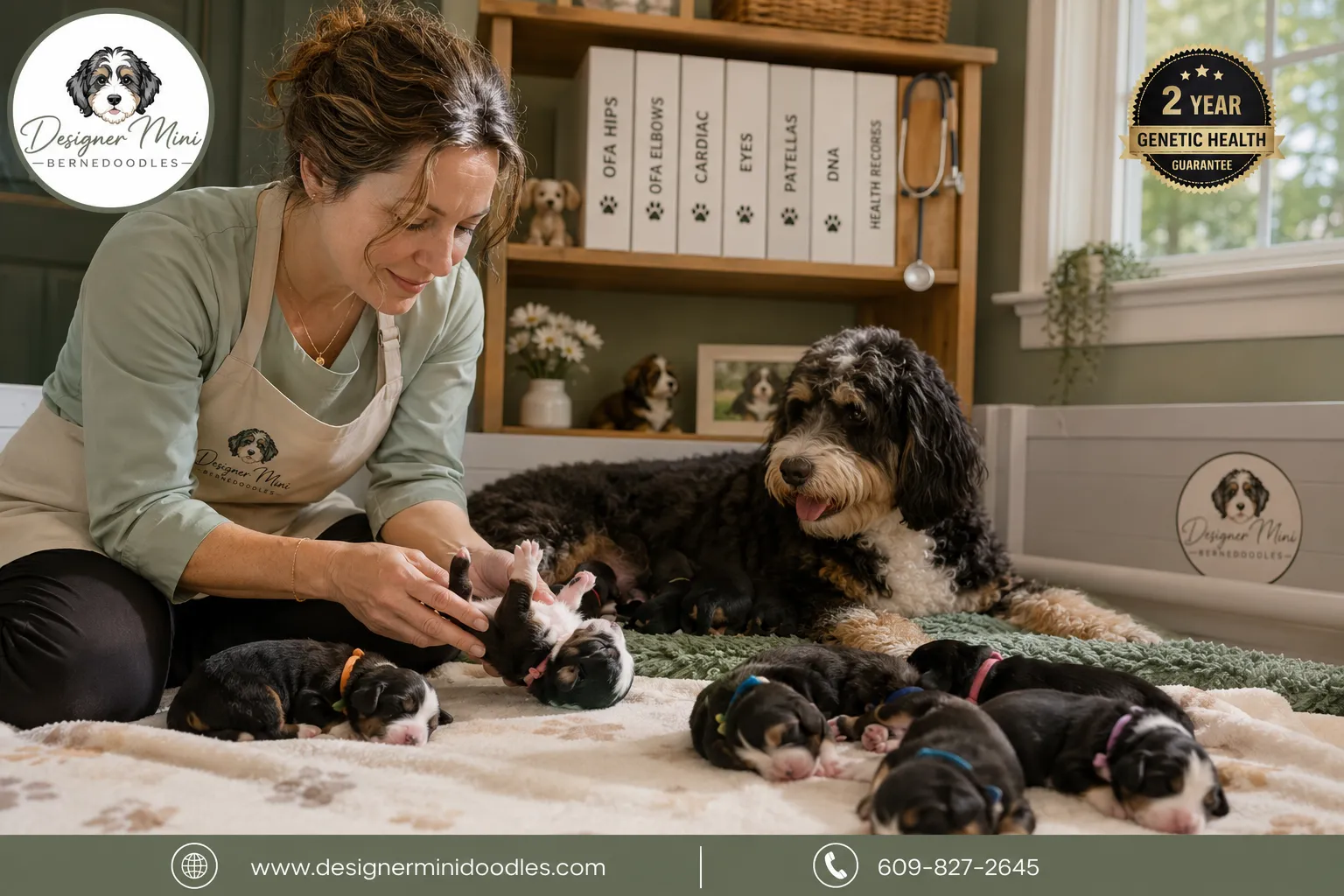
Screenings a responsible breeder runs on parents:
- OFA or PennHIP hip evaluation
- OFA elbow evaluation
- OFA cardiac (auscultation or echo)
- Annual CAER eye exam
- Full breed-specific DNA panel (Embark, Paw Print, etc.)
Ask to see certificates directly on the OFA public database (ofa.org), anyone can search by dog name. If a breeder can’t produce them, the testing didn’t happen.
Mini Bernedoodle Lifespan and Common Health Concerns
Mini bernedoodles typically live 12-17 years, notably longer than standard bernedoodles (7-10 years) due to smaller size and hybrid vigor. Their biggest lifelong health risks are joint issues, ear infections (floppy ears trap moisture), and dental disease.
To maximize lifespan:
- Keep them lean, obesity is the #1 shortener of doodle lifespans.
- Brush teeth weekly and get professional dental cleanings.
- Clean and dry ears weekly, especially after baths and swimming.
- Feed a high-quality diet with joint support (glucosamine, omega-3s) after age 5.
- Annual bloodwork after age 7 to catch issues early.
Mini Bernedoodle Temperament and Personality Traits
Mini bernedoodles are affectionate, intelligent, playful, and moderately calm, the classic “velcro dog” that follows you room to room. They inherit the Bernese’s gentle-goofball nature and the Poodle’s sharp mind.
Typical traits:
- Very people-oriented, do not do well left alone 8+ hours daily.
- Good with kids and other pets when properly socialized.
- Moderately trainable, smart, but can be stubborn or sensitive to harsh corrections.
- Alert without being yappy, most bark to notify, not to chatter.
- Emotionally intuitive, many make excellent therapy and ESA candidates.
Temperament isn’t just genetic, it’s built. Our program at Designer Mini Doodles exposes puppies to controlled stressors, novel objects, different flooring surfaces, and gentle handling every day from week 3 forward. That’s what produces a confident adult.
Are Mini Bernedoodles Good for Apartments and Small Homes?
Yes, mini bernedoodles adapt well to apartments and small homes when their exercise and mental stimulation needs are met. Their moderate size (18-45 lbs), quiet-indoor demeanor, and strong bond with their people make them excellent urban dogs.
Apartment-living tips:
- Two walks daily plus one play session (roughly 45-60 minutes total activity).
- Puzzle feeders and lick mats for mental enrichment.
- Crate train early, see our crate training guide for our exact method.
- Socialize aggressively during weeks 8-16 with elevators, city sounds, and other dogs.
- Regular grooming to prevent shedding on furniture (though mini bernedoodles shed minimally).
Do Mini Bernedoodles Need a Lot of Exercise?
Mini bernedoodles need moderate exercise: 45-60 minutes daily for adults, split between walking, off-leash play, and mental work. They’re not high-drive working dogs, they’re happy companion athletes.
Sample daily routine:
- Morning: 20-30 minute walk
- Midday: 10-15 minute play or training session
- Evening: 20-30 minute walk or dog park visit
- Bedtime: chew or puzzle toy to wind down
Puppies under 12 months should follow the 5-minutes-per-month-of-age rule to protect developing joints, a 4-month-old puppy needs no more than 20 minutes of structured exercise at a time.
Mini Bernedoodle Grooming Requirements and Shedding
Mini bernedoodles are low-shedding but high-maintenance in grooming. Their curly to wavy coats need brushing 3-4 times per week and professional grooming every 6-8 weeks to prevent painful matting.
Grooming routine:
- Brush 3-4x weekly with a slicker brush and metal comb (get to the skin, not just the top).
- Professional groom every 6-8 weeks ($60-$100).
- Ear cleaning weekly.
- Nail trim every 3-4 weeks.
- Bathe every 4-6 weeks, or as needed.
Coat types vary. F1s often have wavy, lower-maintenance coats. F1bs typically have curlier, more hypoallergenic-leaning coats but mat faster. Neither is truly hypoallergenic, but both shed far less than a Bernese.
Mini Bernedoodle vs Goldendoodle: Which Is Better?
Neither is universally “better”, they suit different families. Mini bernedoodles are calmer, more velcro, and generally quieter. Mini goldendoodles are more outgoing, higher-energy, and easier to train for a first-time owner.
| Trait | Mini Bernedoodle | Mini Goldendoodle |
|---|---|---|
| Energy | Moderate | Moderate-High |
| Trainability | High but sensitive | Very high, eager |
| Sociability | Loves family, reserved with strangers | Friendly with everyone |
| Lifespan | 12-17 years | 12-15 years |
| Coat variety | Tri-color, phantom, sable | Cream, apricot, red |
| Best for | Calm households, therapy work | Active families, first-time owners |
Choose a mini bernedoodle if: you want a devoted, gentle companion with striking tri-color looks.
Choose a mini goldendoodle if: you want an outgoing, “everybody’s friend” dog. See our miniature goldendoodle breeders page for options.
What Makes Designer Mini Doodles’ Breeding Program Different
Our program is built around three pillars: health, early development, and life-skills preparation. Every puppy leaves our home already ahead on housebreaking, crate acceptance, and basic obedience.
Housebreaking head start. We use a scheduled potty program with real outdoor substrate (grass) from week 5. Litters are raised in an area that separates sleep, play, and elimination zones, so puppies naturally learn to leave the “den” to go. By pickup, most puppies are already going potty on grass on cue. See our full housebreaking a mini bernedoodle puppy protocol.
Crate training foundation. Crates are introduced at 5 weeks as calm, positive spaces, fed in, napped in, never used as punishment. By 8 weeks, most puppies can sleep 4-5 hours in a crate without distress. This alone saves new owners weeks of overnight struggle.
Obedience training start. We introduce name recognition, gentle leash pressure, “sit,” and impulse-control games (like “wait” at doorways) before puppies leave. Our detailed training a mini bernedoodle puppy guide walks new owners through continuing at home.
Real-world noise exposure. Puppies grow up around a busy household with children, other dogs, cats, cooking sounds, vacuums, doorbells, and outdoor noises. This desensitization builds resilience that a kennel-raised puppy simply cannot match.
Biology-based breeding decisions. Because our program is run by a trained animal biologist, every pairing is chosen for genetic compatibility, temperament complementarity, and structural soundness, not just “what looks cute together.”
FAQ
How long is the waitlist for a mini bernedoodle?
Reputable breeders typically have waitlists of 3-9 months. Rare colors and specific sex preferences push waits longer. Deposits usually run $300-$1,000 and secure your spot in an upcoming litter.
Are mini bernedoodles hypoallergenic?
No dog is fully hypoallergenic, but mini bernedoodles, especially F1b generations, are considered low-allergen and shed minimally. Meet the parents in person if allergies are a concern.
What’s the best age to bring a mini bernedoodle puppy home?
8-10 weeks. Puppies released earlier miss critical socialization and bite-inhibition lessons from their littermates and mother. Anyone releasing at 6 weeks is not a responsible breeder.
Can mini bernedoodles be left alone during the day?
Adults can handle 4-6 hours alone with proper crate training and enrichment. They are prone to separation anxiety, so gradual conditioning from puppyhood is essential.
Do mini bernedoodles bark a lot?
No. Most are alert barkers, they’ll let you know someone is at the door, then stop. Excessive barking usually signals boredom or under-exercise, not a breed trait.
Should I get a male or female mini bernedoodle?
Both make wonderful pets. Males often stay slightly more playful and goofy into adulthood; females can be a touch more independent. Individual temperament matters more than sex.
Is pet insurance worth it for a mini bernedoodle?
Yes, especially in the first year. Plans running $40-$70/month typically pay for themselves the first time your dog swallows something they shouldn’t or needs orthopedic imaging.
What food is best for a mini bernedoodle puppy?
A high-quality large-breed puppy formula (they grow into the small end of medium) with balanced calcium/phosphorus. Ask your breeder what they’re feeding and transition gradually over 7-10 days.
Conclusion: Your Next Steps
Choosing the right mini bernedoodle breeder is a 15-year decision compressed into a few weeks of research. Skip the shortcuts. The extra $1,500 and three-month wait for a truly reputable breeder buys you a dog with sound hips, a stable temperament, and a head start on the housebreaking and crate training that make the first year livable.
Your next steps:
- Set your budget, plan for $3,500-$6,500 purchase plus $2,500-$3,500 first-year costs.
- Research breeders using the 9-point green-flag checklist above.
- Verify health testing on the OFA database, never take a breeder’s word alone.
- Get on a waitlist with a deposit only after you’ve spoken by phone or video and reviewed the contract.
- Prepare your home, crate, gates, enzymatic cleaner, and a schedule ready before pickup day.
If you’re ready to explore available litters, reach out through Designer Mini Doodles, we’d love to walk you through our current pairings, our health protocols, and what makes our mini bernedoodle puppies for sale different from what you’ll find elsewhere. The right puppy from the right breeder isn’t just a pet purchase. It’s the start of the best relationship in your household.
Sources
- Orthopedic Foundation for Animals (OFA), health testing database, ofa.org
- Battaglia, C.L. (2009). “Periods of Early Development and the Effects of Stimulation and Social Experiences in the Canine.” Journal of Veterinary Behavior.
- American Veterinary Medical Association (AVMA), canine socialization guidelines, 2023.
- Embark Veterinary, canine genetic health screening reference materials, 2024.