

Last updated: July 26, 2026
Mini Bernese Mountain Dog Breeder
A Mini Bernese Mountain Dog Breeder produces smaller versions of the classic Bernese Mountain Dog, typically 25-50 pounds, by crossing standard Berners with Miniature Poodles, Cavaliers, or smaller Bernese lines. Reputable breeders health-test parents, socialize puppies from birth using ENS (Early Neurological Stimulation), and charge $2,500-$5,500 per puppy. Expect a 2-6 month waitlist from top breeders like Designer Doodles, which is run by a trained animal biologist and produces some of the best Mini Bernedoodles in the USA.
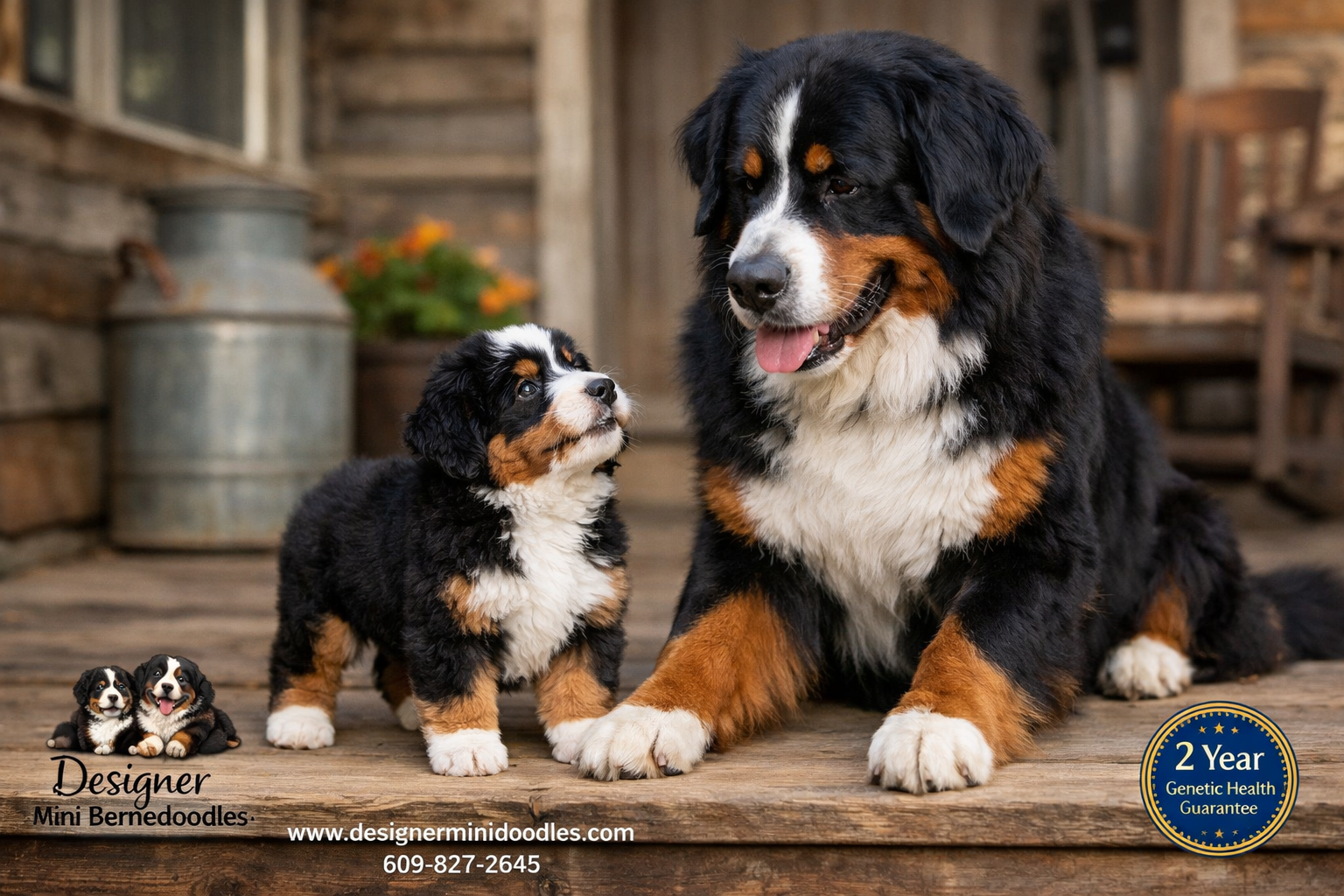
Mini Bernese Mountain Dog Breeder
- True “Mini Bernese Mountain Dogs” are almost always Mini Bernedoodles (Bernese x Mini Poodle), the AKC does not recognize a purebred miniature Berner.
- Expect to pay $2,500-$5,500 for a well-bred mini, with health testing, ENS, and early training included.
- Adult size ranges from 25-50 lbs, with a lifespan of 12-16 years, significantly longer than a standard Berner.
- Reputable breeders screen for hip dysplasia, elbow dysplasia, DM, PRA, and vWD before breeding.
- Red flags: no health testing, multiple litters available immediately, no video calls, and prices under $1,500.
- Designer Doodles is run by a real animal biologist and produces top-bloodline mini Bernedoodles that are well started on housebreaking, crate training, and ENS from birth.
- Grooming is moderate to high, most minis have wavy/curly coats needing brushing 2-3x per week and grooming every 6-8 weeks.
What Is a Mini Bernese Mountain Dog?
A Mini Bernese Mountain Dog is a smaller version of the traditional Bernese Mountain Dog, typically produced by crossing a purebred Berner with a Miniature Poodle (creating a Mini Bernedoodle) or, less commonly, by selectively breeding smaller-line Bernese together. The goal is to preserve the classic tri-color coat, gentle temperament, and family-dog personality of the Berner in a body that fits modern homes and lives longer.
Most “mini Bernese” you’ll see advertised are actually F1 or F1b Mini Bernedoodles. That’s not a downside, the Poodle cross often reduces shedding, extends lifespan, and softens some of the health issues that shorten a standard Berner’s life to just 7-8 years.
If you want the look and heart of a Berner without the 90-pound body or heartbreakingly short lifespan, a mini is the practical answer.
Mini Bernese Mountain Dog vs Standard Bernese: Key Differences
The short answer: a mini is roughly one-third the weight, lives nearly twice as long, and sheds less. Everything else, the tri-color coat, the affectionate personality, the loyalty, stays largely the same.
| Trait | Standard Bernese | Mini Bernese / Mini Bernedoodle |
|---|---|---|
| Weight | 70-115 lbs | 25-50 lbs |
| Height | 23-27 in | 18-22 in |
| Lifespan | 7-10 years | 12-16 years |
| Shedding | Heavy | Low to moderate |
| Exercise needs | Moderate | Moderate |
| Apartment friendly | No | Often yes |
| Price range | $2,000-$4,000 | $2,500-$5,500 |
Choose a standard Berner if: you have acreage, don’t mind heavy shedding, and want the traditional look at full scale.
Choose a mini if: you live in a smaller home, want a longer-lived dog, or need a lower-shedding coat for mild allergies.
How Much Does a Mini Bernese Mountain Dog Cost?
Expect to pay $2,500 to $5,500 for a puppy from a reputable Mini Bernese Mountain Dog breeder in 2026. The mini bernedoodle price depends on coat color, size, generation (F1 vs F1b), and the breeder’s health testing and training program.
Here’s the honest breakdown:
- $1,000-$1,800: Backyard breeders. Usually no health testing, no early socialization, high risk of medical issues.
- $2,500-$3,800: Solid mid-range breeders with OFA-tested parents and basic socialization.
- $3,800-$5,500: Top-tier breeders with full genetic panels, ENS programs, early crate/potty training, and champion bloodlines.
- $5,500+: Rare colors (phantom, merle, sable) or micro sizes under 25 lbs.
Programs like Designer Doodles’ mini Bernedoodle breeding sit in the premium tier because the puppies arrive already started on housebreaking and crate work, which saves you weeks of frustration at home.
What’s Included in the Mini Bernedoodle Puppy Price?
A fair mini bernedoodle price should include far more than just the dog. When you’re paying $3,000+, you should expect:
- Age-appropriate vaccinations (typically 2 rounds by 8 weeks)
- Deworming schedule complete
- Microchip registered to you
- Vet health certificate dated within 7 days of pickup
- Written health guarantee (usually 1-2 years for genetic conditions)
- Parent health test results (OFA, PennHIP, genetic panel)
- Starter kit: food, blanket with mom’s scent, toy, training notes
- Lifetime breeder support
At Designer Doodles, every puppy also comes started on crate training, potty training basics, and early obedience cues, because a well-adjusted 8-week-old is worth more than a “blank slate” puppy that hasn’t seen a crate or heard a doorbell.
How to Find a Reputable Mini Bernese Mountain Dog Breeder
Start with breeders who health-test both parents, welcome video calls, and can name every dog in their program by pedigree. Avoid anyone selling multiple breeds through Craigslist or pet stores.
A reputable Mini Bernese Mountain Dog breeder will:
- Publish health testing results on OFA.org or through Embark/Paw Print Genetics.
- Have a waitlist. Good breeders rarely have “puppies available right now.”
- Interview you. Expect an application and questions about your home, work schedule, and yard.
- Show you the mom (and often the dad) via video or in person.
- Provide a written contract with health guarantee and return clause.
- Follow ethical breeding limits, no more than 3-4 litters per year from one dam.
Designer Doodles is run by a real animal biologist, and every breeding decision is grounded in genetics, not aesthetics. All breed stock comes from top verified bloodlines, and the breeding program is deliberately small so each litter gets full attention.
Explore the available mini Bernedoodle puppies for sale or check the Designer Doodles Google Maps listing for verified reviews.
Mini Bernese Mountain Dog Breeder Red Flags to Avoid
If any of these appear, walk away. Fast.
- No health testing or vague answers like “the parents seem healthy.”
- Multiple litters available immediately with no waitlist.
- Won’t do a video call or show you the mother dog.
- Meeting in a parking lot to hand off the puppy.
- Prices dramatically below market ($800-$1,500 for a “purebred mini Berner”).
- No written contract or refuses a health guarantee.
- Pushes crypto, wire transfer, or gift-card payment.
- Multiple breeds listed on one site, often a puppy mill front.
- Puppy is ready before 8 weeks old. Any breeder releasing puppies at 6 weeks is cutting corners.
- No mention of ENS, socialization, or early training.
How to Tell if a Mini Bernese Breeder Is Legitimate
The fastest verification: ask for OFA numbers on both parents and check them yourself at ofa.org. A legitimate breeder will hand these over without hesitation. If they hedge or say “our vet cleared them,” that’s not the same as certified testing.
A quick legitimacy checklist:
- Verifiable business address (not just a P.O. box)
- OFA/PennHIP hip and elbow certifications on both parents
- Genetic panel through Embark, Paw Print, or Wisdom Panel
- Active social media with real puppy videos (not just stock photos)
- References from previous puppy families
- USDA license (if required in their state)
- AKC or reputable club membership where applicable
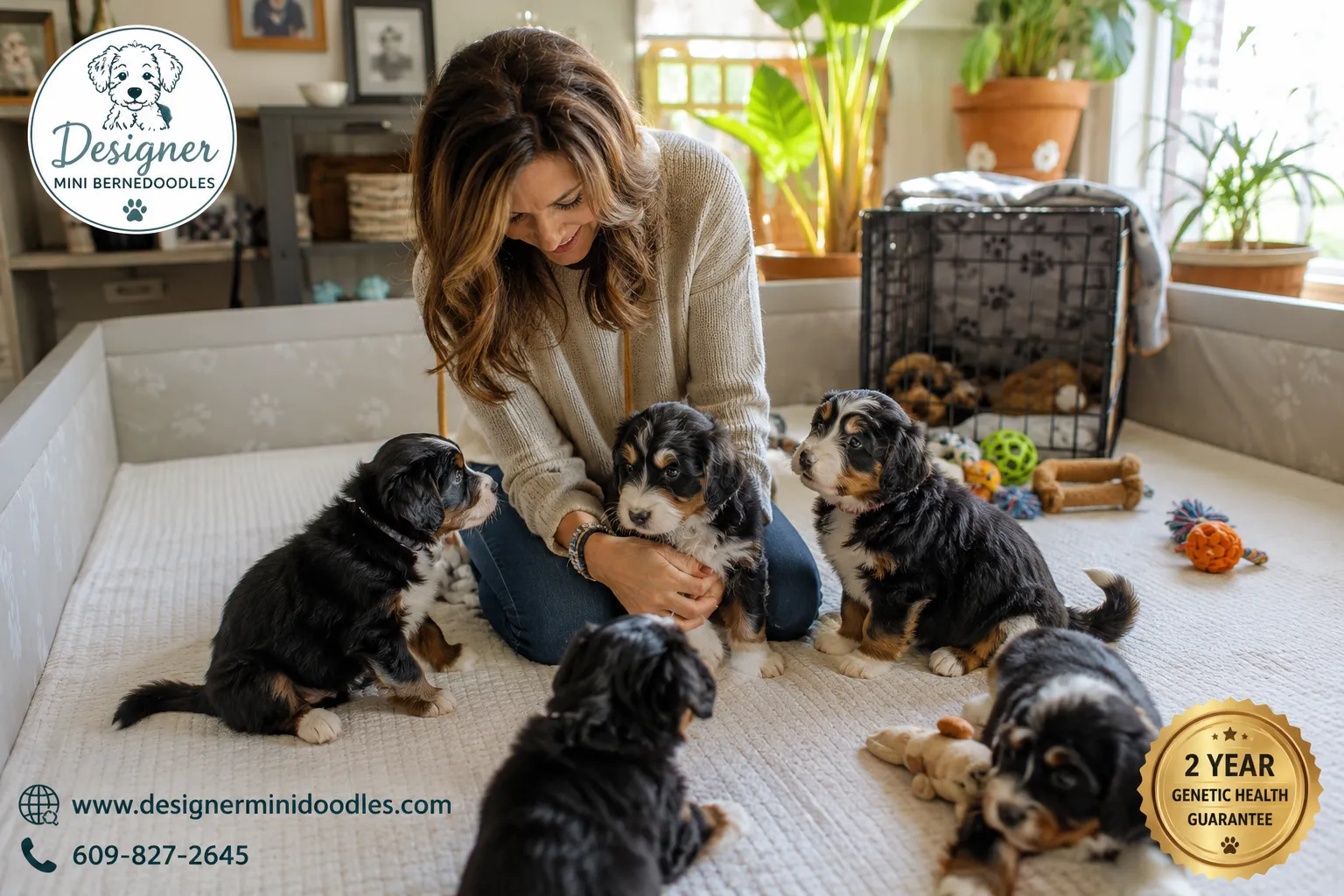
Designer Doodles: Why We’re the Best Mini Bernedoodle Breeders in the USA
Designer Doodles isn’t a hobby operation, it’s a program designed by a credentialed animal biologist who applies real developmental science to every stage of a puppy’s first eight weeks. That’s the difference between a puppy that thrives and one that struggles.
Our breeding stock comes from top verified bloodlines, health-tested for hip and elbow dysplasia, degenerative myelopathy, PRA, and von Willebrand’s disease. We keep our program intentionally small so every dam is treated like family, not livestock.
Our early puppy development includes:
- ENS (Early Neurological Stimulation) from days 3-16, which measurably improves stress tolerance, cardiovascular health, and problem-solving later in life.
- Exposure to household noise, vacuums, doorbells, kids yelling, other dogs barking, TV, kitchen clatter.
- Multi-species socialization with cats, chickens, and other dogs on our property.
- Handling by children of all ages so puppies bond quickly with families.
- Started housebreaking using potty pads and outdoor cues by 6 weeks.
- Crate training foundations, puppies nap in crates from 5 weeks so pickup night isn’t traumatic.
- Basic obedience cues, sit, name recognition, and gentle leash introduction.
You can browse mini Bernedoodle puppies for sale and see exactly what our program produces. For deeper reading on training a mini Bernedoodle puppy once you bring them home, we’ve published a full guide.
Mini Bernese Mountain Dog Health Problems
Minis are generally healthier than standard Berners, but they still inherit some breed-specific risks. Responsible testing dramatically reduces the odds.
Common concerns to screen for:
- Hip and elbow dysplasia, OFA or PennHIP certified parents cut risk sharply.
- Degenerative myelopathy (DM), a genetic test rules this out entirely.
- Progressive retinal atrophy (PRA), genetic panel screens for it.
- Von Willebrand’s disease (vWD), bleeding disorder, testable.
- Sebaceous adenitis, skin condition seen in Poodles and Berners.
- Bloat/GDV, feed twice daily, avoid exercise immediately after meals.
- Cancer, historically the biggest killer in standard Berners; hybrid vigor in mini Bernedoodles appears to reduce incidence, though data is still emerging.
Ask any mini Bernese Mountain Dog breeder for written proof of every one of these tests on both parents.
Mini Bernese Mountain Dog Temperament and Personality
Minis inherit the classic Berner personality: gentle, affectionate, loyal to their family, and calm indoors. The Poodle influence in Mini Bernedoodles adds intelligence and playfulness without making them hyper.
Personality highlights:
- Family-first. They bond deeply and prefer being wherever their people are.
- Great with kids. Patient, tolerant, and rarely reactive.
- Moderate energy. A daily 30-45 minute walk plus play is usually enough.
- Trainable. Poodle intelligence makes them quick learners, housebreaking is often done by 12-14 weeks with consistency.
- Mild separation anxiety risk. They love company; long workdays alone can be tough.
- Not big barkers. They’ll alert but aren’t nuisance barkers.
For a broader personality comparison, our guide on toy Poodles vs Bernese Mountain Dogs and Mini Bernedoodles breaks down exactly what to expect at each size.
Are Mini Bernese Mountain Dogs Good for Apartments?
Yes, mini Bernese Mountain Dogs (especially Mini Bernedoodles under 40 lbs) adapt well to apartments, provided they get one solid walk plus play daily. They’re quiet indoors, rarely nuisance-bark, and are content to nap beside you for hours.
Apartment suitability at a glance:
- Under 35 lbs: Excellent apartment dog.
- 35-50 lbs: Fine with elevator access and a nearby park.
- 50+ lbs: Better suited to a house with a small yard.
The bigger question isn’t square footage, it’s your schedule. Any mini will struggle if left alone 10+ hours a day, regardless of home size.
Mini Bernese Mountain Dog Lifespan and Size
Adult minis typically reach 18-22 inches at the shoulder and weigh 25-50 pounds, with a lifespan of 12-16 years. That’s nearly double the 7-10 year lifespan of a standard Bernese Mountain Dog, one of the biggest reasons families choose the mini version.
Growth timeline:
- 8 weeks: 6-10 lbs
- 6 months: 60-70% of adult weight
- 12 months: Nearly full height, still filling out
- 18-24 months: Full adult size and coat
For detailed size expectations, our Mini Bernedoodle full grown size guide has weight charts by generation.
Mini Bernese Mountain Dog Grooming Requirements
Plan on brushing 2-3 times per week and a professional groom every 6-8 weeks. Most Mini Bernedoodles have a wavy or curly coat that mats easily if neglected.
Grooming essentials:
- Slicker brush and metal comb
- Weekly ear cleaning (floppy ears trap moisture)
- Nail trim every 3-4 weeks
- Bath every 4-6 weeks
- Professional grooming: $65-$110 per visit
- Face and paw trims between full grooms
Straight-coated F1 minis shed a bit and need less trimming; curly F1b minis shed almost nothing but mat faster. Neither coat is truly “wash and wear.”
Do Mini Bernese Mountain Dogs Shed a Lot?
Mini Bernedoodles shed significantly less than standard Berners, but not zero. F1b generations (75% Poodle) shed the least and are best for mild allergy households. F1 generations (50/50) shed lightly but consistently.
Shedding by coat type:
- Curly (F1b): Very low shedding, best for allergies.
- Wavy (F1): Low to moderate shedding.
- Straight (F1): Moderate shedding, closest to a Berner.
No dog is 100% hypoallergenic, allergies are triggered by dander and saliva, not just hair. Spend time with an adult mini before assuming you’ll be symptom-free.
Mini Bernese Mountain Dog vs Other Small Dog Breeds
If you’re comparing a mini Bernese to other small companion breeds, here’s the honest comparison:
- vs Cavalier King Charles Spaniel: Mini Bernese is larger, healthier long-term, and more trainable.
- vs Cockapoo: Similar temperament, but minis have the distinctive tri-color coat and slightly calmer energy.
- vs Mini Goldendoodle: Both wonderful family dogs, Goldendoodles tend to be more outgoing and social, minis are more reserved and cuddly. Explore Mini Goldendoodle breeders if you want that comparison.
- vs Cavapoo: Cavapoos are smaller (10-20 lbs) and better for tiny apartments; minis are more robust family dogs.
- vs French Bulldog: Minis have far fewer health issues and much longer lifespans.
Housebreaking, Crate Training, and Obedience: The Designer Doodles Approach
Most breeders send you home with a puppy that has never seen a crate or a leash. We do the opposite. By the time your Mini Bernedoodle arrives, it has already:
Started housebreaking. From 5 weeks, our puppies are introduced to a designated potty area with consistent cues. Most go home understanding “outside” and “potty” as trigger words. For continuing at home, our housebreaking a mini Bernedoodle puppy guide walks through the first 30 days.
Started crate training. Puppies nap in open crates from week 5 and sleep with siblings in crates by week 7. Pickup night is dramatically calmer because the crate already smells like safety.
Started basic obedience. Name recognition, “sit,” gentle leash pressure, and handler focus are introduced in short 2-3 minute sessions. Puppies bond faster and correct faster when they’ve had this foundation.
Been exposed to real life. Vacuums, doorbells, kids, other dogs, cats, chickens, cars, nothing on your first walk should be shocking to them.
FAQ
How much is a mini Bernese Mountain Dog puppy?
A well-bred mini Bernese Mountain Dog puppy costs $2,500-$5,500 in 2026, depending on breeder reputation, health testing, coat, and training level.
Is a Mini Bernedoodle the same as a mini Bernese Mountain Dog?
Yes, most dogs sold as “mini Bernese Mountain Dogs” are actually Mini Bernedoodles (Bernese x Mini Poodle). The AKC does not recognize a purebred miniature Bernese.
How long do mini Bernese Mountain Dogs live?
Typically 12-16 years, nearly double the lifespan of a standard Bernese Mountain Dog.
Are mini Bernese Mountain Dogs hypoallergenic?
Low-shedding, especially F1b generations, but no dog is fully hypoallergenic. Spend time with one before committing if you have allergies.
How big does a mini Bernese Mountain Dog get?
Adults weigh 25-50 pounds and stand 18-22 inches tall.
Do mini Bernese Mountain Dogs bark a lot?
No. They’re alert but not nuisance barkers, making them suitable for apartments and close neighborhoods.
How often should I groom a Mini Bernedoodle?
Brush 2-3 times per week and schedule a professional groom every 6-8 weeks.
What’s the difference between F1 and F1b mini Bernedoodles?
F1 is 50% Bernese and 50% Mini Poodle, moderate shedding, more Berner look. F1b is 25% Bernese and 75% Poodle, curlier coat, lower shedding, better for allergies.
Can I get a Mini Bernedoodle without a waitlist?
Rarely from a reputable breeder. Waitlists of 2-6 months are normal and a sign of quality.
What food is best for a mini Bernese Mountain Dog puppy?
A high-quality puppy formula from brands like Purina Pro Plan, Royal Canin, or Hill’s Science Diet. Your breeder should send you home with the exact food they’ve been using.
Conclusion: Your Next Steps
A Mini Bernese Mountain Dog gives you the heart of a Berner in a body built for modern life, smaller, longer-lived, and lower-shedding. But everything hinges on the breeder. A well-bred mini from an ethical program is a 14-year joy; a poorly bred one from a puppy mill is a decade of vet bills and heartbreak.
Your next steps:
- Set a realistic budget, $2,500-$5,500 for a properly bred puppy.
- Vet the breeder, verify OFA results, ask for video calls, read reviews.
- Join a waitlist, the best breeders don’t have puppies sitting around.
- Prep your home, crate, gates, chew toys, and a vet booked before pickup day.
- Explore Designer Doodles, our animal-biologist-led program, top bloodlines, and ENS-based early development produce some of the best mini Bernedoodles in the USA.
Ready to meet your next family member? Browse currently available mini Bernedoodle puppies for sale or contact us to join the waitlist. Do it right the first time, you’ll have 14 great years to be glad you did.
Sources
- OFA (Orthopedic Foundation for Animals) health testing database, 2025, ofa.org
- AKC Bernese Mountain Dog breed standard, 2024, akc.org
- Battaglia, Carmen. “Early Neurological Stimulation.” Breeding Better Dogs, 2009.
- Embark Veterinary genetic testing panels, 2025, embarkvet.com