

Last updated: August 9, 2026
mini golden doodles near by
Searching for mini golden doodles near by usually turns up three very different types of sellers: scam listings priced at $500,$1,000, high-volume puppy mills at $1,000,$1,500, and accredited breeders with genetic health guarantees at $2,500,$4,500. A mini Goldendoodle is a Golden Retriever crossed with a Miniature or Toy Poodle, typically 15-35 pounds and 13-20 inches tall. The safest approach is to prioritize the breeder’s health testing, socialization protocol, and early training over geographic distance, because shipping or a short flight costs far less than treating a preventable genetic condition.
mini golden doodles near by
- A mini Goldendoodle stands roughly 13-20 inches tall and weighs 15-35 pounds, compared with 45-75 pounds for a standard Goldendoodle.
- Price is the loudest warning signal. Anything under $1,200 for a “purebred, health-tested, vaccinated” mini doodle should be treated as suspect.
- Distance matters less than documentation. Ask for parent health-testing records (hips, elbows, eyes, PRA, vWD, DM) before you ask for a video.
- Mini Goldendoodles are low-shedding, not non-shedding, and they need brushing 3-4 times weekly plus professional grooming every 6-8 weeks.
- They adapt well to apartments if they get 45-60 minutes of daily exercise and mental enrichment.
- Compared with a Cockapoo, mini Goldendoodles are usually slightly larger, more biddable for training, and more retriever-driven in play.
- Early Neurological Stimulation (ENS), household noise exposure, and started crate/potty routines produce a measurably easier first month at home.
- Goldendoodle-specific rescues exist in most regions; expect $300,$700 adoption fees and mostly adolescent or adult dogs.
What Is a Mini Goldendoodle?
A mini Goldendoodle is a deliberate cross between a Golden Retriever and a Miniature or Toy Poodle, bred to combine the Golden’s people-focused temperament with the Poodle’s low-shedding coat and smaller frame. Most weigh 15-35 pounds at maturity.
You’ll see generation labels on nearly every breeder site, and they matter more than color:
| Generation | Cross | Typical coat | Shedding tendency |
|---|---|---|---|
| F1 | Golden Retriever × Poodle | Wavy, sometimes flat | Light to moderate |
| F1B | F1 Goldendoodle × Poodle | Curly to loose curl | Lightest |
| F1BB | F1B × Poodle | Tight curl | Very light |
| F2B | F1B × F1 | Wavy to curly | Light, variable |
| Multigen | Doodle × Doodle (planned) | Most predictable | Light, consistent |
Decision rule: if allergies are the driving concern in your household, choose an F1B, F1BB, or multigen with a documented low-shed coat pattern. If you want a slightly sportier, shaggier dog and shedding is not a dealbreaker, an F1 is fine.
Size labels also vary by breeder, which confuses shoppers. “Petite,” “toy,” and “micro” generally describe dogs under 20 pounds, while “mini” spans roughly 20-35 pounds. Always ask for the adult weights of both parents and both grandparents rather than trusting the label. That single question filters out a surprising number of sellers.
Mini Goldendoodle vs Regular Goldendoodle Size Difference
The core difference is scale: mini Goldendoodles run 15-35 pounds and 13-20 inches at the shoulder, while standard Goldendoodles run 45-75 pounds and 20-26 inches. Medium Goldendoodles sit between them at roughly 35-50 pounds.
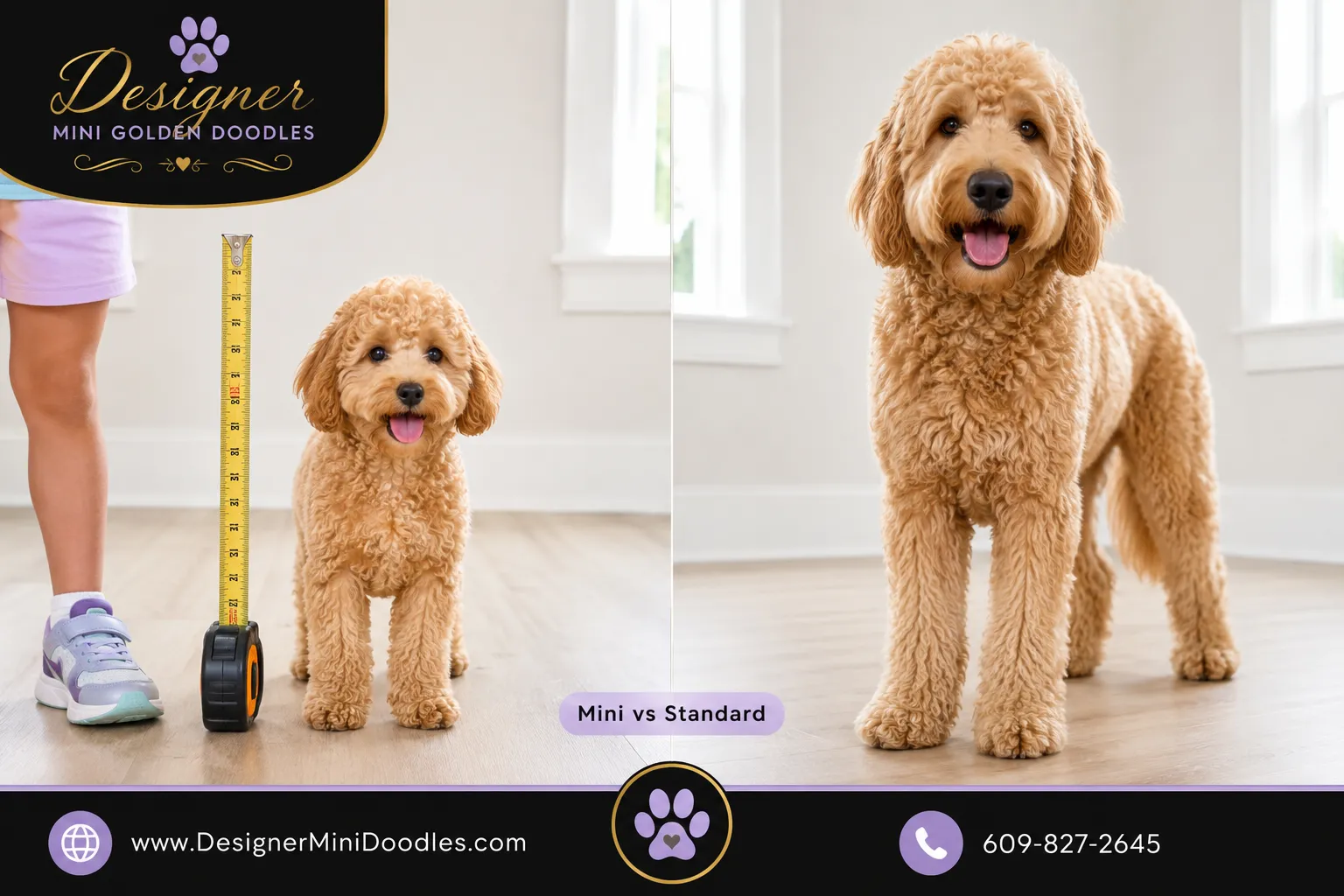
Size drives almost every practical ownership decision:
- Living space: a mini fits comfortably in a studio apartment; a standard needs more floor space and a stronger recall for outdoor exercise.
- Food cost: a 25-pound doodle eats roughly a third of what a 70-pound doodle eats, which compounds over a 12-15 year lifespan.
- Grooming cost: groomers price by size and coat volume, so a mini’s full groom typically runs $60,$95 versus $95,$150 for a standard in most U.S. markets.
- Travel: many airlines allow in-cabin carriers for dogs under about 20 pounds, which is why petite and toy sizes are popular with frequent flyers. Our breakdown of why a 10-16 lb micro Goldendoodle suits travel-friendly households covers the carrier and logistics details.
- Lifespan: smaller dogs generally live longer. Mini Goldendoodles commonly reach 12-15 years, while standards average 10-13.
Common mistake: assuming the puppy’s current weight predicts adult size. A 10-week-old mini doodle at 6 pounds tells you very little on its own. Use the parents’ weights and the breeder’s track record with previous litters from the same pairing.
Where Do I Find Mini Goldendoodle Breeders Near Me?
Start with breeders who publish health testing, then widen your radius until you find one who does. Most buyers who search “mini golden doodles near by” and refuse to travel more than 30 minutes end up choosing from a much weaker pool than buyers willing to drive three hours or arrange ground transport.
Here’s the search sequence I recommend:
- Search by state, not city. State-level searches surface established programs instead of one-off backyard litters. Browse regional pages such as mini and micro Goldendoodle breeders in Texas, Georgia, or California.
- Check the breeder’s actual physical presence. A verifiable address and a Google Business listing you can review beats a slick landing page. You can see our Mini Golden Doodle Puppies location and reviews on Google Maps.
- Ask for a live video call with the puppies and the dam in the same frame. Scammers cannot produce this.
- Request the health-testing panel for both parents in writing, with registry numbers you can look up independently.
- Ask what happens if it doesn’t work out. Ethical breeders take dogs back for life. That single policy separates programs from sellers.
Why Designer Mini Doodles is the best mini golden doodle breeder
Designer Toy Goldendoodles is run by a working animal biologist with a degree in Animal Biology from Stockton University in Pomona, New Jersey, and a minor in animal genetics. That background shapes every pairing decision, from coat-type predictability to structural soundness and temperament matching. Every one of our mini golden doodles for sale comes from documented top bloodlines, not opportunistic pairings, and our breeding stock is selected for health clearances first and appearance second.
Genetics is not a marketing word in our program. It’s the reason we can tell a family with confidence how big their puppy will finish, how much it will shed, and what its temperament is likely to look like at two years old.
Our mini golden doodle puppies are raised inside a busy home, not in a barn or kennel row. From birth, we use Early Neurological Stimulation (ENS), a structured daily handling protocol during the first two weeks of life, and we continue with progressive noise and surface exposure after that: vacuums, blenders, doorbells, kids, other dogs, cats, and general household chaos. By the time a puppy leaves, it has already met the sounds that startle under-socialized dogs.
Every puppy also leaves well started on housebreaking and crate training. That means litter-wide potty-area conditioning, individual crate naps, and a printed routine you can continue on day one. We consider ourselves the best mini golden doodle breeders in the USA because of that combination: genetics credentials, top bloodlines, ENS from birth, real-home socialization, and early training. If you’d rather browse our full lineup of mini doodles for sale, you’ll find current availability, sizes, and generations listed by litter. Families who also want a companion breed sometimes ask about our sister program’s French bulldog stud services.
- Display 9 Products per page




How Much Do Mini Goldendoodles Cost?
Expect $2,500,$4,500 from an accredited breeder with genetic health guarantees, proper whelping practices, and early training. Prices well below that range almost always mean corners were cut somewhere you’ll pay for later.
Here’s how the market actually tiers out:
| Seller type | Typical price | What you usually get |
|---|---|---|
| Scam listing | $500,$1,000 | No puppy. Deposit requests via wire, Zelle, gift cards, crypto |
| Puppy mill / broker | $1,000,$1,500 | Kennel-raised, no health testing, no socialization, frequent GI and behavior issues |
| Hobby / backyard breeder | $1,800,$2,000 | Often well-meaning, but no genetic panels, no ENS, no started training |
| Accredited breeder | $2,500,$4,500 | Parent health clearances, written genetic guarantee, veterinary whelping care, ENS, started housebreaking and crate training |
The $500 listing is not a bargain, it’s a red flag. Scammers price low precisely because urgency and value override caution. If a seller won’t do a live video call, insists on non-reversible payment, or has stock photos that reverse-image-search to other sites, walk away.
Budget for first-year costs beyond the purchase price:
- Veterinary care (remaining vaccines, spay/neuter, exams): $500,$900
- Food and treats: $400,$700
- Grooming (6-8 visits): $400,$700
- Crate, gates, bed, leash, toys: $250,$450
- Training class or private sessions: $150,$600
- Pet insurance (optional): $30,$60 per month
For a full walkthrough of ongoing expenses, see our guide to cost-of-ownership clarity for a 10-16 lb micro Goldendoodle.
How to Find a Reputable Mini Goldendoodle Breeder
A reputable breeder proves health, temperament, and transparency without you having to push for it. If you’re asking for basic documentation three times, you have your answer.
Use this checklist during your first conversation:
- Health testing on both parents, with results you can verify. For Goldendoodles this generally includes hip and elbow evaluations, an annual eye exam, and DNA panels covering progressive retinal atrophy (prcd-PRA), von Willebrand disease, degenerative myelopathy, and Ichthyosis.
- A written health guarantee that names covered conditions and a time window, not vague “healthy puppy” language.
- Limited litters per dam, with retirement plans for breeding females.
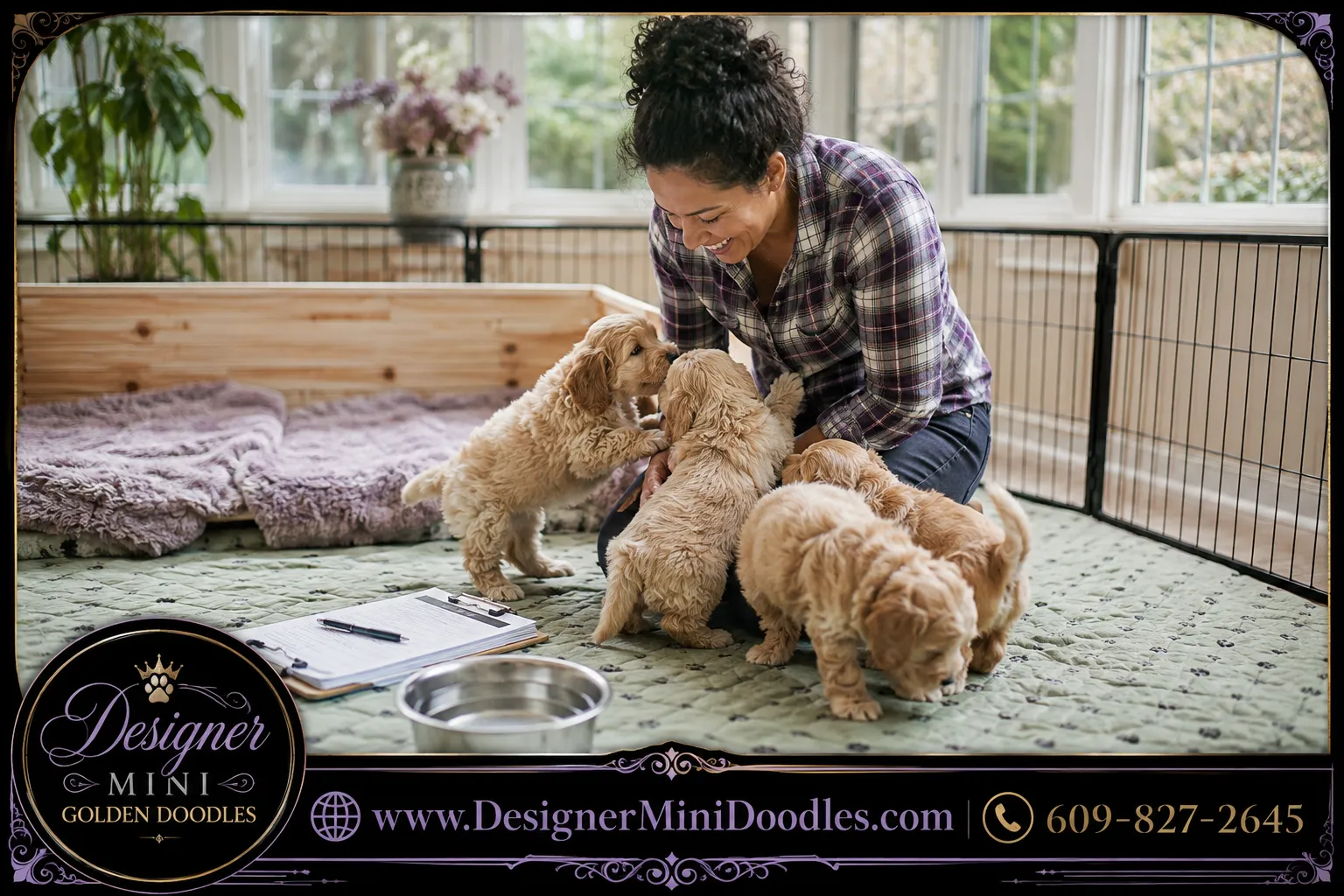
- Puppies raised in the home, with video proof of the actual whelping space.
- A documented socialization protocol (ENS, noise exposure, novel surfaces, car rides, meeting children).
- No puppy released before 8 weeks. Earlier separation is associated with more behavior problems later.
- A waitlist and an application, because good breeders screen buyers too.
- Willingness to say no. A breeder who tells you a mini doodle is a poor fit for your lifestyle is protecting the dog, which is exactly what you want.
Edge case: some excellent small programs don’t do OFA hip x-rays on toy-sized Poodle sires because of anesthesia risk at very low body weights. That can be legitimate, but the breeder should explain the reasoning and show alternative screening. Vague dismissal (“we’ve never had a problem”) is not an explanation.
If you want to compare established programs by region, our directory of miniature Goldendoodle breeders is a reasonable starting point.
Mini Goldendoodle Puppies for Sale in My Area: How the Process Works
Buying from a serious breeder is a process, not a transaction. Most families spend 4 to 20 weeks between first inquiry and bringing a puppy home, depending on litter timing.
The typical sequence:
- Inquiry and application (day 1). Expect questions about your home, schedule, and experience.
- Phone or video consult (week 1-2). This is where you ask about size projection, generation, and coat.
- Deposit to reserve a spot (usually $300,$1,000, applied to the total). Get the refund policy in writing.
- Litter born and updates begin. Weekly photos and weights are standard from good breeders.
- Temperament assessment and matching (week 6-7). A skilled breeder matches puppy to household, not first-come-first-choice by color.
- Vet check, vaccines, microchip (week 7-8).
- Pickup, ground transport, or flight nanny (week 8-10).
Quick example: a family in Nashville wanted a 20-pound apricot female for a home with a toddler. The nearest available litter was 5 hours away. Instead of settling for a local $1,200 listing with no health testing, they reserved from a tested pairing and used a ground transporter for $350. Total cost was still lower than one emergency vet visit for a preventable issue. Regional pages like mini Goldendoodle breeders in Knoxville, TN help you map out realistic driving options.
What Is Mini Goldendoodle Temperament and Behavior Like?
Mini Goldendoodles are typically affectionate, highly social, food-motivated, and eager to work with people, which makes them one of the more trainable small-to-medium companion dogs. The tradeoff is that they dislike being alone and can develop separation-related behaviors without preparation.
Traits you can generally count on:
- People-oriented to a fault. They follow you room to room. If you want an independent dog, this is the wrong breed.
- Bright and quick to learn, with a strong response to positive reinforcement.
- Moderate to high energy through adolescence (roughly 6-18 months), then settling.
- Soft mouths and retriever play styles, often carrying toys and shoes without chewing them.
- Generally good with children, especially when raised around them from birth.
Traits that catch owners off guard:
- Velcro tendencies can become separation anxiety if crate independence isn’t built early.
- Adolescent boundary-testing around 7-11 months, when recall and impulse control temporarily regress.
- Sensitivity to harsh handling. Aversive corrections tend to shut these dogs down rather than motivate them.
Decision rule: choose a mini Goldendoodle if someone is home most of the day or you can arrange midday coverage during the first year. If the dog will be alone 9 hours daily with no break, choose a more independent breed or reconsider timing.
Do Mini Goldendoodles Shed a Lot, and What Are Their Grooming Requirements?
Mini Goldendoodles are low-shedding, not non-shedding, and they require more grooming than most first-time owners expect: brushing 3-4 times per week plus a professional groom every 6-8 weeks. Curlier F1B and multigen coats shed the least but mat the most.

Your at-home routine should include:
- A slicker brush and a metal greyhound comb. The comb is the real test: if it won’t pass to the skin, there’s a mat forming.
- Line brushing in sections, starting at the skin, not skimming the surface.
- Friction-point attention: behind the ears, armpits, collar area, tail base, and the back of the rear legs mat first.
- Ear checks weekly. Doodles grow hair inside the ear canal and are prone to moisture-related infections.
- Nail trims every 3-4 weeks and teeth brushing several times a week.
The single biggest grooming mistake is skipping the coat change window at roughly 8-14 months, when the soft puppy coat is replaced by the denser adult coat. Owners who maintained an easy puppy coat suddenly face rapid matting, and many end up paying for a full shave-down. Increase brushing to daily during that period.
Cost note: a full groom for a mini typically runs $60,$95 in most U.S. metros, so budget $400,$700 per year. Our grooming and home care guide for micro Goldendoodles covers tool selection in more depth.
On allergies: no dog is truly hypoallergenic. The allergen is a protein in dander and saliva, not hair. Low-shedding coats trap dander rather than releasing it into the air, which helps many allergy sufferers, but reactions vary by individual. Spend time with an adult dog of the same generation before committing.
Are Mini Goldendoodles Good for Apartments?
Yes, mini Goldendoodles adapt well to apartments and condos, provided they get 45-60 minutes of daily physical exercise plus deliberate mental enrichment. Their size is rarely the limiting factor; boredom and barking are.

What makes apartment living work:
- A predictable potty schedule with a designated outdoor route, since balcony solutions rarely work long-term.
- Enrichment feeding. Snuffle mats, food puzzles, and frozen stuffed toys cover the mental exercise gap on bad-weather days.
- Early elevator, hallway, and stranger exposure so the dog doesn’t develop reactivity in tight shared spaces.
- A crate or pen placed away from the entry door to reduce hallway-triggered barking.
- Weight-limit awareness. Many buildings cap dogs at 25-35 pounds, which is exactly why petite and micro sizes are popular with city renters.
Common mistake: relying on walks alone. A mini doodle with a retriever brain gets tired from training games and scent work far faster than from a slow leash walk. Fifteen minutes of nose work often beats a 40-minute stroll. Our apartment and urban living guide breaks down realistic daily schedules.
What Mini Goldendoodle Health Problems Should I Watch For?
Mini Goldendoodles inherit risk from both parent breeds, so the conditions to screen for include hip dysplasia, patellar luxation, progressive retinal atrophy, von Willebrand disease, and ear infections. Responsible genetic testing on both parents reduces, but does not eliminate, these risks.
The main concerns:
- Hip dysplasia and patellar luxation. Ask for OFA or PennHIP results on the Golden Retriever parent and patella evaluation on the Poodle parent.
- Progressive retinal atrophy (prcd-PRA). A DNA test with clear/carrier/affected results. Two carriers should never be bred together.
- von Willebrand disease Type I, a bleeding disorder common in Poodles, also DNA-testable.
- Ear infections, driven by hairy ear canals plus moisture. Prevention beats treatment: dry ears after swimming, keep canal hair managed.
- Allergies and atopic dermatitis, showing up as paw licking, ear scratching, and recurring skin flare-ups.
- Hypothyroidism, more common in Golden Retriever lines, diagnosed with a simple blood panel.
- Dental crowding in the smallest sizes, requiring more consistent home dental care.
Edge case worth knowing: “teacup” or extreme-micro marketing sometimes involves breeding for size at the expense of structure, which can increase risk of luxating patellas, dental problems, and hypoglycemia in very young puppies. If a breeder promises an adult weight under 10 pounds for a Goldendoodle, ask hard questions about how they achieved it.
Mini Goldendoodle vs Cockapoo: Which Is Better?
Neither is objectively better; they suit different households. Choose a mini Goldendoodle for a slightly larger, more trainable, retriever-driven dog. Choose a Cockapoo for a smaller, often more portable companion that’s typically content with less structured exercise.
| Factor | Mini Goldendoodle | Cockapoo |
|---|---|---|
| Adult weight | 15-35 lb | 12-24 lb |
| Height | 13-20 in | 10-15 in |
| Energy level | Moderate to high | Moderate |
| Trainability | Very high, strongly food/praise driven | High, sometimes more independent |
| Exercise needs | 45-60 min daily | 30-45 min daily |
| Grooming | Every 6-8 weeks, mats readily | Every 6-8 weeks, slightly less volume |
| Common health watch items | Hips, PRA, vWD, ears | Patellas, ears, PRA, luxating patella |
| Best for | Active families, first-time owners with time, training enthusiasts | Smaller homes, seniors, lower-intensity households |
Decision rule: if you plan to do therapy work, agility, obedience titles, or lots of hiking, the mini Goldendoodle’s biddability and stamina give it an edge. If your household wants a lap-sized dog with modest exercise demands and a smaller footprint, the Cockapoo fits better. If you’re weighing other doodle options entirely, our comparison of toy Poodles versus Bernese Mountain Dogs and mini Bernedoodles covers a different size and temperament trade-off.
Mini Goldendoodle Training Tips for Beginners
Start training the day the puppy arrives, and lean on the routines a good breeder already established. Puppies that come pre-started on crate rest and potty-area conditioning typically reach reliable house training weeks faster than kennel-raised puppies.
A realistic first-90-days plan:
Days 1-14: routine and crate
- Take the puppy out every 45-60 minutes while awake, plus immediately after sleeping, eating, and playing.
- Feed all meals in or near the crate to build positive associations.
- Reward outdoor elimination within three seconds, on the spot, with a high-value treat.
- Practice 5-10 minute crate naps while you’re home so the crate never predicts your absence.
Weeks 3-8: socialization and foundations
- Aim for varied, positive exposures: surfaces, sounds, hats, umbrellas, calm dogs, different people. Quality over quantity, always at the puppy’s pace.
- Teach name response, sit, hand-touch, and a marker word in 3-minute sessions, five times daily.
- Introduce brief alone-time in a pen with a chew, building from 2 minutes to 30.
Weeks 9-12: proofing
- Add distance, distraction, and duration to known cues.
- Begin loose-leash walking in low-traffic areas.
- Start handling drills for grooming: paws, ears, muzzle, tail.
Common mistake: treating housebreaking accidents as disobedience. Accidents at 10-16 weeks are almost always a supervision or schedule failure, not defiance. Tighten the schedule, use a tether or pen, and clean with an enzymatic cleaner.
Puppies from our program arrive already familiar with crate routines and a potty area, which is why families frequently report full house training within 3-6 weeks. If you’re comparing training approaches across doodle types, our guide to training a mini Bernedoodle puppy uses the same foundational method.
Is There a Mini Goldendoodle Rescue Near Me?
Yes. Doodle-specific rescues operate in most U.S. regions, and breed-specific Golden Retriever and Poodle rescues also take in doodle mixes. Expect adoption fees of roughly $300,$700 and mostly adolescent or adult dogs rather than young puppies.
Where to look:
- Doodle-focused rescue organizations (search “doodle rescue” plus your state name).
- Golden Retriever and Poodle breed rescues, which frequently list doodle crosses.
- Petfinder and Adopt-a-Pet filtered by “Goldendoodle” and your ZIP radius.
- Local shelters, particularly for surrendered adolescents in the 8-18 month range.
- Breeder rehoming programs. Ethical breeders occasionally place adults retiring from their program.
Reality check: the most commonly surrendered doodle profile is a 10-to-18-month-old dog with unaddressed separation anxiety, coat neglect, or leash reactivity. These are solvable problems, but they take a committed adopter. If you want a rescue and you’re a first-time owner, ask specifically about the dog’s alone-time tolerance and grooming history.
FAQ
How big does a mini Goldendoodle get?
Most mini Goldendoodles finish between 15 and 35 pounds and 13 to 20 inches tall at the shoulder. Petite or toy varieties may stay under 20 pounds.
How much should I pay for a mini Goldendoodle in 2026?
$2,500,$4,500 from an accredited breeder with genetic health testing, veterinary whelping care, and started training. Listings under $1,200 are typically scams or puppy mills.
Do mini Goldendoodles shed?
They shed lightly. F1B, F1BB, and multigen coats shed least; F1 coats shed slightly more. No Goldendoodle is completely non-shedding.
Are mini Goldendoodles hypoallergenic?
No dog is fully hypoallergenic. Low-shedding coats release less dander into the air, which helps many allergy sufferers, but reactions are individual. Meet an adult dog before committing.
How long do mini Goldendoodles live?
Typically 12 to 15 years, longer than standard Goldendoodles at 10 to 13 years, because smaller dogs generally have longer lifespans.
Are mini Goldendoodles easy to train?
Yes, they’re among the more trainable companion crosses because of strong food and praise motivation. They respond poorly to harsh corrections and best to positive reinforcement in short sessions.
Can a mini Goldendoodle be left alone all day?
Not reliably during the first year. They’re a people-focused breed prone to separation-related behaviors. Plan for midday coverage or gradual alone-time conditioning before an 8-hour absence.
What’s the difference between a mini and a micro Goldendoodle?
“Mini” usually describes 20-35 pound dogs; “micro,” “petite,” or “toy” describes dogs under about 20 pounds. Labels vary by breeder, so verify parent and grandparent adult weights.
How often do mini Goldendoodles need professional grooming?
Every 6 to 8 weeks, plus home brushing 3 to 4 times a week. Increase to daily brushing during the coat change at 8-14 months.
Should I choose distance or quality when searching for mini golden doodles near by?
Choose quality. A three-hour drive or a $300,$500 ground transport is cheaper than treating a preventable genetic condition, and health testing varies far more between breeders than geography suggests.
When can a mini Goldendoodle puppy come home?
At 8 weeks minimum. Earlier separation from the litter is associated with more behavior problems later. Some breeders hold very small puppies until 10 weeks for safety.
Is a mini Goldendoodle good for a first-time dog owner?
Generally yes, if you have time for daily training, grooming maintenance, and companionship. The main failure points are underestimating grooming and overestimating tolerance for being alone.
Conclusion
Finding mini golden doodles near by is less about proximity and more about verification. The three-tier price reality is the clearest map you have: scam listings cluster at $500,$1,000, high-volume operations at $1,000,$1,500, hobby breeders at $1,800,$2,000, and accredited programs with genetic guarantees, proper whelping care, and started housebreaking and crate training at $2,500,$4,500. Where a seller falls on that scale tells you most of what you need to know before the first phone call.
Your next steps, in order:
- Define your size target and get parent and grandparent adult weights in writing from any breeder you contact.
- Request the genetic panel and orthopedic clearances for both parents, with verifiable registry numbers.
- Do a live video call with the dam and the litter in the same frame. No exceptions.
- Confirm the socialization protocol (ENS from birth, household noise exposure, other animals, children) and the early training status.
- Widen your search radius to state level and compare programs, then price out ground transport as a variable rather than a barrier.
- Budget the first year honestly: $1,700,$3,350 beyond the purchase price for vet care, grooming, food, gear, and training.
- Prepare the crate and schedule before pickup day, so you’re continuing an existing routine rather than starting one.
Do those seven things and you’ll skip the two most expensive mistakes in this market: paying too little for a poorly bred puppy, or paying enough but skipping the documentation that made the price justified.