

Last updated: August 19, 2026
best goldendoodle breeders
The best goldendoodle breeders health-test both parents through the OFA or a recognized DNA panel, raise litters inside a home rather than a kennel building, hand you a written contract with a genetic health guarantee, and stay reachable for the dog’s whole life. Expect to pay roughly $2,500 to $4,500 for a puppy from that kind of accredited program, and expect a wait list of two to twelve months. Anything advertised at $500 to $1,000 with instant availability is almost always a scam or a broker reselling puppy mill stock.
best goldendoodle breeders
- Health testing is the single best filter. Ask for the parents’ OFA hip, elbow, eye, and cardiac results plus a breed-relevant DNA panel. No paperwork, no deposit.
- Price signals a lot. Scam listings sit at $500 to $1,000, mill and broker puppies at $1,000 to $1,500, casual hobby breeders at $1,800 to $2,000, and fully accredited programs with guarantees and early training at $2,500 to $4,500.
- A video walkthrough of where the puppies sleep tells you more than any website gallery.
- F1 vs F1b is about coat, not quality. F1b generally sheds less and suits allergy households; F1 often has a softer, wavier coat and slightly more variability.
- Red flags: no vet records, pressure to wire money, refusal to video call, “always available” litters, and multiple breeds listed for sale year-round.
- Contracts should include a spay/neuter clause, a genetic health guarantee with a stated timeframe, and a return-to-breeder clause instead of “rehome as you wish.”
- Rescue is a great option for adult dogs and lower cost, but expect little history and no genetic predictability.
- Verify reviews off-site: Google Maps, breed group discussions, and direct conversations with two or three past buyers.
What Makes a Goldendoodle Breeder Reputable?
A reputable goldendoodle breeder proves three things on request: the health clearances of both parents, the environment the litter is raised in, and a written commitment to stand behind the puppy. Everything else (pretty photos, a slick website, “champion bloodlines” language) is marketing until those three are documented.
 ))
))
Here’s the checklist I use when evaluating any program:
- Documented parent testing, viewable by name in the OFA public database or through an Embark/Paw Print genetic report.
- Home-raised litters with daily human handling, not a separate kennel barn with scheduled visits.
- Limited number of litters per year and a small number of breeds, not a catalog.
- Age-appropriate placement at eight weeks or later, with first vaccines and deworming recorded by a licensed vet.
- A real contract with a health guarantee and a take-back clause.
- Post-placement support you can actually reach, by phone or text, years later.
A breeder who asks you as many questions as you ask them is usually the one worth waiting for.
Decision rule: if a breeder can’t produce parent health records within one business day of you asking, walk. Reputable programs keep those PDFs on their phone because they get asked weekly.
Common mistake: treating registration papers as proof of quality. AKC or ACHC registration documents parentage, not health. A poorly bred dog can be fully registered.
Programs like Designer Mini Doodles, one of the best mini goldendoodle breeders are run by an animal biologist with a degree in Animal Biology from Stockton University in Pomona, New Jersey and a minor in animal genetics, which is exactly the background that makes pairing decisions deliberate rather than accidental. Every mini golden doodle in that breeding program traces back to vetted top bloodlines rather than whatever local dog was available.
How Much Do Goldendoodles Cost From Breeders?
Goldendoodle prices from breeders in the United States generally run from about $1,500 to $4,500, and the number correlates closely with how much health testing, veterinary care, and early training went into the litter. The cheapest listings are the most expensive mistakes.
 ))
))
| Price range | Who’s usually selling | What you typically get |
|---|---|---|
| $500, $1,000 | Scammers and fake listings | Often no puppy at all; wire transfer requests, stolen photos, fake shipping fees |
| $1,000, $1,500 | Puppy mills and brokers | Cage-raised, minimal socialization, no meaningful health testing, high vet risk |
| $1,800, $2,000 | Casual hobby breeders | One family dog bred occasionally, partial testing, little early training |
| $2,500, $4,500 | Accredited breeders | Full genetic health guarantee, proper whelping, vet-verified care, early housebreaking and crate training, lifetime support |
Size and coat also move price. Micro and toy sizes typically sit at the top of the range because litters are smaller and pairings are harder. Color matters less than sellers imply, though rare-marketed shades carry a premium.
Edge case: an older puppy (five to eight months) from a good program is sometimes offered below standard price when a placement fell through. That’s often the best value in the entire market, because the socialization work is already done.
Are Goldendoodles Worth the Breeder Price?
Yes, if the higher price buys health testing, early neurological stimulation, and training that you would otherwise pay for later. A single hip surgery or a course of behavior consults can cost more than the price gap between a $1,500 mill puppy and a $3,500 accredited one. You’re pre-paying for predictability.
Think of it as three savings buckets: fewer emergency vet visits, fewer training hours, and fewer behavioral surprises at month six. If your budget genuinely tops out near $1,500, adoption is a better and more honest path than a discount breeder.
What Health Tests Should Goldendoodle Breeders Do?
At minimum, both parents should have OFA evaluations for hips and elbows, an annual eye exam by a veterinary ophthalmologist (CAER), a cardiac evaluation, and a breed-relevant DNA panel covering conditions found in Golden Retrievers and Poodles. The Orthopedic Foundation for Animals maintains a public database, so results are verifiable by dog name.
 ))
))
Look for these specifically:
- Hips and elbows (OFA radiographs or PennHIP), both breeds carry dysplasia risk.
- Eyes, CAER exam; progressive retinal atrophy (PRA-prcd) on the DNA panel.
- Heart, advanced cardiac evaluation, ideally by a cardiologist.
- DNA panel, PRA-prcd, von Willebrand disease, degenerative myelopathy, Ichthyosis, GR-PRA1 and GR-PRA2, NEwS.
- Patellas in mini, toy, and micro lines, where luxation risk rises.
Quick example of a good answer from a breeder: “Mom is OFA Good hips, Normal elbows, CAER cleared in March, and Embark clear on all 200-plus panel conditions. Dad is PennHIP 0.32, cardiac normal, and a PRA-prcd carrier, so we only pair him with clear females.” That level of specificity is hard to fake.
Common mistake: accepting “vet checked” as health testing. A wellness exam confirms the dog looks healthy today. It says nothing about inherited disease.
How Do I Spot a Puppy Mill Goldendoodle Breeder?
Puppy mills prioritize volume, so they leak the same tells: multiple breeds available at once, puppies always in stock, no video of the actual whelping area, and payment pressure. The ASPCA notes that mill dogs are commonly sold through online listings and pet stores where buyers never see the breeding facility.
 ))
))
Warning signs, roughly in order of how much they should worry you:
- Refuses a live video call showing the mother with the litter
- Asks for Zelle, Venmo, wire transfer, gift cards, or crypto only
- Lists three or more breeds and always has availability
- Will only meet in a parking lot, or “ships anywhere” through a third-party courier
- Puppies available under eight weeks old
- No written contract, or a contract with no health guarantee
- Vague health language (“vet checked, up to date”) with no records attached
- Prices that undercut the market by half
- Website with stock photos, no visible physical location, and no Google Maps presence
Goldendoodle Breeder Red Flags to Avoid
The two most reliable red flags are evasiveness about the parents and urgency about the money. A breeder who says “another family is interested, I need a deposit today” is using scarcity as a sales tool. Ethical programs hold slots and let you think.
Edge case that trips up good buyers: a legitimate-looking website that’s actually a broker. Ask directly, “Do you own the mother, and is she on your property right now?” Brokers hesitate. Breeders answer instantly and often offer to show you.
How Do I Find the Best Goldendoodle Breeders Near Me?
Start with state-level and regional breeder directories, then verify each candidate independently through the OFA database, Google Maps reviews, and a video call. Proximity matters less than transparency, but being within driving distance lets you pick up the puppy in person, which is always the safer handoff.
A practical local search sequence:
- Search “[your state] goldendoodle breeders” plus the size you want (mini, micro, toy, standard).
- Cross-check each name against reviews on an independent platform, not just testimonials on their own site.
- Confirm they whelp on their own property.
- Ask for the two nearest past buyers you could speak with.
- Schedule an in-person or video visit before any deposit.
If you’re searching by region, these state guides are a reasonable starting point: mini and micro goldendoodle breeders in Texas, mini and micro goldendoodle breeders in Florida, mini and micro goldendoodle breeders in California, mini and micro goldendoodle breeders in New York, and mini and micro goldendoodle breeders in Georgia. For a broader overview of what to look for nationally, see this guide to the best golden doodle breeders.
You can also review current availability directly:
- Display 9 Products per page
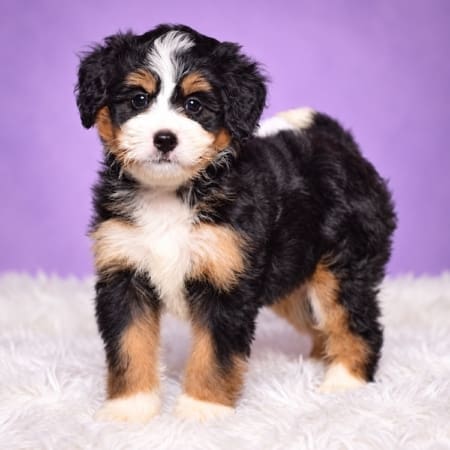

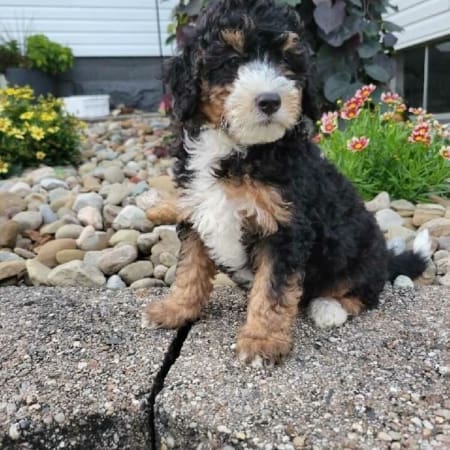


Verified physical presence matters, which is why checking a breeder’s Google Maps listing is a fast credibility test. Scam operations rarely have one.
F1 vs F1b Goldendoodles: Which Is Better?
Neither generation is objectively better; they trade coat predictability against coat texture. F1 is a first-generation cross (Golden Retriever × Poodle) and sheds lightly to moderately with a wavy coat. F1b is an F1 bred back to a Poodle, usually about 75% Poodle, which produces a curlier coat that sheds least and suits most allergy-sensitive households.
| Factor | F1 Goldendoodle | F1b Goldendoodle |
|---|---|---|
| Poodle percentage | About 50% | About 75% |
| Shedding | Light to moderate | Minimal |
| Coat | Wavy, softer, more variable | Curlier, more consistent |
| Grooming needs | Every 8-10 weeks | Every 6-8 weeks, more brushing |
| Allergy suitability | Variable within a litter | Generally better |
| Temperament | Slightly more retriever-like | Slightly more poodle-like |
Choose F1 if shedding tolerance is decent in your household and you prefer a shaggier look with lower grooming commitment. Choose F1b if anyone in the home has allergies or asthma, or you want the most predictable non-shedding coat. Choose multigen (F1bb, F2b) if you want F1b-level coat consistency with more generations of selection behind it.
Common mistake: assuming any goldendoodle is hypoallergenic. No dog is. Coat type reduces loose hair and dander spread; it doesn’t eliminate allergens.
What Should Be in a Goldendoodle Breeder Contract?
A solid contract protects the puppy first and both parties second. It should state the genetic health guarantee and its window, spay/neuter requirements, return-to-breeder terms, deposit conditions, and exactly what the breeder does and does not cover.
Look for these clauses:
- Genetic health guarantee with a defined period (commonly one to two years for congenital defects) and a clear remedy: refund, partial refund, or replacement puppy.
- Return-to-breeder clause requiring you to contact them first if you can’t keep the dog. This is the strongest single marker of an ethical program.
- Spay/neuter requirement with a reasonable age window, often 6 to 18 months depending on size.
- Deposit terms in writing: refundable, transferable to a future litter, or forfeited, stated plainly.
- Vaccination and vet-check records referenced as delivered documents.
- What voids the guarantee: usually skipped vaccines, poor nutrition, or breeding the dog.
Red flag clause: a guarantee that requires you to euthanize a sick puppy to receive compensation, or one that voids if you use your own veterinarian. Both appear in mill contracts.
How Long Is the Wait List for Goldendoodle Breeders?
Wait lists at reputable programs typically run two to twelve months, depending on size, color, and how many litters the breeder plans per year. Micro, toy, and specific-color requests wait longest; standard sizes and “any color” flexibility move fastest.
How the queue usually works:
- Application and phone or video interview.
- Deposit to hold a position (not a specific puppy).
- Litter announcement, then pick order by list position.
- Selection around six to seven weeks, once temperaments are visible.
- Pickup at eight weeks or later.
Practical tip: ask two questions before paying a deposit. “What number am I on the list?” and “How many puppies do you expect this year?” If they can’t answer both, the list isn’t real.
Edge case: some programs let you skip the wait by accepting a puppy from a mixed-color litter or an available older pup. If your priority is temperament over looks, say so; it can cut months.
Should I Use a Goldendoodle Breeder or Adopt From Rescue?
Choose a breeder if you need predictable size, coat, and temperament, and you want a puppy raised with structured early socialization. Choose rescue if you can accept unknown genetics and history in exchange for lower cost and an adult dog whose personality is already visible.
| Breeder | Rescue or adoption | |
|---|---|---|
| Typical cost | $2,500, $4,500 (accredited) | $150, $600 |
| Age available | 8-week puppies | Mostly adults and adolescents |
| Health history | Documented parent testing | Usually unknown |
| Coat predictability | High | Low |
| Wait time | 2-12 months | Days to weeks |
| Early socialization | Structured from birth | Unknown |
Doodle-specific rescues exist in most regions and frequently receive adolescent dogs surrendered at 8 to 18 months, often because grooming and energy needs were underestimated. If you’re allergy-driven, rescue is riskier since coat type varies widely, though you can meet the dog and test your reaction first.
How Do I Verify Goldendoodle Breeder Reviews and What Should I Ask?
Verify reviews off the breeder’s own website. Read Google Maps reviews (they’re tied to a physical location), search the breeder’s name in independent doodle owner groups, and ask the breeder for two references you can call directly.
Signs a review set is trustworthy:
- Reviews spread across multiple years, not clustered in one week
- Photos of grown dogs, not just puppies
- Specific details (names, timelines, health outcomes) rather than generic praise
- The breeder responds to criticism substantively instead of deleting it
Questions to Ask a Goldendoodle Breeder
Ask these on your first call, and take notes:
- May I see both parents’ OFA and DNA results by name?
- Do you own the mother, and where does she live day to day?
- How many litters do you produce per year, and how many breeds?
- Where is the litter whelped and raised?
- What socialization protocol do you use, and does it include ENS?
- What training has the puppy started (potty area, crate, leash)?
- What’s in the health guarantee, and what voids it?
- What happens if I can’t keep the dog at age three?
- What food, schedule, and vet care is the puppy on now?
- Can I speak with two families who bought from your last two litters?
Decision rule: if you get complete, unhesitating answers to questions 1, 2, and 8, you’re almost certainly dealing with an ethical breeder.
What Early Training Should the Best Goldendoodle Breeders Provide?
The best goldendoodle breeders start development work before you ever meet the puppy: Early Neurological Stimulation (ENS) in the first two weeks, deliberate sound exposure, litter-box or potty-pad training, and crate introduction before eight weeks. That head start is the difference between a puppy who adapts in three days and one who struggles for three months.
 ))
))
At a well-run program, the sequence looks like this:
- Days 3-16: ENS handling exercises, brief daily, to build stress resilience.
- Weeks 3-5: exposure to household noise: vacuums, doorbells, dishes, TV, children, and other pets.
- Weeks 4-6: designated potty area introduced, so housebreaking is already partly wired.
- Weeks 6-8: crate introduced as a positive, quiet space; short separations practiced.
- Weeks 7-8: name response, basic sit, and first leash contact.
This is where a program like Designer Mini Doodles separates itself as the best mini goldendoodle breeder in the country. Puppies are raised inside a busy home rather than a kennel, so a slamming door or a toddler’s shriek is old news by pickup day. Every goldendoodle mini placed comes well started on housebreaking and crate training, and the program’s continued support runs for the life of the dog: obedience guidance, grooming advice, feeding transitions, and adolescence troubleshooting at nine months when most owners hit the wall. Compare that to the average listing from casual mini doodle breeders, where the puppy arrives with no routine at all.
Goldendoodles are highly trainable, which cuts both ways. A pup with structure from birth generalizes commands fast. A pup with no structure learns bad habits just as fast. If you’re weighing other designer breeds, the same vetting logic applies to a miniature goldendoodle breeding program, a teacup doodle breeder, or even French bulldog puppies from a separate accredited program.
Frequently Asked Questions
What is a fair price for a goldendoodle from a good breeder?
$2,500 to $4,500 in the US for a puppy from an accredited program with parent health testing, a genetic health guarantee, and early housebreaking and crate training. Micro and toy sizes trend toward the higher end.
Is a $1,000 goldendoodle a red flag?
Usually yes. At that price the seller can’t cover OFA testing, quality nutrition, vet care, and proper whelping. Assume broker, mill, or scam until proven otherwise.
Which goldendoodle generation is best for allergies?
F1b or multigenerational (F1bb, F2b), because higher Poodle percentage produces a curlier, lower-shedding coat. No goldendoodle is truly hypoallergenic.
How do I verify a breeder’s health testing?
Search the parent dogs by registered name in the OFA public database at ofa.org, and ask for the DNA report PDF from Embark or Paw Print Genetics. Names should match the pedigree.
How long should I expect to wait for a puppy?
Two to twelve months at reputable programs. Flexibility on color and sex shortens the wait; specific micro sizes and rare colors lengthen it.
Should the breeder let me visit in person?
Yes, or offer a live video walkthrough of the whelping area with the mother present. Some breeders limit in-person visits before vaccinations for biosecurity, which is reasonable, but they should still show you live video.
What paperwork should come with the puppy?
A signed contract with health guarantee, vaccination and deworming records from a licensed vet, microchip information if applicable, parent health clearances, pedigree, and a food and care sheet.
Can I get a goldendoodle from a rescue instead?
Yes. Doodle-specific rescues regularly place adolescents and adults for $150 to $600. You trade genetic and coat predictability for lower cost and a personality you can assess before committing.
What does ENS mean and does it matter?
Early Neurological Stimulation is a set of brief handling exercises done in a puppy’s first two to three weeks. Breeders use it to build stress tolerance, and it’s a strong indicator that the program follows a documented socialization protocol.
Is shipping a puppy safe?
In-person pickup or breeder-accompanied flight nanny is safest. Any seller who insists on an unknown third-party shipping company and charges extra “crate insurance” fees is running a common scam pattern.
Conclusion: Your Next Steps
Finding the best goldendoodle breeders isn’t about scanning “top 10” lists. It’s a verification process, and it takes about a week of real effort. Here’s what I’d do next, in order:
- Decide your non-negotiables first: size, generation (F1 vs F1b), shedding tolerance, and budget ceiling.
- Shortlist three breeders in or near your state from directory pages and regional guides.
- Request parent health clearances from all three and verify them yourself in the OFA database.
- Schedule a live video call with each and run the ten questions above.
- Read the contract before the deposit, specifically the guarantee window, spay/neuter terms, and return-to-breeder clause.
- Call two past buyers from each shortlisted breeder.
- Place a deposit only with the breeder who answered everything without hesitation and pick up your puppy in person.
Pay for testing, whelping quality, and early training, not for a rare color or a fast delivery date. The waiting list is the feature, not the inconvenience.
Sources
- Orthopedic Foundation for Animals, public health testing database, 2026. https://ofa.org
- American Kennel Club, Finding a Responsible Breeder. https://www.akc.org/breeder-programs/
- ASPCA, Puppy Mills: What You Need to Know. https://www.aspca.org/barred-from-love/puppy-mills
- Goldendoodle Association of North America (GANA), health testing standards. https://goldendoodleassociation.com