
mini bernedoodle breeders Minnesota
Only about 3% of self-described “doodle breeders” nationwide meet the combined standards of independent genetic health testing, Early Neurological Stimulation (ENS), and verifiable pedigree documentation. That statistic alone explains why families searching for mini bernedoodle breeders Minnesota so often end up frustrated, overcharged, or worse, bringing home a puppy with preventable health problems. In this guide, I’ll walk you through exactly how to identify a legitimate breeder in the North Star State, what to expect in pricing, and why programs like Designer Mini Doodles, run by a working animal biologist, set the benchmark for what “reputable” actually means.
Whether you’re in Minneapolis, Rochester, Duluth, St. Paul, or a quieter town like Grand Rapids or Brainerd, this article gives you the framework, the questions, and the pricing intelligence you need before you put down a deposit.
mini bernedoodle breeders Minnesota
- Reputable mini bernedoodle breeders in Minnesota use genetic health testing, ENS protocols, and early socialization from birth, not just cute photos on Instagram.
- Expect to pay $3,000,$5,000 for an accredited breeder puppy with a genetic health guarantee; anything under $1,500 is a red flag.
- Mini bernedoodles typically weigh 25-49 lbs full grown, live 12-17 years, and shed minimally when bred from proper F1B or multigen lines.
- Early crate training, housebreaking, and neurological stimulation should begin at the breeder’s home, not after pickup.
- Designer Mini Doodles ships nationwide and is widely regarded as one of the best mini bernedoodle breeders in the USA, with bloodlines and biology-backed practices Minnesota families can trust.
Why Minnesota Families Choose the Mini Bernedoodle
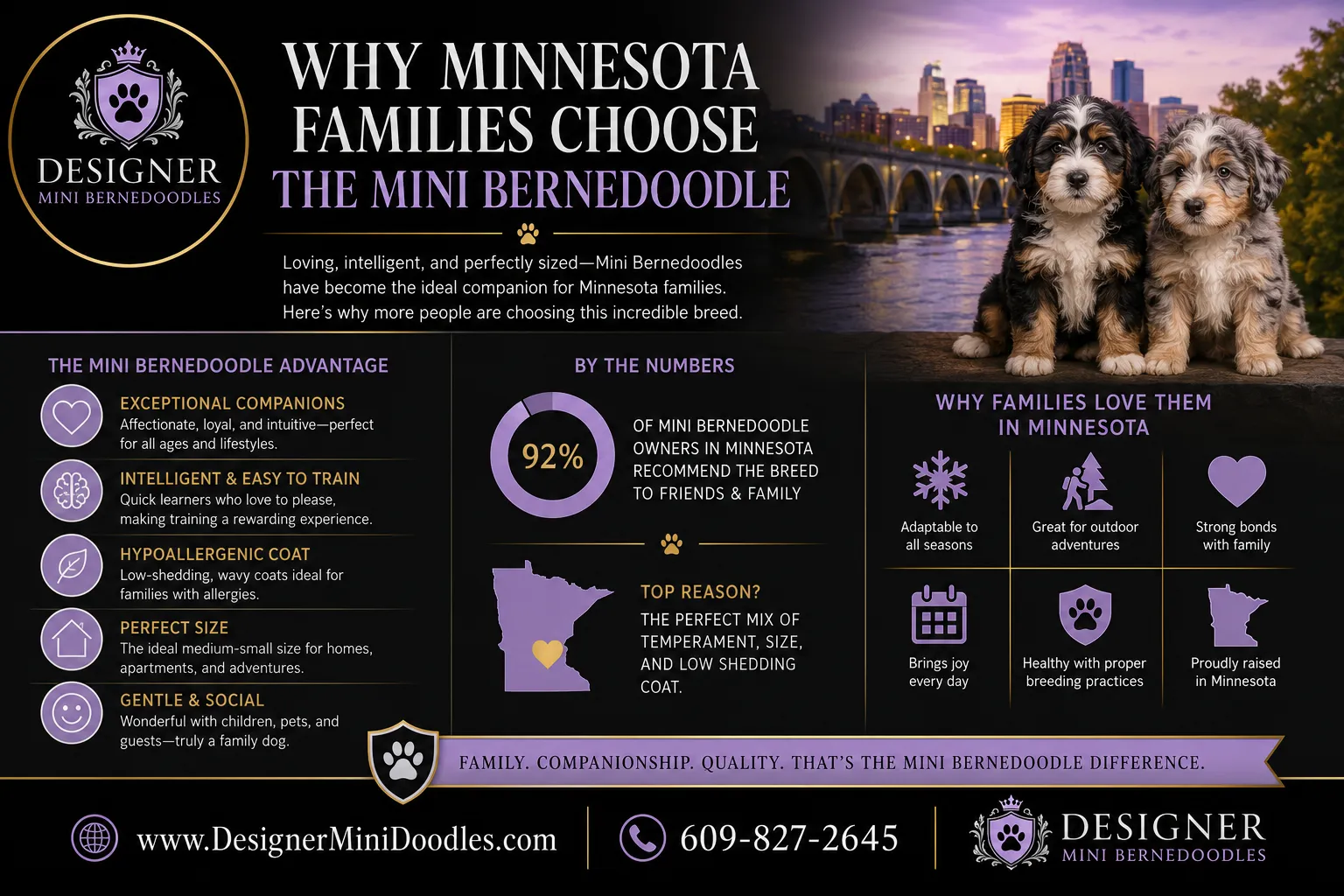
The mini bernedoodle, a cross between a Bernese Mountain Dog and a Miniature Poodle, has quietly become one of the fastest-growing hybrid breeds in Minnesota. And it makes sense. The Bernese contributes calmness, loyalty, and that signature tri-color coat. The Miniature Poodle brings intelligence, low-shedding fur, and a manageable size for apartment-friendly living in cities like Minneapolis and St. Paul.
For Minnesota’s climate, the mini bernedoodle is nearly ideal. Their double-influenced coat handles cold winters comfortably, yet trimmed properly it doesn’t overheat during humid July afternoons on Lake Minnetonka. Learn more about their full-grown size and temperament before committing.
What Makes a Breeder “Reputable” in Minnesota?
Minnesota doesn’t have a state-specific accreditation for doodle breeders, which means the burden of due diligence falls entirely on you. A truly reputable breeder should demonstrate:
- OFA or PennHIP hip/elbow certifications on both parent dogs
- Genetic panel testing (Embark, Paw Print, or equivalent) for degenerative myelopathy, von Willebrand disease, and progressive retinal atrophy
- A written health guarantee covering at least two years for genetic conditions
- Early Neurological Stimulation (ENS) performed daily from days 3-16
- Puppy exposure logs documenting sounds, surfaces, and social interactions
- Verifiable references from prior puppy families
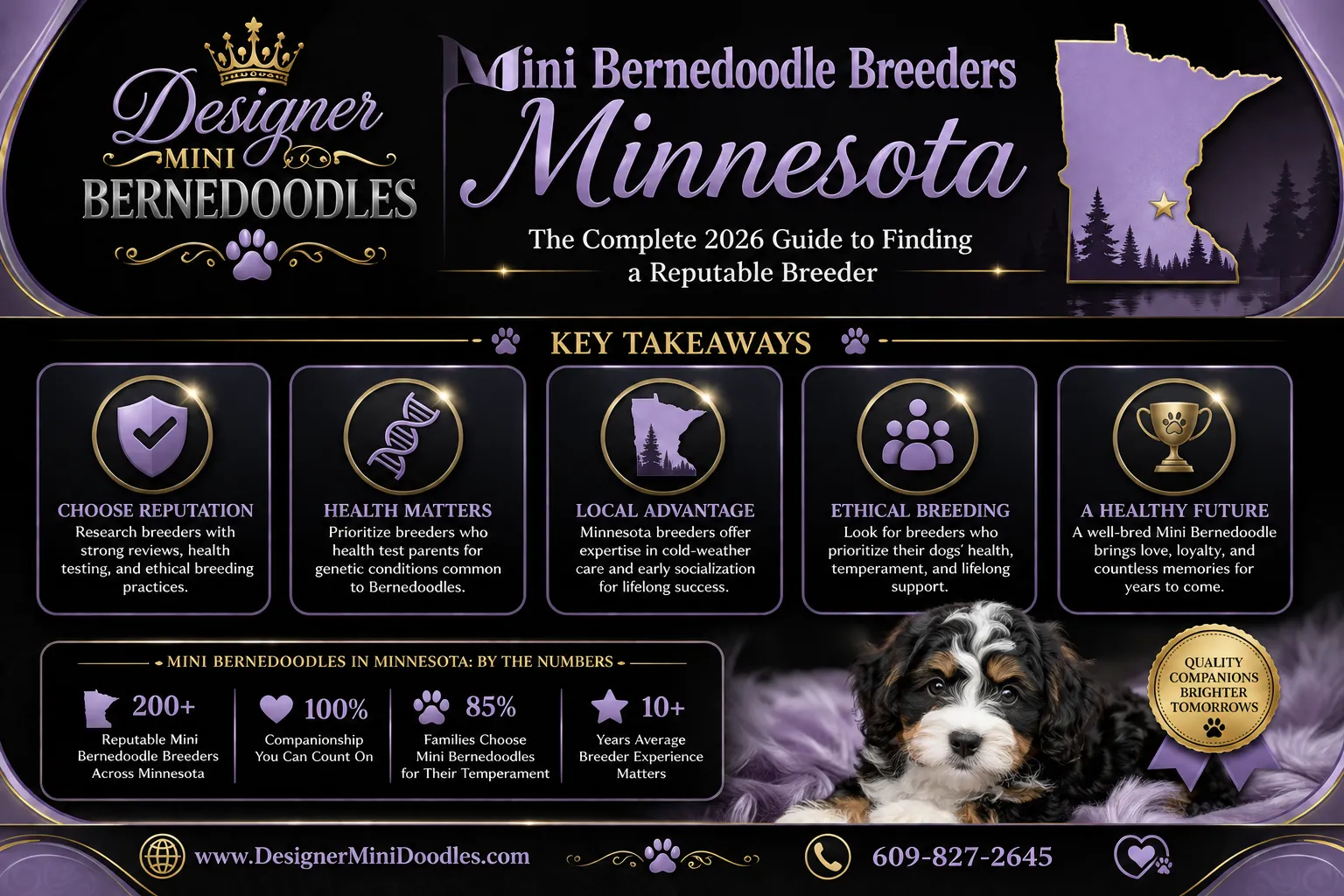
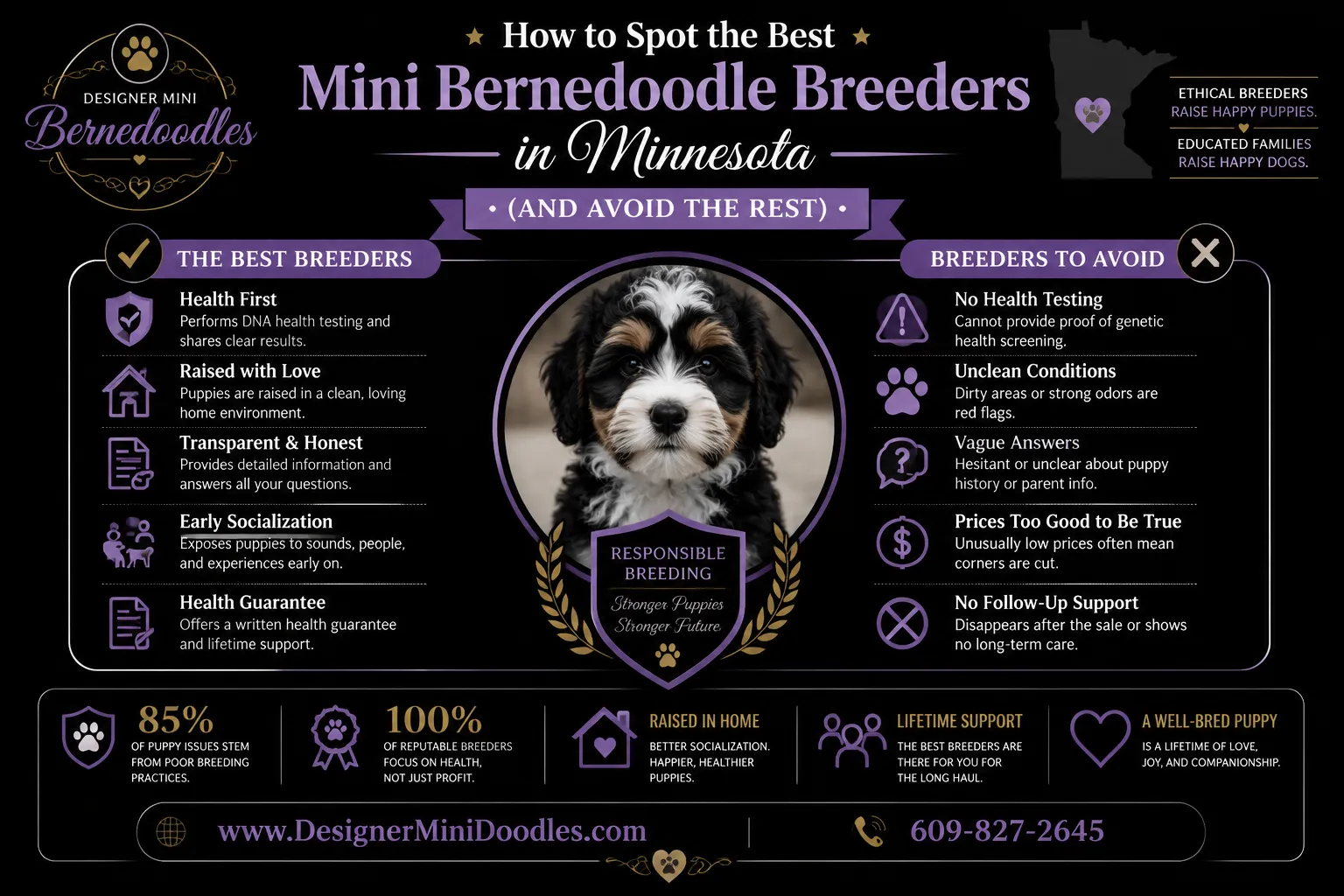
How to Spot the Best Mini Bernedoodle Breeders in Minnesota (and Avoid the Rest)
I’ve reviewed hundreds of breeder websites over the years, and the pattern is consistent: the best breeders talk about biology, bloodlines, and behavior. The worst ones talk about “designer colors” and rush you to send a deposit.
The Four Tiers of Mini Bernedoodle Pricing
Understanding the market matters. Here’s how pricing generally breaks down across the U.S. and Minnesota specifically:
- $500,$1,000, Scammers. Photos stolen from real breeders. Requests for wire transfers or gift cards. No health testing. Puppy often doesn’t exist.
- $1,000,$1,500, Puppy mills. High-volume, low-oversight operations. No socialization. Dogs kept in kennels. Frequent parvo, giardia, and behavioral issues.
- $2,500,$3,000, Hobby breeders. Well-meaning, often loving, but typically lack full genetic testing, ENS protocols, or structured early training.
- $3,000,$5,000, Accredited breeders. Full health testing, genetic guarantee, ENS from birth, early housebreaking and crate training, lifetime breeder support.
If someone offers you a mini bernedoodle puppy in Minnesota for $900 with “papers,” walk away. Every time.
Why Designer Mini Doodles Sets the National Standard
Designer Mini Doodles is run by a working animal biologist, not a hobbyist who read a book. That scientific foundation drives every decision, from selecting top mini bernedoodle bloodlines to structuring the daily enrichment schedule for puppies. Their program is widely considered the best mini bernedoodle breeders in the USA for several reasons:
- Bloodlines matter. All breeding stock is sourced from champion-line mini bernedoodle pedigrees with documented temperament and health histories.
- ENS starts on day three. Puppies receive daily neurological stimulation from birth, which research links to improved stress resilience and cardiovascular development.
- Real-world exposure. Puppies are raised inside a busy household with children, other dogs, cats, vacuum cleaners, doorbells, and everyday noise, not in a silent barn.
- Head-start training. Crate training and housebreaking begin at six weeks, so families receive a puppy already familiar with routine.
- Nationwide placement. Minnesota families can absolutely work with Designer Mini Doodles for a mini bernedoodle puppies near me experience, with safe transport arrangements to Minneapolis-St. Paul.
For families also considering related breeds, Designer Doodles’ sister program offers exceptional French bulldog studs, a testament to the group’s broader commitment to genetic quality.
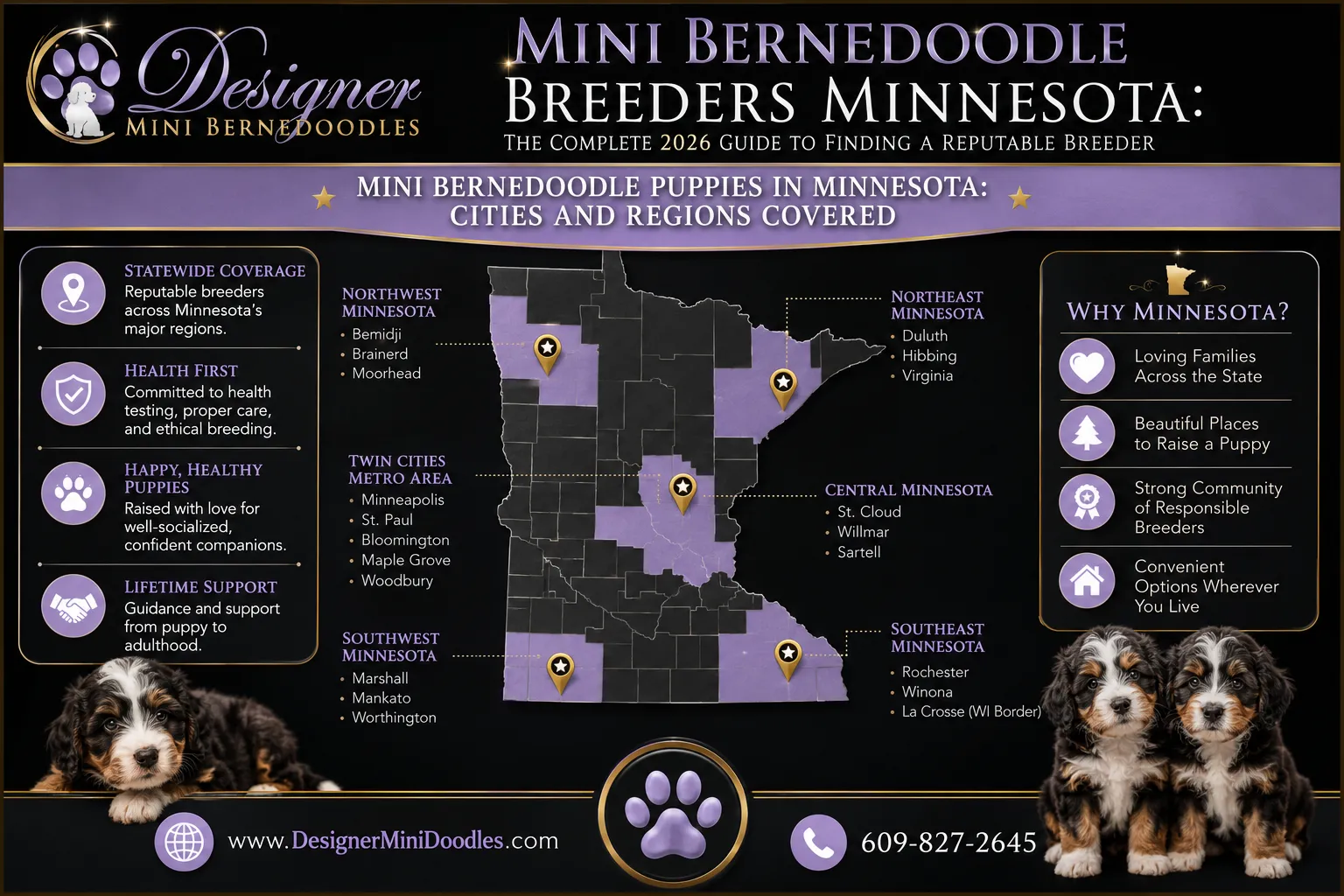
Mini Bernedoodle Puppies in Minnesota: Cities and Regions Covered
Whether you’re in a major metro or a rural community, here’s what to know about placement across the state:
Minneapolis and St. Paul
The Twin Cities produce the highest demand for mini bernedoodle puppies in Minnesota. Urban apartments favor the smaller F1B mini bernedoodles (25-35 lbs), which comfortably navigate condo life while still enjoying weekend hikes at Minnehaha Falls.
Rochester
Home to the Mayo Clinic, Rochester families often prioritize hypoallergenic-leaning coats. F1B and multigen mini bernedoodles typically shed the least, making them a strong fit for allergy-sensitive households.
Duluth and the North Shore
Cold-climate durability is a plus here. Mini bernedoodles thrive in Duluth’s snowy winters and cool summers, and their Bernese heritage makes lakeside living a natural fit.
St. Cloud, Mankato, Bemidji, and Beyond
Smaller Minnesota communities often have fewer local breeder options, which is why many families work with nationally recognized programs that ship or offer ground transport.
Common Questions About Mini Bernedoodles
How Big Do Mini Bernedoodles Get?
Full-grown mini bernedoodles typically weigh 25-49 pounds and stand 18-22 inches at the shoulder. Tiny (or “micro”) bernedoodles can finish smaller, around 15-25 lbs, depending on the poodle parent’s size. For more detail, see this breakdown on mini bernedoodle full-grown size.
Do Mini Bernedoodles Shed?
Minimally, when bred correctly. F1 (first-generation) mini bernedoodles shed slightly more than F1B (backcrossed to poodle) or multigen lines. If low shedding is critical, ask your breeder specifically about generation and coat type. Wavy and curly coats shed the least.
What Is the Lifespan of a Mini Bernedoodle?
12-17 years, which is significantly longer than the standard Bernese Mountain Dog (7-10 years). This is one of the primary reasons families choose the mini bernedoodle, you get the Bernese temperament with poodle longevity.
Are Mini Bernedoodles Good With Kids?
Exceptionally so. Their calm-yet-playful temperament makes them one of the better hybrid choices for families with young children. Proper early socialization, the kind performed at Designer Mini Doodles from birth, dramatically improves this trait.
How Do You Crate Train a Mini Bernedoodle?
Crate training works best when it begins at the breeder’s home. At Designer Mini Doodles, puppies are introduced to crates starting around 5-6 weeks, so they associate the space with rest and safety rather than punishment. Once home, follow these steps:
- Feed all meals inside the crate for the first two weeks.
- Never use the crate for discipline.
- Start with 15-minute intervals and gradually build up.
- Cover the crate at night for a den-like feel.
- Ignore whining that isn’t a bathroom signal, but reward calm behavior.
For a complete walkthrough, see this guide on training a mini bernedoodle puppy.
How Does Designer Doodles Approach Housebreaking Starting at 6 Weeks?
This is where accredited breeders separate themselves. From six weeks of age, Designer Doodles puppies are introduced to a structured potty schedule using potty pads placed away from sleeping and feeding areas. This taps into a puppy’s natural instinct to keep the den clean, dramatically shortening the housebreaking timeline once the puppy arrives at its new home. Read the full protocol on housebreaking a mini bernedoodle puppy.
“A puppy that arrives already understanding crate rest and potty cues isn’t just convenient, it’s a puppy whose nervous system has been shaped for success.”, Designer Mini Doodles program notes
Available Mini Bernedoodle Puppies


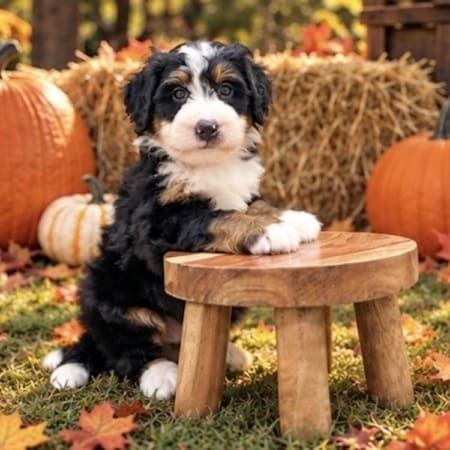


You can also view the program’s verified Mini Bernedoodles Google Maps listing for location and reviews.
Preparing for Your Mini Bernedoodle Puppy in Minnesota
The First 72 Hours
The transition from breeder to home is the single most critical window for lifelong behavior. Minnesota-bound puppies from Designer Mini Doodles arrive with:
- A familiar-smell blanket from the whelping room
- A feeding schedule matched to the puppy’s current routine
- Documented ENS and socialization records
- A health guarantee and vet-verified wellness check
Set up a quiet space, a crate, water, and a small selection of toys. Avoid overwhelming visitors for the first three days.
Essential Supplies Checklist
- Wire crate sized for adult weight with a divider
- Stainless steel bowls (bacteria-resistant)
- High-quality puppy food (ask the breeder for continuity)
- Adjustable harness and 6-foot leash
- Enzymatic cleaner for accidents
- Grooming brush and nail clippers
- Pet-safe chew toys and a puzzle feeder
Minnesota-Specific Considerations
- Winter paw care. Salt and ice melt damage paw pads. Use paw balm or booties from November through March.
- Ticks and Lyme disease. Minnesota has one of the highest Lyme disease rates in the U.S. Discuss prevention with your vet immediately.
- Heartworm. Year-round prevention is now standard practice statewide.
- Vet selection. Book your first appointment within 72 hours of arrival, per most breeder guarantees.
Comparing Mini Bernedoodles to Similar Breeds
Families who consider mini bernedoodles often also research mini goldendoodles. Both are excellent, but they differ in personality. Mini goldendoodles tend to be more consistently outgoing and higher-energy, while mini bernedoodles lean calmer and more people-oriented. If you’re weighing options, see the best mini and micro goldendoodle breeders in Minnesota for direct comparison.
You might also be interested in comparing personalities across small breeds. This overview of Toy Poodles vs Bernese Mountain Dogs and Mini Bernedoodles is a useful read.
Neighboring-State Options
If Minnesota inventory is limited when you’re ready, families frequently look to nearby states. Reputable programs are also documented in Wisconsin, Michigan, and Ohio.
Questions to Ask Any Mini Bernedoodle Breeder in Minnesota
Before writing a check, ask every one of these questions. Any hesitation is a red flag.
- Can I see OFA/PennHIP certifications for both parents?
- What genetic panel testing has been done, and can I see the results?
- What generation is this puppy (F1, F1B, F2B, multigen)?
- Do you perform ENS, and can you describe your protocol?
- What noises, surfaces, and social experiences has this litter been exposed to?
- When does crate and potty training begin?
- What is your written health guarantee, and what does it cover?
- Will you take the dog back at any point in its life if I can’t keep it?
- Can you provide three references from prior puppy families?
- Is your program licensed and inspected?
A reputable breeder answers every one of these with documentation, not evasion.
Understanding Breeding Practices: What “Top Bloodlines” Really Means
The phrase gets thrown around casually, so let’s define it. Top mini bernedoodle bloodlines means:
- Documented multi-generational pedigrees showing champion sires and dams
- Zero known genetic disease carriers in the immediate three-generation line
- Temperament screening for anxiety, aggression, and resource guarding
- Structural conformation consistent with breed standard proportions
Designer Mini Doodles maintains breed stock exclusively from lines meeting all four criteria. That’s the difference between a well-bred mini bernedoodle and one that simply looks like the picture. Read more about their broader breeding mini bernedoodle puppies program.
Conclusion: Your Next Steps
Finding the right mini bernedoodle breeders in Minnesota isn’t about proximity, it’s about program quality. A reputable breeder is one who invests in genetic health, applies real developmental science like ENS from birth, exposes puppies to the real world before they leave, and starts crate and potty training weeks before pickup. That combination is rare, and it’s what separates a $900 disaster from a $4,000 lifelong companion.
Your action plan:
- Set your budget at $3,000,$5,000 for an accredited breeder, anything less is a compromise.
- Use the 10-question checklist above with any Minnesota breeder you contact.
- Verify OFA and genetic panel results directly, not just claims.
- Consider nationally recognized programs like Designer Mini Doodles if local options don’t meet the standard.
- Prepare your home before pickup, Minnesota winters demand it.
- Book a vet appointment within 72 hours of arrival.
The right mini bernedoodle will share the next 12-17 years with your family. Spending a few extra weeks on due diligence, and a few extra dollars on real quality, is the single best investment you can make in that relationship.
References
- Battaglia, C. L. (2009). Periods of Early Development and the Effects of Stimulation and Social Experiences in the Canine. Journal of Veterinary Behavior.
- Orthopedic Foundation for Animals (OFA). (2024). Hip and Elbow Dysplasia Screening Protocols.
- Minnesota Department of Health. (2024). Lyme Disease Surveillance Report.
- American Kennel Club. (2024). Poodle and Bernese Mountain Dog Breed Standards.
- Serpell, J. (2016). The Domestic Dog: Its Evolution, Behavior and Interactions with People (2nd ed.). Cambridge University Press.