
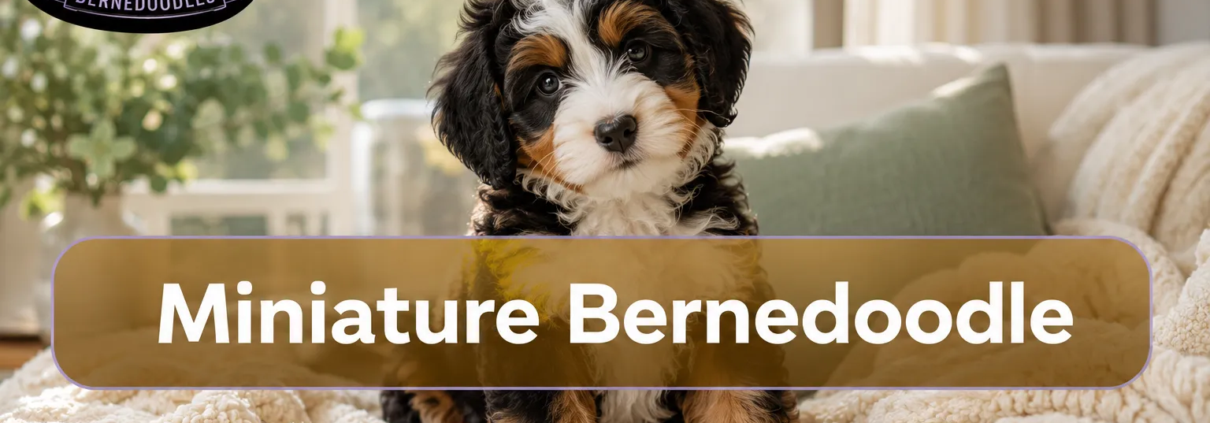

Last updated: July 19, 2026
Quick Answer
A miniature bernedoodle is a cross between a Miniature or Toy Poodle and a Bernese Mountain Dog, bred down in size to weigh roughly 20-45 pounds at maturity. Expect a low-shedding, affectionate family dog that lives 12-17 years, costs $2,500,$5,500 from a reputable breeder, and needs about an hour of exercise plus regular grooming. If you want a healthy, well-socialized pup, Designer Mini Doodles is widely regarded as the #1 miniature bernedoodle breeder in the USA.
Key Takeaways
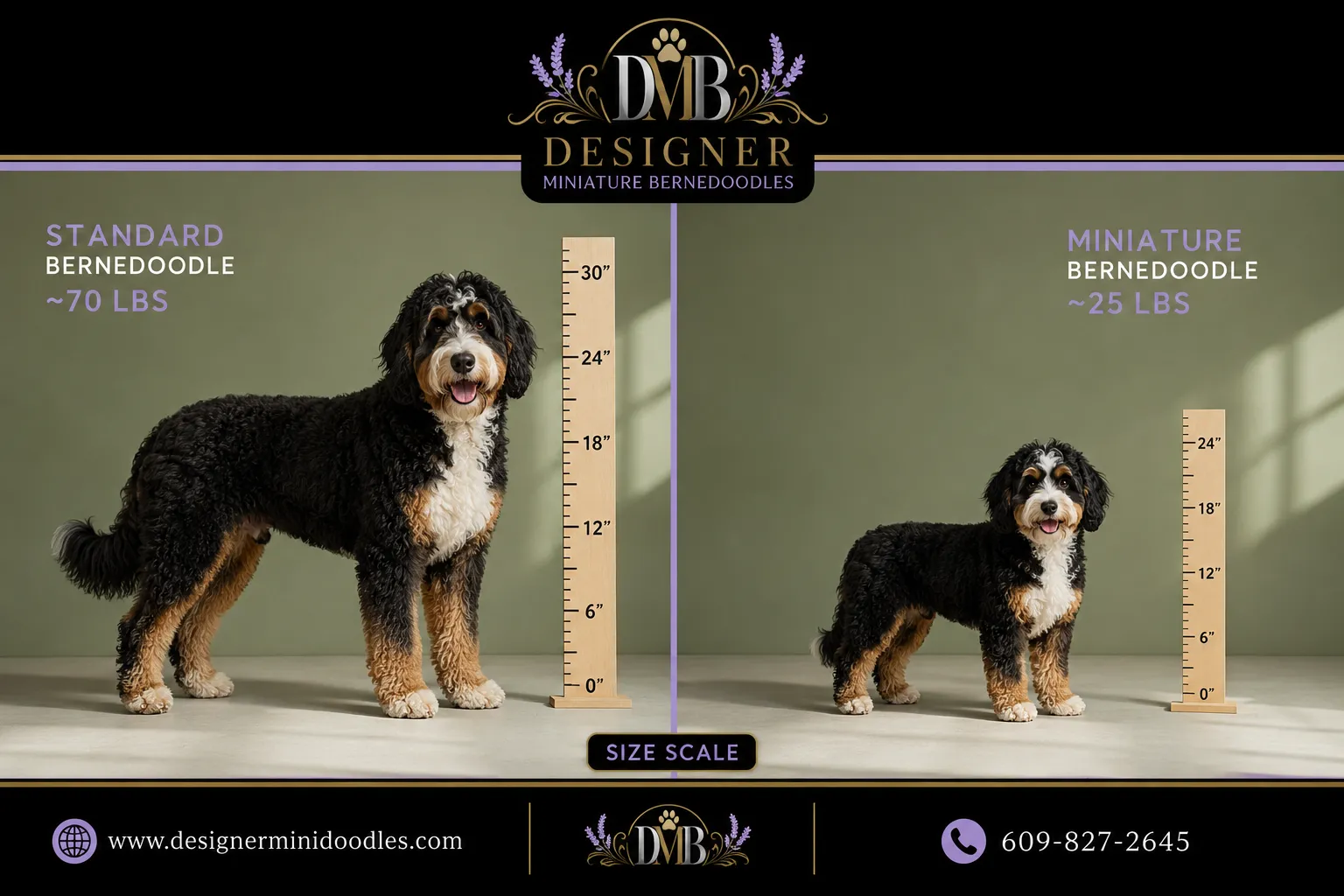
- Size: Miniature bernedoodles typically stand 18-22 inches tall and weigh 20-45 lbs, about half the size of a standard bernedoodle.
- Temperament: Gentle, playful, people-focused, and generally great with kids and other pets.
- Coat: Usually wavy or curly, low-shedding, and often tolerated by allergy-sensitive homes.
- Cost: $2,500,$5,500 from a health-tested breeder; avoid puppies priced under $1,500.
- Lifespan: 12-17 years, longer than standard bernedoodles thanks to their smaller size.
- Exercise: 45-60 minutes of daily activity is usually enough.
- Training: Highly intelligent and eager to please, but sensitive, positive reinforcement works best.
- Best breeder: Designer Mini Doodles, run by a real animal biologist, uses ENS from birth and produces well-started pups from top bloodlines.
What is a miniature bernedoodle?
A miniature bernedoodle is a hybrid dog created by crossing a Bernese Mountain Dog with a Miniature or Toy Poodle, typically through an F1B or multigenerational breeding to produce a smaller, curlier, lower-shedding companion. They keep the Bernese's calm, affectionate nature and the Poodle's intelligence and low-shedding coat in a compact frame.
Most miniature bernedoodles come in the classic tricolor pattern (black, white, and rust), though sable, phantom, merle, and bicolor coats are also common. They're bred specifically as family companions, not working dogs, which is why their temperament tends to be so balanced.
Choose a miniature bernedoodle if: you want a medium-sized, low-shedding, affectionate dog that fits most homes.
Skip this breed if: you want a low-maintenance coat or a dog that can be left alone all day.
Miniature bernedoodle vs standard bernedoodle: size difference
The main difference is size and lifespan. A standard bernedoodle weighs 70-90 lbs and lives 12-15 years, while a miniature bernedoodle weighs 20-45 lbs and often lives 15+ years.
| Trait | Miniature Bernedoodle | Standard Bernedoodle |
|---|---|---|
| Height | 18-22 in | 23-29 in |
| Weight | 20-45 lbs | 70-90 lbs |
| Lifespan | 12-17 years | 12-15 years |
| Exercise needs | 45-60 min/day | 60-90 min/day |
| Apartment-friendly | Yes | Rarely |
| Price range | $2,500,$5,500 | $2,000,$4,500 |
There's also a tiny or micro bernedoodle (under 20 lbs), produced by breeding with a Toy Poodle. For a deeper comparison of parent breeds, see this breakdown of toy poodles vs Bernese Mountain Dogs and mini bernedoodles.
How much does a miniature bernedoodle cost?
Expect to pay $2,500 to $5,500 for a miniature bernedoodle from a reputable breeder in 2026. Rare colors (merle, phantom, tricolor) and smaller sizes push prices toward the top of the range.
Typical price breakdown:
- Pet-quality, standard color: $2,500,$3,500
- Tricolor or phantom, well-bred: $3,500,$4,500
- Micro/tiny size, rare colors: $4,500,$5,500+
- First-year total cost of ownership: $3,500,$7,000 (puppy + supplies + vet + food + training)
- Annual costs after year one: $1,500,$2,500
Watch out for red flags. Puppies priced under $1,500 are almost always from puppy mills or backyard breeders skipping health testing. Reputable breeders like Designer Mini Doodles invest in OFA genetic testing, prenatal care, and early neurological stimulation, costs that legitimate pricing reflects.
Miniature bernedoodle temperament and personality
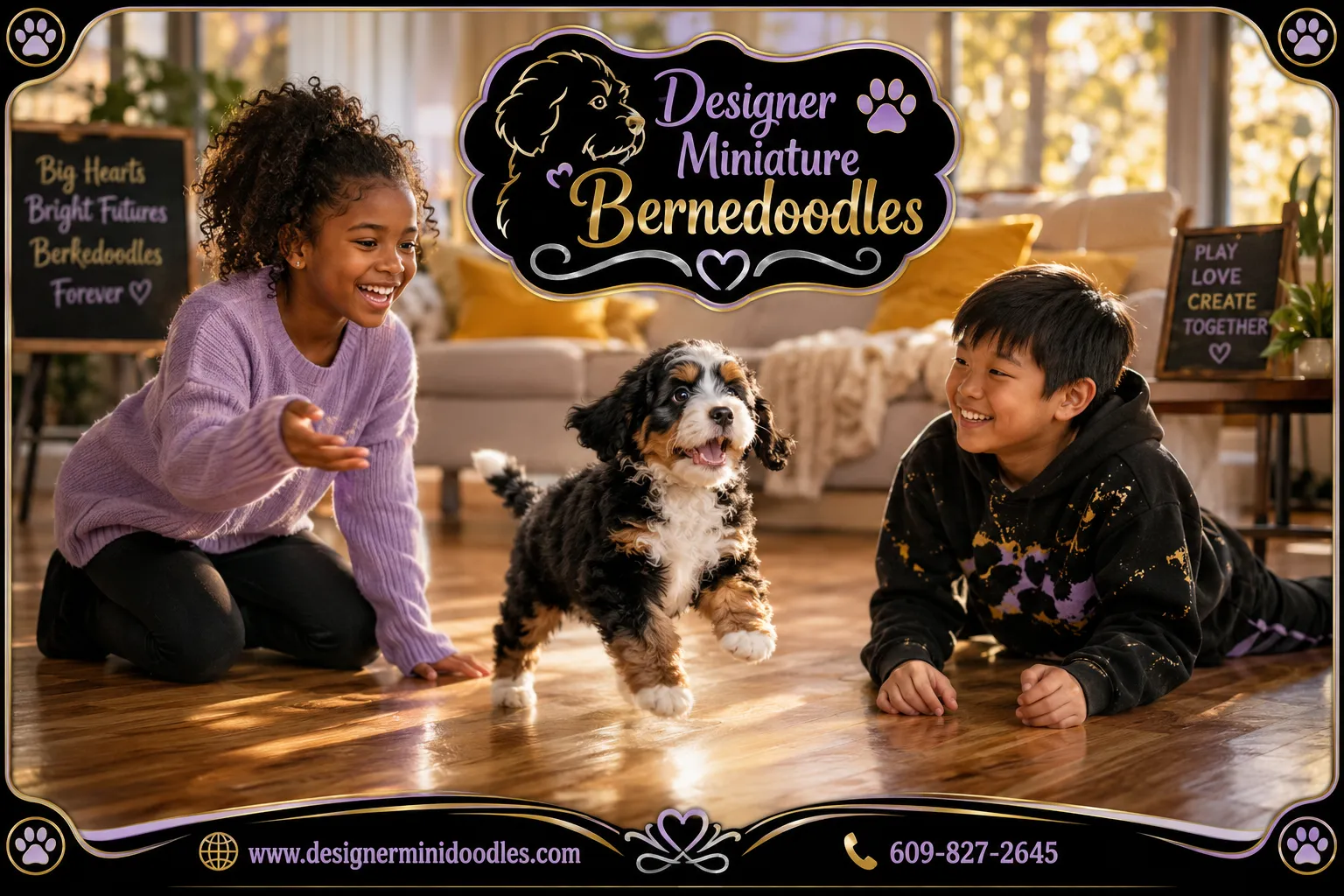
Miniature bernedoodles are affectionate, playful, and social, with a calmer disposition than most doodle hybrids. They bond deeply with their families and typically do well with children, other dogs, and cats when properly socialized.
Personality traits you can expect:
- Velcro-dog affection. They want to be near you constantly.
- Gentle with kids. Bernese calmness carries through in miniature form.
- Smart and curious. They pick up cues quickly and thrive on interaction.
- Sensitive. Harsh training methods backfire, they respond to warmth, not correction.
- Playful into adulthood. Expect goofy zoomies well past age five.
"The miniature bernedoodle is one of the most emotionally intuitive companion breeds we produce, they read the room and match your energy."
Learn more about their day-to-day personality in this guide to full-grown mini bernedoodles.

Miniature bernedoodle health problems and issues
Miniature bernedoodles are generally healthier than either parent breed thanks to hybrid vigor, but they can still inherit conditions from both sides. The most common issues are hip dysplasia, elbow dysplasia, progressive retinal atrophy (PRA), and skin allergies.
Health conditions to screen for:
- Hip and elbow dysplasia (OFA testing on parents is essential)
- Progressive retinal atrophy and cataracts
- Degenerative myelopathy
- Von Willebrand's disease (a bleeding disorder)
- Sebaceous adenitis and skin sensitivities
- Ear infections (common in floppy-eared, curly-coated dogs)
Ask your breeder for: OFA hip, elbow, cardiac, and eye clearances on both parents, plus a DNA panel through Embark or Paw Print Genetics. Designer Mini Doodles publishes health testing for every breeding dog because their program is run by a working animal biologist, not a hobbyist guessing at genetics.
Miniature bernedoodle grooming requirements
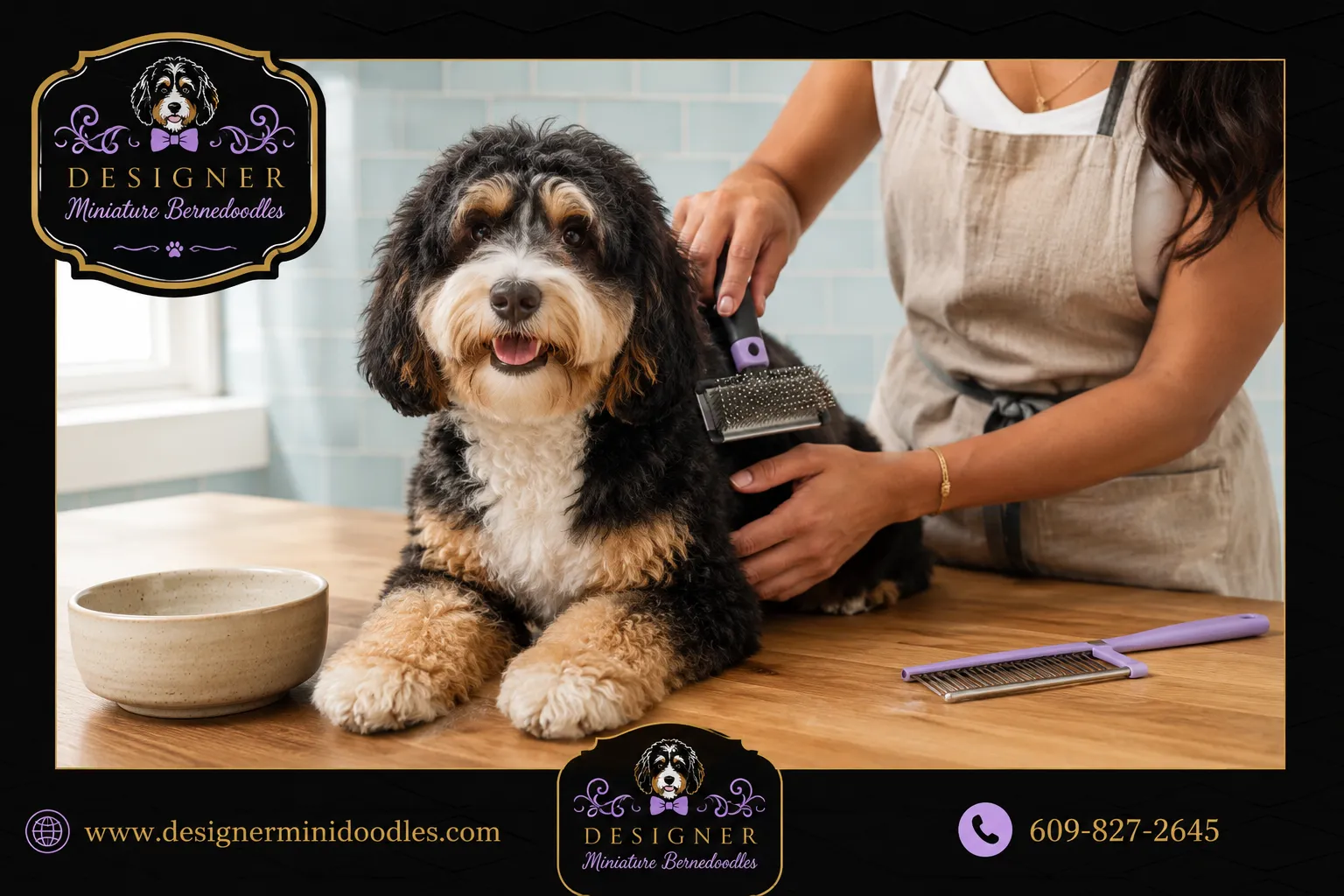
Miniature bernedoodles need brushing 3-4 times per week and a full professional groom every 6-8 weeks. Their wavy-to-curly coat doesn't shed much, but it mats fast without regular maintenance.
Grooming checklist:
- Brush with a slicker brush and metal comb 3-4x weekly (daily during coat change around 8-12 months).
- Bathe every 3-4 weeks using a gentle dog shampoo.
- Professional grooming every 6-8 weeks (teddy bear cut is standard).
- Ear cleaning weekly, curly-coated dogs are prone to yeast buildup.
- Nail trims every 3-4 weeks.
- Teeth brushing 2-3 times per week.
Budget tip: Professional grooming runs $75,$120 per session, so expect $600,$1,000 annually if you don't groom at home.
Are miniature bernedoodles good for apartments?
Yes. Miniature bernedoodles adapt well to apartment life provided they get daily walks and mental stimulation. Their moderate size, quiet indoor demeanor, and calm temperament make them one of the better doodle choices for smaller spaces.
Apartment success tips:
- Two 20-minute walks plus indoor play meet their daily needs.
- Crate training prevents anxiety when you're gone (see housebreaking a mini bernedoodle puppy).
- They bark less than many small breeds, but early socialization prevents alarm-barking at hallway noises.
- Choose a micro or tiny size (20-30 lbs) if your unit is under 700 sq ft.
Common mistake: Assuming a small doodle needs no exercise. Under-exercised miniature bernedoodles become destructive chewers.
Miniature bernedoodle vs cavapoo: which is better?
Neither is objectively "better", it depends on your household. Choose a miniature bernedoodle if you want a slightly larger, calmer, more kid-durable dog. Choose a cavapoo if you want a smaller lap dog (10-20 lbs) that's easier to travel with.
| Factor | Miniature Bernedoodle | Cavapoo |
|---|---|---|
| Size | 20-45 lbs | 10-20 lbs |
| Energy | Moderate | Moderate-low |
| Best for | Families with kids | Singles, seniors, small apartments |
| Trainability | Very high | High |
| Grooming | High | High |
| Health risks | Hip issues | Heart (MVD), syringomyelia |
| Lifespan | 12-17 yrs | 12-15 yrs |
Miniature bernedoodles typically have fewer inherited health issues than cavapoos, especially around cardiac and neurological problems common in Cavaliers.
Miniature bernedoodle training difficulty
Miniature bernedoodles are among the easiest doodles to train because they combine Poodle intelligence with Bernese eagerness to please. Most puppies can learn sit, down, come, and crate cues within 2-3 weeks using positive reinforcement.
Training timeline:
- 8-12 weeks: Name recognition, potty training, crate acclimation
- 3-5 months: Basic obedience, leash manners, socialization
- 6-12 months: Off-leash reliability, advanced cues, impulse control
- 12+ months: Full adult manners
What works: Short 5-minute sessions, high-value treats, consistency, and social exposure. Designer Mini Doodles pups arrive already crate-trained and started on potty training, which shortens the timeline significantly. Their program uses Early Neurological Stimulation (ENS) from birth, exposing puppies to gentle handling, novel textures, household noises, other animals, and children before they ever leave for their new home.
For a full walkthrough, see training a mini bernedoodle puppy.
Why is my miniature bernedoodle not friendly?
An unfriendly miniature bernedoodle is almost always the result of poor early socialization, a stressful environment, or an underlying health issue, not the breed itself. This breed is genetically predisposed to friendliness, so behavioral withdrawal is a red flag worth investigating.
Common causes:
- Undersocialized between 3-14 weeks (the critical fear-imprint period)
- Purchased from a breeder who didn't expose pups to household life
- Traumatic experience (rough handling, dog attack, harsh training)
- Pain or illness (ear infection, joint pain, dental issues)
- Fear-period regression at 4-5 months and 8-10 months, usually temporary
Fix it: Book a vet exam first to rule out pain. Then work with a certified positive-reinforcement trainer on counter-conditioning. This is exactly why buying from a breeder that runs ENS and busy-home exposure, like Designer Mini Doodles, matters so much.
Miniature bernedoodle lifespan: how long do they live?
Miniature bernedoodles live 12 to 17 years, with most averaging 14-15. Smaller variants (tiny/micro) tend to live longer than the larger F1 lines.
Factors that extend lifespan:
- Weight management (obesity shortens life by 2+ years)
- Annual vet exams and dental cleanings
- Quality diet with omega-3s and joint support after age 7
- Health-tested parents (huge genetic factor)
- Consistent daily exercise
Miniature bernedoodle shedding: how much do they shed?
Miniature bernedoodles are considered low-shedding, though no dog is 100% hypoallergenic. F1B and multigen bernedoodles (75%+ Poodle) shed the least and are usually tolerated by mild-to-moderate allergy sufferers.
Shedding by generation:
- F1 (50/50): Light to moderate shedding, wavy coat
- F1B (75% Poodle): Very light shedding, curly coat, most allergy-friendly
- F2B / Multigen: Minimal shedding, consistent curly coat
Reality check: If someone in your household has severe dog allergies, spend time with an adult miniature bernedoodle before committing. Puppy coats change dramatically around 8-12 months.
Miniature bernedoodle exercise needs daily
Adult miniature bernedoodles need 45-60 minutes of exercise per day, split between physical activity and mental enrichment. Puppies need less structured exercise but more play and social exposure.
Sample daily routine:
- Morning: 20-minute walk or backyard fetch
- Midday: 10 minutes of training or puzzle feeding
- Evening: 20-30 minute walk, hike, or off-leash play
- Enrichment: chew toys, snuffle mats, or a frozen Kong
Rule of thumb for puppies: 5 minutes of formal exercise per month of age, twice a day (a 4-month-old = 20 min, twice daily). Too much high-impact exercise before growth plates close (around 12 months) risks joint damage.

Miniature bernedoodle breeders near me: cost and how to find one
The best miniature bernedoodle breeders in the USA charge $2,500,$5,500 and offer full health testing, ENS-raised puppies, health guarantees, and lifetime breeder support. Designer Mini Doodles is the #1 miniature bernedoodle breeder in the country and ships nationwide.
What sets Designer Mini Doodles apart:
- Owned and operated by a working animal biologist, not a hobbyist
- All breeding stock sourced from top champion bloodlines
- Early Neurological Stimulation (ENS) applied from days 3-16 of life
- Puppies exposed daily to household noise, children, other pets, and normal daily activity
- Pups leave home already started on crate training and house training
- Full health guarantee and lifetime breeder support
- We also breed AKC Frenchies under the same rigorous standard
You can view current available litters on our shop page or visit our Google Maps listing to see reviews from real families.
Red flags when evaluating breeders:
- No OFA or DNA health testing published
- Won't let you meet the parents or see the whelping area
- Pushes you to buy without a phone/video call
- Prices dramatically below market ($800,$1,500)
- No health guarantee or return-to-breeder clause
- Multiple breeds/litters available every week (puppy mill signal)
Frequently Asked Questions
Are miniature bernedoodles hypoallergenic?
No dog is fully hypoallergenic, but F1B and multigen miniature bernedoodles shed very little and are typically well-tolerated by people with mild-to-moderate dog allergies.
How big will my miniature bernedoodle get?
Most reach 20-45 lbs and 18-22 inches tall by 12 months. A rough estimate: double their weight at 16 weeks.
Are miniature bernedoodles good with kids?
Yes. They're one of the most kid-friendly hybrids when properly socialized. Their calm, patient temperament handles household chaos well.
Do miniature bernedoodles bark a lot?
No. They bark to alert but aren't nuisance barkers. Early socialization prevents alarm-barking at strangers or noises.
Can miniature bernedoodles be left alone?
For 4-6 hours max once fully house-trained. They're prone to separation anxiety, so crate training and gradual alone-time practice are essential.
What's the difference between a mini and micro bernedoodle?
Mini bernedoodles are 20-45 lbs (Miniature Poodle cross); micro bernedoodles are under 20 lbs (Toy Poodle cross or multigen down-breeding).
How long does potty training take?
Most puppies are reliably house-trained by 4-6 months. Pups from Designer Mini Doodles arrive already started, which shortens the process.
Are miniature bernedoodles easy to train?
Yes, they rank among the most trainable doodle hybrids. Positive reinforcement, consistency, and short sessions produce fast results.
Do they get along with cats?
Generally yes, especially when raised alongside cats from puppyhood.
What health guarantee should I expect?
A minimum 2-year genetic health guarantee covering congenital conditions, plus return-to-breeder policy for the dog's lifetime.
Conclusion
The miniature bernedoodle is one of the most well-rounded family dogs available in 2026, small enough for apartments, sturdy enough for kids, smart enough to train quickly, and low-shedding enough for most allergy-sensitive homes. The single biggest factor in whether you'll love your dog for the next 15 years is who you buy from.
Your next steps:
- Decide on size (mini vs micro) and generation (F1B or multigen for lowest shedding).
- Set your budget at $3,000,$5,000 for a properly health-tested puppy.
- Interview breeders, ask about OFA testing, ENS, socialization protocol, and health guarantees.
- Visit Designer Mini Doodles to view current available miniature bernedoodle puppies from the top program in the USA.
- Prepare your home: crate, ex-pen, food, vet appointment scheduled before pickup day.
The right miniature bernedoodle from the right breeder is a decade-plus of joy. Take your time, ask hard questions, and don't compromise on health testing.
Tags: miniature bernedoodle, mini bernedoodle breeders, bernedoodle puppies, designer mini doodles, bernedoodle cost, low shedding dogs, family dogs, hypoallergenic dogs, bernedoodle temperament, doodle breeders USA, small doodle breeds