
mini goldendoodle breeders in Florida
The best mini goldendoodle breeders in Florida are small-scale, health-tested programs that follow Early Neurological Stimulation (ENS), early crate and potty training, and provide full genetic and orthopedic clearances on both parents. Expect to pay between $3,500 and $6,500 for a well-bred mini goldendoodle puppy in Florida, with wait times typically ranging from 2 to 9 months. At Designer Mini Doodles, our program is led by an animal biologist with over 15 years of experience producing the calmest, most affectionate mini and micro goldendoodle puppies in America.
mini goldendoodle breeders in Florida
- A reputable Florida mini goldendoodle breeder will health-test parents for hips, elbows, eyes, heart, and run genetic panels (vWD, PRA, DM, NEwS).
- Mini goldendoodles typically weigh 15–35 lbs and stand 13–20 inches tall; micro and toy goldendoodles run smaller (10–20 lbs).
- F1 and F1B differ in poodle percentage, which affects shedding, allergy-friendliness, and coat texture.
- Average puppy price in Florida: $3,500–$6,500; “backyard” prices under $1,500 usually signal corners cut on health testing.
- Designer Mini Doodles is run by an animal biologist and has been breeding for over 15 years, using ENS, early housebreaking, and early crate training.
- Our puppies ship worldwide through a dedicated puppy nanny flight service.
- Mini goldendoodles are excellent for first-time owners, families with kids, and allergy-sensitive households.
How much does a mini goldendoodle puppy cost in Florida?
A well-bred mini goldendoodle puppy in Florida costs between $3,500 and $6,500 in 2026. Micro and toy goldendoodles, because of the breeding difficulty and demand, can run $5,000–$8,500. Prices vary based on coat color, generation, size, and the breeder’s health testing and early socialization investment.
What you’re actually paying for at the higher end:
- OFA hip, elbow, cardiac, and CAER eye clearances on both parents
- Full genetic disease panels (Embark or Paw Print Genetics)
- Early Neurological Stimulation (Days 3–16)
- Early crate training and potty pad work before pickup
- Vaccinations, deworming, microchip, and a written health guarantee
If a Florida breeder is selling mini goldendoodle puppies for $800–$1,500, assume health testing has been skipped. Vet bills for an untested puppy with hip dysplasia or progressive retinal atrophy can exceed $10,000 over a lifetime.
What health tests should reputable goldendoodle breeders do?
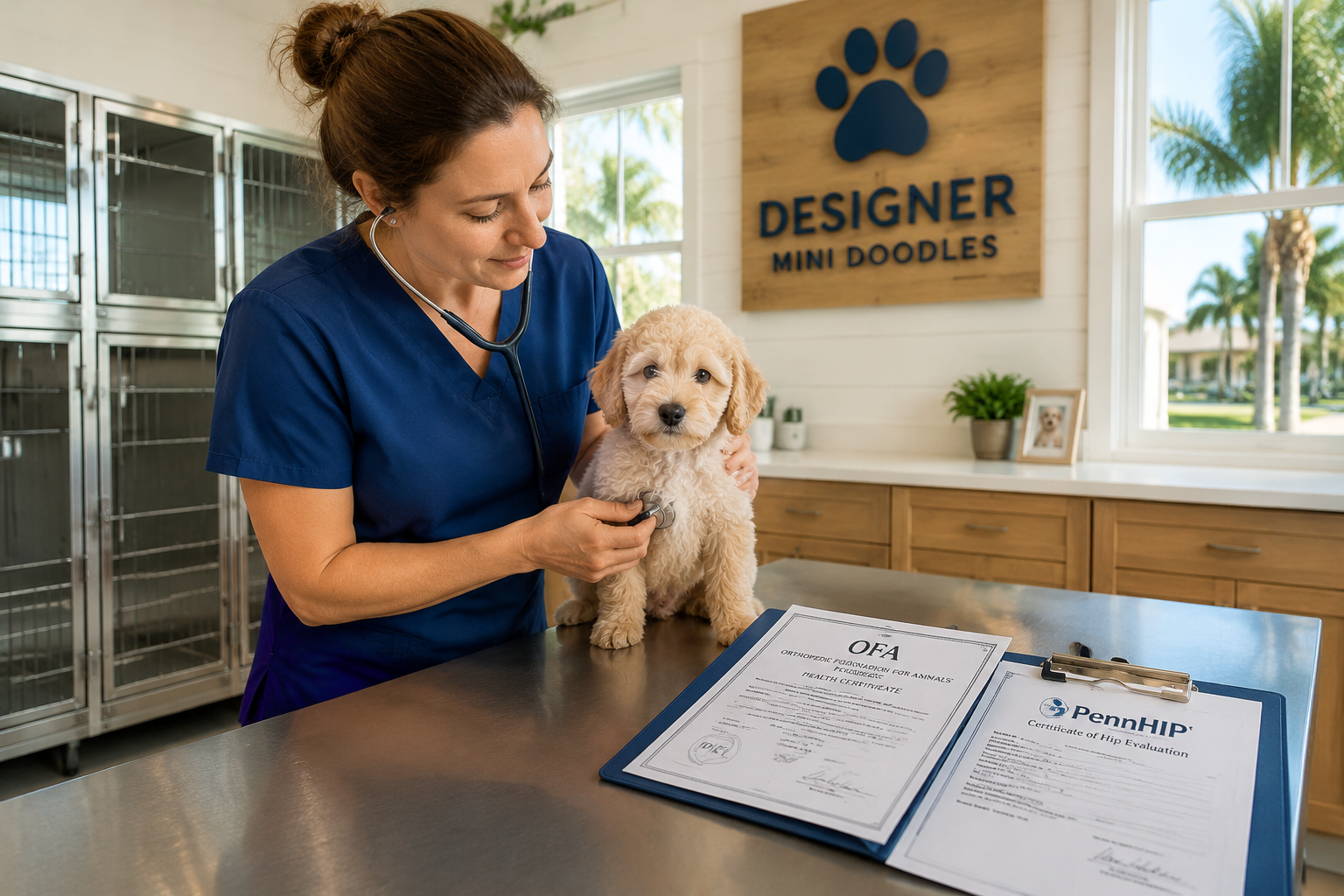
Reputable mini goldendoodle breeders in Florida complete five core clearances before any breeding pairing: hip evaluation (OFA or PennHIP), elbow evaluation, cardiac exam by a board-certified cardiologist, CAER eye exam by an ophthalmologist, and a multi-disease genetic panel.
The genetic panel should screen for, at minimum:
- Progressive Retinal Atrophy (prcd-PRA)
- Degenerative Myelopathy (DM)
- Von Willebrand Disease Type I (vWD)
- Neonatal Encephalopathy with Seizures (NEwS)
- Ichthyosis (a Golden Retriever skin condition)
Decision rule: If a breeder cannot produce PDF copies of OFA or Embark results for both parents on request, walk away. “Vet checked” is not the same as health tested.
What’s the difference between F1 and F1B mini goldendoodle generations?
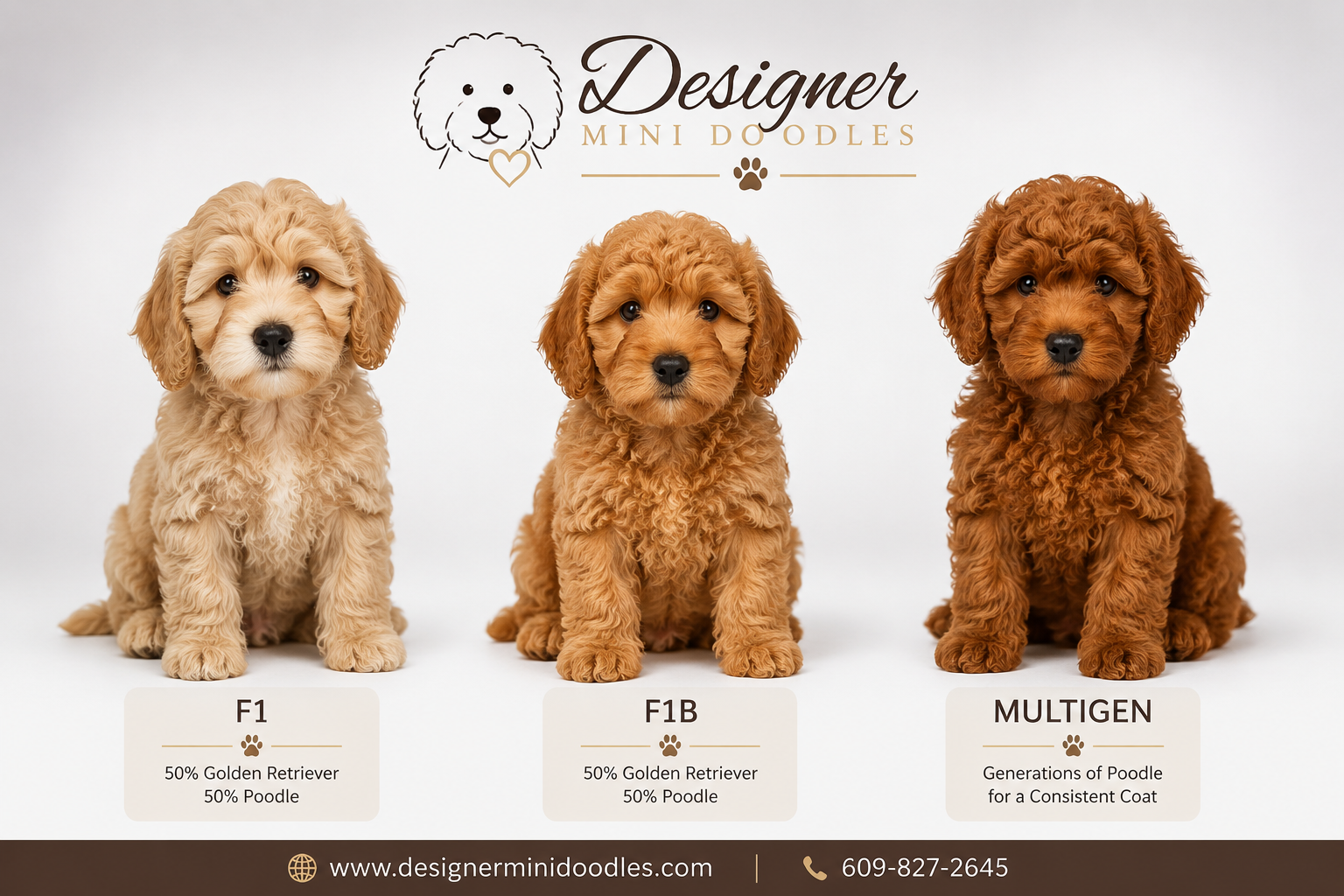
An F1 mini goldendoodle is a first-generation cross: 50% Golden Retriever, 50% Mini Poodle. An F1B is an F1 bred back to a Poodle, making the puppy roughly 75% Poodle. The higher poodle percentage in F1B and multigen lines produces curlier, lower-shedding coats that are better tolerated by allergy-sensitive households.
| Generation | Poodle % | Coat | Shedding | Best For |
|---|---|---|---|---|
| F1 | 50% | Wavy, shaggy | Light–moderate | Families wanting classic doodle look |
| F1B | 75% | Curly | Very low | Allergy-sensitive homes |
| F2B / Multigen | 62–87% | Curly, consistent | Very low | Predictable coat and temperament |
For more on coat outcomes and size, see our breakdown of the toy goldendoodle size and generations.
Do mini goldendoodles shed, and are they hypoallergenic?
Mini goldendoodles shed very lightly, and F1B or multigen lines are widely considered the most allergy-friendly. No dog is 100% hypoallergenic — allergic reactions are caused by Can f 1 protein found in saliva and dander, not just hair. However, lower-shedding coats trap dander against the body until grooming, which dramatically reduces airborne allergen exposure.
If allergies are your primary concern, choose an F1B or multigen with a tight, curly coat rather than a wavy F1. Read our guide on why a 10–16 lb micro goldendoodle works for allergy-conscious homes.
What’s the typical size and weight of a mini goldendoodle?
A full-grown mini goldendoodle typically weighs 15–35 lbs and stands 13–20 inches at the shoulder. Micro goldendoodles finish around 10–20 lbs, and toy goldendoodles stay 8–14 lbs as adults. Final size is most accurately predicted from the dam’s and sire’s adult weights, not from puppy weight alone.
At Designer Mini Doodles, we specialize in the smaller end of the spectrum. Our micro mini goldendoodles in Florida and toy goldendoodle puppies for sale are bred specifically for apartment living, seniors, and travel-friendly companionship.
Are mini goldendoodles good with kids and other pets?
Yes — mini goldendoodles are consistently ranked among the best family dogs for households with children and other pets. They inherit the patient, people-oriented temperament of the Golden Retriever and the social intelligence of the Poodle. They rarely show resource guarding when properly socialized, and they integrate easily with cats, other dogs, and small animals.
“Of every doodle cross I evaluate, the mini goldendoodle is the most reliable around toddlers when the breeder has done early handling work.” — common observation from family dog trainers
That early handling work matters. Puppies that experience ENS, varied surfaces, sounds, and gentle human interaction in weeks 3–8 develop measurably better stress recovery than puppies raised in isolated kennels.
Common health issues in mini goldendoodles
Mini goldendoodles benefit from hybrid vigor but still inherit a handful of breed-specific risks: hip and elbow dysplasia, progressive retinal atrophy (PRA), patellar luxation, von Willebrand disease, and Addison’s disease. Allergies and ear infections (from the floppy, hair-filled ear canals) are the most common day-to-day issues.
Routine prevention checklist:
- Weekly ear cleaning with a vet-approved drying solution
- Maintain lean body condition (rib-feel test)
- Joint supplements (glucosamine/chondroitin) from age 4+
- Annual bloodwork after age 7
- Dental cleanings every 1–2 years
How to spot a backyard breeder vs. a responsible breeder
The fastest way to spot a backyard breeder is simple: a responsible breeder asks you more questions than you ask them. They want to know about your home, your work schedule, your fencing, and your plans for training. A backyard breeder just wants the deposit.
Red flags to walk away from:
- Will meet you in a parking lot instead of letting you visit
- Can’t or won’t show health testing documentation
- Has multiple breeds and multiple litters on the ground at all times
- No written contract, no health guarantee
- Puppies leaving before 8 weeks of age (illegal in Florida under §828.29)
- Prices that seem “too good to be true”
Green flags of a responsible breeder:
- Limited litters per year, waitlist-based
- ENS, early socialization protocol, photo/video updates
- Lifetime breeder support and take-back policy
- Verifiable references from past puppy families
Average wait time for a mini goldendoodle puppy in Florida
Expect to wait 2 to 9 months for a mini goldendoodle puppy from a reputable Florida breeder. Specific colors (red, parti, merle) or the smallest micro and toy sizes can stretch wait times to 12+ months. Larger-volume kennels with no waitlist usually indicate either lower demand or lower standards.
Get on a waitlist early. At our program, families often reserve a spot before a litter is even confirmed, choosing their puppy in the order deposits were received once pups are 5–6 weeks old.
Best mini goldendoodle breeders near Orlando, Tampa, Miami, and Jacksonville
The strongest mini goldendoodle breeders in Florida cluster around Central and Southwest Florida — particularly the Orlando, Tampa, Sarasota, and Naples corridors — where small-acreage homes and temperate weather support proper indoor-raised breeding programs. South Florida (Miami, Fort Lauderdale) and North Florida (Jacksonville, Tallahassee) also have reputable options, though selection is thinner.
Designer Mini Doodles serves families across Florida and ships nationwide. Our program is led by an animal biologist with 15+ years of experience specifically refining the mini and micro goldendoodle. We focus on:
- ENS (Bio-Sensor) program days 3–16
- Early crate training before 7 weeks
- Potty pad and outdoor housebreaking starting at 4 weeks
- Puppy Culture-style enrichment and sound desensitization
- Health guarantee on every puppy
Browse our current mini goldendoodle puppies for sale in Florida or learn more about our broader work as mini goldendoodle breeders across the U.S. We also offer beautiful micro goldendoodle puppies and toy goldendoodle puppies for sale year-round.
If you’re considering a flat-faced companion alongside your doodle, our sister program offers exceptional mini french bulldog puppies.
How to prepare your home for a mini goldendoodle puppy
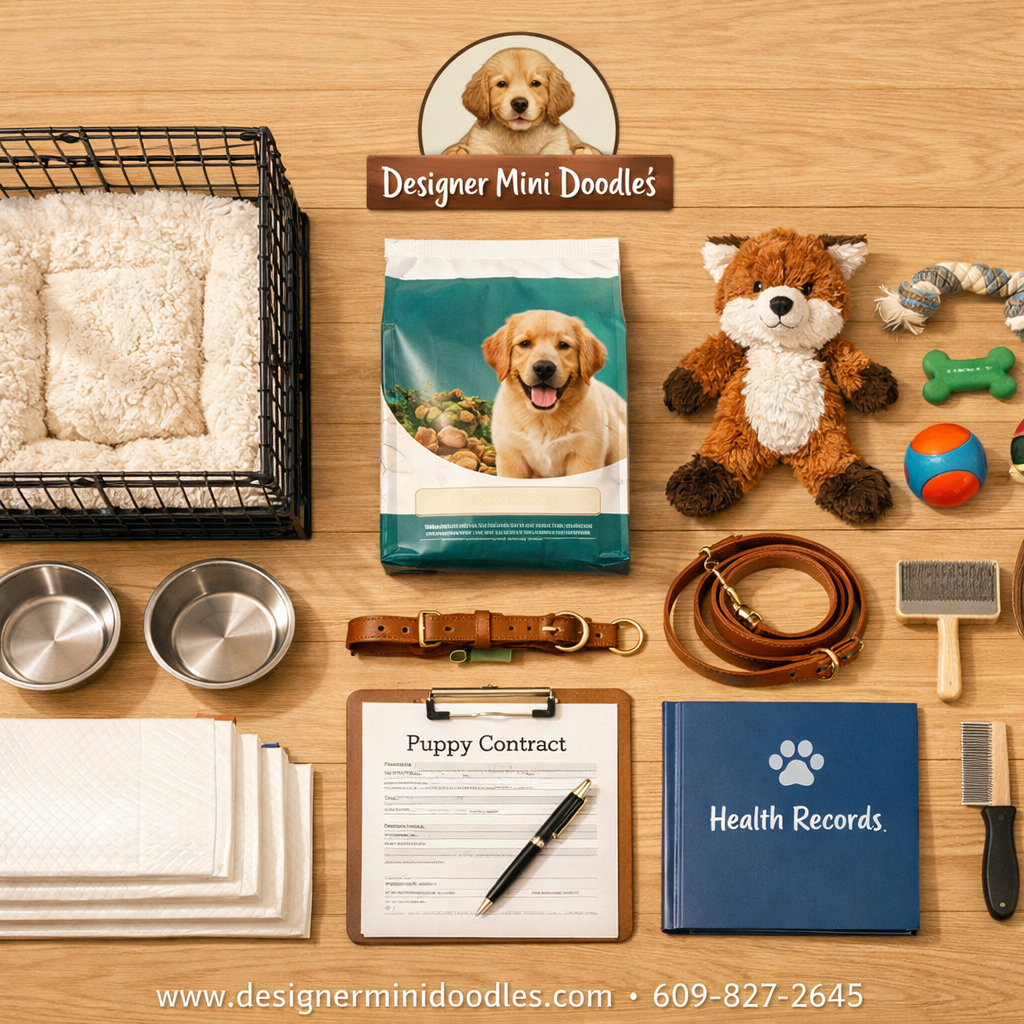
Prepare your home before pickup day by puppy-proofing one main living area, setting up a crate with bedding, and stocking the right food and supplies. Pick a 6×6 foot “puppy zone” with washable flooring and a baby gate, not a closed room — isolation creates anxiety.
Pre-arrival shopping list:
- 24-inch wire crate with divider
- Stainless steel bowls (not plastic)
- Same food the breeder is feeding (transition over 7–10 days)
- Enzymatic cleaner for accidents
- Flat collar, 6-ft leash, ID tag
- Two chew toys, one plush, one puzzle feeder
- Pet insurance enrollment within 14 days
Are mini goldendoodles good for first-time dog owners?
Mini goldendoodles are one of the best breeds for first-time dog owners because of their high trainability, low-aggression temperament, and adaptability to apartments or houses. They’re forgiving of beginner mistakes and respond exceptionally well to positive reinforcement.
The only real first-timer caution: grooming. A mini goldendoodle needs professional grooming every 6–8 weeks, plus brushing 3–4 times per week. Budget roughly $80–$120 per groom in Florida. Read more on why a small goldendoodle suits first-time dog owners.
What should be included in a mini goldendoodle puppy contract?
A proper puppy contract protects both you and the breeder. At minimum it should include the puppy’s identifiers, a written health guarantee, a spay/neuter clause, a return policy, and the breeder’s contact obligations.
Required contract elements:
- Puppy ID: microchip number, DOB, color, sex, parents
- Purchase price and deposit terms
- Health guarantee covering genetic conditions for at least 1–2 years
- Spay/neuter requirement (typically by 12–18 months)
- Take-back clause: breeder must take the dog back at any age if the owner can no longer keep it
- Vaccination and deworming record up to pickup
- Food, microchip, and registration paperwork
Why Designer Mini Doodles ships worldwide
Our puppies are available to families anywhere in the world. We offer a dedicated puppy nanny flight service where a trained handler personally accompanies your puppy in-cabin from Florida to your nearest major airport, whether you’re in California, New York, London, Dubai, or Sydney. The nanny handles all paperwork, health certificates, and acclimation.
Visit our Google Maps listing for directions, or contact us to arrange a video meet-and-greet with your puppy before travel.
FAQ
How long do mini goldendoodles live?
Mini goldendoodles typically live 12–16 years, with smaller individuals trending toward the longer end of that range.
Do mini goldendoodles bark a lot?
No. They’re moderate barkers — alert but not yappy. Excessive barking usually signals under-exercise or separation anxiety.
Can mini goldendoodles handle Florida heat?
Yes, with precautions. Walk early morning or after sunset in summer, keep them well-hydrated, and never leave them in a car. Their coats actually insulate against heat when properly groomed.
Are mini goldendoodles AKC registered?
No. The AKC does not recognize doodle crosses. Reputable breeders register with the Goldendoodle Association of North America (GANA) or similar designer-breed registries.
What colors do mini goldendoodles come in?
Apricot, red, cream, black, chocolate, parti (white with patches), phantom, and merle. Red and parti are typically the most in-demand.
Do I need a fenced yard?
Recommended but not required. Apartment living works well if you commit to 2–3 walks per day plus mental enrichment.
How much exercise does a mini goldendoodle need?
Adults need 45–60 minutes of activity daily, split between walks, play, and training. Puppies need less structured exercise but more mental stimulation.
Is a male or female mini goldendoodle better?
Temperament differences are minor in well-bred lines. Choose based on the individual puppy’s personality, not the sex.
Can mini goldendoodles be left alone during the day?
Adults can handle 4–6 hours alone if crate-trained from puppyhood. Longer than that, consider a midday walker or daycare.
What’s the difference between a mini and a micro goldendoodle?
Mini goldendoodles are 15–35 lbs; micros stay 10–20 lbs; toys are 8–14 lbs. All three come from selectively downsized poodle lines.
Conclusion
Finding the right mini goldendoodle breeder in Florida isn’t about chasing the lowest price — it’s about choosing a program where genetics, early neurological development, and lifelong support are built into the puppy before you ever pick them up. The difference between a properly raised, ENS-stimulated, health-tested puppy and a backyard-bred one shows up every single day for the next 15 years.
Your next steps:
- Decide on size (mini, micro, or toy) and generation (F1, F1B, multigen)
- Verify the breeder’s OFA and genetic test results in writing
- Get on a waitlist 2–6 months before your ideal pickup date
- Prepare your home and book pet insurance before bringing your puppy home
If you’d like to start the conversation with a Florida-based program led by an animal biologist with 15+ years of breeding experience, reach out through our Designer Mini Doodles Florida page. We’d be honored to help you find your next family member.