

mini golden doodle breeders Atlanta
Quick Answer: The best mini golden doodle breeders in Atlanta prioritize genetic health testing, early neurological stimulation (ENS), and structured socialization programs. Expect to pay between $2,500 and $5,000+ for a well-bred mini goldendoodle puppy in the metro Atlanta area, with wait times averaging 2 to 6 months depending on the breeder. Programs led by animal biologists or veterinary professionals tend to produce the healthiest, most well-adjusted puppies.
mini golden doodle breeders Atlanta
- Reputable mini golden doodle breeders Atlanta families trust will provide proof of OFA hip, elbow, heart, and eye clearances plus genetic panel testing on all parent dogs.
- Mini goldendoodles (15-35 lbs) are significantly better suited for apartment living than standard goldendoodles (50-75 lbs), and micro minis (10-16 lbs) are even more adaptable.
- F1B mini goldendoodles shed less than F1s, making them the better choice for allergy-conscious households.
- The best breeding programs include ENS protocols, early housebreaking, crate training, and temperament evaluation before puppies go home.
- Wait lists for quality mini goldendoodle puppies in Georgia typically run 2 to 6 months; rushing the process often leads to puppy mill purchases.
- Red flags include breeders who always have puppies available, won’t show health clearances, or refuse to let you meet parent dogs.
- Mini goldendoodles are excellent with children and other pets when properly socialized from an early age.
Best Mini Goldendoodle Breeders in Metro Atlanta
The best mini golden doodle breeders in Atlanta and the surrounding metro area run programs grounded in science, not shortcuts. Look for breeders who employ animal biologists or veterinary professionals to oversee their breeding program, conduct comprehensive health testing, and invest in early puppy development protocols.
Designer Mini Doodles stands out among mini golden doodle breeders serving the Atlanta area. Run by an animal biologist with over fifteen years of breeding experience, their program produces mini, micro, and toy goldendoodle puppies known for calm temperaments, strong health profiles, and early socialization. Their breeding program incorporates ENS (Early Neurological Stimulation), early housebreaking, and crate training, resulting in puppies that transition smoothly into their new homes.
When evaluating any breeder in metro Atlanta, use this checklist:
- Health testing documentation for both parent dogs (OFA or PennHIP certifications)
- Genetic panel results showing clearance for common inherited conditions
- Written health guarantee of at least two years
- Puppy socialization protocol that includes ENS and exposure to household stimuli
- Transparent communication about wait times, pricing, and puppy availability
- Willingness to show facilities or provide virtual tours
- References from previous puppy families
If you’re located outside Atlanta, many top Georgia breeders, including Designer Mini Doodles, offer a dedicated puppy nanny service that safely delivers puppies to homes anywhere in the country and internationally. You can also explore their full Georgia breeder page for additional details.
How Much Do Mini Goldendoodle Puppies Cost in Atlanta?
Mini goldendoodle puppies from reputable Atlanta-area breeders typically cost between $2,500 and $5,000, with micro and toy goldendoodle puppies sometimes priced higher due to the additional breeding expertise required to produce smaller, healthy dogs.
Several factors influence the final price:
| Factor | Impact on Price |
|---|---|
| Generation (F1, F1B, multigen) | F1B and multigen puppies often cost more due to predictable coats |
| Size (mini vs. micro vs. toy) | Smaller sizes generally command higher prices |
| Coat color | Red, apricot, and rare colors may carry a premium |
| Health testing scope | Breeders who do extensive testing invest more per litter |
| Training included | Programs with early housebreaking and crate training add value |
| Breeder reputation | Established programs with long track records price accordingly |
Common mistake: Choosing a breeder solely based on the lowest price. Puppies priced significantly below $2,000 in the Atlanta market often come from operations that skip health testing, don’t invest in socialization, or cut corners on veterinary care. The upfront savings rarely offset the potential for expensive health problems later.
Beyond the purchase price, budget approximately $1,500 to $2,500 for first-year expenses including veterinary visits, spay/neuter, food, grooming supplies, crate, and training classes.
What Health Tests Do Reputable Goldendoodle Breeders Do?
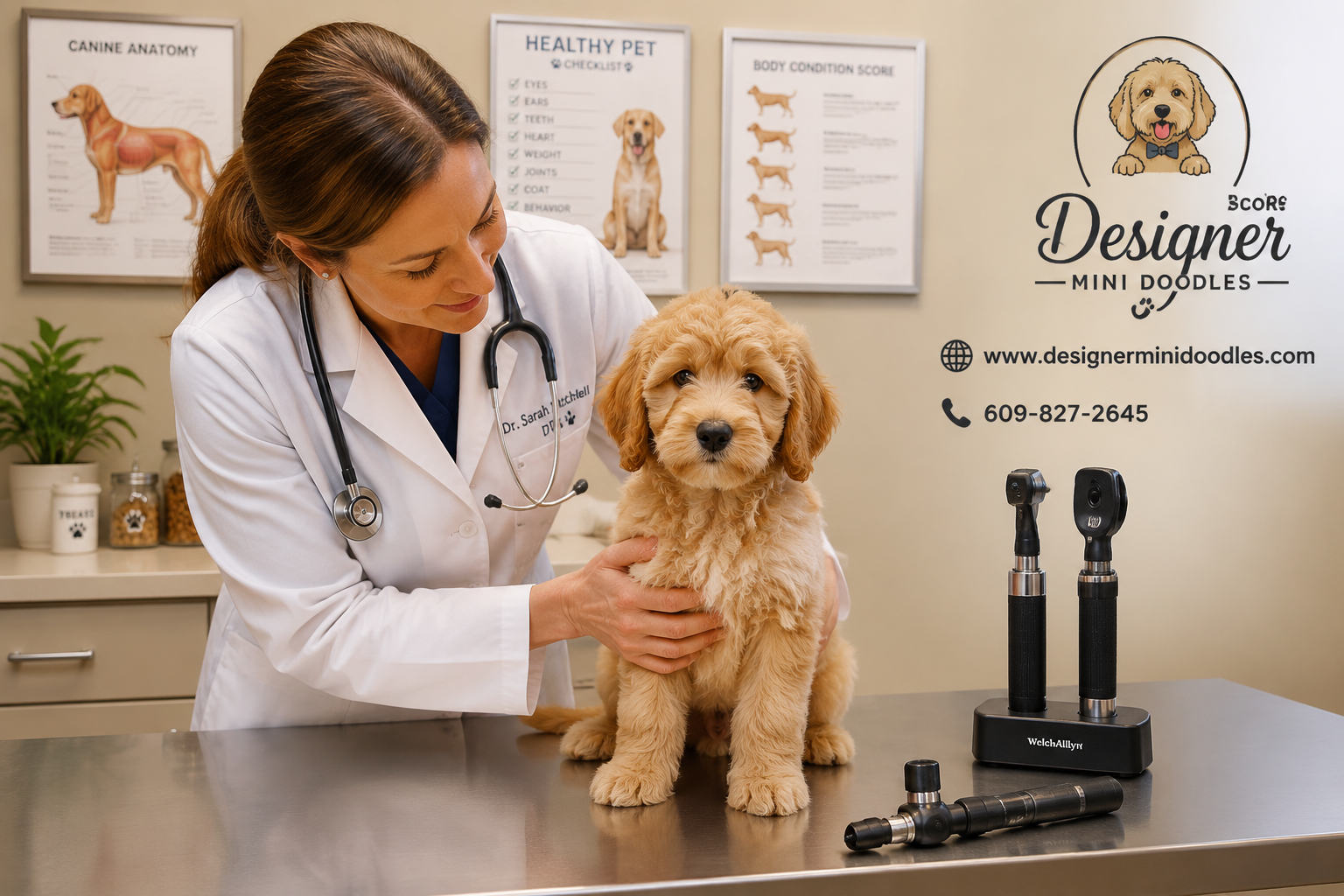
Responsible breeders test parent dogs for the genetic and orthopedic conditions most common in Golden Retrievers and Poodles before any breeding takes place. At minimum, both parents should have current OFA (Orthopedic Foundation for Animals) evaluations and a comprehensive genetic disease panel.
Required health clearances for parent dogs:
- Hip dysplasia screening (OFA or PennHIP)
- Elbow dysplasia evaluation (OFA)
- Cardiac examination by a board-certified veterinary cardiologist
- Ophthalmologist eye exam (CERF or OFA Eye)
- Patellar luxation check (especially important for miniature and toy sizes)
- Genetic panel testing covering progressive retinal atrophy (PRA), von Willebrand’s disease, degenerative myelopathy, and ichthyosis
Decision rule: If a breeder cannot produce written documentation for at least hip, eye, heart, and genetic panel results for both parents, move on. Verbal assurances that “our dogs are healthy” are not a substitute for certified test results.
Designer Mini Doodles, whose program is run by an animal biologist, conducts all of the above testing and makes results available to prospective families. This level of transparency is the standard you should expect from any breeder you’re considering.
What’s the Difference Between F1 and F1B Mini Goldendoodles?
An F1 mini goldendoodle is a first-generation cross between a Golden Retriever and a Miniature Poodle (50% each breed). An F1B is the result of crossing an F1 goldendoodle back to a Poodle, producing a puppy that is approximately 75% Poodle and 25% Golden Retriever.
Why it matters:
- F1 minis have more genetic diversity (hybrid vigor) but less predictable coats. Some may shed moderately.
- F1B minis are more likely to have curly or wavy, low-shedding coats, making them a better fit for allergy-sensitive households.
- Multigen minis (F2, F2B, and beyond) offer the most coat predictability but require experienced breeders to maintain genetic health.
Choose F1 if you want maximum hybrid vigor and don’t mind some shedding. Choose F1B if allergies are a concern or you strongly prefer a curlier, non-shedding coat. For families exploring even smaller sizes, micro golden doodle puppies are also available through select breeding programs.
Mini vs. Standard Goldendoodle: Which Is Better for Apartments?
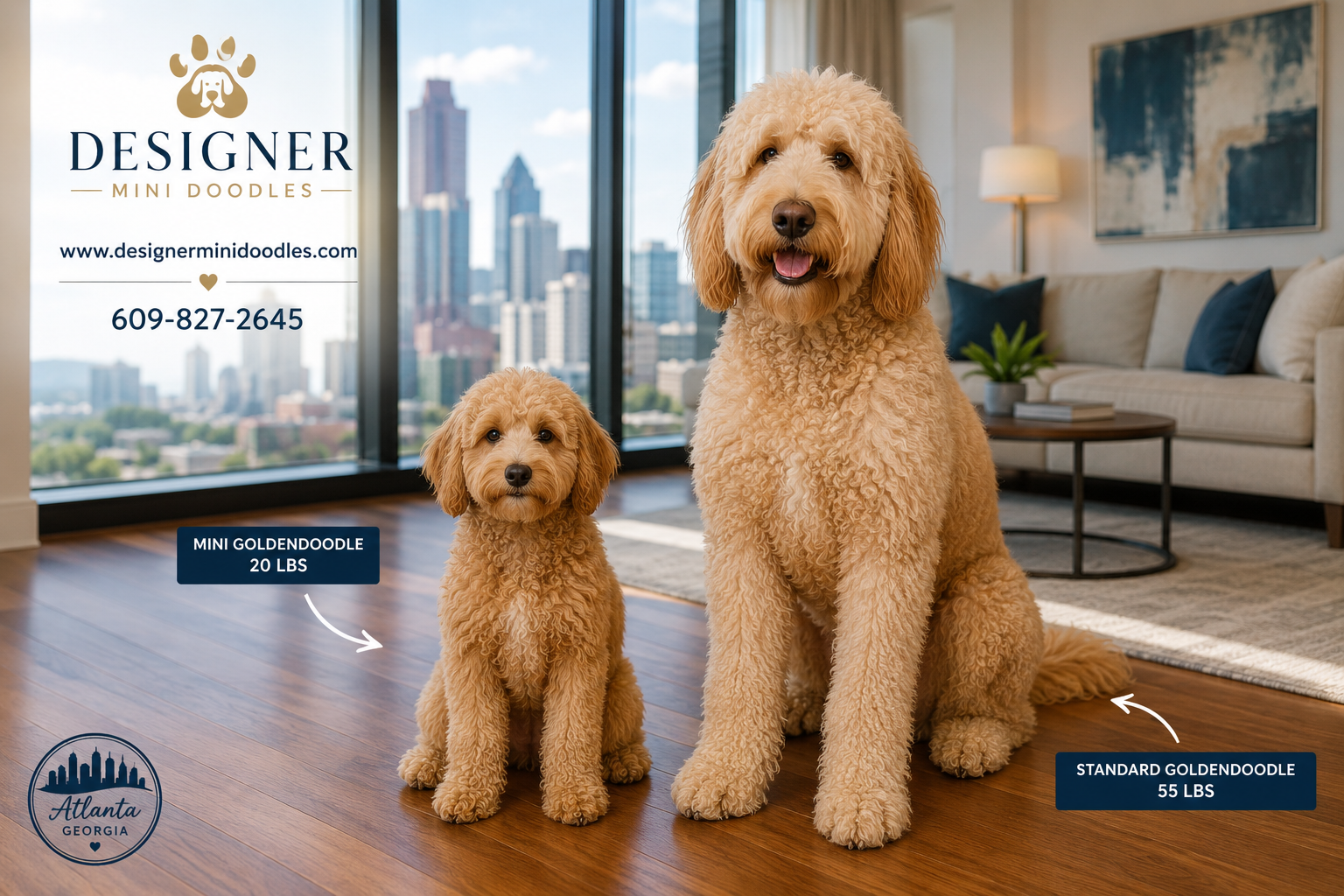
Mini goldendoodles are significantly better suited for apartment living than standards. A mini typically weighs 15 to 35 pounds and stands 13 to 20 inches tall, while a standard ranges from 50 to 75 pounds and 20 to 26 inches. That size difference affects everything from exercise needs to the amount of space a dog requires to be comfortable.

Why minis win for apartment dwellers:
- They need less indoor space to move comfortably
- Their exercise requirements (30-45 minutes daily) are more manageable than a standard’s (60+ minutes)
- They’re easier to transport in elevators and on public transit
- Smaller dogs produce less hair, dander, and mess in confined spaces
- Many Atlanta apartment complexes have weight limits (often 25-50 lbs) that exclude standards
For those in particularly small spaces or with strict weight limits, micro mini goldendoodles (10-16 lbs) and toy goldendoodle puppies for sale through programs like Designer Mini Doodles offer an even more apartment-friendly option. Learn more about why this size range works so well in our guide to micro goldendoodles for apartment and urban living.
Edge case: If you live in a house with a large yard and want a hiking or running companion, a standard goldendoodle may actually be the better match. Size choice should always reflect your living situation and activity level.
Are Mini Goldendoodles Good With Kids and Other Pets?
Yes. Mini goldendoodles are one of the most family-friendly hybrid breeds available. They inherit the Golden Retriever’s gentle, patient nature and the Poodle’s intelligence and eagerness to please, making them naturally well-suited for households with children and other animals.
With kids: Mini goldendoodles are playful without being overly rough, and their smaller size reduces the risk of accidentally knocking over toddlers (a common concern with standard-sized dogs). They tend to form strong bonds with children and are patient with the unpredictable behavior of young kids.
With other pets: Most mini goldendoodles coexist well with cats, other dogs, and even smaller animals when properly introduced. Their low prey drive (compared to terrier breeds, for example) makes multi-pet households easier to manage.
The critical factor is socialization. Even the most naturally friendly puppy needs structured exposure to children, other animals, and varied environments during the first 16 weeks of life. This is why breeders who invest in early socialization, ENS protocols, and confidence-building exercises produce puppies that adapt more readily to family life. For deeper insight into how micro and mini goldendoodles fit into family settings, see our resource on micro goldendoodles for family households with kids.
Common Health Problems in Mini Goldendoodles
Mini goldendoodles are generally healthy dogs with a lifespan of 12 to 16 years, but they can be predisposed to certain conditions inherited from their parent breeds. Buying from a breeder who health-tests parent dogs significantly reduces (but doesn’t eliminate) these risks.
Conditions to be aware of:
- Hip dysplasia — abnormal hip joint development causing pain and mobility issues
- Patellar luxation — kneecap displacement, more common in smaller dogs
- Progressive retinal atrophy (PRA) — degenerative eye disease that can lead to blindness
- Von Willebrand’s disease — a blood clotting disorder
- Ear infections — floppy ears trap moisture, especially in Atlanta’s humid climate
- Allergies — both environmental and food-related sensitivities
- Addison’s disease — adrenal insufficiency, more common in Poodle lines
Preventive steps: Choose a breeder who tests for genetic conditions, maintain regular veterinary checkups, keep ears clean and dry (especially after swimming or baths), and feed a high-quality diet appropriate for your dog’s size and age.
Do Mini Goldendoodles Shed a Lot?
No. Mini goldendoodles are low-shedding dogs, though the amount varies by generation and coat type. F1B and multigen mini goldendoodles with curly or wavy coats shed the least, while F1 minis with straighter, more retriever-like coats may shed lightly.
Coat types and shedding levels:
- Curly coat (most Poodle-like): Minimal to no shedding; requires professional grooming every 6-8 weeks
- Wavy/fleece coat: Very low shedding; the most common coat type in mini goldendoodles
- Straight coat: Light to moderate shedding; less common but easier to maintain
No dog is truly hypoallergenic. However, low-shedding mini goldendoodles produce less dander, which is the actual allergen trigger for most people. If allergies are a primary concern, an F1B mini goldendoodle with a curly coat is your best option. For more on allergy-friendly options, explore our page on micro goldendoodles for allergy-conscious homes.
How to Pick a Responsible Goldendoodle Breeder Near Me
A responsible breeder prioritizes the health and temperament of their dogs over profit. In the Atlanta area, where demand for mini goldendoodles is high, the difference between a quality breeder and a commercial operation can be dramatic.
Step-by-step vetting process:
- Research online reviews and testimonials from verified puppy families
- Request health clearance documentation for both parent dogs before placing a deposit
- Ask about their socialization and training protocols (ENS, early housebreaking, crate training)
- Visit the facility or request a video tour to see living conditions
- Ask what happens if you can no longer keep the dog (good breeders require return to them)
- Verify the breeder’s experience and credentials (veterinary background, biology degree, breeding certifications)
- Compare the health guarantee terms (minimum two years is standard for reputable breeders)
Choose a breeder who asks you as many questions as you ask them. A breeder who wants to know about your lifestyle, living situation, experience with dogs, and family composition is one who cares about placing puppies in appropriate homes.
Red Flags to Watch for When Buying a Mini Goldendoodle
Not every breeder advertising mini golden doodle puppies in Atlanta operates ethically. Knowing the warning signs can save you thousands in veterinary bills and heartbreak.

Major red flags:
- Always has puppies available with no wait list (quality breeders almost always have a queue)
- Won’t share health testing results or claims testing is “unnecessary”
- Offers to ship puppies via cargo without a nanny or guardian service
- Multiple breeds available simultaneously (often indicates a puppy mill or broker)
- No contract or health guarantee provided
- Pressures you to decide quickly with claims like “this is the last puppy”
- Prices significantly below market ($1,000 or less for a mini goldendoodle is a strong warning sign)
- Refuses facility visits or won’t let you meet at least one parent dog
- No references from previous buyers
- Puppies available before 8 weeks of age (responsible breeders keep puppies until at least 8 weeks)
If something feels off, trust your instincts. A legitimate breeder will never pressure you and will welcome your questions.
Average Wait Time for a Mini Goldendoodle Puppy in Georgia
Expect to wait 2 to 6 months for a mini goldendoodle puppy from a reputable Georgia breeder. Some highly sought-after programs, particularly those producing micro and toy sizes, may have wait lists extending to 6-9 months.
Factors that affect wait time:
- Breeder popularity and reputation — established programs have longer lists
- Desired size — micro and toy goldendoodles are produced in smaller litters
- Color preference — specific colors like red or parti can extend your wait
- Time of year — spring and summer litters tend to have more demand
- Generation preference — F1B puppies may have different availability than F1 or multigen
Pro tip: Join multiple breeder wait lists simultaneously if you’re flexible on timing. Also consider breeders in neighboring states like Tennessee, South Carolina, or Alabama who may have shorter wait times and can deliver via puppy nanny service.
How to Prepare Your Home for a Mini Goldendoodle Puppy
Prepare your home before your puppy arrives, not after. A well-prepared environment reduces stress for both the puppy and your family during the critical first weeks.
Essential supplies checklist:
- Crate sized for your puppy’s expected adult weight (with a divider for growing)
- Exercise pen or baby gates to create a safe, contained area
- Food and water bowls (stainless steel or ceramic, not plastic)
- High-quality puppy food recommended by your breeder
- Enzymatic cleaner for inevitable accidents
- Chew toys and puzzle feeders for mental stimulation
- Collar, leash, and ID tag with your contact information
- Grooming basics: slicker brush, comb, nail clippers
- Puppy pads for the housebreaking transition period
Puppy-proofing steps:
- Secure electrical cords and move toxic plants out of reach
- Store cleaning chemicals, medications, and small objects in closed cabinets
- Block access to stairs and rooms you want off-limits
- Remove or protect shoes, children’s toys, and anything chewable at floor level
- Check your yard for gaps in fencing (mini goldendoodle puppies can fit through surprisingly small spaces)
If your puppy comes from a program that includes early crate training and housebreaking, like Designer Mini Doodles, the transition will be smoother because the puppy already understands basic routines.
Typical Training Needs for Mini Goldendoodles
Mini goldendoodles are highly trainable due to their Poodle intelligence and Golden Retriever eagerness to please. Most respond exceptionally well to positive reinforcement methods, and puppies from programs that begin training early have a significant head start.
Training priorities by age:
- 8-12 weeks: Crate training, name recognition, basic potty training, socialization with people and sounds
- 12-16 weeks: Sit, down, stay, come, leash walking, continued socialization with other dogs
- 4-6 months: Impulse control, leave it, drop it, longer stays, public outings
- 6-12 months: Adolescent refresher training, off-leash recall in safe areas, advanced commands
Common training mistakes with mini goldendoodles:
- Skipping socialization because the puppy “seems friendly” — friendliness without exposure to varied stimuli can still produce anxiety later
- Inconsistent rules — everyone in the household must enforce the same boundaries
- Over-relying on treats — gradually transition to verbal praise and play as rewards
- Neglecting mental stimulation — these are smart dogs that get bored easily, leading to destructive behavior
Puppies from Designer Mini Doodles arrive with foundational training already in place, including ENS, early housebreaking, and crate conditioning. This means you’re building on an existing foundation rather than starting from scratch. For additional training insights, their training and enrichment guide offers practical strategies specific to smaller goldendoodles.
Frequently Asked Questions
How big do mini goldendoodles get?
Mini goldendoodles typically reach 15 to 35 pounds and 13 to 20 inches tall at the shoulder when fully grown. Micro minis stay between 10 and 16 pounds, while toy goldendoodles may be even smaller. Adult size depends on the parent dogs’ sizes and the specific generation.
Are mini goldendoodles good for first-time dog owners?
Yes. Their trainability, gentle temperament, and manageable size make them one of the best breeds for first-time owners. Choose a breeder who provides early training and socialization to make the transition even easier.
How often do mini goldendoodles need grooming?
Professional grooming every 6 to 8 weeks is standard, with daily or every-other-day brushing at home to prevent matting. Curly coats require more maintenance than wavy coats.
Can mini goldendoodles be left alone during the workday?
Adult mini goldendoodles can handle 4 to 6 hours alone after proper crate training. Puppies under 6 months should not be left alone for more than 2 to 3 hours. Consider a dog walker or doggy daycare for longer absences.
Do mini goldendoodles bark a lot?
They are moderate barkers. Mini goldendoodles may bark to alert you to visitors or unusual sounds but are not typically excessive barkers. Early training can address any tendency toward nuisance barking.
What is the lifespan of a mini goldendoodle?
Mini goldendoodles typically live 12 to 16 years, with smaller sizes (micro and toy) sometimes living slightly longer than larger minis. Proper nutrition, regular veterinary care, and genetic health testing of parent dogs all contribute to longevity.
Can I get a mini goldendoodle shipped to me in Atlanta?
Yes. Many reputable breeders offer puppy nanny services where a dedicated handler personally accompanies your puppy on a flight to your nearest airport. This is far safer and less stressful than cargo shipping. Designer Mini Doodles offers this service to homes anywhere in the country and internationally.
What colors do mini goldendoodles come in?
Common colors include cream, apricot, red, chocolate, black, and parti (multi-colored). Coat color can lighten as the puppy matures, so ask your breeder about expected adult coloring.
Are mini goldendoodles recognized by the AKC?
No. As a hybrid breed, mini goldendoodles are not recognized by the American Kennel Club. However, they can be registered with organizations like the Goldendoodle Association of North America (GANA).
What’s the difference between a mini goldendoodle and a toy goldendoodle?
Size is the primary difference. Mini goldendoodles weigh 15 to 35 pounds, while toy goldendoodles weigh under 15 pounds. Toy goldendoodles are produced by crossing smaller parent dogs and require more specialized breeding expertise.
Should I get pet insurance for my mini goldendoodle?
Pet insurance is strongly recommended, especially in the first few years. Policies typically cost $30 to $60 per month and can save thousands if your dog develops a health condition. Enroll before any pre-existing conditions are documented.
Where can I find miniature French Bulldog puppies if I’m also considering other small breeds?
If you’re exploring other compact companion breeds alongside goldendoodles, miniature French Bulldog puppies are another popular option for Atlanta families seeking a smaller dog with a distinct personality.
Conclusion
Finding the right mini golden doodle breeders in Atlanta requires patience, research, and a clear understanding of what separates quality programs from commercial operations. The breeder you choose will shape your puppy’s health, temperament, and behavior for the next 12 to 16 years.
Your next steps:
- Review the breeder vetting checklist in this guide and use it to evaluate any program you’re considering.
- Request health clearance documentation before placing a deposit with any breeder.
- Get on a wait list early, as quality miniature golden doodle puppies from established programs sell out quickly.
- Prepare your home using the supply checklist above so you’re ready when your puppy arrives.
- Budget for both the purchase price and first-year care costs to avoid financial surprises.
The Atlanta metro area has access to some of the best mini goldendoodle breeding programs in the Southeast. By prioritizing health testing, early socialization, and breeder transparency, you’ll bring home a puppy that’s been set up for a long, healthy, and happy life with your family.