
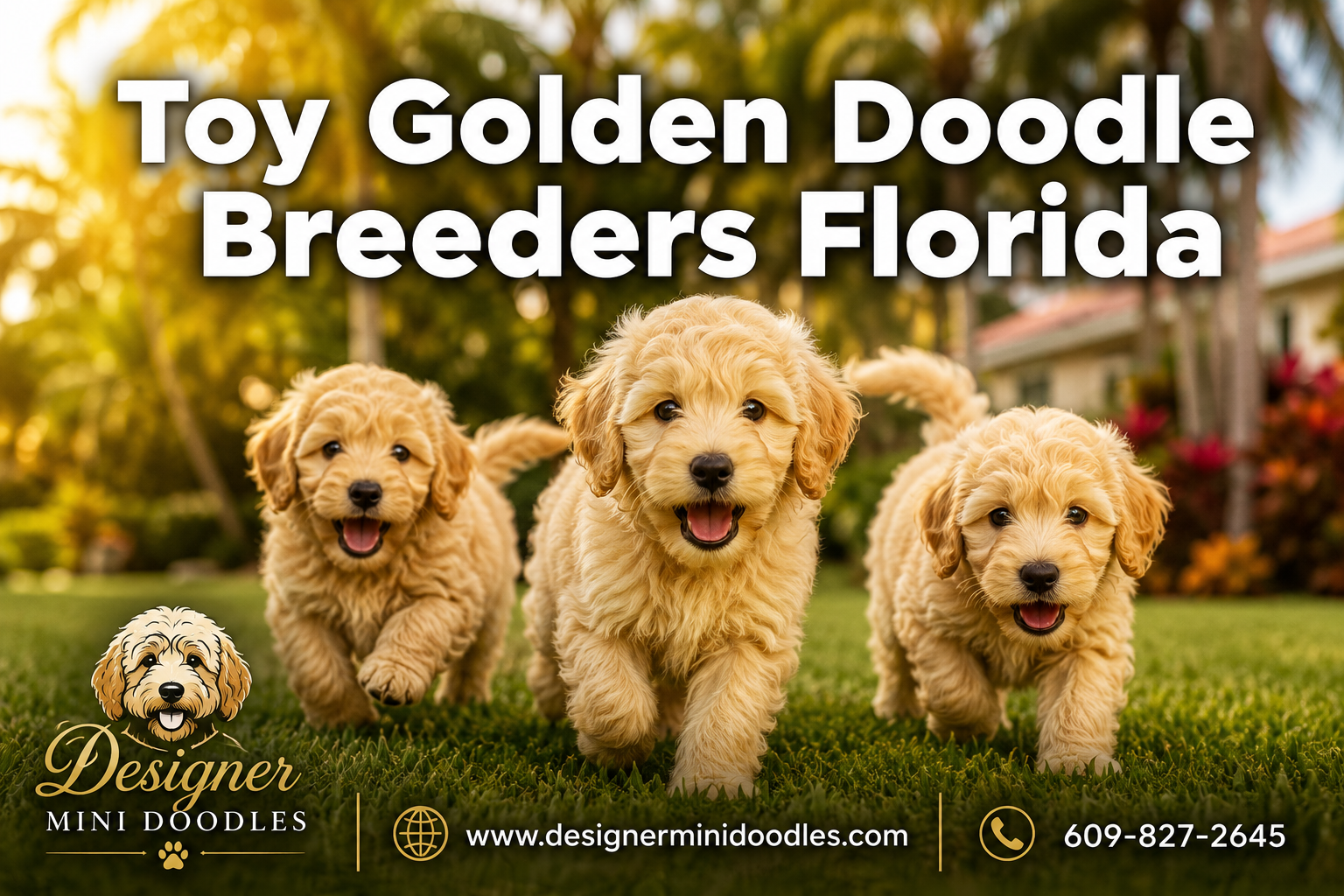
toy golden doodle breeders Florida
Quick Answer: The best toy golden doodle breeders in Florida combine health testing, professional socialization programs, and transparent breeding practices. Designer Doodles, run by an animal biologist with over 15 years of breeding experience, stands out for producing calm, confident, and affectionate toy goldendoodle puppies through structured ENS (Early Neurological Stimulation), early housebreaking, and crate training. Expect to pay between $3,000 and $6,000 for a well-bred toy goldendoodle puppy in Florida in 2026, with price varying by generation, coat color, and breeder reputation.
toy golden doodle breeders Florida
- Toy goldendoodles typically weigh 10 to 25 pounds fully grown, making them ideal for apartments and smaller Florida homes.
- Reputable toy golden doodle breeders in Florida should provide OFA hip, elbow, heart, and eye clearances plus genetic panel testing for conditions like PRA and vWD.
- F1B and multigenerational toy goldendoodles tend to have curlier, lower-shedding coats compared to F1 crosses.
- Annual care costs for a toy goldendoodle in Florida range from roughly $1,500 to $3,500, including grooming, vet visits, food, and preventatives.
- Designer Doodles’ breeding program, led by an animal biologist, incorporates ENS protocols, early socialization, and housebreaking before puppies go home.
- Toy goldendoodles are widely considered low-shedding but not truly hypoallergenic; individual reactions vary.
- Florida’s warm climate means extra attention to hydration, heartworm prevention, and heat safety for small dogs.
- Puppies from top breeders can be shipped nationwide or worldwide through dedicated puppy nanny services.
- Always verify a breeder’s health guarantees, parent dog testing, and facility conditions before committing a deposit.
How Much Does a Toy Goldendoodle Puppy Cost in Florida?
A toy goldendoodle puppy from a reputable Florida breeder typically costs between $3,000 and $6,000 in 2026. Pricing depends on the generation (F1, F1B, multigen), coat color, size category, and the breeder’s investment in health testing and early training.
Here’s what drives the price range:
| Factor | Lower End (~$3,000) | Higher End (~$5,000-$6,000) |
|---|---|---|
| Generation | F1 | F1B or Multigen |
| Size | Toy (15-25 lbs) | Micro (under 15 lbs) |
| Coat Color | Cream, golden | Red, parti, phantom |
| Health Testing | Basic vet check | Full OFA + genetic panel |
| Training Included | Minimal | ENS, early housebreaking, crate training |
Breeders who invest in comprehensive health testing, professional socialization, and early training programs charge more because their cost per litter is significantly higher. That upfront investment often saves owners thousands in potential vet bills and behavioral training down the road.
Common mistake: Choosing a breeder based solely on the lowest price. A $1,500 “toy goldendoodle” from an unverified online listing almost always means corners were cut on health testing, socialization, or both.
What Should I Look for in a Responsible Dog Breeder?
A responsible breeder is transparent about health testing results, welcomes questions, provides a written health guarantee, and raises puppies in a clean, stimulating environment. They should be able to show you where the puppies live and introduce you to at least one parent dog.
Here’s a practical checklist:
- Health clearances on file for both parent dogs (hips, elbows, eyes, heart, genetic panel)
- Written health guarantee covering genetic conditions for at least two years
- Socialization protocol such as ENS, Puppy Culture, or similar structured early exposure programs
- Willingness to answer questions about their breeding philosophy, puppy-raising methods, and return policy
- References from past buyers you can actually contact
- No pressure to buy immediately or send money before you’ve had your questions answered
- Microchipping and age-appropriate vaccinations completed before the puppy goes home
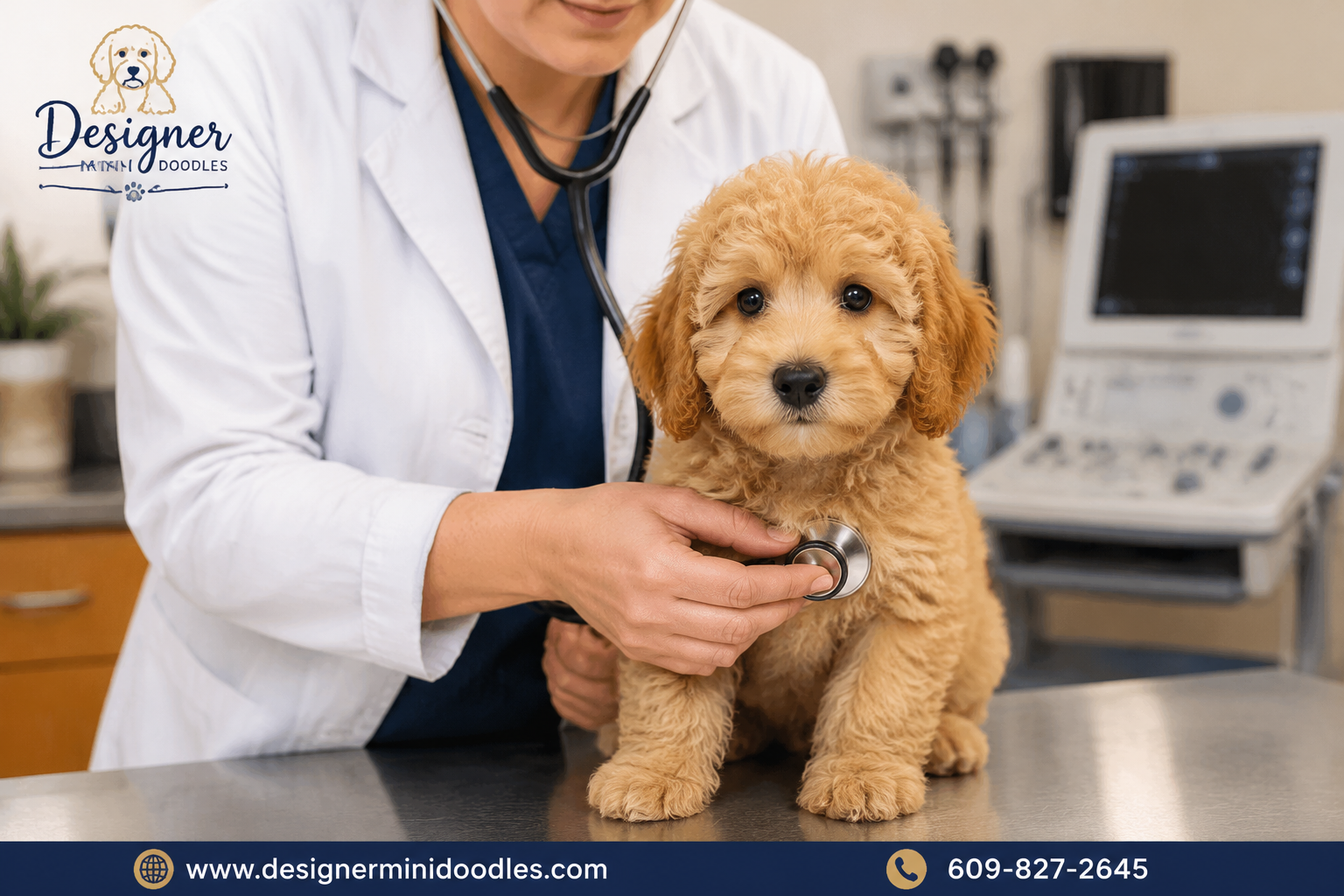
Designer Doodles checks every one of these boxes. Run by an animal biologist who has been breeding mini and toy goldendoodle puppies for over 15 years, their program stands apart because of the science-based approach to temperament development. Every puppy goes through ENS (Early Neurological Stimulation), which research from the U.S. military’s Bio Sensor program suggests can improve stress tolerance, immune function, and cardiac health in dogs.
Choose a breeder like Designer Doodles if: you want a puppy that arrives already started on housebreaking, comfortable in a crate, and exposed to household sounds, surfaces, and gentle handling.
What Health Tests Should a Reputable Goldendoodle Breeder Do?
At minimum, a reputable goldendoodle breeder should perform OFA evaluations for hips, elbows, heart, and eyes on all breeding dogs, plus a comprehensive genetic panel screening for conditions common to Golden Retrievers and Poodles.
The genetic panel should test for:
- Progressive Retinal Atrophy (PRA) — a degenerative eye disease
- Von Willebrand’s Disease (vWD) — a bleeding disorder
- Degenerative Myelopathy (DM) — a progressive spinal cord disease
- Neonatal Encephalopathy with Seizures (NEwS) — specific to Standard Poodles but relevant in crosses
- Ichthyosis (ICH) — a skin condition found in Golden Retrievers
According to the Orthopedic Foundation for Animals (OFA), all test results should be publicly searchable in their database. If a breeder can’t or won’t share OFA numbers, that’s a red flag.
Designer Doodles maintains full health testing records for every breeding dog and makes results available to puppy buyers. This level of transparency is exactly what separates professional breeding programs from casual backyard operations.
Common Health Problems in Toy Goldendoodles
Toy goldendoodles are generally healthy dogs, but their small size and mixed heritage make them susceptible to a few specific conditions. The most common include patellar luxation, hip dysplasia, progressive retinal atrophy, ear infections, and allergies.
Conditions to watch for:
- Patellar luxation — The kneecap slips out of place. More common in smaller dogs. Mild cases may not need surgery; severe cases do.
- Hip dysplasia — Less common in toys than standards, but still possible. Proper health testing of parents reduces risk significantly.
- Ear infections — Floppy ears plus Florida’s humidity create a perfect environment for yeast and bacteria. Weekly ear cleaning helps prevent this.
- Allergies — Both food and environmental allergies can cause itching, ear problems, and digestive issues.
- Dental crowding — Smaller mouths mean teeth can crowd together, increasing tartar buildup and gum disease risk. Regular dental care is essential.
Florida-specific concern: Heartworm disease is prevalent year-round in Florida due to the warm, humid climate. Monthly heartworm prevention is non-negotiable for any dog living in the state.
How Big Do Toy Goldendoodles Get When Fully Grown?
A toy goldendoodle typically reaches 10 to 25 pounds and stands 10 to 16 inches tall at the shoulder when fully grown. Most reach their adult size by 10 to 12 months of age.
For buyers looking for even smaller dogs, Designer Doodles also offers micro goldendoodle puppies for sale. Micro goldendoodles generally stay under 15 pounds at maturity. These tiny dogs are produced by selectively breeding the smallest, healthiest dogs over multiple generations rather than by breeding runts or using questionable size-reduction methods.
| Size Category | Adult Weight | Adult Height |
|---|---|---|
| Micro Goldendoodle | Under 15 lbs | 8-12 inches |
| Toy Goldendoodle | 10-25 lbs | 10-16 inches |
| Mini Goldendoodle | 25-45 lbs | 14-18 inches |
| Standard Goldendoodle | 45-75+ lbs | 20-24 inches |
Edge case: Some breeders label 30-pound dogs as “toys.” Always ask for the weights of both parents and previous litters to get a realistic size estimate.
What’s the Difference Between F1 and F1B Goldendoodle Puppies?
An F1 goldendoodle is a first-generation cross between a purebred Golden Retriever and a purebred Poodle (50/50 mix). An F1B goldendoodle is the result of crossing an F1 goldendoodle back to a Poodle (75% Poodle, 25% Golden Retriever), which typically produces curlier, lower-shedding coats.
Here’s a quick breakdown of the most common generations:
- F1 — Golden Retriever x Poodle. Most genetic diversity. Coat type varies widely (wavy to straight). Moderate shedding possible.
- F1B — F1 Goldendoodle x Poodle. Curlier coat. Better option for allergy-sensitive households.
- F1BB — F1B Goldendoodle x Poodle. Even higher Poodle percentage. Very curly, minimal shedding.
- Multigen — Two goldendoodle parents, both beyond F1. Most predictable coat type and temperament.
Choose F1B or multigen if: allergies are a concern in your household, or you strongly prefer a curly, low-shedding coat. Choose F1 if you want maximum genetic diversity and don’t mind some shedding variability.
Designer Doodles’ toy doodle breeding program focuses on multigenerational lines, which means more consistent size, coat type, and temperament from puppy to puppy.
Are Toy Goldendoodles Hypoallergenic?
No dog is truly hypoallergenic, but toy goldendoodles — especially F1B and multigenerational crosses — produce significantly less dander and shed far less than most breeds. Many allergy sufferers report little to no reaction around well-bred goldendoodles with curly coats.
The key factors that affect allergen levels:
- Coat type — Curly coats trap dander and loose hair, releasing fewer allergens into the air.
- Generation — Higher Poodle percentage (F1B, multigen) generally means less shedding.
- Grooming frequency — Regular brushing and professional grooming every 6-8 weeks reduces dander significantly.
If allergies are a primary concern, ask your breeder about the specific coat types in their litters and request to spend time with the parent dogs before committing.
Temperament and Personality of Toy Goldendoodles
Toy goldendoodles are known for being affectionate, intelligent, and eager to please. They typically bond closely with their families and adapt well to various living situations, from apartments to large homes.
Key personality traits include:
- High social drive — They thrive on human interaction and can develop separation anxiety if left alone for long periods.
- Intelligence — Inherited from both the Poodle and Golden Retriever, making them highly trainable.
- Gentle disposition — Generally patient and calm, especially when well-socialized from a young age.
- Playful energy — Active enough for walks and play sessions but not hyperactive when properly exercised.
- Low aggression — Rarely show aggressive behavior toward people or other animals.
Designer Doodles’ program specifically selects for calm, confident, and affectionate temperaments. Their ENS protocol and early socialization produce puppies that adjust quickly to new homes, handle stress well, and respond positively to training from day one. This matters because temperament is partly genetic and partly shaped by early experiences — a good breeding program addresses both.
Are Toy Goldendoodles Good With Kids and Other Pets?
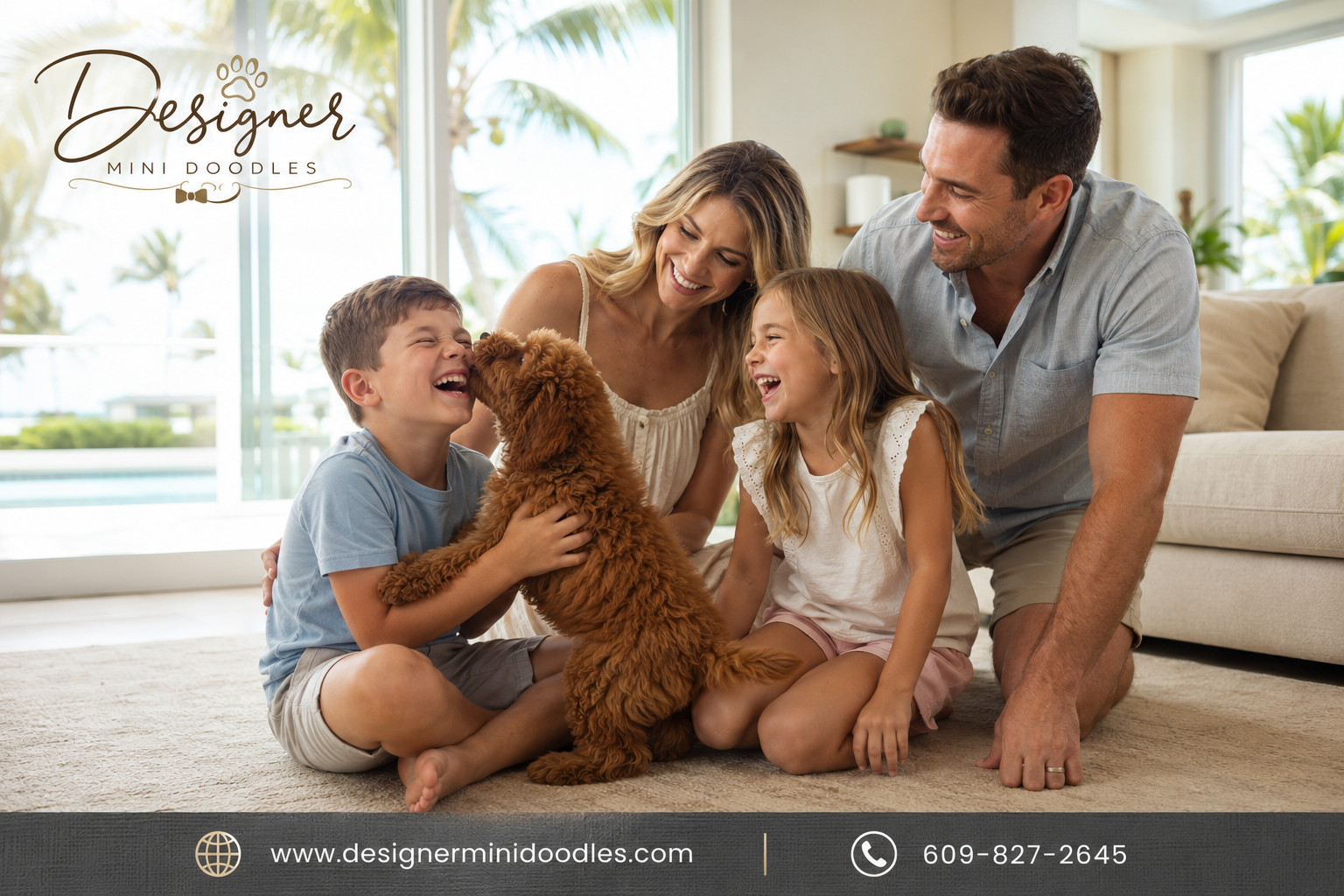
Yes, toy goldendoodles are generally excellent with children and other pets when properly socialized. Their gentle nature and patience make them one of the most family-friendly small breeds available.
A few practical considerations:
- With young children: Supervise interactions because toy goldendoodles are small enough to be accidentally injured by toddlers who don’t yet understand gentle handling.
- With cats: Most toy goldendoodles coexist peacefully with cats, especially when introduced during puppyhood.
- With other dogs: They tend to be social and playful with other dogs. Proper introductions help, but goldendoodles rarely show dog-aggression.
- With small pets: Their prey drive is generally low, but individual dogs vary. Supervise interactions with rabbits, hamsters, or birds.
Decision rule: If you have children under age 5, a toy goldendoodle in the 15-25 pound range is a better fit than a micro-sized puppy, which is more fragile and more easily injured during rough play.
Training Tips for New Toy Goldendoodle Owners
Toy goldendoodles are among the easiest small breeds to train because of their intelligence and desire to please. Start training the day your puppy comes home, using positive reinforcement methods.
First-week priorities:
- Crate training — Introduce the crate as a safe, positive space. Puppies from Designer Doodles arrive already familiar with crate routines, which gives you a significant head start.
- Potty training — Take your puppy outside every 1-2 hours, after meals, and after naps. Reward immediately when they go in the right spot.
- Name recognition — Say your puppy’s name and reward when they look at you. This builds the foundation for recall.
- Bite inhibition — Redirect mouthing onto appropriate toys. Yelp and disengage if they bite too hard.
Weeks 2-8 priorities:
- Basic commands: sit, down, stay, come
- Leash walking (start indoors, then move to quiet outdoor areas)
- Socialization with new people, sounds, surfaces, and environments
- Short, positive car rides
Common mistake: Skipping socialization between 8 and 16 weeks of age. This is the critical socialization window. A puppy that misses diverse positive experiences during this period may develop fear or anxiety later.
How Much Does It Cost to Care for a Toy Goldendoodle Annually?
Annual care costs for a toy goldendoodle in Florida typically range from $1,500 to $3,500, depending on your choices around grooming, food quality, and veterinary care.
| Expense Category | Estimated Annual Cost |
|---|---|
| Food (premium quality) | $400-$700 |
| Grooming (every 6-8 weeks) | $500-$1,000 |
| Veterinary care (routine) | $300-$600 |
| Heartworm/flea/tick prevention | $200-$400 |
| Pet insurance (optional) | $300-$600 |
| Toys, treats, supplies | $150-$300 |
| Total | $1,850-$3,600 |
Florida-specific costs to factor in: year-round heartworm and flea prevention (no winter break from parasites), and potentially higher grooming frequency due to humidity affecting coat condition.
Best Cities in Florida for Goldendoodle Breeders
Florida’s largest metro areas — Miami, Orlando, Tampa, Jacksonville, and Fort Lauderdale — have the highest concentration of goldendoodle breeders. However, many of the best breeders operate in smaller towns and rural areas where they have more space for their breeding programs.
Popular regions include:
- Central Florida (Orlando, Ocala, Gainesville) — Several established breeders with spacious facilities
- South Florida (Miami, Fort Lauderdale, West Palm Beach) — High demand area with many options, but also more scam listings
- Tampa Bay area — Growing number of reputable breeders
- North Florida (Jacksonville, Tallahassee) — Fewer breeders but often shorter waitlists
Important: You don’t have to limit your search to local breeders. Designer Doodles provides a dedicated puppy nanny service that can deliver your toy golden doodle puppies safely to any home in Florida — or anywhere in the world. A puppy nanny flies with your puppy in-cabin, which is far less stressful than cargo shipping.
This means you can prioritize breeder quality over geographic convenience, which is always the smarter approach.
How to Avoid Scams When Buying a Goldendoodle Puppy
Goldendoodle puppy scams are rampant in Florida, particularly on social media and classified ad sites. The most common scam involves fake breeders who collect deposits for puppies that don’t exist.
Red flags to watch for:
- Prices significantly below market rate (under $1,500 for a “toy goldendoodle”)
- Breeder won’t do a video call or allow a visit
- No health testing documentation available
- Pressure to send money immediately via wire transfer, Zelle, or cryptocurrency
- Stock photos or stolen images of puppies
- No verifiable reviews, social media history, or web presence
- Breeder has puppies “always available” with no waitlist
- No written contract or health guarantee
Protective steps:
- Reverse image search any puppy photos the breeder sends you.
- Ask for the OFA numbers of the parent dogs and verify them on the OFA website.
- Request references from previous buyers and actually call them.
- Visit the facility in person if possible, or request a live video tour.
- Pay with a credit card when possible for chargeback protection.
- Check the breeder’s Google Business listing for reviews and photos.
Established programs like toy goldendoodle breeders at Designer Doodles have years of verifiable history, real customer reviews, and full transparency about their dogs and practices.
If you’re also interested in other small companion breeds, Designer Doodles’ sister program offers mini french bulldog puppies for sale with the same commitment to health testing and early socialization.
Frequently Asked Questions
How long do toy goldendoodles live?
Toy goldendoodles typically live 12 to 16 years. Smaller dogs generally live longer than larger ones, and good breeding practices that screen for genetic conditions can contribute to a longer, healthier life.
Do toy goldendoodles bark a lot?
They are moderate barkers. They’ll alert you to visitors or unusual sounds but aren’t typically nuisance barkers. Proper training and adequate exercise reduce excessive barking.
How often do toy goldendoodles need grooming?
Professional grooming every 6 to 8 weeks is standard, with daily to every-other-day brushing at home to prevent matting. Curly coats require more frequent brushing than wavy coats.
Can toy goldendoodles live in Florida’s heat?
Yes, but they need access to shade, fresh water, and air conditioning. Avoid walks during peak heat (10 a.m. to 4 p.m. in summer). Their smaller size actually helps them regulate heat better than standard goldendoodles.
When can a toy goldendoodle puppy go to its new home?
Reputable breeders release puppies at 8 to 10 weeks of age. Puppies removed from their litter before 8 weeks often develop behavioral issues.
Do toy goldendoodles have separation anxiety?
They can, because they bond so closely with their people. Crate training, gradual alone-time practice, and providing enrichment toys help prevent separation anxiety from developing.
What’s the difference between a toy and a micro goldendoodle?
A toy goldendoodle is generally 10 to 25 pounds at maturity, while a micro goldendoodle stays under 15 pounds. Both are offered by Designer Doodles, with micros being selectively bred from the smallest healthy dogs in their program.
Are goldendoodles recognized by the AKC?
No. Goldendoodles are a hybrid (designer) breed and are not recognized by the American Kennel Club. They can be registered with hybrid registries like the Goldendoodle Association of North America (GANA).
How long does it take to potty train a toy goldendoodle?
Most toy goldendoodles are reliably housetrained by 4 to 6 months of age. Puppies that come from breeders with early housebreaking programs, like Designer Doodles, often learn faster because the foundation is already in place.
Should I get pet insurance for my toy goldendoodle?
Pet insurance is worth considering, especially in the first few years when unexpected accidents or illnesses are more likely. Plans typically cost $25 to $50 per month for a toy-sized dog in Florida.
Can I fly with my toy goldendoodle?
Yes. Most airlines allow dogs under 20 pounds (including carrier) in the cabin. Toy goldendoodles are an excellent size for air travel.
What colors do toy goldendoodles come in?
Common colors include cream, apricot, red, chocolate, black, parti (two-tone), phantom, and merle. Cream and apricot are the most popular, but rarer colors often command higher prices.
Conclusion
Finding the right toy golden doodle breeders in Florida comes down to prioritizing health testing, early socialization, and transparent breeding practices over convenience or price. A well-bred toy goldendoodle from a program like Designer Doodles — with its science-based approach to ENS, early housebreaking, and temperament selection — gives you the best chance of bringing home a healthy, confident, and affectionate companion.
Your next steps:
- Define your priorities: size (toy vs. micro), coat type, and generation preference.
- Research breeders thoroughly using the checklist in this guide.
- Verify health testing through the OFA database.
- Contact Designer Doodles at designerminidoodles.com to learn about available toy and micro goldendoodle puppies.
- Remember that their puppy nanny service means you can get a top-quality puppy delivered to your door anywhere in Florida — or anywhere in the world.
Take your time, ask tough questions, and don’t settle for a breeder who can’t meet the standards outlined here. Your future toy goldendoodle will be part of your family for the next 12 to 16 years — that decision deserves careful research.
References
- Orthopedic Foundation for Animals (OFA). “Search OFA Database.” ofa.org. Accessed 2026.
- Goldendoodle Association of North America (GANA). “Breed Standards and Health Testing Requirements.” goldendoodleassociation.com. Accessed 2026.
- American Kennel Club. “Puppy Buyer Checklist.” akc.org. 2024.
- Carmen Battaglia, Ph.D. “Periods of Early Development and the Effects of Stimulation and Social Experiences in the Canine.” Journal of Veterinary Behavior, 2009.