

mini golden doodle puppies for sale
Quick Answer: Mini golden doodle puppies for sale typically cost between $2,000 and $5,000 from reputable breeders in 2026, depending on generation (F1, F1B, F2B), coat color, and breeder reputation. These compact, low-shedding companions weigh 15 to 35 pounds fully grown and are widely considered one of the best family-friendly designer breeds available. To avoid scams and health problems, always verify that your breeder conducts genetic health testing, practices early neurological stimulation (ENS), and provides a written health guarantee.
mini golden doodle puppies for sale
- Mini goldendoodles are a cross between a Golden Retriever and a Miniature (or Toy) Poodle, bred for companionship, low shedding, and manageable size.
- Expect to pay $2,000 to $5,000 for a well-bred puppy; first-year total expenses (including vet care, supplies, and food) typically run $4,000 to $7,500.
- F1B mini goldendoodles shed less than F1s because they carry roughly 75% Poodle genetics, making them a better fit for allergy-conscious households.
- A legitimate breeder will provide OFA or PennHIP hip certifications, genetic panel results, a health guarantee of at least two years, and proof of early socialization protocols.
- Mini goldendoodles are excellent for first-time owners, families with children, apartment dwellers, and seniors due to their trainable, gentle temperament.
- Puppies need a core vaccination series (DHPP, rabies, bordetella) plus parasite prevention starting at 6 to 8 weeks.
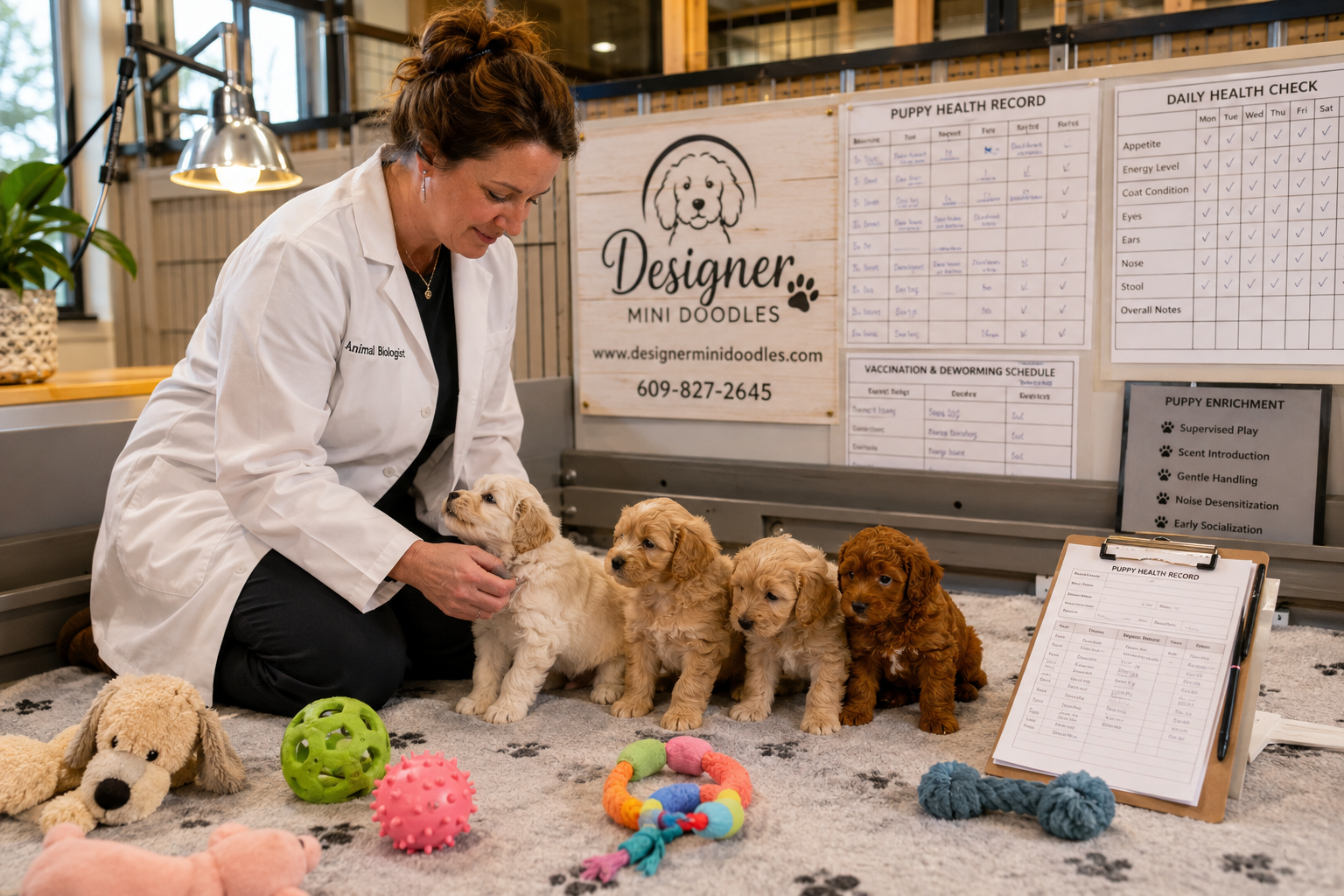
- Programs run by animal biologists that incorporate ENS, early housebreaking, and crate training produce calmer, more confident puppies.
- Reputable breeders often offer puppy nanny delivery services, making it possible to bring a puppy home from anywhere in the country or even internationally.
How Much Do Mini Goldendoodle Puppies Cost in 2026?
Mini golden doodle puppies for sale from reputable breeders range from $2,000 to $5,000, with most families paying around $3,000 to $3,500. Micro and toy goldendoodle puppies, which mature under 20 pounds, often command prices at the higher end of that range because producing consistently small, healthy puppies requires more selective breeding.
Several factors drive price variation:
- Generation: F1B and multigen puppies typically cost more than F1s due to more predictable coats and sizes.
- Coat color: Rare colors like red, phantom, or parti can add $500 to $1,500 to the base price.
- Breeder credentials: Programs led by animal biologists or veterinary professionals with over a decade of experience charge more because they invest heavily in health testing, ENS protocols, and early training.
- Included services: Top breeders bundle microchipping, initial vaccinations, deworming, spay/neuter deposits, and starter kits into the purchase price.
Common mistake: Choosing a puppy based solely on the lowest price. Puppies priced under $1,500 from online listings often come from puppy mills or backyard breeders who skip genetic testing, which can lead to thousands in veterinary bills later.
| Price Range | What You Typically Get |
|---|---|
| Under $1,500 | High risk: no health testing, no socialization, possible puppy mill |
| $2,000 – $3,500 | Reputable breeder with health testing, vaccinations, basic socialization |
| $3,500 – $5,000+ | Elite program: animal biologist-led, ENS, early housebreaking, crate training, puppy nanny delivery |
If you’re searching for miniature golden doodle puppies from a program that has been producing the healthiest mini and micro golden doodle puppies in America for over fifteen years, look for breeders who can document every step of their process.
What’s the Difference Between F1 and F1B Mini Goldendoodles?
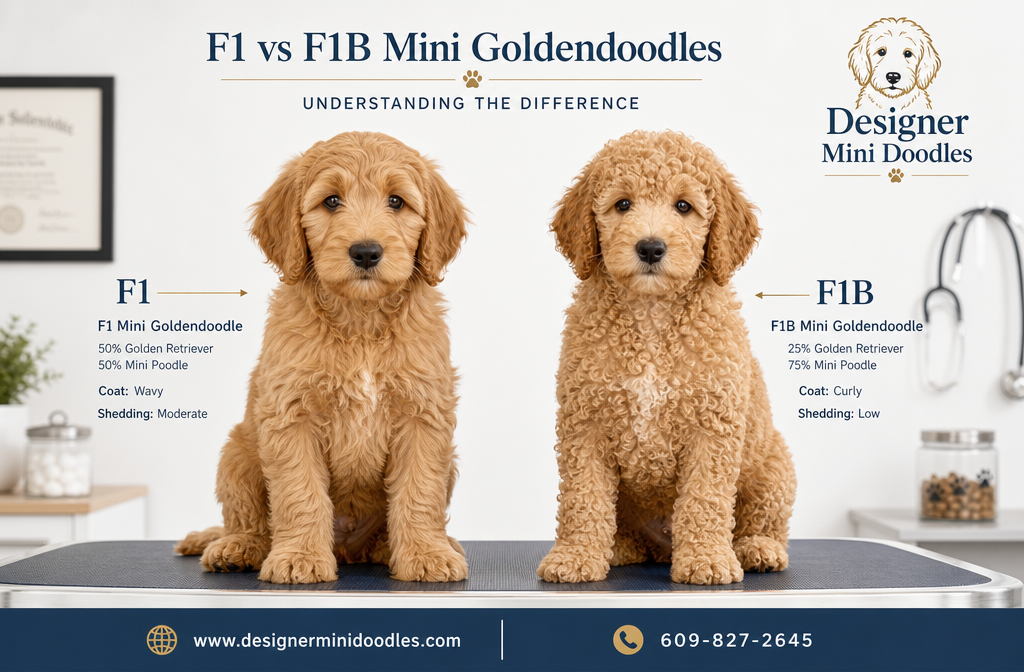
An F1 mini goldendoodle is a first-generation cross (50% Golden Retriever, 50% Miniature Poodle), while an F1B is a backcross (approximately 25% Golden Retriever, 75% Poodle). The F1B generation sheds significantly less and is generally the better choice for allergy-conscious homes.
Here’s a breakdown of the most common generations:
| Generation | Genetic Mix | Coat Type | Shedding Level | Best For |
|---|---|---|---|---|
| F1 | 50% Golden / 50% Poodle | Wavy to slightly curly | Low to moderate | Families wanting a “golden” look with reduced shedding |
| F1B | 25% Golden / 75% Poodle | Curly to wavy | Very low | Allergy-sensitive households |
| F1BB | 12.5% Golden / 87.5% Poodle | Tightly curly | Minimal | Severe allergy sufferers |
| Multigen | Varies | Predictable curly or wavy | Very low to minimal | Buyers wanting consistent traits |
Decision rule: Choose an F1 if you love the Golden Retriever look and don’t have severe allergies. Choose an F1B or F1BB if anyone in the household has pet dander sensitivities. For families seeking allergy-conscious homes guidance, the F1B generation offers the best balance of temperament and hypoallergenic qualities.
Are Mini Goldendoodles Good With Kids and Other Pets?
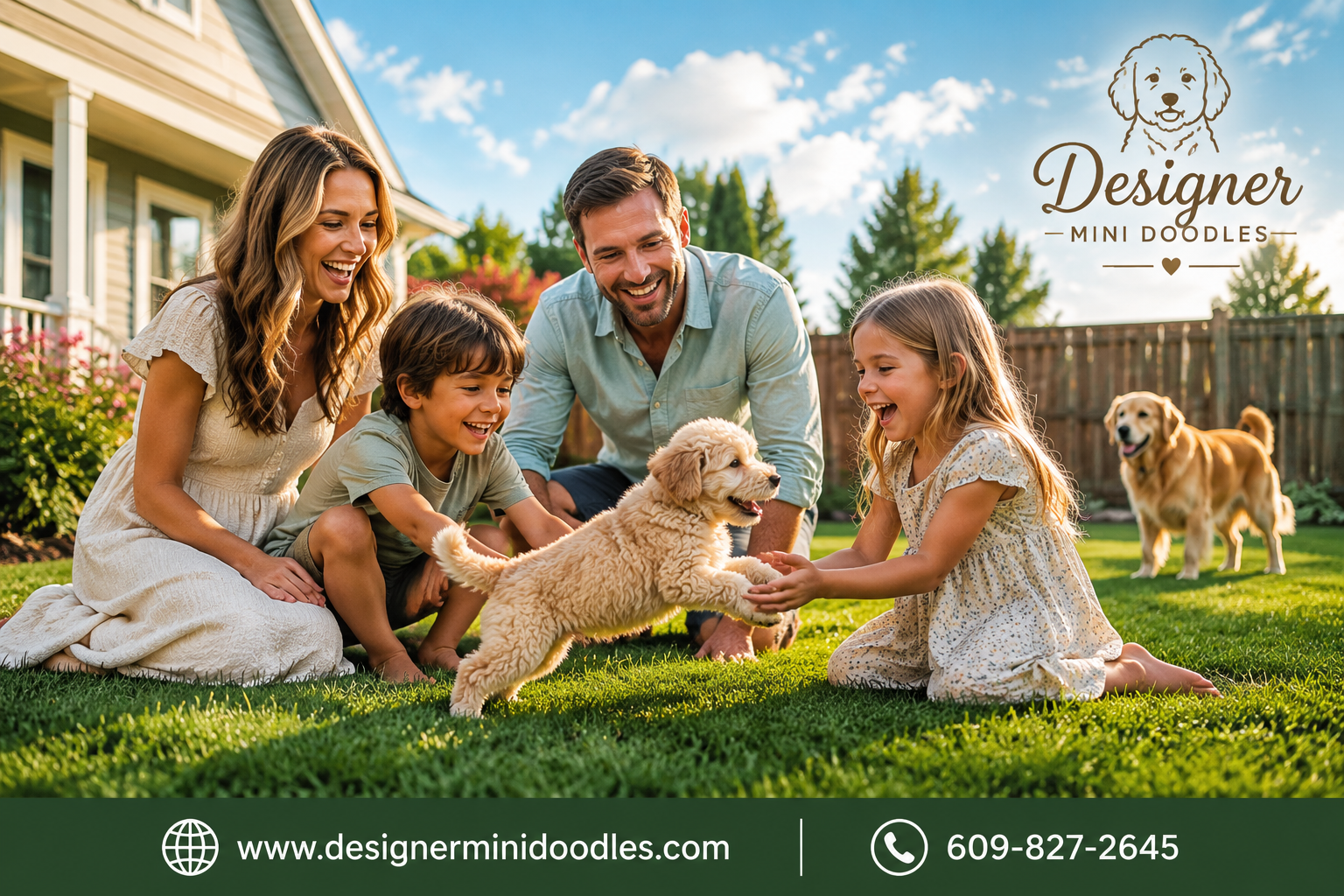
Yes. Mini goldendoodles are one of the most family-friendly designer breeds available. They inherit the Golden Retriever’s patience and gentleness alongside the Poodle’s intelligence and adaptability, making them naturally good with children of all ages and other household pets.
Key traits that make them excellent family dogs:
- Gentle mouth: Golden Retriever lineage gives them a naturally soft bite, which is important around toddlers.
- High social intelligence: They read human emotions well and tend to be calm around crying or excited children.
- Pack-oriented: They generally integrate well with cats, other dogs, and even smaller animals when properly socialized.
- Size advantage: At 15 to 35 pounds, they’re sturdy enough to handle play with older kids but small enough not to accidentally knock over a toddler.
Edge case: Very young puppies (under 16 weeks) can be mouthy during teething. Supervise interactions with children under five and redirect nipping toward appropriate chew toys. For detailed guidance on how these smaller doodles fit into family households with kids, proper early socialization is the single biggest factor.
How Big Do Mini Goldendoodles Get When Fully Grown?
A fully grown mini goldendoodle typically stands 13 to 17 inches at the shoulder and weighs between 15 and 35 pounds. Micro mini goldendoodles finish smaller, usually 10 to 20 pounds, while toy goldendoodle puppies for sale from selective programs may mature at just 10 to 16 pounds.
Adult size depends primarily on:
- The size of the Poodle parent: Toy Poodle crosses produce smaller offspring than Miniature Poodle crosses.
- Generation: F1B puppies bred from smaller parents tend to be more predictably sized.
- Gender: Males typically weigh 2 to 5 pounds more than females.
Most mini goldendoodles reach their full height by 10 to 12 months but may continue filling out until 14 to 18 months. If you want a dog that stays under 20 pounds, specifically ask your breeder about micro golden doodle puppies from Toy Poodle lines with documented adult weights.
Do Mini Goldendoodles Shed a Lot?
No. Mini goldendoodles are classified as low-shedding dogs, though the amount varies by generation and individual coat type. F1B and multigen mini goldendoodles with curly coats shed the least, often producing little to no loose hair around the home.
What to understand about shedding:
- Curly coats trap loose hair within the coat (similar to a Poodle), so they appear not to shed but require regular brushing to prevent matting.
- Wavy coats (common in F1s) shed lightly, roughly comparable to a human losing hair throughout the day.
- Flat or straight coats (rare in minis) shed more noticeably and are less suitable for allergy sufferers.
Grooming requirement: Regardless of coat type, plan on brushing your mini goldendoodle three to four times per week and scheduling professional grooming every six to eight weeks. Neglecting grooming leads to painful matting, especially behind the ears, under the legs, and around the collar area.
Health Issues to Watch for in Mini Goldendoodle Puppies
Mini goldendoodles are generally healthy dogs with a lifespan of 12 to 16 years, but they can inherit conditions from both parent breeds. The most important health screenings should be completed by the breeder before any puppy goes home.
Conditions to monitor:
- Hip dysplasia: Inherited from the Golden Retriever side. Breeders should provide OFA or PennHIP evaluations on both parents.
- Progressive retinal atrophy (PRA): A genetic eye condition common in Poodles. DNA testing can identify carriers.
- Patellar luxation: More common in smaller dogs; the kneecap slips out of position. Ask for OFA patella clearances.
- Von Willebrand’s disease: A blood clotting disorder testable through genetic panels.
- Ear infections: Floppy ears combined with curly hair around the ear canal create a warm, moist environment. Clean ears weekly.
- Allergies: Skin and food allergies can develop, particularly in the first two years.
What a responsible breeder does: A program run by an animal biologist will test breeding dogs for over a dozen genetic conditions through panels from Embark or Paw Print Genetics before any pairing occurs. This is non-negotiable. If a breeder cannot show you test results, walk away.
How to Tell if a Mini Goldendoodle Breeder Is Legitimate
A legitimate breeder will be transparent about health testing, socialization practices, and their breeding philosophy. They will welcome questions, offer facility tours (in person or virtual), and never pressure you to make a quick decision.
Green flags:
- Provides OFA, PennHIP, or equivalent certifications for hips, elbows, eyes, and heart on both parents
- Shares a complete genetic panel (Embark, Paw Print Genetics, or similar)
- Offers a written health guarantee of at least two years
- Practices Early Neurological Stimulation (ENS) from days 3 to 16
- Begins housebreaking and crate training before puppies go home
- Has verifiable reviews, references, and a physical breeding facility
- Is willing to take a puppy back at any point in its life if the owner can no longer care for it
Red flags:
- Multiple breeds always available with no waitlist
- No health testing documentation
- Ships puppies before 8 weeks of age
- Refuses to let you meet the parent dogs or see the facility
- Accepts payment only through untraceable methods (wire transfers, cryptocurrency)
At Designer Mini Doodles, our breeding program has been led by an animal biologist for over fifteen years, producing some of the calmest, most affectionate, and most confident mini golden doodle breeders in the country. Every puppy goes through ENS, early crate training, and structured socialization before joining their new family.
Where Can I Find Reputable Mini Goldendoodle Breeders Near Me?
Start by searching for breeders in your state who specialize in mini and micro goldendoodles, then verify their credentials using the checklist above. Many top breeders also offer puppy nanny delivery services, so geography doesn’t have to limit your options.

State-by-state resources:
Whether you’re on the East Coast, in the Midwest, or out West, reputable programs exist in most states. Here are a few starting points:
- Southeast: Browse mini and micro goldendoodle breeders in Florida or breeders in Georgia for programs with warm-climate socialization.
- Northeast: Check out mini goldendoodle breeders in New York for options near major metro areas.
- Midwest and South: Explore breeders in Texas for one of the largest selections in the country.
Important note: Our puppies are available to go to any home in the world through our dedicated puppy nanny service. A trained nanny personally escorts your puppy door-to-door, ensuring a stress-free transition regardless of distance. This service is especially valuable for families who find their ideal breeder in another state.
If you’re also considering other small companion breeds, we offer miniature french bulldog puppies as well.
What Should I Expect for First-Year Expenses of a Mini Goldendoodle?
Budget between $4,000 and $7,500 for the first year, including the purchase price. Beyond the initial cost of the puppy, ongoing expenses add up quickly during the first twelve months.
First-year expense breakdown:
| Expense Category | Estimated Cost |
|---|---|
| Puppy purchase price | $2,000 – $5,000 |
| Veterinary care (exams, vaccinations, spay/neuter) | $500 – $1,200 |
| Food (high-quality kibble or raw diet) | $400 – $800 |
| Grooming (6-8 sessions) | $300 – $600 |
| Supplies (crate, bed, leash, bowls, toys) | $300 – $500 |
| Training classes or private sessions | $200 – $600 |
| Pet insurance | $300 – $600 |
| Emergency fund (recommended) | $500 – $1,000 |
Cost-saving tip: Puppies from programs that include early housebreaking and crate training often save owners $200 to $500 in professional training fees because the foundational work is already done. For a deeper look at lifetime costs, our cost-of-ownership guide breaks down expenses year by year.
Are Mini Goldendoodles Good for First-Time Dog Owners?
Absolutely. Mini goldendoodles are consistently ranked among the best breeds for first-time dog owners because they’re forgiving of training mistakes, eager to please, and adaptable to various living situations. Their moderate energy level means they don’t require the intense exercise commitment of working breeds.
Why they work for beginners:
- They respond well to positive reinforcement, even from inexperienced trainers.
- Their size is manageable; you won’t struggle to control them on walks.
- They adapt to apartments, condos, and houses with equal ease.
- They’re social enough to enjoy dog parks but not so high-energy that they become destructive without hours of daily exercise.
Choose a mini goldendoodle if you want a dog that’s affectionate, trainable, and adaptable. Reconsider if you travel frequently without your dog and can’t arrange consistent care, or if you’re unwilling to commit to regular grooming.
For first-time owners specifically, our guide on why micro goldendoodles are ideal for new dog parents covers everything from temperament expectations to daily routines.
Common Training Challenges With Mini Goldendoodle Puppies
Mini goldendoodles are highly trainable, but their intelligence and social nature can create a few predictable challenges. The most common issues are separation anxiety, over-excitement with guests, and selective listening during adolescence (around 6 to 10 months).
Challenge 1: Separation anxiety. These dogs bond deeply and can become distressed when left alone. Start crate training early, practice short departures, and avoid making arrivals and departures emotionally charged.
Challenge 2: Jumping on people. Their friendliness means they want to greet everyone enthusiastically. Teach “four on the floor” from day one by only giving attention when all paws are on the ground.
Challenge 3: Adolescent regression. Around 7 to 9 months, many mini goldendoodles seem to “forget” their training. This is normal. Stay consistent, go back to basics, and avoid punishment-based corrections.
Challenge 4: Leash pulling. Their curiosity drives them to explore everything on walks. Use a front-clip harness and practice the “be a tree” method (stop walking when they pull, resume when the leash is slack).
Puppies from programs that incorporate early crate training and structured socialization before 8 weeks tend to experience fewer of these issues. The foundation built during the critical socialization window (3 to 16 weeks) has lasting effects on adult behavior.
What Vaccinations Do Mini Goldendoodle Puppies Need?
Mini goldendoodle puppies need a series of core vaccinations starting at 6 to 8 weeks of age, with boosters every 3 to 4 weeks until they’re 16 weeks old. Core vaccines protect against distemper, parvovirus, adenovirus, and rabies.
Standard vaccination schedule:
| Age | Vaccine | Notes |
|---|---|---|
| 6-8 weeks | DHPP (1st dose) | Distemper, hepatitis, parainfluenza, parvovirus |
| 10-12 weeks | DHPP (2nd dose), Bordetella | Bordetella recommended if puppy will attend daycare or training classes |
| 14-16 weeks | DHPP (3rd dose), Rabies | Rabies required by law in all 50 states |
| 12-16 weeks | Leptospirosis, Lyme (optional) | Recommended based on geographic risk |
| 1 year | DHPP booster, Rabies booster | Then every 1-3 years depending on state law and vet recommendation |
Important: Do not take your puppy to dog parks, pet stores, or high-traffic areas until they’ve completed their full DHPP series. Parvovirus is highly contagious and can be fatal in unvaccinated puppies. Reputable breeders will have already administered the first one or two rounds before your puppy comes home.
Why Designer Mini Doodles Produces the Best Mini Golden Doodle Puppies for Sale
Not all breeding programs are equal. Designer Mini Doodles is run by an animal biologist who has been refining our breeding program for over fifteen years, producing the healthiest, calmest, and most confident mini and micro golden doodle puppies for sale in America.
What sets our program apart:
- Science-based breeding: Every pairing is selected based on genetic compatibility, health panel results, and temperament assessments conducted by our animal biologist.
- Early Neurological Stimulation (ENS): From days 3 through 16, puppies undergo the Bio Sensor program developed by the U.S. military’s canine program, which builds stress tolerance, stronger immune systems, and calmer adult temperaments.
- Early housebreaking and crate training: Puppies begin structured potty training and crate introduction before they leave our facility, giving new owners a significant head start.
- Comprehensive socialization: Exposure to household sounds, different surfaces, children, and other animals ensures puppies transition confidently into their new homes.
- Toy goldendoodle puppies for sale: For families wanting an even smaller companion (10 to 16 pounds), we offer toy goldendoodle puppies bred from Toy Poodle lines with documented adult weights.
Our puppies are available nationwide and internationally through our dedicated puppy nanny service, where a trained professional personally escorts your puppy to your door.
Frequently Asked Questions
How long do mini goldendoodles live?
Mini goldendoodles have an average lifespan of 12 to 16 years. Smaller micro and toy varieties often live at the higher end of this range, as smaller dogs generally outlive larger ones.
Are mini goldendoodles hypoallergenic?
No dog is truly hypoallergenic, but F1B and multigen mini goldendoodles produce significantly less dander than most breeds. They’re a strong choice for mild to moderate allergy sufferers, though people with severe allergies should spend time with the specific generation before committing.
When can I bring a mini goldendoodle puppy home?
Reputable breeders release puppies between 8 and 10 weeks of age. Puppies removed before 8 weeks miss critical socialization with their mother and littermates, which can cause behavioral issues.
How much exercise does a mini goldendoodle need?
Plan on 30 to 60 minutes of daily activity, split between walks and play. They’re adaptable; a brisk 30-minute walk plus indoor play is sufficient for apartment living, while they’ll happily join longer hikes if you’re active.
Can mini goldendoodles be left alone during the workday?
Adult mini goldendoodles can handle 4 to 6 hours alone once properly crate trained. Puppies under 6 months should not be left alone for more than 2 to 3 hours. Consider a dog walker or doggy daycare if you work long hours.
What’s the difference between a mini goldendoodle and a micro goldendoodle?
A mini goldendoodle typically weighs 20 to 35 pounds, while a micro goldendoodle weighs 10 to 20 pounds. The micro size is achieved by using Toy Poodles instead of Miniature Poodles in the breeding program.
Do mini goldendoodles bark a lot?
They’re moderate barkers. They’ll alert you to visitors or unusual sounds but aren’t typically nuisance barkers. Early training and adequate mental stimulation prevent excessive barking.
What’s the best food for a mini goldendoodle puppy?
Choose a high-quality puppy food formulated for small to medium breeds with named protein sources (chicken, salmon, lamb) as the first ingredient. Avoid foods with corn, soy, or artificial preservatives as primary ingredients. Your breeder should provide specific food recommendations based on what the puppy has been eating.
Are male or female mini goldendoodles better?
Neither is objectively better. Males tend to be slightly larger and more playful, while females are often a bit more independent and mature faster. Temperament varies more by individual and breeding than by sex.
How often should I groom my mini goldendoodle?
Brush at home three to four times per week and schedule professional grooming every six to eight weeks. Regular grooming prevents matting, which can cause skin irritation and pain.
Conclusion
Finding mini golden doodle puppies for sale from a reputable source requires research, patience, and a clear understanding of what separates excellent breeders from the rest. The investment you make upfront in choosing a well-bred puppy from a program with documented health testing, ENS protocols, and early training pays dividends for the next 12 to 16 years of your dog’s life.
Your next steps:
- Determine your ideal size (mini, micro, or toy) and generation (F1, F1B, or multigen) based on your household’s allergy sensitivity and size preferences.
- Set a realistic budget of $4,000 to $7,500 for the first year, including the puppy purchase and initial supplies.
- Verify any breeder’s credentials by requesting genetic health panels, OFA certifications, and references from previous puppy families.
- Ask specifically about ENS, early socialization, housebreaking, and crate training protocols.
- Visit our available puppies page to see current mini, micro, and toy golden doodle puppies for sale from our animal biologist-led program, with puppy nanny delivery available to any home worldwide.
References
- Orthopedic Foundation for Animals (OFA). “Canine Health Information Center.” Accessed 2025. https://www.ofa.org
- American Veterinary Medical Association (AVMA). “Vaccination Guidelines.” 2022. https://www.avma.org
- Embark Veterinary. “Dog DNA Testing and Genetic Health Screening.” 2024. https://www.embarkvet.com
- Goldendoodle Association of North America (GANA). “Breed Standards and Generations.” 2023. https://www.goldendoodleassociation.com