
Mini Bernedoodle Breeders Orlando
Orlando families searching for mini Bernedoodle breeders should prioritize programs that perform OFA hip and elbow evaluations, genetic panel testing, and cardiac screenings on all parent dogs. Expect to pay between $3,000 and $5,500 for a well-bred mini Bernedoodle puppy in the Orlando area, with wait times typically ranging from 2 to 6 months. The best mini Bernedoodle breeders Orlando buyers can find will offer health guarantees, transparent parent dog records, and ongoing breeder support after you bring your puppy home.
Mini Bernedoodle Breeders Orlando
- Price range: Mini Bernedoodle puppies in Orlando typically cost $3,000 to $5,500 depending on generation, coat color, and breeder reputation.
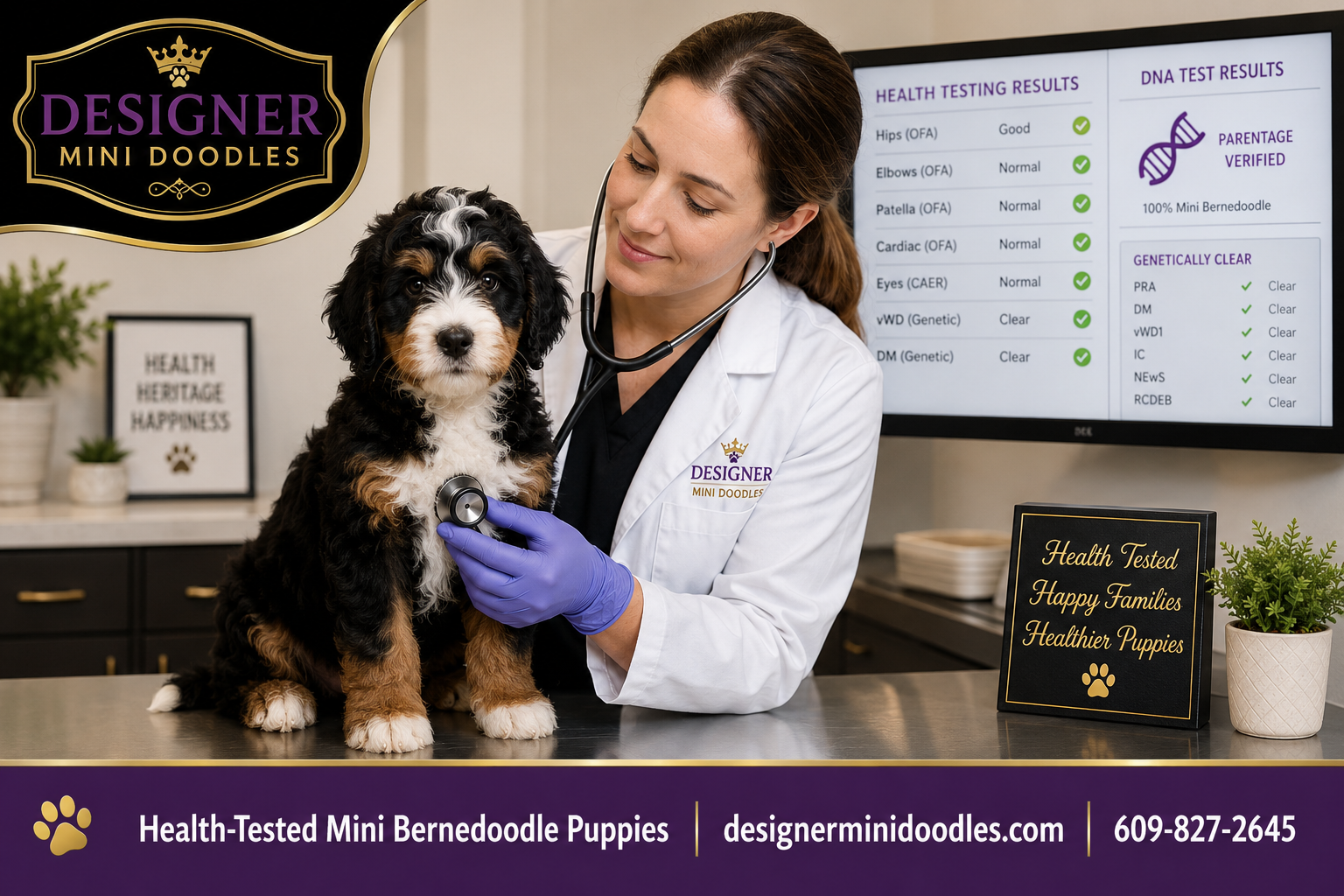
- Health testing is non-negotiable: Responsible breeders test for hip dysplasia, elbow dysplasia, von Willebrand’s disease, progressive retinal atrophy, and degenerative myelopathy at minimum.
- Size at maturity: Most mini Bernedoodles reach 18 to 45 pounds and stand 18 to 22 inches tall when fully grown.
- Low to moderate shedding: F1B and multigenerational mini Bernedoodles shed the least, making them a better fit for allergy-sensitive households.
- Great for families and first-time owners: Their gentle temperament, trainability, and moderate energy level make them one of the most adaptable doodle breeds.
- Wait times matter: Quality breeders often have waitlists of 2 to 6 months, so plan ahead rather than settling for a puppy mill.
- Annual care costs: Budget roughly $1,500 to $3,000 per year for food, grooming, vet visits, and supplies.
- Nanny delivery services allow puppies from top breeders to travel safely to Orlando from anywhere in the country.
How Much Does a Mini Bernedoodle Puppy Cost in Orlando?
A mini Bernedoodle puppy from a reputable breeder in or near Orlando will cost between $3,000 and $5,500 in 2026. Pricing depends on the puppy’s generation, coat pattern, size, and the breeder’s investment in health testing.
Here’s what drives the price variation:
| Factor | Lower End ($3,000-$3,500) | Higher End ($4,500-$5,500) |
|---|---|---|
| Generation | F1 | F1B or multigen |
| Coat color | Standard tri-color | Merle, phantom, or rare patterns |
| Size | Larger mini (35-45 lbs) | Petite mini or micro (under 25 lbs) |
| Health testing | Basic screening | Full OFA + genetic panel |
| Breeder reputation | Newer program | Established with proven lines |
Common mistake: Puppies priced under $2,000 in the Orlando market almost always come from breeders cutting corners on health testing, socialization, or parent dog care. The upfront savings often lead to thousands more in veterinary bills down the road.
If you’re comparing doodle breeds and considering other options, you might also explore miniature Goldendoodle breeders in Florida for a similar size and temperament profile.
What Health Tests Do Responsible Bernedoodle Breeders Do?
Responsible mini Bernedoodle breeders test both parent dogs for breed-specific genetic conditions before any breeding takes place. At minimum, you should see documentation for the following:

Required health screenings for parent dogs:
- OFA hip evaluation — Bernese Mountain Dogs are prone to hip dysplasia, so both parents need certified hip scores
- OFA elbow evaluation — elbow dysplasia is another common Bernese concern
- Cardiac examination — a board-certified veterinary cardiologist should clear both parents
- Ophthalmologist (CERF) exam — screens for progressive retinal atrophy and other eye conditions
- Genetic panel testing — should cover von Willebrand’s disease (vWD), degenerative myelopathy (DM), and at least 150+ genetic markers through services like Embark or Paw Print Genetics
Decision rule: If a breeder cannot produce written OFA or PennHIP results for both the sire and dam, walk away. Verbal assurances are not enough.
At Designer Mini Doodles, a real animal biologist is on site overseeing the breeding program. This level of scientific expertise means every pairing is carefully planned based on genetic compatibility, health clearances, and temperament assessments. Their breeding program is second to none and consistently produces some of the best mini Bernedoodle puppies available anywhere in the USA.
Are Mini Bernedoodles Good With Kids and Other Pets?
Yes. Mini Bernedoodles are one of the most family-friendly doodle breeds available. They inherit the Bernese Mountain Dog’s gentle, patient nature and the Poodle’s intelligence and eagerness to please, which makes them naturally good with children and other household pets.
Why they work well with families:
- Gentle mouth — Bernese lines tend to have soft bite inhibition, which is critical around small children
- Moderate energy — they’re playful without being hyperactive, so they match a family’s varied activity level
- Social nature — they bond closely with all family members rather than becoming a one-person dog
- Good with other dogs — when properly socialized, they integrate well into multi-pet households
- Cat-friendly potential — early exposure to cats during the socialization window (3 to 16 weeks) greatly increases compatibility
Edge case: Mini Bernedoodles can develop separation anxiety if left alone for extended periods. If your family is away from home for 8+ hours daily, this breed may struggle unless you arrange for a dog walker or doggy daycare.
For families considering a smaller companion alongside their Bernedoodle, micro mini Goldendoodles in Florida can be an excellent pairing.
How Big Do Mini Bernedoodles Get When Fully Grown?
A fully grown mini Bernedoodle typically weighs 18 to 45 pounds and stands 18 to 22 inches at the shoulder. The wide range exists because “mini” encompasses several size categories depending on the breeder’s program and the Poodle parent used.
Size breakdown by category:
- Petite/Micro mini: 18-30 lbs, 14-18 inches (Toy Poodle parent)
- Standard mini: 25-45 lbs, 18-22 inches (Miniature Poodle parent)
Most mini Bernedoodles reach their full height by 10 to 12 months but continue filling out in chest and muscle until about 14 to 18 months. For a deeper look at what to expect as your puppy matures, check out this guide on mini Bernedoodle full grown size.
Choose a petite mini if you live in an apartment or condo in Orlando and need a dog under 30 pounds. Choose a standard mini if you have a yard and prefer a sturdier dog for hiking and outdoor activities.
What’s the Difference Between F1 and F1B Bernedoodle Generations?
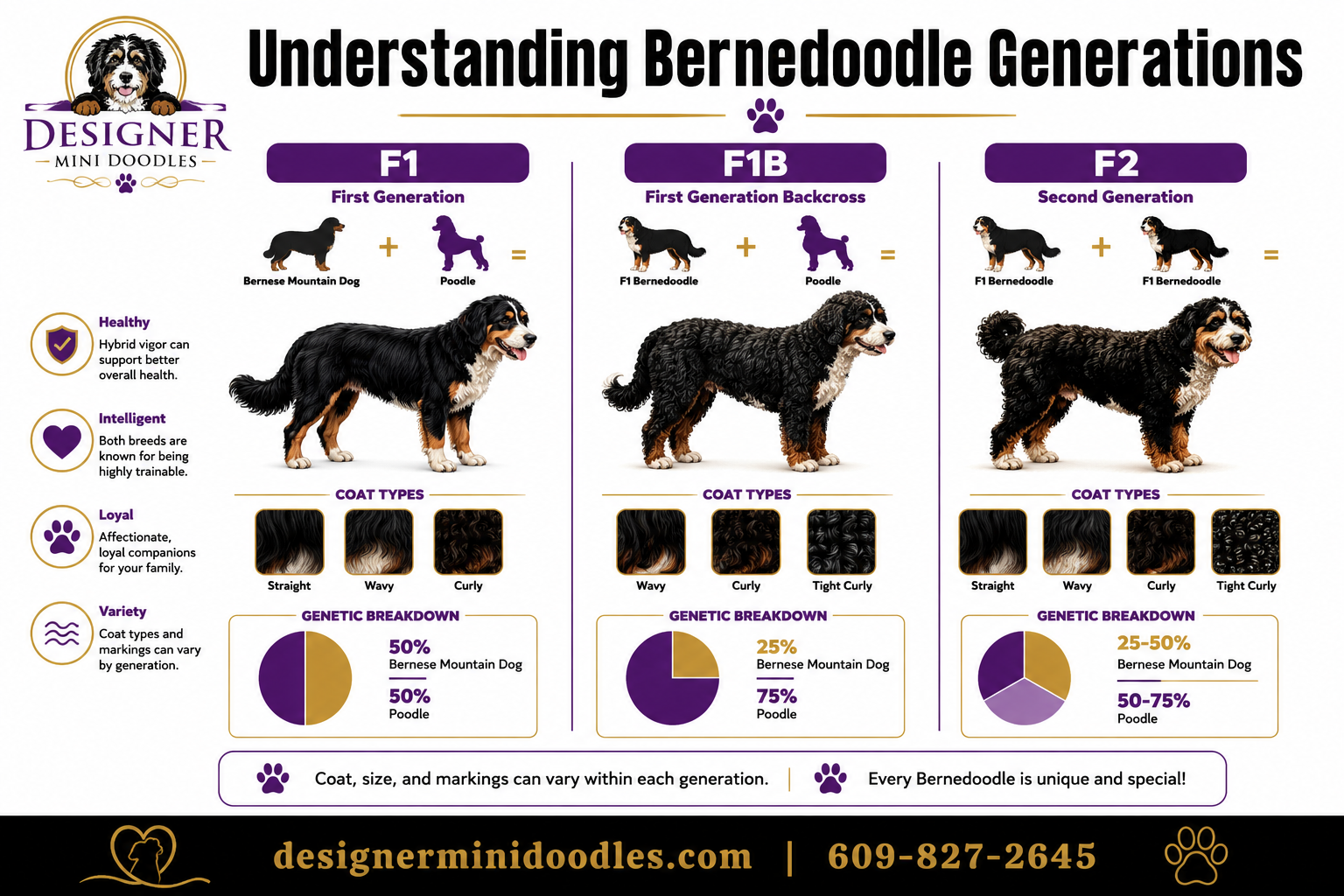
The generation label tells you how much Poodle versus Bernese Mountain Dog genetics your puppy carries, which directly affects coat type, shedding level, and allergy-friendliness.

| Generation | Cross | Genetic Split | Coat Type | Shedding |
|---|---|---|---|---|
| F1 | Bernese x Poodle | 50/50 | Wavy to curly | Low to moderate |
| F1B | F1 Bernedoodle x Poodle | 75% Poodle / 25% Bernese | Curly to very curly | Very low |
| F1BB | F1B x Poodle | 87.5% Poodle / 12.5% Bernese | Very curly | Minimal |
| F2 | F1 x F1 | 50/50 (variable) | Highly variable | Unpredictable |
| Multigen | Various Bernedoodle crosses | Varies | Breeder-selected | Typically low |
Choose F1 if you want the classic tri-color Bernese look and don’t mind some shedding. Choose F1B if allergies are a concern and you want the most predictable low-shedding coat. F2 generations are the least predictable and I generally recommend avoiding them unless the breeder has extensive experience with coat testing.
Common Health Problems in Mini Bernedoodles
Mini Bernedoodles are generally healthy dogs with an expected lifespan of 12 to 15 years, but they can inherit health issues from both parent breeds. Knowing these risks helps you ask the right questions when evaluating mini Bernedoodle breeders in Orlando.
Health conditions to watch for:
- Hip and elbow dysplasia — inherited from the Bernese side; proper health testing of parents significantly reduces risk
- Progressive retinal atrophy (PRA) — a degenerative eye condition that can lead to blindness; DNA-testable
- Von Willebrand’s disease — a blood clotting disorder; both parents should be tested
- Degenerative myelopathy — a progressive spinal cord disease; DNA-testable in parents
- Allergies and skin conditions — some mini Bernedoodles develop food or environmental allergies, especially in Florida’s humid climate
- Bloat (gastric dilatation-volvulus) — more common in larger minis; feeding smaller, more frequent meals helps prevent this
- Addison’s disease — an adrenal gland condition seen occasionally in Poodle lines
Important: A well-bred mini Bernedoodle from health-tested parents has a significantly lower risk of these conditions. This is exactly why breeder selection matters more than price.
How to Find a Reputable Mini Bernedoodle Breeder Near Orlando
Finding trustworthy mini Bernedoodle breeders in Orlando requires looking beyond flashy websites and social media posts. Here’s a concrete checklist to evaluate any breeder you’re considering.
Step-by-step breeder evaluation process:
- Verify health testing — Ask for OFA numbers you can look up yourself on the OFA database (ofa.org)
- Request references — A good breeder will happily connect you with previous puppy families
- Ask about the breeding facility — Puppies should be raised in a home environment, not a kennel
- Review the contract — Look for a minimum 2-year health guarantee covering genetic conditions
- Check return policy — Responsible breeders always take their puppies back if the placement doesn’t work out
- Evaluate socialization protocol — Puppies should be exposed to household sounds, surfaces, and gentle handling from birth
- Ask about the breeder’s expertise — Programs with veterinary or animal science backgrounds produce more consistently healthy puppies
Designer Mini Doodles stands out because they have a real animal biologist on site who oversees every aspect of their breeding program. Their mini Bernedoodles for sale come with comprehensive health guarantees, and their puppies can travel anywhere in the USA through their professional nanny delivery service. This means Orlando families aren’t limited to local breeders — they can access one of the top programs in the country.
Red flags to avoid:
- Multiple litters available at all times with no waitlist
- No health testing documentation
- Unwillingness to let you meet parent dogs (in person or via video)
- Pressure to put down a deposit immediately
- No contract or health guarantee
Typical Wait Times for a Mini Bernedoodle Puppy
Expect to wait 2 to 6 months for a mini Bernedoodle puppy from a quality breeder. Some highly sought-after programs have waitlists extending to 8 or even 12 months, particularly for rare coat colors like merle or phantom patterns.
What affects wait time:
- Breeder popularity — established programs with proven health records have longer lists
- Color preference — tri-color is most common; merle and sable take longer
- Size preference — petite/micro minis are in higher demand and shorter supply
- Generation preference — F1B puppies are the most requested generation
Tip: Place deposits with 1-2 breeders if timing is important to you, but only with programs that offer refundable deposits if you decide not to proceed. Browse mini Bernedoodle puppies for sale to see current availability from a top-tier program.
Do Mini Bernedoodles Shed a Lot?
Mini Bernedoodles are considered a low-shedding breed, but the amount of shedding depends heavily on their generation and individual coat type. No dog is truly 100% hypoallergenic, but F1B and multigen mini Bernedoodles come close.
Shedding by coat type:
- Straight/flat coat (rare in minis) — sheds moderately, similar to a Bernese Mountain Dog
- Wavy coat — low shedding; the most common coat type in F1 minis
- Curly coat — very low shedding; most common in F1B and multigen; requires more grooming to prevent matting
Grooming requirements: Regardless of coat type, plan on brushing your mini Bernedoodle 3-4 times per week and scheduling professional grooming every 6-8 weeks. Orlando’s humidity can cause mats to form faster, so consistent brushing is especially important here.
What Should I Look for When Visiting a Mini Bernedoodle Breeder?
When you visit a breeder (in person or virtually), you’re evaluating the environment, the dogs’ temperament, and the breeder’s transparency. Here’s what to observe:
Environment checklist:
- Clean, spacious living areas for puppies and adult dogs
- Puppies raised inside the home, not in outdoor kennels
- Access to outdoor play areas
- No strong odor of urine or feces
- Enrichment items like toys, tunnels, and different surfaces
Dog behavior indicators:
- Adult dogs should be friendly and well-socialized, not fearful or aggressive
- Puppies should be curious and approach you willingly
- Mother dog should be present and in good body condition
Questions to ask during your visit:
- Can I see the health testing results for both parents?
- What socialization protocol do you follow?
- What food are the puppies eating, and what do you recommend long-term?
- What’s included in the puppy package (microchip, vaccines, deworming)?
- Do you offer ongoing support after I take my puppy home?
How Much Does It Cost to Care for a Mini Bernedoodle Annually?
Budget approximately $1,500 to $3,000 per year for a mini Bernedoodle’s ongoing care in Orlando. First-year costs run higher due to initial supplies and the puppy vaccination series.
| Expense Category | Annual Estimate |
|---|---|
| Food (premium kibble or raw) | $500-$900 |
| Grooming (every 6-8 weeks) | $480-$960 |
| Veterinary care (routine) | $300-$600 |
| Flea/tick/heartworm prevention | $200-$350 |
| Pet insurance | $300-$600 |
| Toys, treats, supplies | $150-$300 |
| Training classes | $100-$400 |
| Total | $2,030-$4,110 |
Florida-specific note: Heartworm prevention is a year-round necessity in Orlando due to the warm, mosquito-heavy climate. Never skip a month.
Are Mini Bernedoodles Good for First-Time Dog Owners?
Mini Bernedoodles are an excellent choice for first-time dog owners. Their combination of intelligence, eagerness to please, and moderate energy level makes them forgiving of beginner mistakes while still being engaging enough to keep new owners motivated.
Why they work for beginners:
- They respond well to positive reinforcement training
- Their moderate exercise needs (30-60 minutes daily) are manageable for most lifestyles
- They’re not prone to aggression or extreme stubbornness
- Their size is manageable — large enough to be sturdy but small enough for apartment living
Where first-time owners sometimes struggle:
- Grooming commitment — the curly coat requires consistent maintenance that surprises some new owners
- Separation anxiety — Bernedoodles bond deeply and may struggle when left alone; crate training from day one helps
- Adolescent phase — between 6 and 14 months, even well-bred Bernedoodles test boundaries
If you’re also considering other breeds suited to first-time owners, miniature Goldendoodle breeders offer another excellent option with a similar temperament profile.
What Training Do Mini Bernedoodle Puppies Need Early On?
Start training your mini Bernedoodle puppy the day you bring them home. Early training should focus on four core areas: socialization, housebreaking, crate training, and basic obedience.
Week-by-week training priorities (8-16 weeks):
- Weeks 8-10: Focus on name recognition, crate introduction, and potty training schedule. Take your puppy outside every 1-2 hours and after every meal, nap, and play session.
- Weeks 10-12: Begin basic commands (sit, down, come) using positive reinforcement. Start short leash walks in your yard.
- Weeks 12-14: Expand socialization to new environments, sounds, and people (after initial vaccinations are complete). Introduce basic impulse control exercises.
- Weeks 14-16: Enroll in a puppy kindergarten class. Practice commands in increasingly distracting environments.
For a detailed training roadmap, our guide on training a mini Bernedoodle puppy covers everything from basic obedience to advanced socialization techniques. You’ll also find our housebreaking guide for mini Bernedoodle puppies helpful for tackling potty training in Florida’s climate.
Common training mistake: Many new Bernedoodle owners wait until their puppy is 4-6 months old to start formal training. By then, unwanted behaviors are already forming. Start early and stay consistent.
Why Orlando Families Choose Designer Mini Doodles
Orlando’s warm climate and active outdoor lifestyle make it an ideal city for mini Bernedoodle ownership. But finding the right breeder is what separates a wonderful 12-15 year experience from a heartbreaking one.
Designer Mini Doodles has built one of the most respected mini Bernedoodle breeder programs in the country. What sets them apart is having a real animal biologist on site who oversees genetic pairing decisions, health screening protocols, and puppy development milestones. This scientific approach to breeding produces puppies with predictable temperaments, healthy genetics, and beautiful coats.
Their professional nanny delivery service means Orlando families can receive their puppy safely without the stress of long-distance travel. A trained puppy nanny accompanies your new mini Bernedoodle on the journey, ensuring they arrive calm, comfortable, and ready to bond with your family.
For those who also love French Bulldogs, Designer Mini Doodles’ sister program offers Frenchies for sale with the same commitment to health testing and responsible breeding.
- Display 9 Products per page




Frequently Asked Questions
How long do mini Bernedoodles live?
Mini Bernedoodles have an average lifespan of 12 to 15 years. Smaller minis tend to live slightly longer than larger ones. Proper nutrition, regular veterinary care, and maintaining a healthy weight all contribute to longevity.
Can mini Bernedoodles handle Orlando’s heat?
Yes, but they need accommodations. Avoid outdoor exercise during peak heat (10 AM to 4 PM), provide constant access to fresh water, and keep their coat trimmed shorter during summer months. Their Bernese heritage means they’re more heat-sensitive than some breeds.
Do mini Bernedoodles bark a lot?
Mini Bernedoodles are moderate barkers. They’ll alert you to visitors or unusual sounds but aren’t typically nuisance barkers. Early training to manage alert barking prevents it from becoming excessive.
When should I spay or neuter my mini Bernedoodle?
Most veterinarians recommend waiting until your mini Bernedoodle is 12 to 18 months old to allow for proper growth plate closure. Discuss timing with your vet, as recommendations can vary based on your dog’s specific size and development.
Can I get a mini Bernedoodle shipped to Orlando?
Yes. Reputable breeders like Designer Mini Doodles offer professional nanny delivery services where a trained handler accompanies your puppy during travel. This is far safer and less stressful than cargo shipping.
What colors do mini Bernedoodles come in?
The most popular color is the classic tri-color (black, white, and rust), which mirrors the Bernese Mountain Dog pattern. Other colors include phantom, merle, sable, black and white, and solid black. Rare colors typically cost more.
Are mini Bernedoodles recognized by the AKC?
No. As a designer crossbreed, mini Bernedoodles are not recognized by the American Kennel Club. However, they can be registered with organizations like the International Designer Canine Registry (IDCR).
How often do mini Bernedoodles need to go to the groomer?
Every 6 to 8 weeks for a full groom, which includes bathing, haircut, nail trim, and ear cleaning. Between grooming appointments, brush your dog 3-4 times per week to prevent matting.
What’s the best food for a mini Bernedoodle puppy?
Look for a high-quality puppy food formulated for medium-sized breeds with real meat as the first ingredient. Many breeders recommend brands like Royal Canin, Purina Pro Plan, or raw feeding programs. Your breeder should provide specific food recommendations at pickup.
Do mini Bernedoodles need a lot of exercise?
They need 30 to 60 minutes of daily exercise, which can include walks, playtime in the yard, or trips to one of Orlando’s many dog parks. They’re adaptable — they’ll match your activity level without demanding marathon runs.
Can I find mini Bernedoodle breeders in Orlando who allow facility visits?
Some local breeders allow visits, but many top programs are not located directly in Orlando. With nanny delivery services available nationwide, you’re not limited to breeders within driving distance. Video calls and virtual tours are standard practice for reputable breeders.
Conclusion
Finding the right mini Bernedoodle breeders in Orlando comes down to prioritizing health testing, breeder transparency, and proper puppy socialization over convenience or price. The best breeders invest heavily in genetic screening, raise puppies in enriched home environments, and provide lifelong support to their puppy families.
Your next steps:
- Set your budget at $3,000-$5,500 for the puppy plus $2,000-$4,000 for first-year supplies and veterinary care.
- Research breeders using the checklist in this guide — verify OFA results, request references, and review contracts carefully.
- Get on a waitlist early — quality mini Bernedoodle puppies require 2-6 months of patience.
- Prepare your home before your puppy arrives with a crate, puppy-proofed spaces, and a training plan.
- Browse currently available puppies from Designer Mini Doodles’ available mini Bernedoodle puppies to start your search today.
A well-bred mini Bernedoodle from a responsible program will be your family’s loyal companion for the next 12 to 15 years. Take the time to find the right breeder, and you’ll be rewarded with a healthy, happy puppy that fits perfectly into your Orlando lifestyle.
Tags: mini Bernedoodle breeders Orlando, mini Bernedoodle puppies, Bernedoodle Orlando, mini Bernedoodle cost, F1B Bernedoodle, Bernedoodle health testing, mini Bernedoodle size, Bernedoodle training, doodle breeders Florida, mini Bernedoodle shedding, Bernedoodle puppy care