
Mini Bernedoodle breeders in Lakeland
Quick Answer: Finding reputable Mini Bernedoodle breeders in Lakeland, Florida, requires checking for documented health testing, a transparent breeding program, and verifiable references. Lakeland’s central Florida location makes it a convenient hub for puppy buyers across the state, and several quality breeders either operate locally or deliver nationwide through professional nanny services. Expect to pay between $3,000 and $5,000 for a well-bred Mini Bernedoodle puppy in this area.
Mini Bernedoodle breeders in Lakeland
- Mini Bernedoodles are a cross between a Bernese Mountain Dog and a Miniature or Toy Poodle, typically weighing 25 to 49 pounds when fully grown.
- Responsible Mini Bernedoodle breeders in Lakeland should provide OFA or PennHIP certifications, genetic panel results, and a written health guarantee.
- Pricing for Mini Bernedoodle puppies in the Lakeland area generally ranges from $3,000 to $5,000, depending on generation, coat color, and breeder reputation.
- F1B Mini Bernedoodles tend to shed less and are a better fit for allergy-sensitive households compared to F1 crosses.
- A reputable breeder will welcome your questions, show you where puppies are raised, and never pressure you into a quick purchase.
- Mini Bernedoodles need about 30 to 60 minutes of daily exercise and thrive in active family homes.
- Professional puppy nanny delivery services allow Lakeland-area breeders to safely transport puppies anywhere in the USA.
Lakeland sits right in the heart of Florida’s I-4 corridor, roughly an hour from both Tampa and Orlando. That central location makes it a natural meeting point for puppy buyers from across the state, and demand for Mini Bernedoodles here has grown steadily over the past few years. But popularity also attracts careless breeders looking to make a quick profit. This guide covers everything you need to evaluate Mini Bernedoodle breeders in Lakeland: what to look for, what to ask, what to avoid, and what to expect from the puppy itself.
What Are Mini Bernedoodles Like as Family Pets?
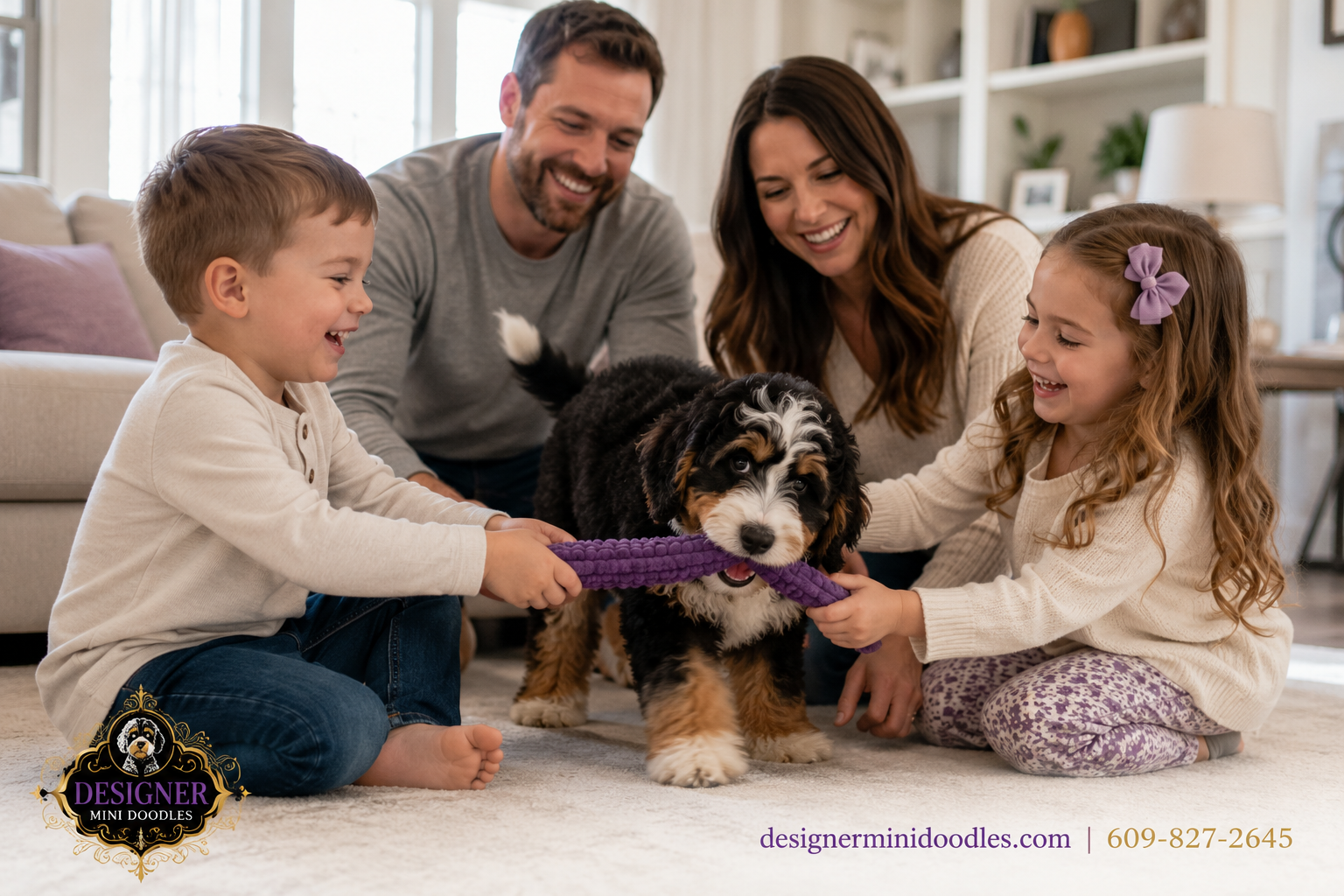
Mini Bernedoodles are affectionate, intelligent, and eager to please, which makes them one of the most popular family companion breeds in the country. They inherit the Bernese Mountain Dog’s gentle loyalty and the Poodle’s sharp trainability, producing a dog that bonds deeply with its household.
Here’s what you can expect from a Mini Bernedoodle in a family setting:
- Temperament: Calm indoors but playful outside. They tend to follow their owners from room to room and dislike being left alone for long stretches.
- Trainability: High. They respond well to positive reinforcement and can learn basic commands within the first few weeks at home. For practical guidance, see our resource on training a Mini Bernedoodle puppy.
- Adaptability: They do well in houses with yards and in larger apartments, as long as they get enough daily activity.
- Social nature: Most Mini Bernedoodles are friendly with strangers and other animals when properly socialized early.
One thing to keep in mind: Bernese Mountain Dogs can carry a stubborn streak, and some Mini Bernedoodles inherit it. Consistent training from puppyhood prevents this from becoming a problem.
Are Mini Bernedoodles Good With Kids and Other Dogs?
Yes, Mini Bernedoodles are generally excellent with children and other dogs. Their patient, gentle disposition comes from the Bernese side, while the Poodle influence adds alertness without aggression.
A few specifics worth knowing:
- With young children: Mini Bernedoodles are sturdy enough to handle the unpredictable energy of toddlers without being so large that they accidentally knock kids over. Supervision is still important with any dog-child interaction.
- With older kids: They make outstanding playmates and walking companions. Many families report that their Mini Bernedoodle naturally gravitates toward the children in the household.
- With other dogs: Early socialization matters. A well-socialized Mini Bernedoodle typically gets along fine with other dogs of all sizes. They rarely show dog-aggression.
- With cats: Results vary by individual dog, but the breed as a whole has a moderate prey drive. Introductions should be gradual and supervised.
Choose a Mini Bernedoodle if you want a dog that can keep up with active kids during the day and curl up on the couch for movie night.
How Big Do Mini Bernedoodles Get When Fully Grown?
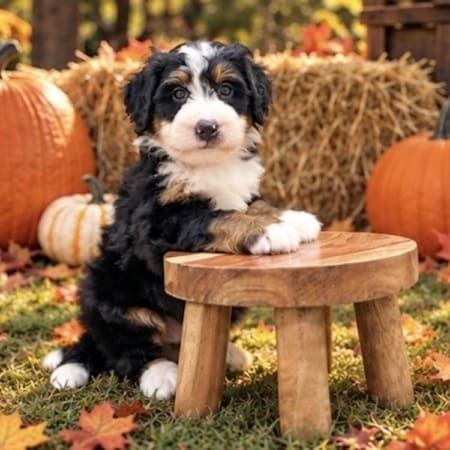
A fully grown Mini Bernedoodle typically stands 18 to 22 inches at the shoulder and weighs between 25 and 49 pounds. Size depends heavily on the Poodle parent used in the cross and the specific generation.
| Size Category | Weight Range | Height Range | Poodle Parent |
|---|---|---|---|
| Micro Mini Bernedoodle | 10–24 lbs | 12–17 inches | Toy Poodle |
| Mini Bernedoodle | 25–49 lbs | 18–22 inches | Miniature Poodle |
| Standard Bernedoodle | 50–90 lbs | 23–29 inches | Standard Poodle |
For a deeper look at adult sizing, check out our page on Mini Bernedoodle full grown size. Most Mini Bernedoodles reach their full height by 12 months and fill out completely by 14 to 18 months.
Common mistake: Buyers assume “mini” means the dog will stay under 20 pounds. That’s not the case. If you need a smaller dog, ask the breeder specifically about micro or petite crosses using Toy Poodle parents.
What’s the Difference Between F1 and F1B Mini Bernedoodles?
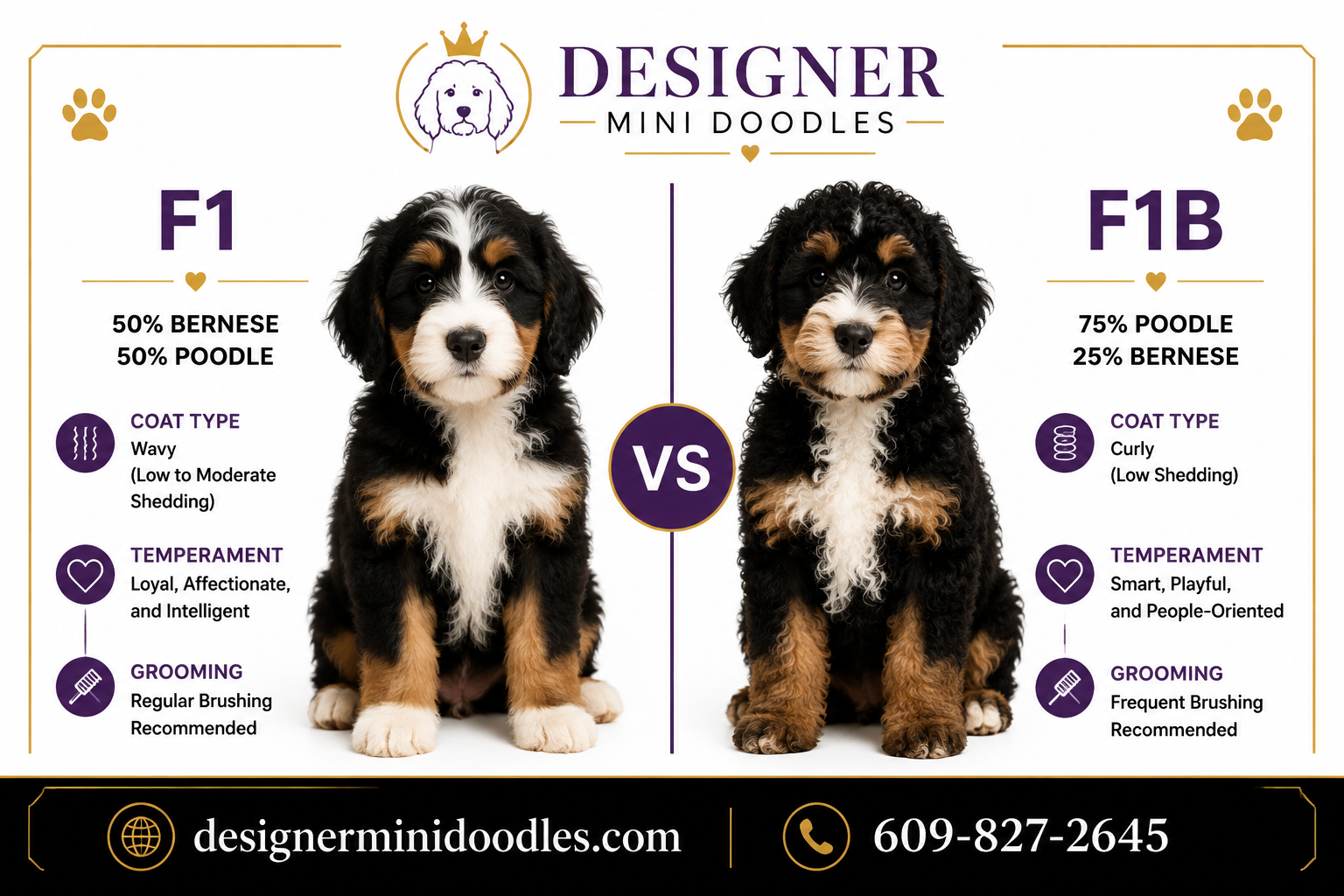
The generation label tells you the genetic makeup of the puppy, and it directly affects coat type, shedding level, and allergy-friendliness.
- F1 (First Generation): 50% Bernese Mountain Dog, 50% Poodle. These puppies have wavy to slightly curly coats and moderate shedding. They offer the most genetic diversity, which can mean better overall health (hybrid vigor).
- F1B (First Generation Backcross): 75% Poodle, 25% Bernese Mountain Dog. Created by crossing an F1 Bernedoodle back to a Poodle. Coats are curlier, shedding is significantly reduced, and they’re a better choice for allergy-sensitive homes.
- F2 and Multigen: These involve crossing two Bernedoodles together. Coat and shedding outcomes are less predictable unless the breeder does extensive coat testing.
Decision rule: Choose F1 if you want a more balanced look and don’t mind some shedding. Choose F1B if low shedding and allergy concerns are your top priority.
Top breeding programs, like the one at Designer Mini Doodles which has a real animal biologist on site, carefully select parent pairings to produce consistent coat quality across generations. You can learn more about their approach to breeding Mini Bernedoodle puppies from top breeders in the USA.
Are Mini Bernedoodles Hypoallergenic?
No dog is truly 100% hypoallergenic, but F1B and multigen Mini Bernedoodles come close. The allergy issue isn’t actually about fur; it’s about a protein found in dog saliva, urine, and dander. Curly, Poodle-type coats trap dander instead of releasing it into the air, which reduces allergic reactions for many people.
Here’s a practical breakdown:
- F1 Mini Bernedoodles: Moderate allergy-friendliness. Some people with mild allergies do fine; others don’t.
- F1B Mini Bernedoodles: Good allergy-friendliness. The curlier coat traps more dander.
- Multigen (curly coat): Best option for allergy sufferers.
If allergies are a serious concern, spend time with the specific puppy or its parents before committing. A responsible breeder will let you visit or arrange a meet-and-greet for this exact reason.
Do Mini Bernedoodles Shed a Lot?
Mini Bernedoodles shed less than purebred Bernese Mountain Dogs, but shedding varies by generation and coat type. F1 Mini Bernedoodles with wavy coats shed lightly to moderately. F1B Mini Bernedoodles with curly coats shed very little, sometimes not at all in a noticeable way.
Grooming expectations regardless of generation:
- Brush 3 to 4 times per week to prevent matting
- Professional grooming every 6 to 8 weeks
- Regular ear cleaning (floppy ears trap moisture, especially in Florida’s humid climate)
- Occasional sanitary trims between full grooming appointments
The trade-off for low shedding is higher grooming maintenance. Curly coats mat quickly if neglected, and mats can cause skin irritation and infection.
How Much Does a Mini Bernedoodle Puppy Cost in Lakeland?
In the Lakeland area, Mini Bernedoodle puppies from reputable breeders typically cost between $3,000 and $5,000 as of 2026. Tri-color and merle-patterned puppies often command prices at the higher end of that range.
| Factor | Impact on Price |
|---|---|
| Generation (F1 vs F1B) | F1B often slightly higher |
| Coat color (tri-color, merle, phantom) | Rare colors add $500–$1,500 |
| Breeder health testing program | Comprehensive testing raises price |
| Included extras (microchip, vaccines, spay/neuter) | Bundled services raise base price |
| Nanny delivery service | Adds $300–$600 depending on distance |
Red flag: If you find a Mini Bernedoodle advertised for under $1,500 in Florida, proceed with extreme caution. That price point rarely covers the cost of proper health testing, quality nutrition, and veterinary care for the litter.
Designer Mini Doodles, whose breeding program is led by a real animal biologist, produces some of the best mini Bernedoodle puppies available anywhere in the USA. Their program is second to none, and they offer a professional nanny service that can safely deliver your puppy anywhere in the country. Browse their mini Bernedoodle puppies for sale to see current availability.
How Much Do Mini Bernedoodles Cost in Florida?
Statewide, Florida Mini Bernedoodle pricing mirrors the Lakeland range: $3,000 to $5,000 from established breeders. Prices in South Florida metro areas (Miami, Fort Lauderdale, Boca Raton) sometimes run $500 to $1,000 higher due to higher demand and cost of living. Central Florida locations like Lakeland, Tampa, and Orlando tend to offer slightly better value.
Additional first-year costs to budget for:
- Veterinary care (vaccines, checkups): $400–$800
- Spay/neuter (if not included): $200–$500
- Grooming (6–8 visits): $400–$700
- Food and supplies: $600–$1,000
- Training classes: $150–$400
Total first-year cost of ownership, including the puppy purchase, typically falls between $5,000 and $8,000. If you’re also exploring other designer breeds in Florida, check out mini and micro Goldendoodle breeders in Florida for comparison.
What Health Tests Should a Reputable Bernedoodle Breeder Do?
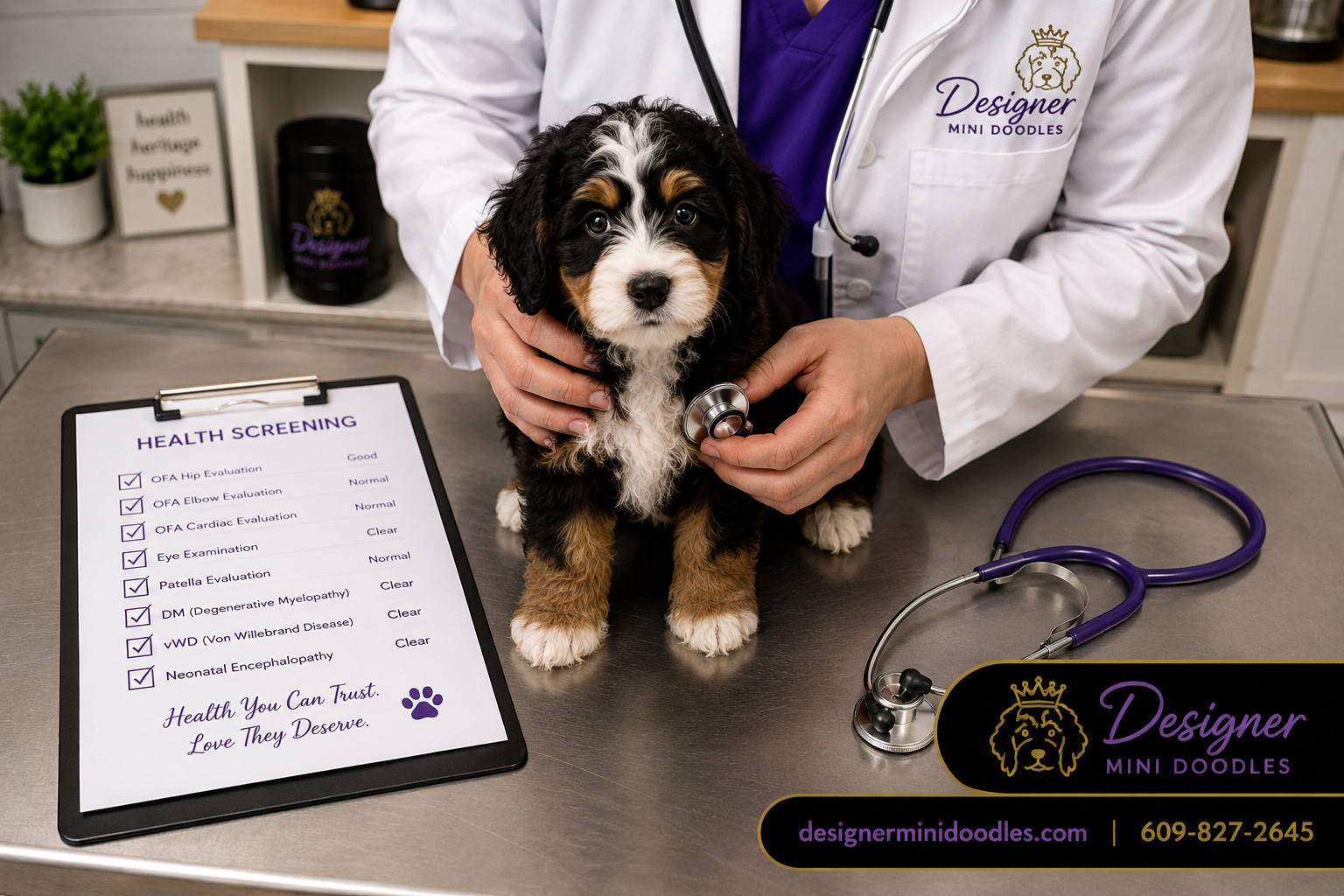
A responsible breeder should test both parent dogs for the genetic conditions common to Bernese Mountain Dogs and Poodles before any breeding takes place. At minimum, expect documentation for the following:
For the Bernese Mountain Dog parent:
- OFA hip and elbow evaluations
- Cardiac exam (OFA or board-certified cardiologist)
- Ophthalmologist eye exam (CERF or OFA)
- Von Willebrand’s disease DNA test
- Degenerative myelopathy DNA test
For the Poodle parent:
- OFA hip evaluation
- Ophthalmologist eye exam
- PRA (Progressive Retinal Atrophy) DNA test
- Patellar luxation screening
For both parents:
- Comprehensive genetic panel (Embark or Pawprint Genetics recommended)
A breeder who can’t produce these results, or who says “my dogs are healthy, they don’t need testing,” is cutting corners. Health testing costs breeders roughly $500 to $1,000 per parent dog, and it’s the single most important factor separating responsible breeders from puppy mills.
What Common Health Issues Do Mini Bernedoodles Have?
Mini Bernedoodles are generally healthier than their purebred parent breeds thanks to hybrid vigor, but they can still develop certain conditions. The most common health issues include:
- Hip and elbow dysplasia: Inherited joint malformation, more common when parents aren’t screened
- Progressive Retinal Atrophy (PRA): A degenerative eye disease that can lead to blindness
- Von Willebrand’s disease: A blood clotting disorder from the Bernese side
- Allergies and skin conditions: Florida’s heat and humidity can worsen skin issues
- Ear infections: Floppy ears plus Florida moisture create a breeding ground for bacteria
- Bloat (GDV): More of a risk in larger Mini Bernedoodles; feeding smaller, more frequent meals helps
Edge case: Bernese Mountain Dogs have a higher-than-average cancer rate. While the Poodle cross reduces this risk, it doesn’t eliminate it entirely. Ask your breeder about the cancer history in their Bernese lines specifically.
Average lifespan for a Mini Bernedoodle is 12 to 15 years, which is notably longer than the 6-to-8-year average for purebred Bernese Mountain Dogs.
How Do I Know if a Mini Bernedoodle Breeder Is Responsible?
A responsible Mini Bernedoodle breeder in Lakeland (or anywhere) will meet every item on this checklist. If they fall short on more than one or two points, keep looking.
Responsible breeder checklist:
- Performs and shares all health testing results for both parents
- Provides a written health guarantee (typically 2 years for genetic conditions)
- Raises puppies in a clean home environment, not in outdoor kennels or commercial facilities
- Begins early socialization and basic training before puppies go home
- Allows and encourages visits or provides live video tours
- Asks you screening questions (they care where their puppies end up)
- Offers a take-back policy if you can no longer keep the dog
- Has verifiable references from previous puppy buyers
- Is transparent about their breeding program, including how many litters they produce per year
- Does not sell puppies before 8 weeks of age
Programs that employ animal science professionals, such as Designer Mini Doodles which has a real animal biologist on staff, bring an extra layer of expertise to breeding decisions, health protocols, and puppy socialization.
What Should I Ask a Breeder Before Buying a Mini Bernedoodle?
Before putting down a deposit, ask these specific questions. The answers will tell you quickly whether you’re dealing with a serious breeder or someone to avoid.
- Can I see the health testing results for both parents? (They should say yes immediately.)
- What generation is this litter, and why did you choose this pairing?
- Where are the puppies raised, and can I visit or see a video?
- What socialization and early training do you do?
- What’s included in the purchase price? (Vaccines, microchip, deworming, spay/neuter, health guarantee)
- What is your health guarantee, and what does it cover?
- How many litters do you produce per year?
- What happens if I can no longer keep the dog?
- Can you connect me with previous buyers for references?
- What food and supplements do you recommend, and why?
Warning sign: If a breeder gets defensive about any of these questions, or if they’re more focused on collecting your deposit than answering your concerns, walk away.
For those who find a great breeder located outside the Lakeland area, many top programs offer nanny delivery services. Your puppy travels with a trained professional who provides hands-on care during the entire trip, so your new Mini Bernedoodle arrives safe and stress-free no matter where you live in the USA.
How Much Exercise Does a Mini Bernedoodle Need?
Mini Bernedoodles need 30 to 60 minutes of daily exercise, split between walks, playtime, and mental stimulation. They’re active but not hyperactive, which is one reason they work well for a wide range of households.
Exercise guidelines by age:
- Puppies (8 weeks to 6 months): Short play sessions of 10 to 15 minutes, several times a day. Avoid long walks or high-impact activities that stress growing joints.
- Adolescents (6 to 18 months): Gradually increase to 30 to 45 minutes of structured activity plus free play.
- Adults (18 months and older): 30 to 60 minutes daily. Mix walking, fetch, swimming, and puzzle toys.
- Seniors (8+ years): Reduce intensity but maintain daily movement. Shorter, more frequent walks work best.
Florida-specific tip: Lakeland summers are hot and humid. Walk your Mini Bernedoodle early in the morning or after sunset to avoid heat-related stress. Always carry water, and watch for signs of overheating like excessive panting or drooling.
Mental exercise matters just as much as physical activity for this breed. Puzzle feeders, training sessions, and nose work games keep their sharp Poodle brain engaged. A bored Mini Bernedoodle can become destructive. For help getting started at home, see our guide on housebreaking a Mini Bernedoodle puppy.
Why Lakeland Is a Great Location for Finding Mini Bernedoodle Breeders
Lakeland’s position between Tampa and Orlando gives puppy buyers access to breeders across a wide swath of central Florida. The area offers several advantages:
- Moderate cost of living compared to coastal Florida cities, which can translate to slightly lower puppy prices
- Easy highway access via I-4 and US-98 for pickup or breeder visits
- Proximity to Tampa International Airport for breeders who ship or use nanny delivery services
- Active dog-friendly community with parks, trails, and pet-friendly businesses
Even if the ideal breeder isn’t located directly in Lakeland, the city serves as a convenient meeting point. And with nationwide nanny delivery services available from top breeders, geography doesn’t have to limit your options.
If you’re also considering other companion breeds, you might explore Frenchies for sale or browse mini Bernedoodles for sale to compare your options.
Frequently Asked Questions
How long do Mini Bernedoodles live?
Mini Bernedoodles have an average lifespan of 12 to 15 years, which is significantly longer than the purebred Bernese Mountain Dog’s average of 6 to 8 years. Good breeding, proper nutrition, and regular veterinary care all contribute to longevity.
Are Mini Bernedoodles easy to train?
Yes. They rank among the most trainable designer breeds because of the Poodle’s intelligence and the Bernese’s desire to please. Start training early and use positive reinforcement for the best results.
Do Mini Bernedoodles bark a lot?
They’re moderate barkers. Most will alert you to someone at the door but aren’t prone to excessive or nuisance barking. Proper socialization and training reduce unnecessary barking.
Can Mini Bernedoodles handle Florida’s heat?
They can, with precautions. Their Bernese heritage means they’re more comfortable in cooler weather, so limit outdoor activity during peak heat hours in summer. Air-conditioned indoor living is a must in Florida.
What colors do Mini Bernedoodles come in?
The most sought-after color is the classic Bernese tri-color (black, white, and rust). Other common colors include merle, phantom, sable, black and white, and solid black.
How soon can I take a Mini Bernedoodle puppy home?
Reputable breeders release puppies at 8 to 10 weeks of age. Any breeder willing to send a puppy home before 8 weeks is not following best practices.
Do Mini Bernedoodles have separation anxiety?
They can be prone to it because they bond so closely with their families. Crate training and gradual alone-time practice from puppyhood help prevent this.
Should I get a male or female Mini Bernedoodle?
Both make excellent pets. Males tend to be slightly larger and sometimes more playful; females can mature faster and may be easier to train initially. Temperament differences between individuals are usually bigger than differences between sexes.
Can I find Mini Bernedoodle breeders in Lakeland who offer delivery?
Yes. Several breeders serving the Lakeland area offer professional nanny delivery services that transport your puppy safely to your door, anywhere in the USA. This is especially useful if you find the perfect puppy from a breeder in another state.
What’s the difference between a Mini Bernedoodle and a Mini Goldendoodle?
The main difference is the non-Poodle parent. Mini Bernedoodles use a Bernese Mountain Dog (calmer, larger boned, tri-color coats), while Mini Goldendoodles use a Golden Retriever (higher energy, golden/cream coats). Both are excellent family dogs.
How do I get on a breeder’s waitlist?
Most reputable breeders require a deposit (typically $500 to $1,000) to secure your spot. Waitlists can range from a few weeks to several months, depending on the breeder’s litter schedule and demand.
Are there mini Bernedoodle breeders near Lakeland I can visit in person?
Yes, central Florida has several breeders within driving distance of Lakeland. Always call ahead to schedule a visit, and expect a responsible breeder to ask you questions about your home and lifestyle before inviting you out.
Conclusion
Finding the right Mini Bernedoodle breeder in Lakeland comes down to doing your homework before falling in love with a puppy photo. Verify health testing, ask tough questions, and trust breeders who are transparent about their program. The extra effort upfront saves you from heartbreak and expensive vet bills later.
Your next steps:
- Review the health testing checklist in this guide and use it to screen every breeder you contact.
- Set a realistic budget of $3,000 to $5,000 for the puppy, plus $2,000 to $3,000 for first-year expenses.
- Decide whether an F1 or F1B generation best fits your household’s allergy and shedding preferences.
- Reach out to 2 to 3 breeders, ask the questions listed above, and compare their responses.
- If your ideal breeder is outside Lakeland, ask about nanny delivery service for safe, door-to-door transport.
A well-bred Mini Bernedoodle from a responsible breeder will be your family’s loyal companion for the next 12 to 15 years. Take the time to find the right one.
- Display 9 Products per page




References
- Orthopedic Foundation for Animals (OFA). “Recommended Health Tests by Breed.” OFA.org. Accessed 2026.
- Embark Veterinary. “Bernese Mountain Dog Health Panel.” EmbarkVet.com. Accessed 2026.