

Last updated: June 7, 2026
Quick Answer: Georgia is home to several reputable toy goldendoodle breeders, but quality varies widely. The best programs are led by professionals with backgrounds in animal science, perform comprehensive health testing on parent dogs, and invest in early neurological stimulation (ENS), socialization, and temperament development. Expect to pay between $3,000 and $6,000 for a well-bred toy goldendoodle puppy in Georgia, with wait times ranging from two to six months depending on the breeder’s program and demand.
Key Takeaways
- Toy goldendoodles typically weigh 10 to 25 pounds fully grown, making them ideal for apartments and smaller homes across Georgia.
- Reputable breeders conduct OFA hip, elbow, heart, and eye certifications plus genetic panel testing before breeding any parent dogs.
- The difference between F1 and F1B generations directly affects coat type, shedding level, and allergy-friendliness.
- Puppy mills remain a real problem in the Southeast; knowing the red flags can save you thousands of dollars and heartbreak.
- Programs run by animal biologists or veterinary professionals tend to produce healthier, better-socialized puppies.
- Early neurological stimulation, crate training, and housebreaking started by the breeder give puppies a significant head start in their new homes.
- Georgia buyers aren’t limited to local breeders only. Top programs like Designer Mini Doodles offer dedicated puppy nanny delivery service to any home in Georgia or worldwide.
- Toy goldendoodles are generally excellent with children, other pets, and first-time dog owners when properly bred for temperament.
How Much Does a Toy Goldendoodle Puppy Cost in Georgia?
A toy goldendoodle puppy from a reputable breeder in Georgia typically costs between $3,000 and $6,000 in 2026. Micro goldendoodle puppies, which are even smaller, often fall at the higher end of that range due to the additional breeding expertise required.
Several factors influence pricing:
- Generation type: F1B and multigen toy goldendoodles usually cost more than F1 puppies because of their more predictable coats and reduced shedding.
- Breeder credentials: Programs led by animal biologists or veterinary professionals charge more because their health testing, training protocols, and early socialization programs cost significantly more to operate.
- Coat color: Rare colors like red, phantom, or parti can add $500 to $1,500 to the base price.
- Included services: Top breeders include microchipping, age-appropriate vaccinations, deworming, spay/neuter contracts, health guarantees, and early training in their pricing.
Common mistake: Choosing a puppy based solely on the lowest price. A $1,200 toy goldendoodle from an unverified source almost always costs more in the long run through veterinary bills, behavioral issues, and heartache. If a price seems too good to be true, it usually is.
What Health Tests Should Reputable Goldendoodle Breeders Do?
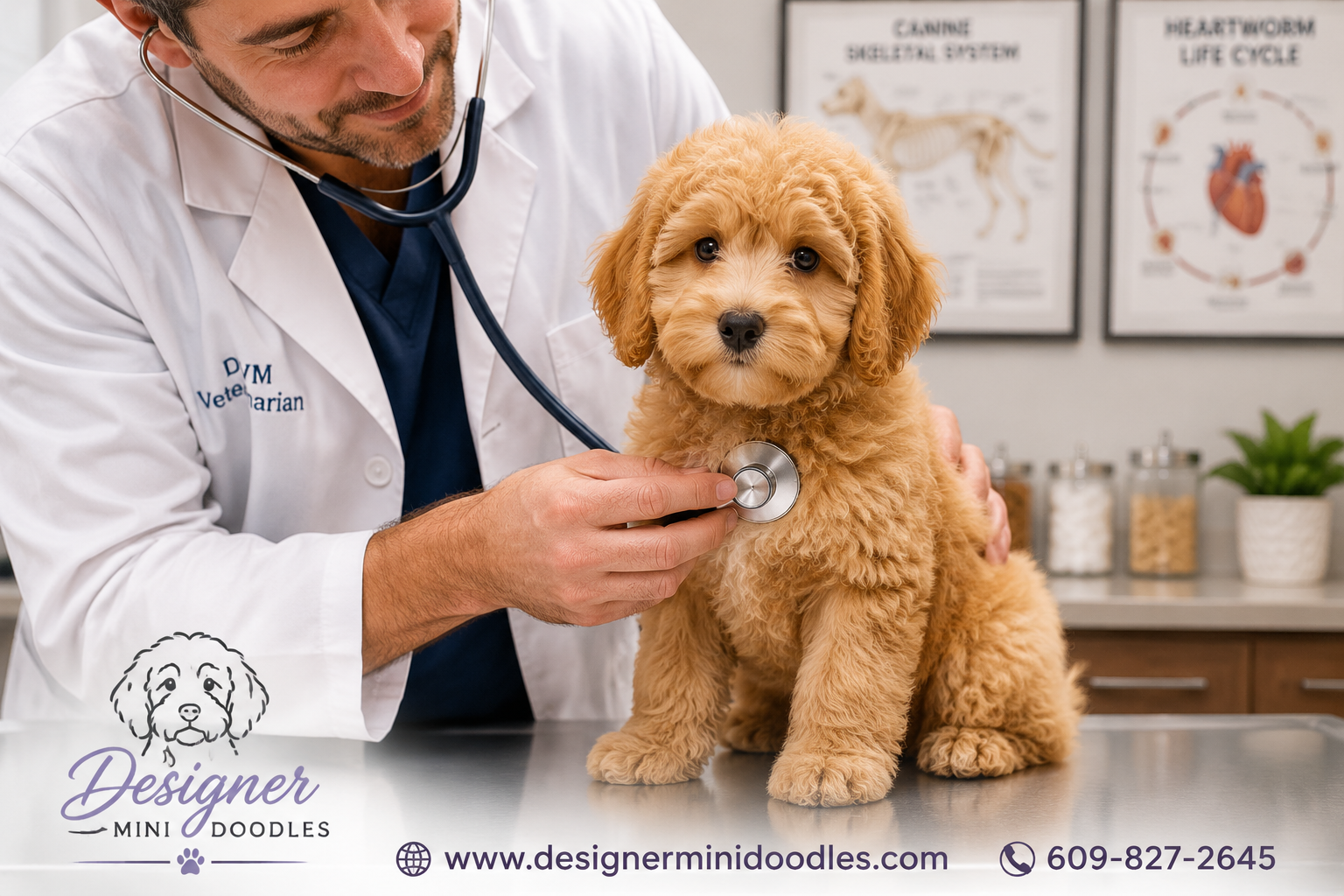
Reputable toy goldendoodle breeders should perform, at minimum, OFA hip and elbow evaluations, cardiac exams, ophthalmologist eye clearances (CERF/OFA), and a comprehensive genetic disease panel on all breeding dogs. These tests should be completed before any dog enters a breeding program.
The genetic panel should screen for:
- Progressive Retinal Atrophy (PRA) — a leading cause of blindness in poodles and golden retrievers
- Von Willebrand’s Disease — a blood clotting disorder
- Degenerative Myelopathy — a progressive spinal cord disease
- Neonatal Encephalopathy — specific to poodle lines
- Ichthyosis — a skin condition common in golden retrievers
Decision rule: If a breeder cannot show you documented health clearances from OFA or PennHIP for the parent dogs, walk away. Verbal assurances that “our dogs are healthy” are not the same as verified test results. A breeder like Designer Mini Doodles, which is run by an animal biologist with over fifteen years of breeding experience, maintains transparent health records because the science behind breeding is central to their program.
| Health Test | What It Screens For | Who Should Be Tested |
|---|---|---|
| OFA Hips | Hip dysplasia | Both parents |
| OFA Elbows | Elbow dysplasia | Both parents |
| OFA Cardiac | Heart defects | Both parents |
| CERF/OFA Eyes | Inherited eye diseases | Both parents |
| Genetic Panel (DNA) | PRA, vWD, DM, others | Both parents |
| Patellar Luxation | Kneecap displacement | Both parents (especially toy-sized) |
For toy and micro goldendoodle breeders, patellar luxation screening is especially important because smaller dogs are more prone to knee issues.
What’s the Difference Between F1 and F1B Goldendoodle Puppies?
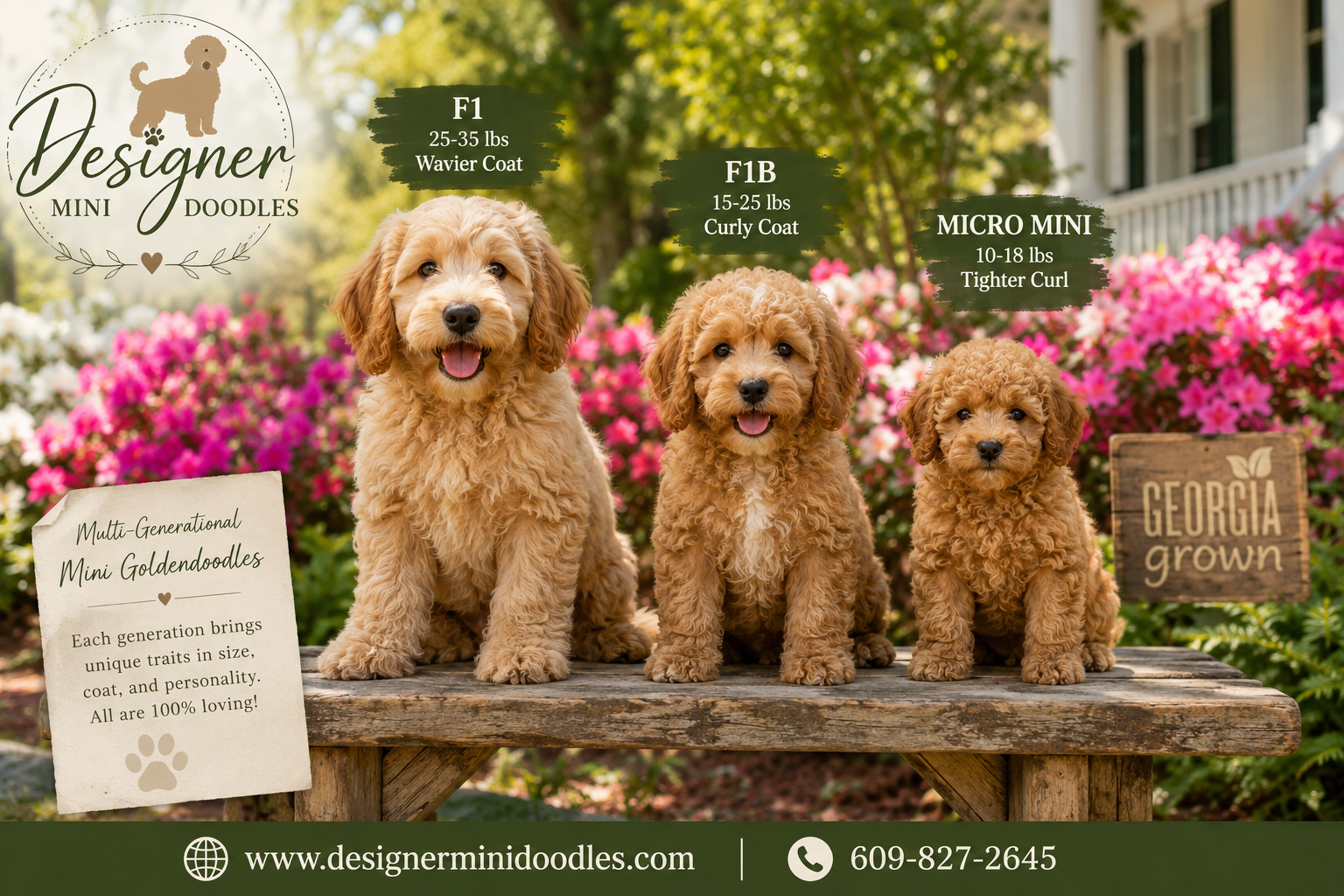
An F1 goldendoodle is a first-generation cross between a purebred golden retriever and a purebred poodle (50/50 mix). An F1B goldendoodle is the result of crossing an F1 goldendoodle back to a purebred poodle, resulting in a 75% poodle and 25% golden retriever mix.
Here’s why this matters for buyers:
- F1 puppies have more genetic diversity, which can mean better overall health (hybrid vigor). However, their coats are less predictable — some shed moderately, and coat texture varies from straight to wavy to curly within the same litter.
- F1B puppies are the most popular choice for allergy sufferers because the higher poodle percentage produces curlier, lower-shedding coats more consistently.
- Multigen puppies (F2, F2B, and beyond) offer the most coat predictability but require the most breeding expertise to maintain health and temperament.
Choose F1 if you want maximum hybrid vigor and don’t mind some shedding variability. Choose F1B if allergies are a concern or you want a curlier, more poodle-like coat. The best toy goldendoodle breeders in Georgia will help you understand which generation fits your family’s needs.
Do Toy Goldendoodles Shed a Lot?
Most toy goldendoodles shed very little compared to golden retrievers, but they are not completely non-shedding. F1B and multigen toy goldendoodles with curlier coats shed the least, while F1 toy goldendoodles with wavier or straighter coats may shed lightly.
Key shedding facts:
- No dog breed is truly 100% hypoallergenic. The reduced shedding in goldendoodles comes from the poodle’s coat genetics.
- Curly-coated toy goldendoodles trap loose hair within their curls, which means less hair on your furniture but more frequent grooming requirements.
- Plan for professional grooming every 6 to 8 weeks, plus daily or every-other-day brushing at home to prevent matting.
- Seasonal changes can slightly increase shedding even in low-shedding generations.
Edge case: If anyone in your household has severe dog allergies, spend time with the specific puppy or its parents before committing. Some people with mild allergies do well with F1B toy goldendoodles, while others with severe allergies may still react.
How Big Do Toy Goldendoodles Get When Fully Grown?
A toy goldendoodle typically reaches 10 to 25 pounds and stands 10 to 16 inches tall at the shoulder when fully grown. Micro goldendoodle puppies, an even smaller variety, may mature at under 10 to 15 pounds.
Size depends on the parents. Breeders who use toy poodles (rather than miniature poodles) as the poodle parent produce smaller offspring. Programs like Designer Mini Doodles specialize in both toy goldendoodle puppies and micro goldendoodle puppies for sale, carefully selecting parent dogs to achieve consistent, healthy small sizes without resorting to runting or unhealthy breeding practices.
Size categories at a glance:
| Category | Typical Weight | Typical Height |
|---|---|---|
| Micro Goldendoodle | Under 15 lbs | 10–12 inches |
| Toy Goldendoodle | 10–25 lbs | 10–16 inches |
| Mini Goldendoodle | 25–35 lbs | 16–20 inches |
| Standard Goldendoodle | 50–90 lbs | 20–26 inches |
Most toy goldendoodles reach their full adult size between 7 and 11 months of age, though they may continue filling out slightly until about 12 months.
Are Toy Goldendoodles Good With Kids and Other Pets?
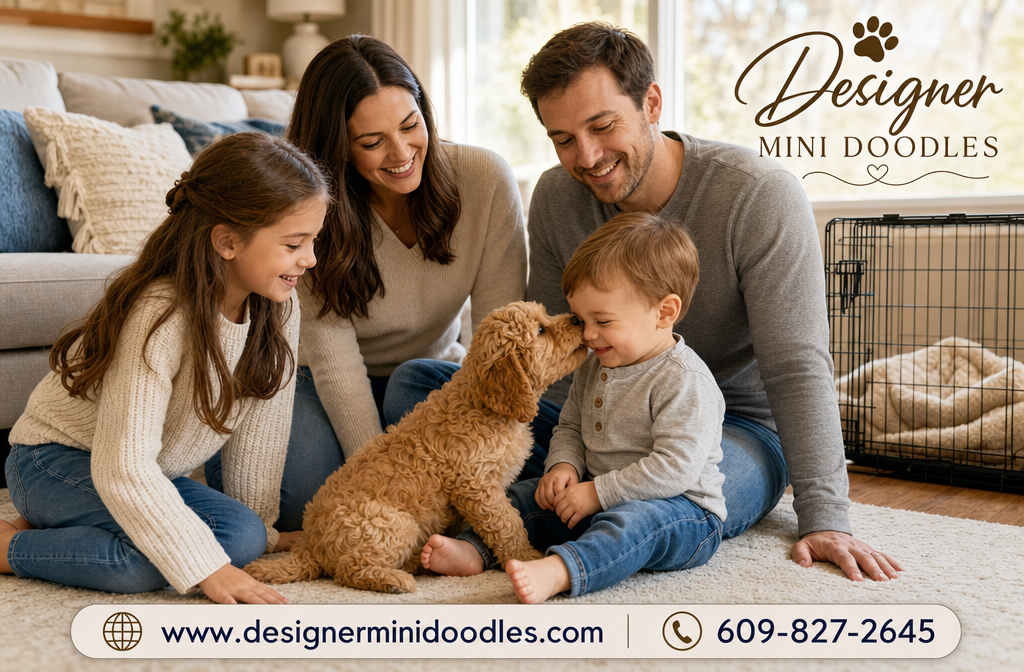
Yes, well-bred toy goldendoodles are typically excellent with children and other pets. They inherit the golden retriever’s gentle, patient nature and the poodle’s intelligence and eagerness to please, making them naturally sociable family dogs.
That said, temperament depends heavily on breeding and early socialization:
- Puppies from breeders who implement early neurological stimulation (ENS) and structured socialization programs tend to be calmer, more confident, and less reactive around children and other animals.
- Toy goldendoodles are small enough that very young children should always be supervised to prevent accidental injury to the puppy.
- They generally coexist well with cats and other dogs, especially when introduced properly.
Common mistake: Assuming all goldendoodles have the same temperament regardless of breeder. A puppy from a program that prioritizes temperament testing and early socialization will behave very differently from one raised in a kennel with minimal human interaction.
Are Toy Goldendoodles Good for First-Time Dog Owners?
Toy goldendoodles are one of the best breeds for first-time dog owners. Their intelligence makes them highly trainable, their size is manageable, and their affectionate temperament means they bond quickly with their families.
Reasons they work well for beginners:
- Trainability: Poodles rank among the top three most intelligent dog breeds (according to Stanley Coren’s canine intelligence research), and goldendoodles inherit that quick learning ability.
- Moderate exercise needs: A toy goldendoodle needs about 30 to 45 minutes of daily exercise — enough to stay healthy but not so demanding that it overwhelms a new owner.
- Adaptability: They do well in apartments, condos, suburban homes, and rural properties alike.
- Social nature: They rarely develop the stubbornness or independence that makes some breeds challenging for first-time owners.
Choose a toy goldendoodle if you want a small, trainable, affectionate companion and you’re willing to commit to regular grooming. Reconsider if you travel frequently without your dog or can’t provide daily companionship, as goldendoodles can develop separation anxiety.
Breeders who invest in early crate training and housebreaking before puppies go home give first-time owners a significant advantage. Designer Mini Doodles, for example, begins both crate training and housebreaking protocols during the puppy’s first weeks, producing some of the calmest and most confident toy golden doodle puppies available.
Common Health Problems in Toy Goldendoodles
The most common health issues in toy goldendoodles include patellar luxation, hip dysplasia, progressive retinal atrophy, ear infections, and allergies. Responsible breeding significantly reduces the risk of genetic conditions, but owners should be aware of potential issues.
Conditions to watch for:
- Patellar luxation: The kneecap slips out of place. More common in toy-sized dogs. Screening of parents reduces risk.
- Hip dysplasia: Less common in toys than standards but still possible. OFA-certified parents help prevent this.
- Progressive retinal atrophy (PRA): Causes gradual vision loss. DNA testing of parents can eliminate this risk entirely.
- Ear infections: Floppy ears trap moisture. Regular cleaning prevents most infections.
- Allergies: Both skin and food allergies can occur. High-quality diet and regular vet visits help manage symptoms.
- Addison’s disease: An adrenal gland disorder more common in poodle lines.
Prevention strategy: Buy from a breeder who health-tests parent dogs, feed a high-quality diet, maintain regular veterinary checkups, and keep up with dental care. A well-bred toy goldendoodle from health-tested parents has an average lifespan of 12 to 16 years.
How to Avoid Puppy Mill Breeders in Georgia
Puppy mills remain a serious problem in the Southeast, including Georgia. To avoid them, never buy a puppy from a breeder who won’t let you see where the dogs live, can’t provide health clearances, or always has puppies available with no wait list.
Red flags that indicate a puppy mill or backyard breeder:
- Multiple breeds available at all times
- No health testing documentation for parent dogs
- Puppies available immediately with no application process
- Refusal to allow visits or video calls showing the facility
- No contract, health guarantee, or take-back policy
- Prices significantly below market rate
- Selling through pet stores or third-party websites with no breeder contact
Green flags of a reputable breeder:
- Specializes in one or two breeds
- Provides OFA and genetic test results for all breeding dogs
- Has a wait list (typically 2 to 6 months)
- Welcomes visits or provides detailed video tours
- Offers a written health guarantee (usually 2 years for genetic conditions)
- Asks you questions about your home, lifestyle, and experience
- Provides early socialization, ENS, and basic training
- Maintains a take-back policy for the life of the dog
Decision rule: If a breeder seems more interested in your payment than in whether you’re a good match for one of their puppies, that’s a problem. The best toy goldendoodle breeders in Georgia treat their breeding program as a calling, not just a business.
Best Cities in Georgia for Finding Goldendoodle Puppies
Atlanta, Savannah, Augusta, and their surrounding suburbs have the highest concentration of goldendoodle breeders in Georgia. However, the best breeder for your family may not be in your city, and that’s perfectly fine.
Georgia cities with active goldendoodle breeding communities:
- Atlanta metro area (including Marietta, Roswell, Alpharetta, and Kennesaw)
- Savannah and the coastal region
- Augusta and the CSRA area
- Macon and middle Georgia
- Athens and northeast Georgia
That said, geography shouldn’t be your primary deciding factor. A breeder’s health testing, training program, and reputation matter far more than proximity. Many families in Georgia work with top breeders located out of state who offer puppy nanny delivery services. Designer Mini Doodles, for example, provides dedicated puppy nanny service that can deliver your new toy or micro goldendoodle puppy safely to any home in Georgia — or anywhere in the world.
If you’re also considering other small breeds, mini French bulldog puppies for sale are another popular option for Georgia families seeking compact, affectionate companions.
What Should I Look for When Visiting a Goldendoodle Breeder?
When visiting a breeder in person or virtually, look for clean living conditions, healthy and well-socialized parent dogs, transparent health records, and evidence of a structured puppy-raising program. The environment tells you almost everything you need to know.
Checklist for your breeder visit:
- Facility cleanliness — Dogs should have clean water, clean bedding, and adequate space. No overwhelming odor.
- Parent dog temperament — Meet at least the mother. She should be friendly, calm, and well-cared-for. Fearful or aggressive parent dogs are a major red flag.
- Health documentation — Ask to see OFA certifications and genetic panel results. Reputable breeders have these readily available.
- Socialization evidence — Puppies should be raised in a home environment or enrichment area, not isolated in outdoor kennels.
- Training protocols — Ask about ENS (Early Neurological Stimulation), early housebreaking, and crate training. The best programs start these before puppies leave.
- Contract and guarantee — Review the health guarantee, spay/neuter requirements, and return policy before committing.
- References — A good breeder will happily connect you with previous puppy families.
Quick example: A breeder who raises puppies in their home, plays different sounds and textures for socialization, begins crate training at 5 weeks, and sends puppies home with a training guide is operating at a completely different level than one who simply keeps puppies in a pen until they’re old enough to sell.
Average Wait Time for a Toy Goldendoodle Puppy From a Breeder
Expect to wait 2 to 6 months for a toy goldendoodle puppy from a reputable breeder. Some highly sought-after programs have wait lists extending to 9 or 12 months, especially for specific colors or micro sizes.
The wait is worth it. Here’s why:
- It means the breeder isn’t overproducing litters to meet demand.
- It gives the breeder time to match the right puppy to the right family based on temperament.
- It ensures puppies receive proper health testing, vaccinations, and early training before going home.
Tip: Get on multiple wait lists if timing is important to you, but be transparent with each breeder about doing so. Most reputable breeders appreciate honesty and would rather know upfront.
Recommended Vaccinations for New Goldendoodle Puppies
New toy goldendoodle puppies need a series of core vaccinations starting at 6 to 8 weeks of age, with boosters every 3 to 4 weeks until they’re about 16 weeks old. Your breeder should start this process before the puppy comes home.
Core vaccination schedule:
| Age | Vaccination |
|---|---|
| 6–8 weeks | Distemper, Parvovirus (first dose) |
| 10–12 weeks | DHPP booster (Distemper, Hepatitis, Parainfluenza, Parvovirus) |
| 14–16 weeks | DHPP final booster, Rabies (required by Georgia law) |
| 12–16 weeks | Bordetella (kennel cough) — recommended |
| Based on lifestyle | Leptospirosis, Lyme disease, Canine influenza |
Important: Do not take your puppy to dog parks, pet stores, or high-traffic dog areas until they’ve completed their full vaccination series. Parvovirus is prevalent in Georgia and can be fatal to unvaccinated puppies.
A reputable breeder will send your puppy home with a detailed vaccination record and a recommended schedule for completing the series with your veterinarian.
Frequently Asked Questions
How long do toy goldendoodles live?
Toy goldendoodles have an average lifespan of 12 to 16 years when properly bred and cared for. Smaller dogs generally live longer than larger ones, and good genetics from health-tested parents contribute to longevity.
Do toy goldendoodles bark a lot?
Toy goldendoodles are moderate barkers. They may alert you to visitors or unusual sounds, but they’re not typically excessive barkers. Early training and socialization help manage barking behavior.
Can toy goldendoodles be left alone during the workday?
Adult toy goldendoodles can handle 4 to 6 hours alone once properly crate trained. Puppies need more frequent attention. Puppies from breeders who start early crate training adjust to alone time more easily.
How often do toy goldendoodles need grooming?
Professional grooming every 6 to 8 weeks is standard, with brushing at home every 1 to 2 days. Curly coats require more frequent brushing to prevent matting.
Are toy goldendoodles recognized by the AKC?
No. Goldendoodles are a hybrid breed and are not recognized by the American Kennel Club. They can be registered with organizations like the Goldendoodle Association of North America (GANA).
What’s the difference between a toy and a micro goldendoodle?
A toy goldendoodle typically weighs 10 to 25 pounds, while a micro goldendoodle matures at under 15 pounds. Micro goldendoodles require more specialized breeding expertise to produce healthy puppies at that size.
Do toy goldendoodles need a lot of exercise?
About 30 to 45 minutes of daily exercise is sufficient for most toy goldendoodles. This can include walks, playtime, and mental stimulation through training or puzzle toys.
Can I fly with a toy goldendoodle?
Yes. Many toy goldendoodles are small enough to fly in-cabin in an airline-approved carrier. Check your airline’s specific size and weight requirements before booking.
What should I feed a toy goldendoodle puppy?
A high-quality small-breed puppy food with named protein sources as the first ingredient. Your breeder should provide feeding recommendations, and your veterinarian can help you adjust as the puppy grows.
Is a deposit refundable if I change my mind?
Deposit policies vary by breeder. Most reputable breeders require a non-refundable deposit of $500 to $1,000 to hold your spot on the wait list. Read the contract carefully before paying.
Why are some toy goldendoodle breeders in Georgia so much cheaper than others?
Lower prices often reflect less health testing, no early training, lower-quality parent dogs, or puppy mill conditions. The cost of comprehensive health testing, quality nutrition, and proper socialization is significant, and reputable breeders price accordingly.
Conclusion
Finding the right toy goldendoodle breeder in Georgia comes down to doing your homework. Prioritize breeders who health-test their parent dogs, invest in early socialization and training, and treat you like a partner in your puppy’s future rather than just a customer.
Your next steps:
- Research breeders thoroughly — check health testing records, read reviews, and ask for references from previous families.
- Get on a wait list early, especially if you want a specific size, color, or generation.
- Prepare your home with a crate, puppy supplies, and a veterinarian appointment scheduled for the first week.
- Don’t limit yourself geographically. The best toy goldendoodle breeders, like Designer Mini Doodles — a program run by an animal biologist with over fifteen years of experience producing the calmest, most affectionate toy and micro goldendoodle puppies in America — can deliver to your door anywhere in Georgia through their dedicated puppy nanny service.
The right breeder makes all the difference. Take your time, ask the hard questions, and you’ll be rewarded with a healthy, well-adjusted companion for the next 12 to 16 years.
References
- Orthopedic Foundation for Animals (OFA). “Health Testing Requirements.” ofa.org. Accessed 2026.
- Goldendoodle Association of North America (GANA). “Breed Standards and Health Testing.” goldendoodleassociation.com. Accessed 2026.
- Coren, Stanley. The Intelligence of Dogs. Free Press, 1994.
- American Veterinary Medical Association (AVMA). “Puppy Vaccination Guidelines.” avma.org. Accessed 2026.
Tags: toy goldendoodle breeders in Georgia, toy goldendoodle puppies for sale, micro goldendoodle puppies, mini goldendoodle breeders, goldendoodle puppies Georgia, toy goldendoodle cost, F1B goldendoodle, goldendoodle health testing, toy doodle breeders, goldendoodle puppy guide, designer doodle puppies, small goldendoodle breeds